
人教版初中英语九年级全册教案整理
新目标英语九年级全册教案Unit 1 How do you study for a test?Section A 1a—2c【学习目标】知识目标:1、熟练掌握以下句型:(1)A: How do you study for a test?B: I study by working with a group?(2)A: Have you ever studied with a group ?B: Yes, I have. I’ve learned a lot that way.2、掌握“by doing”结构3、熟练掌握词汇:aloud, pronunciation, flashcard, vocabulary技能目标:能用how引导的特殊疑问句和by短语对学习方法进行讨论。
情感目标:能与别人交流学习方法,形成相互交流相互促进的学习氛围。
【课前准备】I、(1)你认为下面图片中的人或物哪些对你的英文学习有帮助,快把它们选出来吧。
(2)你能根据图片,结合课本1a和2a内容,用英文写一写学习英语的方法吗?(越多越好哦!)1、对照课前准备I的内容,在班里举办一个自由访谈,向你认为英语成绩优异的同学请教一下学习方法,或者把你的经验告诉其他同学。
并由老师帮助汇总。
2、在1a中选出你认为适合自己的学习方法。
并在1a中补充你采用的其他方法。
3、观察1a中三幅图片,他们都在做什么?用英语怎么说?1、听1b中孩子们谈论的学习英语的方法。
根据所听录音,将1b中的人名与1a图片中的字母匹配。
2、听两遍录音,完成下面的对话。
A: You did really well on the last English test, didn’t you, Mei?C: Yeah, I did OK.A: well, how did you study?C: By .A: Maybe I’ll try that. How did you study, Pierre?D: By . She was really happy I asked.A: That’s interesting., Antonio?E: I like to study by . But sometimes my mother thinks I’m listening to music. And then she gets mad.观察与思考:通过刚才的听力训练,请你来总结一下:向他人请教学习英语的方法应该用来提问。
告诉他人自己的学习方法应该用结构来表达。
3、Pairwork: 根据你总结的句式,仿照1c对话,两人一组,试着练习下面的句型,A: How do you study …? B :I study by …?4、熟读2a的五个问题。
5、听2a录音,2a中的问题有哪些在录音中提到?请在你听到的问题前打(√)。
6、听2b录音,从2b的句子中找到2a问题的答语。
并将2b的字母与1a的序号匹配。
7、听录音,完成下面的对话。
Girl 1: Welcome to the English club. Today we're going to talk about the best ways to learn English. Who has an idea?Boy 1: Do you learn English by ?Girl 2: No. It's too hard to understand the voices .Boy 1: What about ? Do you learn English that way?Girl 2: I think so. It helps to write every day.Girl 3: Have you ever studied ?Girl 2: Yes, I have! I've learned a lot that way.Girl 1: Do you ever with friends?Girl 2: Oh, yes. It improves my speaking skills.Boy 1: What about ?Girl 3: I do that sometimes. I think it helps.观察与思考:这些学习方法的效果如何呢?用什么句式对它们进行评价?请参照2b内容进行总结,并把这些句式记录下来。
1、在1a和2a中出现很多学习英语的方法,你能把它们找出来吗?2、Pairwork: 采用合理的学习方法很重要,针对自己的情况,与同桌一起讨论从1a和2a中找到的学习方法,对其效果进行评价。
评价时可借助如下对话形式:A: Have you ever studied with a group?B: Yes, I have. I’ve learned a lot that way.I、用所给单词的适当形式填空。
1. Do you learn English by (watch) English-language videos?2. Do you often practice (speak) English with friends?3. What about (read) the text aloud?4. Have you ever (study) with a group?5. They are studying the (pronounce) of English.II、根据所给汉语提示完成句子。
1.-How do you study for the test?- (通过制作抽认卡).2.-How does Pierre study Chinese?- (通过朗读课文).3.-How does Mei study English?- (通过制作词汇表).4.-How does Tom improve his listening skills?- (通过听磁带).5.-How are you going to study to improve your spoken English?-I'm going to study (通过和朋友练习对话以及大声读练习发音)I have made in class.【课堂反思】1、你和你的朋友在学习的过程中遇到很多困难,当你们互相探讨学习方法时,应采用什么句式呢?请你把它总结出来。
2、将本课学到的学习方法记录下来。
在以后的学习中,希望你能将这些方法学以致用,使你的学习成绩更上一层楼。
【家庭作业】1、结合课堂反思情况和学习目标,熟练掌握本课的语言结构。
2、利用本课所学重点句型,并联系你的生活实际,编写对话。
对话内容:你和你的英国朋友Mike互相请教学习英语和汉语的方法。
3、依据下一个学案的学习目标,完成课前准备。
Unit 1 How do you study for a test?Section A 3a—4【学习目标】知识目标:1.熟练掌握以下句型:(1)Lillian Li, for example, said the best way to learn newwords was by reading English magazines.(2)She said that memorizing the words of pop songs alsohelped a little.(3)Sometimes, however,he finds watching moviesfrustrating because the people speak too quickly.(4)We get excited about something and then end upspeaking in Chinese.2熟练掌握词汇:differently, quickly, specific, memorize, grammar, frustrate, add 技能目标:能用知识目标1中的句型对各种学习方法进行讨论,探讨最佳学习方法。
情感目标:能根据自己的实际采用适合自己的学习方法,形成个性化的学习特点。
【课前准备】I、回忆过去学过的程度副词,并按照由弱到强的顺序排列。
(弱)————————(强)II、对于各种学习英语的方法,哪些是你经常采用的?哪些是你有时采用的?哪些是你从来不用的?把它们列举出来。
often:sometimes:never:III、在众多的学习英语方法中,你认为哪些是最佳的方法,而哪些是最不实用的?the best ways to learn English:the ways that aren’t helpful at all:1、Groupwork:小组讨论课前准备III的内容,阐明自己观点,并说明自己的理由。
2、将讨论的结果分类汇总。
The best way to learn English Reason1234The way that isn’t helpful at all Reason1 12 23 341、在3a中许多学生对于英语学习,提出了具体的建议。
快速阅读短文,回答下列问题。
(1)How many students talked about the ways to learn English?(2)How many ways did every student talk about?2、仔细阅读短文,将每个学生提到的学习方法在3a中标出3、再细读短文,完成3a的表格。
4、自我检测一下你对课文的理解,相信你是最棒的。
How do you learn best ?This week we asked students at New Star High School about the best waymore English. Many said they learnt by English. Some students had more specific suggestions. Lillian Li, for example, said the best way new words was by English magazines. She said that the words of pop songs also helped a little. When we asked about grammar, she said. “I never grammar. It's too boring.”Wei Ming feels differently. He's been learning English for six years and really loves it. He thinks grammar is a great way a language. He also thinks that English movies isn't a bad way because he can watch the actors say the words. Sometimes, however, he finds movies frustrating because the people speak too quickly.Liu Chang said that the English club at school was the best way her English. Students get lots of practice and they also have fun .She added thatconversations with friends was not helpful at all. “We get excited about something and then end up in Chinese,” she said.观察与思考:通过刚才的填空练习,你发现下面这些用法的规律了吗?(1)way后面既可跟作定语,也可以跟结构作定语。
英语人教版九年级全册完整教学设计
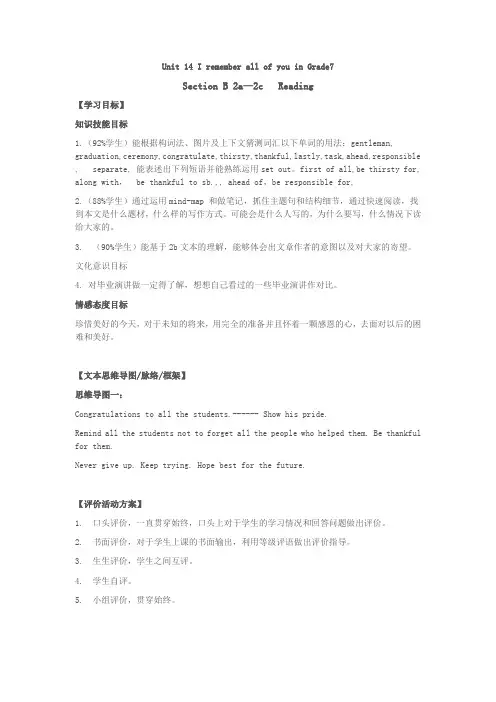
Unit 14 I remember all of you in Grade7Section B 2a—2c Reading【学习目标】知识技能目标1.(92%学生)能根据构词法、图片及上下文猜测词汇以下单词的用法:gentleman, graduation,ceremony,congratulate,thirsty,thankful,lastly,task,ahead,responsible , separate, 能表述出下列短语并能熟练运用set out。
first of all,be thirsty for, along with,be thankful to sb.,, ahead of,be responsible for,2.(88%学生)通过运用mind-map 和做笔记,抓住主题句和结构细节,通过快速阅读,找到本文是什么题材,什么样的写作方式。
可能会是什么人写的,为什么要写,什么情况下读给大家的。
3. (90%学生)能基于2b文本的理解,能够体会出文章作者的意图以及对大家的寄望。
文化意识目标4. 对毕业演讲做一定得了解,想想自己看过的一些毕业演讲作对比。
情感态度目标珍惜美好的今天,对于未知的将来,用完全的准备并且怀着一颗感恩的心,去面对以后的困难和美好。
【文本思维导图/脉络/框架】思维导图一:Congratulations to all the students.------ Show his pride.Remind all the students not to forget all the people who helped them. Be thankful for them.Never give up. Keep trying. Hope best for the future.【评价活动方案】1. 口头评价,一直贯穿始终,口头上对于学生的学习情况和回答问题做出评价。
人教版九年级英语全册教学设计:Unit1sectionA

4.词汇练习:完成一份本节课所学词汇的练习题,包括填空、选择、匹配等,巩固词汇记忆。
5.家庭作业:家长协助学生制定一份切实可行的学习计划,以实现他们在课堂上学到的梦想和目标。
3.任务型教学,注重实践:设计丰富多样的任务型活动,如小组讨论、角色扮演、采访等,让学生在实践中学习和运用目标词汇和句型。
4.适时引导,培养策略:在教学过程中,教师应关注学生的学习策略,适时给予指导和培养,提高学生的学习效率。
5.情感教育,提升价值观:结合教材内容,引导学生思考个人梦想与国家、社会的关系,培养学生的社会责任感和使命感。
2.讨论内容:小组成员分享各自的梦想和目标,并探讨如何实现这些梦想和目标。
3.教师指导:教师巡回指导,关注学生的讨论过程,适时给予鼓励和建议。
(四)课堂练习
1.听力练习:教师播放一段关于梦想和目标的听力材料,要求学生完成相关练习,如填空、选择等。
2.阅读练习:教师发放关于梦想和目标的阅读材料,要求学生快速阅读,并完成相应的阅读理解题。
2.九年级学生正处于青春期,个性鲜明,有较强的表现欲和自尊心,渴望得到他人的认可和鼓励。
3.学生在英语学习上存在一定程度的分化,部分学生对英语学习兴趣浓厚,成绩较好;另一部分学生则感到学习吃力,缺乏自信。
4.学生对梦想和目标的话题有一定的认知,但可能缺乏明确的人生规划和实现目标的途径。
5.在学习策略上,学生尚未完全形成适合自己的学习方法,需要教师引导和培养。
3.口语练习:教师设计一些口语练习题,如角色扮演、小组讨论等,让学生在实际语境中运用目标词汇和句型。
(五)总结归纳
(完整版)人教版新目标初中九年级英语全册教案

(完整版)人教版新目标初中九年级英语全册教案-CAL-FENGHAI-(2020YEAR-YICAI)_JINGBIANUnit 3 Teenagers should be allowed to choose their own clothes.Section AThe Third PeriodTarget language:A: What rules do you have at home?B: Well, I'm not allowed to go out on school nights. How about you?A: I'm not allowed to go out on school nights either. But I can study at a friend's house.教学难点Talk about agreement and disagreement.教学内容及教师活动学生活动设计意图Step 1 RevisionCompetition: Write “are allowed to” and “aren't allowed to” on the blackboard. Divide the class into groups.Each group is asked to write down as many things as they can think of about what teenagers are or aren't allowed to do. See which group can think of the most items for each category.Step 2 PresentationI.1aThis activity reviews the use of always, sometimes, usually and never.Point to the picture. Ask students to describe what is happening in the picture.Help students to say, The boy is late for class. Invite a student to read the four questions in the box to the class.Read the instructions and remind students of the exact meanings of the adverbs of frequency. Work as theteacher says.Look at thepictures and saywhat is happeningin each picture.Students finishthe task on their激发学生兴趣,对所学知识进行复习,使记忆更加深刻。
九年级英语全一册(人教版)
4.提高听力技能,能够理解并获取与节日相关的信息,如:时间、地点、活动等。
5.培养学生的阅读能力,通过阅读文章,了解不同国家和地区的节日文化,拓展国际视野。
(二)过程与方法
1.通过小组合作的方式,让学生在互动交流中学习英语,培养团队协作能力和口语表达能力。
2.操作步骤:
(1)教师发放练习题,要求学生在规定时间内完成。
(2)学生独立完成练习题,教师巡回指导,解答学生的疑问。
(3)教师收集学生答案,进行批改和反馈,针对共性问题进行讲解。
(五)总结归纳
1.教学活动设计:教师引导学生回顾本节课所学内容,总结一般现在时态的用法和与节日相关的新词汇。
2.操作步骤:
(4)学生模仿示例句型,进行口头练习,巩固新学的词汇和语法。
(三)学生小组讨论
1.教学活动设计:学生分小组,讨论以下问题:“What is your favorite festival? Why? Can you describe the traditions and activities of your favorite festival?”
九年级英语全一册(人教版).docxUnit13第二课时教学设计
一、教学目标
(一)知识与技能
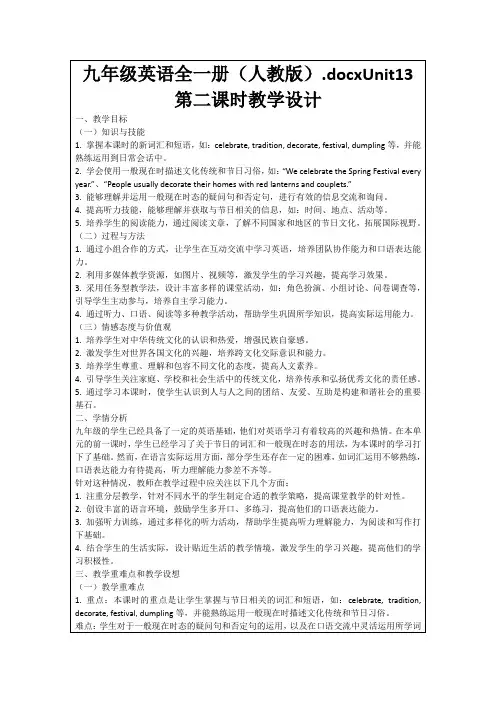
1.掌握本课时的新词汇和短语,如:celebrate, tradition, decorate, festival, dumpling等,并能熟练运用到日常会话中。
2.学会使用一般现在时描述文化传统和节日习俗,如:“We celebrate the Spring Festival every year.”、“People usually decorate their homes with red lanterns and couplets.”
人教版英语九年级全册Unit3SectionB2a2d优秀教学案例

4.教师根据评价结果,调整教学策略,以满足学生的不同需求,提高教学质量。
四、教学内容与过程
(一)导入新课
1.利用图片、视频等多媒体教学资源,展示与本节课相关的情景,激发学生的学习兴趣,引发学生的思考。
2.学生认真完成作业,检查自己的学习成果,发现不足,及时进行调整。
3.教师批改作业,及时给予反馈和评价,帮助学生提高作业质量。
4.教师根据学生的作业完成情况,了解学生的学习状况,调整教学策略,提高教学质量。
五、案例亮点
1.情景创设:本节课通过展示图片、视频等多媒体教学资源,创建了真实且生动的情景,让学生身临其境。这样的情景创设不仅激发了学生的学习兴趣,还提高了学生的参与度,使得学生能够更好地理解和运用所学知识。
2.学生围绕讨论主题,积极发表自己的观点,进行互动交流,培养团队合作能力。
3.教师巡回指导,关注学生的讨论情况,及时给予反馈和指导,帮助学生解决问题。
4.各小组汇报讨论成果,教师对各组的讨论情况进行评价,给予肯定和鼓励。
(四)总结归纳
1.教师引导学生对所学知识进行总结归纳,梳理知识体系,提高学生的理解能力。
2.学生通过总结归纳,巩固所学知识,形成系统化的认知结构。
3.教师通过提问、讨论等方式,检查学生对所学知识的掌握情况,及时发现并解决学生的学习问题。
4.教师对本节课的学习内容进行简要回顾,强调重点和难点,为学生的复习和巩固提供指导。
(五)作业小结
1.教师布置作业,要求学生运用所学知识,完成相关练习,巩固所学内容。
3.学生通过学习英语,拓宽视野,了解不同的文化,培养跨文化交际的能力。
Units3-4教案.2023-2024学年人教版英语九年级全册

板书设计
①艺术性:
- 使用不同颜色的粉笔进行板书设计,如用蓝色粉笔书写过去进行时的构成,用红色粉笔标注重点难点。
- 利用图表、图片等元素,将过去进行时的用法以直观的方式呈现,例如用一个正在进行的动作的插图来表示过去进行时。
教学资源拓展
1.拓展资源:
(1)英语绘本:选择一些与过去进行时相关的英语绘本,如《The Cat in the Hat》等,让学生在阅读过程中感受过去进行时的运用,提高他们的语言素养。
(2)英语电影:推荐一些经典的电影片段,如《Back to the Future》、《The Godfather》等,让学生观看并分析其中过去进行时的运用,增强他们的语感。
3.成果分享:每个小组将选择一名代表来分享他们的讨论成果。这些成果将被记录在黑板上或投影仪上,以便全班都能看到。
五、总结回顾(用时5分钟)
今天的学习,我们了解了过去进行时的基本概念、重要性和应用。同时,我们也通过实践活动和小组讨论加深了对过去进行时的理解。我希望大家能够掌握这些知识点,并在日常生活中灵活运用。最后,如果有任何疑问或不明白的地方,请随时向我提问。
第一课时
步骤
师生互动设计
二次备课
教学方法与手段
教学方法:
1. 任务驱动法:通过设计具有挑战性和实际意义的任务,激发学生的学习兴趣和主动性,培养他们的语言能力和合作精神。例如,让学生分组讨论和编写关于过去进行时的故事,并在课堂上进行分享。
2. 情境教学法:通过创设真实、生动的情境,帮助学生理解和运用过去进行时。例如,利用图片、视频等材料,展示过去某个时刻正在进行的动作,引导学生用英语进行描述。
人教版九年级英语全册Unit3SectionB2a~2d教学设计
针对以上学情,教师在教学过程中应关注个体差异,采取分层教学,提供有针对性的指导。同时,注重激发学生的学习兴趣,培养他们的自信心和团队精神,为学生的全面发展奠定基础。
三、教学重难点和教学设想
(一)教学重难点
1.重点:
-掌握本节课的核心词汇和短语,如:destiny, talent, confidence, opportunity等。
2.难点:
-对一般过去时和现在完成时的区别和运用进行深入理解。
-在实际语境中灵活运用目标词汇和句型进行表达。
-提高听力理解能力,特别是在处理语速较快、信息量较大的听力材料时。
-阅读理解中,对文章细节和隐含信息的捕捉以及推理判断能力的培养。
(二)教学设想
1.教学策略:
-采用任务型教学法,设计真实、有意义的任务,激发学生的兴趣和参与度。
5.培养阅读技巧,如快速阅读、细读、推理等,提高阅读理解能力。
(二)过程与方法
在本章节的教学过程中,学生将通过以下方式培养英语能力:
1.通过小组合作,进行课堂讨论,培养学生主动思考和合作交流的能力。
2.利用听力材料,进行听力训练,提高学生的听力技巧和注意力。
3.采用任务型教学法,设置各种真实语境,让学生在实际运用中掌握目标知识。
-帮助学生了解自己的优势和梦想,增强自信心。
3.教学过程:
-教师提出讨论问题,学生进行小组讨论。
-每个小组选派代表进行汇报,其他学生认真倾听,给予评价和反馈。
(四)课堂练习
1.教学活动设计:
-设计听力练习,让学生听懂并获取关键信息,如:人物的经历、梦想等。
-设计阅读练习,让学生运用阅读策略,理解文章深层含义,进行推理判断。
人教版九年级英语上册教案(全册)
九年级英语上册全册教案Lesson1Teaching & Practicing lessonPeriod 1 for the whole lessonⅠ Teaching Material1.Functional and notional items: Talk about what has done.nguage points: words: CD player, several, shelf,Sentences: Have you got …? I haven’t got …. Have you seen it anywhere Ⅰ Teaching Objectives1.Talk about what has done orally.2.Try to understand the whole lesson and read it fluently. The tone and pronunciation should be basicallyright.3.Master the following words and sentences.4Ss: Words: CD player, shelf, severalYes, I have. / No, Sentences: Have you got …? I haven’t got …. Have you seen it anywhere?I haven’t.Ⅰ Teaching Points1.The main points: Ⅰ&Ⅰ of teaching objectives2.The difficult point:Ⅰ shelf (pl) shelvesⅠI have a pen.= I have got a pen.Ⅰthe use of the present perfect tenseⅠ Teaching Procedureanization of the classA.GreetingB.Raise requirementT: We’re going to talk about the library.2.ReviewA.OralT: Do we have a library in our school? What do we have in the library? What can we do in the library?3.The teaching of the new lessonLesson 1T: Let’s learn Unit 1 In the library, Lesson 1. (write down the title)Teach: Have you got …?T: If you want to borrow a history book from the library, what do you say?Ss: Excuse me, do you have a history book?T: Yes, and we can also say: Have you got a history book?Write down the new sentence and compare the new one and the old one. Then teach the negative form and simple question form.And make more examples.Examples: He has got a good pen.They haven’t got any water.Our school has got a lot of students.B、Teach: Part 1T: Have you got a ruler? S1: Yes, I have. Here you are.T: Have you got an umbrella? S2: Sorry, I haven’t. Ask …Ask the Ss to use Part 1 to make new dialogue in pairs and then ask some to do it in front of the class. Teach player” at the same time.B.Teach: severalT: Have you got a pen? How many pens have you got?S1: FiveT: We may also say: “You’ve got several pens.”Write down the word: severalB.Teach: shelfT: Just now we talked about the library, we know there are many books in the library. Where are the books put? Teach: on the shelf shelf (pl) shelvesB.Part2T: Now I’d like you to make a dialogue talking about borrowing books about different subjects.Do it in pairs first then ask some to do it.Analysis: books about … at the moment = now = right nowB.Part 3Dialogue 1Listen and answer: Well, when you borrow books from the library, you must be careful, but Jim is not careful. What happened? Where was the book?Then read it and learn the dialogue.Analysis: Have you seen it anywhere? ( tense and the use of anywhere)Dialogue 2Listen and answer: How about Tom? What has he lost? Where was it?Read and learn.Analysis: have lost (tense)Perhaps he’s seen it. ( ‘s is short for has)I saw it on Lin Tao’s desk five minutes ago. ( tense)B. Conclusion1. have got = have 2 several = a few 3.on the shelf 4. the present perfect tenseA.Wb. Ex1 &24.Homework1.Do Wb. Ex 3&42.Recite Part 3Lesson 2Reading lesson2 periods for Lesson 2ⅠTeaching Materialsnguage points:Words: already, yard, schoolyard, step, librarian, probably, pay, sadly, mark, bookmarkPhrases: used to, put down, pay for, come up withSentences: Her hobby is reading.So was the librarian.Now her lost books are usually returned to the library.ⅠTeaching Objectives1.Read the whole lesson and try to understand its content. Make sure to answer the questions in Wbcorrectly.2.Read the lesson fluently, the pronunciation and tone should be right.Ⅰ Teaching Points1.The main points---(1)&(2) in teaching objectives2.The difficult pointsA: already, “al” makes an / / soundB: the difference between “on” and “about”C: make sb. + adj.D: used to do sth.E: come up with an idea= think of an ideaPeriod 1Ⅰ Teaching Procedureanization of the classT: Today we are going to Lesson 2, in Lesson 2, we are going to talk about the library.2.ReviewT: Before we learn the new lesson, let’s go over what we learned yesterday.A.OrallyHave = have got eg. They don’t have any shelves.= They haven’t got any shelves.Has = has got eg. Does he have a CD player?= Has he got a CD player?Several=a fewOn the shelfThe construction and concept of the present perfect tenseB.Recite Part 2C.Wb. Ex33.The teaching of the new lessonA.Lesson 2T: We know we can borrow books from a library. But if we lose the books, what should we do? Letgo on to learn Lesson 2, we will know the answer in it.( write down Lesson 2)B.pay forWell, you should pay for it.Teach: pay, paid, paidPay for : give money to sb. for sth.C.onT: Why do people like to go to the library?T: Because there are books on many different subjects.D.knowledgePeople can learn much knowledge from them.E.Part 1 Pre-readF.Part 2Ask the Ss the read the passage and answer questions in their Wb. Ex 1G.Read and learnParagraph 1T: How old is the writer’s grandma?What was she?What is her hobby?Why does she love books?4.Homework.A. Read the end of the text and finish the exercises in Wb.Junior English for ChinaBook 3Lesson 3课型:讲练课ⅠTeaching Materials1.Functional and notional itemsAsk questions about something has donenguage MaterialsWords: encourage, once, abroad, copyPhrases: think of, encourage sb. to do sth., get sth. back, pick upSentences: Have you ever been abroad? Yes, just once.I’ve just cleaned the kitchen.Really? I did that hours ago.Grammar: The difference between the present perfect tense and the past indefinite tenseⅠTeaching Objectives1.Learn to ask questions about something has done2.Read the whole lesson fluently, and pronunciation and intonation should be right.3.Master the following materials(4 skills) Words: once, copyPhrases: think of, pick upSentences: Have you been abroad? Yes, only once.(3 skills) Words: encourage, abroadPhrases: get sth. back, be abroadⅠ Teaching Points1.The main points: (1)&(2) in teaching objectives2.The difficult points:A.“ever, just, already”, they should be put in the middle of “ have done”B. The difference between the present perfect tense and the past indefinite tenseⅠ Teaching Procedureanization of the class2.RevisionBefore we go on to learn the new lesson, let’s go over what we learn in Lesson 2.A.OralGrandma lost library books. If she really lose them, what should she do?Did the librarian have any ideas? What is it?What did they doB. Workbook Ex23.The teaching of the new lessonA.Lesson 3Can Grandma get all her lost books back? Let’s go on to learn Lesson 3.B.Read Part 1 and answer the following questions:Did Grandma get all her lost books back?How did she get them back?C.Read and learn*Think of:认为、想起、想出Eg: What do you think of it?I often think of my friends in Beijing.*Encourage sb. to do sth.Eg. The teacher thought a lot about how to encourage his students to study hard.*Pick up: pick it\them up*return sth. to sb.*get sth. from sb.D.Reading practiceE.Retell the storyF.Ask and answerHave you ever picked up a library book? Yes, I have\ No, I haven’t.Ask the students to ask and answer in pairs by using Part 2 and ask some to do it in class.Teach: abroad, onceDo Wb. Ex1G.Part 3Play and English songT: Have you ever listened to foreign music?Ss: Yes, we have.T: And we have just listened to it.Make sentences by using “ I have just…”Read and learnTeach: copyPoint out the difference between the present perfect tense and the past indefinite tense.The present perfect tense shouldn’t be used together with the past time.H.Conclusionthe use of “ever, just, already” in the present perfect tensethe difference between the present perfect tense and the past indefinite tense4.HomeworkA.Wb. EX2&3B.Go over the language pointsLesson 4课型:练习课ⅠTeaching Materialsnguage MaterialsWords: spoil, as, screenPhrases: on the computer, find outSentences: I guess somebody else has borrowed it.Could you find out who has taken it?Grammar: The present perfect tenseⅠTeaching Objectives4.Read the whole lesson fluently, and pronunciation and intonation should be right.5.Learn to read the information on the library cards and the computer screen.6.Master the following materials(4 skills) Word: asphrase: on the computer, find out(3 skills) Words: spoil, screenⅠ Teaching Points3.The main points: (1)&(2) in teaching objectives4.The difficult points: learn to read the information on the library cards and the computer screenⅠ Teaching Procedureanization of the classToday, we are going to learn Lesson 4. In Lesson 4, we’re going to talk about the information on thelibrary cards and the computer screen.6.RevisionBefore we go on to learn the new lesson, let’s go over what we learn in Lesson 3.A.OralHow could Grandma get all her lost books back?the use of the adverbs in the present perfect tense.7.The teaching of the new lessonA.Lesson 4Yesterday, we learned that grandma usually borrowed books from the library. There is a new librarytoday. If you want to read books, how can you find them? Let’s go on to learn Lesson 4.B.Part1I’d like you to listen and do Wb. Ex.1C.Part 2Ask the students to write down something about the school librarian and report it to the class. Teach:as He works there as a shop assistant.D.Part 4Learn to read the information on the cards and the computer screen.E.Part 3Listen and answer: What does the boy want to borrow?What’s its name?Who has borrowed it?Read and learn.has borrowed, has taken, has got( the present perfect tense)find outRead and act.F.Part 5Read and learn.G.Checkpoint 1H.Wb. Ex.2&58.HomeworkA.Wb. Ex 3B.Go over the whole unit.Lesson 5课型:讲练课ⅠTeaching Materials4.Functional and notional itemsA. Learn to ask how long sb. has done sth.B. Learn to talk about if someone has been to a place.nguage MaterialsWords: surf, surfing, surfer, wave, Hawaii, beach, twice, Bondi, none, Newquay, water-ski, canoe Phrases: have a try, since last Wednesday, learn sth. from sb. how to do it, several timesSentences: What’s …like?How long have you been in Sydney?Have you ever been to …?Grammar: the present perfect tenseⅠTeaching Objectives7.Learn to ask questions about something has done8.Read the whole lesson fluently, and pronunciation and intonation should be right.9.Master the following materials(4 skills) Words: surf, surfing, surfer, wave, beach, twice, nonePhrases: have a trySentences: Have you been to…? Several times.(3 skills) Words: water-ski, canoe(1 skill) Words: Hawaii, Bondi, NewquayⅠ Teaching Points5.The main points: (1)&(2) in teaching objectives6.The difficult points:A.“ever, just, already”, they should be put in the middle of “ have done”B. The difference between the present perfect tense and the past indefinite tenseⅠ Teaching Procedureanization of the classToday, we’re going to talk about water sports.2. RevisionRevise the names of the sports they have learnt: roller-skating, skating, jump, race, skiing.10.The teaching of the new lessonA.Lesson 5And swimming is a kind of water sport because you have to swim in the water.Well, what other water sports do you know? Let’s go on to learn Unit 2 Water sports.e colour page1 to teach: surf, surfing, surfer, wave, water-skiing, canoe.C.Part 1Listen and answer: Who can surf, Ted or Bruce?How long has Bruce been in Sydney?Why did he come to Sydney?Who teach Bruce to surf?Read and learn:What’s …like? = How is …?Since last WednesdayLearn sth. from sb.Have you ever been to …?Have a tryHow to do itD.Read and act.E.Part 2Have you ever surfed?Have you ever been to Hawaii?Ask and answer in pairsLearn: Bondi, Cape Town, Newquay, noneNo one 人单数No one is herenone 人/物单数/复数None of them is here.F.Wb. Ex3. 2 . 1 .G.ConclusionSurf, surfing, surfer, waveHe’s a surfer. Have a tryHow long have you been in …?Have you ever been to …?11.Homeworkwb. Ex 2P.S.The writing on the blackboardUnit 2 Water sportsLesson 5surf ⅠWhat’s …like? = How is …? Have a trylearn sth. from sb.surfing ⅠHow long have you been in …?surfer Since last Wednesday no one 人/ 单wave ⅠHave you ever been to …? none人/物单/复Hawaii ⅠNone of us has. none of us (true)Cape Town No one has. no one of us (false)Lesson 6ⅠTeaching MaterialsWords: describe, especially, attract, so-called, possible, since, part-time, although, fit, prize, competition, event, Olympic, Waikiki, Honolulu, San FranciscoPhrases: all over, large numbers of, no matter, both…and…, give up, ever since, the Olympic Games Sentences: Now it is enjoyed by people all over the world.You can always find surfers out riding the waves.In the morning, he works as a part-time assistant in a surf shop.ⅠTeaching Objectives1.Try to understand the whole passage and read the whole lesson fluently and the pronunciation andintonation should be right.2.Master the following materials:4Ss Words: describe, especially, attract, so-called, possible, since, part-time, although, fit, prize,competition, event, OlympicPhrases: all over, large numbers of, no matter, both…and…, give up, ever since, the Olympic Game Sentences: Now it is enjoyed by people all over the world.You can always find surfers out riding the waves.In the morning, he works as a part-time assistant in a surf shop.3.Master the following materials:3Ss Words: Waikiki, Honolulu, San FranciscoⅠ Teaching Points1.The main points: (1) &(2) in teaching objectives2.The difficult points: A. the use of “although” B. the use of “no matter”C. the use of “ both…and…”Ⅰ Teaching ProcedurePeriod 1anization of the classTalk about surfing2.ReviewHave you ever been to Qingdao?Who has ever been to Bondi Beach? None of us.Has anybody water-skied before? Nobody has.3.The teaching of the new lessonA.Lesson 6In Lesson 5, we learned some water sports. Today, we are going to talk about one of them----surfing.B.Talk about surfingWhere is the best place for surfing? Why?Have you ever watched people surf?What do you think of it?Ask the students to say something about it.Teach: fit, prize, competitionSurfing will make you fit( healthy). Maybe you can take part in a surfing competition, then you maywin a prize.Part 1 Pre-read Ask and answer then teach: watch sb. do sth.; describe sth.C.Part 2Read and do wb. Ex.1D.Conclusion.fit, win a prize4.HomeworkA.Go over what we learn todayB.Read the passage and find out all the new words, try to guess their meaning.Period 2Teaching Procedureanization of the classLearn the passage2.ReviewWatch sb. do sth.; fit(healthy); win a prize3.The teaching of the new lessonA. Paragraph 1Find out the key sentence. Then learn the new language points.one of…; be enjoyed by sb.; all over the world= everywhere in the world;be famous for\ as; especially; attract sb. to somewhere; large numbers of people(it is used to modify countable nouns)= a number ofRead this paragraph after the tape and then read it together. Ask some to read it in classB. Paragraph 2Find out the key sentence. Then learn the new language points..Read this paragraph after the tape and then read it together. Ask some to read it in classC.Paragraph 3Find out the key sentence. Then learn the new language points.D.Paragraph 4Find out the key sentence. Then learn the new language points.E.Conclusion4. HomeworkA.Wb. Ex. 2&3B.Retell the storyLesson 7课型:讲练课ⅠTeaching Materials1.Functional and notional itemsLearn to talk about something has donenguage materialsWords: such, fail, practice, New Zealand, businessPhrases: such great fun, on business, so farSentences: Time flies!He’s gone to New Zealand on business.ⅠTeaching Objectives1.Learn to talk about something has done.2.Try to understand the content and read the dialogue fluently, the pronunciation and intonation should beright.3.Master the following materials:4 skills Words: such, fail, practice, businessPhrases: so far, on businessSentences: He’s gone to …4.Master the following materials:2 skills Words: New ZealandⅠTeaching Points1.The main points: (1) & (2) in teaching objectives2.The difficult pointsA.such great funsuch+adj. +n.(不可数/复数)such a + adj. + n.(可数名词单数)与so的区别B.have been surfingC.practice sth.\ doing sth.D.gone to & been togone to去了,强调不在说话地点been to 去过,强调对某地有所了解,可以在说话地点ⅠTeaching Procedureanization of the classWe are going to talk about Bruce and Ted again. In grammar, we are going to talk about the present perfect tense.2.RevisionA.Retell the story in Lesson 6.B.Wb. Ex2&33.The teaching of the new lessonA.Lesson 7In lesson 5, we know Bruce will show Ted how to surf. Can Ted surf now?B.Listen and answerCan Ted surf? What has Bruce been doing every day? Why?When is Ted leaving for home?How about Bruce?Where is Bruce’s uncle?C.Read and learnTeach: *on Bondi Beach*such great fun: very funnysuch+adj. +n.(不可数/复数) such beautiful flowerssuch a + adj. + n.(可数名词单数) such a beautiful flowerso+ adj. So beautiful a flower前,要用“so”如果在数量词“many, much, few, little”eg: so much water, so many people* fail (in) the examfail to do sth.=can’t do sth.eg: fail the exam=not pass the examfail to catch the bus= miss the bus* need more practicepractice: 练习,实践(为不可数名词)如:Practice makes perfect.Practice : 练习(为及物动词)如:practice doing sth.* Time flies.* gone to去了,强调不在说话地点been to 去过,强调对某地有所了解,可以在说话地点eg: Where is he? He’s gone to his home.* on businessD.Reading Practice.E.Part 2 Ask and answeryet 用于否定句,一般疑问句及条件状语从句already用于肯定句,如果用于一般疑问句则表示惊讶的语气F.Answer the questions in groups. Teach: so far: up to nowAsk some to do it in classG.ConclusionH.Wb. Ex 14.HomeworkA.Recite Part 1B.Go over the whole lessonLesson 8课型:练习课ⅠTeaching MaterialsWords: cross, channel, mainland, slow, journey, among, proud, pride, unless, shot, truthPhrases: come true, slow down, be proud of, speak highly of, not only…but also…Sentences: Among them were his parents.He is not only the pride of our school, but also the pride of all the people in Hainan.ⅠTeaching Objectives1.Read the passage in Part 3 and try to understand its meaning. Read it fluently and the pronunciation andintonation should be right.2.Finish all the exercises in this lesson.3.Master the following materials as four skills:Words: cross, channel, mainland, slow, journey, among, proud, pride,Phrases: come true, slow down, be proud of, speak highly of, not only…but also…Sentences: Among them were his parents.He is not only the pride of our school, but also the pride of all thepeople in Hainan.4. Master the following materials as three skills: words: unless, shot, truthⅠTeaching Points1.The main points: (1) & (2) in teaching objectives如果连接两个主语时,用就近一致原则。
人教版英语九年级全册Unit4优秀教学案例
在教学过程中,我以一位教师的角色,设计了一系列的教学活动,旨在帮助学生掌握一般过去时态的用法,提高他们的英语语言运用能力。针对九年级学生的知识深度,我注重引导学生在语境中感知语言,通过合作、探究的学习方式,激发学生的学习兴趣,培养他们的自主学习能力。
在教学设计中,我充分考虑了学生的实际需求和兴趣点,将教材内容与学生的生活实际相结合,创设真实、有趣的学习情境。通过运用多媒体教学资源,如图片、视频等,丰富教学手段,提高学生的学习积极性。同时,我还注重培养学生的团队协作精神,通过小组讨论、表演等形式,让学生在互动中提高英语口语表达能力。
五、案例亮点
1.情景创设:本节课通过播放视频、使用图片和道具等教学资源,创设了真实、有趣的学习情境,使学生在情境中感知、理解和运用语言。这种情境创设的方式不仅激发了学生的学习兴趣,还提高了学生的学习积极性。
2.问题导向:教师在教学过程中提出了与本节课相关的问题,引导学生思考、讨论,激发了学生的求知欲。通过探究问题,学生自主发现了知识规律,提高了解决问题的能力。
2.学生完成作业,教师及时批改和反馈,给予鼓励和建议。
3.教师根据学生的作业表现,总结本节课的学习情况,为下一节课做好准备。
本节课通过导入新课、讲授新知、学生小组讨论、总结归纳和作业小结等环节,系统地教授了动词的一般过去时态。教师关注学生的学习过程,引导学生在实践中感知、理解和运用语言,提高学生的英语语言运用能力。同时,教师运用人性化的语言和教学策略,营造一个积极、和谐的学习氛围,激发学生的学习兴趣和动力。
人教版九年级下册英语全册教案
人教版九年级下册英语全册教案一、教学目标1.让学生掌握本册书的核心词汇、短语和句型,提高学生的英语综合运用能力。
2.培养学生的听说读写技能,提高学生的英语实际运用能力。
二、教学内容1.Unit1-3:重点学习动词时态、被动语态、宾语从句等语法知识。
2.Unit4-6:重点学习情态动词、条件句、祈使句等语法知识。
3.Unit7-9:重点学习名词性从句、定语从句、状语从句等语法知识。
4.Unit10-12:重点学习过去进行时、过去完成时、过去将来时等语法知识。
Unit11.教学目标:学习一般过去时的动词变化,掌握过去进行时和过去完成时的区别。
2.教学重点:一般过去时的动词变化,过去进行时和过去完成时的运用。
3.教学难点:过去进行时和过去完成时的区别。
4.教学步骤:Step1:导入通过图片或故事引入本课主题,激发学生的学习兴趣。
Step2:讲解语法讲解一般过去时的动词变化,过去进行时和过去完成时的用法。
Step3:课堂练习学生进行课堂练习,巩固所学知识。
Step4:小组讨论学生分组讨论,运用所学知识进行实际交流。
Unit21.教学目标:学习情态动词can、may、must等,掌握其用法和区别。
2.教学重点:情态动词can、may、must的用法。
3.教学难点:情态动词的区别和实际运用。
4.教学步骤:Step1:导入通过图片或情景引入本课主题,激发学生的学习兴趣。
Step2:讲解语法讲解情态动词can、may、must的用法和区别。
Step3:课堂练习学生进行课堂练习,巩固所学知识。
Step4:角色扮演学生进行角色扮演,运用所学知识进行实际交流。
Unit31.教学目标:学习宾语从句的构成和用法,提高学生的句子表达能力。
2.教学重点:宾语从句的构成和用法。
3.教学难点:宾语从句的实际运用。
4.教学步骤:Step1:导入通过图片或故事引入本课主题,激发学生的学习兴趣。
Step2:讲解语法讲解宾语从句的构成和用法。