
英语外研版七年级下册Unit1课件
W/'ru:lə/ /'kæ rI/ /tʃeIndʒ/ /'evrIθIŋ/ /'fju:tʃə/
粉笔n.
chalk
直尺n.
ruler
拿;带v.
carry
改变;变化v.&n. change
每样事物
everything
将来;未来n. future
Heisn’tachildanymore.他不再是小孩子了。 Iwon’tdothatanymore.我再也不那样做了。
Homework
Reviewandrecitetheimportant pointsofUnit1. 复习并记忆Unit1重点内容。
Teacherswon’tusechalkonablackboardands tudentswon’tusepenandpaper,orerasersany more!老师们将不再用粉笔在黑板上写字, 学生们也将不再使用钢笔、纸或橡皮!
句中的“not...anymore”的意思是“不再”。 例如:
/mɔ:/
水平n.
能够…的adj. 能够做…
更加;更adv. 更多的adj.
level able
beableto more
不再… notanymore /fri:/ (时间)空闲的;空余的adj. free
chalkn.粉笔 rulern.尺子 questionn.问题
lifen.生活; 生命
leveln.水平
Listenandrepeat.
// futurestudentuse // butfunstudyus // ruler // put
Askandanswerthequestions. 1.Willschoolsbedifferentinthefuture? 2.Willstudentsusebooksinthefuture?
Theycanasktheirteachersquestionsby Internet,telephoneoremail.他们可以通过互
联网、电话或电子邮件向老师提问。
句中的“by”表示方式,意思是 “用……,靠……,通过……”。
例如: Senditbyairmail.用航空邮件寄吧。 Theywanttotravelbytrain. 他们想坐火车旅行。
预习测评
1.He________anicecook. A.isgoingtoisB.isgoingtobe C.isgoingtoD.isgoingtoare 2.----Areyougoingto___yourgrandparentsthisweeken ----Yes,Iam. A.tovisitB.visitC.visitedD.visiting 3.He____anewbikenextweek. A.willsbuyB.willbuyC.willbuysD.willbuying 4.—Willyouhavelongholidays? —________.SoIwillvisitBeijing. A.Yes,IwillB.No,Iwill C.Y一es,般I将do来‰D时.N:o,beIgdooingto&will? 5.Whatwilllife________inthefuture?
4.Willstudentsneedcomputeratschool? Yes,theywill./No,theywon’t.
5.Willtheycarrylotsofbookstoschool? Yes,theywill./No,theywon’t.
Nowcheck(√)thestudents’ideasaboutthe future.
blackboardchalkcom puteremail eraserInternetpaper pen pencilrulertelephone
ListenandchooseLingling’sanswerstot hequestions.
carrychangeeverythingfuturelifeneedwill
Computerwon’tbeabletodothat. 计算机无法胜任。
句中的“beableto”的意思是“能够,会, 胜任”。相当于can,比起can来可以用 于更多的时态中。例如:
I’mabletoswim.=Icanswim. 我会游泳。
再如: Theywillbeabletotellyouthenewssoon. =Theycantellyouthenewssoon. 他们很快就能够告诉你这个消息了。 Hewasabletowritewhenhe’sthree. =Hecouldwritewhenhe’sthree. 他两岁就会写字了。
Ideas
Daming Betty Tony
Everyonewillstudyatho
meinthefuture.
√
Studentswilltalktotheir
teachersontheInternet. √
Schoolisgoodfunand youcanmakefriendst here.
Noonewillusepens,p aperorerasers.
free—busy 空闲的反义词忙碌的
例如: IamfreetodaybutIwasbusyyesterday. 今天我有空,但昨天我很忙。
infuture“今后”,表示从今以后 inthefuture“将来”,表示未来。
例如: Pleasebemorecarefulinfuture. 今后小心点。 Idon’tknowwhatwillhappeninthefutur e. 我不知道将来会发生什么事。
你都记住了吗? 你太棒啦!
重难点讲解
more是形容词many和much“多的” 的比较级。意为“更多的”,即:
many—more 多的更多的
much—more 多的更多的
如: manybooks许多书 —morebooks更多书 muchmilk许多牛奶 —moremilk更多牛奶
free是形容词,意思是“(时间)空闲; 空余的”,反义词是busy“忙碌的”。即:
Willstudentsneedtogotoschool(6) _a_n__y_m_o_r_e__?Yes,(7)___m__a_y_b_ethey will,becauseschoolisgoodfun,but everyonewillhavelotsof(8) __fr_e_e__time.
Listenandmarkthestress. Nowlistenandrepeat.
小组活动——想象一下你心目中未来的 学校的样子吧!
Studentswillusecomputersandget informationontheInternet. Teacherwon’tusechalkinthefuture.
eth ewordsintheboxtohelpyou.
Learningaims:
1. 掌握本节课的词汇及短语:
chalkcarrychangeeverythingfuture inthefuturelifeneedwillmaybequestionlevelablebe abletomorenotanymorefree 2.能够听懂有关未来学校生活的简单对话。 3.能用一般将来时will谈论未来的学校生活。
1.Willourlifebedifferentinthefuture? Yes,itwill./No,itwon’t.
2.Willourschoolchange? Yes,theywill./No,theywon’t.
3.Willeverythingbedifferent? Yes,itwill./No,itwon’t.
你都记住了吗? 你太棒啦!
重难点突破
In20year’stime,maybetherewon’tbeanyschool s.二十年之后,也许一所学校都没有了。
句中的“in+一段时间”表示“一段时间之后”, 常用于将来时。可以用howsoon来提问。 例如:
—Howsoonwillyoubeback?你多久回来? —Inaweek.一个月之后。
小组活动——展开联想的~翅膀~
Talkaboutwhatyourschoolwill belikeintenyears. —Wewillstudyathomeandonlygoto schoolforsportsandgames. —Well,thisisgood,butI’llmissmy teachersandfriends.
willv.aux.(would)将;将要;将会 e.g.Ourlifewillchangealotinthe future. askv.询问;问 e.g.CanIaskyouaquestion? byprep.用;靠;乘(交通工具) e.g.Ioftengotoschoolbybike.
moreadv.更加;更adj.更多的 not…anymore…不再…… e.g.Idon’twanttoeatanymore. freeadj.(时间)空闲的;空余的 e.g.Ihavesomefreetimenow.
carryv.拿;带 e.g.Letmecarrythemforyou. changev.&n.改变;变化 e.g.Let’schangethesubject. needv.&v.aux.需要 e.g.Ineedyourhelp. ableadj.能够……的 e.g.I’mabletolearnthisnewlesson.
将来 inthefuture
/laIf/
生活;生命n.
/ni:d/
需要n.&v.aux.
/wIl/
将;将要v.aux.
合集下载
外研版七年级下册英语精品教学课件 Module 6 Around town Unit 1
along across cross opposite
A: Is there a museum in your home town? B: Yes, there is. A: Where is it? B: It’s opposite the East Lake.
3. Listen and read. Tourist: Excuse me! Can you tell me the way to Wangfujing Dajie?
A: There’s a bookshop near here. What’s the name of the street?
B: It’s Xi Chang’an Jie.
round 1
find out the treasure(宝藏)
turn left turn right go straight
七年级英语下(WY) 教学课件
Module 6 Around town Unit 1 Could you tell me how to
get to the National Stadium?
学习目标
➢ Key words & phrases: bank; museum; along; cross; across; opposite; tourist; excuse;
把(某人)带往;使(某人)到
➢Do you know these places around you ?
A: Do you like this park? B: Yes, I do. /ˈrestrɒnt/ /ˈrestərɑːnt/餐馆 A: Is there a restaurant near here? B: Yes, there is.
A: Is there a museum in your home town? B: Yes, there is. A: Where is it? B: It’s opposite the East Lake.
3. Listen and read. Tourist: Excuse me! Can you tell me the way to Wangfujing Dajie?
A: There’s a bookshop near here. What’s the name of the street?
B: It’s Xi Chang’an Jie.
round 1
find out the treasure(宝藏)
turn left turn right go straight
七年级英语下(WY) 教学课件
Module 6 Around town Unit 1 Could you tell me how to
get to the National Stadium?
学习目标
➢ Key words & phrases: bank; museum; along; cross; across; opposite; tourist; excuse;
把(某人)带往;使(某人)到
➢Do you know these places around you ?
A: Do you like this park? B: Yes, I do. /ˈrestrɒnt/ /ˈrestərɑːnt/餐馆 A: Is there a restaurant near here? B: Yes, there is.
外研版七年级英语下册同步教学课件 Module 1 Unit 2 Are they yours?
A.on;on
B.on;in
C.in;on
D.in;in
( A )2.That’s there are lost and found offices at the stations.
A.why
B.when
C.what
D.because
( C )3.I want two of meat and one of .
8.许多
______a__lo_t_o_f________
二、单项填空。
( A )1.—How many trees are there on the farm? —About two trees.
A.hundred
B.hundreds
C.hundred of
D.hundreds of
( C )2.My computer is very good.What about ?
3.失物招领处 _l_o_s_t _a_n_d_f_o_u_n_d__o_f_fi_ce__
4.匆匆忙忙 _____i_n_a__h_u_r_ry_______
5.成百上千 ____h_u_n_d_r_e_d_s__o_f_____
6.寻找
______lo_o_k__fo_r________
7.此时此刻 ___a_t_t_h_e_m__o_m__e_n_t____
This is the lost and found office at No.3 Middle School.If you lose something,you can come here and 1 it.
There is a pen,a set of keys,an English 2 and an ID card today.The ID card is a 3 .Her photo is on it. 4 name is Linda.The 5 of the pen is black.The English book is about the eighth⁃grade, 6 it’s an eighth⁃grade student’s.There are 7 keys in the key ring,two long and two short.I lost my maths book this morning.But I found it in the lost and found box.I’m very 8 .
外研版英语七年级下册Module_12_Unit_1课件PPT

Fill in the blanks with the right forms.
1.What
___ you __ on your last holiday? (do) did do 2. I went to Hollywood two years ago. (go) ____ 3. How did Betty _____ there yesterday? spend (spend) 4. Where did you often _____? (swim ) swim 5. My mother met at the station last weekend. ___ (meet)
Read and answer the questions.
1. When did Betty go to Los Angeles on holiday? She went two years ago. 2. How long did it take her ? It took her about nine hours. 3. Where did she go ? She went to Disneyland then Hollywood and finally Santa Monica.
Do you like them?
Mickey Mouse
Donald Duck
Where can you see them?
Disneyland
California
Which country is it?
The United States of America
Listen and answer.
4. How long did Betty spend in Disneyland? She spent two days in Disneyland. 5. What did Betty do or see at Santa Monica? She swam in the Pacific Ocean. 6. What was Santa Monica like? She thought it was great.
外研版七年级下册英语Module-8-Unit-1-课件

Useful phrases:
1.be born 出生于 2.e.g. I was born in Jiangmen. 3. 我出生于江门。 2. the name of …的名 3.e.g. The name of our school is 4. Chuangxin Middle School. 5. 我们学校的名字是创新中学。
Tapescript
Daming: Where were you born, betty? Betty: I was born in Quincy, a small
town in the USA. Daming: What was your first school
called?
Betty: My first school was called John Adams Primary School.
3. be strict with sb 对某人严格 4.e.g. Our teacher is strict with us. 5. 我们的老师对我们严格要求。 4. well- behaved 5. 有礼貌的,循规蹈矩的
1.Where were you born? 2.What was the name of your first school? 3.3.What was the name of your first
teacher? 4.4.What was he / she like? 5.5.Who were your first friends ? 6.6.What were they like?
friends? Betty: They were called Jamie and Kate.
Daming: What were you like? Betty: They were friendly. But Jamie
【新】外研版七年级英语下册Modele11 Unit1 优质课课件(共13张PPT)
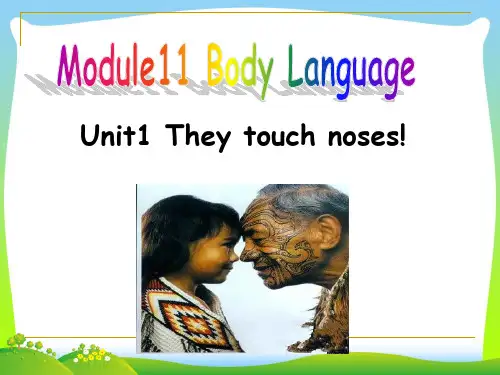
____.
kiss
meet
In India People put their hands __t_o_g_e_thanedr _v_i_si_t_o_rs
In Russia
___tnheoidr heads. People kiss__e_a_c_h__o_t_htehrree times.
In New
wdoaywsheonf
tghreeyemteinegt?
Countries Ways of greeting
In China People shake hands and ___s_m_i.le When
In America People shake hands and sometimes they
Tip21: LGiesteinnffoorrmtahteionkefyrom
2
wthoerdpsi(c关tu键re词a)n-dgrpereetdinicgt预an测d nbaetfioornealliitsietesnwinhgi.le listening.
They are _ki_s_si_n_g_a_n_d__sm__ili_n_g_.
German( ) India ( )
Maori People
1: Who will Linging meet tomorrow?
Russia or Russian
2: What will she do to welcome the visitors?
In _R_u_s_s_ia, people usually _k_is_s_t_h_r_e_e_t_im_e_s,
They are _F_re_n_c_h__________.
外研版七年级下册英语精品教学课件 Module 11 Body language Unit 1

2. That’s because people do different things in different countries. (教材P66)
That’s because….. 是一个常用句式,意为“那是因为……”其中,that 表示刚刚谈到的内容。 注意,这里要用that,而不能用 this , 因为this 表示将要谈及的内容。 e.g. ---Mum, why do I always make the same mistake?
India kiss Russia together touch visitor
In China, people shake hands and smile
American people shake hands and sometimes (1) ____k_i_ss_
In (2) ____I_n_d,iapeople put their hands (3) ___t_o_g_e_t_her and nod their heads
bow kiss shake shake hands smile British German Japanese
v. 鞠躬,弯腰
v. & n. 吻,亲吻
v.
摇晃
握手
v. & n. 微笑
adj. 英国的,英国人的
n. 德国人;德语 adj. 德国(人)的;德语的
n. 日本人;日语 adj. 日本(人)的;日语的
5. Work in pairs. Talk about what you do and say when you meet:
• your teacher • your head teacher • your parents after school • your best friend • your best friend’s parents • your favourite film star • a visitor to your school • an American • a Russian
外研版七年级英语下册Module 5 Unit 1 课件
How much are they? 问价格 — Ten yuan a kilo. — One kilo, please. Here’s fifty-nine
yuan.
Self -check
Read the passage loudly and find out the
important phrases.
1.-- What can I do for you? -- I’d like to buy a T-shirt for my mum. 走进商店或市场,服务人员常这样招呼顾客:
Can / May I help you? / What can I do for you?
顾客表示想买某物,常这样表达:
supermarket
market
clothes shop
shoe store
Listening and vocabulary
1 Match the words and expression from the box with the pictures.
clothes shop ③ market ①supermarket ②
Unit 1 What can I do for you?
=Can I help you?
预习: 根据音标读单词,不会读的用铅笔标出来。
1. 大声跟读单词。 2. 自读3遍。 等会儿提问,检查。
Байду номын сангаас M5U1
1.['mɑːkɪt] 2.['suːpəmɑːkɪt] 3.['bɪskɪt]
4.['lemən] 5.['strɔːb(ə)rɪ] 6.母亲节
宾语
turn it on/off
yuan.
Self -check
Read the passage loudly and find out the
important phrases.
1.-- What can I do for you? -- I’d like to buy a T-shirt for my mum. 走进商店或市场,服务人员常这样招呼顾客:
Can / May I help you? / What can I do for you?
顾客表示想买某物,常这样表达:
supermarket
market
clothes shop
shoe store
Listening and vocabulary
1 Match the words and expression from the box with the pictures.
clothes shop ③ market ①supermarket ②
Unit 1 What can I do for you?
=Can I help you?
预习: 根据音标读单词,不会读的用铅笔标出来。
1. 大声跟读单词。 2. 自读3遍。 等会儿提问,检查。
Байду номын сангаас M5U1
1.['mɑːkɪt] 2.['suːpəmɑːkɪt] 3.['bɪskɪt]
4.['lemən] 5.['strɔːb(ə)rɪ] 6.母亲节
宾语
turn it on/off
七年级英语下册Module1unit2课件2外研社
通过观察学生在课堂上的口头表达和 写作表达能力,教师可以评估学生对 语言运用的熟练程度,并据此调整教 学方法。
Homework and quizzes
布置有针对性的作业
教师应根据课程内容和学生实际情况, 布置有针对性的作业,帮助学生巩固所 学知识。
VS
定期进行小测验和考试
通过定期进行小测验和考试,教师可以了 解学生对课程内容的掌握情况,以便及时 调整教学进度和策略。
01
Teaching objectives
Knowledge objectives
掌握本单元的核心词汇和短语,如“historical”, “fascinating”, “ancient”等 。
理解并能够运用本单元的语法点,如现在完成时态和副词的用法。
熟悉本单元的主题——古代文明,包括古埃及、古希腊和古罗马的文化和历史。
7th Grade English Volume 2 Module 1 Unit 2 Coursew
目录
• Teaching objectives • Teaching content • teaching process • Teaching methods and means • Teaching evaluation and feedback
Inquiry-based learning
This method encourages students to ask questions, seek answers, and investigate topics on their own. It is useful for promoting critical thinking and
Student feedback and teacher reflection
Homework and quizzes
布置有针对性的作业
教师应根据课程内容和学生实际情况, 布置有针对性的作业,帮助学生巩固所 学知识。
VS
定期进行小测验和考试
通过定期进行小测验和考试,教师可以了 解学生对课程内容的掌握情况,以便及时 调整教学进度和策略。
01
Teaching objectives
Knowledge objectives
掌握本单元的核心词汇和短语,如“historical”, “fascinating”, “ancient”等 。
理解并能够运用本单元的语法点,如现在完成时态和副词的用法。
熟悉本单元的主题——古代文明,包括古埃及、古希腊和古罗马的文化和历史。
7th Grade English Volume 2 Module 1 Unit 2 Coursew
目录
• Teaching objectives • Teaching content • teaching process • Teaching methods and means • Teaching evaluation and feedback
Inquiry-based learning
This method encourages students to ask questions, seek answers, and investigate topics on their own. It is useful for promoting critical thinking and
Student feedback and teacher reflection
外研版七年级英语下册同步教学课件Unit 1 Whose bag is this?
I 5 a good friend at school. 6 name is Zhang Liang.He 7 English and now he can say “How are you?”,“What’s 8 name?” or “What’s this in English?” He is nice to me 9 I like him very much.
Unit 1 Whose bag is this?
外研社版
七年级英语下册
教学目录
1.课前导学 2.课堂基础训练 3.培优提高训练
◆ 课前导学 ◆
一、根据汉语提示写出英语短语,做到会运用。
1.首先;第一 2.失物招领箱 3.别客气。
_f_ir_s_t_o_f_a_l_l __________ _l_o_s_t_a_n_d__fo_u_n__d_b_o_x____ _Y_o__u_’r_e_w__e_lc_o_m__e_._____
A.in the end
B.all the time C.first of all
D.as a result
( B )6.—Do you eat fruit and vegetables every day?
—Yes,I like them .
A.a lot;a lot of
B.a lot of;a lot C.a lot of;a lot of D.a lot;a
C.his
D.him
( A )4.—Excuse me,how can I get to the restaurant?
— ,you need to go to the park.And then you can find it.
A.First of all B.At last
Unit 1 Whose bag is this?
外研社版
七年级英语下册
教学目录
1.课前导学 2.课堂基础训练 3.培优提高训练
◆ 课前导学 ◆
一、根据汉语提示写出英语短语,做到会运用。
1.首先;第一 2.失物招领箱 3.别客气。
_f_ir_s_t_o_f_a_l_l __________ _l_o_s_t_a_n_d__fo_u_n__d_b_o_x____ _Y_o__u_’r_e_w__e_lc_o_m__e_._____
A.in the end
B.all the time C.first of all
D.as a result
( B )6.—Do you eat fruit and vegetables every day?
—Yes,I like them .
A.a lot;a lot of
B.a lot of;a lot C.a lot of;a lot of D.a lot;a
C.his
D.him
( A )4.—Excuse me,how can I get to the restaurant?
— ,you need to go to the park.And then you can find it.
A.First of all B.At last
外研版七年级英语下册Module1 Unit1 Whose bag is this优课件
本句为there be 句型,意为“某处有某物” ①如果there be 后为可数名词单数或不可数
名词,be用is,若为可数名词复数,be用 are。
There is some food in the fridge. 冰箱里有一些食物。
②如果there be后的主语包含两者或两者以上, be的形式适用于就近原则,故be与离它最 近的主语在数上保持一致。
• 1. This is _____(my ,mine) sister. • 2. _____(She, Her) name is Lisa. • 3. Lily’s mother is a worker and _____(he, she )
works in a factory. • 4. That is my cat. _____(It, Its) name is Mimi. • 5. This is ________(our, ours) classroom and it is big. • 6. The girl is Linda. _____(Her, Hers) bike is green. • 7. The football is ________(Tom, Tom’s). • 8. —Is this your computer?
❖ 4. I don’t want to _lo__s_e (失去)you.
❖ You are my good friend.
❖ 5. My sister is _c_a_r_e_fu__l _(认真的)and she works hard. ❖ 6. I have got some _c_ra__y_o_n_s_ (蜡笔). ❖ 7. Is this __a_n_____ _e__ra_s_e__r _(一块橡皮)?