
英语人教版八年级下册Unit 4 Period 4 Grammar 4a-4c
1. I’m very shy. Advice: Why don’t you talk loudly in front of your classmates for many times? 2. My sister and I fight all the time. Advice: Maybe you should think about what you always fight about and try to have a talk with her about it.
注意:不能与but 同时使用。
so that 的用法:
so that 为了/以便 接目o that I could catch the early bus. so that = in order that
用until,although,so that 填空 1.You should do sports everyday so that you can keep healthy. 2.Although our teacher is ill, he still comes to our class to teach us. 3.Although he is rich, he spends little on clothes. 4. 4.We won’t go to bed until 5. 5.We played until we finish our work.
词组点拨: leave sth at home将某物忘在家里 be afraid of 害怕… not … anymore不再 spend …on …花费… 在… 上
My best friend is more popular than me. I want to be like him. What should I do? You could try to be friendlier.
Fill in the blanks with although, so that or until.
2. A: I don’t have any friends at my new school. What should I do? Although you don’t have any now, you’ll soon make B: _________ some.
4. My cousin borrows my things without returning them. Advice: Maybe he’s forgetful. You could call him and tell him you need them recently. 3. My sister spends all evening on the phone. Advice: You could tell her you need a good rest to study well at school tomorrow.
【归纳拓展】提出建议的句型
What/How about+ doing sth?做某事 怎么样? You could do… 你可以做… You should do… 你应该做… 提出 建议
Why don’you(we) +do sth? 为什么不做某事呢?
Let’s do…! 让我们…吧!
Would you like to do…? 你愿意做某事吗?
3. A: I’m worried about my school grades. What’s your advice? until the last minute to study B: You shouldn’t wait _____ for a test. 4. A: Mike is my best friend, but he always copies my homework. What should I do? Althoughhe’s your best friend, you should still tell B: ________ him that copying others’ homework is wrong.
You should just be yourself.
Discuss: What should the little girl do ? What should her mother do?
Unpleasant advice is a good medicine.
忠言逆耳利于行。
6:00pm yesterday.
4a
1. A: What’s wrong? B: My sister borrows my clothes without asking. What should I do? A: Well, you could tell her that this makes you angry _______ so that she’ll ask you next time.
Unit 4 Why don’t yo
talk to your parents?
Section A 4A---4C
—You look tired. What’s the matter? —I studied until midnight last night so I didn’t get enough sleep. should do? —What _______I —______ Why _____ don’t you forget about it? Although she’s wrong, it’s not a big deal. should he do? —What ______ —He should talk to his friend so that he can say he’s sorry. —Maybe you ______ could go to his house. —I guess I could, but I don’t want to surprise him.
词组识记
未经许可 使某人生气 担心某事
without asking make sb angry be worried about sth study for a test
. . .
为考试而学习
抄袭某人的作业
.
copy sb’s homework .
4b
Write one piece of advice for each problem. Then compare which advice is better.
until 的用法
1、until 直到…为止 8:00 pm. I waited until she came back. 2、not…until… 直到…才…
We didn’t go home until
6:00 pm. the rain stopped.
although 的用法
although=though 尽管 虽然 接让步状语从句 Although/Though he has a lot of money, he is unhappy. He is unhappy, although/though he has a lot of money.
4c
Choose one of the problems and ask your classmates for advice to make a conversation.
Problems You left your homework at home. You are afraid of speaking in front of people. Your best friend does not trust you any more. You parents always argue. You spend too much time on Internet. You have no money to buy a guitar.
5. My parents won’t be let me have a pet. Advice: When you get a good grade at school, you could talk ______________________________________________ about it with her. _________________
人教版八年级下册英语复习 Unit 4 重要短语、句型、重点讲解及作文范文

人教版八年级下册英语 Unit 4重要短语、句型、重点讲解及作文范文Unit 4 Why don’t you talk to your parents?一、重点短语1. have free time有空闲时间2. allow sb. to do sth. 允许某人做某事3. hang out with sb. 与某人闲逛4. after-school classes课外活动课5. get into a fight with sb. 与某人吵架/打架6. until midnight直到半夜7. talk to sb. 与某人交谈8. too many太多9. study too much学得过多10. get enough sleep有足够的睡眠11. write sb. a letter给某人写信12. call sb. up打电话给某人13. surprise sb. 令某人惊讶14. look through翻看15. be angry with sb. 生某人的气16. a big deal重要的事17. work out成功地发展;解决18. get on with不11睦相处;关系良:19. fight a lot经常吵架/打架20. hang over笼罩21. refuse to do sth. 拒绝做某事22. offer to do sth. 主动提出做某事23. so that以便24. mind sb. doing sth. 介意某人做某事25. all the time一直26. in future今后27. make sb. angry使某人生气28. worry about sth. 担心某事29. copy one’s homework抄袭某人的作业30. be oneself做自己31. family members32. spend time alone独自消磨时光33. give sb. pressure给某人施压34. have a fight with sb. 与某人吵架35. compete with sb. 与某人竞争36. free time activities业余活动37. get better grades取得更好的成绩38. give one’s opinion提出某人的观点39. learn exam skills学习应试技巧40. practice sports体育训练41. cause stress造成压力42. cut out删除第1页共12页二、重点句型1. I studied until mid night last night so I didn’t get enough sleep.我昨晚学习到半夜所以睡眠不足。
Unit 4 Why dont you talk to your parents (Grammar 4a-4c)
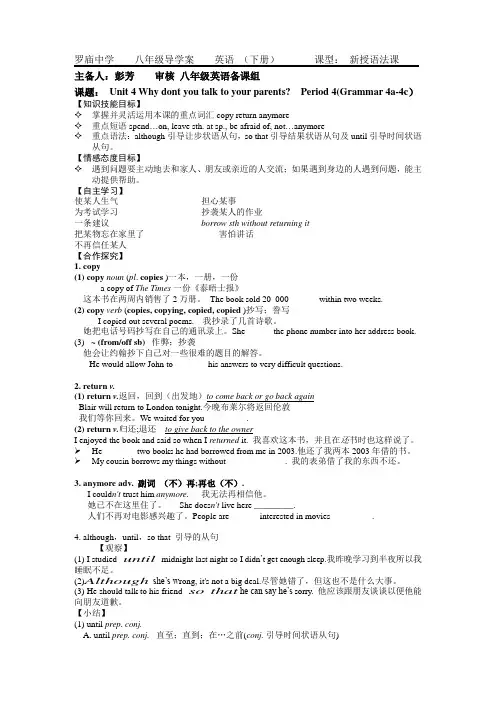
罗庙中学八年级导学案英语(下册)课型:新授语法课主备人:彭芳审核八年级英语备课组课题:Unit 4 Why dont you talk to your parents? Period 4(Grammar 4a-4c)【知识技能目标】✧掌握并灵活运用本课的重点词汇copy return anymore✧重点短语spend…on, leave sth. at sp., be afraid of, not…anymore✧重点语法:although引导让步状语从句,so that引导结果状语从句及until引导时间状语从句。
【情感态度目标】✧遇到问题要主动地去和家人、朋友或亲近的人交流;如果遇到身边的人遇到问题,能主动提供帮助。
【自主学习】使某人生气_______________ 担心某事________________为考试学习________________ 抄袭某人的作业__________________一条建议________________ borrow sth without returning it_______把某物忘在家里了_______________ 害怕讲话_________________不再信任某人________________【合作探究】1. copy(1) copy noun(pl. copies )一本,一册,一份a copy of The Times一份《泰晤士报》这本书在两周内销售了2万册。
The book sold 20 000 ______ within two weeks.(2) copy verb(copies, copying, copied, copied )抄写;誊写I copied out several poems. 我抄录了几首诗歌。
她把电话号码抄写在自己的通讯录上。
She ______the phone number into her address book.(3) ~ (from/off sb)作弊;抄袭他会让约翰抄下自己对一些很难的题目的解答。
人教版八年级下册英语教案unit4

人教版八年级下册英语教案unit4教材分析1. 教学内容本课是新目标英语八年级下册第4单元阅读部分,本单元的语言目标是“Report what someone said”(引述别人讲的话),学习直接引语和间接引语。
本课以“志愿者支教”为主要内容,通过志愿者杨蕾的支教事迹和想法而引出助人为乐,扶危济困这一中心话题,本文篇幅长,生词多,读前、读中、读后的任务多。
鉴于学生的实际情况及教材的特点,考虑到学生对长篇阅读的畏难情绪以及他们在课堂上可能出现的一些反应,我大胆构思了整个教学过程,构建“以生为本”的互动式阅读课堂,想办法尽可能降低文章难度,将难点分散,并根据需要整合了运用多种教学方法,让学生在互动中享受阅读。
2. 教学目标A. Knowledge objectives:To master the words and expressions.To get familiar with the topic and use the sentences about helping others.To use “Direct Speech and Reported Speech”.B. Ability objectives:To find out the information and get the general idea of th e text.To infer the meaning of the word they don’t knowfrom the context.C. Affective objectives:Students are to realize the importance of helping others and they are encouraged to help others.Students’ team spirit will be improved by completing a certain task together.By understanding the life in rural areas, students are to realize how happy they are.3. 教学策略:(1)兴趣激发策略。
Unit4SectionA(GrammarFocus4c)课件初中英语人教版新目标八年级下册(1)
一、译一译 1.尽管她错了,但这不是什么大事。 Although she's wrong, it's not a big deal. 2.抄袭其他人的作业是不对的。 Copying others' homework is wrong.
3.你害怕在人们面前讲话。 You are afraid of speaking in front of people.
I won't copy his homework anymore.我不会再抄他的作业了。 My father didn't smoke anymore.=My father no more smoked. 我爸爸不再抽烟了。
小组合作 我为智囊团
1.翻译下列句子。
(1)你把作业忘在家里了。
You left your homework at home
— Why don't
you call him up?
(3)—I am really tired because I studied until midnight last
night. — You'd better go to sleep earlier this evening.
(4)—I don't want to swim tomorrow. — What about/ How about playing basketball? (5) You'd better nottalk to her when she is very angry.
although,but并完成下面的填空。
(1) until + 时间状语,表示“一直到……(时候)”。 (2) although 既可放句首也可放句中,表示“虽然;尽管”。 (3) so that 通常放在句中连接两个句子,其后接结果,表示
人教版八年级下册英语UNIT3 SectionA (Grammar Focus-4c)

温 馨
wearingnewclothes.
提 示:
A. hangupB. hangbackC. hangout
可 返
回
原
文
【点拨】本题用短语辨析法。句意为“春节第一天,人 们穿着新衣服闲逛”。hangup“挂断电话”; hangback “留下”;hangout“闲逛”。
考点精讲
②Couldyoupleasepassmethesalt?
Sorry,
Ic肯an’定t. 答 Yes, sure./Yes, I can. /Of course, I Ioh.a..ve语t can. /No problem. /With pleasure ...
/Sorry,
In’mg否tgoo定..i. 答 /I’ma语f
可先拒绝,再说明理由:Sorry, I can’t. I have to ... /Sorry, I’m going
(时间)过去;流逝
考点精讲
③CouldIborrowthatbook?
本意 borrow/'bɒrəʊ/, /'bɑːrəʊ/v. 借;借用
为“保 存辨;析:borrow, lend与keep
保留”,
引为b申“借orro 用”,w
用于
表示“借入”,即说话人向别人借东 西供自己使用,常用于borrow sth. from sb. or somewhere 结构中。
考点精讲
e.g. Wecouldhangthispictureonthewallnexttothedoor. 我们可以把这张照片挂在门旁边的墙上。 Thecurtainshangwell. 窗帘挂得很好。 ThestudentshungamapofChinaonthewall. 不及物动词 同学们把一幅中国地图挂在墙上。 Thecriminalwashanged. 罪犯被处以绞刑及。物动词
新人教版八年级(下册)英语全册教案.pdf

一寸光阴不可轻Unit 1 What’s the matter?一、教学目标:1. 语言知识目标:1) 能掌握以下单词:foot, knee, neck, stomach, throat...2) 能掌握以下句型What’s the matter?I have a headache. You should drink some tea. That sounds a like a good idea. I have a sore back.二、教学重难点:1) Talk about your health. 2) Make suggestions.三、教学方法:Revision, Learning, Practice and Reading.四、教学辅助:Tape-recorder and Lattern.五、课时:Six periods六、教学过程:Period 1(Section A1a-2d)I. Teaching Aims and Demands1. Knowledge Objects. Body names. Illness.What’s the matter? I have a cold.2. Ability Objects. Listening skill. Recognizing skill.3. Moral Objects. Exercise every day and keep healthy and strong.II. Teaching Importance and DifficultyWhat’s the matter?I have a cold.III. Teaching MethodsRecognizing method Listening method. Discover method. Pairwork.IV. Teaching AidsA tape recorder. A doll for teaching the names of the body. A Projector. V. Teaching ProceduresLead-in Name the parts of the body by pictures.Step 1 Read a chant about the body.Step 2 Enjoy a song.Step 3 Play a game. Say and draw the part of body.Step 4 Activity 1a.Let Ss to look at the picture and write the correct letter [a-m] for each part of the body.Step 5 Judge their problems based on every picture.Step 6 Activity 1b.Listen and look at the picture. Then number the names [1-5].Step 7 Act it out with their partner.Step 8 Listen again and complete the table.Step 9 Activity 1c. Pair works.Make conversations according to pictures.Step 10 Think how to give advice if somebody is ill and give examples by using pictures.Step 11 Activity 2a.Let Ss to listen and number the pictures [1-5] in the order they hear them. Step 12 Activity 2b.Listen again and match the problems with the advice. Step 13 Activity 2c.Make conversations using the information in 2a and 2b. Step 14 Activity 2d.Role-play the conversation.Step 15 Language points: explain the key words and phrases in section A-1.Homework:Teaching thought:Period 2(Section A 3a-3c)I. Teaching Aims and Demands1. Knowledge Objects New words. Some advice. Grammar Focus.2. Ability ObjectsListening skill. Reading skill.Writing municative competence.3. Moral Object To be a doctor and serve the people heart and soul.II. Teaching Importance and DifficultyWhat’s the matter? I have a toothache.Maybe you should see a dentist. That’s a good idea.III. Teaching Methods Listening method. Reading and writing methods. Pair-work.IV. Teaching Aids A tape recorder A projector.V. Teaching ProceduresLead-in Review some usual disease by pictures.Step 1 Talk about advice about health.Step 2 Learn some new words.Step 3 Discussion. Look at the title and the picture. Work in pairs and discuss some questions.Step 4 Activity 3a. Read the passage. Discuss where it comes from.Step 5 Give some reading strategies simply.Step 6 Read the passage and do true or false.Step 7 Activity 3b.Ask Ss to read the passage again and check (√) the things that happened in the story.Step 8 Free talk.If you see someone lying on the street, what should you do?.Step 9 Respect the aged and care for the young. It is a fine tradition of the Chinese nation. Teach the spirit to Ss.Step 10 Activity 3c. Discuss the questions with a partner.Step 11 Language points: explain the key words and phrases in section A-2. Step 12 More exercises about the language points.Homework:Teaching thought:Period 3(Grammar Focus-4c)I. Teaching Aims and Demands1. Knowledge Objects Reading and writing materials. Oral Practice.2. Ability Objects Reading skill. Writhing skill. Communicative competence.3. Moral Object Give good advice when someone needs your help.II. Teaching Importance and Difficulty Reading practice. Oral practice. III. Teaching Methods Reading and writing methods. Pair-work. Group-work. IV. Teaching Aids Workbook exercises.V. Teaching ProcedureLead-in Role - play a conversation between a patient and a doctor. Step 1 List some health problems and give some advice.Step 2 Explanation about the use of modal verb should.Step 3 Do some basic exercise.Step 4 Compare some other modal verbs.Step 5 Do more exercise.Step 6 Complete activity 4a and 4b.Step 7 Work in groups. Discuss how to keep ourselves healthy.Step 8 Complete activity 4c.Step 9 Do exercise to review the structures of this unit.Homework Finish off the exercises of workbook.Teaching thought:Period 4(Section B 1a-1d)I. Teaching Aims and Demands1. Knowledge Objects Key vocabulary. Reading practice. Oral practice.2. Ability ObjectsListening skill. Reading skill. Writhing skill.Practice municative competence.3. Moral Object Ask for help when you have problem.II. Teaching Importance and DifficultyKey vocabulary. Reading practice. Oral practice.III. Teaching MethodsReading and writing methods. Understanding method.Pair-work.Listening method.IV. Teaching Aids A tape recorder.V. Teaching ProceduresLead-in Free talk: When these accidents happen, what should you do? Step 1 Activity 1a. Put the actions in order.Step 2 Activity 1b. Listen to the school nurse. Check (√) the problems you hear.Step 3 Activity 1c. Listen again. Write the letter of each treatment next to the problems you checked in the chart above.Step 4 Free talk:1.What would you do in these situations?2. What could we do to prevent these accidents?Step 5 Give advice when accidents happen.Step 6 Pair works. Let Ss make conversations.E.g.:A:Who came to your office today?B: First, a boy came in. He hurt himself in P.E. class.A: What happened?B: …Homework After class you can talk to an expert about a particular problem. For exaple, what should I do when I have problems with my little brother? Teaching thought:Period 5(Section B 2a-2e)I. Teaching Aims and Demands1. Knowledge Objects Key vocabulary.Reading material.Group work.2. Ability Objects Reading skill.Writhing municative competence.3. Moral Object Great Chinese culture.II. Teaching Importance and DifficultyKey vocabulary.Reading practice.Writing exercise.Group-work.III. Teaching Methods Reading and writing municative approach.IV. Teaching Aids A projector.V. Teaching ProceduresLead-in Learn some new words.Step 1 Free talk: What is the most important in our life?Step 2 Think about the question by giving pictures:What kind of accident or problem can happen when you …?Step 3 Think about some accidents and talk about some advice to protect them.Step 4 Activity 2a.Write the letter of each sport next to each accident or problem that can happen.Step 5 Discuss these questions in groups.Step 6 Activity 2b.Read the passage and underline the words you don’t know. Step 7 Activity 2c.Read the statement s and circle True, False or Don’t know. Step 8 Activity 2d. Read the passage again and answer the questions. Step 9 Activity 2e.Put the sentences in the correct order.Step 10 Introduce the story of 127 Hours.Homework Write down the sentences about when you’re tired in your exercise book.Teaching thought:Period 6(Section B 3a-Self Check)I. Teaching Aims and Demands1. Knowledge Objects Vocabulary in this unit.Writing practice.Just for Fun.2. Ability Objects Reading skill.Writhing municative competence.3. Moral Object Give your help to who needs one.II. Teaching Importance and Difficulty Vocabulary in this unit.Writing practice.III. Teaching Methods Reading and writing methods.Self check method. IV. Teaching Aids A projector.V. Teaching ProceduresStep 1 Enjoy a video: Between a Rock and a Hard Place.Step 2 Talk about a story about a person who once were “between a rock and a hard place”.Step 3 Activity 3a:Imagine you are the school nurse and a student just had an accident or a health problem. Make notes about what he/she should and shouldn’t do. Step 4 Activity 3b:Write a conversation between the nurse and the student using the notes in 3a. Step 5 Do self – check.Step 6 Language points: explain the key words and phrases in section B-2. Step 7 More exercisers about the language points.Homework Finish off the workbook exercises.Teaching thought:Unit 2 I’ll help to clean up the city park.一、教学目标:1. 语言知识目标:1) 能掌握以下单词:clean up, city, cheer, cheer up, give out, volunteer, notice,...2) 能掌握以下句型:① You could help to clean up the city parks. ....3) 能了解以下语法:情态动词could, should的用法;用should或could提出建议并对别人的建议作出评价。
人教版初二(下)英语 Unit4知识点精讲
Unit 4 Why don’t you talk to your parents?课时 1 Section A(1a-2d)学习目标:一、学会描述人们日常生活中遇到的各种问题。
二、理解并运用Why don’t you...?及should/ could提出合理的建议。
(重点)课堂导学:1.Why don’t you talk to your parents?你为什么不同你的父母谈一谈呢?句型1:Why don’t you do...?Why don’t you do...? = Why not do...? 意为“(你)为什么不做......呢?”用来向对方提出建议Why don’t you try again?即学即练一根据汉语意思完成句子为什么不躺下休息一下呢?Why not lie down and rest for a while.2.My parents don’t allow me to hang out with my friends. 我的父母不允许我和我的朋友们闲逛。
单词1:allow 允许;准许allow是动词,意为“允许;准许”,侧重听从、不阻止,通常用于下列结构中:(1)allow sb. to do sth. (允许某人做某事)My mother didn’t allow me to drive her cat.(2)be allowed to do sth. (被允许做某事)Passengers are not allowed to smoke on the bus.(3)allow doing sth. (允许做某事)They don’t allow talking in public places.短语1:hang out闲逛;闲荡hang out 为动词短语,意为“闲逛;闲荡”。
hang 作“绞死”讲时,其过去式和过去分词都为hanged; 作“悬挂”讲时,其过去式和过去分词都为hung。
人教八年级下册英语Unit 6Section A (Grammar Focus 4a-4c) (共2
unless 的用法
unless 用作连词,意为“除非,如果不”,引导条件状 语从句。
主句用一般将来时,从句多用一般现在时表示一般将来时。 主句是祈使句,从句通常要用一般现在时表示一般将来时。 主句含有情态动词时,从句多用一般现在时表示一般将来时。
Nobody will come to the party unless you change the date. Don't go out unless your mother allows you. You can't pass the exam unless you study harder. 若主句是过去将来时,从句则用一般过去时表示过去将来时。
(2)当that引导的结果状语从句是否定句时,so...that... 可以与too...to...或be not...enough to do sth.进行转换。
Tom is so young that he can't go to school.
=Tom is too young to go to school. =Tom is not old enough to go to school.
An old man tried to move the mountains.
Period Three Section A (Grammar Focus 4a-4c)
1. 主人公 2. 第一次做某事 3. 对某人来说新鲜 4. 中国传统著作
5. 对外形和大小有72种变 化 6. 把自己变成不同的动 物和物体
用 if 或 unless 填空:
1. Please call me__i_f__ you want to know more
初中英语人教新目标八年级下册Unit4Grammar预习指导(知识点+练习题)
八年级英语下册Unit4Grammar预习指导一、知识点一、语法:(一)until, so that和although/though的用法1.Until “直到...为止”用来引导时间状语从句Not...until... “直到...才...”Eg: She did her homework until 12:00 pm last night.她昨晚作业做到半夜12点。
She didn’t go to bed until her mother came back.直到她妈妈回来她才去睡觉。
2.So that “以便;为了”用来引导目的状语从句So...that...“如此...以至于...”Eg: She got up early so that she can catch the first bus.她起得早为了可以赶上头班车。
She is so young that she can’t look after herself.她如此小以至于不能照顾自己。
3.Although/though “虽然;即便;尽管”用来引导让步状语从句(不能与but连用)Eg: Although it rained heavily, they still went to the movies.尽管雨下得很大,他们仍然去看电影。
(二)提建议的常用表达1.Why don’t you do sth.? 你为什么不做...呢?2.What/How about doing sth.? 做某事怎么样?3.Let’s do sth. 让我们做...吧!4.You should (not) do sth. 你(不)应该做...。
5.You’d better (not) do sth. 你最好(不)做某事6.Would you like to do sth. 你愿意做某事吗?7.Shall we do sth.? 我们应该做某事吗?8.You could do sth. 你可能做某事。
英语人教版八年级下册Unit4 Grammar Focus-4C
Unit 4 Why don’t you talk to your parents?Section A (Grammar Focus-4c) Period 3Teaching aims:(1) Knowledge aims:1.Master the ways ways of giving advice:Why don’t you do sth.?You/He/She should do sth..You/He/She could do sth..2.know the meanings and usages of the conjunctions : although,so that,until.(2) Ability aims:1.Students can use the key sentence patterns to give advice to others.2.Students can use the conjunctions (although,so that,until)correctly.(3)Emotion aims:1.Students learn to cooperate with each other while learning.2. Students learn to be helpful.Teaching key points:Master the three sentence patterns and the three conjunctions inthis lesson.Teaching difficult points: Use the sentence patterns to give advice.Teaching Methods:1.Task-based Language Teaching Method.g2. Student-centered Teaching.Teaching process:Stage 1. Get students ready for learning.Step 1: Greeting .I will greet the students and tell them that I am new here and I am a little nervous,then beg them to give some advice.(Why don’t you...?/You could.../You should...)(This part will help them to be closer to the teacher and make students dare to stand up to express their opinion.)2.Introduce the title of the lesson and confirm the studying aims .(This part will help them work better with the clear goals.)3. Divide the Studying Groups and introduce the competition rules.(This part will motivate students to be active in the class.)Stage 2. Master the sentence patterns in this lesson.Task 1. Let’s find out the problems and give advice.Firstly, watch a flash and find out LiuYun’s problem.Then ask some students to give some advice . At last, show a micro-class to learn the key sentence patterns .(This part will present the key sentence patterns in this lesson and help to understand the key sentence patterns quickly and thoroughly.)Task 2:Let’s give advice and make conversations.Firstly, create situations and let students understand the five problems, then group leaders draw lots to decide which problem they will deal with. At last,give advice and make conversations in groups.(This part will help students to practice the key sentence patterns in this lesson and develop the ability of applying the language.)Stage 3. Master the usage of the conjunctions in this lesson.Task 3: Let’s learn the conjunctions and practice.First, play a small magic trick to lead in the conjunctions. Then understand the conjunctions.At last,make sentences with the conjunctions and finish 4a on the book. (Fill in the blanks with ‘although’, ‘so that’, ‘until’.)(This part will help students to understand the conjunctions better and use them flexibly.)Stage 4. Consolidation.Task 4: Let’s write some advice with the conjunctions.First, Create a situation and ask students to write a piece of advice for Mr Li. (Try to use the conjunctions in their sentences.) Then, Share the advice in the group and decide which groupmember has the best advice. At last ,write the best advice on the card paper. Choose some of them to show on the screen.(This part will help students to give better advice with the conjunctions and develop the ability of writing by using the conjunctions in their sentences.)Stage 5. Sum up the ways of giving advice.Ask the students to tell any other ways of giving advice and then show a micro-class to present the ways of giving advice that they have learned before.(This part will help students to review the ways of giving advice that they learned before.)Stage 6 .Exercise.In this stage,students are asked to finish the some exercise by themselves.Because all the exercises are that the students learned in this lesson,I believe most of them can solve them easily.Stage 7. Summary.Summarize the whole class to help the students to recycle and check.Stage 8. Group evaluationWhich group is the best group?(This part is to give some encouragement to the best groups.)Stage 9 .Class is over.Blackboard design:Unit4 Why don’t you talk to your parents?Section A(Grammar Focus-4c)。