
北师大版高中英语选修七 Unit 21 Human Biology 教案设计
Unit 21 HUMAN BIOLOGY 教案Teaching Plan For Unit 21 Warm Up教案Objectives1. Draw student’s attention to the unit objectives .2. To practice using the vocabulary of parts of the bodyTeaching aids : computer , projectorTeaching difficulties:To recognize and practice using the vocabulary of parts of the body Teaching procedures:Step 1 To learn the unit objectivesStep 2 Key words study1. Look at some statements and decide which part of the body is described .2. Look at the pictures and tell which parts of the body they are .3. Find six key words to label the parts of the body in the diagramStep 3 Test Y our Body MachineTest the students memory and heart function .Ask the students to work in pairs .Step 4 Do You Look After YourselfAsk the students to do a questionnaire to check whether they look after thems elves .Ask the students to work in pairs .Unit 21 Human BiologyLesson 1 Super AthletesGrammar : Conditionals Revision1.条件句有两类,一类是真实条件句,一类是虚拟条件句。
2.如果假设的情况是有可能发生的,就是真实条件句(Zero conditional)。
真实条件句中的谓语用陈述语气。
Eg。
If it doesn’t rain tomorrow, we will go to the par.如果明天不下雨,我们就去公园.3.如果假设的情况是过去或现在都不存在的,或将来不大可能发生的,则是虚假条件句,共有三种情况.Eg. If he had seen you yesterday, he would have asked you about it.如果他昨天见到你,他会问你这件事的.(事实上他昨天没有见到你,因此也未能问你这件事.)4.在含有虚拟条件句的复合句中,主句和从句的谓语都要用虚拟语气.虚拟条件从句和主句的动词形式列表如下:5.虚拟条件句的用法1)表示与现在事实相反的假设和结果(1st conditional)Eg. If I were you,I should/could/would/might tell him the truth.如果我是你,我就会/可能对他说实话.If he had time, he would/could/might go with you.如果他有时间,他就会/可能和你一起去.If my brother were here,everything would be all right.要是我哥哥在这儿,一切都没问题了.2)表示与过去事实相反的假设和结果(2nd conditional)Eg. If you had taken my advice, you wouldn’t/couldn’t have failed in the exam.如果你按照我的建议去做,你不会/不可能考试不及格.If I had had the money last week, I should/would/could/might have bought a car.如果我上星期有了这笔钱,我就会/可能买辆车.She would/could/might have telephoned you immediately, if she had won the game.如果她比赛赢了,她就会/可能给你打电话.If you had come a few minutes earlier, you would/could/might have met the famous singer.如果你早来几分钟的话,你就会/可能会见到那个著名的歌唱家.3)表示与将来事实可能相反的假设和结果(3rd conditional)Eg. If it were Sunday tomorrow, I should/would/could/might go to see my grandmother.如果明天是星期天,我就/可能去看我的奶奶.If it were to snow this evening,they would not go out.如果今晚下雪,他们就不出去了.If it should rain,the crops would/could/might be saved.如果下雨,庄稼就一定/可能有救.6.主,从句的动作发生时间不一致的情况(mixed conditional)有时条件从句中的动作和主句中的动作发生的时间不一致,这时动词的形式要根据它所表示的时间加以调整.Eg. If you had listened to the doctor, you would be all right now.如果你当初听了医生的话,身体现在就好了.(从句动作指过去,主句动作指现在) If you had practiced speaking English more, you would be able to speak it fluently.如果你多练习讲英语,现在就能讲得很流利了.Unit 21 Human BiologyLesson 2 Brain PowerTeaching Aims:1. To practise using listening strategies for completing a text2. To practise giving and asking for advice.3. To practise using phrasal verbs4. To practise using the vocabulary of science5. To practise using the vocabulary of parts of the bodyTeaching difficulties:1. To practise giving and asking for advice.2. To practise using phrasal verbsResources used: computer and cassetteTeaching procedures:ⅠWarm upT: first let’s read the words about brain. Now read together.S:T: Every day we use our brain. Especially our students all hope to own clever brain. However, how much do you know about your brain? How does it work?ⅡListeningBefore you listen, read the text, and predict what kind of information you need,Do the exercise 2Listen to a science lesson, Use the strategies to complete the gaps in this summary.Listen to the tape again do the following the exercise.1.The brain ______.A. looks like a potato.B. weigh 20﹪of the body.C. control all our movements.2. The different areas of the brain _____.A. are responsible for different function.B. have no connection.C. haven’t been mapped.3. It is ____ that listen and see what’s happening around us.A. ears and eyes.B. brainC. nervous system.Answers : C A BⅢListening and speakingDo the exercise 3Listen to the lesson again and answer these questions.1.How do you think the teacher feels about his subject?2.What example does he use to explain the way the brain controls different parts ofthe body?3.What does he compare to a film studio?Answers: 1.enthusiastic puter 3.The areas of the brain related to controlling sight and hearing.ⅣListeningListen to the cassette and answer the questions1.The dialogue is between_______.A. host and listener.B. Teacher and student.C. doctor and patient.2. Caller one _____.A. is learning French and German.B. pay attention to getting things organized.C. Always makes a list of things that will be bought.3. Caller two thinks ______.A. drinking coffee can keep the brain working well.B. It is good for the brain to take a walk.C. you should go for library to study for hours for the exam.4. Caller three thinks______.A. you should think about the exam all the time.B. If you do something you should give yourself reward.C. You must watch a film or listen to some music before exam.Answers: A B B BListen to a student phone-in program about revising for exams and complete the table. Do the exercise 4ⅤSpeakingWhich piece of advice do you think is the most useful? Why?ⅥlisteningDo the exercise 5.Ⅶvocabulary : phrasal verbsDo the exercise 7ⅧSpeakingDo the exercise 8.Work in pairs. Discuss these questions.Unit 21 Human BiologyLesson 3 Epidemics explained教案一教学设计,目的和思路、1.教材内容说明Epidemics explained 是北师大版教材选修模块7 的最后一个单元中的阅读课,介绍瘟疫在历史上的流行和发展, 文章生词量大, 有一定的教学难度.2.教学目的学生通过阅读课文, 了解文中一些科普知识, 学会描述瘟疫的特点, 掌握阅读科普文章的一些方法3.课堂形式提倡学生自学, 以检查预习, 合作讨论, 你说我猜的形式学习, 体现学生学习的主动性, 还课堂以学生4.教材内容的加工处理用相关插图, 图表等直观的教学形式, 让学生能更快理解课文; 必要的阅读指导,有利于学生技巧的形成; 相关文章的阅读, 能扩大学生知识面; 一些直观的教具如红丝带和抽象的音乐, 希望培养学生的人文素质和高尚情感二教学过程简述1.布置学生预习包括读单词, 找出文中数字的含义, 简单口头描述各次瘟疫的特点,做好文中的一道涉及段落补全的练习2.课文导入包括简介和听英文歌曲“Tears in heaven”, 讨论死亡的原因, 以及有哪些常见的瘟疫3.课文的阅读和学习Step 1: 阅读标题, 预测文章主题,同时找出文中主要瘟疫Step 2: 讨论数字在文中不同的含义, 进一步了解和熟悉课文Step 3: 进一步阅读文章, 了解造成瘟疫的元凶---病毒;描述瘟疫的传播途径, 找出各次瘟疫造成的巨大影响; 描述和猜测不同的瘟疫Step 4: 完成段落补全练习, 介绍相关方法4.点出阅读技巧5. 读一段有关爱滋病对儿童危害的文字, 提示我们应该做点什么课堂的延伸和升华三感受体会在教学过程存在一些问题, 最主要的是课堂时间的把握和安排. 在设计中内容太多, 在课堂上有些环节没有把握好, 如讨论数字用时过多; 提问学生差生面多, 造成进展不顺; 全班朗读课文也费时太多.下面谈谈我本人对这次活动的感想:1.还课堂与学生由于面临着高考的压力, 我们平时的教学中有时舍不得拿出时间让学生在课堂上说,讨论, 而且要设计直观有效的练习形式也相对费力; 可是英语课上我们还是可以还课堂与学生, 尽量让他们自己来学会学懂2.教师的工作真的是只有更好, 没有最好我的教案前期后后修改了几次, 我自己都觉得惊奇: 一堂课, 可以这样上, 也可以那样上, 前后顺序可以不一样, 教学重点可以不一样, 课堂形式可以有天壤之别---那些天我满脑子都在想这堂课要怎么上呢? 而你自己想的和学生的实际情况也不一定想府, 你觉得感动的歌学生可能听不懂, 这个班学生都会的问题, 另一个班的学生会表现出不知所措( 如知道病毒造成瘟疫, 2班学生感到困难, 这是我没有料想到的)---这份工作真的是要有极大的热情才能做3.我学会了许多东西我在和大家的讨论中, 进一步地思考课堂结构和课堂节奏的安排问题; 由于这一次公开课的主题是学法研讨, 我更多地关注学生在课堂上的表现; 在孔艳焰老师帮我润色修改课件的过程中, 我学到了许多电脑知识---我还了解了自己的许许多多不足之处, 明白自己努力的方向4.我心中充满了感激我感谢学校安排的这次活动, 使我们有学习交流的良好契机: 我感谢高中学段英语组全体老师对我的信任和无私的帮助, 使我有了锻炼和提高的机会; 希望大家多多指出我的不足, 使我能够不断进步; 也希望我们要更多的机会学习交流, 把我们的工作越做越好. Teaching Aims:To read an article about epidemicsTo improve the Ss’ reading abilityTo improve the Ss’ speaking abilityLearning method: ConcludingTeaching procedure:Step 1: AddressingStep 2:Lead-in1.Listen to the song “Tears in heaven” .2.What’s your feeling after hearing the song?3.Why was the singer so sad?4.What else may cause death?5.Epidemics can cause more deaths than anything else.Step 3 : Reading Strategies: how to read a science article1.Read the title carefully(1)To present question 1What’s the main idea of the text?A.New health threats is on the rise.B. A lot of epidemics happened in history.C.SARS used to be out of control, now people are trying to stop it on the track.D.We should pay more attention to our health.(2)We can predict what will happen in the text from the titleIn this text, some epidemics in the history will be talked.(3)Give more titles and ask the Ss what will be talkedA.EpidemicsB.Epidemics and economyC.SARSD.The history of the Black Death2. Read the text fast and get the general idea and basic information(1)To present question 2Read the following graphic and try to tell which epidemics are described?(To see the PPT.)(2)We will try to know some basic information about epidemics in history.3.Read the text carefully and understand related science termsIn this text, a lot of medicine words are involved.(1)To present question 3What does the word “affect” mean in the 5th paragraph?A 影响B效果C感染D死亡(2)Now read the text carefully and complete the sentences using medicine words in the text:1.Bacteria and __________(病毒)have been around since the beginning of life on Earth.2.It’s important to look at the __________(传播)of diseases throughout history to discover the__________(原因)and __________(影响) of epidemics.3.Another epidemic __________(开始) and __________(传播)in similar conditions was the GreatFlu. It __________(侵袭)near the end of the first World War and __________(持续)after the war.4.Doctors weren’t sure how to __________(治疗)or __________(预防)it and since most peoplehad no natural __________(防御)against the disease, it was harmful to doctors.5.One half to one third of the population was __________(死于)to the Black Death. Less populatedareas were less severely__________(感染).6.SARS epidemic quickly __________(扩大)across the globe. Health experts worked together to__________(阻止)the virus in its __________(路径).7.It __________(席卷)North Africa, the middle East and Europe.(3)While doing these kind of exercise, explain some words such as “track”.4.Try to know more science knowledge through reading the text carefully(1)To present question 4The Black Death spread rapidly in Asia and Europe because_________A It was the terrible bubonic plague that returned.B There were so many people in these areas.C At that time, people didn’t know how to treat it.D People suffered from the bad climate , the war and hunger. There were so many people and they didn’t h ave daily health care.(2)To show a picture to demonstrate(3) To answer more questions about science knowledge●Why do we say epidemics have been with us for thousands of years? (ppt)●Why was bubonic plague one of the key cause in the fall of the Roman Empire?●How did SARS spread from Hong Kong to Canada, Vietnam and Singapore?●Why did many doctors and nurses become ill with SARS ?5.To figure out the development of the text(1)To introduce sequencing exercise (ppt )(2)To present question 5Read the whole text and match the five paragraph(A-E) with gaps 2,4,7,9 and 11 in the text6.Conclusion●Read (Find ) the title carefully●Read the text fast and get the general idea●Read the text carefully and understand related science terms●Try to know more science knowledge through reading the text carefully●To figure out the development of the textStep 4:Read the text again and give your own questions using the strategies we have learnt1.Show an example about giving questionsQuestions about general ideaWhat can be inferred from the text?A.Epidemics develops with the development of human beingsB.An old epidemic will cause another oneC.Epidemics may disappear one day due to the development of medical scienceD.Epidemics can cause a lot of deaths.2.Show the Ss ways to ask questions●The purpose of the writer is to---●The story tells us that----●According to the text,-------●It can be learned from the text that----●The best title for the text would be---●Which of the following statement is true (false)?●Arrange the event in the text according to the correct order.●After reading the text, we know that---●The word “---” in the text means-----●What’s the Chinese meaning of these words?●The word “---”can be replaced by---●Why----- ?●What is the reason for-----?●What is----?●We learn from the text that -----3.The Ss are asked to give out their own questions in groupsGroup 1-2: questions about basic details in the textGroup 3-4: questions about wordsGroup 5-6: questions about science knowledgeGroup 7-8: questions about sequencing4.Ask the Ss to change their questions and answer it.Good question: 1o score Good answer: 6 scoreOrdinary question: 7 score Ordinary answer : 4 scoreBad question: 4 score Wrong answer: 2 scoreStep 5: HomeworkRead another science article and give 5 questions of your ownTears in HeavenWould you know my nameif I saw you in heaven?Would you feel the sameif I saw you in heaven?I must be strong and carry on'Cause I know I don't belong here in heaven... Would you hold my handif I saw you in heaven?Would you help me standif I saw you in heaven?I'll find my way through night and day'Cause I know I just can't stay here in heaven..北师大版高中英语选修七Unit 21 Human Biology 教案设计Time can bring you down,time can bend your kneesTime can break your heart,have you begging please,begging please...Beyond the door there's peace I'm sureAnd I know there'll be no more tears inheaven...歌手简介:1945年3月30日Eric Patrick Clapton出生于英国萨里郡的瑞普雷在演出过程中逐渐形成了自己的蓝调风格,是摇滚乐坛中首屈一指的吉他大师.五十多岁方育得一子,然造化弄人,稚龄爱子竟从纽约数十层高的公寓阳台意外摔下身亡,这个打击几乎让他再度一蹶不振,不过将近50岁的Eric Clapton将他思念之苦寄情歌中,于是产生"Tears In Heaven"这首歌,它首先被收录于电影《迷途枷锁》(Rush)的原声带中,他的歌声苍凉悲壮却又柔情似水,能够净化人的灵魂。
北师大版高中英语选修7Unit21Human Biology教案
Unit21 Human Biology Teaching aims1.words and phrases2.to write a discursive essay3.to practise using linking words and phrases4.to listen to and understand a TV panel discussion5.to finish the exercises about the text6.pronunciationTeaching timeTwo periodsTeaching processStep 1 Revision1.dictation2.check the homework exercisesStep 2 new words learning1.ask some students to read the new words first and correct their pronunciation2.play the tape and have them read after the tape.Step 3 writing1.exercise 1a)ask students to read the given words and expressions in exercise 1 first .b)read the instructions and the example sentence to the class.c)ask some students do exercise 1 on blackboard2.exercise 2a)give students a few minutes to read the text and do the exerciseb)check their answers3.exercise 3a)students do the exercise individuallyb)check their answers by having individuals read out the sentences.step 4 listening:a TV programme1.exercise 1a)read out the types of programme to the class.make sure that they understand what they are.b)look at the picture,let students guess what type of programme this is.2.exercise 2a)listen to the cassette for students to check their answer to exercise1.b)play the tape again,let students put these topics in the order they are mentioned.3.exercise 3a)let students read the sentences firstb)play the cassette twice for them to complete the sentence.c)check their answersstep 5 pronunciation:exercise 41.give students a few minutes to read through the sentences and the option answers2.play the tape twice for students to listen and choose the correct meaning.3.check the answersstep 6 speaking:a discussion1.exercise 1,read out the instructions to the class first. then play the cassette twice for students to decide what Tom’s and Jan’s opinions are.2.exercise 2a)let students read through the words and colloquial expressions.b)play the tape twice for students to match the words and expressions3.exercise 3,students do the exercise in pairs, then check their answers.step 7 homeworkexercise 2 on page 87。
高二英语(师大版)-选修七 Unit 21 Human Biology(1)-1 教案
教学过程(表格描述)
教学环节
主要教学活动
设置意图
Warm-up
Students list some athletes and their recordsand talk about what athletes do to achieve beyond their natural limits.
2. How does the author help readers better understand his idea?
能根据议论文中所提取的信息推断作者的态度,并概括议论文的论证方法。
Voice your opinion
Students express their opinions on doping and gene-therapy,and make suggestions about promoting fair competition in sports.
能就本文话题阐述个人观点,并对如何促进公平竞赛提出相关建议。
Homework
Suppose you are an athlete and you are making a speech about doping in sports at a conference. The outline below will help you.
1. classify information and draw a mind map;
2.express opinions on “doping” and “gene-therapy”.
教学重点、难点:
重点:
1.获取、归类话题相关信息,并构建文章结构;
2.运用自己的语言介绍兴奋剂和基因治疗。
北师大版高中英语选修721.2Human Biology教案1
Unit 21 Human BiologyLesson 2 Brain PowerTeaching Aims:1. To practise using listening strategies for completing a text2. To practise giving and asking for advice.3. To practise using phrasal verbs4. To practise using the vocabulary of science5. To practise using the vocabulary of parts of the bodyTeaching difficulties:1. To practise giving and asking for advice.2. To practise using phrasal verbsResources used: computer and cassetteTeaching procedures:ⅠWarm upT: first let’s read the words about brain. Now read together.S:T: Every day we use our brain. Especially our students all hope to own clever brain. However, how much do you know about your brain? How does it work?ⅡListeningBefore you listen, read the text, and predict what kind of information you need,Do the exercise 2Listen to a science lesson, Use the strategies to complete the gaps in this summary. Listen to the tape again do the following the exercise.1.The brain ______.A. looks like a potato.B. weigh 20﹪of the body.C. control all our movements.2. The different areas of the brain _____.A. are responsible for different function.B. have no connection.C. haven’t been mapped.3. It is ____ that listen and see what’s happening around us.A. ears and eyes.B. brainC. nervous system.Answers : C A BⅢListening and speakingDo the exercise 3Listen to the lesson again and answer these questions.1.How do you think the teacher feels about his subject?2.What example does he use to explain the way the brain controls different partsof the body?3.What does he compare to a film studio?Answers: 1.enthusiastic puter 3.The areas of the brain related to controlling sight and hearing.ⅣListeningListen to the cassette and answer the questions1.The dialogue is between_______.A. host and listener.B. Teacher and student.C. doctor and patient.2. Caller one _____.A. is learning French and German.B. pay attention to getting things organized.C. Always makes a list of things that will be bought.3. Caller two thinks ______.A. drinking coffee can keep the brain working well.B. It is good for the brain to take a walk.C. you should go for library to study for hours for the exam.4. Caller three thinks______.A. you should think about the exam all the time.B. If you do something you should give yourself reward.C. You must watch a film or listen to some music before exam.Answers: A B B BListen to a student phone-in program about revising for exams and complete the table. Do the exercise 4ⅤSpeakingWhich piece of advice do you think is the most useful? Why?ⅥlisteningDo the exercise 5.Ⅶvocabulary : phrasal verbsDo the exercise 7ⅧSpeakingDo the exercise 8.Work in pairs. Discuss these questions.。
高二英语(师大版)-选修七 Unit 21 Human Biology(3)-教案
Students listen to, take notes of and retell the description of different body parts.
Students discuss on the criteria for after-listening retelling.
激活已有知识,
熟悉速记方法。
Practice 1
Students guess meanings of new words and get familiar with these words throughvocabularypractice.
Students share what they do before, while and after listening.
Students discuss andlearnthe note-taking strategies for listening and retelling.
Students practiceabbreviatingwords.
Students evaluate their retelling according to the criteria.
操练听记和复述。
Practice 2
Students guess meanings of new words and get familiar with these words throughvocabularypractice.
教学重点、难点:
这一课时的重点:
高二英语 (师大版)-选修七-Unit 21 Human Biology (8)-1教案
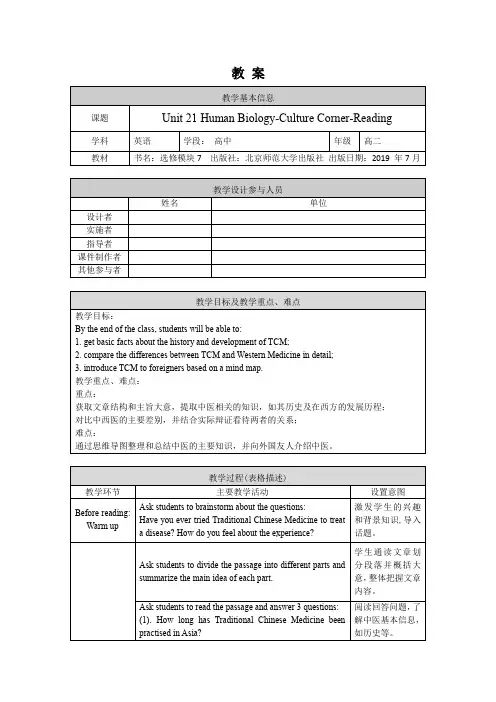
Guide students to read and finish the timeline to illustrate the development of Traditional Chinese Medicine in the Western World.
Bythe end of the class, students will be able to:
1. get basic facts about the history and development of TCM;
2. compare thedifferences between TCM and WesternMedicine in detail;
3. introduce TCM to foreignersbased ona mind map.
教学重点、难点:
重点:
获取文章结构和主旨大意,提取中医相关的知识,如其历史及在西方的发展历程;
对比中西医的主要差别,并结合实际辩证看待两者的关系;
难点:
通过思维导图整理和总结中医的主要知识,并向外国友人介绍中医。
教学过程(表格描述)
教学环节
主要教学活动
设置意图
Before-reading:
Warm up
Ask students to brainstorm about the questions:
Have you ever tried Traditional Chinese Medicine to treat a disease? How do you feel about the experience?
Guidestudents to do an extended learning about Tu Youyou and her discovery, and further understand the importance of integrating Traditional Chinese Medicine and Western Medicine in creating a healthier world.
英语选修7北师大版unit21lesson2教案

Unit 21 Human BiologyLesson 2 Brain PowerTeaching aims1.words and phrases:2. listening:to practise using listening strategies for completing a text.To practise giving and asking for advice3.to practise using phrasal verbs4.to practise using the vocabulary of parts of the bodyTeaching timeTwo periods(两课时连堂)Teaching processStep 1 RevisionCheck homework exercisesStep 2 learn the new words of lesson 21.ask some students to read the new words first and correct theirpronunciation2.play the tape and have them read after the tape3.give them a few minutes to read the new words freely ,tell them if theycan’t read the words, ask the teacher .step 3 listening1.Before you starta) students work in pairs, matching the key words with thedefinitions.b)check their answers.c)ask them to read the key words and the definitions.2.listen to learnexercise 2:a)ask four students to read the listening strategies. make sure they getthe meaning.b) give them a few minutes to read through the summary.c)play the tape once for students to listen and write abbreviationsfor the missing words.c) play again for students to complete the gaps.d)check their answers.3. exercise 3.a) let the students read through the questions .b) play the tape two or three times.c) Ask some students to answer the questions4.exercise 4a) listen to a student phone-in programme about revising for examsand complete the table.b) play the cassette twice, then give them some time to complete thetable.c) check their answers.5.exercise 5.a)give students time to read the Function File and the list of wordsand see if they can guess any of the missing words.b)play the tape two or three times for students to complete the functionfile.c)check their answersd) read the function filestep 4 vocabulary: phrasal verbs1.exercise 7a)ask students to read through the text quickly.b)ask them to read the given words and expressionsc)give them some time to do the exercise individually.d)check students’ answers.step 5 HomeworkExercise 1 on page 83。
高中英语北师大版选修7教案-Unit21_Human_Biology_教学设计_教案
教学准备1. 教学目标Some believe that human cloning is a good thing. Firstly。
think if people had too much work to do , they could get their own cloneto help them.2. 教学重点/难点Some believe that human cloning is a good thing. Firstly。
think if people had too much work to do , they could get their own cloneto help them。
3. 教学用具4. 标签教学过程导学案Discursive essay——discussion reportAfter a discussion, we will write a report to show people’s different ______________ about the topic and give some examples/materials to____________ them.Task 1:Read the passage to match the heading with the paragraphsWe have a heated discussion in our class about whether it is good or not to have human cloning. Opinions are divided.Some believe that human cloning is a good thing. Firstly, They think if people had too much work to do , they could get their own clone to help them. That wouldn’t be cheating because it would still be themselves doing the work. As a result, they would have so much time to rest and have fun. What’s more, human cloning could alsosolve the problem of finding the organs for organ transplants. Sothat it could help people lead longer and healthier lives.However, others are against it .They think human cloning is a terrible idea, which could cause a lot of problems. First of all, it could cause family confusion. If people were cloned , how could their clone fit into their family? Remember, their clone would be exactly like them. In addition, clone could cause problem for society. If everyone decided to be cloned there would be a population of explosion.In my opinion, I ’d prefer to have human cloning . In that case, we can clone people with special talents that would be helpful for social development.People are against the human cloning and the argument Paragraph 1Writer’s opinion about thetopic Paragraph 2People are for the human cloning and theargument Paragraph 3Introduction of thetopic Paragraph 4Task 2:Read the passage to fill in the formTask 3:find out topic sentences in each paragraph.Paragraph 1 Topic sentence________________________________________________________________1)______________________________________________________________2) _____________________________________________________________3)______________________________________________________________Opinions _____ whether we choose to be treated by Chinese traditional Medicine _____________________.(人们关于是否选择使用中药治疗的看法不同)。
高二英语(师大版)选修七-Unit 21 Human Biology (10)-1 教案
Pre-reading
Checkself-study homeworkand do thevocabularyexercise.
检验学生的自学效果。
The1st Reading
Read fast and answer two questions.
把握文章主要观点和体裁。
其他参与者
教学目标及教学重点、难点
教学目标
At the end of the class, students will be able to:
1.identify the meaning ofsomewordsrelatrize the basic structure of an argumentative essay;
教学难点
Expresstheiropinionsabout health and beautycritically.
教学过程(表格描述)
教学环节
主要教学活动
设置意图
Lead-in
Ask Ss about their opinions of their body shapes and introduce typical types of body shapes.
通过分享交流,启发思考与表达。
Summary
Summarize the class with a video and pictures.
引导学生理性认识,鼓励学生增强自信。
Homework
Ss write a short passage to share their understanding of health and beauty.
引导学生分析段落大意和总结文章结构框架。
高二英语 (师大版)-选修七 Unit21 Human Biology (2)-1教案
教学过程(表格描述)
教学环节
主要教学活动
设置意图
Review
Review the meaning and structure of the Zero, First, Second and Third Conditional by listing sample sentences
通过完成基础练习巩固混合虚拟条件句的结构掌握,在语境中理解句意。
Language in use
Ss complete the following exercise: write answers to the questions, language in useand Alex’s day.
通过生动的情景让学加深学习印象,启发学习兴趣。
Homework
Watch the video Alex’s day again. And try to write a short story with the beginning: “Alex had a terrible, horrible, not good, very bad day. If Alex … ”
1. identify different types of Conditionals;
2. summarize the usage of Mixed Conditionals;
3. describe the situations with Mixed Conditionals.
教学重难点:
重点:发现总结混合虚拟条件句的形式、使用方法和意义,能够读懂句子大意。
通过阅读例句让学生注意、观察、发现、总结混合虚拟条件句的结构与意义。
Paraphrase the sentences
高二英语(师大版)-选修七 Unit 21 Human Biology(4)-教案
2. gather the meaning of phrasal verbs related to healthy lifestyle;
3. talk about your own lifestyle with phrasal verbs;
学生再次阅读文章,获取细节信息,回答四个理解问题,对John生活方式改变的前因后果有进一步了解,并能用原文语言进行阐述。
Third Reading
Studentsretell the story based on the article. By learning teacher’s example, students will learn about phrasal verbs and come to notice the use of phrasal verbs instoryretelling.
Students fill in all the blanks and complete the story retelling.
1.学生通过老师的示范,意识到动词短语在故事讲述中的使用。
2.学生在文段复述的练习中,使用动词短语,通过情景猜出动词短语的意思。
Review
Students readand memorize the meaning of important phrasal verbs in the story.
学生完成写作任务,根据写作自评表格,评价自己的写作。
4. write a short story about lifestyle using the newly learnt phrasal verbs.