
牛津译林七年级下册第四单元Unit4FindingyourwayGrammar‖教案
7B unit 4 Finding your way
(Grammar‖)
Teaching Analysis
Text analysis The topic of this unit is “Finding
your way”. And this part is about
prepositions of place. Students have
learnt about them in the primary school.
Words about prepositions of place will
be taught in this part to help the students
describe a certain place. So this part
plays an important role in this unit. Students analysis Students have known somewords
about prepositions of place, but as
students in Grade 7, they need to
practice more to describe different
places. Some students are not active in
class; they need to be encouraged more.
Teaching Aims Knowledge aims
1.To know somewordsabout
prepositions of place.
2.To know the use of prepositions of
place.
Ability aims
1.Students are able to use prepositions
of place to describe a certain place.
2.Students can communicate freely.
3.Have more confidence in using
language creativity and express their
own imagination.
Emotional aims
1.Students realize the happiness of
helping each other.
2.Students become helpfuland can do
their own things by themselves.
Teaching Important Points 1.below, above, over, under, behind, inside, outside
2.Train the students’ speaking ability.
Teaching
Difficulty Students are able to describea certain place.
Teaching Methods 1.Students-centered teaching method
2.Situational teaching method
municative teaching method
4.Task-based teaching method
7. TPR
Teaching Aids Multi-media, object teaching
Teaching Procedures
Procedures The teacher’s activities The students’ activities Purpose
Warming-up 1.Introduce myself to the
students.
2.Tell them my problem
and ask them to help
me.
3.Introduce Conan to
them. 1.Practice greetings
with the teacher.
2.Learn some
prepositions of place.
3. Get to know the task of
this class.
Arouse the
students’interests
oflearning this class.
Presentation Clue 1
1.Lead the students to
read Clue 1.
2.Go to the hospital to
find the cat.
3.Play TPR.
1.Listen to Clue 1.
2.Watch the video and
sing after it.
3.Fill in the blanks
according to the
pictures.
4.Students do as the
teacher says.
Students revise and
learn some
prepositions of place.
Clue 2
1. Present Clue 2 and go to
1. Listen to Clue
2.
2. Look for the animals in
Students can learn
new words and speak
and Drill the park to look for the cat.
2. Students tell where the
animals are. the park.
3. Describe their
positions.
while playing.
Clue 3
1. Present Clue 3 and go to the neighborhood.
2. Present the new words.
3. Ask students to work in pairs to practice them with each other. 1.Listen to Clue 3
2.Students work in
pairs.
3.Watch and describe
the positions of the
cat in Picture A and B.
1. Help the students
understand and use
the opposites of
prepositions of place
better.
2.Improve students’
ability of speaking
and working together.
Help students use
the target language
orally and creatively.
Encourage them to
speak out and
improve the ability of
reading.
Clue 4
1.Present Clue 4.
2.Ask the students to
describe the picture.
3.Guess which the cat’s
house is.
4.Fill in the blanks and
read the short passage.
Find out the cat’s
house. 1.Students describe the picture orally.
2. Fill in the blanks and then find out the cat’s house on the picture.
Chant 1.Lead the students to
complete the chant.
2.Chant it. 1.Work in groups and
complete the chant.
2.Chant with the
teacher.
Review the words we
learnt today.
Homework 1.Recite the prepositions
we have learnt today.
2.Describeyour
neighborhood or your
bedroom using the words
on the blackboard.
Blackboard 7B unit 4 Finding Your Way
Where is the cat? He’s…
in above outside
on under below
between behind over
beside inside in front of。
牛津译林版英语七下Unit 4《Finding your way》(Welcome to the u
牛津译林版英语七下Unit 4《Finding your way》(Welcome to the unit)教学设计一. 教材分析《Finding your way》是人教版牛津译林英语七年级下的一个单元,主题是关于方向和地点的询问与描述。
本节课的主要内容是通过学习如何描述路线和地点,提高学生的语言运用能力和人际沟通能力。
教材中包含了丰富的图片、对话和活动,为学生提供了充足的语言实践机会。
二. 学情分析七年级的学生已经掌握了基本的英语语法和词汇,对于日常生活中的简单交流已经没有太大问题。
但是,他们在描述具体地点和路线时,可能会存在一定的困难。
此外,部分学生可能对方向感不强,需要在教学过程中加以引导和训练。
三. 教学目标1.知识目标:学生能够掌握描述路线和地点的常用词汇和句型,如:turn left/right, go strght on, take the second/third turning on the left/right等。
2.能力目标:学生能够在实际情境中运用所学语言描述路线和地点,提高人际沟通能力。
3.情感目标:培养学生对探索和发现的兴趣,增强团队协作精神。
四. 教学重难点1.重点:描述路线和地点的词汇和句型。
2.难点:如何在实际情境中灵活运用所学语言进行交流。
五. 教学方法1.情境教学法:通过设定具体的生活场景,让学生在实际情境中学习和使用语言。
2.任务型教学法:通过完成各种任务,培养学生运用英语进行实际交流的能力。
3.小组合作学习:鼓励学生分组进行讨论和实践活动,提高团队协作能力。
六. 教学准备1.准备相关图片和地图,用于展示和练习。
2.准备录音机和磁带,用于播放对话和歌曲。
3.准备教案和教学课件。
七. 教学过程1.导入(5分钟)利用图片和歌曲《London Bridge》引导学生进入话题,激发学生对方向的兴趣。
2.呈现(10分钟)展示一幅学校地图,引导学生观察并找出学校各个场所的位置。
牛津译林版七年级英语下册Unit4FindingyourwayGrammar优质教案
2. To recognize and use adverbs of frequency: always, usually, often, sometimes, seldom, never.
Step 2 Presenting
Ask: When is Christmas? ( It’s on December 25th.) Is it cold at Christmas? Why? (Yes. Because it is in winter.) Wint er is one of the seasons of the year. There are 4 seasons in a year. The y are spring, summer, autumn and winter. Which is the hottest/coldest season? Which season comes after spring/ summer/ autumn/ winter? Which i s your favourite season? Why?
·Ask students to write out their diets on a piece of paper.
·Then in pairs, students ask their partners about these foods, using the structureHowoften do you eat…?
教学
要点
教学重点
How to use prepositions to talk about time and adverbs of frequency.
2013春牛津译林版七下《Unit4 Finding your way》(grammar)ppt课件2
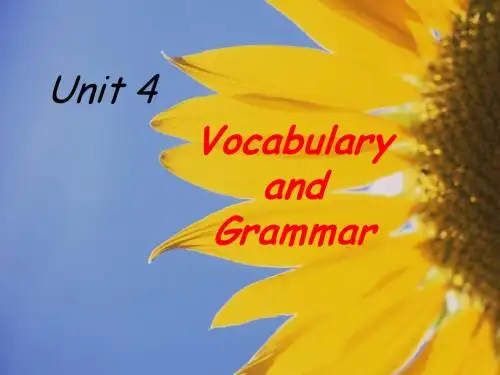
Part One Some common signs
Do you know them?
No smoking
No swimming
No parking
No fishing
You can’t drive a car here.
You must wait. You can’t cross the road now.
She must _________ turn left if she wants to go to the cinema.
She must turn ________ right if she wants to go to the post office.
straight on She must go_________ if she wants to go to the shopping mall.
museum
corner
When you come to the corner of the road, turn left. Walk along the road and you’ll see the museum on your right.
hotel
museum
Walk along the road, turn left at the
Let’s read the words: • 1.crossroads n. 十字路口 • 2.straight adv. 径直 adj. 笔直的 • 3. entrance n. 入口 • 4. correct adj. 正确的 • 5. corner n. 角落, 拐角 • 6. hotel n. 旅馆 • 7. cross v. 穿过 • 8. museum n. 博物馆
牛津译林七年级下册第四单元Unit 4 Finding your wayGrammar‖教案
Blackboard
7B unit 4 Finding Your Way
Where is the cat? He’s…
in above outside
1.Students describe the picture orally.
2. Fill in the blanks and then find out the cat’s house on the picture.
Chant
1.Lead the students to complete the chant.
2.Students become helpfulandcan do their own things by themselves.
Teaching
Important Points
1.below, above, over, under, behind, inside, outside
2.Train the students’speaking ability.
Purpose
Warming-up
1.Introducemyself to the students.
2.Tell them my problem and ask them to help em.
1.Practice greetings with the teacher.
2.Chant it.
1.Work in groups and complete the chant.
2.Chant with the teacher.
牛津译林版英语七年级下册教案Unit 4 Finding your way Grammar

Unit 4 Finding your wayGrammar设计说明教学反思首先复习Reading的内容,有意识的用含有定冠词和不定冠词的句子去表达在阳光动物园看到的动物,通过这种方式呈现出第一个语法——定冠词和不定冠词,再利用这些句子来总结出它们各自的用法和注意点。
在帮助学生总结了它们的用法之后,进行突破——让学生考虑平时的学习中有哪些地方是不需要用冠词的。
最后用课本的练习作为巩固。
至于方位介词,继续用图片呈现出已经学过的方位介词,然后再呈现新的方位介词,对几组重要的介词加以区分,最后新旧知识进行大综合,以练习结束。
教学目标通过本课节的教学,让学生达成以下目标:1.知识目标掌握词汇:cage,across, inside, outside, above, below, sign, over, bench。
2.能力目标(1)能掌握冠词的用法;(2)能运用方位介词来表达物体的位置。
3.情感目标培养学生的方向感。
重点难点1.重点:掌握冠词的用法。
2.难点:运用方位介词来表达物体的位置。
教学准备PPT 课件;相关图片授课时数1课时教学过程Step 1 Warming upRevise what the Ss see in Sunshine Zoo.A panda, a lion, a bird, a monkey, a giraffe, an elephant and so on.Step 2 Presentation1. Present a, an and the and their usage.Daniel sees panda. panda is eating bamboo. Millie sees lion. lion is on a big cage. Answers: a; The; a; TheThey also see giraffe and elephant. giraffe has long neck. elephant has large ears. ears are like open fans.Answers: a; an; The; a; The;The2.Teach the students the different usages of a/an. 不定冠词 a, an 的用法:(1)当第一次提到某人或某物时。
牛津译林版七年级英语下册 Unit 4 Finding your way教案(10课时,含练习)
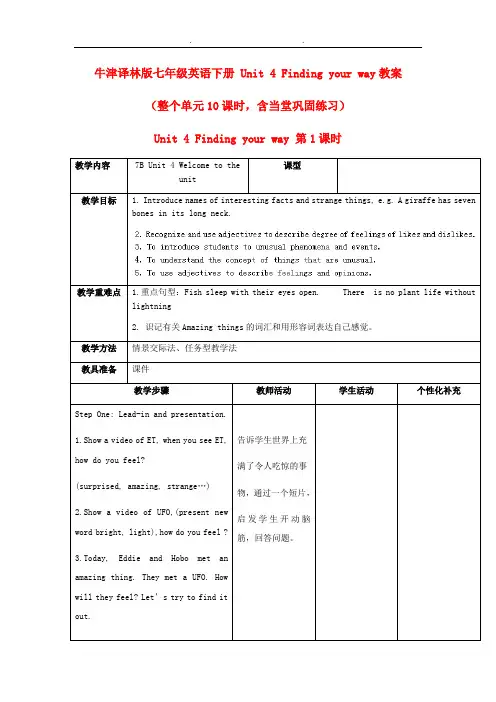
牛津译林版七年级英语下册 Unit 4 Finding your way教案(整个单元10课时,含当堂巩固练习)Unit 4 Finding your way 第1课时教学内容7B Unit 4 Welcome to theunit课型教学目标 1. Introduce names of interesting facts and strange things, e.g. A giraffe has seven bones in its long neck.教学重难点 1.重点句型:Fish sleep with their eyes open. There is no plant life without lightning2. 识记有关Amazing things的词汇和用形容词表达自己感觉。
教学方法情景交际法、任务型教学法教具准备课件教学步骤教师活动学生活动个性化补充Step One: Lead-in and presentation.1.Show a video of ET, when you see ET,how do you feel?(surprised, amazing, strange…)2.Show a video of UFO,(present newword bright, light),how do you feel ?3.Today, Eddie and Hobo met anamazing thing. They met a UFO. Howwill they feel? Let’s try to find itout.告诉学生世界上充满了令人吃惊的事物,通过一个短片,启发学生开动脑筋,回答问题。
4.Then let’s listen to the tape recorder of the text. And then try to answer my questions.Listen to the recorder twice. Questions: 1). What are Eddie and Hobo doing?2). What did Eddie think it is?3). What did Hobo think it is?4). Did Eddie think it is a plane? Why not?5). Do you think Eddie is a clever dog?Read the text as the role of Eddie and Hobo.Act a short play with your partner. (ask two or three groups of students to do it.)Discussion: Do you believe there are UFOs in the world?Step Two: PresentationActually there are lots of amazingthings in the world. Here are lots of surprising things. 利用图片进行生词教学通过听对话找到问题的答案。
牛津译林版七年级下册英语 Unit 4 Finding your way grammar(共45张PPT)
The dog is _u_n_d_e_r_ the toy plane.
above
↖ behind
on the left outside
below
over
on
in ↖inside in the middle of
next to on the right
in the south / on the right / in the day / in the end
特别提醒: 名词前不加冠词。
月份 ,季节,星期,国家,体育运动,一日 三餐, 语言,节日,人、地名,专有名词或可数名词
复数前。 一些固定短语中 eg. by plane, go to school/work, after school, at night, at work
--- Yes. _T_h_e_ library is just next to our
classroom. 3. I have _a_n_ apple. It’s in my bag. Can you
see _t_h_e_ apple? 4. There is __a___cinema in Green Street.
3.My cousin ,Amy,like playing _th_e__violin.乐器前 4._T_h_eearth goes around __th_e_sun.世界上独一无二的事物
5.I believe you are __th_e_best singer . 形容词最高级前
6.__Th_e_rich should try their best to help __th_e_poor. 某些形容词前,表示某一类人
牛津译林初中英语七下Unit 4 Finding your way Task课件1
………
How…t…o…write le详t细te地r址s,in可附E日n期glish? ………
Dear ###,
礼貌用语不可少
正文表达简洁无误
……………………………………………………
……………………………………………………
……………………………………………………
……………………………………………………
Guide Two
• 1.Suzy wants to show her friends how to get to her home in her letter.
• Complete the above passage.(5')
Orange Street
This is the way to my home. Take the_u_n_d_e_r_g_r_o_u_n_d.Get out at Exit
3. signature
Practice in class(15')
Tom打算在下周日下午3:00在 家开个生日聚会,他想邀请他 的好朋友John,请你帮他写一 份邀请信。注意人称和格式。
60词左右。
中考作文评分标准
先根据文章整体内容和语言表达确定档次,然后在该档次内 评出分数。
第五档(15~13分) 完全符合题目要求,表达思想清楚,内容丰富。使用多种语
• Suzy, one of the Class 1, Guide 7 students,is going to invite her friends to her birthday party at home. Listen to her invitation.
Guide One(5')
• 1.Listen and answer the following questions. • (1).Where is Suzy going to have his birthday
2019精选教育牛津译林七年级下册第四单元Unit 4 Finding your wayGrammar‖教案.doc
1. sten to Clue 2.
2. Look for the animals in the park.
3. Describe their positions.
Students can learn new words and speak while playing.
2.Improve students’ ability of speaking and working together.
Help students use the target language orally and creatively. Encourage them to speak out and improve the ability of reading.
Students analysis
Students have known some words about prepositions of place, but as students in Grade 7, they need to practice more to describe different places. Some students are not active in class; they need to be encouraged more.
2.Students become helpful and can do their own things by themselves.
Teaching
Important Points
1.below, above, over, under, behind, inside, outside
牛津译林版英语七下Unit 4《Finding your way》(Grammar)教学设计
牛津译林版英语七下Unit 4《Finding your way》(Grammar)教学设计一. 教材分析《牛津译林版英语七下Unit 4》主要讲述了如何根据地图和路标找到目的地。
本节课的核心语法是情态动词can的用法,表达能力的具体体现。
教材通过具体的语境,让学生学会使用情态动词can来描述能力,同时结合一般现在时,使学生能够熟练运用该语法点进行实际交流。
二. 学情分析七年级的学生已经掌握了情态动词can的基本用法,同时具备了一般现在时的基本运用能力。
但学生在实际运用中,可能会对情态动词can和一般现在时的混合使用产生困惑。
因此,在教学过程中,需要帮助学生巩固已学知识,提高在新的语境中运用语言的能力。
三. 教学目标1.知识目标:学生能够掌握情态动词can的一般现在时用法,学会根据地图和路标找到目的地。
2.能力目标:学生能够在实际情境中运用情态动词can的一般现在时描述自己的能力,并能够正确使用地图和路标。
3.情感目标:培养学生独立思考、合作学习的能力,提高他们对英语学习的兴趣。
四. 教学重难点1.重点:情态动词can的一般现在时用法。
2.难点:情态动词can和一般现在时的混合使用。
五. 教学方法采用情境教学法、任务型教学法和合作学习法。
通过设定具体情境,让学生在完成任务的过程中,学会运用情态动词can的一般现在时描述能力,并能够结合地图和路标找到目的地。
六. 教学准备1.教学PPT:制作包含本节课主要内容、图片、例句等信息的PPT。
2.地图和路标:准备一些地图和路标的图片,用于教学活动。
3.任务单:为学生准备任务单,以便于他们在课堂上完成任务。
七. 教学过程1.导入(5分钟)利用PPT展示一些有趣的地图和路标图片,引导学生谈论他们所熟悉的地图和路标。
教师提问:“Do you like maps and signs? Why?”,让学生自由回答,从而引起学生对地图和路标的兴趣。
2.呈现(10分钟)教师通过PPT呈现本节课的主要内容,包括情态动词can的一般现在时用法,以及如何根据地图和路标找到目的地。