
牛津译林版七年级英语上册《nit 6 Food and lifestyle Reading 1: Keeping fit》精品课课件_17
6. Kitty and Daniel have healthy lifestylelanks. (P72) Simon: How often does Kitty dance? Millie: She dances (1)_e_v_e_r_y_d_a_y__. Simon: How long does Kitty dance every
What food do you like?
Fruit
Vegetables Fast food
Snacks
Main food Meat
WDhDWoaotyyhdooaouut’ytskohynuinoukwr
likihtefoitaswovhoeteauoatrbl?itteheyd?rink? healthy?
Practise 你晚饭吃的是什么? What did you have for supper? 我姐姐经常晚饭只吃一个苹果。 My sister often has only an apple for supper.
【拓展】关于一日三餐的表达,有如 下几点值得注意: (1)按英美人的习惯,每天有一餐为正餐, 称为dinner ,它可以是午餐也可以 是晚餐; (2)表示吃饭的动词,英国人一般用 have,而美国人喜欢用eat;
打电脑游戏
play computer games
需要做某事
need to do something
打算做某事
plan to do something
去游泳
go swimming
1. I seldom eat cakes or sweets. seldom 很少, 不常。形式上是肯定的, 含义上是否定的。
Sometimes I have an _a_p_p_l_e_ or a __p_e_a_r_
between meals.
I seldom eat __c_a_k_e_s _ or __s_w_e_e_ts___.
Listen to Daniel’s articles carefully and answer the question.
I do not often eat _fi_s_h.
Daniel
B3
(P 72)
1. Kitty loves swimming. F 2. Kitty often eats healthy food. T
3. There is too much sugar in cakes and sweets. T
Practise 你在五点到七点之间叫我吧。
You can call me between 5:00 and 7:00. 在我们四个女孩中间她是最聪明的。
She is the cleverest girl among four of us.
so 连词,可用于连接两个句子,意为 “因此”。
Practise 我身上没带钱,因此我无法给你一块。 I have no money with me, so I cannot give you 1 yuan. 今天天气晴朗,因此我们打算去野炊。 Today is sunny, so we decide to have a picnic.
He plans to eat:
How he How often does exercises he exercise?
hamburgers, beef and cola fruit, fish and vegetables
seldom
He plans to:
go swimming every week
v_e_g_e_t_a_b_l_es__ every day. Simon: What does Daniel plan to do? Millie: He plans to (6) _g_o_s_w_i_m_m__i_n_g_.
Fill in the table with the information
e.g. I seldom go swimming. 我很少去游泳。
巩固:kitty很少吃汉堡。 Kitty ______ ______ hamburgers.
2. I dance for two hours twice every week. ①②
区分: how long/how often
对表示持续时间的状语提问要用 how long。
(3) breakfast, lunch, supper, dinner 这几个名词前一般不用冠词,只有在表 达特指或强调之意时才用冠词。
5. Sometimes I feel hungry between meals, so I eat an apple or a pear.
between 两者之间,常用于短语 between…and…中。注意区别among。 among,也表示 “在……之间”,但用 于三者或者三者以上。
Different lifestyles B1 Match the words with the meanings. (P71)
healthy fit
hungry seldom exercise lifestyle
not often do sports how one lives good for one’s health needing food strong and healthy
Listen to Kitty’s article carefully and answer the questions. What does Kitty love doing?
She loves dancing. How long does she do that every day? For half an hour.
swimming
Do you know them?
fruit 水果
apples
orange
pineapple
pears
Do you know them?
drink 饮料
Coca Cola
juice
tea
milk
Do you know them?
food 食物
cake
hamburger
rice
noodles
much too “太”是副词, 后接形容词或 副词。
e.g. It is much too cold today. be bad for……意为“对……有害(不 利)” e.g. Smoking(吸烟) is bad for our
health.
3. I need to keep fit.
keep作系动词时,意为“保持某种状 态”,后接形容词。keep fit/healthy 意为“保持健康”。
How often does she
exercise?
every day
How long does she
exercise?
half an hour
Fill in the table with the information about Daniel.
What he eats
Daniel
He loves:
What does he like to do, to eat and to drink?
I love _h_a_m__b_u_r_g_e_rs_ and _c_o_l_a_.
My favourite meat is _b__ee_f_.
I do not eat _fr_u_i_t_ and _v_e_g_et_a_b_l_e_s every day.
NMoy, Ifatvhoinukrite iEdt’rrs…inbkaI dtihsficonorkla….
mI ylikheeatoltmh.atoes.
fit adj. 健康的 keep fit 保持健康
meal n. 一餐(饭) pear n. 梨 sugar n. 食糖;糖 tooth n. 牙齿 computer n. 电脑游戏 game vt. & vi. 改变,变化 change vt. 打算,计划 plan n. 水池,水塘 pool n. 游泳池
Simon: Does Daniel have a healthy lifestyle?
Millie: (4)_N_o_, _h_e_d_o_e_s_n_’_t_. Simon: What does Daniel plan to eat every day? Millie: He plans to eat (5) m__o_r_e_f_r_u_it__a_nd
每周两次 保持健康 感到饥饿 很少吃蛋和糖果 在两餐之间
twice every week keep fit feel hungry seldom eat cakes or sweets between meals
太多的糖
too much sugar
对我的牙齿有害 be bad for my teeth
How often does he go swimming?
巩固:请分别对划线部分①②处提问。
3. They have too much sugar and are bad for my teeth.
区分 too much/much too too much “太多”用作形容词,后接不 可数名词。如:too much water, too much snow, too much rain。也可用作 代词。 e.g. Don’t eat too much. 别吃太多了。
Say something about Kitty and Daniel.
牛津译林版七年级英语上册:Unit 6 Food and lifestyle. Period 2
Unit 6 Food and lifestylePeriod 2【教学目标】1.Of knowledge:Revise and learn some new words about food and lifestyles.2.Of skills: Improve the skills of looking for the main idea and details of an article.3.Of emotion: Know about the relationship between food and health.【教学重难点】Words: fit, meal, pear, sugar, tooth, change, plan, more, pool, swimming pool【教学过程】Part one: 预习作业与交流Part two: 交流展示与点拨提高Step one:导入1.复习:教室请几组学生表演上一节课布置的对话。
2.与学生自由讨论饮食和生活习惯,引入生词。
1)What do you often eat for three meals a day?2)Do you know how to eat healthily?3)Do you like eating sugar? Eating too much sugar is bad for our teeth. Do you think so?4)Do you often drink cola? Cola is unhealthy. How to change this bad habit?5)If you are not strong or healthy enough, what do you plan to do?3.教师总结讨论结果,引入课文:To have a healthy lifestyle is very important. For breakfast we can have something like milk and bread.For lunch we should eat more, like beef, fish, rice and some vegetables. They can give us enough energy. We should not eat too much for supper because we do fewer activities in the evening. Doing enough exercise is necessary. Swimming is good exercise.Step two: 呈现1.听录音,回答问题。
牛津译林版七年级英语上册《nit 6 Food and lifestyle Integrated skills》精品课课件_8

3.How long do you watch TV every day?
a.more than 2 hours
b.1-2 hours
c.less than 1 hour
√
4.How often do you eat cake ,chocolate?
a. every day
b. often
√
c. seldom
Green vegetables Green beans Cabbages Tomatoes Carrots potatoes
Orange juice Lemon juice Apple juice Cola Milk Tea Wine(酒) Beer(啤酒)
menu
Fruits
Lemons Watermelons Apples Grapes Oranges
Benny’s lifestyle
Total number of as Total number of bs Total number of cs
Your score:_______
you Benny
0 1
Scores:
a=1 point b=2 points c=3points
5 Benny’s score:_____1_7_
14-18 points: Your lifestyle is healthy.Very good!
Make a survey(调查)
The
13
number
8of7来自thestudents
(6-9) points
(10-13) points
(14-18) points
Menu
What would you like to order?
牛津译林版七年级英语上册《nit 6 Food and lifestyle Grammar》精品课课件_24
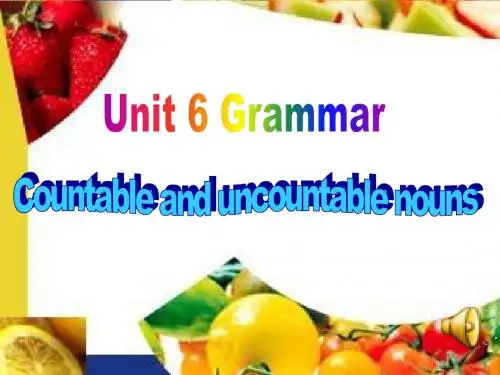
apple orange cup plate egg bowl beef bread cake hamburger cola juice salt pear pork coffee water meat milk rice tomato carrot
特殊的名词复数形式
man teacher ----men teachers man doctor ------men doctors man worker -----men workers
woman teacher ---women teachers woman doctor -----women doctors woman worker ----women workers
leaf
leaves
piano
pianos
box
boxes
tomato tomatoes
brush
brushes
watch watches
bag
bags
cat
cats
radio
radios
boy
boys
strawberry strawberries
几种特殊名词的用法
1、people 作“人们,人民”解时,只有复数形式 ,谓语动词作复数。作“民族”解时,单复数不 同,复数要在词尾加s。 There are five people in my family. There are fifty-six peoples in our country.
sheep fish Chinese Japanese
不规则名词复数变化(三)
牛津译林版七年级英语上册:Unit 6 Food and lifestyle. 课件(共20张PPT)

bread
Put the food into the correct groups. Vegetables: potatoes, tomatoes, carrots… Fruits: lemons, watermelons meat: chicken, beef, pork…… drinks: milk, juice…… snacks: chocolate, sweets ……
Millie likes b_a_n_a_na_s__, c_a_rr_o_ts____ and _f_is_h____.
She dislikes __eg_g_s__.
Daniel likes h_a_m_b_u_rg_e_rs_. He likes ___e_g_gs____. He dislikes _c_ar_r_ot_s____.
Christmas Thanksgiving Day
meat
sweets/ candies
bread
carrots
Coke
milk
Let’s learn different kinds of food!
fish meat
turkey(火鸡)
chicken
pork(猪肉) beef and mutton
Ten.
True or False
• 1.It’s time for breakfast.
F
• 2.Eddie wants to have a hamburger.
T
• 3.Hamburgers are not good for us.
T
• 4.Eddie likes apples.
F
• 5.Apples are not good for us.
牛津译林版牛津译林版七年级英语上册Unit 6 Food and lifestyle Reading 1

Fill in the blanks : (individual work )
Kitty wants to be a ___d_a_n_c_e_r__. She dances for __h_a_l_f _a_n_h_o_u__r every day . She thinks ___a_h_e_a_l_th_y__d_ie_t__ is very important for her. She _s_e_l_d_o_m__eats c_a_k_e_s__o_r_s_w__e_e_ts_between meals because there is _to_o__m_u__c_h_s_u_g_a_r_in them. She usually has _f_r_u_it_a_n_d__v_e_g_e_t_a_b_le_s. For breakfast, she always drinks some _____m__il_k_and eats some __b_r_e_a.d
plan to go swimming every week
Skimming : ( individual work )
1. Kitty wants to be a teacher.
F2. Kitty is careful with her diet because she T wants to be healthy.
Daniel is a student . He likes playing _c_o_m__p_u_te_r_g_a_m__e_s_. He likes h_a_m__b_u_r_g_erasnd
_c_o_la_______. He seldom _e_x_e_r_c_is_e_s_.
He wants to c_h_a_n_g_e_ his lifestyle now. He plans to eat more _fr_u_it_a_n_d__v_e_g_e.tHabeleaslso needs to eat some _fi_sh____. He plans to
牛津译林版七年级英语上册 Unit 6 Food and lifestyle 笔记
Unit 6 Food and lifestyle (生活方式)Welcome2. Fish is good for our health.鱼肉对我们的身体有益。
对...有益/有害be good for/be bad forhealth n.身体/健康;adj. healthy-unhealthy3. Hamburgers are not good for us.= Hamburgers are bad for us.4. An apple a day keeps the doctor away .一天一苹果,医生远离我。
ReadingWhat we eat and how we live 我们吃什么以及如何生活 (Food and lifestyle )Kitty1. 健康的事物对我很重要。
Healthy food is important for me.= It ’s important for me to have healthy food.(It ’s + adj. + for sb+ to do sth 对某人而言做某事怎么样) 3. I always have milk and bread for breakfast. For lunch and dinner , I usually eatfish and vegetables. 我经常早饭喝牛奶吃面包。
午饭和晚饭,我通常吃鱼肉和蔬菜。
4. Sometimes I feel hungry between meals .有时候我在两餐之间感觉饿。
5. I seldom eat cakes or sweets.我几乎不吃蛋糕和糖。
seldom 表示否定,原句and 变成or6. They have too much sugar and are bad for my teeth.他们含有太多糖分,并且对我的牙齿有害。
Daniel1.I like playing computer games.我喜欢玩电脑游戏。
牛津译林版英语七年级上册Unit6FoodandlifestyleReading优秀教学案例
1.教师和学生共同对课堂学习和活动进行反思,总结学习的收获和不足,提出改进的建议和策略。
2.学生通过自我评价和同伴评价,了解自己的一)导入新课
1.教师通过展示一张中国美食的图片,如火锅、炒菜等,引导学生谈论他们对中国美食的了解和喜好。
2.教师提出问题:“你们知道为什么中国人的饮食习惯和西方人不同吗?”引起学生对饮食习惯和生活方式的兴趣。
(三)情感态度与价值观
1.学生能够通过阅读和讨论,认识到健康饮食习惯和生活方式的重要性,培养良好的生活习惯和健康意识。
2.学生能够尊重和理解不同的饮食习惯和生活方式,培养跨文化交际能力和包容性。
3.学生能够积极主动地参与课堂活动,展示自己的观点和想法,培养自信和团队合作精神。
三、教学策略
(一)情景创设
3.小组合作:教师组织了学生进行小组讨论和分享,鼓励他们积极表达自己的观点和想法,培养学生的团队合作精神和沟通能力。通过小组合作,学生能够共同完成任务,提高学生的综合运用能力和团队合作能力。
4.反思与评价:教师和学生共同对课堂学习和活动进行反思,总结学习的收获和不足,提出改进的建议和策略。学生通过自我评价和同伴评价,了解自己的学习情况和进步,培养自我反思和评价的能力。这种反思与评价的教学策略有助于学生更好地掌握知识和技能,提升学习效果。
牛津译林版七年级英语上册《nit 6 Food and lifestyle Reading 1: Keeping fit》精品课课件_10
Learn the new words
sugar
teeth
one tooth
fit adj. 健康的 keep fit 保持健康
学科网
meal n. 一餐(饭) three meals a day
1) To be a careful reader
I have _m__il_k_ and _b_r_ea_d__ for breakfast every day.
I eat _f_i_sh__ and _v_e_g_e_ta_b__le_s_ for lunch and dinner.
Kitty
Sometimes I have an _a_p_p_l_e_ or a __p_e_a_r_
He needs to c_h_a_n_g_e__h_is__li_f_e_s_ty_le (改变他生活方 式)now. He plans t_o__e_a_t _m_o_r_e__fr_u_i_t _a_n_d_v_e_g_e_t_a_b_les (多吃水果和蔬菜). He loves beef, but he also _n_e_e_d_s__to__e_a_t_s_o_m__e_f_is_h_(需要吃一些鱼). He plans to _g_o__s_w_i_m_m__i_n_g__ (去游泳 ) every week.
healthy you
Sum up
Today we know how to k_e_e_p fit. Sweet snacks and h_a_m_b_u_rg_ers are delicious to e_a_t_, but they are not g_o_od_ for us. We should eat h_e_al_t_h_y_ food. Every day, we should e_x_e_rc_i_se for half an hour. We must c_h_an_g_e_ our diet and l_if_e_st_y_l_e from today. We should not play computer g_am__e_s and c_ha_t_ with friends online for a long time. They cannot make us healthier.
牛津译林版七年级上册Unit 6《Food and lifestyle》(第7课时)word教案
Unit 6 Food and lifestyleTaskI. Teaching aims and learning objectivesBy the end of the lesson, students should be able to:1. retell Simon’s lifestyle;2. write about their lifestyles.II. Teaching contents1. New words and expressions: energy, whole, play football to keep fit, help me start the day well, give me energy for the whole afternoon, be good for us, need them to keep healthy2. New structures: I often play football to keep fit.For breakfast, I always have an egg.This helps me start the day well.Fruit and vegetables are good for us.III. Focus of the lesson and predicted area of difficulty1. Find the useful expressions in Simon’s article;2. Analyze the structure of Simon’s article;3. Write about their own lifestyles.IV. Teaching proceduresStep 1 Lead-inFree talk.T: Boys and girls, do you remember Kitty’s lifestyle?1. What does she love doing?2. How long does she dance? Why does she dance every day?3. What does Kitty eat for three meals?4. When she feels hungry, what does she eat? Does she eat sweet snacks?5. Why doesn’t she eat sweet snacks?6. Who can make a conclusion about Kitty’s three meals?Step 2 Listening1. Listen and answer.T: Today we’ll read an article about Simon’s lifestyle. Please take some notes while listening and try to answer the following questions.(1) What does Simon often do?(2) What does Simon have for three meals?2. Retell with useful expressions.T: Please retell Simon’s hobby and his three meals with the useful expressions bel ow. For example: For breakfast, Simon always has an egg./Simon always has an egg for breakfast.S: He often pl ays football to keep fit.S: He also eats baozi or mantou for brea kfast.Step 3 Reading1. Read and finish a table.T: Turn to Page 78. Please read the article by yourselves and fini sh another table on the screen.2. Retell with the useful expressions.T: Can you tell me why Simon often pl ays football?T: Why does Simon has an egg,baozi o r mantou and a glass of milk for breakfast?T: What abo ut his lunch and dinner? Why does he eat them?3. Analyze the structure of the article.T: From Simon’s article, we know that he lives a very healthy life. Do you know how to write an article to talk about your lifestyle? Let’s read Simon’s article again, and analyze the structure.Paragraph 1: name and hobbyParagraph 2: breakfast and reasonParagraph 3: lunch and reasonParagraph 4: dinner and reasonStep 4 Writing1. Before writing.(1) Revise five different kinds of food.T: Before writing, we should write the outline first.T: The food you eat every day is the most important part in this kind of article.Do you remember the five different kinds of food?S: Yes. They are vegetables, drinks, snacks, fruit and meat.(2) Present more words about food.(3) Finish t he outline.(4) Pair work.T: Talk to your partners about your three meals with the useful expressions.Then I’ll choose some of you to speak in front of the whole class.2. During writing.3. After writing.(1) Ask several students to read their articles before class.Help correct the mistakes and find beautiful sentences. Give their articles scores according to the evaluation form.(2) Students rewrite their articles.4. Suggestions for health.T: Here are some suggestions for health. I hope all of you can live a healthy life after learning this unit.V. HomeworkFinish the exercises of this period in the Workbook.【教学反思】。
牛津译林版牛津译林版七年级英语上册Unit 6 Food and lifestyle
多于,不仅仅
散步
总的,总计的, 全部的
数量,数 得分 分数
(程度上)更强, 更多
点菜 菜单 豆,豆科植物 行了,好吧 有……的味道 能量 整个的
Food
1. rice , bread , hamburgers
2.vegetables
3. fruit : apples , oranges , bananas , strawberries , pears , grapes… …
Unit 6 Food and lifestyle Revision
生活方式 正午 汉堡包 保持 柠檬 西瓜 巧克力 牛肉 胡萝卜 猪肉 糖果,甜点 肉
小吃,零食 健康 健康的 保持健康 一餐 梨 食糖,糖 牙齿 电脑游戏 可乐饮料 改变,变化 打算,计划 水池,水塘
一片…… 玻璃杯,玻璃 盘子 盐 茶杯,杯 千克,公斤 盒 瓶子 较少的,更少
boxes
a wish wishes
s,sh,ch,or x + es
a story stories c a family families
a consonant +y -y +ies
a mango
b a radio a potato
mangoes radios
potatoes
o + s or es
4. eggs 5. meat : fish , chicken… … 6. sweets , candies , chocolates , cakes 7. drink : water , tea , milk , juice, coke
Language focus
1. I want to be a dancer. would like to do =want to do