
初中英语人教版八年级下册Unit 4 Why don’t you talk to
Section A话题阅读与交际
第三课时单元语法精讲与精练 单元语法精讲
一、四会单词
第三课时单元语法精讲与精练
一、四会单词
第三课时单元语法精讲与精练 单元语法精练
一、四会单词
第三课时单元语法精讲与精练 单元语法精练
一、四会单词
第三课时单元语法精讲与精练 单元语法精练
一、四会单词
第三课时单元语法精讲与精练 单元语法精练
一、四会单词
第四课时Section B (1a~1e)
一、四会单词
第四课时Section B (1a~1e)
一、四会单词
第四课时Section B (1a~1e)
一、四会单词
第四课时Section B (1a~1e)
一、四会单词
第四课时Section B (1a~1e)
一、四会单词
第四课时Section B (1a~1e)
单元阅读与写作 单元写作
一、四会单词
单元阅读与写作 单元写作
一、四会单词
单元阅读与写作 单元写作
一、四会单词
第六课时Self Check
一、四会单词
第六课时Self Check
一、四会单词
第六课时Self Check
一、四会单词
第六课时Self Check
一、四会单词
第六课时Self Check
一、四会单词
第六课时Self Check
一、四会单词
第六课时Self Check
一、四会单词
第六课时Self Check
一、四会单词
第六课时Self Check
一、四会单词
第六课时Self Check
一、四会单词
第六课时Self Check
一、四会单词
一、四会单词
第一课时Section A (1a~2d)
一、四会单词
第二课时Section A (3a~4c)
一、四会单词
第二课时Section A (3a~4c)
一、四会单词
第二课时Section A (3a~4c)
一、四会单词
第二课时Section A (3a~4c)
一、四会单词
第二课时Section A (3a~4c)
一、四会单词
第二课时Section A (3a~4c)
一、四会单词
第二课时Section A (3a~4c)
一、四会单词
Section A话题阅读与交际
一、四会单词
Section A话题阅读与交际
一、四会单词
Section A话题阅读与交际
Section A话题阅读与交际
Section A话题阅读与交际
Unit 4 Why don’t you talk to your parents?
第一课时Section A (1a~2d) 第二课时Section A (3a~4c) Section A话题阅读与交际
第三课时单元语法精讲与精练
第四课时Section B (1a~1e) 第五课时Section B (2a~2e)
题组训练三offer的用法 一、四会单词
重难点题组训练
题组训练四Why don’t you 句型的用法 一、四会单词
重难点题组训练
题组训练四Why don’t you 句型的用法 一、四会单词
单元阅读与写作 单元阅读
一、四会单词
单元阅读与写作 单元阅读
一、四会单词
单元阅读与写作 单元阅读
一、四会单词
重难点题组训练
单元话题阅读与写作 第六课时Self Check
第一课时Section A (1a~2d)
一、四会单词
第一课时Section A (1a~2d)
一、四会单词
第一课时Section A (1a~2d)
一、四会单词
第一课时Section A (1a~2d)
一、四会单词
第一课时Section A (1a~2d)一、四会单词第五课时来自ection B (2a~2e)
一、四会单词
题组训练一allow的用法
一、四会单词
重难点题组训练
重难点题组训练
题组训练二instead和instead of 辨析 一、四会单词
重难点题组训练
题组训练二instead和instead of 辨析 一、四会单词
重难点题组训练
一、四会单词
第五课时Section B (2a~2e)
一、四会单词
第五课时Section B (2a~2e)
一、四会单词
第五课时Section B (2a~2e)
一、四会单词
第五课时Section B (2a~2e)
一、四会单词
第五课时Section B (2a~2e)
一、四会单词
第五课时Section B (2a~2e)
八年级英语下册 Unit 4 Why don't you talk to your parents
13.The old man didn't hear what I said.He _A__talking without a stop. A.continued B.stopped C.minded D.forgot 14.—I _A__my best friend yesterday morning. —Why not call her up and say sorry to her? A.argued with B.looked after
第3页
二、用括号内所给单词适当形式填空。 6.Our English teacher taught us some reading __sk_i_ll_s_(skill). 7.They played a great role in the _d_ev__el_o_p_m__en__t (develop) of the factory. 8.Too much___p_r_e_s_su_r_e__ (press) made him even want to give up the job. 9.I really don't know what __to__s_a_y_(say) to him at the moment. 10.Mary kept on _l_is_te_n_i_n_g_(listen) to the song until she could sing it.
第6页
15.I don't like rock music.It often makes me _C__. A.shy B.patient C.crazy D.quiet
第7页
四、依据汉语意思完成以下句子。 16.妈妈直到她儿子回来才吃晚饭。 The mother __d_i_d_n_'t__have dinner __u_n_ti_l__her son came back.
八年级英语人教版下册Unit4Whydon'tyoutalktoyourparents教学设计

(4)巩固:通过听力、阅读练习,帮助学生巩固所学知识,提高听力和阅读能力。
(5)拓展:鼓励学生课后观察和思考家庭成员之间的沟通问题,尝试用英语与家人进行有效沟通,将所学知识运用到实际生活中。
3.教学评价设想:
5.引导学生树立正确的人生观和价值观,关注家庭和谐,为构建和谐社会贡献自己的力量。
二、学情分析
八年级的学生已经具备了一定的英语基础,他们在一、二年级的学习中,掌握了基本的语法、词汇和日常会话。在此基础上,他们对英语学习有了更深入的了解,具备了一定的自学能力和合作学习能力。然而,在语言实际运用方面,尤其是家庭成员之间的沟通问题,学生们的表达能力和解决问题的能力还有待提高。
5.教师在教学过程中关注学生的个体差异,给予个性化的指导和鼓励,提高学生的学习信心。
(三)情感态度与价值观
1.培养学生关爱家人、尊重家庭成员之间的差异,学会与家人沟通、解决问题的情感态度。
2.培养学生团结协作、互相帮助的精神,增强团队意识。
3.培养学生面对问题时,保持积极乐观的心态,勇于承担责任。
4.增进学生对家庭、亲情和友谊的认识,培养珍惜家人、朋友之间的感情。
(1)形成性评价:关注学生在课堂活动中的表现,鼓励学生积极参与,给予及时的反馈和指导。
(2)终结性评价:通过单元测试、口语表达等形式,全面评估学生的学习效果。
(3)个性化评价:针对学生的个体差异,给予个性化的评价和指导,激发学生的学习兴趣和自信心。
四、教学内容与过程
(一)导入新课
1.教师展示一幅家庭成员争吵的图片,引导学生观察并思考:“What is happening in this picture? Can you guess why they are arguing?”
人教版 八年级英语 下册 Unit_4Why_don't_you_talk_to_your
2d. Read the conversation first, answer the questions.
• ① What’s wrong with Kim?
• ② What should she do?
Read the conversation again, then find out the phrases.
1b Listen and circle the problems you
hear in 1a.
1. I have to study too much so I don’t get enough sleep. 2. I have too much homework so I don’t have any free time to do things I like. 3. My parents don’t allow me to hang out with my friends. 4. I have too many after-school classes. 5. I got into a fight with my best friend.
Listen again, fill in the blanks.
• Girl 1: You look really tired. What’sthe matter ? • Girl 2: I studied untilmidnight last night so I
didn’t getenoughsleep. • Girl 1: Why don’t you go to sleep earlier tonight?
3. 我的父母不允许我和我的朋友闲逛。
My parents don’t allomwe
初二英语(人教版)Unit 4 Why don’t you talk to your ...
The letter from the teenager
Dear Mr. Hunt, My problem is that I can’t get on with my family. Relations between my parents have become difficult. They fight a lot, and I really don’t like it. It’s the only communication they have. I don’t know if I should say anything to them about this.
Q: Why does the problem worry him?
…They fight a lot, and I really don’t like it. It’s the only communication they have. I don’t know if I should say anything to them about this. When they argue, it’s like a big, black cloud hanging over our home. to speak angrily to each other A: Because he doesn’t like that and doesn’t know
refuse: not allow
A: His elder brother is not nice to him. He doesn’t think it’s fair.
人教版英语八年级下册(讲义)Unit 4 — Why don`t you talk to your parents .词句精讲精练
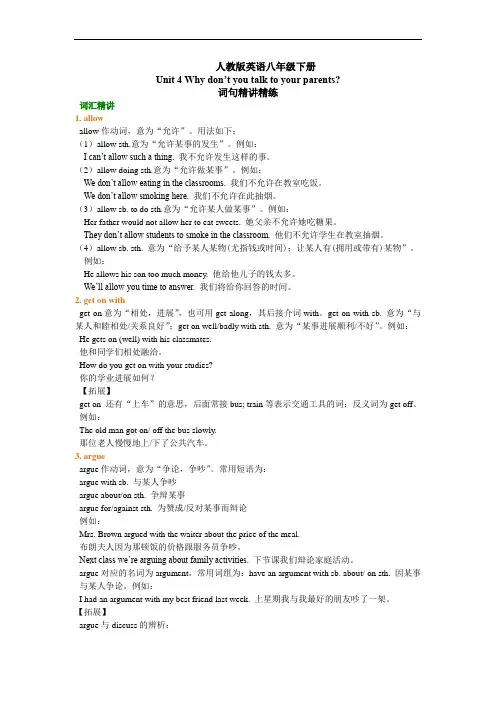
人教版英语八年级下册Unit 4 Why don’t you talk to your parents?词句精讲精练词汇精讲1. allowallow作动词,意为“允许”。
用法如下:(1)allow sth.意为“允许某事的发生”。
例如:I can’t allow such a thing. 我不允许发生这样的事。
(2)allow doing sth.意为“允许做某事”。
例如:We don’t allow eating in the classrooms. 我们不允许在教室吃饭。
We don’t allow smoking here. 我们不允许在此抽烟。
(3)allow sb. to do sth.意为“允许某人做某事”。
例如:Her father would not allow her to eat sweets. 她父亲不允许她吃糖果。
They don’t allow students to smoke in the classroom. 他们不允许学生在教室抽烟。
(4)allow sb. sth. 意为“给予某人某物(尤指钱或时间);让某人有(拥用或带有)某物”。
例如:He allows his son too much money. 他给他儿子的钱太多。
We’ll allow you time to answer. 我们将给你回答的时间。
2. get on withget on意为“相处,进展”,也可用get along,其后接介词with。
get on with sb. 意为“与某人和睦相处/关系良好”;get on well/badly with sth. 意为“某事进展顺利/不好”。
例如:He gets on (well) with his classmates.他和同学们相处融洽。
How do you get on with your studies?你的学业进展如何?【拓展】get on 还有“上车”的意思,后面常接bus; train等表示交通工具的词;反义词为get off。
【人教版】八年级英语下:Unit4 Why don’t you talk to your parents单元学案(含答案)
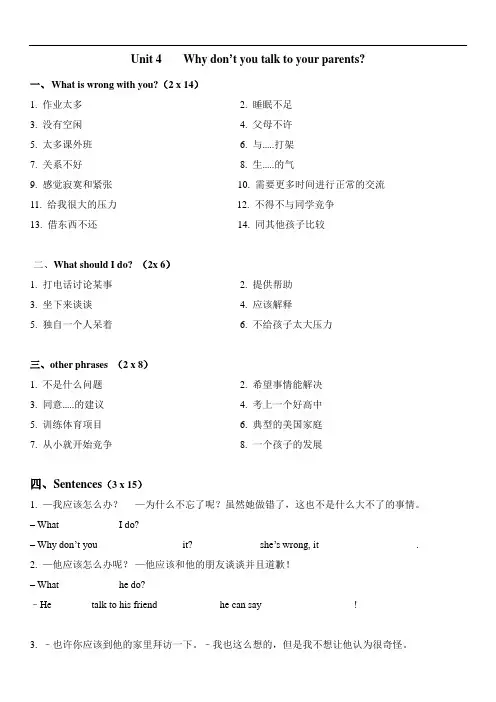
Unit 4 Why don’t you talk to your parents?一、What is wrong with you?(2 x 14)1. 作业太多_________________________2. 睡眠不足___________________________3. 没有空闲_________________________4. 父母不许___________________________5. 太多课外班________________________6. 与…..打架__________________________7. 关系不好________________________ 8. 生…..的气_________________________9. 感觉寂寞和紧张____________________ 10. 需要更多时间进行正常的交流______________ 11. 给我很大的压力____________________ 12. 不得不与同学竞争____________________ 13. 借东西不还________________________ 14. 同其他孩子比较____________________二、What should I do? (2x 6)1. 打电话讨论某事_____________________2. 提供帮助________________________3. 坐下来谈谈________________________4. 应该解释________________________5. 独自一个人呆着_______________________6. 不给孩子太大压力___________________三、other phrases (2 x 8)1. 不是什么问题_____________________2. 希望事情能解决__________________________3. 同意…..的建议_______________________4. 考上一个好高中__________________________5. 训练体育项目________________________6. 典型的美国家庭__________________________7. 从小就开始竞争________________________8. 一个孩子的发展__________________________四、Sentences(3 x 15)1. —我应该怎么办?—为什么不忘了呢?虽然她做错了,这也不是什么大不了的事情。
人教版八年级英语下册Unit 4 Why don’t you talk to your parent
1. Why don’t you talk to your parents? 为什么不跟你的父母谈谈呢?
【自主领悟】(1)Why don’t you do sth. ? 这是一个否定疑问 句, “为什么不……? ”常用来征求意见和提出建议, 相当于 Why not do sth. ? 句式。例如: Why don’t you go with us? = Why not go with us? 为什么不同我们一起去呢? (2)talk to sb. 意为“同某人谈话”。例如: He talked to me about my study. 他跟我谈了关于我的学习的事情。
Unit 4 Why don’t you talk to your parents?
Section A (1a-2d)
Ⅰ. 短语互译 1. get enough sleep 2. have a fight with sb. 3. look through 4. hang out 5. 把……归还给…… 6. 允许某人干某事 7. 成功地发展; 解决 答案: 1. 有足够的睡眠 2. 跟某人打架 3. 浏览 4. 闲逛 5. give. . . back to. . . 6. allow sb. to do sth. 7. work out
【归纳拓展】allow的不同搭配 (1)allow sth. /doing sth. 允许(做)某事 例如: We don’t allow eating in the classroom. 我们不允许在教室里吃饭。 (2)allow sb. sth. (双宾语)给予某人某物 例如: He allows his son too much money. 他给他儿子太多的钱。
speak to sb. “跟某人讲话”
人教新目标八年级英语下册Unit4Whydon'tyoutalktoyourparents说课稿
人教新目标八年级英语下册Unit 4 Why don’t you talk to your parents说课稿一. 教材分析人教新目标八年级英语下册Unit 4 Why don’t you talk to your parents是一篇关于日常交流和沟通的文章。
本篇文章主要讲述了在遇到问题时,如何与父母沟通,寻求解决方案。
通过本节课的学习,学生能够掌握情态动词why not的用法,以及如何运用交际策略进行日常交流。
教材内容贴近学生生活,有利于激发学生的学习兴趣和积极性。
二. 学情分析八年级的学生已经掌握了基本的英语语法和词汇,具备一定的听说读写能力。
但在实际交流中,学生往往因为害羞、紧张等原因不敢开口说英语,本题正好可以引导学生学会如何与父母沟通,提高他们的交际能力。
同时,学生在这个年龄段开始关注家庭和社交问题,对本节课的内容会产生浓厚兴趣。
三. 说教学目标1.知识目标:学生能够掌握情态动词why not的用法,了解日常交际中的沟通策略。
2.能力目标:学生能够运用所学知识进行日常交流,提高口语表达能力。
3.情感目标:学生学会与父母沟通,增进家庭关系,培养良好的交际习惯。
四. 说教学重难点1.重点:情态动词why not的用法和日常交际策略。
2.难点:如何运用所学知识进行实际交流,克服羞涩、紧张等心理障碍。
五. 说教学方法与手段1.情景教学法:通过设定情景,让学生在实际语境中学习英语,提高交际能力。
2.任务型教学法:学生分组完成任务,激发学习兴趣,培养合作精神。
3.互动式教学法:教师与学生互动,引导学生积极参与课堂讨论,提高口语表达能力。
六. 说教学过程1.导入:用一段关于家庭沟通的短片引出本节课的主题,激发学生的学习兴趣。
2.新课呈现:教师展示文章,引导学生关注文章标题和关键词,预测文章内容。
3.课堂讲解:教师讲解情态动词why not的用法和日常交际策略,让学生通过例句理解并掌握。
4.实践环节:学生分组进行角色扮演,运用所学知识进行实际交流,教师巡回指导。
英语人教版八年级下册Unit4 Why don't you talk
B:I..
A:Why not…
B:Sounds great, thank you.
2.Group work
List some problems at home or at school for the students, and ask them to discuss about the advice in groups.
C. A match activities about the advice.
D. Listening
①pre-listeningask students toreadthefive problemsbefore the whole class.
②while-listening circle the problems and write downtheadvice
Pair work鼓励学生多讨论自己的问题并且想办法给他人提出意见或者建议。
让学生进一步讨论自己在学校在家庭的各种问题,并且想出解决办法,并且在全班同学面前展示小组讨论结果。
和学生一起总结今天所学的知识点并布置家庭作业。
Summary
1. problems at home & at school
2. three ways of giving advice:
B:I’m really tried because I studied until midnight last night.A: Why don't you go to sleep earlier this evening?
2.Ability Objectives
Ss learn to talk about their problemsin daily lifeandcangive advice.
初中英语人教版八年级下册Unit 4 Why don't you talk to
Life is a journey with trouble, but with care(谨慎) and wisdom (智慧) you can work out any problem you face.
) 1. Why don’t you ______ her a watch? A. get B. to get C. getting D. gets ( ) 2. Eating ______is bad for our health. A. too many B. much too C. too much D. too little ( )3. My parents never allow me________to watch a football match on TV. A. staying up B. stay up C. to stay up D. stayed up ( )4. Lisa found her sister________her diary when she got into her room. And that made her angry. A. look through B. looking through C. looks through D. looking after ( )5. —It’s very kind of you to________the problem for me. —That’s all right. A. take out B. come out C. give out D. work out
Problems: get a fight with my best friend Advice: call her up, ……
2a Listen. Peter’s friend is