
PEP小学英语五年级上册unit2 Part A Let’s learn教案
Unit 2 My week
(Period1 Part A Let’s learn)
教学目标
a.能听懂问句:What do you have on Mondays? I have Chinese、English、maths and music 并能作出正确回答;
b.能够正确听、说、读、写单词:weekend, Sunday , Monday , Tuesday, Wednesday, Thursday, Friday, Saturday,并能熟练运用;
c.认读相关学科的单词及词组;
d.学习歌曲“Days of the week”
教学重点:
要求学生开动脑筋巧记表示星期的单词,并结合所给句型灵活运用这几个单词。
教学难点:
正确拼写从星期一至星期日这些英语单词。
理解和使用各科目的名称来表述课程安排,能够在情景中询问他人的课程安排。
教学准备:tape, word cards and some pictures
教学课时:1课时
教学过程:
Step1:Warm-up
根据四年级下册第二单元中的句型:“It’s 8 o’clock. It’
s time for Chinese.”引出句型:We have Chinese, English…on Mondays. 结合课程表,进行日常口语练习,内容可参考如下:
A: Hello, B. What time is it?
B: Hello, A. It’s 8:20. It’s time for English class. 1.教师播放Start部分的歌谣Let’s chant,学生感知星期一至星期五的表述。
还可选择播放前几册学生用书中与本单元内容有关的Let’s chant、Let’s sing、Let’s do 部分的录音,学生听音,有节奏地吟唱,并做出相应动作。
Step2:Presentation
1.学生看图中七个小矮人的帽子,上面有星期名称的缩写,让同学们猜一猜每个名称的全称是如何拼写的。
2、观看Let’s learn 部分的挂图,听读星期一至星期五的名称,跟读。
根据教师范写五个单词进行书写。
用彩色粉笔标出五个单词的后缀-day,仔细观察,发现单词构成上的这一共同点。
3、班内进行“谁的记忆力最好?”的拼写单词竞赛。
最后让学生在单词卡背面仿写单词。
1、教师提问:“What classes do you like?”引导学生复习有关课程的词汇。
学生理解一些新开课的名称或较难掌握的名称,如science, moral education, social studies。
3、教师激励学生巧记、速记单词。
Step3: Practice
读课表
让学生按座次,依次说出Let’s learn 图片中的课程表,每人说一个。
教师可给学生们起个头,说:“It’s a time schedule. Let’s have a look.”第一名学生说,“It’s 8:00. It’s time for Chinese. We have
Chinese on Monday.”第二名学生说,“It’s 8:50. It’s time for English. We have English on Monday.”第三名学生说,“It’s 9:50. It’s time for math. We have math on Monday.”第四名学生说,“It’s 10:40. It’s time for music. We have Chinese on music.”
Step4: Consolidation
1、Let’s play
学生手持标有星期的圆盘,随意转动指针,根据指针停下的位置用句型“What day is it today? It’s….”进行交流,巩固所学新单词。
还可加入询问和回答课表的句子,如What do we have on Monday? We have….
2、Let’s sing
学生听录音或者看教学VCD,学唱歌曲“My Days of the Week”。
可根据教学实际情况不在本课选用此部分。
学生手持标有星期的圆盘,随意转动指针,根据指针停下的位置用句型进行交流,巩固所学新单词。
Step5: Home work
1、listen to the tape.
2、sing the song.
板书设计:
Unit 2 My week
What do you have on Mondays?
I have Chinese , English , maths and music.
Monday Tuesday Wednesday
Thursday Friday Sunday Saturday。
五年级上册英语教案Unit2 My week PartA Let's learn∣人教(PEP)

五年级上册英语教案Unit2 My week PartA Let's learn∣人教(PEP)Unit 2 My WeekPart A Let’s learn教学目标:1.掌握7个四会单词Monday, Tuesday, Wednesday, Thursday, Friday, Saturday,Sunday。
2.学会使用What do have on…? 和I have….两个句型询问课程。
教学重点:1. 星期一至星期天7个单词的学习。
2. What do hav e on…? 和I have….两个句型的使用。
教学难点:1.Wednesday, Thursday 单词的正确发音。
2. What do have on…?句型中on+单词的复数形式。
Steps SuggestionsStep 1 Warm-up1. Greetings2. Let’s say: What class is it?3. Free-talk: What do you have on Wednesdays/Thursdays? 由于learn 是本单元的第二课时,借助talk中的这两个句型帮助学生回忆Wednesdays 和Thursdays.让学生说说自己的星期三和星期四都有哪些课。
Unit2 My weekPart A Let’s learnWhat do you have on …?I have …. and…. Mon dayTues dayWednes dayThurs dayFri daySatur daySun day教学反思:星期的单词重在记忆,应该好好地教会学生记忆的方法,渗透一些关于星期的小知识。
在巩固时可能还可以加一个游戏,如给出几月几日星期几,再给出关于这个日期前后的日子,让学生说说是星期几,不是死记硬背,而是需要一定的思维。
五年级英语下册-Unit2 第2课时 A Let's learn【教案】
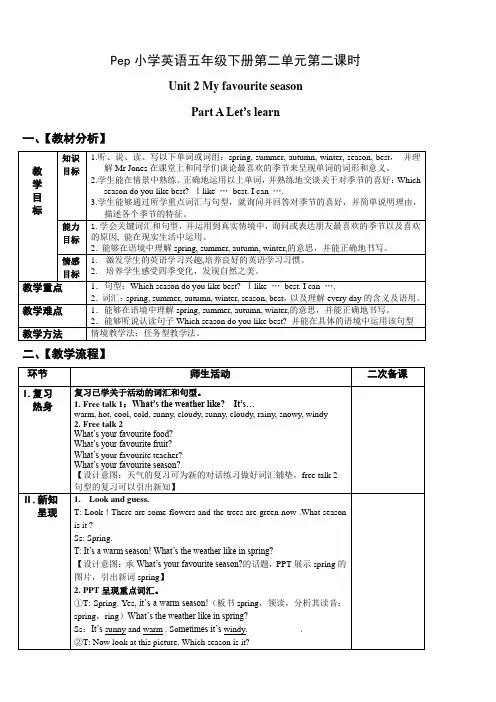
情境教学法;任务型教学法。
二、【教学流程】
环节
师生活动
二次备课
I.复习
热身
复习已学关于活动的词汇和句型。
1.Free talk 1:What’s the weather like?It’s…
warm, hot, cool, cold, sunny, cloudy, sunny, cloudy, rainy, snowy, windy
句型的复习可以引出新知】
Ⅱ.新知
呈现
1.Look and guess.
T:Look ! There are some flowers and the trees are green now .What season is it ?
Ss: Spring.
T: It’s a warm season! What’s the weather like in spring?
3.Games:
What’s missing?
Read and guess
【设计意图:利用游戏的方式巩固核心词汇,活跃课堂气氛。】
4.Listen and answer
T: Weare talking about seasons. Mr. Jones and the children are talking about seasons too. Let’s listen and answer the following questions: What does Mr Jones ask? Which season does Oliver like ? Why?
2.词汇:spring, summer, autumn, winter, season, best,以及理解every day的含义及语用。
(PEP)五年级英语上册教案 Unit 2 Part A Let’s learn
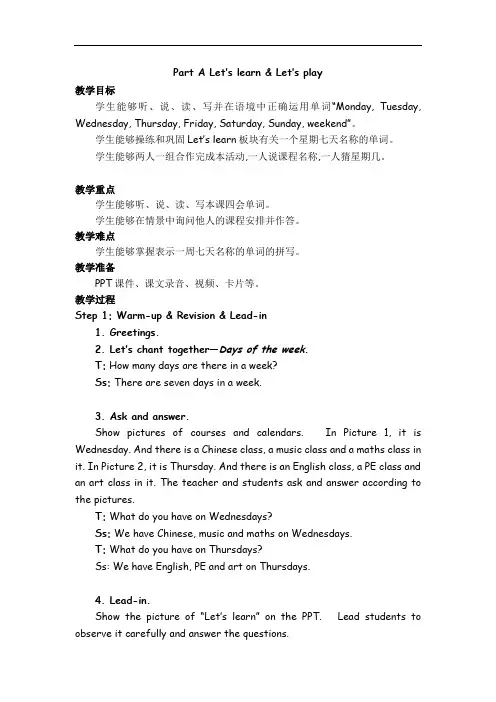
Part A Let’s learn & Let’s play教学目标学生能够听、说、读、写并在语境中正确运用单词“Monday, Tuesday, Wednesday, Thursday, Friday, Saturday, Sunday, weekend”。
学生能够操练和巩固Let’s learn板块有关一个星期七天名称的单词。
学生能够两人一组合作完成本活动,一人说课程名称,一人猜星期几。
教学重点学生能够听、说、读、写本课四会单词。
学生能够在情景中询问他人的课程安排并作答。
教学难点学生能够掌握表示一周七天名称的单词的拼写。
教学准备PPT课件、课文录音、视频、卡片等。
教学过程Step 1: Warm-up & Revision & Lead-in1. Greetings.2. Let’s chant together—Days of the week.T: How many days are there in a week?Ss: There are seven days in a week.3. Ask and answer.Show pictures of courses and calendars. In Picture 1, it is Wednesday. And there is a Chinese class, a music class and a maths class in it. In Picture 2, it is Thursday. And there is an English class, a PE class and an art class in it. The teacher and students ask and answer according to the pictures.T: What do you have on Wednesdays?Ss: We have Chinese, music and maths on Wednesdays.T: What do you have on Thursdays?Ss: We have English, PE and art on Thursdays.4. Lead-in.Show the picture of “Let’s learn” on the PPT. Lead students to observe it carefully and answer the questions.T: Who are they? Ss: They are Robin and Wu Yifan.T: Are they talking about classes? Ss: Yes. T:Good! Let’s go and see!Step 2: Presentation1. Learn the new words.(1)Show the pictu re of the class schedule on Monday in “Let’s learn”.T: What classes can you see?Ss: I can see Chinese, English, maths and music.T: What day is it? Ss: It is Monday. T: Yes, it is Monday.Teach the word like this: “monkey (mon+key)” and “day”, “Mon/mʌn/+day/deɪ/=Monday//”. Write down “Monday” on the blackboard. Lead students to practice reading it three times.(2)Show the picture of the class schedule on Tuesday in “Let’s learn”.T: What does Wu Yifan have on this day?Ss: He has maths, science, Chinese and art.T: What day is it? Ss: It is Tuesday. T: Yes, it is Tuesday.(4)Ask students to look at the whole class schedule in “Let’s learn”. Point to “Saturday” and “Sunday”.T: Why are there no classes in these two days?Ss: Because they are Satur day and Sunday. We don’t go to school.T:Excellent! “Saturday and Sunday” is the weekend. We are free at the weekend.Write down “week + end=weekend” on the blackboard. Lead students to practice reading it three times.T: What can we do at the weekend? Ss:…2. Find the rules.Show all the seven words on the PPT. Ask students to observe them carefully and try to find out their spelling rules. Ask several students to stand up and express their opinions.At last, make a conclusion: The last three letters of these seven words are the same. They are all “day”. And all the first letters of these words are capital letters. Use the red chalk to stress all the first letters and the last three letters. Lead students to read all the words.3. Role-play.Show the picture of “Let’s learn”. Role-play the dialogue between Robin and Wu Yifan with students. The teacher acts Robin. All the students act Wu Yifan. Use the five days’ class schedule to ask and answer like this:T: What do you have on Mondays?Ss: I have Chinese, English, maths and music.T: What do you have on Tuesdays?Ss: I have maths, science, Chinese and art.T:What do you have on…?Ss:I have…Step 3: Practice1. Play a game: Whack-a-mole.2. Finger game.The teacher shows his/her fingers to express the seven days of a week. Students count the number of the fingers and try to speak out the right word as quickly as possible. If the teacher shows only one finger, students should say “Monday”. If the teacher shows two fingers, students should say “Tuesday”.3. Play a game: Let’s drive a train to read!Divide students into seven groups. Name them after the seven days in a week. Take out the word cards of the seven days and distribute them to each group randomly. Each group should remember its name. Then let the seven groups drive a train to read their names according to the right order of a week. Keep driving the train till the teacher says “Here we are!”Step 4: Consolidation & Extension1. The turntable game.2. Guess what day it is.3. Make your own schedules.Ask students to work out their own schedules. They can imitate the schedule in the last activity.Let several students stand up and show their schedules. They can talk about the schedule with their teacher. Make a model:T: What do you have on Mondays/…? Ss:I have…The others can talk about the schedule with their partners.板书作业Tell your parents about your class schedule in English.教学反思教师引导学生观察、总结单词的构成规律,很好地突破了教学难点,降低了学习的难度,也提高了学生的学习积极性。
五年级上册PEP英语Unit 2 教案(第二课时)

一、教材内容分析本单元为小学英语(PEP)五年级上册第二单元My week第二课时。
Let’s learn部分学习的单词是:Monday, Tuesday, Wednesday, Thursday, Friday, Saturday, Sunday。
教材通过吴一凡和机器人Robin讨论吴一凡课程表的情景,呈现单词的词形和意义。
本部分的教学目标是:学生能够听、说、读、写上述单词,并能够在语境中正确运用上述单词。
Let’s play部分用于操练和巩固A Let’s learn板块有关一周七天名称的单词。
本活动要求同桌两人合作完成,一人说课程名称,一人猜星期几。
二、学生情况分析五年级学生已经具备一定的听说读写能力,并且已经学习过本课涉及的科目单词。
同时,学生已在本单元第一课时已经接触过主句型What do you have on … ? I have … 在此基础上,本课要使学生进一步掌握运用主句型谈论学校课程安排情况,并学习重点词汇:Monday, Tuesday, Wednesday, Thursday, Friday, Saturday, Sunday。
三、教学目标1.能够听、说、读、写以下七个单词:Monday, Tuesday, Wednesday, Thursday, Friday, Saturday, Sunday。
2.能够在语境中正确运用上述单词。
3.能够完成“猜一猜”的活动。
四、教学重难点(一)教学重点通过学习学生能听说读写本课四会单词。
运用所学单词结合重点句型遣词造句。
(二)教学难点鼓励、引导学生结合自己生活实际,运用本课内容进行自主对话。
五、教学步骤1.热身、复习(1)教师热情地和学生打招呼,相互问好。
(2)跟唱有关星期单词的歌曲。
【设计意图】开课时,唱与本课息息相关的歌曲达到唤醒学生学习热情的目的。
(3)自由交谈。
让学生运用上节课所学句型What do you have on…. ? I have … on …自由交谈,由旧知识过渡到本课重点词汇。
五年级英语上册Unit3课时2Let'slearn_Role_play教案人教PEP(含教学反思)

五年级英语上册教案人教PEP:Unit 3What would you like?Part A第二课时Let's learn&Role-play教学目标:1.能听、说、读、写单词sandwich,salad,hamburger,ice cream和tea。
2.能在创设的实际情景中灵活运用句型:What would you like to eat/drink?I'd like …3.能完成Role-play部分的任务。
4.继续保持学生对学习英语的兴趣,激发学生用英语进行交流的热情。
教学重点:1.能听、说、读、写单词sandwich,salad,hamburger,ice cream、tea。
2.能在创设的实际情景中灵活运用句型What would you like to eat/drink?I'd like …教学难点:能完成Role-play部分的任务。
教学准备:单词卡片,课件,教学光盘,学生人物头饰。
教学过程:Step 1: Warm up1.Discuss about the food you like or you have learned.学生列举如:noodles,beef,pork,chicken,bread等,教师出示相应图片,帮助学生巩固复习。
2.用英语相互交流,询问对方最喜爱的食物。
Step 2: Presentation1.师生对话:T: What do you like?Chinese food or Western food?Ss:I like …T: Some like Chinese food and some like Western food.What western food do you know?Ss:…T:Today let's learn some popular western food.教师出示三明治,沙拉,汉堡和冰激凌图片,引出单词:sandwich,salad,hamburger,ice cream,教师依次教读。
PEP小学英语五年级上册Unit2 PartB Let's learn 教学设计
PEP小学英语五年级上册Unit2 PartB Let's learn 教学设计Unit 2 Part B Let's Learn is a part of the PEP Fifth Grade English textbook. In this unit, students will learn about different types of vegetables, their colors, and how they grow. This lesson plan will cover the main objectives of the unit, including vocabulary, grammar, listening, and speaking.Objectives:- To introduce and familiarize students to different types of vegetables- To teach students the names, colors and how they grow- To build students’ vocabul ary related to vegetables- To enhance students’ comprehension and speaking skills- To encourage students to use the vocabulary in their everyday contextMaterials:- PowerPoint presentation- Worksheets- Images and videos of different vegetablesVocabulary:- Tomato- Carrot- Cucumber- Eggplant- Potato- OnionGrammar:- 'How do you spell?'- 'What color is it?'- 'Where do they grow?'- 'How do you make a salad?'Procedure:Introduction: (10 minutes)1. The teacher will introduce the aims and objectives of the session to the students.2. The teacher will share a brief overview of what the class will learn.Vocabulary Building: (10 minutes)1. The teacher will display images of various types of vegetables and ask students to identify them.2. Students will learn the name of the vegetables.3. Teacher will teach the spelling of the vegetables while writing them on the board.4. Teacher will also ask students to name the color of eachvegetable and write it on the board.Listening: (10 minutes)1. The teacher will play an audio recording of someone saying the names of the vegetables.2. Students will listen to the recording and repeat after the speaker.3. Teacher will ask individual students to name the vegetables to make sure everyone in the class knows them.Speaking: (15 minutes)1. The teacher will divide students into pairs.2. Each pair will take turns asking their partners about various vegetables.4. The teacher will give each child a vegetable card and they will describe the vegetable to their partner.5. Students will describe the color, shape, and size of their vegetable and tell their partner what they can cook with it6. To make the activity more interesting, they can use words like tasty, healthy or delicious to describe the vegetable. Grammar: (10 minutes)1. The teacher will teach the grammar exercises related to the session.2. The teacher will write some sentences on the board, and students will need to correct them.3. The teacher can also explain some grammar structures related to the lesson, for example, the present continuous tense or how to use adjectives to describe something.Conclusion: (5 minutes)1. The teacher will summarize the lesson with a review of the vocabulary, grammar and speaking activities.2. The teacher will give some tips on how to use the language in their everyday context.Assessment:1. During the speaking activity, the teacher can evaluate student pronunciation and communication skills.2. The teacher can observe students’ participation in the class discussions and provide feedback to each student individually.3. The teacher can also assess the results of the grammar exercise to see how well students have understood the lesson. Conclusion:This lesson covers the key concepts of Unit 2 Part B Let's Learn. The students will have learned the names of different vegetables, their colors, and how they grow. Through this lesson, they will have acquired vocabulary related to vegetables and learned how to use adjectives to describe them. Students will have also enhanced their listening skills, grammar skills, and pronunciation.。
人教版(PEP)英语五年级下册 Unit 2 A Let’s learn(教案)
Unit 2 Myfavourite seasonPart A Let’s learn一、教学目标1. 能够听、说、读、写与季节相关的单词:season, spring, summer, autumn, winter2. 能听懂、会说并运用句型“Which season do you like best? Spring/ Winter.”询问某人最喜爱的季节并简单描述喜欢的原因。
3. 能够结合季节特点和个人喜好,阐述最喜爱某个季节的原因。
4. 能够感受四季的美,培养热爱自然的情感。
二、教学重点及难点重点:1. 能够听、说、读、写与季节相关的单词:season, spring, summer, autumn, winter.2. 能听懂、会说并运用句型“Which season do you like best? Spring/ Winter.”询问某人最喜爱的季节并简单描述喜欢的原因。
3. 能够结合季节特点和个人喜好,阐述最喜爱某个季节的原因。
难点:1. 能听懂、会说并运用句型“Which season do you like best? Spring/ Winter.”询问某人最喜爱的季节并简单描述喜欢的原因。
2. 能够结合季节特点和个人喜好,阐述最喜爱某个季节的原因。
三、教学过程四、板书设计Unit 2 Myfavourite seasonPart A Let’s learnWords:season, spring, summer, autumn, winterSentences:— Which season do you like best?— Summer. I can go swimming every day.。
人教pep版五年级英语上册Unit 2 Part A Let's spell (3)教案
Unit 2 《My week》教案第三课时(Part A Let’s spell)教学目标1. 学生能通过听例词发音,观察例词结构特征,掌握字母组合ea和ee的发音;2. 能够读出符合ee和ea发音规则的单词;3.能够根据单词的发读音拼写出符合ea和ee发音规则的单词;4.能够在单线上完成抄写句子的活动,做到书写规范正确。
教学重点注意区分meat, feet, read, sea, tea, eat, feed, repeat, beef的读音,能够正确读出来。
教学难点能够根据单词的发音拼写出符合ea和ee发音规则的单词。
教学工具ppt教学过程一、Warm-up1.Play a game火眼金睛Read quickly,让学生快速读出出现的单词。
2. RevisionT: What do you have on Wednesday?Ss: We have…然后教师让学生两两一组练习句型。
教师巡视。
A: What do you have on Monday?B: I have Chinese, maths and English.C: What do you have on Tuesday?D: I have maths, Chinese and art.[设计意图]复习的同时为后面的教学做铺垫。
二、Let’s spell(一)、Look, listen and read.1. 教师用ppt出示几句话,或者图片,让学生读一读圈出来的单词的发音,然后找出它们的发音规律。
2.用ppt出示一双脚和一块牛肉的图片,并说Mr. Lee has big feet. Mr.Lee likes to eat some bear.将这两句话写到黑板上,引导学生读并向学生解释单词feet, beef的中文意思,并注意ee, ea的发音。
3. 用ppt出示看书和吃东西的图片,并说But Mr. Lee likes to read the book . And he also likes to eat.将这两句话写到黑板上,引导学生读并向学生解释单词read, eat的中文意思,并注意ee, ea的发音。
Unit2 My week part A Let's learn(说课稿)人教PEP版英语五年级上册
Unit2 My week part A Let’s learn (说课稿)一、教材分析1. 教学目标本节课是英语五年级上册第二单元的第一部分,主要通过学习“my week”这个主题,来帮助学生学习作息习惯和时间的表达方式。
通过本课的学习,学生应该能够:1.学习和掌握以下词汇:week, Monday, Tuesday, Wednesday, Thursday, Friday, Saturday, Sunday, day, morning, afternoon, evening;2.能够介绍一周的安排;3.能够简单询问和回答“what time do you…”的问题;4.能够用英语介绍自己的一周安排。
2. 教学重难点本课教学的重点是学习并掌握一周内时间和作息习惯的表达方式,通过简单的对话表达自己的一周安排。
难点在于学生不仅要学会单纯的表达时间,还得通过语境和表达方式正确地理解意思,并回答与之相关的问题。
同时,本课的句式和词汇比较简单,如何能够寓教于乐,提高课堂的趣味性,也是需要考虑的难点。
二、教学过程设计1. 创设情境,引出本课的教学内容•Step1:Warming-up教师播放歌曲“Days of the Week”,依据歌曲让学生跟着节奏跳舞,引出本课的话题。
•Step 2:Presentation教师拿出一个日历,指着周一,周二,周三等,用黑板上的单词卡片帮助学生输入词汇。
最后,教师带领全班一起说:“Monday, Tuesday, Wednesday, Thursday, Friday, Saturday, Sunday.”2. 启发学生,探究语言点•Step 3: Practice教师向学生展示几幅图片,比如上学,吃午饭,做作业等。
请学生回答,这些事情在什么时候发生?借助图片,让学生探究如何表达不同时间,让学生探究每时每刻的表达方式,如morning, afternoon, evening。
五年级Unit3Part-A-Let’s--learn教学设计
Unit3 What would you like? A Lets learn教案【教学内容分析】本课时是PEP小学英语五年级上册 Unit3 What would you like?第2课时,包括Let’s learn和Role-play两部分。
其中Let’s learn部分是通过S arah 和妈妈的对话表现五个相关食品类的单词的词形和意义,让学生能听说、认读、写 ice cream, tea, hamburger, sandwich ,salad这些单词。
能够在具体语境中准确使用这五个单词模拟点餐。
Role play部分是通过模拟填写菜单、点餐的对话,进一步强化单词的音、形、义,提升课堂学习的趣味性。
【学情分析】五年级的学生经过两年的英语学习,具备了一定的英语基础知识,对英语充满了学习热情,上课发言积极,勇于乐于表现。
本节课的学习内容又特别贴近学生的生活和学习实际,选择的话题也都是学生喜闻乐见的内容。
所以活动的设计应根据学生的特点,激活他们原有的知识经验和语言水平,为学生提供能够表达语言的平台。
利用生活情景实行的教学设计,更能激发学生的兴趣,以便于学生在愉快的学习气氛中学得和习得。
【教学设计】一、教学目标:1. 能听说读写相关食物的五个单词“sandwich”,“salad”,“hamburger”,“ice cream”和“tea”。
2. 能灵活使用句型“What would you like to eat/drink?”,“I’d li ke…”实行点餐交流。
3. 理解中西方餐桌礼仪和饮食差异。
4. 继续保持学生对学习英语的兴趣,激发学生用英语交流的热情。
二、教学重难点(一)重点1. 能听、说、读、写单词“sandwich”,“salad”,“hamburger”,“ice cream”和“tea”。
2. 能灵活使用句型“What would you like to eat/drink?”,“I’d like…”实行交流。