
人教版英语人教新目标八年级下册(新)unit1what'sthematter
某人某部位不舒服/出了毛病。
常用sore 修饰的词: throat leg foot eye 常加后缀-ache构成的词: head tooth stomach
两者都可用的词:back
a.喉咙痛 b.背痛 c.牙痛 d.头痛 e.胃痛 f.感冒 g.发烧
B:Thatsoundslikeagoodidea.
Conversation3
A:Youlookterrible!What’sthematter? B:IthinkIatetoomuchatdinnerlastnight.It wasanall-you-caneatmealattherestaurant.ButnowIhaveast omachache. A:That'stoobad.Youshouldn'teatso muchnexttime.Rightnow,youshouldl iedownandrest.
你怎么啦?
Ihavea(bad)cold.
=Ihavegota(bad)cold. 我患感冒了。
What’sthematterwithhim? Hehas/hasgotastomachache.
他胃痛。
What’sthematterwithhim? Hehas/hasgotasoreback/backache.
Conversation2
Nurse:What’sthematter,David? AreyouOK? David:Iatetoomuchjunkfoodatmyfriend' sbirthdayparty. Solastnight,Igotastomachache.Ialmost couldn'tgetmyselfoutofbedthismorning.
如her,him,them等。
eg:What’sthematterwithyourmother? What’swrongwithyou? What’sthetroublewithher?
GrammarFocus
在英语中,表达“疼痛或不舒服”时的常用结构: (1)主语+have/has+病症 (2)主语+have/has+a+sore+发病部位
a.liedownandrest
b.drinksomehottea withhoney
c.seeadentistandg etanX-ray
d.takeyourtemperature e.putsomemedici neonit
Conversation1
A:Youdon'tlookwell.Yourfacelooksabitre d. B:Yeah,andmyheadfeelsveryhot.Whatsh ouldIdo? A:Maybeyouhaveafever.Youshouldtakey ourtemperature. B:Yes,you'reright.
Lookandsay
haveasorethroat haveasoreback haveatoothache haveaheadache haveastomachache haveacold
haveafever
1b:Listenandlookatthepicture.
Thennumberthenames(1-5).
Nancy___4__Sarah_____1David_____ 2 Ben____3___Judy____5_
Conversation1
haveacold=catchacold
Nurse:Youdon'tlookwell. What’sthematter,Sarah? Sarah:Iwasplayingwithmyfriendsatthep arkyesterday. Thenitgotwindy,butIdidn‘tputonmyjac ket.NowIhaveacold.
他背痛。
What’sthematterwithhim? Hehasasorethroat.
他喉咙痛。
What’sthematterwithher?
Shehas/hasgota(high)fever.
她发烧。
What’sthematterwithher?
Shehasa(bad)toothache.
症
下
药
toothache
fever
sorethroat
--Whatshouldn’thedo? --Ithinkheshouldn’t… shouldn’t=shouldnot
Heshouldn’t
Hehasasorethroat drinkcolddrink. eaticecream. eathotfood. talktoomuch. talkloudly.
Pairwork:
What’sthematter? Ihavea__s_o_r_e_b_a_c_k. Youshould__s_e_e_a_d_o_c_to_r__. Youshouldn't__e_x_e_r_c_is_e___.
What’sthematter? Ihavea____f_ev_e_r__. Youshould__d_r_in_k_l_o_t_so_f_w_a_t_e_r_a_n_d_g_o_t_o_b_e_d____. Youshouldn't___g_o_o_u_t_a_n_d_e_x_e_rc_i_s_e_______.
她牙痛。
What’sthematterwithhim? Hehasa(bad)headache.他头痛。 Hehasalotofheadaches.他头经常痛。
What’sthematter? Hehasasoreback Hehasasoreneck.
Shehasasorethroat.
What’sthematter?
B:OK,thanks.
problemn.问题,难题,习题(有待解决) questionn.问题(有待回答) Thisquestionisaproblem. Theyaredoingsomemathproblems/exercises. MayIaskyouaquestion?
对
stomachache
haveastomachache 胃痛
havea(high)fever 发烧
haveatoothache 牙痛
haveaheadache 头痛
haveasoreback
背痛
haveasorethroat
喉咙痛
What’sthematterwithyou? =What’sthetroublewithyou? =What’swrongwithyou?
Conversation3
Nurse:What’sthematter,Ben? Canyoumove? Ben:Notreally.Iwasplayingsoccertheoth erdayandIhurtmyself. ItseemedOKatfirst,butnowIhaveareally soreback.
2a-2b
Listenandnumberthepictures15intheorderyouhearthem.Listenagainandm atchtheproblemswiththeadvice.
1.fever 2.stomachache
3.coughand sorethroat
4.toothache 5.cutmyself
Conversation5
A:Oh,no!Whathappened? B:IwasmakingdinnerjustnowandIcutmys elfbyaccident. A:Oh,thatlooksserious.Youshouldpu tsomemedicineonit.Here,letmehelpy ou.
A:What’sthematter?
Doyouhave_____a_t_o_o__th__a_c_h?e
B:Yes,Ido.
A:Youshould__s_e_e_a_d_e_n__ti_s_t__. Youshouldn't_______e_a_t_sw__e._e_t_t_h_i_n_g. s
Ihaveacold.WhatshouldIdo?
Hehasaheadache. Hehasatoothache.
Hehasastomachache.
GrammarFocus
1.What’sthematterwithsb?
怎
=What’sthetroublewithsb?
么 了
=What’swrongwithsb?
注:with为介词,后跟人称代词宾格,
Conversation4
Nurse:Youlookreallytired. What’sthematter,Nancy? Nancy:Ididn'tsleepwelllastnight. Ihaveatoothache.It'sterrible! Ican'treallyeatanythingeither. Ithurtsalot.
Conversation2
A:What’sthematter? B:Ididn'ttakegoodcareofmyself.Ididn'tw earenoughwarmclothesyesterday.NowIh aveacoughandasorethroat.
A:Youshoulddrinksomehotteawithh omey.
Conversation5
Nurse:What’sthematter,Judy? Judy:I'msorry,butit'sverydifficultform etotalk. Nurse:Oh,dear.What’sthematter? Judy:Italkedtoomuchyesterdayanddidn ‘tdrinkenoughwater. Ihaveaverysorethroatnow.
人教版初二(下)英语unit1 what's the matter知识点讲解与练习
八年级下册英语Unit 1 what’s the matter?词汇篇学生通过本讲学习,能够掌握本单元的重点词汇句型,并在综合能力上有一定的拓展。
1.matter的用法(1)名词:事情,问题What’s the matter? =what’s wrong (with you)? =what’s the trouble怎么啦?出什么事啦?(2)动词:有重大影响,有重要性如:What does it matter?2.疾病的表达法have a cold/a fever/ a toothache/ a stomachache3.take 的固定搭配take one’s temperature/ take breaks/ take risks/take some medicine/take off/ take care of/take away 4.surprise的用法1.做名词:to one’s surprise 使。
惊讶的,出乎。
意料2.做动词:surprise sb使某人吃惊3.做形容词:surprising, surprised的用法5.get的用法get off下车/get on上车/get into陷入,参与6.be used to sth/doing sth 习惯于做某事be used to do sth 被用作去做某事used to do sth 习惯于做某事7.out of的固定搭配look out of 向。
外看/ get out of从。
出来/ run out of用光基础演练1.---What’s wrong ______you?---I fell off the bike and hurt my leg.A. ofB. withC. forD. by2.Tom and Jenny enjoyed _________playing computer games.A. himselfB. herselfC. ourselvesD. themselves3. Sally became interested ___________science and wanted to be a scientist.A. forB. inC. throughD. at4. ---I had a __________.---You’d better go to see a dentist.A. headacheB. feverC. coldD. toothache5. I didn’t _________my temperature, but I knew I had a fever.A. giveB. setC. takeD. show二、根据汉语意思翻译句子。
新版人教新目标英语八年下册课本作文范文

新版人教新目标英语八年级下册课本作文范文Unit1 What’s the matter?P8 3b Write a conversation between the nurse and the student using theNurse: Are you OK?Student:NO, I don’t feel well, I have a bad headache. What should I do?Nurse: You have a fever .You have a bad cold.Student: What should I do? Should I take some medicine?Nurse: You shouldn’t be in school today. You should go home now, take this medicine, and get some rest.Student: Thank you. I’ll go home right now.Unit2 I’ll help to clean up the city parks.Dear Sir or madam,I am waiting to you about volunteering at the library. I am interested in computers and teaching, and I want to volunteer as a computer teacher for people who lack computer skills.I love working with computers and I’m good at explaining how to use new software to younger students at school. I’ve taught my grandparents how to use e-mail and wordprocessing software.I like to help people to enjoy computers as much as I do, so I think I’d be good at this job.I want to help out help out as a volunteer at your library because I know that many people go there to use your computers.I’m free to help on weekends and sometimes in the evenings.Yours truly,Jiang HuaUnit3 Could you please clean your room?P24 3b Write a letter to the Sunday Mail and express your opinion.Dear Sir or Madam,I believe that children should do some chores at home. I disagree that children’s only job is to study hard and do well at school. Of course it is important for child to study hard. However, I think it is unfair for children to expect their parents to work hard outside and do all the household chores, too. I think children should at least do some simple chores to help their busy parents. For example, they should make their own beds and clean their own rooms because they are the ones who use these. They may not have time to help with the other parts of the house, but they should try to be responsible for their own areas. This will help them to grow up to be independent and responsible adults.Yours truly,Chen ShiUnit4 Why don’t you talk to your parents?P32 3b Write a letter to the magazine to express your opinions on after-school classes for children. Use the following expressions to help you.Dear Sir or Madam,I don’t really agree with what parents are saying about after-school classes because they only seem to think about getting their children into good schools or having successful children.Although some parents are right about the importance of learning from a young age,I think children should be allowed to be children and have a carefree childhood.In my opinion, it is important for parents not to push their children too hard. I believe it is better if parents try to really understand their children’s interests and abilities first so that they will not make their children take classes that are not suitable for them.Perhaps parents could let their children decide for themselves if they want to have any after-school classed. If children are allowed to take the classes they choose for themselves, they will benefit more from these classes. They will grow up to be not only successful in their own way but happy too.Yours truly,WeisongUnit5 What were you doing when the rainstorm came?P40 3b Write a short article about the important event in 3a. Try to write three paragraphs.An important event that I remember well was the Indian Ocean earthquake and tsunami that happened on December 26, 2004. The earthquake happened under the sea and caused a tsunami that killed many people and destroyed many places in different countries.When I heard the news of the earthquake and tsunami, I was hanging out at my classmate’s house with my friends. My friends were eating snacks and playing computer games.I remember this event well because my mother was in Phuket, Thailand at the time for her job, and Phuket was one of the places affected by the tsunami. I was so worried and afraid for my mother that I cried. I went home immediately and waited for hour with my family before we received the news that my mother was alive and safe.Unit6 An old man tried to move the mountains.Unit7 What’s the highest mountain in the world?P56 3b Write a passage about whales and why they need to be protected. Use the information in 3a. Then make a poster.Whales are huge animals. They live in the sea and eat small fish and other sea life. One interesting fact is whales can jump high out of the water. Some kinds of whales are in danger because humans catch them for meat, fat, and oil, and use whale parts to make candles and soap. Whales are also in danger from water pollution. We should protect whales are also in danger from whale protection and by not putting rubbish into the sea. I think people should learn more about whales.Unit8 Have you read Treasure Island yet?P64 3b Write an article about the singer or writer. Here are some words and phrases you can use.My favorite singer is Jay Chou(Zhou Jielun). It took him a few years to become famous. While Jay wrote songs for other pop singers, he also learned recording and sound mixing.His first album was released in 2000, and since then, he has released about one album per year. His albums have enjoyed great success in many countries, and his songs are popular with listeners of all ages.I like his music very much. It is pop music, but it has a mix of other kinds of music, such as R&B, rap, and rock. Many of his songs are about the world we live in. One of my favorite songs is “Dao Xiang”, which encourages people not to give up even when life is difficult.I feel happy and full of energy when I listen to his songs. I have introduced my best friend to Jay’s songs, and he enjoys the songs, too!Unit9 Have you ever been to a museum?P72 3b Write an article to advertise your hometown or a place you have been to.Have you ever been to Sydney, Australia? It is the state capital of New South Wales, and is a wonderful, modern city with a population of more than four million people.Sydney was established in 1788 as the first British colony in Australia.If you go to Sydney, you can visit the famous UNESCO World Heritage Site – the Sydney Opera House, and maybe watch a performance there. The Sydney Opera House was opened in 1973, and is now one of the busiest performing arts centers in the world.You should also pay a visit to Bondi Beach. Many people say it is Australia’s most famous beach. There are many things you can do at Bondi Beach, including learning to surf or scuba dive. Have you ever seen a shark feeding up close? If you visit the Sydney Aquarium, you can go on the glass-bottom boat ride and see a shark feeding in perfect safety!Unit10 I've had this bike for three years.P80 3b Write three paragraphs about your favorite thing. Use your notes in 3a to help you.My favorite thing from childhood is my teddy bear. I’ve had it since I was five years old. My grandmother gave it to me on my birthday.I like the teddy bear so much because it’s dressed in my favorite color. It’s special to me because my grandmother made it for me. I think I will keep it forever, to remind me of my grandmother.The teddy bear has given me many good memories. I remember when I was young and I was scared at night because I didn’t like the dark, I held my teddy bear to feel safe.。
人教新目标八年级英语下册教案Unit1Whatsthemat教案
Unit1 What’s the matter?复习课教学设计一、设计背景初中英语升学考试所涉及的知识面广,因而复习时需要扎扎实实打好基础,对课本的复习可以说是以“地毯式”搜捕的方式进行的。
教师要在有限的时间内完成如此大容量的复习任务,就必须要想方设法提高复习效率,让学生的复习取得事半功倍的效果。
我在复习中采用“知识递进式”复习法,用话题带动词句的使用,注重知识的综合运用。
二、设计理念本课是以“problems and advice”为话题的复习课,课堂上把主动权交给学生,以听说训练为主线,通过看、听、说、写等一系列教学活动,让学生运用所学知识来完成单词拼写、即时翻译短语、小组合作翻译句子,定时背诵语篇。
使学生获得最基本的英语听、说、读、写能力,并在教学中充分激发学生强烈的学习愿望。
在注重学生知识能力发展的同时,注重提高学生的人格修养,学会关心别人,帮助别人,达到培养学生互助的德育教育的目的。
三、教学目标设计用具体、明确、可操作的行为语言,描述本课的知识、技能、能力、方法、情感、态度、价值观等方面的教学目标。
Objectives: By the end of the session, most students will be better able to acquire the required information. This will be achieved by: 1.Knowledge Objectives:1)Be able to master the pronunciation, meaning and spellingof the names of diseases: fever, sore throat, sore back; stomachache, headache, toothache, cold, cough; 2) Be able tolearn the e某pressions of giving advice: lie down and rest, drink hot tea with honey, see a dentist, take this medicine;3) Be able to talk about health problems by using “What’s the matter? I have a?” and give advice by using “Youshould?You shouldn’t?” 2. Ability Objectives:1) Be able to talk about one’s health problems and give advice fluently; 2) Be able to role play doctor and patient; 3. Moral Objectives:1) Improve the cooperative spirit through pair work and role playing 2) Care more about yourself and your family members’ health. 四、教学重点难点设计由于本节课的话题是谈论健康,根据教学大纲的要求,学生需掌握有关疾病的单词,并能针对疾病提出合理的建议。
人教新目标八年级英语下册Unit 1 What's the matter单词速记
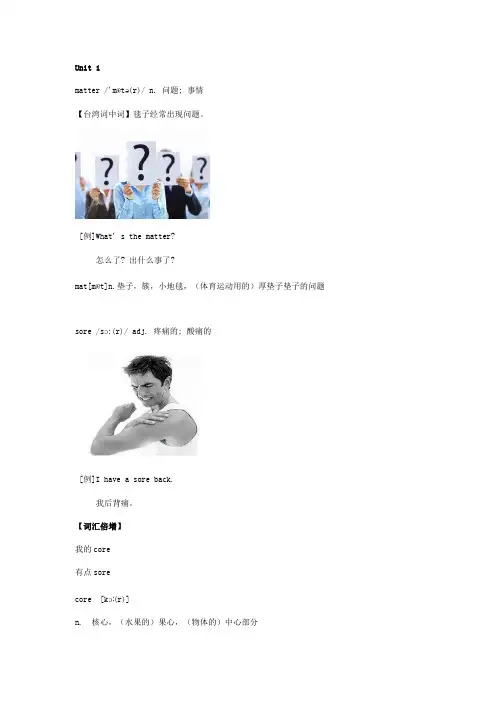
Unit 1matter /'mætə(r)/ n. 问题; 事情【台湾词中词】毯子经常出现问题。
[例]What' s the matter?怎么了? 出什么事了?mat[mæt]n.垫子,簇,小地毯,(体育运动用的)厚垫子垫子的问题sore /sɔ:(r)/ adj. 疼痛的; 酸痛的[例]I have a sore back.我后背痛。
【词汇倍增】我的core有点sorecore [kɔː(r)]n. 核心,(水果的)果心,(物体的)中心部分have a cold 感冒[例]I have a cold.我感冒了。
stomachache /'stʌməkeɪk/ n. 胃痛; 腹痛have a stomachache 胃痛[例]I have a stomachache.我胃痛。
【英国字母索源法】stomach(胃)+ache(痛)foot /fʊt/ n. 脚; 足【英国字母索源法】f代表“五官”[例]One of my feet is dirty.我的一只脚脏了。
neck /nek/ n. 颈; 脖子【英国字母索源法】n代表“细长”[例]The neck of the glass is dirty.杯颈脏了。
stomach /'stʌmək/ n. 胃; 腹部[例]what a stomach he has got !他可真是个大腹便便的人!【脑图单词速记】蛇s吐to马ma吃chthroat /θrəʊt/ n. 咽喉; 喉咙 p.1【英国字母索源法】thr代表“三”throat喉咙--通向三处,Third第三 thirteen十三 thirty三十。
[例]She has a very sore throat now.她现在嗓子疼的很厉害。
【词汇倍增】一只goat(山羊)穿件coat(衣服)上了boat(船)掉进moat(城壕)摔断throat (喉咙)fever /'fi:və/ n. 发烧[例] She has a fever.她发烧了。
Unit 1 What 's the matter 知识点讲解带练习 课件 人教版英语八年级下册
谢谢大家!
三、语法知识
● 1.询问某人的身体状况及遇到麻烦的表达方法 ● What’s the matter (with sb.)?(某人)怎么了? ● What’s wrong (with sb.)? ● What’s the trouble (with sb.)?
●2. 表达身体疼痛或不舒服的句型
● ①某人+have/has+病症/身体部位+ache. ● ②某人+have/has+a+sore+发病部位. ● ③某人+hurt(s)+身体部位或反身代词(oneself). ● ④某部位+hurt(s). ● ⑤There is something wrong with one’s+sb/部位
●
= have difficulty doing
●
= have problems doing
●
●4.反身代词
● 【考点】① 第一人称和第二人称的反身代词 形代+self
●
② 第三人称的但身代词宾格+self
●
③ 常见的搭配
● enjoy oneself=have a good time=have fun玩的开心 ● help yourselves/yourself随便吃;别拘束 ● by oneself= on sb’s own靠某人自己;独立
● (一)单项选择
● 5. The old man is used to __________ tea after he gets up.
● A. drink
B. drinks
C. drinking
D. drank
● 6. Don't forget to take your bag when you________ the bus.
人教版新目标初中英语八年级下册Unit1学霸笔记

meaningful adj.有意义的
meaningless adj.无意义的
②mean v.意味mean doing sth.意味着干某事
③mean v.打算mean to do sth.打算干某事
importance [ɪmˈpɔ:tns] n.重要性
enjoy oneself玩得开心
learn by oneself自学
bandage ['bændɪdʒ] n. & v.绷带;用绷带包扎
put a bandage on sth.用绷带包扎
breathe [bri:ð] v.呼吸
11.have problems breathing呼吸困难
have problems(in) doing sth.干某事有困难
②What’s wrong (with sb.)?
③What’s the trouble (with sb.)?
④W hat happened to sb.?
⑤What’s up?
⑥Are you OK?
⑦Is there anything wrong (with sb.)?
knee [ni:] n.膝盖
foot [fu:t] n.脚(复数feet)
neck [nek] n.颈,脖子
throat [θrəʊt] n.喉咙
nosebleed [ˈnəʊzbli:d] n.鼻出血
blood [blʌd] n.血
sore [sɔ:(r)] adj.疼痛的,酸痛的
headache [ˈhedeɪk] n.头痛
be surprised at对……感到吃惊
be surprised to do sth做某事而感到惊讶
八年级英语下册 Unit 1 What’s the matter短语、句子练习(新版)人教新目标版
第一单元短语、句子What’ s the matter?怎么啦?出什么事情了?What’ s the matter with you?= What’s the trouble/problem with you?= What’ s wrong with you?= What happened (to you)?=Is there anything wrong (with you )?Section 短语1.患(重)感冒2.发烧/咳嗽3.头痛/胃痛/牙痛/背痛4.背痛/喉咙痛5.患心脏病6.躺下休息7.喝点蜂蜜热茶8.看牙医9.拍X光片10.量体温11.吃药12.在伤口上敷药13.割/切/擦伤自己14.做某事伤了自己15.远离电脑16.看医生17.期待某人做某事18.等下一班车19.照看好某人20.偶然;意外地21.看见某人在做某事22.大声呼救23.认真思考;权衡利弊24.下车/上车25.让某人感到惊奇的是26.同意做某事同意某人的观点27.多亏;因为;由于28.及时29.陷入麻烦30.考虑自己31.救命32.摔倒;跌倒句子1、你怎么了?2、她该怎么办呢?她应该喝些蜂蜜热茶。
3、我应该量一下体温吗?4、你晚上不应该出去。
5、我想我以同样的姿势一动不动地坐得太久了。
6、回家路上,我看见一条狗正躺在地上。
7、多亏了王老师,我取得了好成绩。
Section B短语33.用绷带包扎伤口34.在水下冲洗伤口35.按压住鼻子的两边36.放弃做37.用……来做……被用于做某事习惯于(做)某事38.让自己活得自在39.休息几天40.在烈日下41.感觉病了/感到不舒服42.划伤了膝盖43.流鼻血44.伤了背45.碰了头46.晒伤47.呼吸有问题48.被球打/碰了49.爬山(活动)50.去爬山51.对……有兴趣52.冒险53.失去生命54.因为55.亲自;独自56.(主语为物)耗尽;用光(主语为人)耗尽;用光57.准备做某事58.切掉他一半右臂59.失血太多60.左右为难;进退两难61.在困难的情况下62.摆脱;脱离63.学好英语的重要性64.做出好决定65.掌控一生66.坚持爬山67.活着还是死亡68.发生事故69.放弃做句子1、他在学习英语方面有困难。
人教版(新目标)初中英语八年级下册Unit 1
人教版(新目标)初中英语八年级下册Unit1Unit1 Whats the matter?Unit1 知识梳理【重点单词】matter [?m?t?] v. 重要,要紧,有关系Whats the matter? 怎么了?出什么事了?sore [s?:(r)] adj. 疼痛的,酸痛的have a cold 感冒stomach [st?m?k] n. 胃,腹部stomachache [st?m?ke?k] n. 胃痛,腹痛have a stomachache 胃痛foot(复数feet) [fu:t] n. 脚neck [nek] n. 颈,脖子throat [rt] n. 喉咙fever [fi:v?] n. 发烧,发热lie [la?] v. 躺,平躺lie down 躺下rest [rest] n. 剩余部分,其余;放松,休息cough [k?f] n. v. 咳嗽X-ray [eksre?] n. X光,X射线toothache [?tu:e?k] n. 牙痛take ones temperature 量体温headache [?hede?k] n. 头痛have a fever 发烧break [bre?k] n. v. 休息,暂停;打破take breaks (take a break)休息hurt [h?:t] v. 伤害,损害,使受伤passenger [p?s?nd] n. 乘客,旅客off [?f] adv. prep. 离开(某处);从去掉get off 下车to ones surprise 使惊讶,出乎意料onto [nt?] prep. 向,朝trouble [?tr?bl] n. 麻烦,烦扰,问题hit [hit] n. v. 碰撞,打,打击right away 立即,马上get into 陷入,参与herself [h?:?self] pron. 她自己,她本身(she的反身代词)bandage [b?nd?d?] n. v. 绷带;用绷带包扎sick [s?k] adj. 患病的,不适的knee [ni:] n. 膝盖nosebleed [?nzbli:d] n. 鼻出血breathe [bri:e] v. 呼吸sunburned [?s?nb?:nd] adj. 晒伤的ourselves [ɑ:?selvz] pron. 我们自己(we的反身代词)climber [?kla?m?(r)] n. 登山者be used to 习惯于适应于risk [r?sk] n. v. 风险,危险;冒险take risks (take a risk) 冒险accident [ksid?nt] n. 意外事件;事故situation [?sitju?ein] n. 状况,形式,情况kg=kilogram [?k?l?gr?m] n. 公斤,千克rock [r?k] n. 岩石run out (of) 用尽,耗尽knife [naif] n. 刀,餐刀cut off 切除blood [bl?d] n. 血mean [mi:n] v. 意味着,意思是,意欲get out of 离开,从出来importance [?m?p?:tns] n. 重要性decision [d?sn] n. 决心,决定,抉择control [k?ntrl] v. 控制,支配,操纵be in control of 掌管,管理spirit [sp?r?t] n. 勇气,意志death [de] n. 死亡give up 放弃nurse [n?:s] n. 护士【重点短语】1.have a fever 发烧2.have a cough 咳嗽3.have a toothache 牙疼4.talk too much 说得太多5.drink enough water 喝足够的水6.have a cold 受凉;感冒7.have a stomachache 胃疼8.have a sore back 背疼9.have a sore throat 喉咙痛10. take risks 冒险11.hot tea with honey 加蜂蜜的热茶12.see a dentist 看牙医13.get an X-ray 拍X 光片14.take one s temperature 量体温15.put some medicine on sth. 在上面敷药16. give up 放弃17. sound like 听起来像18. all weekend 整个周末19. in the same way 以同样的方式20. go to a doctor 看医生21. go along 沿着走22. on the side of the road 在马路边23. shout for help 大声呼救24. without thinking twice 没有多想25. get off 下车26. have a heart problem 有心脏病27. to one s surprise 另某人惊讶的是28. thanks to 多亏了;由于29. in time 及时30. make a decision 做出决定31. get into trouble 造成麻烦32. right away 立刻;马上33. because of 由于34. get out of 离开;从出来35. keep on doing sth. 继续或坚持做某事36. put a bandage on sth. 用绷带包扎37. fall down 摔倒38. feel sick 感到恶心39. have a nosebleed 流鼻血40. cut his knee 割伤他的膝盖41. put her head back 把她的头向后仰42. have problems breathing 呼吸困难43. mountain climbing 登山运动44. be used to doing sth. 习惯做某事45. run out (of) 用完;用尽46. so that 以便47. so...that... 如此以至于...48. be in control of 掌管;管理49. in a difficult situation 在闲境中【重点句型】1. Whats the matter with you?= Whatthe trouble with you?= Whats wrong with you? 你怎么了?2. What should she do? 她该怎么办呢?3.Should I take my temperature? 我应该量一下体温吗?4.You should lie down and rest. 你应该躺下休息一会儿。
人教新目标八年级英语下册语法讲义:Unit1What'sthematter?
Unit 1What's the matter?1.I have a stomachache.我胃痛。
(1)stomachache为可数名词,意为“胃痛;腹痛”。
在英语中,一部分表示身体部位的名词加上名词ache(疼痛),可以构成合成名词。
如:headache头疼;toothache牙痛;backache背痛。
(2)have a+以上合成名词,表示“……痛”。
如:Mary didn't come to school yesterday because she had a stomachache.昨天玛丽因为胃痛没来上学。
2.drink some hot tea with honey喝一些加蜂蜜的热茶(1)with作介词,意为“具有;带有”,表示某物带有或具有某种特征。
如:She is a girl with big eyes.她是一个大眼睛女孩。
(2)反义词为without,意为“没有”。
如:I think I sat in the same way for too long without moving.我想我保持同一个姿势一动不动地坐太久了。
3.see sb. do sth.和see sb. doing sth.的区别(1)see sb. do sth. 意为“看见某人做某事”(看到动作发生的全过程或经常看到动作发生)。
如:I often see him play basketball on the playground.我经常看见他在操场上打篮球。
(2)see sb. doing sth. 意为“看见某人正在做某事”(强调动作正在发生)。
如:I saw him playing basketball on the playground just now.刚才我看见他正在操场上打篮球。
八年级英语下册 Unit 1 What’s the matter知识点总结、作文 (新版)人教新目标
What’s the matter1.What’s the matter?= What’s the trouble?=What’s wrong? 怎么了?(wrong 错误的,有毛病的)2.What’s the matter with you? 你怎么了?What’s the trouble with her? 她怎么了?What’s wrong with the computer? 电脑怎么了?感冒发烧咳嗽头疼胃疼,肚子疼牙疼背疼,腰疼背疼,腰疼喉咙痛脖子疼腿疼疼; 使……受伤My head hurts. = I have a headache. 我头疼。
I hurt my leg. 我伤到了腿。
You hurt my heart/feelings. 你伤了我的心/感情。
5.He has a bad/terrible cold. 他得了重感冒。
He has a high fever. 他发高烧。
6.with prep. 用We look with our eyes. 我们用眼睛看。
Don't write with a pencil. 别用铅笔。
7.lie v. 躺;撒谎;位于n. 谎言 tell lies 撒谎A boy is lying on the grass. (lie - lying)Don't lie. = Don’t tell lies. 别撒谎。
Shandong lies in the east of China.山东位于中国东部。
8.休息一下 have a rest = have a break=take a rest =take a break9.carry 运,搬,提,背He is carrying a big bag his back.他背着一个大包。
10.There is something wrong with………有毛病。
11.There is nothing wrong with………没毛病。