
冀教版五年级上册英语Lesson16 How can we
第16课 我们可以怎样去北京?
New words:
• • • • •
slow [sləʊ] adj. 慢的;缓慢的 fast [fɑːst] adj. 快的,迅速的 take [teɪk] v. 乘坐 plane [pleɪn] n. 飞机 train [treɪn] n. 火车
A bus is slow. I don't want to take a bus.(否定句)
Let's take a train. A train is fast. Okay.
howcheap来自方式便宜的not cheap just right
on our trip
不便宜 刚刚好
在我们的旅行
How far is it from Xi'an to Lanzhou? It's 676 kilometres.
• far [fɑː] adj. 远的 短语:how far 多远 • kilometre ['kɪləˌmiːtə] n. 千米 (复数)kilometres 千米 • from...to... 从...到... • cheap [tʃiːp] adj. 便宜的
take a plane 乘飞机 take a train 乘火车 take a bus 乘公共汽车 by plane 乘飞机
北京不远。
让我们做某事。
I want to take a bus. (肯定句)
How far is it from Shijiazhuang to Beijing?
It's 278 kilometres.
two hundred and seventy-eight
句型:How far is it from A to B ? 从A地到B地有多远?
1. Bus or plane?
公共汽车还是飞机?
This is a bus. A bus is slow.
This is a plane. A plane is fast.
2. Let's go by train.
让我们乘火车去吧。
Let's go to Beijing by plane, Mum? A plane is fast. let's=let us 让我们 Let's+动词原形. No, Li Ming. It's not far.
冀教版 五年级上册Lesson 16 How Can We Go to Beijing
Lesson 16 How Can We Go to Beijing ?教学目标知识与能力:1.重点词语及词组:slow,fast,plane,train,from...to,take a bus,by plane。
2.重点句型:(1)How can we go to Beijing?(2)How far is it from ...to ...? (3)I want to take a bus.过程与方法1.能认读交通工具的名称。
2.可以说出几种表达交通方式的词组和句子。
情感、态度与价值观1.培养学生的语言综合运用能力及小组合作意识。
2.旅游是一件很有趣的事,但是提前为自己的出行做好打算。
选择交通工具是很重要的一个方面,要体谅父母挣钱的不容易,选择一种最适合的交通工具。
教学重点教学难点1.掌握本课的单词及词组;能就交通的话题和同学进行交谈。
2.乘坐某种交通工具有不同的表达方式,本课出现了by plane和take a bus两种,要明白不同词组的使用特点并正确应用。
学情分析谈论旅行,对孩子来说非常有吸引力,而且更能够在很大程度上开阔学生的视野,在保证孩子掌握基础知识的同时,引导孩子从不同角度去考虑问题。
选择旅行交通工具时,不仅要考虑交通工具的快慢,还要考虑时间以及预算。
教学准备PPT 教学环节教学过程启智探究1. Greetings:T: Good morning, boys and girls. Ss: I’m fine, thank you, and you?T: I’m fine, too. Let’s say a chant, OK? 2.listen the song “Wag Your Tail”(设计意图:通过“Wag Your Tail”这首歌帮助学生迅速地进入到英语学习氛围中,调动学生的积极性,同时学习本课重点词汇fast 和slow。
)3. Game:do as I say. (设计意图:通过游戏让学生感受fast和slow,比对这两词汇进行巩固,为下一部分学习打基础。
五年级上册英语教案-Lesson16HowcanwegotoBeijing?冀教版(三起)
教案:五年级上册英语教案Lesson 16 How can we go toBeijing?冀教版(三起)一、教学目标1. 知识目标:(1)能够听懂、会说、会读本课的生词和重点句子。
(2)能够运用所学知识询问和描述去北京的方式和原因。
2. 能力目标:(1)能够正确使用情态动词 can 询问和回答能力。
(2)能够运用所学知识进行简单的日常交流。
3. 情感目标:培养学生对北京的文化兴趣,提高他们的跨文化交际意识。
二、教学内容1. 单词:plane, train, car, bus, because, want2. 重点句子:How can we go to Beijing?We can go plane/train/car/bus.Because it's fast/slow/far/near.I want to see the Great Wall.三、教学重点与难点1. 重点:本课的生词和重点句子。
2. 难点:情态动词 can 的运用和询问原因的表达方式。
四、教具与学具准备1. 教具:PPT、图片、卡片2. 学具:课本、练习册、单词卡片五、教学过程1. 热身(5分钟)教师与学生进行简单的英语对话,询问学生上周的学习情况,然后带领学生一起做英语歌曲热身。
2. 导入(10分钟)教师展示北京的图片,引导学生谈论自己去北京的经历,引出本课的主题。
3. 呈现(15分钟)教师通过PPT展示本课的生词和句子,引导学生跟读并模仿。
同时,教师用卡片展示不同的交通工具,让学生用英语描述自己去北京的方式。
4. 练习(15分钟)教师组织学生进行小组活动,让学生用英语互相询问去北京的方式和原因,并进行角色扮演。
5. 巩固(10分钟)教师播放听力材料,让学生回答相关问题,巩固所学知识。
6. 拓展(5分钟)教师引导学生谈论其他城市的交通方式,提高学生的跨文化交际意识。
六、板书设计1. How can we go to Beijing?2. We can go plane/train/car/bus.3. Because it's fast/slow/far/near.4. I want to see the Great Wall.七、作业设计1. 抄写本课生词和句子。
五年级上册英语-Unit3Lesson16HowCanWeGotoBeijing冀教版
一、教学目标1. 知识目标:(1)能够听懂、会说、会读本课的生词和重点句子。
(2)能够运用所学知识谈论交通工具和路线。
(3)能够理解并运用句型“How can we go to? We can go to”进行交流。
2. 能力目标:(1)能够正确使用地图和指南针。
(2)能够根据地图和指南针找到去北京的路。
(3)能够用英语描述去北京的路。
3. 情感目标:(1)培养学生对北京的了解和兴趣。
(2)培养学生热爱祖国,为祖国的繁荣富强而自豪的情感。
二、教学内容本课主要讲述如何去北京。
通过学习,学生能够掌握有关交通工具和路线的词汇,运用句型“How can we go to? We can go to”进行交流,学会根据地图和指南针找到去北京的路,并用英语描述。
三、教学重点与难点1. 重点:(2)句型:How can we go to? We can go to2. 难点:(1)正确使用地图和指南针。
(2)根据地图和指南针找到去北京的路。
(3)用英语描述去北京的路。
四、教具与学具准备1. 教具:(1)教科书。
(2)录音机。
(3)课件。
(4)地图和指南针。
2. 学具:(1)课本。
(2)练习本。
(3)彩笔。
五、教学过程1. 热身(5分钟)(1)唱一首关于交通工具的歌曲。
(2)学生分享他们去北京的经历。
2. 引入(10分钟)(1)教师出示地图和指南针,引导学生关注。
(2)教师通过提问,引导学生思考如何去北京。
3. 呈现(15分钟)(1)教师播放课文录音,让学生跟读。
(2)教师出示生词和句子,引导学生学习和模仿。
4. 操练(15分钟)(1)学生分组,每组一张地图和指南针。
(2)学生根据地图和指南针,找到去北京的路。
(3)学生用英语描述去北京的路。
5. 巩固(10分钟)(1)教师出示情景,学生运用所学知识进行角色扮演。
(2)学生展示角色扮演成果,教师点评。
6. 作业布置(5分钟)(1)学生回家后,用英语向家长介绍如何去北京。
冀教版 五年级上册Lesson 16 How Can We Go to Beijing 说课稿
冀教版五年级上册Unit A Travel PlanLesson 16 How Can We Go to Beijing ? 说课稿各位老师大家好:我今天的授课内容是冀教版五年级上册Unit 3 A Travel Plan中的Lesson16 How Can We Go to Beijing?下面,我将主要从说教材、说学情、说教法与学法、说教学过程等几方面来谈谈自己对本课的认识、看法和设计。
一、教材1. 教材的地位及作用第三单元主要讲的是李明如何去北京,本课向学生展示的是去北京要如何乘坐交通工具,是本单元重要的组成部分。
本课主要介绍了两种交通工具的速度比较,并给出了一个李明和李明妈妈决定乘坐什么交通工具的简单对话。
2. 教学目标《英语新课程标准》认为:小学阶段的英语课主要是激发学生学习英语的兴趣;培养学生对英语学习的积极态度,使他们建立学习英语的自信心;培养学生一定的语感和良好的语音、语调,为英语的进一步学习打下基础。
综合《英语课程标准》的教学理念,教材特点以及五年级学生的认知水平,本课主要有三个层次上的教学目标:知识与能力:会听,说,写,读单词,plane ,train ,fast ,slow , take a bus ,by plane 等单词和短语,并理解拓展词语cheap、expensive其含义。
掌握一些日常用语,如:I want to take a train .过程与方法:能认读交通工具的名称;可以说出几种表达交通方式的词组和句子。
情感与价值观:培养学生的语言综合运用能力及小组合作意识;旅游是一件很有趣的事,但要提前为自己的出行做好打算。
选择交通工具很重的一个方面,要体谅父母挣钱不容易,选择一种最适合的交通工具。
3. 教学的重点与难点根据上述教学目标,确定本课的教学重点为:掌握单词plane, train ,fast ,slow,熟读(或者背诵)课文。
能就交通的话题和同学进行交谈。
冀教版英语五年级上册Lesson 16 How Can We Go to Beijing教学设计教案
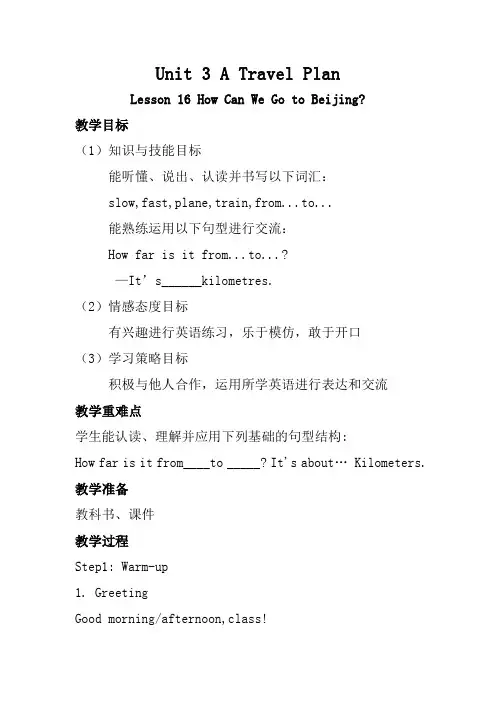
Unit 3 A Travel PlanLesson 16 How Can We Go to Beijing?教学目标(1)知识与技能目标能听懂、说出、认读并书写以下词汇:slow,fast,plane,train,from...to...能熟练运用以下句型进行交流:How far is it from...to...?—It’s______kilometres.(2)情感态度目标有兴趣进行英语练习,乐于模仿,敢于开口(3)学习策略目标积极与他人合作,运用所学英语进行表达和交流教学重难点学生能认读、理解并应用下列基础的句型结构:How far is it from____to _____? It's about… Kilometers.教学准备教科书、课件教学过程Step1: Warm-up1. GreetingGood morning/afternoon,class!2. Review(1)复习Lesson15对话(2)复习表示交通方式的词汇bike car taxi bus 课件出示图片,学生快速回答Step 2: Presentation1. Demonstrate(1)New words:Show the new words,read and repeat(2)新单词小练习巩固2. Listen and read part 1.3.Listen to the text,read and answer the questions.4.教师领读课文,学生自由读课文。
5.Role play学生分组练习对话,并展示。
Step 3.Let’s sing !Listen to the music.Step 4.Let’s do it!Pair work,ask and answer.Step 5当堂小检测,利用优学资源,课堂随机点名回答问题。
课堂小结总结并回顾本课重难点Homework1.Read the text.2.Make a dialogue with your partner according to part 4.板书设计Lesson 16 How Can We Go To Beijing?train slowplane fastHow far is it from...to...?—It’s...kilometres.课后反思。
冀教版五年级英语上册Lesson 16 How Can We Go to Beijing课件

例句
拓展
take a/the+ 交通工具名词 意思是 “乘……(交通工具)”,类似的短语 有:take a car 乘小汽车;take a train 乘火车;take a plane 乘飞机。
重难点探究
难点词汇
from … to … 从……到……
例句
Please count from 1 to 100 .请从1数到100。
It’s 278 kilometres from Shijiazhuang to Beijing. 从石家庄到北京有278千米。
重难点探究
重点句型
详解
1.Let’s go to Beijing by plane, Mum! 妈妈,我们坐飞机去北京 吧!
此句是let’s引导表示建议的祈使句。
句型结构:Let’s+ 动词原形 + 其他. 如:Let’s go to the park! 我们去公园吧! Let’s walk to school! 我们步行到学校吧!
例句
我想乘飞机去北京。 复数 planes
短语
by plane 乘飞机
重难点探究
难点词汇
fast(形容词/副词)快的;迅速 的
He runs fast. 他跑得快。 quick/quickly
例句 近义词
反义词 slow 慢的;缓慢的 slowly 慢地; 缓慢地
课文朗读
小喇叭朗读开始 了,点一点音箱,一 起跟着读吧。
2
train/treɪn/ (名词) 火车
新词展示
3
slow/sləʊ/(形容词) 慢的;缓慢的
4
fast/fɑːst/(形容词/ 副词)快的;迅速的
5
五年级上册英语教案Lesson16HowCanWeGotoBeijing冀教版
标
知识与技能
家庭是幼儿语言活动的重要环境,为了与家长配合做好幼儿阅读训练工作,孩子一入园就召开家长会,给家长提出早期抓好幼儿阅读的要求。我把幼儿在园里的阅读活动及阅读情况及时传递给家长,要求孩子回家向家长朗诵儿歌,表演故事。我和家长共同配合,一道训练,幼儿的阅读能力提高很快。1.能听懂会说交通工具的单词。
T: Good morning,everyone. How are you today?
Step 2. New Concepts.
1.Review.
T: Say the words quickly.(learn the new words. )
2.New concepts:
T: Good job, Can you describe it ?
语文课本中的文章都是精选的比较优秀的文章,还有不少名家名篇。如果有选择循序渐进地让学生背诵一些优秀篇目、精彩段落,对提高学生的水平会大有裨益。现在,不少语文教师在分析课文时,把文章解体的支离破碎,总在文章的技巧方面下功夫。结果教师费劲,学生头疼。分析完之后,学生收效甚微,没过几天便忘的一干二净。造成这种事倍功半的尴尬局面的关键就是对文章读的不熟。常言道“书读百遍,其义自见”,如果有目的、有计划地引导学生反复阅读课文,或细读、默读、跳读,或听读、范读、轮读、分角色朗读,学生便可以在读中自然领悟文章的思想内容和写作技巧,可以在读中自然加强语感,增强语言的感受力。久而久之,这种思想内容、写作技巧和语感就会自然渗透到学生的语言意识之中,就会在写作中自觉不自觉地加以运用、创造和发展。学
b. Does Li Ming want to take a bus to Beijing ?
c. How does they go to Beijing
小学英语五年级上册 Lesson 16 How can we go to Beijing 教案 冀教
小学英语五年级上册 Lesson 16 How can we go toBeijing 教案冀教版三起Lesson 16 How can we go to Beijing?Teaching Objectives:1. To enable students to learn and understand the ways and means of transportation to Beijing.2. To enable students to learn and understand vocabulary related to transportation.3. To enable students to ask and answer questions about transportation.Teaching Procedures:1. Greeting and warm-up (5 minutes)a. Greet the students and ask them about their preferred modes of transportation.b. Show pictures of different modes of transportation and ask students to name them.c. Discuss with the students the advantages and disadvantages of different modes of transportation.2. Vocabulary introduction (10 minutes)a. Introduce new vocabulary by presenting pictures of transportation (car, bus, train, plane).b. Repeat the words while showing the pictures.c. Encourage the students to repeat the words.3. Reading (10 minutes)a. Display the text of the lesson on the board.b. Read the text aloud while students read along.c. Ask students to underline the transportation modes mentioned in the text.4. Comprehension (10 minutes)a. Ask students to answer the following questions based on the text:i. Where does the text talk about going?ii. What are the different modes of transportation mentioned in the text?iii. Which mode of transportation takes the longest time?iv. Which mode of transportation is the most expensive?5. Grammar (10 minutes)a. Highlight the “How can we…” structure in the text.b. Ask students to form their own questions using the same structure with given prompts (e.g. “go to Shanghai”).6. Role-play (20 minutes)a. Divide students into pairs.b. Assign roles to each pair: one student is a tourist and the other is a travel agent.c. The tourist will ask the travel agent “How can I go to Beijing?” while the travel agent will respond with different modes of transportation.d. Ask students to switch roles and repeat the activity.7. Conclusion (5 minutes)a. Recap the lesson and highlight key points.b. Give students feedback and commendations.Materials Needed:1. Pictures of transportation modes2. Text of Lesson 163. Prompts for Grammar activity4. Role-play scenariosEvaluation:1. Students are able to identify different modes of transportation.2. Students are able to use the “How can we…”structure to form questions related to transportation.3. Students are able to role-play as tourists andtravel agents, demonstrating knowledge of different modesof transportation.Homework:1. Students will be assigned to write about their preferred mode of transportation and why.2. Students will be asked to create a travel poster promoting a transportation mode of their choice.。
五年级上册英语课件-lesson16 How can we go to Beijing 冀教版 (共14张PPT)
How Can We Go to Beijing?
Look and say.
plane
train
fast
slow
…
…
A ____ is fast/slow.
Can you describe it? The book is interesting. The flowers are beautiful.
A plane is not cheap. A train is just right! We can take a train, On our trip to Beijing !
Pair work.
A: How far is it from ___ to ____? B: It’s __ kilometres.
The ____ is/are _____.
Fill in the blanks.
1.____ do you go to the zoo? By bus. 2.____ are you? I’m fine. 3.____ books are there on the desk? Five. 4.____ is it? It is five Yuan.
C: …
Role play
Homework
Retell the dialogue with your friend.
பைடு நூலகம்
Follow the model and make sentences.
A: How far is it from t_h_e__z_o_o to _th_e__p_a_rk__? B: It’s _1_0__ kilometres.
Let’s sing a song. A plane is fast. A bus is slow. Let’s take a plane. That is how I want to go!
五年级上册英语说课稿-Lesson 16 How can we go to Beijing?冀教版(
五年级上册英语说课稿-Lesson 16 How can we go to Beijing?冀教版(三起)一、教学背景本课为五年级上册英语教材中的第十六课,主要内容为表达交通方式及询问路线。
通过本课的学习,能够让学生熟悉常用的交通方式和对方提出询问时的回答方式,培养学生英语口语表达和交流的能力。
二、教学目标语言知识目标1.学生能够掌握以下单词:•airplane 飞机•bike 自行车•bus 公共汽车•car 汽车•train 火车•subway 地铁2.学生能够理解以下句型:•How can we go to Beijing? 我们怎样去北京?•We can go by _____. 我们可以乘坐_____。
•Is it far? 远吗?•No, it isn’t far. 不,不远。
情感态度价值观目标1.通过本课的学习,学生能够进一步了解中国的交通状况,增强对本国文化的认识和维护自身文化的信心。
2.在教学中渗透乘车中应注意的礼仪和安全常识,培养学生良好的行为习惯。
三、教学重难点教学重点1.单词积累以及掌握交通方式和对应的英文表达。
2.熟练掌握句型How can we go to Beijing? 以及We can go by _____的用法。
教学难点学生对于交通方式和路线的表达是否准确和恰当。
四、教学过程1. 热身教师可以先在黑板上画一个地图或者用其他教具模拟一个旅行的场景,然后与学生们互动,引入本课的话题。
2. 呈现新词教师利用图片或者其他教具呈现出本课的单词,适当引导学生们发音以及记忆。
然后可以进行一些有趣的游戏,比如让学生们利用这些单词造句或者进行问答游戏。
3. 教学重点教师现场使用影片或其他教具创设出旅行场景,引导学生们用英文进行交流,模拟真实情况。
学生们可以把常见的交通工具用英语表达出来,并进行搭配练习,例如:•How can we go to Beijing?•We can go by plane.•How can we go to the park?•We can go by bike.当学生们能够熟练运用这些交通方式时,教师可以进行更为细节的教学,包括一些常见的问答句型以及其中的谢绝礼仪和安全注意事项等。