
PEP小学五年级英语下册unit6(3)
The ants likes sweet food.(
√)
A: Hey! What are you doing there? Are you eating lunch? B: No, we aren’t. We are doing an experiment. A: What experiment? B: What do ants like to eat? A: That’s interesting. C: Come and have a look at the ants. A: Are they eating the vegetable? B: No, they aren’t. They don’t like it. A: Are they eating the honey? C: Yes, they are. They like sweet food. A: I like sweet things, too. Do an experiment on me, please.
The ants are eating the vegetables.( ×)
A: Hey! What are you doing there? Are you eating lunch? B: No, we aren’t. We are doing an experiment. A: What experiment? B: What do ants like to eat? A: That’s interesting. C: Come and have a look at the ants. A: Are they eating the vegetable? B: No, they aren’t. They don’t like it. A: Are they eating the honey? C: Yes, they are. They like sweet food. A: I like sweet things, too. Do an experiment on me, please.
Is Zhang Peng drawing pictures ?
No, he’s taking pictures.
That’s interesting.
(那真有趣。)
Are you catching butterflies ? No, we aren’t.
We’re watching insects.
Unit6 A field trip
A Read and write
Let’s go on a field trip. There’s so much to do. We can collect leaves, and take pictures, too. We can watch the ants and see what they eat. Let’s go on a field trip. It’s quite a treat.
Are they watching insects? No , they aren’t. They are catching butterflies.
That’s interesting.
That’s interesting.
Are they catching butterflies?
No , they aren’t. They are picking up leaves.
Wu Yifan likes sweet food, too.(√ )
A: Hey! What are you doing there? Are you eating lunch? B: No, we aren’t. We are doing an experiment. A: What experiment? B: What do ants like to eat? A: That’s interesting. C: Come and have a look at the ants. A: Are they eating the vegetable? B: No, they aren’t. They don’t like it. A: Are they eating the honey? C: Yes, they are. They like sweet food. A: I like sweet things, too. Do an experiment on me, please.
What experiment? What do ants like to eat?
A: Hey! What are you doing there? Are you eating lunch? B: No, we aren’t. We are doing an experiment. A: What experiment? B: What do ants like to eat? A: That’s interesting. C: Come and have a look at the ants. A: Are they eating the vegetable? B: No, they aren’t. They don’t like it. A: Are they eating the honey? C: Yes, they are. They like sweet food. A: I like sweet things, too. Do an experiment on me, please.
The ants like to eat vegetables.( ×)
A: Hey! What are you doing there? Are you eating lunch? B: No, we aren’t. We are doing an experiment. A: What experiment? B: What do ants like to eat? A: That’s interesting. C: Come and have a look at the ants. A: Are they eating the vegetable? B: No, they aren’t. They don’t like it. A: Are they eating the honey? C: Yes, they are. They like sweet food. A: I like sweet things, too. Do an experiment on me, please.
Can you say any sweet things?
What about ants? What do ants like to eat?
Let’s do an experiment on the ants.
Read and answer
What are the children doing?
Let’s read
A: Hey! What are you ______ there? Are you eating lunch? B: No, we _______. We are _______ an experiment. A: What experiment? B: What _____ ants like to eat? A: That _____ interesting. C: Come and have a ______ at the ants. A: Are they _______ the vegetable? B: ______, they aren’t. They ______ like it. A: Are they eating the honey? C: _____, they are. They ______ sweet food. A: I like sweet things, ___. Do an experiment __ me, please.
Let’s read
A: Hey! What are you doing there? Are you eating lunch? B: No, we aren’t. We are doing an experiment. A: What experiment? B: What do ants like to eat? A: That’s interesting. C: Come and have a look at the ants. A: Are they eating the vegetable? B: No, they aren’t. They don’t like it. A: Are they eating the honey? C: Yes, they are. They like sweet food. A: I like sweet things, too. Do an experiment on me, please.
The ants are eating the honey.( √ )
A: Hey! What are you doing there? Are you eating lunch? B: No, we aren’t. We are doing an experiment. A: What experiment? B: What do ants like to eat? A: That’s interesting. C: Come and have a look at the ants. A: Are they eating the vegetable? B: No, they aren’t. They don’t like it. A: Are they eating the honey? C: Yes, they are. They like sweet food. A: I like sweet things, too. Do an experiment on me, please.
2023-2024学年PEP版五年级英语下册Unit 6综合训练(附听力材料及答案)
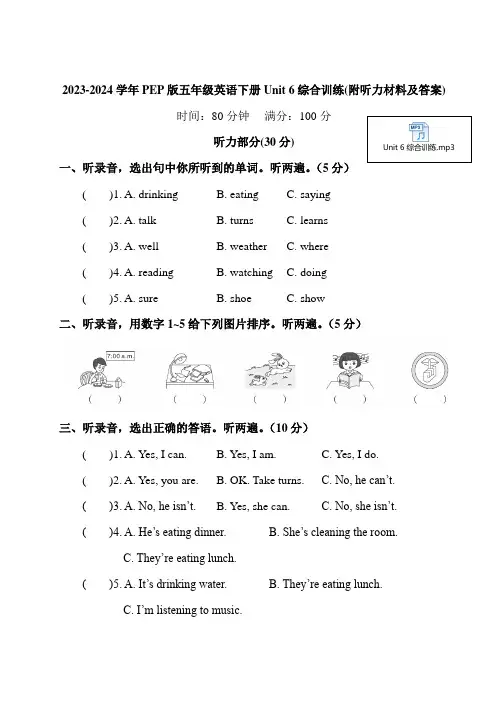
2023-2024学年PEP版五年级英语下册Unit 6综合训练(附听力材料及答案)时间:80分钟满分:100分听力部分(30分)Unit 6 综合训练.mp3一、听录音,选出句中你所听到的单词。
听两遍。
(5分)( )1. A. drinking B. eating C. saying( )2. A. talk B. turns C. learns( )3. A. well B. weather C. where( )4. A. reading B. watching C. doing( )5. A. sure B. shoe C. show二、听录音,用数字1~5给下列图片排序。
听两遍。
(5分)三、听录音,选出正确的答语。
听两遍。
(10分)( )1. A. Yes, I can. B. Yes, I am. C. Yes, I do.( )2. A. Yes, you are. B. OK. Take turns. C. No, he can’t.( )3. A. No, he isn’t. B. Yes, she can. C. No, she isn’t.( )4. A. He’s eating dinner. B. She’s cleaning the room.C. They’re eating lunch.( )5. A. It’s drinking water. B. They’re eating lunch.C. I’m listening to music.四、听录音,根据短文内容在表格相应的栏中打“√”。
听两遍。
(10分)TinaAnnaSandyJackTom笔试部分(70分)五、判断下列每组单词中画线部分的发音是(T)否(F)相同。
(5分)( )1. wait what ( )2. write where( )3. wall weather ( )4. when who( )5. whose white六、从括号里选择正确的单词补全句子。
PEP新版小学英语五年级下册《Unit6 Work quietly A Let’s talk》教学设计
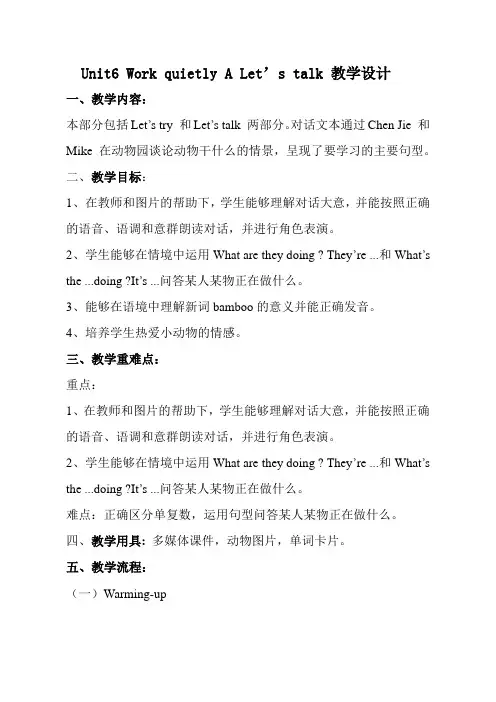
Unit6 Work quietly A Let’s talk 教学设计一、教学内容:本部分包括Let’s try 和Let’s talk 两部分。
对话文本通过Chen Jie 和Mike 在动物园谈论动物干什么的情景,呈现了要学习的主要句型。
二、教学目标:1、在教师和图片的帮助下,学生能够理解对话大意,并能按照正确的语音、语调和意群朗读对话,并进行角色表演。
2、学生能够在情境中运用What are they doing ? They’re ...和What’s the ...doing ?It’s ...问答某人某物正在做什么。
3、能够在语境中理解新词bamboo的意义并能正确发音。
4、培养学生热爱小动物的情感。
三、教学重难点:重点:1、在教师和图片的帮助下,学生能够理解对话大意,并能按照正确的语音、语调和意群朗读对话,并进行角色表演。
2、学生能够在情境中运用What are they doing ? They’re ...和What’s the ...doing ?It’s ...问答某人某物正在做什么。
难点:正确区分单复数,运用句型问答某人某物正在做什么。
四、教学用具: 多媒体课件,动物图片,单词卡片。
五、教学流程:(一)Warming-up1、sharp eyes(设计意图:通过出示单词和图片,复习学过的动词ing形式,为文本的学习做好铺垫。
)2、You all did good job . Here is a picture to reward you .学生看图,Guessing : Where are the animals ?(设计意图:自然引入本课情景: Zoo )3、Enjoy a song and answer:What animals do you see in the zoo ?(二)Presentation1、Look there ! There are also birds and tigers in the zoo.What are they doing ? Listen and tick .(学生听音答题之前,教师带领学生先认读一下图片信息,培养学生识图和听音技巧。
五年级下册英语教案-Unit6 We are watching the games.(Lesson3
五年级下册英语教案-Unit6 We are watching the games.(Lesson32)|人教精通版一、教学目标1.通过学习本课,学生能够掌握单词和短语:watch, game, have a race, jump.2.通过学习本课,学生能够听懂、理解、朗读并模仿对话。
3.通过学习本课,学生能够运用本课所学的知识,能够表达自己正在观看或参与的运动。
二、教学重点1.学习单词和短语:watch, game, have a race, jump.2.学习听懂、理解、朗读并模仿对话。
三、教学难点1.能够运用本课所学的知识,能够表达自己正在观看或参与的运动。
四、教学准备1.教材:人教精通版五年级下册英语教材。
2.大纸张、彩笔。
五、教学过程1. Class opening•GreetingT: Good morning/afternoon, boys and girls.Ss: Good morning/afternoon, teacher.T: Are you ready for today’s class?Ss: Yes, we are.•Free talkT: What sports do you like?S1: I like basketball.S2: I like soccer.S3: I like swimming.T: Good.2. Presentation•Show pictures of different sports, one by one.T: Do you know what sports they are?Ss: Yes, they are…•Listen to the tape and repeat after it.3. Practice•Point to the pictures.T: Look at the pictures. What is he/she doing?Ss: He/She is watching the game.T: Can you say more?Ss: He/She is watching…•Pair workT: Work in pairs. Ask and answer. What game are you watching?S1: What game are you watching?S2: I’m watching soccer.•Group workT: Now you are divided into four groups. Each group chooses one game and describe it.Group 1: soccerGroup 2: basketballGroup 3: swimmingGroup 4: runningT: Each group has three minutes.4. Production•Individual assessmentT: Using the vocabulary we learned today, write three sentences and read them aloud.5. Summary•T: Today we learned new words and phrases. We also learned how to describe what sports we are watching.6. Homework•Write a short passage about your favorite sport and how you play it.•Prepare for the next lesson.六、板书设计•Watch, game, have a race, jump.•Lesson 32•We are watching the games.七、教学反思本节课的教学流程清晰,依照教学目标,布置了多种教学活动来帮助学生运用新词汇和短语,并且在语言表达上进行了多方面的训练,使学生能够在互动交流中更好地掌握所学内容。
小学PEP新教材五年级下册英语教案(第六单元)
Unit 6 A Field Trip第一课时教学目标1、能够听、说、读、写本课动词短语的ing形式:taking pictures , watching insects , picking up leaves , doing an experiment , catching butterflies .2、能够听、说、认读What’s Sarah doing ? She’s doing an experiment 并能在情景中运用。
教学重点1、重点:掌握Let’s learn部分的五个动词短语的ing形式,并能进行简单问答。
2、难点:单词insects , experiment以及picking up的发音。
教学过程1、热身Let’s chant播放第六十八页的歌谣。
2、预习出示四、五单元的动词的词卡,要求学生看图卡表演、说句子。
3、新课呈现Let’s learnTPR全身动作反应法练习方法:1、游戏(跑过去)把该部分的单词卡片和本册四、五单元的部分卡片分别贴在教室的四面。
教师发指令,如run to “playing chess” ,学生比赛看谁最先跑到该卡片处。
(按我说的做)教师说一个动词短语的ing形式,如picking up leaves, 但故意做另外一个动作。
学生按听到的指令做动作,如果受老师的误导做错了动作,就被淘汰。
误导做错了动作,就被淘汰。
4、作业1、活动手册相应的题目2、抄写单词教学反思Unit 6 A Field Trip 第二课时教学目标1.能在Let’s find out 部分用本课时目标语言询问同学的作息时间,并能对调查结果做简单的反思。
2.能够听懂Let’s try部分的录音,完成听音找对应作息时间表的练习。
3、能够听懂、会说本课对话,并能做替换练习。
4、能够听、说、认读句型Are they…?Yes, they are / No, they aren’t ,并能在情景中正确运用。
人教版PEP小学英语五年级下册知识点汇总(最新)

人教版PEP小学英语五年级下册知识点汇总(最新)Unit One: This Is My DayBasic Vocabulary:Activities: get up。
do morning exercises。
have English class。
play sports。
play the piano。
climb mountains。
go shopping。
go hiking。
visit grandparents。
eat breakfast。
eat dinner.Basic XXX Structures:1.Asking about daily routines:When do you。
(你什么时候。
)XXX I。
(我通常在。
(点钟)。
(做什么事)。
有时。
)XXX: When do you go to school。
(你每天几点去上学?)I usually go to school at 7:00.Sometimes I go to school at7:10.2.Asking about XXX:What do you do on the weekend。
(你周末做什么?)XXX I。
(我通常/经常。
有时。
)XXX: What do you do on the weekend?I often play XXX I go shopping with my mom.3.Introducing one's own habits:Every weekend。
I go hiking。
(我每个周末远足。
)Every day。
I do my homework at 8:00 in the evening。
(我每天晚上8点做作业。
)4.Asking XXX:What do you do。
(你是干什么的?)Time:morning。
afternoon。
evening。
noon。
at night。
6:00.on Sunday。
PEP小学五年级英语下册知识清单
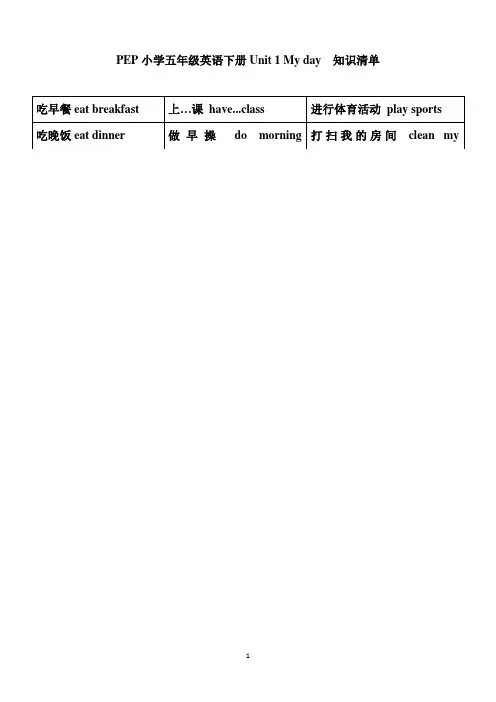
PEP小学五年级英语下册Unit 1 My day 知识清单【句型/语法知识点】一. 频度副词(放主语之后)。
always总是(100%); usually通常(80%); often 经常(60%);sometimes有时(30%);never从不(0%)二. 重点句型。
1. 询问别人什么时候做某事的句型及回答。
句型结构:问:When +助动词do/does + 主语(非三单/三单)+ 动原+ 其他?答:①主语(非三单)+(频度副词)+动原+ at + 时间点.例:问:When do you go to bed?答:I go to bed at 9:00p.m答:②主语(三单)+(频度副词)+动词三单形式(动词s/es)+ at + 时间点.例:问:When does Amy go to bed?答:She goes to bed at 9:00 p.m.2. 询问别人周末做什么的句型及回答。
句型结构:问:What +助动词do/does + 主语(非三单/三单)+ do + on the weekend?答:①主语(非三单)+(频度副词)+动原.例:问:What do you do on the weekend?答:I usually read books.答:②主语(三单)+(频度副词)+动词三单形式(即动词s/es).例:问:What does Amy do on the weekend?答:She often goes shopping with her mother .三.句型转换:1.肯定句↔一般疑问句:I usually get up at 6:00. ↔ Do you usually get up at 6:00?肯定回答:Yes, I do. 否定回答:No, I don’t.(第三人称时) He eats dinner at 6:00p.m. ↔ Does he eat dinner at 6:00p.m.?肯定回答:Yes, he does. 否定回答:No, he doesn’t.2.肯定句↔否定句:I like playing the piano. ↔ I don’t like playin g the piano.I can play the piano. ↔ I can’t play the piano.3.划线提问:⑴ I often go shopping on the weekend. → When do you go shopping ?⑵ I often go shopping on the weekend. → What do you do on the weekend?⑶ I go to school at 7:00. → When do you go to school?四. 语音:cl /kl/ clean clock class clever pl /pl / plate eggplant please playPEP小学五年级英语下册Unit 2 My favourite season 知识清单【四会单词】【重点句型】【句型/语法知识点】一. 重点句型1. 询问别人天气怎么样的句型及回答。
人教版(PEP)小学英语五年级下册第六单元作业设计
小学英语单元作业设计一、单元信息二、单元分析本单元学习的主题是询问并回答某人是否正在做某事,以及谈论在一些公共场所的行为规范。
主情景图中通过孩子们分别在教室上课和在餐厅排队的情景,呈现出核心词汇和句型(详见单元单元学习与作业目标要求)及语用环境,学生通过看图,了解单元话题及相关文化知识,了解核心词汇与句型出现的语用环境。
在C部分故事呈现的是Zoom和Zip在电影院看电影时不注意公共场合行为规范引发的故事,复习巩固现在进行时态和行为规范的语言,理解film,gorilla, popcorn,exciting,crunch,sign等单词的意思。
三、单元学习与作业目标能够听、说、读、写下列单词: ill, bad, cold, thank, head, arm, face, hand, car, foot, some, grape;能够听、说、认读下列单词和词组:fever, stomachache, headache, toothache, cough, do maths problems, go on a field trip, go to a concert, go to the music club, a get-well card, grapefruit, a cherry (cherries) , a strawberry(strawberries) , elbow, hurt, lower, move;能够听、说、读、写下面的句子:I'm ill today. I have a bad cold. Thank you.Open your mouth.Here are some grapes for you.能够听、说、认读下列句子:I can't go to school today.What's wrong with you? My neck (elbow, kne,…) hurts.You have to take some medicine.Don't worry about your lessons.I'll help you with your lessons.能够正确说唱3个chants,感知字母o和e的发音。
人教PEP五年级下册英语教案Unit 6 Work quietly!A Let’s learn
Unit6 A Let’s learn教案一、教学内容本课的教学内容是人教PEP五年级下册Unit 6 Work Quietly A Let’s learn部分,本单元主要围绕谈论在公共场所,如动物、图书馆,看到的事物、做的事情和参观时应该遵守的文明礼仪。
本课是第一课时,是一节单词学习课,主要谈论陈洁正在做的事情,理解并回答句型:What’s Chen Jie doing? She’s … / What are the students doing? They are …二、教学目标1. 知识目标(1) 通过观察动物园的动物正在做什么,巩固复习关于现在进行时的动词词组:sleeping, jumping, playing, drinking water, running等等。
(2) 通过看教师的一天,初步了解句型:It’s ... I’m doing ...(3) 通过看陈洁的一天,学习句型:What’s Chen Jie doing? She’s ...(4) 通过听录音跟读,掌握正确的朗读技巧,注意恰当的语音、语调、语速。
2. 能力目标(1) 能够理解句型:What are the students doing? What’s Chen Jie doing?询问图片上的人正在做什么,能区分句型的单、复数形式,并作正确回答。
(2) 能够延伸、运用句型,询问别人正在做什么,并做正确回答。
(3) 能够运用思维导图对文本进行简要的概括。
3. 策略目标(1) 在理解动词短语的基础上,通过对文本的重点句型进行理解,以巩固掌握文本。
(2) 通过文本重构,让学生能够灵活运用句型,询问别人正在做的事情。
4. 情感与态度目标(1) 通过课文学习,培养孩子对小动物的关爱情感。
(2) 结合人文价值教育因素,教育学生要热爱自己的学校。
三、学情分析本节课的授课对象是小学五年级的学生,他们已有一定的生活经历,对动物比较喜爱,对动物的生活习性有一定了解。
PEP人教版小学英语五年级下册Unit6单元教案
Unit 6 Work quietly!第一课时一、教学目标1.掌握五个动词短语的ing 形式:doing morning exercises,having...class,eating lunch,reading a book,listening to music。
2.能运用句子What is Chen Jie doing?来询问别人正在做什么。
3.能用现在进行时描述某人在某时正在做的事情。
二、教学重难点1.重点:掌握五个动词短语的ing 形式;能运用以What 开头的特殊疑问句来询问别人某时某刻正在做什么。
2.难点:掌握动词have 的ing 形式。
三、教学准备动作短语卡片、图片、实物投影仪、录音机及录音带。
四、教学过程(一)、热身(Warm-up)1.Sing the song Animals,animals are everywhere.2.看图说话。
教师每次闪显五张动物做某事的图片,请某一组学生,凭记忆分别用一句话描述动物在做的事情。
例如:图片上描绘的是一只熊猫在爬树,学生则说:The panda isclimbing the tree.如果图片上描绘的是两只或以上的熊猫,学生则说:The pandas areclimbing the trees.学生必需凭记忆正确地说出五张图片上所描绘的动物在做的事情。
3.师生对话。
T:When do you do morning exercises? S:At 7 0-clock。
T:When do you usually eat breakfast? S:I usually eat breakfast at 8:00. T:What do you often do on the weekend? S:I often go shopping.以师生问答的形式复习第一单元的内容,并为本课时教学作铺垫。
(二)新课呈现(Presentation)1.Let’s learn(1)教学doing morning exercises 接上个环节,教师说:I know you usually do morning exercises at 7 0'clock. It’s 7 a.m.now.Look at the students. They are doing morning exercises.教师出示卡片并进行doing morning exercises 的教学,然后指着图片,面向学生自问自答:What is the girl doing? She is doing morning exercises.然后以chant 形式巩固操练动词短语的ing 形式。
人教PEP版五年级英语下册Unit 6单元教案优秀范文
人教PEP版五年级英语下册Unit 6单元教案优秀范文下面是我为大家收集好了人教PEP版五年级英语下册Unit 6单元教案,希望你你们能喜欢,人教PEP版五年级英语下册Unit 6单元教案优秀范文一教学目标1.能听、说、读、写单词和短语: bamboo, its, eating lunch, having an English class。
2.能根据图片运用句型: —What are they doing? —They are eating lunch.—What is the little monkey doing?—It's playing with its mother.和同伴进行对话交流。
3.完成Let's try部分的听力。
4.能和同伴分角色表演Let's talk,熟练掌握动词的现在分词的构成。
5.教育学生要细心观察身边的事物,从而不断提高自己的知识水平。
教学重点1.掌握本课时的单词和句型。
2.进一步巩固现在进行时,并在句子中学会使用进行时态。
3.分角色表演Let's talk。
教学难点1.物主代词its(它的)与it's(它是)要区分开。
2.注意动词短语play with 中with的用法。
3.熟练掌握现在分词的构成。
教学准备教师准备:1.与本课时相关的录音和课件。
2.本课所需的单词卡片。
学生准备:本课所需单词卡片。
教学方法1.分角色表演教学法教师让同学们分角色表演Let's talk小对话,创设英语情景,让同学感受英语的语言氛围。
2.问答教学法同学两人一组根据图片进行问答练习:What are you doing? I'm eating dinner. What is he doing? He is having an English class. 在问答练习中,不断提高学生的口语表达能力和运用英语的能力。
教学过程Step 1: Warm-up1.教师热情地和学生打招呼问好,做简单的Free talk。