
仁爱英语九上U3T3SA
2. Listen, check and match (P70)
(录音)
Li Ming’s difficulty
( ) 1. can’t read English ______ news (√ ) 2. can’t pronounce d ______ well ______ ( √ ) 3. forgets new words b ( √ ) 4. can’t always understand when people talk to him a ______ ( ) 5. isn’t good at ______ grammar ( √ ) 6. isn’t good at writing c ______ compositions
Miss Wang’s suggestion
a. take part in the English corner b. copy new words in a notebook and take it with him c. keep a diary in English d. listen to the tape e. sing English songs f. buy a grammar book
I’m sorry, I can’t follow you. Can you speak more slowly?
Excuse me, could you tell me where the Beijing Theatre is?
I can’t spell the word in English.
I can’t understand others.
Don’t worry! You may say like this
c. Can you speak more slowly, please? d. I beg your pardon? e. How do you spell/say it, please?
I can’t … I am afraid of … I find it difficult to… I have difficulty in (doing)… It is hard for me to… pronounce the pass the exam follow the teacher words well in class use the expressions correctly remember the new words grammar write a composition
Useful expressions
1. 2. 3. 4. 5. 6. 7. 8. 9. 10. 11. 12. 13. 14. 15. places of interest=a place of interest 名胜古迹 get into trouble 遇上麻烦 很多不同的口音 many different accents 和人们进行长对话 have a long conversation with people 更卖力地学英语 work harder at English 不敢当众讲英语 dare not speak English in public 做某事感到害怕 be afraid of (doing) sth final exam 期末考试 too… to 太……而不能 a whole week 一整个星期 在……上取得进步 make progress in doing sth 想要(做)某事 feel like (doing) sth 放弃(做)某事 give up (doing) sth be good at (doing) sth=do well in 擅长于 be weak in; be poor at 不擅长于 我不知道如何是好。 I don’t know what to do.(wh-to do作宾语 )
h. I don’t understand. k. Could you repeat that, please?
I can’t hear clearly.
Don’t worry! You may say like this
b. I’m sorry, I only know a little English. e. How do you spell/say it, please?
Don’t worry! You may say like this
a. I don’t know the word in English. d. How do you say… in English?
e. How do you spell it, please? f. I don’t know how to spell that in English.
课前预习——单词过关
1. Lin Tao is a shy girl, so she ________/der / dare not speak in the class. 2. I beg your pardon _________/’pɑ:dn/ . I can’t follow you. 3. I have ________/’kɔpid/ the text twice. copied 4. The teacher asked us to write down the grammar _________/ˈ ɡræmə/ on the notebooks. repeating 5. She is tired of the _________ /riˈpi:tiŋ/ housework.
It is difficult for Li Ming to learn English well. He can’t pronounce well. It is easy for him to forget new words. What’s more, he can’t always understand when people talk to him. He isn’t good at writing compositions either. He feels really worried. Fortunately, Miss Wang is nice to give him some suggestions. She tells Li Ming to listen to the tape. She says that taking part in the English corner is also a good way. He should copy new words in a notebook and take it with him so that it’s helpful to remember the new words. Last but not least, try to keep a diary in English. Nothing is difficult if we put our heart in it. Whenever we get into trouble, we can ask others for help and work harder instead of giving up.
④_________ is good at English. Kangkang He can ask him for help.
Read the passage again and fill out the table.
Name Difficulty
spoke too quickly They _______________ for him. He couldn't have long conversations Wang Junfeng ___________________________ with the people there. dare not speak English He ___________________ in public. feels sleepy And he always__________________ Li Ming in English classes. He is really afraid of ____________ the final exam. Li Xiang 1 It's difficult for him to remember new words. 2 He is afraid of the final exam, too.
Let’s discuss the following questions together. 1. How many languages are there throughout the world? 2. What languages do you know? 3. Where are they spoken? 4. Do you have any difficulties in learning English? What are they?
Wang Junfeng: Because peoplespeak too ____ quickly and there are many_______, accents can’t have long conversations he_________________________ with people. dare not Li Ming: He ________ speak English in public. He always feels sleepy in English classes. _________ afraid of is What’s worse, he ___ really__________ the final exam. remember Li Xiang: It’s too difficult for him to _______ _______ new words.
最新仁爱版初中九年级英语上册Unit 3Topic 3 Could you give us some advice on how to leran English well

2Could Wang Junfeng make himself understood in the U.S.A.?
No, he couldn’t.
3 Who is good at English?
1. enjoy oneself 玩的开心
2. places of interest 名胜古迹
3. get into trouble 陷入困境
4. work hard at
在某方面努力
5. agree with
同意某人
6. give up
放弃
7. had better not do 最好不做
8. ask sb. for help 向某人求助
It’s difficult for him to remember new words. He is afraid of the final exam, too.
He dare not take drugs.(情态) David dares to sing English songs.(实义)
dare
At times, I feel like giving up. = sometimes= once in a while
feel like 想要
sth. doing sth. =want to do sth.
=would like to do sth.
1. I feel like an apple very much. 2. My mother feels like buying a new coat.
9. be good at
Unit 3 Topic 3 Section A课件2021-2022学年仁爱版英语九年级上册

操练: I’m hungry. I feel like
something.
பைடு நூலகம்
A. to eat B. eat C. ate D. eating
Free Talk What’s your problems in learning English?
reading
speaking
English problems
Dear Mr. Zhao, How are you doing? We’re
writing to ask you for help. Most of our group members have difficulties in learning English.
In our group, …………….
writing
listening
Free Talk What’s your problems in learning English?
New words Main idea
reading
speaking
Too shy pronunciation
Difficult sentences
Word spelling grammar Chinese thinking
c. I dare not speak English in public.
d. I always feel sleepy in English classes.
e. Americans spoke too quickly to understand.
f. I couldn’t have long conversations with American people.
C. No
2021仁爱英语9年级上册Unit 3 Topic 3学科讲义(有答案)
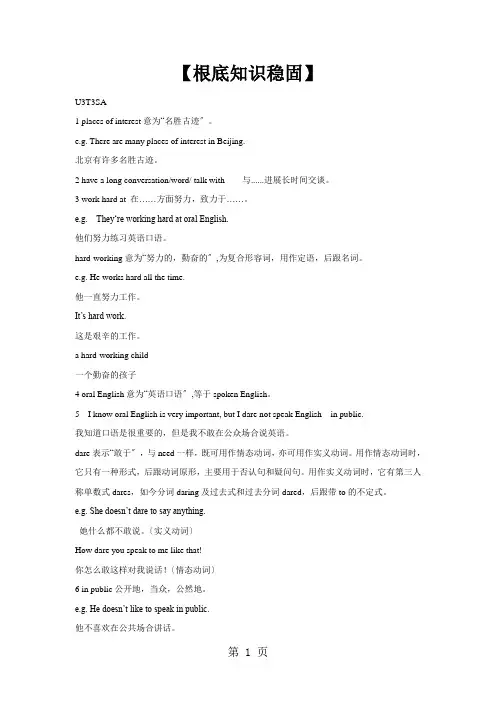
【根底知识稳固】U3T3SA1 places of interest意为“名胜古迹〞。
e.g. There are many places of interest in Beijing.北京有许多名胜古迹。
2 have a long conversation/word/ talk with 与......进展长时间交谈。
3 work hard at 在……方面努力,致力于……。
e.g. They‘re working hard at oral English.他们努力练习英语口语。
hard-working意为“努力的,勤奋的〞,为复合形容词,用作定语,后跟名词。
e.g. He works hard all the time.他一直努力工作。
It’s hard work.这是艰辛的工作。
a hard-working child一个勤奋的孩子4 oral English意为“英语口语〞,等于spoken English。
5 I know oral English is very important, but I dare not speak English in public.我知道口语是很重要的,但是我不敢在公众场合说英语。
dare表示“敢于〞,与need一样,既可用作情态动词,亦可用作实义动词。
用作情态动词时,它只有一种形式,后跟动词原形,主要用于否认句和疑问句。
用作实义动词时,它有第三人称单数式dares,如今分词daring及过去式和过去分词dared,后跟带to的不定式。
e.g. She doesn’t dare to say anything.她什么都不敢说。
〔实义动词〕How dare you speak to me like that!你怎么敢这样对我说话!〔情态动词〕6 in public公开地,当众,公然地。
e.g. He doesn’t like to speak in public.他不喜欢在公共场合讲话。
U3T3SA(仁爱版英语九年级上教学设计)

1 / 11Topic 3Could you give us some advice on how to learn English well?Section AⅠ. Material analysis本课是九年级第三单元第三话题的第一课时。
主活动是1a 和2。
1a 通过王俊峰与孩子们交流在美国所碰到的困难引出话题:英语学习的困境。
除了引出话题,还引出了语法:how/what+ to do 。
1b 是个听力任务,以此来训练"边听边排序"的能力,这也是课程标准要求学生掌握的技能。
1c 初步呈现构词法,2重点学习一些常见的构词法。
3a 与1a 相似,只是把王俊峰换成了李明,除了要听问题,还要听解决方法,学生在无形中也可以学到一些学习技巧。
3b 是一个完全开放式的口语任务,主要是模仿3a 来口头描述问题,然后给出合理的建议。
这个任务要综合1a 和3a 的内容,要经过准备、演练、展示三个环节,故作为课后练习,并要求学生在下一次课进行展示。
通过学习本课,可以培养学生相互沟通、相互帮助的美德,也让学生知道前缀和后缀是英语词汇的重要构词方式。
Ⅱ.Teaching aims 1. Knowledge aims :掌握本课的重点词汇和短语,初步学习"how/what to do sth."。
2. Skill aims:能通过学习构词法,来猜测新词的含义,读出新词的发音。
能够通过听前的阅读,猜测部分听力答案。
如:3a 的听力任务。
能够综合所学知识,进行替换性会话。
如:3b 的对话。
3.Emotional aims:<optional>培养学生相互沟通、相互帮助的美德。
4. Culture awareness: <optional>Ⅲ. The key points and difficult points1. Key points:Words and phrases: sleepy, real, granddaughter, pronounce, dialog, copy, notebook, diary, tape, dare, keep a diary, feel like doing, give up, be afraid of, work hard at, make oneself understoodSentences: Could you make yourself understood?I don’t know what to do.I dare not speak English in public.At times, I feel like giving up.Grammar: how/what + to do2. Difficult points:能正确地运用dare。
2017年九年级英语上册第三单元知识点仁爱版

2017年九年级英语上册第三单元知识点(仁爱版)U3T1SAv. 粘贴,粘住。
e.g. Pleaaawall. 请把这幅中国地图贴在墙上意为“坚持;坚守(某种观点、主张、理想、真理、协议)”。
后跟名词。
e.g. He alwawn d他总是坚持自己的决定。
表示“坚持做某事”时,后跟动名词。
e.g. Haking English every da他坚持每天说英语。
木棍(棒),枝条。
e.g. walking stick手杖,拐杖2 Disneylandd by millle from all over the world.迪斯尼乐园被来自全世界的数以百万记的人喜欢。
是一般现在时的被动语态。
被动语态表示主语是谓语动词的承受者,其结构由“助动词am, is, are+及物动词的过去分词”构成。
动作的执行者由by引出的短语表示,by意为“被……,由……”。
e.g. Englby many people. 许多人说英语。
day既可用来表示“将来有一天”,也可表示“过去曾经有一天”。
e.g. One daan old friend.一天,他遇见了一位老朋友。
I am going to Tibet one da将来有一天我要去西藏。
day 只表示“将来有一天”。
e.g. I will see you agaday/one day. 我改天再来看你。
an’t wait to do sth.迫不及待地做某事。
e.g. A new headmaster willur school. We can’t wa一位新校长要来我们学校。
我们迫不及待地想见他。
ave a (good) chance to do sth.有(好)机会做某事,have no chance to do sth. 没有机会做某事。
e.g. He has a good chance to visit Beijing Univ他有很好的机会去参观北京大学。
仁爱英语九上Unit3课文翻译
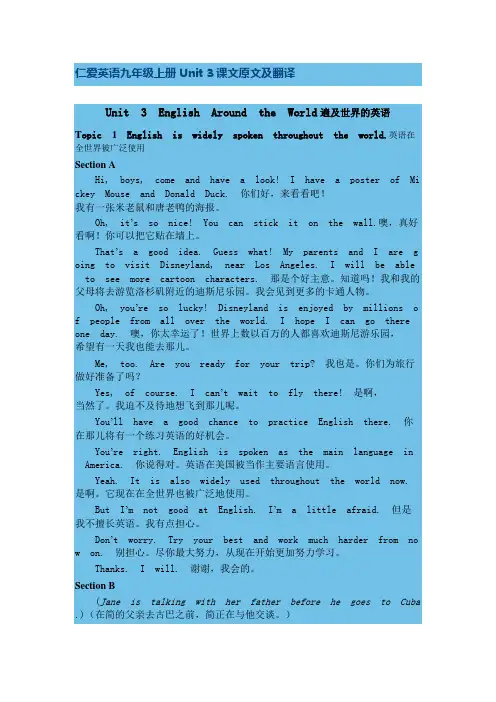
仁爱英语九年级上册Unit 3课文原文及翻译Unit 3 English Around the World遍及世界的英语T opic 1English is widely spoken throughout the world.英语在全世界被广泛使用Section AHi, boys, come and have a look! I have a poster of Mi ckey Mouse and Donald Duck. 你们好,来看看吧!我有一张米老鼠和唐老鸭的海报。
Oh, it’s so nice! You can stick it on the wall.噢,真好看啊!你可以把它贴在墙上。
That’s a good idea. Guess what! My parents and I are g oing to visit Disneyland, near Los Angeles. I will be able to see more cartoon characters. 那是个好主意。
知道吗!我和我的父母将去游览洛杉矶附近的迪斯尼乐园。
我会见到更多的卡通人物。
Oh, you’re so lucky! Disneyland is enjoyed by millions o f people from all over the world. I hope I can go there one day. 噢,你太幸运了!世界上数以百万的人都喜欢迪斯尼游乐园,希望有一天我也能去那儿。
Me, too. Are you ready for your trip? 我也是。
你们为旅行做好准备了吗?Yes, of course. I can’t wait to fly there! 是啊,当然了。
我迫不及待地想飞到那儿呢。
You’ll have a good chance to practice English there. 你在那儿将有一个练习英语的好机会。
九年级英语上册unit3重点词组归纳(仁爱版)
九年级英语上册unit3重点词组归纳(仁爱版)1gtthepitures去看电影;gtthevies去看电影2…listtheuntriesthatuseEnglishasanffiiallanguage列举把英语用作官方语言的国家3theradt…通向……之路4attheendf在……末端,在……尽头,btheend最后beausef因为……anbeautifulfisharefastdisappearingbeauseftheseverep llutin因为污染严重,许多美丽的鱼类正在面临绝种。
Anarguentasinevitablebeausethedisliedeahthersuh 争论是不可避免的,因为他们彼此非常厌恶。
6nativeEnglishspeaers以英语作为母语的人7evenif即使,用来引导一个让步状语从句,后面既可用陈述语气,也可用虚拟语气,但是evenif/eventhugh,引导的从句中不用将来时。
如:Eventhugh/ifitrainstrr,eillleavefrBeiing8eup走上前来,走近,发生,出现eupith追上,赶上,提出9Atuallalllanguageshangeanddevelphenultureseetandun iateitheahther事实上,当不同文化相互交流渗透时,所有的语言都会有所发展、有所变化。
0bedifferentfr…与……不同bedifferentin…在……不同stfpretsillbeildldifferentinperfranefrnenighttthene xt我多数作品每天晚上的演奏风格都各不相同。
Asen,BritainEnglishisalittledifferentfrAerianEnglis h中所周知,英国英语和美国英语有点不同。
仁爱英语九上U3T3SA
4. I don’t know what to do. 我不知道该怎么办。
+ v. 原形 情态动词 常用于否定句和疑问句
dareBiblioteka 敢于实义动词+ to do (不定式) 可用于任一句式 dares daring dared dared
eg:
1.How dare you do that thing to others?
Listen, check and match
录音P70-2
Li Ming’s difficulty
( ) 1. can’t read English ______ news (√ ) 2. can’t pronounce d ______ well ______ b ( √ ) 3. forgets new words ( √ ) 4. can’t always understand when people talk to him a ______ ( ) 5. isn’t good at ______ grammar ( √ ) 6. isn’t good at writing c ______ compositions
录音P69-1a
1. Did Wang Junfeng enjoy himself in Disneyland?
Yes, he did. 2. Did he have any difficulties when he was in
the U.S.A.?
Yes, he did.
Listen again and fill out the table. Name Difficulty
sth. doing sth.
2. I don’t feel like going outsides today.
仁爱版英语九上u2T3sa课件
仁爱版英语九上U2T3sa课件课程概述本课是仁爱版英语九上第二单元的第三节课,主要内容是关于“T3”单元文化知识的学习。
通过这节课的学习,学生将了解到有关沉香的种植、制作及其相关文化知识,培养学生的跨文化意识和跨文化交流能力。
课程目标1.学习沉香的来源、种植和制作过程;2.了解沉香的文化价值和传统用途;3.培养学生的跨文化意识和跨文化交流能力。
课程内容一、沉香的来源与种植沉香是一种名贵的香材,主要产自于东南亚地区,如印度尼西亚和越南等地。
沉香树是一种常绿乔木,喜欢生长在高温潮湿的环境中。
其花色鲜艳,叶片翠绿,树体高大。
本节课将通过图片、视频等多媒体展示的形式,向学生展示沉香的来源和种植过程。
二、沉香的制作过程沉香的制作过程十分复杂,需要经历多个步骤。
首先,采伐沉香树并将其树干切割成适当大小的块。
然后,将沉香块进行烘干处理,以去除其中的水分。
接着,经过打磨、修整、雕刻等工序,最终形成具有独特芳香的沉香制品。
通过展示沉香的制作过程,引导学生了解沉香制品的制作工艺。
三、沉香的文化价值和传统用途沉香在东方文化中具有重要的地位,被誉为“香中之王”。
学习沉香的文化价值和传统用途,有助于培养学生对中华传统文化的热爱和保护意识。
通过分发资料、展示图片等方式,向学生介绍沉香在佛教、道教及文人雅士中的应用,并导引学生思考沉香在现代社会的价值与用途。
四、跨文化交流与应用通过本节课的学习,学生将了解到沉香的种植和制作过程,并了解到沉香在东方文化中的重要地位。
通过小组讨论、语音交流等活动,鼓励学生对沉香文化进行反思和思考,培养学生的跨文化意识和跨文化交流能力。
同时,引导学生将所学的知识应用到实际生活中,例如制作沉香香囊、了解购买沉香制品的渠道等。
总结通过本节课的学习,学生将了解到沉香的来源、种植和制作过程,了解沉香的文化价值和传统用途。
同时,通过引导学生进行跨文化交流和应用能力的培养,培养学生的跨文化意识和跨文化交流能力。
仁爱版九年级unit3知识点
仁爱版九年级unit3知识点Unit 3: Knowledge Points of 9th Grade Revised English VersionIntroductionIn the 9th-grade English curriculum, one of the key units is Unit 3, which encompasses various essential knowledge points. This unit focuses on enhancing students' language skills in the areas of vocabulary, grammar, reading comprehension, and writing. Each of these components plays a crucial role in developing students' language proficiency. In this article, we will delve into the significant knowledge points covered in Unit 3.Vocabulary DevelopmentExpanding vocabulary is an integral part of language acquisition. Unit 3 offers a wide array of new vocabulary words, including adjectives, adverbs, idioms, collocations, and phrases. These words enable students to express themselves more precisely and fluently, making their language usage more sophisticated. Engaging in vocabulary-building exercises such as flashcards, word association, andcontextualized activities can greatly enhance students' knowledge and understanding of new vocabulary words.Grammar MasteryUnit 3 emphasizes the mastery of various grammar concepts that are vital to constructing accurate and coherent sentences. It includes exercises on verb tenses (present, past, future), reported speech, conditional sentences, passive voice, and direct-indirect questions. Understanding these grammatical structures allows students to effectively communicate their thoughts, ideas, and experiences. Regular practice and reinforcement, such as sentence construction and error correction exercises, can help solidify students' understanding and application of grammar rules.Reading ComprehensionEngaging with a variety of texts is crucial for improving reading comprehension skills. Unit 3 presents students with a collection of engaging and thought-provoking passages, including narratives, news articles, and informative texts. Through guided reading, reading strategies, and analysis of text structures, students can enhance their comprehension skills. Focusing on identifying main ideas, supportingdetails, and making inferences allows students to deepen their understanding of the texts, ultimately improving their overall reading proficiency.Writing SkillsUnit 3 aims to enhance students' writing skills by focusing on different genres and text types. It covers descriptive, narrative, and persuasive writing, allowing students to explore their creativity while following the conventions of various text forms. Students are encouraged to present their ideas coherently and persuasively, supported by relevant arguments and evidence. Regular writing assignments, peer review sessions, and teacher feedback are utilized to nurture students' writing abilities, promoting effective communication through written expression.Language Functions and PragmaticsUnit 3 also introduces language functions and pragmatics to further develop students' language proficiency. Language functions encompass skills such as giving opinions, expressing agreement or disagreement, making suggestions, and offering explanations. Understanding pragmatics enables students to use language appropriately in varioussocial contexts, taking into account factors such as politeness, formality, and cultural norms. Engaging in role-plays, discussions, and debates allows students to practice and apply these language functions in real-life situations.ConclusionUnit 3 of the 9th-grade English curriculum is a comprehensive module that focuses on various essential knowledge points. From vocabulary development and grammar mastery to reading comprehension and writing skills, this unit aims to foster students' language proficiency in a well-rounded manner. By strengthening these language skills, students are better equipped to express themselves fluently and effectively. Continuous practice and engagement with the materials covered in Unit 3 will undoubtedly contribute to students' overall language development and success in English studies.。