
八年级英语上册 Unit 7 Have you ever been to a museum?SectionA 3a-3c精品教案
多音节词和部分双音节形容词最高级加most构成,前面加the。如: the most beautiful girl
2. The old computers were much bigger.
much可修饰形容词比较级,表示……得多。
如: much richer
a little, even, a bit也可以修饰形容词比较级。
3. I wonder how much more computer will be able to do in the future.不知道将来电脑还能够做些什么事情呢。
看沏茶的过程和饮茶本身一样令人愉快。
-able 是一个典型的形容词后缀,可加在动词之后,表示“可…..的;能够……的”。此处enjoyable(能使人快乐的;令人愉快的)便是一例,再如:drinkable(可饮用的), washable(可洗的), readable(可读的), usable(可用的;可使用的)等等。
板书
设计
示意
框图
Unit 9 Have you ever been to a museum?
时序
Teaching Procedures
Step 1 Greetings and Revis ion
Look at the pictures and make conversation:
A: Have you ever been to…?
2. Target language:
1)I wonder how much more computer will be able to do in the future
2) Watching them prepare the tea with the beautiful tea sets is just as enjoyable as drinking the tea itself
( ) 5. Linlin didn’t know why her grandpa loved drinking and collecting tea set.
Step 4 Detailed reading
Read the passage again and answer the questions.
1. Key vocabulary:unbelievable, progress, rapid, unusual, toilet, encourage, social, peaceful, performance, perfect, itself, collect
2. Target language:
1.Which three museums do the students talk about?
2.What does Ken say about theAmericanComputerMuseum?
3. What can we learn at the International Museum of Toilets?
encourage sb. to do sth.
鼓励某人做某事
e.g. My father encouraged me to take part in the sports meeting.
父亲鼓励我参加运动会。
5. Watching the tea preparation is just as enjoyable as drinking the tea itself.
( ) 2. Ken thinks computers will do more work in the future.
( ) 3. International Museum of Toilets is a very unusual museum. ( ) 4.Indiahas the most advanced toilet.
4. Why is theHangzhouNationalTeaMuseuma nice place to enjoy tea?
5. What do you think is the most interesting thing about each museum?
Step 5Explanation
Step 6 Homework
1. Remember the words and expressions.
2. Finish the exercises in the workbook.
Unit7SectionA 3a-3c
课题Unit 7 Have you ever been to a museum?Section A 2 (3a-3c)
教
学
目
标
I. Knowledge and Ability Objects
1. Key vocabulary:unbelievable, progress, rapid, unusual, toilet, encourage, social, peaceful, performa nce, pe rfect, itself, collect
2) Reading for comprehension.
3) Communicative approach.
III. Sensibility a nd Value
To raise students’ interest of learning English.
教
材
分
析
I. Teaching Key Points
1)I wonder how much more computer will be able to do in the future
2)Watching them prepare the tea with the beautiful tea sets is just as enjoyable as drinking the tea itself
e.g. I don’t know when he will come.
我不知道他什么时候来。
I don’t know where he lives.
我不知道他住在哪里。
4. It also encourages governments and social groups to think about ways to…
3)Talk about the video .
Step 3 Fast reading
Match the words with its meaning and learn some new words.
True or False
( ) 1. American Computer out different computers there.
B: Yes, I have./ No, I haven’t.
Step 2 Pre-reading
1)Brainstorm: think of the kinds of museums that you can name.
2)Watch a video. A video about the InternationalMuseum of Toilets
II. Teachi ng Difficulties
1) How to improve reading skill.
2) To understand the passage and the culture.
III. Teaching Aids
1. A computer for multimedia use.
3. To train students’ reading ability
4. To get students know some knowledge about many kinds of museums.
II. Method Objects in Teaching
1) Skimming for details.
1)wonder表示“ (对某事)感到疑惑;想要知道 ;想弄明白;琢磨”,后面常接由what, how, who或者if/whether引导的宾语从句。
e.g. I wonder how they’re getting on.
我想知道他们现在过得怎样。
I just wonder if they’ve arrived safely.
我就想知道他们是否安全抵达了。
2)此句从句部分的原始结构是: How much more will computers be able to do in the future?是 对陈述句Computers will be able to do (much) more in the future.(电脑将来能够做更多的事情。)的提问。由于充当了宾语从句,疑问结构改成了陈述结构: how much more computers will be able to do in the future,即:将助动词还原到陈述句的位置。
八年级英语上册 Unit 7 Have you ever been to a muse
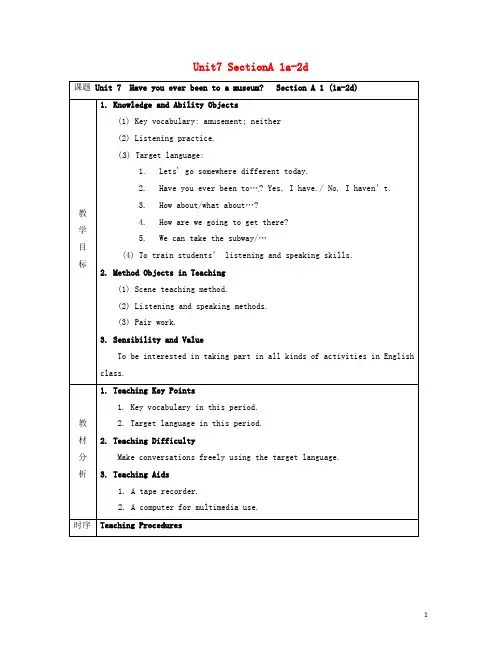
Unit7 SectionA 1a-2d课题Unit 7 Have you ever been to a museum? Section A 1 (1a-2d)教学目标1. Knowledge and Ability Objects(1) Key vocabulary: amusement; neither(2) Listening practice.(3) Target language:1.Lets' go somewhere different today.2.Have yo u ever been to…? Yes, I have./ No, I haven’t.3.How about/what about…?4.How are we going to get there?5.We can take the subway/…(4) To train students’ listening and speaking skills.2. Method Objects in Teaching(1) Scene teaching method.(2) Listening and speaking methods.(3) Pair work.3. Sensibility and ValueTo be interested in taking part in all kinds of activities in English class.教材分析1. Teaching Key Points1. Key vocabulary in this period.2. Target language in this period.2. Teaching DifficultyMake conversations freely using the target language.3. Teaching Aids1. A tape recorder.2. A computer for multimedia use.时序Teaching ProceduresStep 1 Greetings and RevisionGreet the class and check the homework.Step 2 Lead-in1. Guess the places of the pictures; they are the British Museum, spacemuseum, history museum, water park, zoo, amusement park while lead insentenc e patterns:“ Have you ever been to …?”2. SpeakingGet students to work in pairs to practice the conversation: “ Have you ever been to…”“Yes, I have”/ Not, I haven’t.Step 3 Pre-listening1. Section A 1aT: OK. Now open your books on Page 65. In Part 1a, 6 places are given. Please read the names of these places. (Teacher writes the names on theblackboard.) Which of these places would you like to visit? Rank themfrom 1 to 5.S 4:Amusement park ______, water park ______, zoo ______ aquarium ______ space museum ______.S5: Space museum ______, aquarium ______, zoo ______, water park ______, amusement park ______S6: …2. Talk about the pictureStep 4 Listening1.Listen and choose the best answer. The first and the second question aim tolistening to time, and the third one aims to listen for the relationship. This activity trains students’ listening ability for listening for specific relationship.1)When did Sarah visit the National Science Museum?A. TodayB. YesterdayC. Last year2)When did Claudia visit the nature museum?A. last yearB. last summerC. Last school trip3)What may the relationship be between the two speakers?A. FriendsB. Teacher and studentC. Mother and kid.Answer: CCA2.Listen again. Listen and check the boxes. Have these students ever been to theseplaces?Science museum HistorymuseumArt museum Nature museum Space museumClaudiaSarah √Step 5 SpeakingAsk and answer in pairs:A: let’s go somewhere different today.B: OK. Where do you want to go?A: Have you ever been to the space museum?B: No, I haven’t. How about you?A: …Step 6 Listening 2a 2b1.Listen and circle the places that you hear.2.Listen again and circle T for true or F for false.Conversation 11. Tina went to the space museum last year. T/F2. John has never been to the sp ace museum. T/F3. They are going to take the subway. T/FConversation 21. Linda has been to the amusement park. T/F2. Linda went to the amusement park yesterday. T/F3. Linda is going to the amusement park again by bike. T/FConversation 31. Frank had a great time at the water park. T/F2. Frank’s friend has never been to the water park. T/F3. Frank and his friend are going skating. T/FAnswer: TFT TFT FTT3.SpeakingLook at the map in 2a and make conversations about the places.A: Have you ever been to the space museum?B: Yes, I have. How about you?A: No, I haven’t.B: Oh, it’s fantastic. Let’s go tomorrow.A: OK. How are we going to get there?B: We can take the subway.4.SpeakingRole-play the conversation in 2d.A: I went to the film museum last weekend. Have you ever been there? …B: Yes, I have. I went there back in April. …Step 7 Language points1. I learned about the inventions that led to color movies, too. 我还了解了一些发明,它们成就了彩色电影。
八上Unit7 Have you ever been to a museum单元教学设计
单元整体教学设计
单元主题内容框架图/思维导图单元主题内容框架图/思维导图
课标分析大单元教学基于课程标准,围绕单元主题,对教材单元等资源进行深入解读分析,结合学习主体的认知及生活经验,对教材单元进行必要的整合或重组,搭建一个由单元主题,各语篇主题相互关联,逻辑清晰的完整的学习单元,即单元育人蓝图。
从而使教师能够围绕一个完整的主题设定单元目标。
教师进而将单元教学目标转为基于语篇的学生学习活动,构成学生学习单元。
使学生能通过对各种语篇的语言学习和意义建构,逐步学会运用所学语言,思想观点,方法策略,生成围绕该单元主题的深层认知,态度和价值判断。
体现单元核心素养的重点语言表达体现单元核心素养综合表现的重点语言表达如下:
【单词、短语】camera照相机unbelievable难以置信的progress 进步、发展rapid快速的unusual不寻常的toilet厕所
【句子】我父亲去过北京两次。
My father has been to Beijing twice.
你曾去过英格兰吗?
Have you ever been to England?
检查人签字:_____________ 时间:年月日。
鲁教版(五四学制)英语八年级上册:Unit 7 Have you ever been to a museum. 教案3
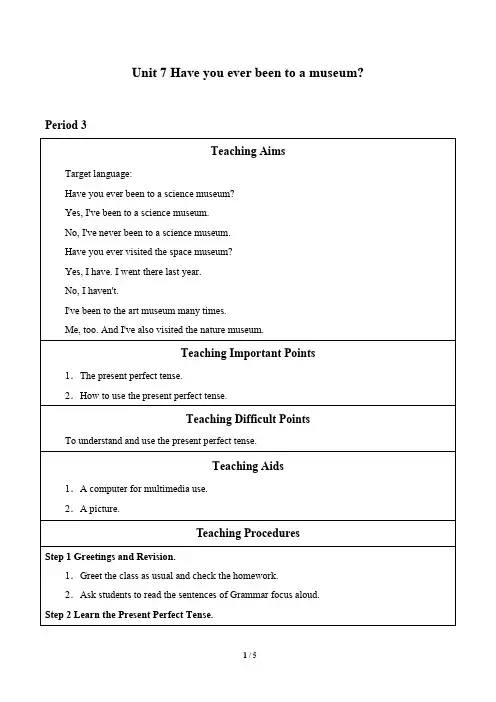
Unit 7 Have you ever been to a museum? Period 3e.g.: Have you ever been to Hong Kong?你曾去过香港吗?I haven't ever spoken to her.我未曾和她说过话。
never意为“从来没有”常与before连用,多放在助动词与过去分词之间。
e.g.: I have never travelled by plane before. 我以前从来没有乘飞机旅行过。
3.have been to & have gone to区别。
比较:He has been to Beijing.他曾去过北京。
(人已回来,可能在这儿。
)He has gone to Beijing.他已经去北京了。
(人已走,不在这儿了。
)(1)have / has been (to) 表示“曾经到过某地”,说话时此人不在那里,已经回来。
侧重指经历。
(2)have / has gone (to) 表示某人“已经去某地了”,说话时此人可能在路上或已到那里,反正不在这里。
4.一般过去时与现在完成时的区别。
比较:I have seen the film.我看过这部电影。
(我了解这部电影的内容。
)I saw the film last month.我上个月看了这部电影。
(只说明上星期看了这部电影,不涉及现在情况。
)(1)一般过去时只强调过去的动作;现在完成时强调过去的事情对现在的影响。
(2)一般过去时通常与表示过去的时间状语连用;现在完成时则不能与表示过去的时间状语连用。
(3)一般过去时单纯表示过去的经历;现在完成时表示过去的动作或状态延续到现在并可能持续下去。
一般过去时的时间状语有:yesterday, last week, ago, in1980, in October, just now…共同的时间状语有:this morning, tonight, this summer, before, already现在完成时的时间状语有:for, since, ever, never, just, already, yet, in past years Step 3 Exercises.Finish exercises.1.根据括号内的要求完成下列各句,每空一词(含缩写)。
河南省濮阳市第六中学八年级英语上册 Unit 7 Have you ever been to a

Unit 7 Have you ever been to a museum【学习目标】1、掌握本课时词汇:amusement park, somewhere .2、能运用本课时句型描述曾经去过哪些有趣的地方和谈论过去的经历。
【学习重点与考点】能够正确使用现在完成时询问曾经去过某个地方的句型:—Have you ever been to a science museum?—Yes, I have. I went to National Science Museum last year.【课前自学指导】(一)知识链接:区分 have/has been to与have/has gone tohave /has been to 和 have/has gone to 都是指已经去了某个地方,但是 have /has been to 强调的是曾经去了某个地方并回来了; have/has gone to强调的是去了某个地方还没有回来。
--Have you ever been to Shanghai? --Yes, several times.-- Where is Mr. Wang? -- He has gone to Shanghai.【拓展】have been in:表示在某地呆了有多久,从过去一直延续到现在。
e.g. My family has been in Puyang since I was born.自从我出生,我家人就一直呆在濮阳。
预习检测:选择填空(have / has been to, have/has gone to或have been in)1. A:Where’s Tony?B:He’s got a headache so he _________to bed.2. A:Sally and Tim are on holiday, aren’t they? Where ____they ______?B:To Florida, again.A:How many times _____they ____ there?B:This is their third visit.3. A:(On the phone)Can I speak to Mary, please?B:She’s out, I’m afraid. She ________ to the cinema this evening.4. –How long ____ you ____ ____ Beijing?—I ____ ____ here for a week.(二)Me neither. 我也没有。
最新版鲁教版八年级上册英语Unit7单元检测题及答案解析
UNIT 7 Have you ever been to a museum?检测题Ⅰ.听力(20分)(一)听句子,选择你听到的内容。
(句子读一遍)1. A. umbrella B. museum C. brother2. A. tall B. short C. long3. A. dog B.cat C. panda4. A. good B. important C. importance5. A. school B. class C. group(二)听句子,根据所听到的内容选择正确答语。
(句子读一遍)6. A. No, I’d like to. B. Yes, please. C. I don’t want.7. A. Five years ago. B. For ten years. C. In four years.8. A. She likes apples. B. She is a kind-hearted woman.C. I don’t know.9. A. No, she hasn’t. B. Yes, she does. C. No, she isn’t.10. A. It’s fantastic. B. Sorry.C. It tells something about the island.(三)听对话,根据对话内容及问题选择正确答案。
(对话读两遍)11. How long is the history of China?A. 5,000 years.B. About 5,000 years.C. Less than 4,000 years.12. Where is Mr. Green?A. In the library.B. At home.C. In the office.13. When did Mr. Smith move to New York?A. In 2005.B. Six years ago.C. In 2000.14. Which mount did the man visit?A. Mount Hua.B. Mount Tai.C. Mount Heng.15. Whose backpack is it?A. Nancy’s.B. Sally’s.C. Cindy’s.(四)听短文,根据短文内容选择正确答案。
八年级上册Unit7HaveyoueverbeentoamuseumSectionB1a

Japanese food.
Name of the night zoo inSingapore
(4) ___________
Temperature inSingapore
It is (5) _________
_____ all year round.
B: Yes, I ,ve ____ toSingaporemany times. It ,s my favoritecountryin ____
Asia.
A: What languagesdo people ______ there?
B: Mostly Chinese and _______.
A: What about the food? Is it good?
2. very easy
3. at night
4. whenever you like
6. Work on 2d.Fill in conversation aboutSingaporeusing the information form the article.
A: I am going toSingaporenext week. _____ you ever ____ there before?
1.Introduction ofSingapore
1)Look at some pictures and watchsomevideosaboutSingapore
2)Talk about the symbol of Singapore
2. Fill in theblanks according to the article.
鲁教八年级英语上册Unit 7 Have you ever been to a museum 课件
现在完成时
Read and translate the following sentences. 1. I have just heard the news. 2. They haven’t returned from America yet. 3.I have already finished my homework. 4. My mother isn’t at home. She has gone
1、书籍是朋友,虽然没有热情,但是非常忠实。2022年4月22日星期五2022/4/222022/4/222022/4/22 2、科学的灵感,决不是坐等可以等来的。如果说,科学上的发现有什么偶然的机遇的话,那么这种‘偶然的机遇’只能给那些学有素养的人,给那些善于 独立思考的人,给那些具有锲而不舍的人。2022年4月2022/4/222022/4/222022/4/224/22/2022 3、书籍—通过心灵观察世界的窗口.住宅里没有书,犹如房间里没有窗户。2022/4/222022/4/22April 22, 2022
I ____ (see) many kinds of animals thheraev.e learned
7. We _____ _______ (learn) English for
more tr. Wang? -- Hhea_s_g_on_e____ (go) to the
5. He _h_a_s_ ever _b__ee_n__ (be) to the History Museum several times.
6. -- _H__a_v_eyou ever b__ee_n__ (be) to the zoo? went -- Yessa.wI _____ (go) there last summer.
鲁教版八年级英语上册Unit 7 Have you ever been to a 预习学案(无答案)
Unit 7 Have you ever been to a museum?Period1 Section A 1a-2d班级姓名书写等级【知识与技能目标】1.根据拼读规则读写本节课的5个单词和1个短语eg :camera, amusement park。
2.能听懂描述关于人们参观景点经历的听力材料,并完成相关练习。
3.学会用have/has been to...谈论曾经去过的地方。
【学习重点】能够能听懂描述关于人们参观景点经历的听力材料并能够正确使用have/has been to…谈论曾经去过的地方。
【学习难点】1.能够正确地使用现在完成时态来进行描述。
2.能够区分并正确使用have/has been to have/has gone to have/has benn in。
一、预习案【预习指导】仔细阅读课文P49-50内容,阅读过程中翻译并圈出相关的短语以及知识点,理解2d 大意,并用红笔圈出难以理解的地方,用15分钟完成预习任务。
Task1.预习课本P49-50 单词和P49 1a,根据汉语意思进行默写:单词:娱乐,游戏_______________在某处,到某处__________照相机,摄影机____________发明物________________(发明______________)短语:太空博物馆_______________历史博物馆_____________游乐场__________________水上乐园___________________Task2.预习课本P49 1c及P50 2b&2c,完成下列句子。
1.今天让我们去不同的地方吧。
Let’s go today.2.你曾经去过太空博物馆吗?Have you a museum?3.Linda 计划再骑自行车去一次游乐场。
Linda is going to the by bike.Task3.预习课本P50 2d, 完成下列任务。
八年级上unit7 Have you ever been to a museum Period1
教学设计教学主题八年级上unit7 Have you ever been to a museum?Period1一、教材分析单元话题是Have you ever been to a museum? 本节课是八年级上册Unit7 Have you ever been to a museum?第一课时的内容,本课内容接近学生的实际生活,能够轻松地激发学生的学习兴趣。
要求学生能初步尝试运用现在完成时谈论同学们去过的地方。
本课的主要任务是理解掌握现在完成时的意义及用法,能听懂含有现在完成时的听力材料并谈论自己去过的地方。
二、学生分析八年级的学生已经初步掌握了大量的词汇并且对现在完成时的结构及基本用法有了解,能够利用前一单元的知识进行简单的交流和运用。
这个时期的学生正处于青春期,精力充沛,表现欲强,对新鲜事物充满好奇。
通过让学生浏览一些图片,让他们对课本内容有一个整体感知。
本节课的内容是比较接近学生的生活也是他们感兴趣的话题,因此只要运用恰当的方法引导,学生能够积极参与课堂。
但是学生容易混淆现在完成时与一般过去时的使用。
三、教学目标1.知识目标:词汇:neither,amusement,have been to句式:A:Have you ever been to a museum?B: Yes, I have. I went to the national Science Museum last year.A: Have you ever been to a history museum?B: No, I haven’t.A: Me neither.Let’s go to one tomorrow.2.语言技能目标:运用现在完成时结构谈论去过的地方。
4.情感目标:通过合作的方法谈论去过的地方,感悟自然之美,表达对祖国大好河山的热爱。
四、教学环境√简易多媒体教学环境五、信息技术应用思路(突出三个方面:使用哪些技术?在哪些教学环节如何使用这些技术?使用这些技术的预期效果是?)200字本节课多处使用现代化信息技术,整个教学环节运用powerpiont 设计的教学课件,融入了大量收集的图片及文字,截取的听力录音,能够吸引学生的兴趣,提高了课堂容量和效率。
鲁教版 新八年级上 unit 7 Have you ever been to a museum section B
1c Listen again and take notes. Name: ______________________ Peter Country: ___________________ Australia two weeks How long in China: __________
the Palace Museum, Places visited: _______________ the Great Wall , the Bird’s Nest, ____________________________ the Terracotta Army
e.g. I’ve got to go in a quarter of an
hour. 一刻钟以后我就得走了。
3. May be you fear that you won’t… fear v. 害怕;担心 e.g. Many people fear change because they do not like the old ways to be changed. 很多人惧怕变化,因为他们不 喜欢旧有的生活方式被改变。
e.g. On the one hand, she taught English, Chinese.
她一方面教英语, 一方面学习汉语。
2. …more than three quarters of the population are Chinese…
quarter n. 四分之一;一刻钟
three quarters 四分之三
3. 我很久没有看到你了。 haven’t ____ seen you for a long time. I _______ 4. 雨下了多久了?
How long ___ has __ it ____ been raining?