
七年级下册 Unit 3 Section A 1A-1C教案
Explain : get to
Step 2.While-task
1a&1c.
1. Write down how you get to school .
2. Look at the picture .Write down how the students get to school.
Step 1. Leadin
1. Greetings and free talk .
1. T: How do we get to school ? Some students walk ,some students take the bus ,some students ride a bike .Does anyone take the subway ? No , we have no subway .
Step 3. 1b .Listening
1.Listen to the tape and answer the following questions.
1) How does Bob get to school? (take the train)
2) How does Mary get to school? (take the subway)
3. Make dialogues with the phrases .
4. Groupwork: Divide the students into groups of three or four .Practice reading the dialogues.
5. Act out their dialogues .
Difficult points: The special questions: how /how far /how long…?
教学策略
Task-based teaching method, situational teaching, listening
教学活动
Teaching procedures:
--I get to school on / in the /a/one’s +交通工具
--I get to school by+交通工具.
2.句型:询问:做某事花费某人多长时间43; to do sth?
--It takes (sb) some time (to do sth).
2、过程与方法
Talk about how to get to places
3、情感态度与价值观
Learn some ways of transpotation.
重点难点
Important Points: The expression of choosing different kinds o f transportation
3) How does John get to school? (take the bus)
4) How do Paul and Yang Lan get to school? (walk)
5)How does Jim get to school? (ride the bike)
2.Task 2: 1cMake conversations in pairs about how to get to school for Bob, Mary, John, Paul, Jim and Yang Lan.
e.g. --去学校花费你多长时间?
--去上学花费我十分钟。
How long does it take you to get to school?
It takes (me) ten minutes (to get to school).
3.句型:询问距离从A地到B地有多远?
--How far is it from A to B?
编写时间3月21日执行时间3月22日主备人执教者总序第13个教案
课题
Unit3How do you get to school?(SectionA 1A-1C)
共1课时
第1课时
课型
New
教学目标
1、知识与技能
Target language: How do you get to school?
I walk. take the bus, take the train
--It is…kilometer(s).
Step5 . Homework.
1 Read and write the words.
2 Make the conversation
【板书设计】
A: How does Bob get to school?
B: He takes the train.
教学反思
e.g.A: How does Bob get to school?
B: He takes the train.
Step 4. Explanation
1.句型:询问交通方式(用HOW提问):
--How do you get to school?
--I + take / ride+ the / a+交通工具to school.
初中英语人教版七年级下册Unit3 Section(1a-1c)
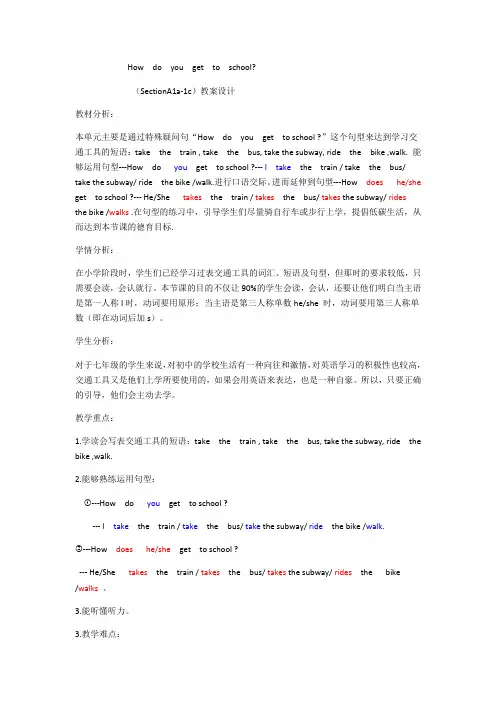
How do you get to school?(SectionA1a-1c)教案设计教材分析:本单元主要是通过特殊疑问句“How do you get to school ?”这个句型来达到学习交通工具的短语:take the train , take the bus, take the subway, ride the bike ,walk. 能够运用句型---How do you get to school ?--- I take the train / take the bus/ take the subway/ ride the bike /walk.进行口语交际。
进而延伸到句型---How does he/she get to school ?--- He/She takes the train / takes the bus/ takes the subway/ ridesthe bike /walks .在句型的练习中,引导学生们尽量骑自行车或步行上学,提倡低碳生活,从而达到本节课的德育目标.学情分析:在小学阶段时,学生们已经学习过表交通工具的词汇、短语及句型,但那时的要求较低,只需要会读,会认就行。
本节课的目的不仅让90%的学生会读,会认,还要让他们明白当主语是第一人称I时,动词要用原形;当主语是第三人称单数he/she 时,动词要用第三人称单数(即在动词后加s)。
学生分析:对于七年级的学生来说,对初中的学校生活有一种向往和激情,对英语学习的积极性也较高,交通工具又是他们上学所要使用的,如果会用英语来表达,也是一种自豪。
所以,只要正确的引导,他们会主动去学。
教学重点:1.学读会写表交通工具的短语:take the train , take the bus, take the subway, ride the bike ,walk.2.能够熟练运用句型:①---How do you get to school ?--- I take the train / take the bus/ take the subway/ ride the bike /walk.②---How does he/she get to school ?--- He/She takes the train / takes the bus/ takes the subway/ rides the bike/walks。
人教版英语七年级下册unit3 SectionA (1a-1c) 教案设计
Unit 3 How do you get to school ?Section A (1a-1c)Unit 3 How do you get to school ?Section A (1a-1c)Ⅰ. Teaching Aims1.Knowledge aims:vocabulary: get to , how far , bike , subway , minute , mile , bus , takethe bus /subway /train /taxi , ride a bike /walklanguage: How do you get to school?I ride my bike.How does Mary get to school?She takes the subway.2. Ability aim:To know how to get to places in real situations freely.3.Emotion aim: Let students obey the transportation rules and pay attention totheir safety all the time.Ⅱ. Key and Difficult Points1.The expression of choosing different kinds o f transportation.2.I ride a bike to school.I get to school by bike.Ⅲ. Teaching and Learning MethodsSpeaking Method, Listening Method , Task-based Language Teaching Method. Ⅳ. Teaching AidA tape recorder. Pictures, PPTⅤ. Teaching ProceduresStep 1.New Words and Phrases1. T: listen and guess which vehicle it is?first one?S s:It is a bike.T:Second one?S s:It is the sound of walk.2. Have a dictation and check each other.3. work on 1a and check the answer.Step2. Presentation1.Leading inEnjoy a video and ask the students to think about the question ”How do you get to school?”2. let the students look at the pictures on the screen, and then answer thequestion: How do you get to school? Then write down the sentence”How do you get to school?”on the blackboard. Help the students toanswer “take the subway, take the train, ride a bike, walk .”3.Pair work . Ask the student practice in pairs. After that, ask them topractice in groups like this:A: How do you get to school?B: I…to school. How about you ?A: I…to school.Step3. listening1.Work on 1b.Listen and write the numbers.Before I play 1b. I ask thestudents: how do you get to school? I want them to remember the ways oftransportation. And I play 1b, let the students to complete 1b, then checkthe answer. And then let the students listen and imitate the dialogue.2.listen again and fill in the blanks ,then check the answer.3.I’ll ask the students about the picture characters “How does he/she get towork?”Help the students to answer “take s the subway, takes the train,rides a bike, walks .”4. Pair work .Ask the students practice in pairs according to the listeningconversation, After that, ask them to practice in groups like this:A: How does Mary get to school?B: She takes a subway.Step 4.ExtensionTell the students another way of these sentences on the screen and practice.In this step, tell the students: take the/a transportation to a place and get/goto a place by transportation have the same meaning.Step 5. ConclusionIt’s time to consolidate them Firstly, summarize the two ways ofdescribing the means of transportation . Secondly, tell students take the/atransportation to a place and get/go to a place by transportation have thesame meaning. They can change each other.Step 6. Group workAsk the students to make a survey in each group and have areport.Encourage them to use different means and find out the best group.Step 7. ExerciseAsk the students to choose the right one and check the answer.Step8. Homework1.Copy the new words and phrases.2. Make a survey: How do your parents go to work?Ⅵ. Blackboard DesignUnit 3 How do you get to school?。
人教版英语七年级下册 Unit 3 Section A 1a-1c 教学设计(表格式)
课堂小结
本节课我们主要学习了 ”询问出行方式“的核心句型和重点词汇。如:
-How do you get to school ?
-I take the bus ./I get to school by bus .
-Doe he walk to school ?
T:How does he go to school ?
S:He walks /He gets to school on foot .
T: How long does it take ?
S: It takes twenty-five minutes .
T: How long does it take you to get to school ?
•通过听力与写对所学的数字进行巩固。
•通过模仿对话引入本节课所要学的重点,遵循由易到难的原则,同时又有知识的拓展与延申。
知识拓展
观察和思考
1.take+冠词+交通工具=by+交通工具
2.How far is it from your home to school 意思是_______
3.询问去某地的交通方式,用____提问,get to 表示____,后面是副词时,不需_____,如,到家______
4.Say these numbers .
5.Have a competition .
While listening :
Play the tape for the students to finish 2a&2b
Then play again and check the answers.
七年级下 Unit 3Why do you like koalas(SectionA 1a-1c)
/i?ct=5033=%D0%DC%C3%A8&in=2668&cl=2&lm=-1&st=&pn=6&rn=1&di=134978158170&ln=2000&fr=&fm=hao123&fmq=1331860740546_R&ic=&s=&se=&sme=0&tab=&width=&height=&face=&is=&istype=
一、教学目标
1、知识目标:学习本课例的词汇和句型结构
1)词汇:
zoo, animal, tiger, elephant, koala, dolphin, panda, lion, penguin, giraffe, smart, cute, fun, ugly, intelligent, friendly, shy, kind of, Africa
11动物_____________12北极____________13南洲_______
14中国___________15印度_______16澳大利亚_____________________
二、翻译句子。
1.让我们先看看大象。
2.你为什么喜欢熊猫?
3.因为他们有点有趣。
4.狮子来自非洲。
Step 2.Warming up
四.教学方法
1、教法
(1)我采用《英语课程标准》倡导的任务型教学模式。让学生在教师的指导下,通过感知,体验,实践,参与和合作等方式,实现目标,感受成功。结合任务型的教学模式,在本课时适当设计了学生的邀请活动。
(2)以话题为核心,通过个人思考、小组及班级活动等不同途径,在听、说、读中使单词及句型以不同的形式反复出现,在足够的输入中,达成有效的语言输出。
人教版初中英语七年级下册Unit3SectionA1a1c教学设计

6.拓展任务:鼓励学生关注生活中的天气变化,记录一周的天气情况,并用英文进行简要描述,提高学生的观察力和语言表达能力。
7.小组合作:以小组为单位,讨论并创编一个关于天气和物体状态的小故事,要求使用一般现在时,每个成员都要参与,并在课堂上进行分享。
人教版初中英语七年级下册Unit3SectionA1a1c教学设计
一、教学目标
(一)知识与技能
在本章节的学习中,学生将掌握以下知识与技能:
1.掌握本节课的主要词汇和短语,如:sun, sky, cloud, wind, tree, fly, sail等,并能在实际情境中运用。
2.学会使用一般现在时描述天气和物体的状态,如:“The sun is in the sky.”和“The clouds are white and fluffy.”
3.教师引导学生回顾已学的天气词汇和一般现在时态,为新课的学习做好铺垫。
(二)讲授新知
1.教师呈现本节课的主要词汇和短语,如:sun, sky, cloud, wind, tree, fly, sail等,并引导学生学习、朗读和记忆。
2.教师通过示例和练习,讲解一般现在时的用法,特别强调主语和动词的形式匹配,如:“The sun is in the sky.”和“The clouds are white and fluffy.”
3.教师设置情境,让学生进行角色扮演,练习一般现在时的问答句型,如:“What's the weather like?”, “How is the sky?”等。
4.教师呈现课文1a-1c的内容,引导学生阅读、理解和模仿,巩固所学知识。
人教版七年级英语下册Unit3SectionA(1a2c)优秀教学案例
4.学生能够通过参与课堂活动,体验到合作学习的乐趣,培养自己的团队合作精神。
三、教学策略
(一)情景创设
1.教师可以通过播放不同类型的音乐,如流行音乐、摇滚音乐、古典音乐、爵士音乐、乡村音乐等,让学生在听音乐的过程中,感受不同音乐类型的特点和魅力。
(四)总结归纳
1.教师可以对本节课的主要内容进行总结和归纳,突出重点和难点,帮助学生巩固所学知识。
2.教师可以设计一些问题,引导学生进行思考和讨论,如“我们今天学习了什么?你有什么收获?”等,通过问题的引导,让学生进行自我反思和总结。
3.教师可以给予学生一些学习建议和技巧,如如何记忆单词和句型,如何提高口语表达能力等,帮助学生提高学习效果。
(三)学生小组讨论
1.教师可以让学生分成小组,讨论自己喜欢的音乐类型和音乐经历,让学生在小组讨论中,练习英语口语,提高语言表达能力。
2.教师可以设计一些小组活动,如小组竞赛、小组讨论等,让学生在活动中,提高自己的团队合作能力和竞争力。
3.教师可以让学生通过小组合作,完成一些任务,如填空题、选择题等,让学生在完成任务的过程中,巩固和运用所学知识。
3.学生能够听懂并模仿本节课的两个对话,能够运用所学知识进行角色扮演,进行日常的英语交流。
4.学生能够通过听力练习,提高听力理解能力,能够从对话中获取关键信息,如人物、地点、活动等。
(二)过程与方法
1.学生能够在教师的引导下,通过观察、听辨、模仿等方法,学习和掌握本节课的核心词汇和句型。
2.学生能够在小组讨论和角色扮演的过程中,提高自己的合作能力和口语表达能力。
在教学过程中,教师应充分利用多媒体教学资源,如音频、视频等,为学生提供丰富的语言输入,让他们在真实的语言环境中感受、体验和学习英语。同时,教师还要注重创设互动性强、参与度高的课堂活动,如小组讨论、角色扮演等,让学生在实践中提高英语运用能力。此外,教师还要关注学生的个体差异,给予不同水平的学生适当的指导和帮助,让他们在课堂上都能有所收获。
Unit3SectionA1a-1c教学设计2023-2024学年人教版初中英语七年级下册
二、新课讲授(用时10分钟)
1.理论介绍:首先,我们要了解与天气相关的英语词汇和句型。比如,sunny表示晴天,cloudy表示多云,rainy表示雨天,windy表示有风。我们将学习如何使用这些词汇来描述天气。
2.案例分析:接下来,我们来看一个具体的案例。这个案例展示了如何用英语描述不同的天气情况。比如,听力材料中的对话会让我们了解到人们在不同天气下的活动和感受。
首先,我发现学生在学习新的天气词汇时,有些词汇的发音和记忆上存在困难。例如,sunny和cloudy等词汇的发音对于一些学生来说比较困难,他们可能需要更多的练习和指导来掌握正确的发音。同时,这些词汇的记忆也需要时间和重复的练习,我需要设计一些有趣的活动和游戏来帮助学生记忆这些词汇。
其次,在听力练习中,我发现一些学生对于听力材料中的语速和口音有些难以理解。这可能是因为他们的听力水平还不够熟练,需要更多的听力训练来提高他们的听力理解能力。我可以在课堂上多播放一些不同口音和语速的听力材料,让学生逐渐适应各种口音和语速,提高他们的听力理解能力。
课后作业
为了让同学们更好地巩固本节课所学内容,我为大家设计了以下五个课后作业题型:
题型1:用所学的天气词汇描述今天的天气。例如:“Today is sunny with a gentle breeze.”
题型2:根据对话内容,完成填空。例如:“How's the weather inBeijing? It's _._”
再者,在小组活动中,我发现一些学生不太敢开口说英语,可能是因为缺乏自信。我需要鼓励他们,让他们知道犯错是正常的,重要的是勇于尝试和表达。我可以在课堂上设置一些简单的角色扮演和对话练习,让学生在安全的氛围中练习英语口语。
人教版英语七年级下册Unit3SectionA1a1c优秀教学案例
为实现上述目标,教师应关注学生的个体差异,合理分配小组成员,设计丰富多样的合作活动,激发他们的学习兴趣,提高合作能力。
(四)反思与评价
1.教师引导学生进行自我评价,培养他们的自我反思能力,帮助他们找到自己的不足,调整学习策略。
2.教师设计评价量表,对学生在学习过程中的表现进行评价,给予及时的反馈,指导他们改进学习方法。
在教学过程中,教师需要关注学生的学习兴趣,调动他们的积极性,引导他们通过观察、思考、讨论等方式自主学习。教师应设计丰富多样的教学活动,如图片展示、情境对话、小组讨论等,让学生在实际操作中感知和运用语言知识。同时,教师还需关注学生的个体差异,给予不同程度的学生个性化的指导,确保他们能在课堂上充分参与、积极互动,提高课堂效果。
3.教师通过问题引导学生进行自主学习、合作学习,提高他们的学习能力。
为实现上述目标,教师应关注学生的认知水平,设计具有针对性和启发性的问题,引导他们在思考、解决问题的过程中,掌握知识,提高能力。
(三)小组合作
1.教师将学生分成若干小组,设计小组合作活动,让学生在合作中学习、交流,提高团队协作能力。
2.教师针对学生的不同特点,给予个性化的指导,确保他们在小组合作中都能发挥自己的优势,共同进步。
3.教师关注学生的情感态度,对他们在学习过程中的努力、进步给予肯定和鼓励,提高他们的自信心。
为实现上述目标,教师应关注学生的学习过程,设计科学的评价体系,充分发挥评价的诊断、反馈、激励等功能,促进学生的全面发展。
四、教学内容与过程
(一)导入新课
1.教师通过展示与一般过去时态相关的图片、视频等素材,引导学生回忆过去发生的事情,激发他们对一般过去时态的兴趣。
2.教师提出引导性问题,如“Can you remember something that happened in the past?”,引导学生思考并分享自己的过去经历。
+Unit+3全单元教案2023-2024学年人教版英语七年级下册
Unit 3 How do you get to school?全单元教案课题:Unit3 Section A (1a-1c)教学目标:语言能力、思维品质、文化品格、学习能力语言能力:1、单词:get to, train, bus, subway, take the subway, ride, bike, ride a bike2、句型:—How do you get to school? →I walk/ ride my bike.思维品质:通过听、说等一些活动培养良好的听力习惯和能力,再通过通过独学和小组合作,学会使用本单元重点句型。
文化品格:1、通过互相谈论如何去上学,增进同学之间的了解和友情。
2、了解英语国家学生的学习生活,增强跨文化交际的意识。
学习能力:通过对话练习和小组合作,能够进行角色扮演并创编对话。
教学重点:1.单词:get to, train, bus, subway, take the subway, ride, bike, ride a bike2.句型:—How do you get to school? →I walk/ ride my bike.教学难点:1.熟练运用所学的词汇、句型表达和交流信息。
2.正确运用本课中所学的表示交通方式的短语,表述自己如何去上学。
德育渗透:正确的表达如何去某地。
教学准备:PPT课件教学时间:一课时教学过程:一、复习巩固,预习检测(时间分配:5分钟)让学生做根据简笔画猜交通工具的游戏进行热身。
教师在黑板上画出某种交通工具的一部分,然后让学生猜是哪一种交通工具,看谁猜得既对又快。
(游戏的目的是活跃课堂气氛,充分调动学生学习的积极性,培养学生学习英语的兴趣;同时达到巩固旧知识、进而引出要学习的新知识的目的。
)For example:T:I will draw some kinds of transportation on the blackboard. Can you guess what they are?When you give me the correct answer,I will write the words on the blackboard.(教师画公共汽车、火车、自行车、地铁等交通工具,让学生去猜。
七年级英语下册Unit3SectionA教学设计
七年级英语下册Unit 3 Section A (1a-1c)教学设计教学目标:1.语言目标:(1)能掌握以下单词:train, bus, subway, ride, bike, on foot, walk.(2)能掌握以下句型:①—How do you get to school? —I ride my bike. ②—How does Mary get to school? —She takes the subway.2.能力目标:能够谈论出行方式,培养学生自主学习、合作学习的能力。
3.情感态度与价值观:培养学生学习英语的兴趣、倡导自觉遵守交通法规及礼貌,构建和谐的人际关系。
重点:学习乘坐交通工具的表示方法.难点:—How do you get to school? —I take the …/ride …/ walk…—How does Mary get to school? —She takes the subway.教学方法:任务型教学法学法:分组合作、自主学习教具:白板教学过程:Step1. Greeting and Lead inT: Good morning , classSs : Good morning , teacher.T: I go to work by bus every day . What about you ?Q1:How many kinds of transportation do you know ?Q2:What are they?(学生和老师进行简单的问候并相互交流,每天都怎样来学校。
然后导入:学生们知道哪些交通方式。
)Step2.Presentation1.利用白板展示一些含有各种交通工具的图片,呈现有关交通工具的单词。
bike, car, ship, train, taxi, boat, plane, bus,subway,2. A guessing game.Listen to sound of the transportation and guess what kind of transportation it is.(利用图片,引导学生学习新单词,提高学生学习英语的兴趣。