
外研版高中英语必修2《Module 3 Music》(Listening and speaking)
Pre-listening – Part 2
• Answers to Part 2: 1.They remember it.
2.The words.
3.Difficult.
4.More than one.
5.They like them.
6. No, they don’t.
Use of the vocabulary
First listening – Part 3
Listen to the tape and finish Part 3 on your own. Then check the answer with your partner.
Answers: 1. 2. 3. 4. 5. 6. T F T T T T All the Beatles were born in Liverpool in the north of England.
Some information about the Beatles.
• The Beatles formed in England in 1959. Their first record went into the top twenty in 1962. Their third single became their first No. 1 hits. Then they went on to have 16 more No. 1 hits, most of which were written by one of the members called McCartney. The band split up to pursue solo careers with more or less success.
• The Beatles were the most successful ________ band
in the _______ history of popular music. The band ___________ consisted of John Lennon, Paul McCartney, George Harrison and Ringo Starr. Starr played ______, guitar Lennon drums the other three played ______. and McCartney wrote _____ most of the songs. All the Beatles were born ____ in Liverpool _____________________. in the north of England
Second listening – Part 4
• Listen again and make notes about the songs and albums.
• Answers: 1. serious
2. ballad
3. complex
4. last album
Listen and fill in the blanks.
Module 3
Listening
Music
Pronunciation
Revision
1. Beethoven is a German c________. omposer He lost his hearing in 1801 and was d_____ eaf later, but he c_________ ontinued composing. 2. Mozart was b______ in Austria. He had orn usic alent m______ t________ from a very early ge and started composing when he was a____ five. nown s 3. Bach is k__________ a_____ “the father of symphony”.
Pre-listening
Questions:
Does the word “band” mean one person or more than one? Can you name some of the famous bands, both at home and abroad? What is your favorite band? Say why?
1. The song written by him is very c______, athy so I like it very much. yrics 2. I like the l_________ of the song. It tells us about his life and the words of the song are not c________, omplex so they are easy to understand.] and 3. The b______ formed by 4 young man, who nfluence had a big i__________ on young people, p decides to s______ u______ this coming plit olo month as they want to be s_______ a_________. rtist
Prediction
• Do you think all the words in the
word box in Part 2 will exist in the
listening passage?
• How will they exist and connect with each other? Can you use the words to say something about the Beatles?
Pre-listening – Part 1
• Look at the photograph of the Beatles. Answer the questions in Part 1. Have you ever heard of the Beatles? If so,
what do you know about them? How old do youently? How do you know?
高中英语外研版必修二-Module-3-music.ppt
3. How long were Mozart and Haydn friends?
They were friends for ten years.
Step 3 Intensive reading (Ⅱ) Read paragraph 3、4
and 5 about Mozart and match the time with the
• Beethoven was born in GAeursmtraian.y .( F )
• Beethoven learned to play the violin and
piano from his father ,who was a
T
singer.( )
• Beethoven met Hayden in 17901 . ( F )
FAMOUS PIECES
a person whds in front of a group of musicians or singers and directs their playing or singing.
pianist
《献给爱丽丝》
When he was a teenager
composed many pieces for the harpsichord ,piano and violin
Fast reading (III)
Read the last three paragraphs
1. Who taught Beethoven how to play the piano?
London
Eastern Austria
Fast reading (II) Read paragraphs 3,4,5
外研社高中英语Module3《Music》知识与要点课件_外研版必修2
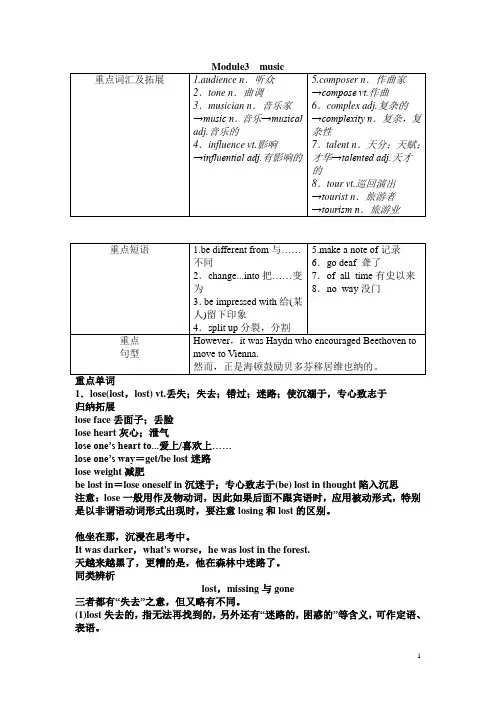
Module3 music重点词汇及拓展 1.audience n.听众2.tone n.曲调3.musician n.音乐家→music n.音乐→musicaladj.音乐的4.influence vt.影响→influential adj.有影响的poser n.作曲家→compose vt.作曲6.complex adj.复杂的→complexity n.复杂,复杂性7.talent n.天分;天赋;才华→talented adj.天才的8.tour vt.巡回演出→t ourist n.旅游者→tourism n.旅游业重点短语 1.be different from与……不同2.change...into把……变为3.be impressed with给(某人)留下印象4.split up分裂,分割5.make a note of记录6.go deaf 聋了7.of_all_time有史以来8.no_way没门重点句型However,it was Haydn who encouraged Beethoven to move to Vienna.然而,正是海顿鼓励贝多芬移居维也纳的。
重点单词1.lose(lost,lost) vt.丢失;失去;错过;迷路;使沉溺于,专心致志于归纳拓展lose face丢面子;丢脸lose heart灰心;泄气lose one’s heart to...爱上/喜欢上……lose one’s way=get/be lost迷路lose weight减肥be lost in=lose oneself in沉迷于;专心致志于(be) lost in thought陷入沉思注意:lose一般用作及物动词,因此如果后面不跟宾语时,应用被动形式,特别是以非谓语动词形式出现时,要注意losing和lost的区别。
他坐在那,沉浸在思考中。
It was darker,what's worse,he was lost in the forest.天越来越黑了,更糟的是,他在森林中迷路了。
外研版高中英语必修二Module3 Music单元练习

高中英语学习材料(灿若寒星*制作整理)Module3 Music单元练习一、听力(听力)(共20小题;共20分)第一节(共5小题;每小题1.5分,满分7.5分)请听下面5段对话,选出最佳选项。
1. Which sport does the woman like best?A. Baseball.B. Badminton.C. Volleyball.2. What are the two speakers going to do?A. Go shopping.B. See a film.C. Have hair cut.3. Where does the conversation probably take place?A. At a hospital.B. At a shop.C. At a post office.4. What's the probable relationship between the two speakers?A. Colleagues.B. Friends.C. Couple.5. What does the woman probably do?A. A reporter.B. A student.C. A tour guide. 第二节(共15小题;每小题1.5分,满分22.5分)请听下面5段对话或独白,选出最佳选项。
请听第6段材料,回答第6至7题。
6. What happened to the man?A. He lost his job.B. He failed his final test.C. He was late for school.7. How is the man's feeling to the woman?A. Frightened.B. Grateful.C. Disappointed. 请听第7段材料,回答第8至9题。
8. Where will the woman take the boys to?A. School.B. Park.C. Hospital.9. What is the man planning to do?A. Open a savings account.B. Bake a birthday cake.C. Buy a birthday present.请听第8段材料,回答第10至12题。
Module3Musici课件(外研版必修2)
Discussion: Is it easy for a deaf person to compose music? What can you learn from his spirit? If you were him, what would you do?
His attitudes towards difficulties music life His character and willpower
He checked into a hotel room where he could continue his experiments. where This is the factory ______I used to work. I used to work in the factory which This is the factory ______ I’ve ever visited.
By the time he got there, the plane had taken off.
The new bridge _______________ by the end of had been designed last month. (design)
will have learnt2,000 By the end of next term we ____________ English words. (learn)
Musical Genius
Haydn 海顿
Father of symphonies
Mozart
Beethoven
Haydn, father of the symphony, changed the symphony into a long piece for a large orchestra _____________________
高中英语 Module 3《music》教案 外研版必修2
Module 3 musicAims and requirements●To enable the students to listen and talk about likes and dislikes (especially about music and musicians),encouraging them to try the vocabulary and everyday English in this unit●To develop the students’ reading ability●To help the students learn and use two grammars (adverbial clause of time and the past perfect tense) in different situations●To help the students to write a biography of a person, using the time expressions in Grammar 1Teaching proceduresPeriod 1 Introduction ,Warming upTeaching aims:Enabling the students to1. know some words about music2. know something about three great posersstep1. Warming up by listening pieces of music and asking questionsPlay several pieces of music (music from Haydn, Mozart and Beethoven will be best) to let the students listen and appreciate, then ask them:1) Do you like music?2) What about these pieces?3) What is your favorite kind of music?4) Who is your favorite musician? And who is your favorite poser?step2. Warming up by showing some pictures and discussing1) Do you know who they are?2) What kind of things are these pictures connected with, science, culture, politics, painting, drawing or music?step3. Warming up by listening to a piece of musicGood morning, class. Today we are going to read a passage about three great musicians who are all posers. A poser is a musician who writes pieces of beautiful music forothers to sing or to play. Now,let’s listen to a piece of music.(the teacher playsa piece of music ----er quan yingyue)1.do you know what kind of music it is?2.whose work is it?3.what kind of music is it?4.what is your feeling after listening to it?Step 4 show the following picturesAnd make the students familiar with these new words:Piano violin saxphone drum erhu guitarste p4.now please match these musical instruments with their names.Step 5 work in groups to discuss these questions:1.which of the instruments do you like listening to?2.which famous musicians play them?3.is the chinese instruments different from the other instruments?describe thedifference,if there is one.Step6 summary and homework:Today we’ve learnt the Introduction,know something about music,and we’ve also learnt some new words.The homework:1.Try to instruct your favorite musician to your class orally.2.Learn the new words again, using the dictionary if necessaryPeriods 2 Reading and VocabularyTeaching Aims:Train the students' reading ability.Learn some useful words and expressions.Teaching Important Points.Help the students to understand the passage better.Learn and master some important words and phrases in this period.Teaching Difficult Points:How to help the students improve their reading and understand the passage better. Teaching Methods:Fast reading to get the general idea of the text.Careful reading to understand the passage better.Discussion to help the students understand what they've learned better. Teaching procedure.Step 1 Lead --inThe teacher may play a kind of music written by Beethoven.------- What kind of music do you think it?----- Who do you know wrote it ?The teacher may discuss the questions and answer them freely.T: As we know, there are various kinds of music around the world. They all have their own obvious characteristic. And also there were famous posers such as Joseph Haydn, Mozart, and Beethoven. Today we may learn of their life from the text.Step 2 Reading prehension.Fast reading: Read the passage quickly and choose the best title.A.Three Great Austrian posers.B.Three Great poser of the eighteenth Century.C.Three Great Child posers.Key: B.Now let's read the passage again, underline new words in the text and decide whether the following statements are right or not.1.The three posers were all born in Austria.2.Mozart had a beautiful singing voice.3.Mozart died before his fortieth birthday.4.Beethoven once worked at the court of a prince, who began to go deaf when he grew older.5.Beethoven had ever met Haydn, but he didn't think he taught him a lot.6.Both Haydn and Mozart had fathers who were musicians.Key:1.F Beethoven was born in Bonn, Germany.2.F. Haydn had a good singing voice.3.T4.F. Haydn once worked at the court of a prince, but he didn't go deaf.5.T6.F. Haydn was the son of a peasant( The teacher may begin with the T/F questions orally and this is a good time to test their listening abilities as well as their prehension of the text. )Step 3 Read and listen to the passage. Meanwhile, some more questions are waiting for you.1.How did Haydn change the form of symphonies?2.How long did he work in eastern Austria?3.How many pieces of music did Mozart pose?4.How old was he when he played for the Empress of Austria?5.How long were Mozart and Haydn friends?6.Who taught Beethoven how to play the piano?7.Did he stop posing when he became deaf?Keys:1 He changed the symphony into a long piece for a large orchestra.2. 30 years.3.More than 600 pieces of music.4. When he was 6 , he played the harpsichord in a concert for the Empress of Austria.Periods 3, Function and GrammarTeaching aims:1 To learn grammar rules2 To use the grammar rules for correct munication3 To study co-operatelyTeaching important points: To use the correct tense and the proper conj. Teaching difficult points: To use correctly the two tenses and the three conj. Teaching methods: Explanation and practiceTeaching procedure:Step Ⅰby telling the class what happened to the Shenzhou Ⅻlot in the area of.Shenzhou Ⅻand the whole nation were waiting and I came back home fromschool and heard the news, I couldn’t help getting exciteed. I feelproud of our country.Step Ⅱ Grammar 11 Make sentences with “when , while, e in , have a lesson〞( Here is a picture of a classroom and a student ing in)A When he came in, we were having a lesson.B When we were having a lesson, he came in.C While we were having a lesson, he came in.2 Say the meaning of “as〞 in the following sentences.D As he was a child, he studied drawing.E As he grew older, he began to go deaf.F He listened to music as he walked.当…之时随着一边…一边…3Answer the three questions.When we talk about a single event in the past,we use when as in A .When we talk about a period of time in the past,we use when/ while / asas in B C D.We use as to refer to a progressive change as in E F .4Practiceplete the following sentences with “when ,while , as〞(1) ___she was studying at school, she also sang in the school choir.(2) ___he was living in Vienna, he studied music.(3) ___she met bach,she was only 20 years old.(4) ___he grew older, he found it more difficult to pose music(5) ___he was playing in the orchestra, he met his wife.(6) ___he was working in Hollywood, he became ill and died.(7) ___I listened to the violin solo, I fell in love with classical music.(8) ___they toured Europe for 10 years, they finnally decided to live inAustrilia.Step Ⅲ Grammar 2 The past perfect tense1Read the following sentences and summarise rules, paying attention to tenses. Fill in the blanks.After Liping had finished doing his homework, he turned on the TV.After they had got everything ready, they began to do the experiment.Before he came to our school, he had taught English for several years.Before his letter reached me, I had received his telephone call.They had finished the project by last month.I had left the country by the time the letter reached me.had done before diddid after had donehad done by did/past time2 PracticeWorkbook Grammar (2)(3)(4)plete the sentences using the verbs in brackets and the past simple or past perfect tense.Step Ⅳ1 Game Oral practice ,pair work.Ask and answer questions using all kinds of tenses.Example:-- When did you have your breakfast this morning?-- At 6.-- Have you prepared for the English lesson?-- Yes, I have. I have finished the exercises in the workbook.2 Watch a vedio play.Step Ⅴ Sum upAsk some students to make sentences using “when, while, as, before, after, by〞. Step Ⅵ Homework: Present a biography of a famous Chinese musician or poser.Periods 4 Speaking and WritingTeaching Aims:1.Knowledge and Skilla.To develop speaking ability by talking about likes and dislikes.b.To learn about some vocabulary and knowledge related to music and posers.c.To develop writing ability by presenting a biography of a famous Chinesemusician or poser.d.Train the ability of collecting and dealing with information, and developtheir abilities of getting new information, munication and cooperation.2.Emotion and Valuesa.To raise students’ interests in science and form the right attitude towardsall kinds of music.b.To help them know Chinese traditional music well and cultivate their interestin playing some Chinese instrument.3. Character-building:a.To make them know how to enjoy different kinds of music.b.Arouse their interest of playing some kinds of instrument and enrich theirleisure time.4. Cross-cultural awarenessa.To help them know the difference between China and some western countries ininstruments.b.Cultivate their awareness of cultural munication through the speciallanguage—music.Difficulties and Importance:a.To make the students understand and grasp the vocabulary and knowledge relatedto music.b.To enable the students to know how to use adverbial clause of time. Teaching Method:a.Task-based methodologyb.municative ApproachTeaching Procedures:Step 1 Pre-readingLook at the picture and answer the following questions.1.Who is he?2.Have you ever know something about him?Step 2 While-readinga. SkimmingRead the passage quickly, and make a note of some basic information about Ye xiaogang.Suggested answers:b. Detailed readingRead the passage carefully and fill in the blanks with proper words. Find what Ye Xiaogang did or what happened to him in the following years:Suggested answers:Step 3. Post-readingDiscussion.1.Are there any similarities between Ye Xiaogang and the European posers you haveread about in this module?2.Do you think it is a good idea to mix Chinese and western music?Step 4 Everyday Englisha. Listen to two people talking about the way they listen to music and answer the questions.1.How do they listen to it?2.Are they happy with the way they listen to music?3.What does Anna offer to do for Tom?b. work in pairs. Discuss your favourite music and how you listen to it.Step 4 Guided writingWrite a short passage of a famous singer in China—Han Hong.The following words may help you:1. sing well successful song writer2.born in1971 in Tibet(某某)3. young watch her mother sing and dance4. at the age of nine professional(专业的) training in Beijing.5. in 1985 her first national prize6. write songs in 19937. song Hometown number one in ChinaHomework:1.Finish writing the biography of Han Hong—a famous Chinese singer.2.Finish other exercises in this module.Periods 5 culture cornerTeaching aims:Enabling the students to1. to know sth about Ye Xiaogang2. write a biography of a famous Chinese musician or poser.Teaching steps:I. Ask some students to say something about Mozart.Give as many details as possible. II. Try to think of a Chinese musician or poser, eg. Xu Peidong.Gather these materials.1. when, where and in what kind of family he/ she was born.2. how he/ she spent his/ her childhood or youth.3. about his/ her education4. what are his/ her famous works5. what his/ her style is / wasGroup work. Ask the students to discuss about the musician or poser.Then ask some students to stand up to say sth. about the musician or poser.Correct the mistakes if any.III. Cultural Corner.Ye Xiaogang1. Listen to the passage and try to find the answer to this question:When did his album Horizon appear? (in 1986)2. Read the passage thoroughly and make a note of the information about Ye Xiaogang.Name:_________________ Sex: __________________Nationality:_____________ Job:___________________Main achievements: ____________________________________________Style of music: ____________________________What he did or happened to him in the following years:1955: ___________________________________________From 1978 to 1983: ___________________________________________1985: ___________________________________________1986: ___________________________________________1996: ___________________________________________3. Check the answers with the whole class. Then ask one or two students to say sth about Ye Xiaogang with the help of the notes made.4. Language points:1) work as2) leading modern posers 主要作曲家leading article 社论the leading cause 主要原因a leading role 主角3) mix A with B= mix A and B togethermix win with waterNever mix with such people.mix up 弄混,弄错It’s mon to mix him up with his brother.弄乱mix up the papersmix up those data4) receive many prizes5) part ofIV. Homework:Write a short passage about the Chinese musician or poser we talked about this period.。
高中英语外研版必修二《Module 3Music3》课件
指;谈到;参与;查阅 第一次 把……和……混合 分裂;分割 记录 因为……而著名 没门儿 有……天赋
Ⅲ.经典句式 1.As Beethoven grew older, hef_o_u_n_d_i_t_m__o_re__d_if_f_ic_u_l_t_to__c_o_m_p_o_s_e_ good music. 随着年龄的增长,贝多芬觉得谱出好的乐曲越来越难了。 2.__If__so__, what do you know about them? 如果这样,你对他们了解多少? 3 . If the words of a song are complex, a_re__th_e_y__e_a_sy__o_r_d_i_ff_i_cu_l_t_t_o_u_n_d_e_r_s_ta_n_d? 如果一首歌的歌词很复杂,那它们理解起来是容易还是困难 呢? 4.Are they happy with _t_h_e_w__a_y_t_h_e_y_l_i_st_e_n_t_o_m__u_s_ic_?__ 他们对听音乐的方式满意吗?
“no+n.”短语大全 ①no way 没门儿 ②no doubt 毫无疑问 ③no wonder 难怪 ④no problem 没问题 ⑤no hurry 不用急 ⑥no comment 无可奉告
“have a/an+n.+for”短语集锦 ①have a talent for 有……的天赋 ②have a gift for 有……的天赋 ③have a taste for 有……的品位 ④have an eye for 有……的鉴赏力
We can't afford to go abroad this summer. 今年夏天我们没有足够的钱去国外。
[特别提醒] afford 后不接 v.-ing 形式作宾语,常与 can, could, be able to 连用,表示具备做某事的能力。
module3-music 外研版必修二课文
Part 2
1.How many pieces of music did Mozart compose?
Over 600 pieces of music.
2.How old was he when he learned to
play the harpsichord ?
When he was four
Three Great Austrian Composers Three Great Composers of the Eighteenth Century
Three Great Child Composers
Read part I and answer:
1.What is Haydn known as? He is known as “the father of the symphony”. 2.How did Haydn change the form of symphonies?
1.弹吉他 2.弹钢琴 3.打鼓 4.拉二胡 5.拉小提琴 6.吹萨克斯
musical instruments
Beethoven
composer/musician a person who composes/writes music
conductor/director
Ones who listen to or watch programmes or performances
[bæ nd]
group of people playing popular music
How many types of music do you know?
Folk music
Country music (乡村音乐)
高考英语外研社通用版:必修2+3+Module+3 Music+Word版含答案
一、语基必备知识(一)重点词汇——分类记忆Ⅰ.阅读词汇——在不认识的词汇前划√jazz n.classical n.conductor n. court n.genius n. tour v t.album n. band n.catchy adj. solo adj.tune n. lecturer n.Ⅱ.核心词汇——写其形1.audience n.听众2.peasant n. 农民3.complex adj. 复杂的4.record v t. 录音Ⅲ.拓展词汇——通其变1.compose v t.作曲;创作→composer n.作曲家→__composition n.作曲;作文;作品2.music n.音乐,乐曲→musician n.音乐家→musical adj.音乐的3.direct v.指挥adj.直接的;径直的→director n.指挥;董事;经理→__direction n.方向4.lose v t.失去;丢失→lost/lost(过去式/过去分词)→loss n.损失→lost adj.丢失的;迷失的5.talent n.天分;天赋;才华→talented adj.有才能的6.influence v t.影响→influential adj.有影响的7.mix v t.使混合→mixture n.混合物1.既可表单数也可表复数的集合名词①audience观众②family家庭;家人③team 队伍④class 班级⑤committee 委员会2.“影响”词汇面面观①influence n.& v.影响②affect v. 影响③effect n. 影响;作用④impact n. 影响;作用3.表达“聪明与愚蠢”的形容词小结①gifted/talented有才能的②stupid 愚蠢的③wise 明智的;聪明的;博学的④silly 傻的;愚蠢的⑤intelligent 聪明的;智能的⑥foolish 傻的;愚蠢的(二)重点短语——记牢用活1.be__known__as作为……而出名2.change...into... 把……变成……3.of__all__time 有史以来4.be__impressed__with 留下深刻印象5.go__deaf 变聋6.if__so 如果这样的话7.split__up 分裂;分割8.make__a__note__of 记录9.no__way 没门10.as__well__as 也1.known短语全扫描①be/become known as作为……而出名②be/become known to sb.为某人所熟知③be/become known for因……而出名2.“no+n.”短语大全①no way没门儿;一点也不②no doubt 毫无疑问③no wonder 难怪④no problem 没问题⑤no comment 无可奉告⑥no sense 没道理3.if省略结构小结①if so如果这样的话②if not 不然的话;否则③if any 即使有……④if anything 如果有……的话⑤if ever (即使有……也)极少⑥if possible 如果可能的话⑦if necessary 如果有必要的话(三)重点句式——背熟巧用Ⅰ.语境填词——根据提示写出该词的适当形式A.根据汉语提示写出下列单词1.Look! The audience(观众) are dressed in a variety of clothes, some in suits, and some in jeans.2.When I am playing a sad tune(音调), I’m crying in my heart.3.Thomas Edison once said, “Genius(天才) is one percent inspiration and ninety-nine percent perspiration.”4.The plot in this novel is so complex(复杂的) that many people can’t understand it well.5.These musicians’tour(巡回演出) of China was well received among the Chinese young people.B.根据所给单词写出适当形式6.After the harvest, peasants(peasant) began to prepare the soil for seed.7.The songs recorded(record) by the radio company are popular with the young now.8.He had lost(lose) his identity card and was being questioned by the police.9.I remember you were a talented(talent) pianist at college. Can you play the piano for me?10.Jack is a gifted composer(compose) and the music written by him is popular with people.Ⅱ.语境品词——写出加黑词汇在语境中的意义1.(2019·全国卷Ⅲ)In addition, most newspapers had little in them that would appeal to a mass audience.读者2.(2019·全国卷Ⅲ)Yolo! Productions and the Great Griffon present the play by Rajiv Joseph, in which an origami(折纸术) artist invites a teenage talent and his teacher into her studio.有才能的人;天才3.(2019·全国卷Ⅲ)The exhibition had record attendance, showing that there is huge interest in Chinese influences.创纪录的Ⅲ.选词成篇make a note of; have a talent for; be known as; as well as; be impressed with; no wayMr. Smith 1.is__known__as an excellent teacher. He is our friend 2.as__well__as our teacher. We 3.are__impressed__with his lessons and in class we try to 4.make__a__note__of every word he says. He is respected by all of us.go deaf; if so; split up; change...into...; of all time5.split__up6.has__gone__deaf for almost one year. In order to communicate with others well, he often uses a hearingaid. He also likes helping homeless children and he7.has__changed his house into a shelter. His life is different from what it used to be.Ⅳ.完成语段1.Having__worked__for__two__days(工作了两天), the director managed to finish his work on schedule. He happily hurried to the station, but by the time he got to the station2.the__train__had__already__gone(火车已经开走了). However,3.it__was__in__the__station__that__he__came__across(就是在车站他遇见了) his old classmate.lose vt.失去;丢失;迷路;使沉溺于;专心致志于[基础练习]——单句语法填空①a.Because she was__lost(lose) in her study, she didn’t notice me come in.b.Lost(lose) in her study, she didn’t notice me come in.c.Losing(lose) herself in her study, she didn’t notice me come in.②When I arrived home, I found one of my suitcases lost(lose).③(湖北卷)Faced with so many new things to learn, I was overcome by fear and was at a loss(lose) what to do.[能力提升]——完成句子④(天津卷)We should not lose__heart(失去信心) in face of difficulties.⑤(湖南卷) If he had followed my advice, he wouldn’t have lost__his__job(丢掉工作).(1)lose oneself in sth./be lost in...专心致志于某事(2)loss n.失去;丧失at a loss 困惑;不知所措(3)lost adj. 失去的;丢失的;迷路的[佳句背诵] In class you should lose yourself in/be lost in listening to the teacher and keep a record of what the teacher says in order not to forget some knowledge. 课堂上你应该专心听讲,把老师讲的记下来,以免忘记一些知识。
外研版高中英语必修二《Music》优质课公开课课件、教案
外研版高中英语必修二《Music》优质课公开课课件、教案Module 3 MusicI.教学内容分斩本模块以“Music”为话题。
学生通过本模块的学习可以了解古今中外的音乐家,提高他们的音乐欣赏水平,培养他们对音乐的评价和鉴赏能力,从而丰富学生的音乐知识,提高学生的艺术修养。
Introduction部分通过设计的两个活动让学生复习和学习一些常见的乐器的名称,激发学生学习本模块的兴趣。
Reading and Vocabulary该部分向同学们介绍了音乐家海顿、莫扎特和贝多芬以及他们的伟大成就。
让同学们在阅读的过程中了解音乐家的奋斗历程,树立正确的人生观和价值观。
通过相关的活动,训练学生的综合语言能力。
Grammar 1学习并巩固时间状语从句。
Writing要求学生阅读一封外国朋友的电子邮件,并根据问题写一封回信。
Function通过回答问题和完成句子让学生懂得如何表达喜好和厌恶,从而初步培养学生的鉴赏能力。
Listening and Vocabulary首先通过听力活动帮助学生了解和学习有关英国乐队The Beatles的背景知识,接着让学生学习新的词汇。
在训练学生听力的同时考查学生的理解能力。
Grammar 2复习过去完成时态。
通过练习帮助学生巩固过去完成时态的基本用法。
Pronunciation学会如何在日常交际中使用升调和降调。
Everyday English要求学生掌握表达喜好的一些用语和有关音乐的日常用语。
Cultural Corner学习一篇有关著名作曲家叶小刚的文章,了解他的音乐经历和音乐成就,增强学生的民族自豪感。
Task训练学生仿写一篇介绍著名音乐家生平和作品的文章。
Module File对整个模块的学习内容进行归纳总结,有助于学生对所学知识进行复习和巩固。
II.教学重点和难点1.教学重点(1)本模块的生词和短语。
(2)弄清楚时间状语从句和过去完成时态的用法。
(3)谈论有关音乐的话题。
高中英语Module3Music试题(含解析)外研版必修2
Module 3 Music(一)The Music Within 心灵深处的音乐生命是什么?这是个见仁见智的问题。
生命在四季变换中流转演绎,一季有一季的风情。
或许春有骤雨连绵,夏有骄阳似火,秋有落叶寂寥,冬有风雪凛冽……Life ... What is it? 生命……是什么?See it in the colors of autumn,看呀,生命是绚烂的秋色,A gentle snowfall in winter,轻盈的冬雪,A sudden shower in spring,春天的骤雨,The radiance of a summer day. 夏日的暖阳。
Behold it in the laughter 瞧呀,生命是童叟的欢笑。
Of the young and the old. 体味生命,Know of it in a surge of hope,怀着满心的希望,The blessings that are bountiful(丰富的). 带着丰盛的祝福。
What is life? 生命是什么?It is joy,awareness,是喜乐,是领悟,And the music within. 是心灵深处的音乐。
(二)那些不喜欢音乐的人 Those Who Don’t Like Music Everybody likes music,right?人人都爱音乐,对吧?I mean,no matter who you are,where you live,or what your ethnic or cultural background is,people everywhere derive some pleasure from listening to their favorite music.不管你是谁,住在哪,来自什么种族,拥有什么文化背景,听自己喜爱的音乐都会感到快乐。
Apparently,though,some people are simply not capable of enjoying music.但是,很明显,有些人就是无法欣赏音乐。