
北师大版八年级英语上册 Unit 3 笔记
爸爸两年前戒烟了。
三、知识梳理
5. at the age of 在...岁时 He could paly the violin at the age of five. 他五岁时就能拉小提琴。 6. have an accident 发生事故 He had an accident on his way home. 他回家的途中发生了事故。 7. half 用作形容词,意为“一半的,半数的”。half 可以与 a/an 连用,也可以构成“half + the + 名词”或“half + one's + 名词”的搭配。 half an hour 半小时 Half the students are girls 半数的学生为女孩子。 He lost half his left leg and half his right arm.
三、知识梳理
1. It's time for sth. 到...时间了 It's time for after-class activities.
到课下活动的时候了。
2. any other+单数名词 I was faster than any other student.
3. a bit 程度副词,副词可以修饰动词、形容词、副词。
一、重点短语 二笔记
一、重点短语
1、do the high jump 跳高 2、do the long jump 跳远 3、do push-ups 做俯卧撑 4、do sit-ups 做仰卧起坐 5、do pull-ups 做引起向上 6、climb a rope 爬绳 7、after-class activities 课下活动 8、break the record 打破记录 9、a bit 稍微;有点儿 10、joke around 开玩笑
我比任何其他学生都要快。
9. She began swimming at the age of eight.
他8岁开始游泳。
10. This made the expedition even more difficult. 这使得这次探险更加艰难。
二、关键句型
11. You must describe your building but it doesn't have to be long. 你必须描述你的建筑作品,但是没必要耗时太长。 12. Mike can't stand travelling alone. 迈克不能忍受独立旅行。 13. It takes me half an hour to walk to school every day. 我每天都花半小时步行上学。 14. I don't mind waiting for a long time. 我不介意等这么长时间。 15. You mustn't cross the street on a red light. 红灯时禁止过马路。
一、重点短语
11、the North Pole 北极 12、the South Pole 南极 13、any other student 任何其他的学生 14、half way through 中途 15、a few 几个,一些 16、prepare for =get ready for 为某事做准备 17、have an accident 发生一次事故 18、be careful 小心 19、get better 有所好转 20、arrive at/in 到达
二、关键句型
1. Climbing the rope is harder than sit-ups and push-ups. 爬绳子比做仰卧起坐和俯卧撑难。 2. I can jump higher than that table. 我可以比那个桌子跳得高。 3. The lake expedition was the most difficult of the three. 湖探险是三项探险项目中最危险的。 4. Our girl athlete jumped highest in the high jump event. 我们的女子运动员在跳高中跳得最高。 5. I always give up half way through. 我总是半路放弃。
二、关键句型
6. Tim is much stronger than last year.
Tim 今年比去年强壮的多。
7. It's even harder than sit-ups and push-ups.
它甚至比仰卧起坐和俯卧撑还要难。 8. I was faster than any other student!
Unit 3 Faster, Higher, Stronger
重点知识
送给你们的话:
有一句话说的很有意思:今天很 残酷,明天更残酷,后天很美好, 但是绝大多数人都“死”在明天 晚上,见不到后天的太阳,道理 就是这样。如果细心观察,你就 会发现,最成功的人,往往是那 些坚持最持久、走得最远的人。
书写格式
一、重点短语
21、get to 到达 22、take place 发生 23、give the best answer 给出最好的答案 24、begin doing/to to 开始做某事 25、give up+sth/doing sth 放弃做某事 26、ask sb. to do sth. 让某人做某事 27、argue with sb. sbout sth. 和某人就某事争论 28、make+宾语+adj. 使...怎么样 29、at the age of 在...岁的时候 30、at the end of 在...的末尾
北师大版-英语-八上-Unit 3 Countries and Citie语法及短语解析
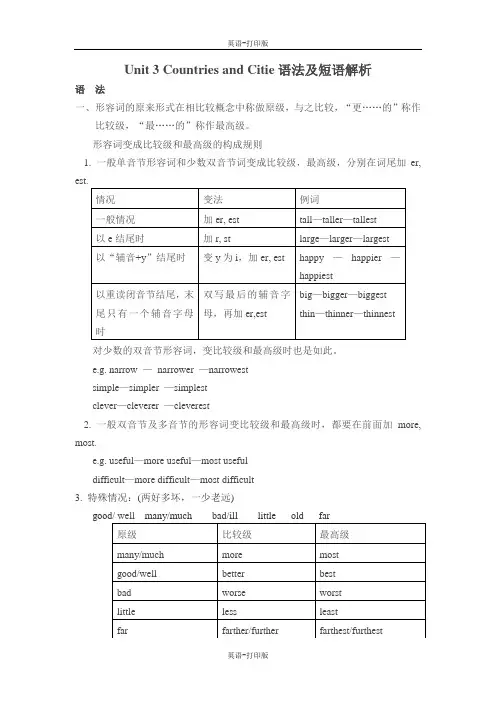
Unit 3 Countries and Citie 语法及短语解析语 法一、形容词的原来形式在相比较概念中称做原级,与之比较,“更……的”称作比较级,“最……的”称作最高级。
形容词变成比较级和最高级的构成规则1. 一般单音节形容词和少数双音节词变成比较级,最高级,分别在词尾加er,对少数的双音节形容词,变比较级和最高级时也是如此。
e.g. narrow — narrower —narrowestsimple —simpler —simplestclever —cleverer —cleverest2.一般双音节及多音节的形容词变比较级和最高级时,都要在前面加more, most.e.g. useful —more useful —most usefuldifficult —more difficult —most difficult3. 特殊情况:(两好多坏,一少老远)4. 其他用法。
(1)形容词的同级比较。
表示两者一样时,用as…as,不及……时,用not so…as, not as…ase.g. He is as tall as his elder sister.I read lesson 2 as many times as lesson 1.In winter it is not so cold in Nanjing as in Beijing.(2)形容词比较级的单独用法。
Are you feeling better now?Be more careful.Eat less meat and more vegetable.He has less money.(3)more and more 越来越After March, the weather is getting warmer and warmer.Now our country is getting stronger and stronger.The garden is becoming more and more beautiful.(4)the more… the more 越是……就越The more angry she became, the more they laughed at her.The harder you work, the better you will do.二、不定代词的用法不是指明代替任何特定名词的代词叫做不定代词。
八上英语第三单元笔记
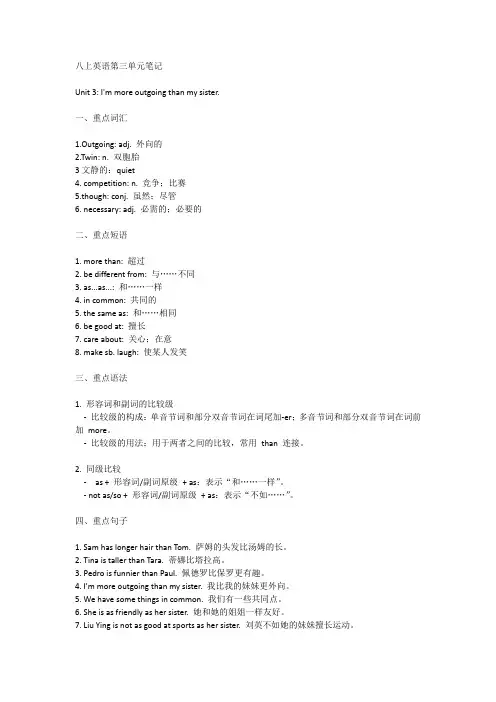
八上英语第三单元笔记Unit 3: I'm more outgoing than my sister.一、重点词汇1.Outgoing: adj. 外向的2.Twin: n. 双胞胎3文静的:quiet4. competition: n. 竞争;比赛5.though: conj. 虽然;尽管6. necessary: adj. 必需的;必要的二、重点短语1. more than: 超过2. be different from: 与……不同3. as...as...: 和……一样4. in common: 共同的5. the same as: 和……相同6. be good at: 擅长7. care about: 关心;在意8. make sb. laugh: 使某人发笑三、重点语法1. 形容词和副词的比较级-比较级的构成:单音节词和部分双音节词在词尾加-er;多音节词和部分双音节词在词前加more。
-比较级的用法:用于两者之间的比较,常用than 连接。
2. 同级比较-as + 形容词/副词原级+ as:表示“和……一样”。
- not as/so + 形容词/副词原级+ as:表示“不如……”。
四、重点句子1. Sam has longer hair than Tom. 萨姆的头发比汤姆的长。
2. Tina is taller than Tara. 蒂娜比塔拉高。
3. Pedro is funnier than Paul. 佩德罗比保罗更有趣。
4. I'm more outgoing than my sister. 我比我的妹妹更外向。
5. We have some things in common. 我们有一些共同点。
6. She is as friendly as her sister. 她和她的姐姐一样友好。
7. Liu Ying is not as good at sports as her sister. 刘英不如她的妹妹擅长运动。
北师大版八年级上册英语 Unit 3 词汇和语法基础(解析版) (2)
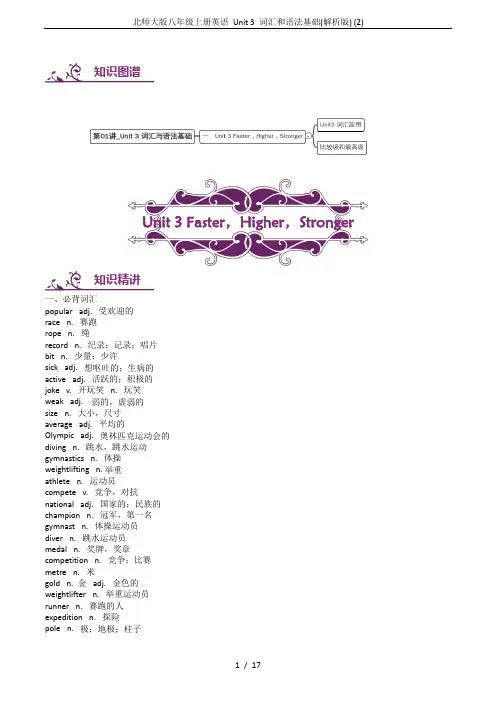
7. accident noun /ˈæksɪdənt/
something bad that happens that is not expected or intended and that often damages something or injures someone意外;不测;事故
Olympic adj.奥林匹克运动会的
diving n.跳水,跳水运动
gymnastics n.体操
weightlifting n.举重
athlete n.运动员
compete v.竞争,对抗
national adj.国家的;民族的
champion n.冠军,第一名
gymnast n.体操运动员
diver n.跳水运动员
(尤指重大或不寻常的)事情,事件
例句:
This year’s Olympic Games will be the biggest ever sporting event.
今年的奥林匹克运动会将是历史上规模最大的体育盛事。
Susannah’s party was the social event of the year.
(在思想上或心理上)作好准备;防范
例句:
It almost seems as if she is preparing to die.
看来她好像已经作好了赴死的准备。
You need to prepare yourself for a long wait.
你需要作好长时间等待的准备。
9. artificial adjective /ˌɑːtɪˈfɪʃəl/
计算机公司间的竞争很激烈。
初二上册英语第三单元笔记
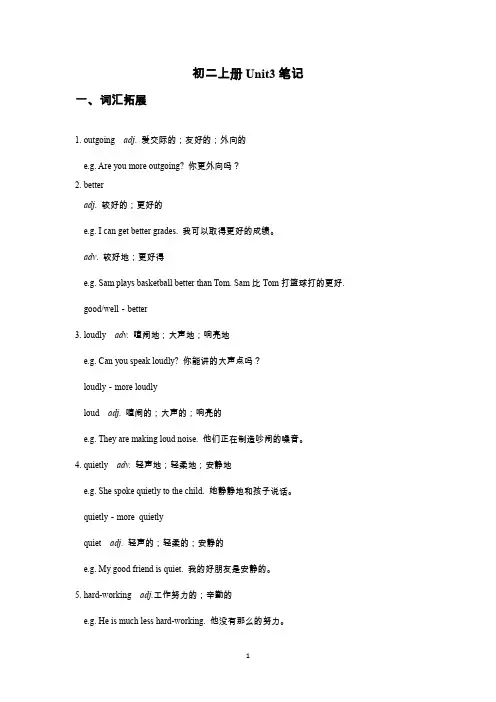
初二上册Unit3笔记一、词汇拓展1. outgoing adj. 爱交际的;友好的;外向的e.g. Are you more outgoing? 你更外向吗?2. betteradj.较好的;更好的e.g. I can get better grades. 我可以取得更好的成绩。
adv. 较好地;更好得e.g. Sam plays basketball better than Tom. Sam比Tom打篮球打的更好. good/well-better3. loudly adv.喧闹地;大声地;响亮地e.g. Can you speak loudly? 你能讲的大声点吗?loudly-more loudlyloud adj. 喧闹的;大声的;响亮的e.g. They are making loud noise. 他们正在制造吵闹的噪音。
4. quietly adv. 轻声地;轻柔地;安静地e.g. She spoke quietly to the child. 她静静地和孩子说话。
quietly-more quietlyquiet adj. 轻声的;轻柔的;安静的e.g. My good friend is quiet. 我的好朋友是安静的。
5. hard-working adj.工作努力的;辛勤的e.g. He is much less hard-working. 他没有那么的努力。
hard-working-more hard-workinghard-working-less hard-working6. competition n.比赛;竞赛;竞争e.g. Do you like the singing competition? 你喜欢这个歌唱比赛吗?7. clearly adv.清楚地;清晰地;明白地e.g. She sings more clearly than others. 她比其他人唱得更清楚。
北师大版初二上英语unit 3 词汇语法复习篇
Unit 3 词汇篇____________________________________________________________________________________________________________________________________________________________________1. 理解并灵活运用重点单词、词组2. 理解、掌握并灵活运用重点句型1. compete v. 竞争,对抗compete常用于下列短语:compete with意为“与…媲美;比得上”,例如:She competes with her best friend. 她和她最好的朋友互相竞争。
compete for 意为“为…竞争”,例如:They competed for the gold medal. 他们为了金牌而竞争。
competition n. 竞争,比赛2. prepare v. 准备常与for一起连用,构成短语prepare for 意为“为…做准备”,例如:I can’t go to the movie with you because I have to prepare for an exam.我不能和你一起去看电影,因为我不得不为考试做准备。
3. arrive v. 到达,抵达arrive不及物动词,后接表地点的名词时,要使用介词in或at。
其中arrive in后接比较大的地点,如国家或城市等;arrive at后接具体的小地点,如车站、学校、公园等。
例如:He arrived in England last week. 他上周抵达英国。
When did you arrive at the bus station. 你什么时候到达公共汽车站的?4. spend v. 花费过去式、过去分词spent, spent 主语是人spend some time /some money on sth. 花时间/钱在某事上spend some time /some money (in) doing sth. 花时间/钱做某事例如:I spent 10 dollars on the book. / I spent 10 dollars (in) buying the book.我花10美元买了这本书。
英语:Unit 3 Countries and Cities词汇学习(北师大版八年级上)
Unit 3 Countries and Cities 1. such as 1)比如,例如2)像……这样的,诸如……这类There is a lot of fruit in the shop, such as oranges, bananas, etc.店中有多种水果出售,比如橘子、香蕉等等。
They visited several cities such as Beijing, Shanghai, and Qingdao.他们游览了几个城市,如北京、上海、青岛。
Animals such as dogs and cats are called pets.像狗、猫这类动物叫做宠物。
2. of course当然,自然;当然可以Of course he’ll help me.他当然会帮助我。
“Are you going to see Mr. Green with us?” “Of course!”“你和我们一起去看望格林先生吗?”“当然!”“May I use your telephone?” “Yes, of course.”“我可以借您的电话用一用吗?” “当然可以。
““Do you want to go back?” “Of course not!”“你想回去吗?”“当然不想!”3. prefer to do sth.宁愿做(某事);更喜欢……He prefers to live among the young people.他更喜欢和年轻人住在一起。
I would prefer not to go out today.我今天宁愿不出去。
He offered to drive us to the theatre, but we preferred to walk. 他愿意开车送我们去剧场,但我们愿意走着去。
4. not…any more(=no more)不再……,没有再……We did not see him any more.我们没有再见到他。
八年级上册英语第3单元笔记
第三单元《询问信息》1. 问路问路是交流中非常重要的部分。
我们可以用一些常用的问路短语来向别人询问路线。
例如:- Can you tell me how to get to the post office?(你能告诉我去邮局怎么走吗?)- Do you know where the train station is?(你知道火车站在哪里吗?)- Could you give me directions to the park?(你能给我指路去公园吗?)- How do I get to the zoo?(我怎么去动物园?)当我们向别人问路时,一定要保持礼貌和友好。
例如:- Thank you for your help!(谢谢你的帮助!)- You're welcome!(不客气!)- It was very nice of you to help me.(你帮了我很大的忙。
)2. 询问时间当我们需要知道时间时,可以用一些常用的询问短语。
例如:- What time is it now?(现在几点了?)- Can you tell me what time it is?(你能告诉我现在几点了吗?)- When is the meeting supposed to start?(会议什么时候开始?)- Is it already 5 o'clock?(现在已经是5点了?)当我们得到别人的时间回答后,可以用一些回答短语来表达感谢。
例如:- Thank you.(谢谢。
)- That's great.(太好了。
)- I appreciate it.(我很感激。
)3. 询问价格当我们需要知道某件商品的价格时,可以用一些常用的询问短语。
例如:- What is the price of this item?(这个物品多少钱?)- Can you tell me what this item costs?(你能告诉我这个物品的价格吗?)- How much does this T-shirt cost?(这件T恤多少钱?)当我们得到别人的价格回答后,可以用一些回答短语来表达感谢。
八上英语Unit 3笔记整理
八上英语Unit 3笔记整理【重点单词】①outgoing ['aʊtɡəʊɪŋ] adj. 外向的②better ['betə(r)] adj. & adv.(good和well的比较级) 较好的(地);更好的(地)③loudly ['laʊdli]adv. 喧闹地,大声地;响亮地④quietly ['kwaɪətli]adv. 轻声地;轻柔地;安静地⑤hard-working [ˌhɑː(r)d'wɜːkɪŋ]adj. 工作努力的;辛勤的⑥competition [ˌkɒmpə'tɪʃn], [ˌkɑːmpə'tɪʃn]n. 比赛;竞赛;竞争⑦fantastic [fæn'tæstɪk]adj. 极好的;了不起的which [wɪtʃ] pron. & adj. 哪一个;哪一些⑧clearly ['klɪəli], ['klɪrli]⑨adv. 清楚地;清晰地;明白的win [wɪn] v. 获胜;赢;赢得though [ðəʊ] adv. 不过;可是;然而conj. 虽然;尽管;不过talented ['tæləntɪd] adj. 有才能的;有才干的truly ['truːli] adv. 真正;确实care [keə] , [ker] v. 在意;担忧;关心care about 关心;在意⑩serious ['sɪəriəs], ['sɪriəs]adj. 严肃的;稳重的mirror ['mɪrə(r)] n. 镜子kid [kɪd] n. 小孩;年轻人as long as 只要;既然necessary ['nesəsəri], ['nesəseri]adj. 必需的;必要的be different from与······不同;与······有差异both [bəʊθ] adj. & pron. 两个;两个都bring out 使显现;使表现出grade [greɪd] n. 成绩等级;评分等级should [ʃʊd] , [ʃəd] modal v. 应该;应当;可以the same as 和······相同;与······一致saying ['seɪɪŋ] n. 谚语;格言;警句reach [riːtʃ] v. 伸手;到达;抵达hand [hænd]n. 手touch [tʌtʃ] v. 感动;触摸heart [hɑː(r)t] n. 内心;心脏fact [fækt]n. 现实;事实in fact 确切地说;事实上;实际上break [breɪk] v. (broke [brəʊk]) (使)破;裂;碎;损坏arm [ɑːm] n. 手臂;上肢laugh [lɑːf], [læf]v. 笑;发笑n. 笑声share [ʃeə] , [ʃer] v. 分享,共享;共用;分摊loud [laʊd] adj. 响亮的;大声的similar ['sɪmələ(r)] adj. 相像的;类似的be similar to 与······相像的;与······类似的primary ['praɪməri], ['praɪmeri] adj. 最初的,最早的primary school 小学information [ˌɪnfə(r)'meɪʃn] n. 信息;消息Tara ['tɑːrə], ['tærə] 塔拉(女名)Sam [sæm]萨姆(男名)Nelly ['nelɪ] 内莉(女名)Larry ['lærɪ] 拉里(男名)【重点短语】1. more outgoing 更外向/更开朗2. as...as...与……一样3. the singing competition 歌咏比赛4. the most important 最重要的5. be talented in music 在音乐方面有天赋6. the same as 与……相同7. care about 关心/留意/关注8. be different from 与…...不同9. be like a mirror 像一面镜子10. as long as 只要;与…...一样长11. bring out 显示/显出12. get better grades 取得更好的成绩13. reach for 伸手达到/达到14. touch one’s heart 感动15. in fact 事实上16. make friends 交朋友17. be good at 在某方面成绩好18. the other 另一个19. be similar to 与…相似20. be good with 与…和睦相处【重点句型】1. Sam has longer hair than Tom.= Sam’s hair is longer than Tom’s. Sam 的头发比Tom的长。
八年级上册英语unit 3的知识点
八年级上册英语unit 3的知识点在八年级上册英语教材中,Unit 3是一个非常重要的单元,其中蕴含着丰富的语言知识和文化知识。
本文将详细介绍Unit 3的知识点,以帮助读者更好地学习和掌握英语知识。
一、词汇1. 关于食物和饮料的词汇例句:I like to eat pizza, fried chicken, and ice cream.Tom prefers to drink milk and orange juice.2. 形容词例句:The shirt is too small for me.My brother is very tall and strong.3. 时间和日期例句:We have a math class at 8:30 in the morning. My birthday is on October 10th.4. 数字例句:There are four seasons in a year.The price of this book is ten dollars.二、语法1. 现在进行时态现在进行时态表示现在正在进行的动作。
它的构成是be动词+现在分词。
常见的be动词有:am、is、are。
例句:I am reading a book.They are playing soccer in the park.2. 宾格代词宾格代词是指在句子中作为宾语使用的代词。
常见的宾格代词有:me、you、him、her、it、us、them。
例句:She gave me a gift for my birthday.The teacher asked him a question.3. 物主代词物主代词是用来表示所有权的代词。
常见的物主代词有:my、your、his、her、its、our、their。
例句:This is my book, not yours.His new car is very expensive.三、阅读本单元的阅读部分是一篇介绍英国学校生活的文章。
八年级上册英语三单元笔记
以下是一份八年级上册英语第三单元的笔记,供您参考:
第三单元动词不定式
动词不定式是一种非谓语形式,在句子中不能充当谓语,但可以充当主语、宾语、表语、定语或状语等成分。
动词不定式的形式:to + 动词原形,如:to run、to go、to study等。
动词不定式的用法:
1. 做主语:To learn English is very important. 学习英语很重要。
2. 做宾语:I want to go to the park. 我想去公园。
3. 做表语:My dream is to become a doctor. 我的梦想是成为一名医生。
4. 做定语:He has a lot of work to do. 他有很多工作要做。
5. 做状语:I will go to the library to study. 我将去图书馆学习。
注意事项:
1. 动词不定式需要使用动词原形,不能使用其他形式。
2. 动词不定式可以带宾语或表语,如:to see a movie(看电影)、to go to the beach(去海滩)。
3. 动词不定式可以省略to,如:Let me help you(to)carry the box. 让
我帮你搬箱子。
4. 动词不定式需要使用正确的形式,根据时态和语态进行变化。
以上是八年级上册英语第三单元的笔记,希望对您有所帮助。