
外研版高中英语必修二课件 Unit 6 Earth first Section Ⅲ
上是主谓关系。能接-ing 形式作补语的有两类动词: (1)感觉、感官类动词:see, notice, watch, look at, hear, listen to, find, feel, smell 等。 ◆He heard the wind blowing outside. 他听到外边在刮风。 ◆I felt my heart beating faster. 我感到我的心跳得更快了。
栏目 导引
Unit 6 Earth first
劝说信 文体感知
劝说信的内容来源于我们对生活的感知,是就我们所发现 的家庭生活、学校生活或社会生活中的某种现象,向某个组织 或个人提出劝说性的建议的一种应用文体。
栏目 导引
Unit 6 Earth first
增分佳句 1.The reason why the environment is polluted is that we don’ t attach great importance to it. 2.We are concerned that materials will be used up soon. 3.Now people in growing numbers are coming to realize that taking exercise is beneficial to our health. 4.A recent study shows that people spend most of their spare time on phones.
栏ห้องสมุดไป่ตู้ 导引
Unit 6 Earth first
写作要求 每年的 10 月 31 日是联合国确定的“世界勤俭日”。假如
你是李华,请针对校园中学生花钱如水、没有节约意识以及追 求高水平生活、追求时髦等现象,写一封劝说信,鼓励同学们 养成勤俭节约的好习惯。 注意:1.词数 80 左右;
2.开头和结尾已写好,不计入总词数。
栏目 导引
Unit 6 Earth first
5.The man left us __s_t_a_n_d_in__g___ (stand) alone, unable to find
any help. 6.When the Greens found their house ___b_r_o_k_e_n____ (break)
(stare) at the steak on the plate. 10.Don’t leave the girl ___w__a_it_in_g____ (wait) outside all the
time.
栏目 导引
Unit 6 Earth first
Ⅱ 语法与写作 1.My mother kept me _p_r_a_c_ti_s_in_g_/_p_r_a_c_t_ic_i_n_g_p_l_a_y_in_g__t_h_e_p_i_a_n_o_ (练习弹钢琴), which made me annoyed. 2.W__i_t_h_t_h_e_t_e_m__p_e_ra_t_u_r_e_r_i_s_in_g_ (随着温度的升高), the leaves and grass began to appear. 3.To his surprise, he didn’t ___n_o_t_ic_e_h_i_s_w__a_ll_e_t_s_to_l_e_n_______ (注意到被人偷) on the bus.
◆She was glad to see her child taken good care of. 她很高兴看到自己的孩子被照顾得很好。
◆I was sleeping when I heard my name called. 我正在睡觉,这时听到有人喊我的名字。
栏目 导引
Unit 6 Earth first
栏目 导引
Unit 6 Earth first
Ⅰ 单句语法填空 1.When I passed by his office, I heard him _s_i_n_g_in__g__ (sing) a Chinese song. 2.The place looks much better since they had it _r_e_d_e_c_o_r_a_te_d__ (redecorate). 3.Tom has been away from home for two years, leaving his room __c_o_v_e_r_e_d____ (cover) with dust. 4.When I saw the dog _b_e_i_n_g_b__e_a_te_n_ (beat) by several boys, I came up to stop them.
(2)位于 get, have, make, keep, leave 等使役动词后作补语。 ◆They are going to have the house painted white. 他们准备把房子刷成白色。
1.使役动词 have, get 后接非谓语动词作补语的异同点: (1)have sth.done=get sth.done ◆I had/got my hair cut yesterday. 我昨天理了发。 ◆The lady had/got her bag stolen on the bus yesterday. 昨天,这位女士的包在公共汽车上被偷了。
栏目 导引
Unit 6 Earth first
(2)have sb./sth.doing sth. 让 某 人 / 某 物 一 直 做 某 事 ; get sb./sth.doing sth.使某人/某物(开始)做某事。sb./sth.与构成现在 分词的动词之间是主谓关系。 ◆Don’t have the water running while brushing your teeth. 刷牙时,别让水一直流着。 ◆Let’s get the machine running. 让我们使这台机器运转起来吧。
______________________________________________________
______________________________________________________
______________________________________________________
栏目 导引
2.-ed 形式作补语
Unit 6 Earth first
ed 形式作宾语补足语既可表示被动又可表示动作已经完
成;宾语与宾语补足语之间在逻辑上是动宾关系。ed 形式作
补语的常见情况:
(1)位于 feel, find, hear, notice, see, smell, observe 等感官动词后 作补语。
栏目 导引
Unit 6 Earth first
(2)with+名词/代词+过去分词。过去分词可表示被动和动作已 完成。 ◆With his hair cut, he looked much younger. 理了发,他看起来年轻多了。(原因状语) (3)with+名词/代词+不定式。不定式表示动作尚未发生。切记: 不定式一般情况下都用主动形式。 ◆With a lot of homework to do, I can’t go skating with you. 因为有很多家庭作业要做,我不能和你一起去滑冰了。(原因状 语)
into, they called the police at once. 7.Did you hear the song ___su_n__g__ (sing) in Chinese when in the U.S.A.? 8.When I was on my way to school this morning, I saw two women __a_r_g_u_i_n_g____ (argue). 9.A beggar in rags stood there with his eyes ___st_a_r_i_n_g____
栏目 导引
Unit 6 Earth first
2.with 复合结构中作宾补的非谓语动词 “with+宾语+宾补”结构可在句中作定语或状语(表示
原因、时间、条件、伴随、方式等),宾补可以是名词/形容词/ 副词/介词短语/现在分词/过去分词/不定式。 在此我们重点讲解 宾补是分词和不定式的情况。 (1)with+名词/代词+现在分词。现在分词可表示主动和动作正 在进行。 ◆He lay on the grass with his eyes looking at the sky. 他躺在草地上,眼望着天空。(伴随状语)
栏目 导引
Unit 6 Earth first
(2)使役动词:keep, get, leave, have 等。 ◆I’m sorry to have kept you waiting for so long. 不好意思让你等这么久。 ◆The captain got the soldiers moving toward the front after a short rest. 休息了片刻之后,上尉让士兵们朝前线行进。
栏目 导引
Unit 6 Earth first
Dear friends,
As we know, World Thrift Day falls on October 31st. So this time I’d like to discuss thrift with you.
______________________________________________________
Section Ⅲ Using language & Writing
Unit 6 Earth first
-ing 形式和-ed 形式作宾语补足语 补足语是用来说明宾语或主语情况的成分,在英语中,ing 形式和-ed 形式都可以作补足语。
栏目 导引
Unit 6 Earth first
劝说信 文体感知
劝说信的内容来源于我们对生活的感知,是就我们所发现 的家庭生活、学校生活或社会生活中的某种现象,向某个组织 或个人提出劝说性的建议的一种应用文体。
栏目 导引
Unit 6 Earth first
增分佳句 1.The reason why the environment is polluted is that we don’ t attach great importance to it. 2.We are concerned that materials will be used up soon. 3.Now people in growing numbers are coming to realize that taking exercise is beneficial to our health. 4.A recent study shows that people spend most of their spare time on phones.
栏ห้องสมุดไป่ตู้ 导引
Unit 6 Earth first
写作要求 每年的 10 月 31 日是联合国确定的“世界勤俭日”。假如
你是李华,请针对校园中学生花钱如水、没有节约意识以及追 求高水平生活、追求时髦等现象,写一封劝说信,鼓励同学们 养成勤俭节约的好习惯。 注意:1.词数 80 左右;
2.开头和结尾已写好,不计入总词数。
栏目 导引
Unit 6 Earth first
5.The man left us __s_t_a_n_d_in__g___ (stand) alone, unable to find
any help. 6.When the Greens found their house ___b_r_o_k_e_n____ (break)
(stare) at the steak on the plate. 10.Don’t leave the girl ___w__a_it_in_g____ (wait) outside all the
time.
栏目 导引
Unit 6 Earth first
Ⅱ 语法与写作 1.My mother kept me _p_r_a_c_ti_s_in_g_/_p_r_a_c_t_ic_i_n_g_p_l_a_y_in_g__t_h_e_p_i_a_n_o_ (练习弹钢琴), which made me annoyed. 2.W__i_t_h_t_h_e_t_e_m__p_e_ra_t_u_r_e_r_i_s_in_g_ (随着温度的升高), the leaves and grass began to appear. 3.To his surprise, he didn’t ___n_o_t_ic_e_h_i_s_w__a_ll_e_t_s_to_l_e_n_______ (注意到被人偷) on the bus.
◆She was glad to see her child taken good care of. 她很高兴看到自己的孩子被照顾得很好。
◆I was sleeping when I heard my name called. 我正在睡觉,这时听到有人喊我的名字。
栏目 导引
Unit 6 Earth first
栏目 导引
Unit 6 Earth first
Ⅰ 单句语法填空 1.When I passed by his office, I heard him _s_i_n_g_in__g__ (sing) a Chinese song. 2.The place looks much better since they had it _r_e_d_e_c_o_r_a_te_d__ (redecorate). 3.Tom has been away from home for two years, leaving his room __c_o_v_e_r_e_d____ (cover) with dust. 4.When I saw the dog _b_e_i_n_g_b__e_a_te_n_ (beat) by several boys, I came up to stop them.
(2)位于 get, have, make, keep, leave 等使役动词后作补语。 ◆They are going to have the house painted white. 他们准备把房子刷成白色。
1.使役动词 have, get 后接非谓语动词作补语的异同点: (1)have sth.done=get sth.done ◆I had/got my hair cut yesterday. 我昨天理了发。 ◆The lady had/got her bag stolen on the bus yesterday. 昨天,这位女士的包在公共汽车上被偷了。
栏目 导引
Unit 6 Earth first
(2)have sb./sth.doing sth. 让 某 人 / 某 物 一 直 做 某 事 ; get sb./sth.doing sth.使某人/某物(开始)做某事。sb./sth.与构成现在 分词的动词之间是主谓关系。 ◆Don’t have the water running while brushing your teeth. 刷牙时,别让水一直流着。 ◆Let’s get the machine running. 让我们使这台机器运转起来吧。
______________________________________________________
______________________________________________________
______________________________________________________
栏目 导引
2.-ed 形式作补语
Unit 6 Earth first
ed 形式作宾语补足语既可表示被动又可表示动作已经完
成;宾语与宾语补足语之间在逻辑上是动宾关系。ed 形式作
补语的常见情况:
(1)位于 feel, find, hear, notice, see, smell, observe 等感官动词后 作补语。
栏目 导引
Unit 6 Earth first
(2)with+名词/代词+过去分词。过去分词可表示被动和动作已 完成。 ◆With his hair cut, he looked much younger. 理了发,他看起来年轻多了。(原因状语) (3)with+名词/代词+不定式。不定式表示动作尚未发生。切记: 不定式一般情况下都用主动形式。 ◆With a lot of homework to do, I can’t go skating with you. 因为有很多家庭作业要做,我不能和你一起去滑冰了。(原因状 语)
into, they called the police at once. 7.Did you hear the song ___su_n__g__ (sing) in Chinese when in the U.S.A.? 8.When I was on my way to school this morning, I saw two women __a_r_g_u_i_n_g____ (argue). 9.A beggar in rags stood there with his eyes ___st_a_r_i_n_g____
栏目 导引
Unit 6 Earth first
2.with 复合结构中作宾补的非谓语动词 “with+宾语+宾补”结构可在句中作定语或状语(表示
原因、时间、条件、伴随、方式等),宾补可以是名词/形容词/ 副词/介词短语/现在分词/过去分词/不定式。 在此我们重点讲解 宾补是分词和不定式的情况。 (1)with+名词/代词+现在分词。现在分词可表示主动和动作正 在进行。 ◆He lay on the grass with his eyes looking at the sky. 他躺在草地上,眼望着天空。(伴随状语)
栏目 导引
Unit 6 Earth first
(2)使役动词:keep, get, leave, have 等。 ◆I’m sorry to have kept you waiting for so long. 不好意思让你等这么久。 ◆The captain got the soldiers moving toward the front after a short rest. 休息了片刻之后,上尉让士兵们朝前线行进。
栏目 导引
Unit 6 Earth first
Dear friends,
As we know, World Thrift Day falls on October 31st. So this time I’d like to discuss thrift with you.
______________________________________________________
Section Ⅲ Using language & Writing
Unit 6 Earth first
-ing 形式和-ed 形式作宾语补足语 补足语是用来说明宾语或主语情况的成分,在英语中,ing 形式和-ed 形式都可以作补足语。
合集下载
2020学年新教材高中英语 UNIT 6 Earth first Section Ⅱ Using language课件 外研版必修第二册
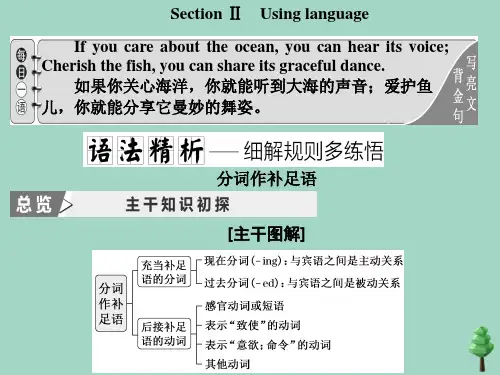
同的句式中。具体地说,主动语态句子中的宾语补足语就是 被动语态句子中的主语补足语。 2.分词作主语(宾语)补足语时,若主语(宾语)与分词之间是主 动关系,则用现在分词表示主动;如果主语(宾语)与分词之 间是被动was heard singing in the next room.(主语he与 “sing”之间是 主动关系,故用现在分词singing作主语补足语) 有人听到他在隔壁房间唱歌。 One of the glasses was found broken.(主语one of the glasses与 “break”之间是被动关系,故用过去分词broken作主语补足语) 有一个玻璃杯被发现碎了。 Don't leave the water running while you brush your teeth.(宾语 the water与“run”之间是主动关系,故用现在分词running作宾 语补足语) 刷牙的时候不要让水一直淌着。
Section Ⅱ Using language If you care about the ocean, you can hear its voice; Cherish the fish, you can share its graceful dance. 如果你关心海洋,你就能听到大海的声音;爱护鱼 儿,你就能分享它曼妙的舞姿。
4.set, start, catch常跟现在分词作宾语补足语,make常跟过去 分词作宾语补足语。如: He looked around and caught a man putting his hand into the pocket of a passenger. 他环顾四周,看见一个人把手伸进乘客的口袋里。 The speaker raised his voice but still couldn't make himself heard. 演讲者提高了声音,但仍然不能使别人听到他说的话。
Section Ⅱ Using language If you care about the ocean, you can hear its voice; Cherish the fish, you can share its graceful dance. 如果你关心海洋,你就能听到大海的声音;爱护鱼 儿,你就能分享它曼妙的舞姿。
4.set, start, catch常跟现在分词作宾语补足语,make常跟过去 分词作宾语补足语。如: He looked around and caught a man putting his hand into the pocket of a passenger. 他环顾四周,看见一个人把手伸进乘客的口袋里。 The speaker raised his voice but still couldn't make himself heard. 演讲者提高了声音,但仍然不能使别人听到他说的话。
新外研社高中英语必修二Unit6Earth first-Using Language课件

because trees absorb the
for example.
__L_E__D_b__u_lb___is a great start. carbon dioxide in the air.
• Work in pairs. Discuss what you can do to help deal with global warming,using the
3. Just then he heard someone __c_a_l_li_n_g_____(call) for help.
4. He worked so hard that he got his pay _r_a_is_e_d_________(raise).
5. The speaker raised his voice to make himself _h_e_a_r_d_____________(hear).
on. ⑥ With exams approaching, it's a good idea to
review your class notes.
动词-ing形式作宾补,表示动作正在进行,尚未结束 。宾语与宾补之间是逻辑上的主谓关系,表主动。
-ing as object complement 过去分词作宾补
新外研社高中英语必修二 Unit 6 Earth First Using Laectives
宾补出现的结构
① She is listening to the birds singing. 她正在听鸟儿歌唱。
② I didn't notice him sleeping in the class. 我没注意到他在课堂上睡觉。
① I'd like to see the plan carried out. ② I was surprised to find my hometown changed so
【精品课件】新教材高中英语UNIT6EARTHFIRST单元基础课件外研版必修第二册
29._c_a_m_p_a_ig_n_ n. (宣传)活动 30.___u_r_ge___ v. 竭力主张,强烈要求,敦促
31.c_o_n_c_er_n_ed__ adj. 焦急的,担忧的 32.__a_ve_r_ag_e__ adj. 平均(数)的
33.catch the train _fo_r_tu_n_a_te_ly_ 幸运地赶上了火车→in the _f_o_rt_u_n_at_e_
7.____o_n_a_v_e_ra_g_e_____ 平均 8.____b_re_a_k_d_o_w_n_____ 分解 9._____t_u_rn_o_f_f ______ 关闭 10._____i_n_f_e_ar_______ 恐惧,担心
Ⅲ.句式结构 1.形容词短语作状语 有些人因为害怕电影里可怕的生物而不再在海里游泳。
6.__h_un_t_in_g__ n. 打猎,狩猎
7.__r_e_se_r_ve__ n. (野生生物)保护区
8.___s_ta_ff___ n. 员工 9.__es_t_ab_l_is_h_ v. 建立,设立 10.__d_am__a_ge__ v. 破损,损害,损伤 11.___a_ff_ec_t__ v. 影响
助记
①派生 major adj.主要的→majority n.多数,大多数(人或物) electric adj.电的→electricity n.电 ity名词后缀:具有某种特性的状态 ②对比 mount n.山—amount n.数量 山(mount)的数量(amount)极多 ③对比 camp n.& v.露营—campaign n.(宣传)活动 这次露营(camp)本身就是一场宣传活动(campaign) ④谐音 canteen—餐厅:别在餐厅“看题” ⑤派生 concern vt.使忧虑,使担心→concerned adj.焦急的,担忧的 ed形容词后缀:有某种特征的 ⑥谐音 average:尽管我的成绩刚过平均(average)分,妈妈仍然 说“爱我睿智”
31.c_o_n_c_er_n_ed__ adj. 焦急的,担忧的 32.__a_ve_r_ag_e__ adj. 平均(数)的
33.catch the train _fo_r_tu_n_a_te_ly_ 幸运地赶上了火车→in the _f_o_rt_u_n_at_e_
7.____o_n_a_v_e_ra_g_e_____ 平均 8.____b_re_a_k_d_o_w_n_____ 分解 9._____t_u_rn_o_f_f ______ 关闭 10._____i_n_f_e_ar_______ 恐惧,担心
Ⅲ.句式结构 1.形容词短语作状语 有些人因为害怕电影里可怕的生物而不再在海里游泳。
6.__h_un_t_in_g__ n. 打猎,狩猎
7.__r_e_se_r_ve__ n. (野生生物)保护区
8.___s_ta_ff___ n. 员工 9.__es_t_ab_l_is_h_ v. 建立,设立 10.__d_am__a_ge__ v. 破损,损害,损伤 11.___a_ff_ec_t__ v. 影响
助记
①派生 major adj.主要的→majority n.多数,大多数(人或物) electric adj.电的→electricity n.电 ity名词后缀:具有某种特性的状态 ②对比 mount n.山—amount n.数量 山(mount)的数量(amount)极多 ③对比 camp n.& v.露营—campaign n.(宣传)活动 这次露营(camp)本身就是一场宣传活动(campaign) ④谐音 canteen—餐厅:别在餐厅“看题” ⑤派生 concern vt.使忧虑,使担心→concerned adj.焦急的,担忧的 ed形容词后缀:有某种特征的 ⑥谐音 average:尽管我的成绩刚过平均(average)分,妈妈仍然 说“爱我睿智”
【精品推荐】(新教材)2019-2020学年新课程同步外研版高中英语必修第二册课件:UNIT 6 Earth first Sectio
污染
5.waste n.
废料;垃圾
6.noisy adj.
嘈杂的;喧闹的
7.smelly adj.
有臭味的
8.radiation n.
放射,放射物
9.emission n.
排放
10.rubbish n. 11.litter v. 12.forbid vt. 13.permit vt.& n. 14.proper adj. 15.punish vt. 16.reduce vt. 17.prevent vt. 18.recycle vt. 19.advocate vt. 20.replace vt.
灯泡 (能源)可更新的,可再生的,可恢复的 碳 温室,暖房 可再度使用的,可多次使用的 小册子 减少,降低 利用太阳光(能)的 释放,排放 烟雾,雾霾 雾
38.infection n. 39. lecture n. 40. permission n. 41. slide n. 42. false adj. 43. amount n. 44. device n. 45. stand-by adj. 46. mode v. 47. leak v.
由于,因为 在这/那时候 ……的数量 切断;中断 扔回 成千上万的;无数的 对……有影响 偶遇;无意中发现 而不是
10. see ...as 11. by mistake 12. in fear 13. take ...into account 14. take steps 15. break down 16. up to 17. turn off 18. make sure 19.in some case
十分重视
6.contribute to
导致
7.on account of
2019_2020学年新教材高中英语UNIT6EarthfirstSectionⅤ多模态学习课件外研版必修第二册

颜色的。
M:Are they the Golden monkeys?
W:Yes. They're China's “national treasure”.
Hale Waihona Puke M:它们是金丝猴吗?W:是的,它们是中国的“国宝级动物”。
[词汇积累]
①national adj.
全国的
②treasure n.
珍品;珍宝
③typical adj.
——马丁·路德·金
用英语介绍中国——必用三句 1.Golden monkey is one of the rare and precious animals in the
world. 金丝猴是世界上的珍稀动物之一。 2.Golden monkey is peculiar to China and under the State's first-class protection. 金丝猴是中国特有的物种,属国家一级保护动物。 3.Golden monkey is a typical arboreal animal inhabiting mountainous forests. 金丝猴是典型的山区森林树栖动物。
金丝猴的鼻子扁平,鼻孔朝上,嘴唇厚实,没有颊 囊。金丝猴背部毛发青色油亮,肩部、上臂、后背、头冠、尾 巴有黑灰色毛发。头冠、颈部、腹部、内臂和腿部有棕色的柔 软毛发。
3.Living Environment and Diet 栖息地与食物 Golden monkey is a typical arboreal animal inhabiting
金丝猴是世界上的珍稀动物之一。世界上只有4种金丝猴, 分别是川金丝猴、黔金丝猴、滇金丝猴和越南金丝猴。金丝猴 是中国特有的物种,属国家一级保护动物。在中国,金丝猴与 熊猫一样珍贵,属于“国宝级动物”。
M:Are they the Golden monkeys?
W:Yes. They're China's “national treasure”.
Hale Waihona Puke M:它们是金丝猴吗?W:是的,它们是中国的“国宝级动物”。
[词汇积累]
①national adj.
全国的
②treasure n.
珍品;珍宝
③typical adj.
——马丁·路德·金
用英语介绍中国——必用三句 1.Golden monkey is one of the rare and precious animals in the
world. 金丝猴是世界上的珍稀动物之一。 2.Golden monkey is peculiar to China and under the State's first-class protection. 金丝猴是中国特有的物种,属国家一级保护动物。 3.Golden monkey is a typical arboreal animal inhabiting mountainous forests. 金丝猴是典型的山区森林树栖动物。
金丝猴的鼻子扁平,鼻孔朝上,嘴唇厚实,没有颊 囊。金丝猴背部毛发青色油亮,肩部、上臂、后背、头冠、尾 巴有黑灰色毛发。头冠、颈部、腹部、内臂和腿部有棕色的柔 软毛发。
3.Living Environment and Diet 栖息地与食物 Golden monkey is a typical arboreal animal inhabiting
金丝猴是世界上的珍稀动物之一。世界上只有4种金丝猴, 分别是川金丝猴、黔金丝猴、滇金丝猴和越南金丝猴。金丝猴 是中国特有的物种,属国家一级保护动物。在中国,金丝猴与 熊猫一样珍贵,属于“国宝级动物”。
新教材外研版高中英语必修第二册 Unit6 Earth first 精品教学课件
The effects of the melting ice could be felt as far away as the Indian Ocean as the warm weather sets off 19 global tipping points(临界点), according to the new Arctic Resilience Report. Those tipping points happen when a natural system quickly changes, leading to great effects on nearby ecosystems that might never be reversed(彻底转变).
2.According to the passage, which one is WRONG about the film Jaws? A.A woman died as a result of a shark’s attack. B.It was popular with huge audiences. C.It changed people’s longheld idea of shark as a dangerous animal. D.It won a great reputation in the field of film. 3.Why did the number of large sharks fall quickly? A.Because of the climate change. B.Because of people’s killing and finning. C.Because of lacking of enough food. D.Because of the pollution of the ocean.
高中英语外研版必修二Unit6.Earth first Understanding Ideas课件
and winning many awards. People have always been 2.scared(scare) of sharks,
but Jaws made things worse. Many people 3.who/that saw the film considered
Lead in
Watch a clip from the fappens.
pre-reading
Tick the words that you would use to describe sharks. Add any more you can think of.
Part 1: (para. 1__& para. _2_) Sharks are __d_a_n_g_e_r_o_u_s_
Part 2:(Para. _3_ & Para._4_)
Sharks are _e_n_d__a_n_g_e_r_e_d_
Part 3:(para. _5_) Sharks are being __p_ro_t_e_c_t_e_d__
Book 2 Unit 6
Earth first Period 2 Starting out & Vocabulary
We won’t have a society if we destroy the environment. --Margaret Mead
Learning Objectives
By the end of this class, you are expected to be able to:
want to protect
learn more,understand
外研版高中英语新教材必修第二册课件:UNIT 6 Earth first
高中英语 必修第二册 UNIT 6 Earth first
题组练·领悟方法
核心词汇
词汇一 refer to 提到,谈到;查阅,参考;涉及,关于
◆教材原句
What environmental problem does each cartoon refer to? 每幅漫画都提到了什么环境问题?
◆要点必记
cut up 切碎,剁碎
cut in 插嘴,打断别人说话
cut across 抄近路穿过
cut through 开辟(通道)
高中英语 必修第二册 UNIT 6 Earth first
单句写作
(1) The army was
cut
off (失去了联络)from its base.
(2) Busy with his project,he felt ___c_u_t___ ____o_f_f __ __f_ro_m____ ___t_h_e___ __o_u_t_s_id__e(与外界
高中英语 必修第二册 UNIT 6 Earth first
UNIT 6 Earth first
Section A Starting out & Understanding ideas Section B Using language
Section C Developing ideas,Presenting ideas & Reflection
(5) She always focused on what her friend said and seldom cut in .
(6) Don’t cut down the tree that gives you shade.
Unit+6+Earth+first+单词讲解课件-高一英语+外研版(2019)必修第二册
25.adopt/əˈdɒpt/ v.采取(某种方法);领养(小孩)
派生: adopted adj.收养的,领养的→ adoption n.采用;收 单词辨析:adjust 调整; adapt 适应;adept 内行
例句:There is little or no incentive to adopt such measures.几乎或根本 没有鼓励来采取这样的措施。
26. sustainable/səˈsteɪnəb(ə)l/adj.可持续的,不破坏环境的
派生:sustain v.维持,保持
短语:sustainable development 可持续发展 例句:The creation of an efficient and sustainable transport system is critical.一个高效而可持续发展的交通系统的创建是非常重要的。
现在的(前置定语) 短语:present sth. to sb. 向某人提出/陈述某事;把某物赠送/颁发给某人; present sb. with sth. 向某人颁发/赠送某物;把某物呈现给某人; be present at 出席…… for the present/moment 暂时,就目前来说 at present=at the present time 目前,现在 例句:I am making a multimedia presentation for my science project.我正在为我的科 学项目做多媒体演示。
例句: Large numbers of immigrants flooded into the area. 大批移民涌 入了这个地区。
22.affect/əˈfekt/ v.影响
外研英语必修第二册(2019版)_Unit6_Understanding_ideas_公开课课件
2. To explain people’s misunderstanding of sharks and raise awareness of shark protection.
3. To inform people about sharks and recommend the film and the book to them.
flexible, fierce, ocean giant, sharp teeth ...
Hale Waihona Puke Pre-readingFree talk: Have you ever seen the film Jaws? Tell something about it.
Ⅱ Fast reading
Fast reading Read the passage and find out how sharks are described in the film Jaws.
Ⅴ Language points
Language points: Important words and expressions 1. strengthen v 加强
strengthen environmental protection 加强环境保护 strengthen the awareness 增强意识
_偶__然__发__现__;__偶__然__遇__见__ ___被__…__…__覆__盖________
_而__不__是______________ _倒__过__来__;__从__相__反__方__向__ _错__误__地______________ _保__护__…__…__免__受________
Pre-reading
Brainstorm: think of words and phrases related to the environmental problems.
3. To inform people about sharks and recommend the film and the book to them.
flexible, fierce, ocean giant, sharp teeth ...
Hale Waihona Puke Pre-readingFree talk: Have you ever seen the film Jaws? Tell something about it.
Ⅱ Fast reading
Fast reading Read the passage and find out how sharks are described in the film Jaws.
Ⅴ Language points
Language points: Important words and expressions 1. strengthen v 加强
strengthen environmental protection 加强环境保护 strengthen the awareness 增强意识
_偶__然__发__现__;__偶__然__遇__见__ ___被__…__…__覆__盖________
_而__不__是______________ _倒__过__来__;__从__相__反__方__向__ _错__误__地______________ _保__护__…__…__免__受________
Pre-reading
Brainstorm: think of words and phrases related to the environmental problems.