
六年级下册英语知识点总结
Key sentences
---How tall are you? Wu yifang is160 cm tall. ---Who's taller than you? John is taller the wu yifang.
---How heavy are you? I'm 86 kg. ---Who's heavier than you? John is heavier than me.
--last, weekend, cook, to, park, --go (went) swimming --go (went) fishing --go (went) hiking
Key sentences
--What do you usually do on the weekend? --What did you do last weekend? --Did you ...?
英语
六年级下册
Unit 1
How tall are you?
Key words
taller--shorter, older--younger, stronger, little, tail, think
--bigger, --heavier, --longer, --thinner, --smaller, --size,wear.
Unit 3
Last weekend
Key words
动词的过去时态: --watch, watched --wash,washed --clean, cleaned --play, played --visit, visited --do, did
Key words
--cook, cooked --go, went --read, read --study, studyed --fly, flew --swim, swam
What did you do yesterday? I went hiking. I read a book. I went to park. I cleaned my room.
Unit 4
My holiday
Key words
动词的过去时态 learn--learned sing--sang dance--danced eat--ate take--took climb--climbed
-- You're taller than your brother. --John is shorter than you. --Amy is older than Sarah. --Helen is younger than Sarah.
--His tail is longer. --His head is smaller. --My hands are bigger than yours. --I'm thinner than you.
Tips
学会应用以上句型提问和回答,以及学会 运用动词的过去时态和动词过去式的变化 形态。比如: What did you do last weekend? I played football. / I visited my grandparents. Did you play basketball? yes, i did. / No, i went swimming.
I feel sick. I have a fever/ toothache/ headache/ cold, sore,etc. 学会应用以上句型以及表达感觉的词汇 比如:sick, headache,etc.
Tips
用颜色表达情感,such as:
If you are healthy,you are in the pink. If you are sad, you are in feeling blue. If your are angry, you are seeing red. If you are very very sad, you are in a black mood.
have--had buy--bought row--rowed see--saw leave--left get--got
Chinese, and, good, cousin, present, boat, elephant, how, last, --go (过去时went) skiing --go (went) ice-skating
I climbed a mountain. I took pictures. I went ice-skating. I rowed a boat. I bought presents. I saw elephants.
Tips
运用以上的问句提问问题以及运用课文中 单词的比较级形式回答。
Unit 2
What's the matter, Mike?
Key words
hurt, matter, sore, nose, angry, bored, tired--excited, sad--happy.
Key sentences
Key sentences
What do you usually do on your holiday? Where did you go on your holiday? What did you do on your holiday?
ps
学会应用以上句型和词汇提问和回答,正 确应用动词的过去时态。 Where did you go on your holiday? I went to ....... What did you do on your holiday? I sang and danced with my new friends. I learned Chinese. I ate delicious food.
--Have a fever, --Have a cold, --Have a toothache, --Have a headache, --Have a sore throat.
What's the matter?/ What's wrong? How are you feeling? How do you feel?
最新人教版六年级英语下册各单元知识点总结归纳

人教版六年级英语下册各单元知识点总结归纳. 短语想做某2 .want to do sth =would to do=feel likedoing岁(年龄)… . … year(s) old 1 事严格/对某人严厉3 .be strict with sb 5. from Monday to ...到...从 .from ...to (4)从星期一到星期五 Friday 在星期一 6. on Monday 例如8. for example …忙碌于 7.be busy(with sth/doing sth) 10.play with sb / … 下课后/放学后/下班后/午饭后.after lunch / work / school / class…9 用于否定句及( any 用于肯定句中)( 11. 7some用某物玩/ 和某人一块儿玩sth 疑问句中)一些句型你最喜爱的学科是什么?1. What‘s your favorite subject? s favorite sth‘sb)”….最喜爱的…“名词,+favorite+(形容词性物主代词我最喜爱的学科是科学。
2. My favorite subject is science. Because it‘s interesting. ?3. Why do you / does she like science? 谁是你的美术教师?4. Who is your art teacher?你什么时候上数学?5. When do you have math?我打排球两个小时。
6. I have volleyball for two hours.时间段)for + (7. What subject do you like best? ---I like math best. ---Her favorite subject is P.E. What‘s her favorite subject?8. -星期二Tuesday星期一Monday星期日Sunday一周名称::三、重点语法Wednesday 星期三星期六Saturday星期五Friday星期四Thursday Unit 3 Can you play the guitar ? 动词原形,它不随主语和数而变化。
JOIN IN六年级下册英语课本知识点总结(Unit 2 Food and health)

Unit 02Food and health02第1课时要求掌握6个单词,2个语法。
cherry grape celerycorn-on-the-cob string bean carrot sticks1. 变复数后,词尾是-s的名词复数形式;2. 变复数后,词尾是-ies的名词复数形式.第2课时要求掌握4个单词,4个句型,1个语法。
grape healthy memorycelery1. My favourite red/orange/... food is.eg.My favourite red food is tomato.2. ... is/are good for ...eg.Red fruit and vegetables are good foryour heart.3. ... help/helps keep sb. from + V-ing...eg.Yellow fruit and vegetables help keepyou from getting ill.4. What s your favourite food/drink?1. 介词/介词短语-⽬的/原因-for第3课时要求掌握5个单词,3个句型,1个语法。
chips drink healthhealthy stay1. ... is/are good for ...eg.Red fruit and vegetables are good foryour heart.2. ... is/are bad for ...eg.Cola is bad for your health.3. Sth. is/are (not) healthy.eg.Vegetables are healthy.1. 介词/介词短语-⽬的/原因-for第4课时要求掌握11个单词,2个句型,1个语法。
active drink glasshabit healthy ownstay sugar protein plenty(of)whole grains1. Eat more+饮⻝.eg.Eat more vegetables.2. Eat/Drink+饮⻝+with sth..eg.Eat some food with healthy protein.1. 形容词/副词⽐较级的不规则变化第5课时要求掌握2个单词,7个句型,1个语法。
人教PEP版英语六年级下册Unit 1-4知识点总结(期末复习)
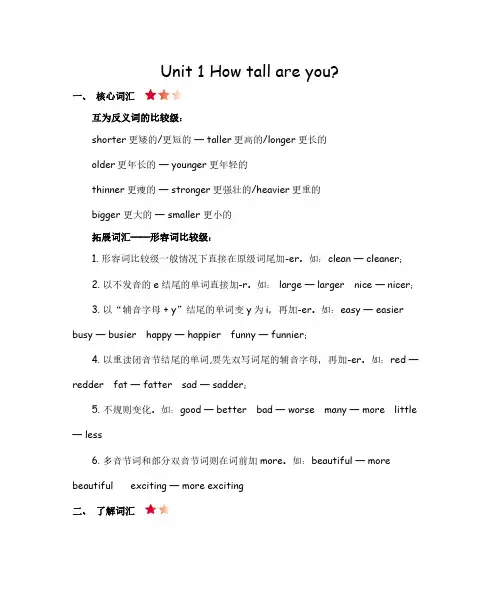
Unit1How tall are you?一、核心词汇互为反义词的比较级:shorter更矮的/更短的—taller更高的/longer更长的older更年长的—younger更年轻的thinner更瘦的—stronger更强壮的/heavier更重的bigger更大的—smaller更小的拓展词汇——形容词比较级:1.形容词比较级一般情况下直接在原级词尾加-er。
如:clean—cleaner;2.以不发音的e结尾的单词直接加-r。
如:large—larger nice—nicer;3.以“辅音字母+y”结尾的单词变y为i,再加-er。
如:easy—easier busy—busier happy—happier funny—funnier;4.以重读闭音节结尾的单词,要先双写词尾的辅音字母,再加-er。
如:red—redder fat—fatter sad—sadder;5.不规则变化。
如:good—better bad—worse many—more little —less6.多音节词和部分双音节词则在词前加more。
如:beautiful—more beautiful exciting—more exciting二、了解词汇dinosaur恐龙hall大厅metre米(美式英语:meter)than比both两个都kilogram千克;公斤countryside乡村lower(low的比较级)更低地shadow阴影;影子smarter(smart的比较级)更聪明的become开始变得;变成三、核心句型1.—How tall are you?你有多高?—I’m1.64metres.我身高1.64米。
2.—What size are your shoes,Mike?迈克,你穿多大号的鞋?—Size7.7号。
3.—How heavy are you?你体重多少?—I’m48kilograms.我体重48公斤。
六年级下册英语知识点复习总结
六年级下册英语知识点复习总结六年级下册英语知识点复习总结在平平淡淡的学习中,大家最不陌生的就是知识点吧!知识点也可以理解为考试时会涉及到的知识,也就是大纲的分支。
哪些知识点能够真正帮助到我们呢?以下是店铺为大家整理的六年级下册英语知识点复习总结,欢迎阅读,希望大家能够喜欢。
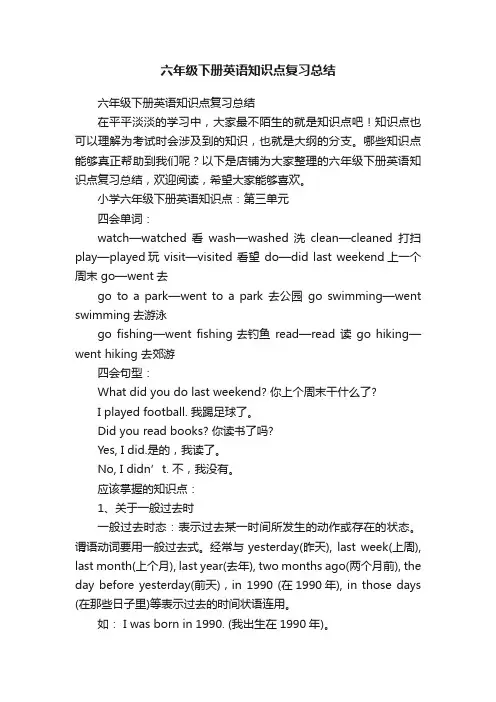
小学六年级下册英语知识点:第三单元四会单词:watch—watched 看wash—washed 洗clean—cleaned打扫play—played玩 visit—visited 看望do—did last weekend上一个周末 go—went去go to a park—went to a park 去公园go swimming—went swimming去游泳go fishing—went fishing去钓鱼read—read 读go hiking—went hiking 去郊游四会句型:What did you do last weekend? 你上个周末干什么了?I played football. 我踢足球了。
Did you read books? 你读书了吗?Yes, I did.是的,我读了。
No, I didn’t. 不,我没有。
应该掌握的知识点:1、关于一般过去时一般过去时态:表示过去某一时间所发生的动作或存在的状态。
谓语动词要用一般过去式。
经常与yesterday(昨天), last week(上周), last month(上个月), last year(去年), two months ago(两个月前), the day before yesterday(前天),in 1990 (在1990年), in those days (在那些日子里)等表示过去的时间状语连用。
如: I was born in 1990. (我出生在1990年)。
When did you go to the park? (你是什么时候去的公园)。
六年级下册英语外研版知识点

六年级下册英语外研版知识点
以下就是小编给大家整理的完六年级下册英语外研版知识点,仅供参考。
一、词汇:
hot dog热狗、cashier收银员、cola可乐、soup汤、dollar美元、cent美分、enjoy享用,享受、meal餐。
二、句子:
1.I want a hamburger.我想要一个汉堡。
2.What do you want?你想要什么?
3.I want a hot dog.我想要一个热狗。
4.Can I have some soup?我可以要一些粥吗?
5.How much is it?多少钱?
6.It’s thirteen dollars and twentyfive cents.
一共是13美元,25美分。
7.Here’s your food.这是你的食物。
8.What do you want to eat?你想吃什么?
9.I want to eat some meat.我想吃些肉。
以上就是小编给大家整理的外研版六年级下册英语的知识点。
(完整版)六年级下册英语知识点总结

(完整版)六年级下册英语知识点总结六年级下册英语知识点总结第一单元(Unit1 How tall are you?)单词:tall—taller更高的short—shorter 更矮的strong—strong更强壮的old—older年龄更大的young—younger 更年轻的big—bigger更大的heavy—heavier 更重的long—longer 更长的thin—thinne更瘦的small—smaller 更小的dinosaur恐龙hall大厅metre,meter 米than比both 两个都kilogram千克,公斤countryside乡村low—lower更低的shadow阴影,影子smart—smarter更聪明的become开始变得,变成句子:1、That's the tallest dinosaur in this hall.那是这个厅里最高的恐龙。
2、You’re older than me. 你比我大。
3、How tall are you ?你有多高?I’m 1.65 metres.我身高1.65米。
4、What size are your shoes ?你穿多大号的鞋?5、My shoes are size 37. 我穿37号的鞋。
6 、Your feet are bigger than mine .你的脚比我的大。
7、How heavy are you ?你有多重?I’m 48 kilograms .我体重48公斤。
8、It’s taller than both of us togethe r .它比我们俩加在一起还高。
应该掌握的知识点:1、形容词变为比较级的变化规则:(1)一般情况下,在形容词的词尾直接加er。
如: tall—taller short—shorter.(2)以字母e结尾的形容词,在词尾直接加r,如:nice—nicer. late—later(3)以重读闭音节结尾,且结尾只有一个辅音字母的词,先双写这个辅音字母,再加er.如:big—bigger thin—thinner fat—fatter(4)以辅音字母加y结尾的双音节形容词,先变y为i , 再加er。
六年级下英语知识点总结(优秀)
六年级下英语知识点总结(优秀)六年级下册英语知识点复习总结篇一①playbadminton打羽毛球②alwaysdoyourhomework总是做家庭作业③drythedishesaftersupper晚饭后擦干盘子④atthesportsstore在运动品专卖店⑤makelunch做午饭⑥lastweek上周⑦before/afterbreakfast⑧onceayear一年一次⑨wakeup起床动词原形及过去式buy----bought(买)teach----taught(教)think----thought(想)win-----won(赢)do----did(做)lose----lost(丢失)throw----threw(扔)swim----swam(游泳)have----had(有)lie-------lay(躺)say------said(说)forget-----forgot(忘记)begin------bagin(开始)bring-----brought(带来)eat----ate(吃)go-----went(去)isam-----wasare-----were六年级英语知识点大总结篇二六年级英语知识点大总结Unit1 How can I get there?key words(重点单词)museum 博物馆 postoffice 邮局bookstore 书店 cinema 电影院hospital 医院 restaurant 餐馆crossing 十字路口 turn left/ right 左转go straight 笔直走 map 地图next to 与。
相邻 near在。
附近key sentence patterns (重点句型)1. Where is the cinema? 电影院在哪?2. It’s next to the bookstore.它紧邻书店。
3. How can I get there? 我怎样到那儿?4. Turn left at the bookstore. 在书店左转。
2020新人教版(PEP)小学英语六年级下册各单元知识点总结
2020新人教版(PEP)小学英语六年级下册各单元知识点总结Unit 1 How tall are you?Here XXX:1.Regular adjectives: add -er to the end of the word.tall - XXXshort - shorterlong - longerstrong - strongerold - olderyoung - youngersmall - smallerlow - lowersmart - smarter2.Adjectives ending in -e: add -r to the end of the word.large - largerlate - latersimple - simplersafe - safer3.Adjectives XXX: double the final consonant and add -er.big - biggerXXX - XXXfat - fattersad - sadderhot - hotterwet - wetter4.Adjectives ending in -y: change the -y to -i and add -er.happy - happierheavy - XXXXXX - funnierangry - angrierXXX - XXXwindy - windierbusy - busierearly - earlierXXX:dinosaur。
hall。
than。
both。
meter。
kilogram。
size。
feet。
wear。
countryside。
shadow。
e.Here XXX:1.Asking about age。
height。
weight。
etc.How old are you?How tall are you?How heavy are you?I am (age) years old。
六年级下册英语一单元知识点
六年级下册英语一单元知识点
以下是六年级下册英语Unit 1的知识点:
1. 词汇:学习并掌握一些关于季节的词汇,如spring(春天),summer (夏天),fall(秋天),winter(冬天)。
2. 语法:学习使用一般现在时来描述日常活动和习惯。
例如:I usually get up at 7 o’clock。
3. 语音:了解并练习使用元音字母在单词中的发音。
4. 日常用语:掌握并能够使用一些关于天气和季节的日常用语,例如:What’s the weather like today? 和 Which season do you like best?
5. 文化知识:了解不同国家的季节和天气情况,以及人们在这些季节中的活动和传统。
以上仅为基础内容,具体的知识点可能因教材版本和地区不同而有所差异。
建议参考具体教材和教辅,获取更准确的信息。
六年级下英语知识点总结
六年级下英语知识点总结导读:一、单词young— younger更年轻的 old -older更年长的 tall- taller 更高的short-shorter更矮的 long-longer更长的 thin-thinner更瘦的heavy-heavier更重的 big-bigger更大的 small -smaller更小的`strong -stronger更强壮的二、句子1. That's the tallest dinosaur in this hall. 那是这个厅里最高的恐龙。
2. You're older than me.你比我大。
3. How tall are you? 你有多高? I'm 1.65 meters.我身高1.65米。
4. What size are your shoes?你穿多大号的鞋。
5. My shoes are size37.我穿37号的鞋。
6. Your feet are bigger than mine.你的脚比我的大。
7. How heavy are you?你有多重?8. I'm 48 kilograms.我体重48公斤。
三、语法复习要点:形容词的比较级1、形容词比较级在句子中的运用:两个事物或人的比较用比较级,比较级后面一般带有单词than。
than后的人称代词用主格(口语中可用宾格)。
2.形容词加er的规则:⑴一般在词尾加er ;⑵以字母e 结尾,加r ;nice---nicer⑶以一个元音字母和一个辅音字母结尾,应双写末尾的辅音字母,再加er ;big--- bigger thin---- thinner⑷以“辅音字母+y”结尾,先把y变i,再加er 。
heavy----heavier3.不规则形容词比较级: good/well-better例句:(1).It's taller than both of us together.它比我俩加起来还高。