
世界非物质文化遗产古琴中英文
2003年 11 月7 日,中国古琴艺术继昆曲之后,入选世界“人类口头和非物质 遗产代表作”名录,有着3000年悠久历史的古琴艺术的突出价值再次得到了 世界公认。 古琴,是物,它不是非物质文化遗产;古琴演奏家,是人,也不是非物质 文化遗产;只有古琴的发明、制作、弹奏技巧、曲调谱写、演奏仪式、传承 体系、思想内涵等等,才是非物质文化遗产本体。所以,联合国批准的世界 遗产是“中国古琴艺术”,而不是古琴这个乐器或那些古琴演奏家,虽然古 琴这种乐器和那些演奏家们都很重要。
This meant that instead of having two lines of written text to describe a few notes, a single character could represent one note, or sometimes as many as nine. This notation form was called jianzi pu (减字谱) and it was a major advance in qin notation. It was so successful that from the Ming dynasty onwards, a great many qinpu (琴谱) appeared, the most famous and useful being "Shenqi Mipu" (The Mysterious and Marvellous Tablature) compiled by Zhu Quan, the 17th son of the founder of the Ming dynasty.
历代琴书
汉代最重要的琴谱琴书:扬雄《琴清英》、诸葛亮的《琴经》。
现存最早的大型古琴曲集:明初朱权编辑的《神奇秘谱》(1425)。 古琴打谱,是指按照琴谱弹出琴曲的过程。由于琴谱并不直接记录乐音,只 是记明弦位和指法,其节奏又有较大的伸缩余地。因此,打谱者必须熟悉琴 曲的一般规律和演奏技法,揣摩曲情,进行再创造,力求再现原曲的本来面 貌。 打谱非常费时,所以琴界用“大曲三年,小曲三月”来形容这个过程。 Transcription :Dapu (打譜) is the transcribing of old tablature into a playable form.
世 界 非 物 质 文 化 遗 产
In 2003, guqin music was proclaimed as one of the Masterpieces of the Oral and Intangible Heritage of Humanity by UNESCO.
Guqin
Arts—— the Masterpieces of the Oral and Intangible Heritage of Humanity
其形
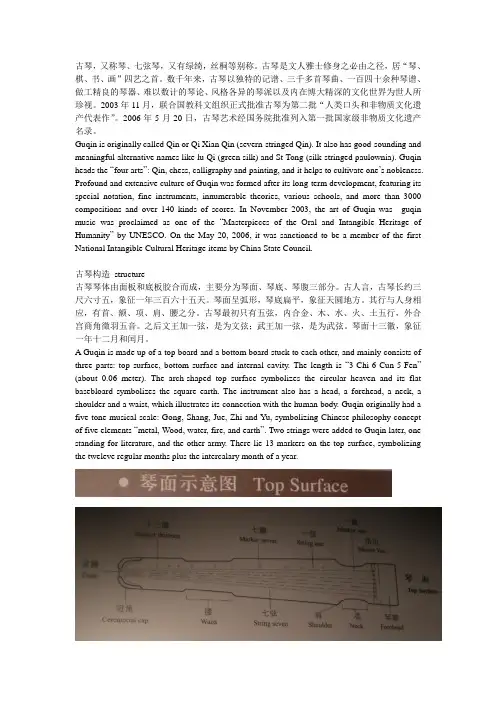
古琴造型优美,常见的为伏羲式、神农式、仲尼式、列子式、连珠式、 落霞式、灵机式、蕉叶式等。主要是依琴体的项、腰形制的不同而有所 区分。琴漆有断纹,它是古琴年代久远的标志。由于长期演奏的振动和 木质、漆底的不同,可形成多种断纹,如梅花断、牛毛断、蛇腹断、冰 裂断、龟纹等。有断纹的琴,琴音透澈、外表美观,所以更为名贵。古 代名琴有绿绮、焦尾、春雷、冰清、大圣遗音、九霄环佩等。 琴一般长约三尺六寸五(约120—125公分),象征一年三百六十五天 (一说象周天 365 度)。一般宽约六寸( 20 公分左右)。一般厚约二寸 (6公分左右)。琴体下部扁平,上部呈弧形凸起,分别象征天地,与古 时的天圆地方之说相应和。整体形状依凤身形而制成,其全身与凤身相 应(也可说与人身相应),有头、颈、肩、腰、尾、足。 古琴最初只有五根弦,内合五行,金、木、水、火、土;外合五音, 宫、商、角、徵、羽。后来文王囚于羑(yǒu)里,思念其子伯邑考,加 弦一根,是为文弦;武王伐纣,加弦一根,是为武弦。合称文武七弦琴。
The Inheritance(Tablature and notation)
An earlier form of music notation from the Tang era survives in just one manuscript, dated to the seventh century CE, called Jieshi Diao Youlan (碣石调·幽兰). It is written in a longhand form called wenzi pu (文字谱) which gives all the details using ordinary written Chinese characters.
概述
古琴,又称瑶琴、玉琴、丝桐和七弦琴,是中国汉族传统拨 弦乐器,有三千年以上历史,属于八音中的丝。古琴音域宽广, 音色深沉,余音悠远。
自古“琴”为其特指,19世纪20年代起为了与钢琴区别而改 称古琴。初为5弦,汉朝起定制为7弦,且有标志音律的13个徽, 亦为礼器和乐律法器。琴是汉文化中地位最崇高的乐器,有 “士无故不撤琴瑟”和“左琴右书”之说。位列中国传统文化 四艺“琴棋书画”之首,被文人视为高雅的代表,亦为文人吟 唱时的伴奏乐器,自古以来一直是许多文人必备的知识和必修 的科目。伯牙、钟子期以“高山流水”而成知音的故事流传至 今;琴台被视为友谊的象征。大量诗词文赋中有琴的身影。 现存琴曲3360多首,琴谱130多部,琴歌300首。主要流传范 围是中华文化圈国家和地区,如中国、朝鲜、日本和东南亚, 而欧洲、美洲也有琴人组织的琴社。古琴作为中国最早的弹拨 乐器,是汉族文化中的瑰宝,是人类口头和非物质遗产代表作。
The Shape(CONSTRUCTION)
According to tradition, the qin originally had five strings, representing the five elements of metal, wood, water, fire and earth. Later, in the Zhou dynasty, Zhou Wen Wang added a sixth string to mourn his son. His successor, Zhou Wu Wang, added a seventh string to motivate his troops into battle with the Shang. The thirteen hui on the surface represent the 13 months of the year (the extra 13th is the 'leap month' in the l u n a r calendar ) . Th e s u r fa ce b o ard is r o un d to represent Heaven and the bottom board flat to represent earth. The entire length of the qin (in Chinese measurements) is 3 chi, 6 cun and 5 fen; representing the 365 days of the year (though this is just a standard since qins can be shorter or longer depending on the period's measurement standard or the maker's preference). Each part of the qin has meaning,
传承
记谱法 1 .文字谱:为一篇详细说明弹奏法的文字,不直接记音高和节奏。今世仅 存的文字谱为南朝梁丘明所传的《碣石调幽兰》,现存于日本东京国立博物 馆。现今演奏的《碣石调幽兰》就是根据该谱打出的。
2 .减字谱:相传为唐代曹柔根据文字谱简化、缩写而成。减字谱的每一字 块为由汉字减少笔画后组合而成的复合字。这种谱式主要只记指法动作和弦 序、徽位而不记音高和节奏,所以属于指法谱(Tablature)。
A Brief Introduction
The guqin is a plucked seven-string Chinese musical instrument of the zither family. It has been played since ancient times, and has traditionally been favored by scholars and literati as an instrument of great subtlety and refinement, as highlighted by the quote "a gentleman does not part with his qin or se without good reason," as well as being associated with the ancient Chinese philosopher Confucius. It is sometimes referred to by the Chinese as "the father of Chinese music" or "the instrument of the sages". (古琴音乐也被誉为“国乐之父”、“圣人音乐”) The guqin is not to be confused with the guzheng, another Chinese long zither also without frets, but with moveable bridges under each string. Because Robert Hans van Gulik's famous book about the qin is called The Lore of the Chinese Lute, the guqin is sometimes inaccurately called a lute.Other incorrect classifications, mainly from music compact discs, include "harp" or "table-harp".
世界非物质文化遗产古琴中英文共23页文档

11、获得的成功越大,就越令人高兴 。野心 是使人 勤奋的 原因, 节制使 人枯萎 。 12、不问收获,只问耕耘。如同种树 ,先有 根茎, 再有枝 叶,尔 后花实 ,好好 劳动, 不要想 太多, 那样只 会使人 胆孝懒 惰,因 为不实 践,甚 至不接 触社会 ,难道 你是野 人。(名 言网) 13、不怕,不悔(虽然只有四个字,但 常看常 新。 14、我在心里默默地为每一个人祝福 。我爱 自己, 我用清 洁与节 制来珍 惜我的 身体, 我用智 慧和知 识充实 我的头 脑。 15、这世上的一切都借希望而完成。 农夫不 会播下 一粒玉 米,如 果他不 曾希望 它长成 种籽; 单身汉 不会娶 妻,如 果他不 曾希望 有小孩 ;商人 或手艺 人不会 工作, 如果他 不曾希 望因此 而有收 益。-- 马钉路 德。
31、只有永远躺在泥坑里的人,才不会再掉进坑里。——黑格尔 32、希望的灯一旦熄灭,生活刹那间变成了一片黑暗。——普列姆昌德 33、希望是人生的乳母。——科策布 34、形成天才的决定因素应该是勤奋。——郭沫若 35、学到很多东西的诀窍,就是一下子不要学很多。——洛克
古琴中英文对照介绍
古琴,又称琴、七弦琴,又有绿绮,丝桐等别称。
古琴是文人雅士修身之必由之径,居“琴、棋、书、画”四艺之首。
数千年来,古琴以独特的记谱、三千多首琴曲、一百四十余种琴谱、做工精良的琴器、难以数计的琴论、风格各异的琴派以及内在博大精深的文化世界为世人所珍视。
2003年11月,联合国教科文组织正式批准古琴为第二批“人类口头和非物质文化遗产代表作”。
2006年5月20日,古琴艺术经国务院批准列入第一批国家级非物质文化遗产名录。
Guqin is originally called Qin or Qi Xian Qin (severn-stringed Qin). It also has good-sounding and meaningful alternative names like lu Qi (green silk) and St Tong (silk-stringed paulownia). Guqin heads the “four arts”: Qin, chess, calligraphy and painting, and it helps to cultivate one’s nobleness. Profound and extensive culture of Guqin was formed after its long-term development, featuring its special notation, fine instruments, innumerable theories, various schools, and more than 3000 compositions and over 140 kinds of scores. In November 2003, the art of Guqin was guqin music was proclaimed as one of the “Masterpieces of the Oral and Intangible Heritage of Humanity”by UNESCO. On the May 20, 2006, it was sanctioned to be a member of the first National Intangible Cultural Heritage items by China State Council.古琴构造structure古琴琴体由面板和底板胶合而成,主要分为琴面、琴底、琴腹三部分。
世界非物质文化遗产古琴中英文
其形
古琴造型优美,常见的为伏羲式、神农式、仲尼式、列子式、连珠式、 落霞式、灵机式、蕉叶式等。主要是依琴体的项、腰形制的不同而有所 区分。琴漆有断纹,它是古琴年代久远的标志。由于长期演奏的振动和 木质、漆底的不同,可形成多种断纹,如梅花断、牛毛断、蛇腹断、冰 裂断、龟纹等。有断纹的琴,琴音透澈、外表美观,所以更为名贵。古 代名琴有绿绮、焦尾、春雷、冰清、大圣遗音、九霄环佩等。 琴一般长约三尺六寸五(约120—125公分),象征一年三百六十五天 (一说象周天 365 度)。一般宽约六寸( 20 公分左右)。一般厚约二寸 (6公分左右)。琴体下部扁平,上部呈弧形凸起,分别象征天地,与古 时的天圆地方之说相应和。整体形状依凤身形而制成,其全身与凤身相 应(也可说与人身相应),有头、颈、肩、腰、尾、足。 古琴最初只有五根弦,内合五行,金、木、水、火、土;外合五音, 宫、商、角、徵、羽。后来文王囚于羑(yǒu)里,思念其子伯邑考,加 弦一根,是为文弦;武王伐纣,加弦一根,是为武弦。合称文武七弦琴。
Guqin and the Guqin Arts
In 2003, guqin music was proclaimed as one of the Masterpieces of the Oral and Intangible Heritage of Humanity by UNESCO.
The Inheritance(Tablature and notation)
An earlier form of music notation from the Tang era survives in just one manuscript, dated to the seventh century CE, called Jieshi Diao Youlan (碣石调·幽兰). It is written in a longhand form called wenzi pu (文字谱) which gives all the details using ordinary written Chinese characters.
古琴介绍中英文
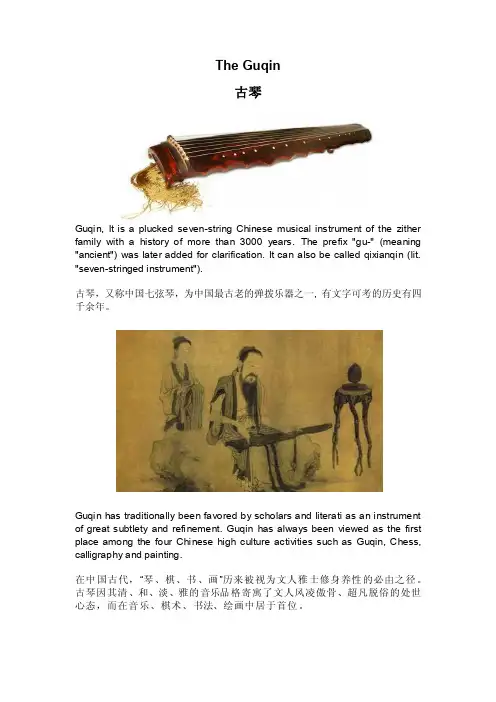
The Guqin古琴Guqin, It is a plucked seven-string Chinese musical instrument of the zither family with a history of more than 3000 years. The prefix "gu-" (meaning "ancient") was later added for clarification. It can also be called qixianqin (lit. "seven-stringed instrument").古琴,又称中国七弦琴,为中国最古老的弹拨乐器之一, 有文字可考的历史有四千余年。
Guqin has traditionally been favored by scholars and literati as an instrument of great subtlety and refinement. Guqin has always been viewed as the first place among the four Chinese high culture activities such as Guqin, Chess, calligraphy and painting.在中国古代,“琴、棋、书、画”历来被视为文人雅士修身养性的必由之径。
古琴因其清、和、淡、雅的音乐品格寄寓了文人风凌傲骨、超凡脱俗的处世心态,而在音乐、棋术、书法、绘画中居于首位。
.Symbolism in the Guqin古琴结构与文化象征There are a lot of symbols around this instrument. 在古琴中我们可以找到许多中国传统文化的元素。
Guqin’s measurement line is 3 feet 65 inches representing the 365 days in a year. The top part is round representing the sky. The bottom part is flat, representing the earth. The whole body of the Guqin correspond the body of phoenix which is a bird of wonder, also the body of Guqin looks like the human body, with head, neck, shoulder, waist and feet etc.琴一般长约三尺六寸五(约120—125公分),象征一年三百六十五天(一说象周天365度)。
千年古琴,世界非遗
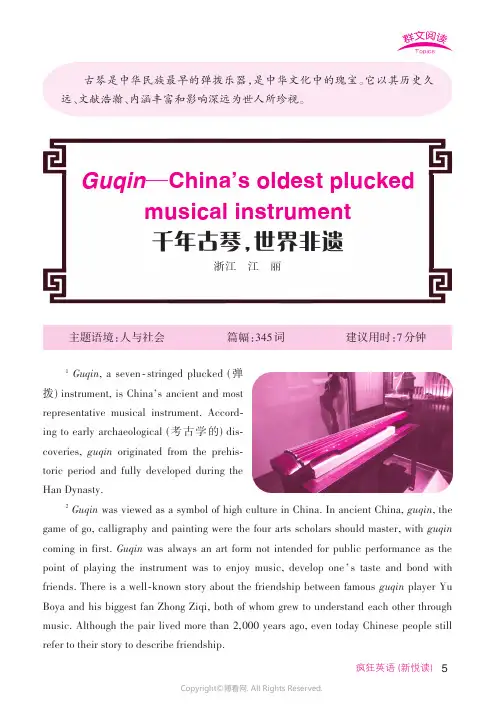
疯狂英语(新悦读)Guqin —China s oldest pluckedmusical instrument千年古琴,世界非遗浙江江丽古琴是中华民族最早的弹拨乐器,是中华文化中的瑰宝。
它以其历史久远、文献浩瀚、内涵丰富和影响深远为世人所珍视。
主题语境:人与社会篇幅:345词建议用时:7分钟1Guqin ,a seven ⁃stringed plucked (弹拨)instrument,is China s ancient and mostrepresentative musical instrument.Accord⁃ing to early archaeological (考古学的)dis⁃coveries,guqin originated from the prehis⁃toric period and fully developed during the Han Dynasty.2Guqin was viewed as a symbol of high culture in China.In ancient China,guqin ,the game of go,calligraphy and painting were the four arts scholars should master,with guqin coming in first.Guqin was always an art form not intended for public performance as the point of playing the instrument was to enjoy music,develop one s taste and bond with friends.There is a well⁃known story about the friendship between famous guqin player Yu Boya and his biggest fan Zhong Ziqi,both of whom grew to understand each other through music.Although the pair lived more than 2,000years ago,even today Chinese people stillrefer to their story to describefriendship.53Guqin has seven strings and13marked pitch(音高)positions.By attaching the strings in10different ways,players can produce a range of four octaves(八度音阶).The three basic playing techniques are known as san(open string),fan(harmonics)and an (stopped string).According to tradition,it takes20years of training to become proficient in the instrument.The sound of guqin is deep,remote and light.More than100harmonics have been preserved using a unique notation system,and most of the tunes have been passed down orally from teachers to students.4Guqin techniques are divided into various schools around the country,including Yushan,Guangling,Zhejiang,Zhucheng and Lingnan schools among others.The most fa⁃mous musical works include White Snow in Sunny Spring,Three Stanzas of Plum Blossoms, High Mountain and Flowing Waters and so on.5Due to the influence of Western music and modern media,guqin music was in dan⁃ger of becoming lost.In order to protect it,the instrument was listed as a national intangible cultural heritage in China in2006and was listed on the Representative List of the Intangible Cultural Heritage of Humanity by UNESCO in 2008.ReadingCheck1.Why did people in ancient China learn guqin?A.To perform in public.B.To produce famous musical works.C.To enjoy music,develop one s taste and make friends.D.To kill their boring time.2.What s the purpose of mentioning Yu Boya and Zhong Ziqi?A.To show their talents.B.To show the influences of guqin.C.To show their popularity in history.D.To show the true friendship between them.3.How were most of guqin tunes passed down from teachers to students?A.By spoken words.Crazy English 2022.126B.By writing them down.C.By digital records.D.By singing special songs.4.What does the last paragraph talk about?A.Famous guqin works.B.Guqin techniques.C.Influences of Western music.D.Measures to protect guqin .LanguageStudyUseful expressionsoriginate from起源于be viewed as a symbol of被看作是……的象征intend for为……而准备bond with与……交往understand each other through music通过音乐了解彼此refer to提及become proficient in 变得精通……CulturalBackground古琴的三种音古琴的音色分三种——散音、泛音、按音。
古典乐器中英文对照简介

古琴:Qin, also known as Yao Qin, Yu-Qin, a lyre, for the Chinese one of the oldest plucked instruments, the qin is already prevalent in the Confucian period instruments, there are words to consider the history of thousand years, according to "Historical Records" contains, The emergence of Qin period no later than Yao and Shun. The beginning of this century, only for the distinction of Western instruments in the "piano" added in front of a word "historic", called "Qin." Still ringing in his study so far, the ancient musical instruments on stage.巴乌Bau, is a bamboo reed instruments copper, spring for the tongue. The Yi, Hani, Dai, Wa, Blang, Miao and other ethnic wind instruments. Yi called the local "and Fei Limo", Hani called "Meiba." Bau is popular in southwest China Yi, Miao, Hani and other single-reed wind instrument family, Bau is made with bamboo, has eight finger holes (seven before the latter), disposed in the mouthpiece of a brass reed tongue tip, blowing across the top of playing, vibrating reed sound. Bau smallervolume, but the sound soft, southwest China's people call it a talking instrument. Bau popular in the Red River in Yunnan Province, Wenshan, Simao, Xishuangbanna, Lincang, Dehong, meltwater Guangxi Zhuang Autonomous Region, Guizhou Province, Guizhou and South Guizhou and other places.Dizi (笛子): The dizi is a bamboo flute.It has been suggested thatthe instrument originated in Southern orCentral Asia over 2000 yearsago. It is a unique solo instrument and isalso used extensively inensembles and orchestras. These flutes have 6open holes and a lovelybright sound.笛子是由竹子做成的乐器,据说在2000年前最早出现于南亚和中亚。
古琴的英文翻译古琴英文怎么说古琴的英文例句
古琴的英文翻译古琴英文怎么说古琴的英文例句古琴的英文翻译与发音古琴古琴的中英文例句与用法古琴的英文翻译与发音[gǔ qín]guqin, a long zither with 5 or 7 strings, plucked with a plectrum the ancestor of the long zither family, dating back to pre-classical times (playing it was an essential acplishment of a Confucian gentleman)long [lɔŋ; (-) lɔ:ŋ]adj.长的,长期的,做多头的,高的 vi.渴望,热望 adv.长期地,始终 n.长时间,(市场上)做多头的人,[语音]长音节zither [ziðә(r)]n.筝,齐特琴,扁琴strings [striŋz]弦;名词string的复数形式plectrum [plektrәm]n.拨子,琴拨ancestor [ænsәstә(r)]n.祖先,祖宗family [fæmili]n.家庭,家族,家属,亲属,子女,僚属 adj.家庭的,家族的dating ['detɪŋ]约会;期日back [bæk]adj.后面的,在后面,早过去的,前(欠)的钱 adv.向后地 n.背部,后面 v.后退,支持timesn.时期,次playing [pleiŋ]比赛,演奏;动词play的现在分词it [it]pron.它;Italy,义大利;Information Technology,资讯技术wasvbl.be的过去式古琴的中英文例句与用法以一把阔斧砸毁我的古琴!听哪!生命终了的声音!神的旨意呀!With this ax I strike my koto! Listen! The sound of life's end!古琴一种类似于齐特琴的日本乐器,在一个长方形的盒子上有七到十三根弦A japanese instrument similar to a zither having7to13silk strings stretched over an oblong box.古琴音色丰富,泛音轻盈虚飘,散音古朴凝厚。
世界非物质文化遗产古琴中英文解读
In 2003, guqin music was proclaimed as one of the Masterpieces of the Oral and Intangible Heritage of Humanity by UNESCO.
Guqin
Arts—— the Masterpieces of the Oral and Intangible Heritage of Humanity
Later in the Tang dynasty, Cao Rou and others simplified the notation, using only the important elements of the characters and combined them into one character notation.
Guqin and the Guqin Arts
In 2003, guqin music was proclaimed as one of the Masterpieces of the Oral and Intangible Heritage of Humanity by UNESCO.
Hale Waihona Puke 概述
古琴,又称瑶琴、玉琴、丝桐和七弦琴,是中国汉族传统拨 弦乐器,有三千年以上历史,属于八音中的丝。古琴音域宽广, 音色深沉,余音悠远。
自古“琴”为其特指,19世纪20年代起为了与钢琴区别而改 称古琴。初为5弦,汉朝起定制为7弦,且有标志音律的13个徽, 亦为礼器和乐律法器。琴是汉文化中地位最崇高的乐器,有 “士无故不撤琴瑟”和“左琴右书”之说。位列中国传统文化 四艺“琴棋书画”之首,被文人视为高雅的代表,亦为文人吟 唱时的伴奏乐器,自古以来一直是许多文人必备的知识和必修 的科目。伯牙、钟子期以“高山流水”而成知音的故事流传至 今;琴台被视为友谊的象征。大量诗词文赋中有琴的身影。 现存琴曲3360多首,琴谱130多部,琴歌300首。主要流传范 围是中华文化圈国家和地区,如中国、朝鲜、日本和东南亚, 而欧洲、美洲也有琴人组织的琴社。古琴作为中国最早的弹拨 乐器,是汉族文化中的瑰宝,是人类口头和非物质遗产代表作。
中国世界非物质文化遗产名录中英文对照
以下是部分中国世界非物质文化遗产名录中英文对照:传统剪纸(Paper-cutting)粤剧(Cantonese Opera)中国皮影戏(Chinese Shadow Puppets)中国书法(Chinese Calligraphy)篆刻(Seal Carving)中国传统木结构营造技艺(Traditional Chinese Wood-structuring Technique)南京云锦织造技艺(Nanjing Brocade Weaving Technique)南宋御街传统商贸与表演(Lunar New Year Temporary Market on the Imjin Road)西安城墙(The Xi'an City Wall)龙泉青瓷传统烧制技艺(Traditional Kiln-firing Technique of Longquan Celadon)宣纸传统制作技艺(Traditional Production Skills of Xuan Paper)彝族传统音乐(Traditional Music of the Yi Ethnic Group)麦西热甫(Mazrrafa)江永女书习俗(Women's Script of Jiangyong)哥巴节(Coba Festival)红山峪村民俗表演与祭拜活动(Folk Entertainment andWorship in Hongshanyu Village)金源民间音乐文化传承(Jinyuan Folk Music Cultural Transmission)拉康加尔的表演艺术(Performance Art of Laxangar)玛纳斯(Manas)贵州侗族大歌(Dong ethnic group's big song in Guizhou province)中国传统木拱桥营造技艺(Traditional Chinese Wooden Arch Bridge Construction Technique)中国雕版印刷技艺(Chinese Woodblock Printing Technique)中国书法工具及文房四宝制作技艺(Traditional Chinese Calligraphy Tools and Four Treasures of the Study Production Skills)中国剪纸(Chinese Paper-cutting)中国传统木结构建筑营造技艺(Traditional Chinese Wooden Architecture Construction Skills)中国传统服饰制作技艺(Traditional Chinese Costume Production Skills)中国传统泥塑艺术(Traditional Chinese Clay Sculpture Art)中国传统面食制作技艺(Traditional Chinese Pastry Cooking Skills)中国传统制茶技艺及茶文化(Traditional ChineseTea-making Skills and Tea Culture)。
世界非物质文化遗产古琴中英文解读课件
This style draws inspiration from traditional Chinese folk music, emphasizing the use of folk melodies and instruments. It often has a more earthy and folksy sound, making use of simple finger techniques and standard tunings.
Famous Guqin repertoire
"The Flowing Stream" (流水)
This piece is known for its beautiful melody and technical challenges, featuring fast finger work and intricate phrases.
history of Guqin.
The Current Status and Challenges of Protecting Guqin
• Status of Protection: Guqin is now recognized as a World Intangible Cultural Heritage site, which has raised awareness and provided more resources for its protection.
Characteristics
The guqin is known for its warm, ethereal sound and its ability to express a wide range of emotions. It is usually played with a bamboo stick called a "qin