
英语人教版八年级下册Unit9
语法归纳
. Me neither. Let’s go to one tomorrow.
我也没去过。我们明天去参观一家吧。 【句型剖析】
neither 用 作 副 词 , 意 为 “ 也 不 ” , 常 用 于 句 首 , 如 Me
neither(=Neither have I), 表示前面否定的内容也适合于另一个 人或物。置于句首时, 主语要放在助动词、系动词或情态动词
2c.Look at the map in 2a and make conversations about the Places. A: Have you ever been to the space museum? B: Yes, I have. How about you? A: No, I haven’t. B: Oh, it’s fantastic. Let’s go tomorrow. A:OK. How are we going to get there? B: We can take the subway.
A: Have you ever been to ..ቤተ መጻሕፍቲ ባይዱ? B: No, I’ve never been to … A: Me I’veneither. never been to ...
1c PAIRWORK Ask and answer questions about the places in 1b.
I have been to a water park. I have been to a history museum.
1.sb.have /has been to sp. 意为“某人曾经去过某地”,
但现在已不在那里了, ”已经回来,侧重指经历,后 可接次数,如once,twice,three times等,表示 “去过某地几次”,也可和 just,never,ever等连用 2.sb.have/has gone to sp.
the Great Wall
A: Have you ever been to …? B: No, I haven’t.
zoo
A: Have you ever been to a zoo? B: Yes, I’ve been to a zoo.
space museum
太空馆
A: Have you ever been to a space museum? B: No, I’ve never been to a space museum.
art museum , amusement park , zoo, history museum………….. take the train, take the bus walk, ride the bike ………
Anna:I went to the film museum last weekend. Have you ever been there? here、there、home前面不加介词 Jill:Yes, I have. I went there back in April. Anna:It’s really interesting, isn’t it? It’s a great way to spend a Saturday afternoon. 反义疑问句 Jill:Yes, I love all the old movie cameras there. I learned about the inventions that led to color movies, too. Anna:So, what did you do on the weekend? Jill:I camped in the mountains with some friends. We put up a tent and cooked outside. Anna:That sounds fun. I’ve never been camping. Jill:You should try it!
an amusement park 游乐园
A: Have you ever been to an …? B: Yes, I’ve been to an ... / No, I’ve never been to an ...
water park
水上公园
A: Have you ever …? B: Yes, I’ve... / No, I’ve never …
zoo
space museum
A: Have you ever been to a/an …? B: Yes, I’ve been to a/an ... / No, I’ve never been to a/an ...
amusement park
water park
bookshop
A: Have you ever been to a…? B: Yes, I’ve been to a... A: A: I’ve Me, also too. been to a...
4. 我了解了一些电影的知识。
I ______ learned______ about some information about
movie.
5. 他的粗心导致了这次失败。
His carelessness ____ led ___ to this failure.
选用have, has填空:
1. I _______ have told him the news.
语 现在完成时的用法
法
—Have you ever been to an amusement park? —Yes, I have. I went there last year. / No, I haven’t been to an amusement park.
你曾经去过…吗?
A: Have you ever been to a beach? B: Yes, I have.
1. 我去过北京两次。 I ______ have ______ been _____ to Beijing twice. 2. 大声读书是一种学习英语的好方法。 Reading aloud is a ____ ____ ____ good way to learn English. 3. 昨天他没有去那,我也没去。 He didn’t go there yesterday. _____ Me _________. neither =Neither did I.=I didn’t go there, either.
意为“某人已经去某地了”,可能在去某地的路上, 也可能到达了某地。总之,说话时该人不在现场, 一般不用第一人称、第二人称代词作句子的主语。 3.sb.have/has been in sp.
表示“在某地呆了多少时间”,常与时间段状语连用
1. My father has been to Beijing twice. 我父亲去过北京两次。 2.I have never been to the Great Wall. 我从未去过长城。 3.—Where is Jim?吉姆在哪里? —He has gone to England.
Conversation 2 Linda has been to the amusement park. T / F Linda went to the amusement park yesterday . T / F Linda is going to the amusement park again by bike. T / F
1a Which of these places would you like to visit? Rank them from 1 to 5.
space museum __History museum art museum water park zoo ___amusement park
n. 娱乐;消遣
Have you ever been to a museum?
Language Goals:
Talk about past experiences
句
子
Have you ever been to ...? Yes, I’ve been to ... No, I have never been to ...
之后。
—Kate hasn’t finished her book report yet. 凯特还没完成她的读书报告。
—Me neither=Neither have I.
我也没完成。
【归纳拓展】
neither的用法小结
作副词, 常用于短语“neither. . . nor. . . ”, 连接并列成分, 意为 “既不……也不……”, 当连接并列主语时使用就近原则。 Neither I nor my mother _____ likes (like) red. 我和妈妈都不喜欢红色。
【展】
spend time/money on sth. Spend time/money (in)doing sth. spend time with sb.
Read 2d and answer these questions.
1.When did Jill go to the film museum? In April. 2.What does Jill love the film museum? She loves all the old movie cameras. 3.Who did Jill camp with on the weekend? With her friends. 4.Has Anna ever been camping? No, she hasn’t.
太空博物馆
历史博物馆
艺术博物馆 水上公 园 动 物 游 乐 园 场
Unit9 sectionA重要知识点讲解课件人教版八年级英语下册
Jennifer likes to listen to music; so do I.
10.“so + 主语+动词”,这一结构用来表示对上文情况给 予进一步的肯定或确认。
---It was cold yesterday.昨天很冷。 ---So it was.确实是这样。
--- The students study hard.学生们学习很努力。 ---So they do.他们确实很努力。
--- He went to Shanghai yesterday.他昨天去北京了。 ---So he did.他确实去了。
1.— Have you ______ been to Xiamen? — No, ___A_____.
使用这一结构应注意以下几点: 一、注意结构中and 与标点符号的使用。 这一结构是一个完整的倒装句,因此,若前一句用句号,则so 应大写第一个字母。
Jennifer likes to listen to music. So do I.
若前一句用逗号,则so 前须加and,构成并列分句; Jennifer likes to listen to music, and so do I.
当前面的陈述句中有否定词few, little, never, no, nobody, hardly, seldom等词时,其后的简短疑问句应用肯定形式。 He can hardly swim, __ca_n__h_e_?
We have a little water, _d_o__w_e__?
以let’s开头的反义疑问句,简短疑问句部分用shall we;以let us 开头的反义疑问句,简短疑问部分用will you.
人教版八年级下册 英语 Unit 9(43个单词)
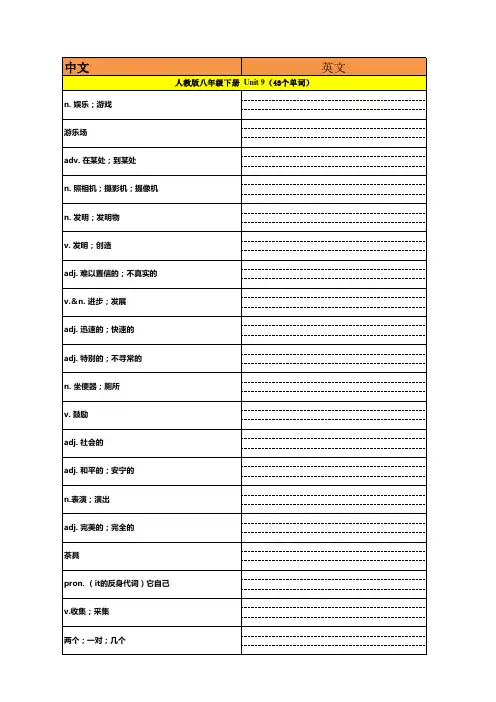
n. 娱乐;游戏
英文
人教版八年级下册 Unit 9(43个单词)
游乐场
adv. 在某处;到某处
n. 照相机;摄影机;摄像机
n. 发明;发明物
v. 发明;创造
adj. 难以置信的dj. 迅速的;快速的
adj. 特别的;不寻常的
n. 坐便器;厕所
v. 鼓励
adj. 社会的
一方面 另一方面
adj. 和平的;安宁的
n.表演;演出
adj. 完美的;完全的
茶具
pron. (it的反身代词)它自己
v.收集;采集
两个;一对;几个
adj. 德国的;德语的;德国人的 n. 德国人;德语 n. 主题 n. 供骑乘的游乐设施;短途旅程 n. 省份 num.一千 adj. 安全的;无危险的 adv. 仅仅;只;不过 v.&n. 害怕;惧怕 conj.不管…(还是);或者…(或者);是否 n. 印度人 adj. 印度的 n. 日本人;日语 adj. 日本的;日本人的;日语的 n. 狐狸 全年 n. 赤道 conj. 在任何…的时候;无论何时 n. 春天 adv. 主要地;通常 n. 地点;位置 唐老鸭 n. 新加坡 n. 东南亚
新课标人教版八年级英语下册Unit 9 Have you ever been to an amuse
—So did Tina.
中国地图
蒂娜也去了。
—He has been a soldier for two years.
要点点拨
他已经当了两年兵了。
go inline skating 滑旱冰
—So have I.
我也是。
全析提示
3.Look at the map of the town.Listen and circle the places 助动词 have 和 has 可以与前面的
you hear.
主语缩略’ve 和’s。
看城镇的地图。听录音并圈出你听到的地方。
如:we’ve,they’ve,he’s,
water world 水上世界
it’s 等。
city library 城市图书馆
have not 常缩略为 haven’t,has
fun times amusement park
如果说“欢迎回家”该怎么说呢?
把 1a 中你的回答和你搭档的回答对照一下。
Wele back home!
4.For me,“I have to!” is number two.
对我来说“I have to!”是第二位的。
要点点拨
5.Listen to a teacher interview a student.Circle the newsletter 业务通讯;新闻信札
route“路线、小路、小巷”,使
The main attraction was a Charlie Chaplin film.
用 X 围也较小。course 表示船的
吸引人的主要是查理·卓别林的电影。
“航道”或飞机的“航线”。
The idea of being a teacher has little attraction to young
人教版八年级下册初二英语unit9第九单元词形转换及默写
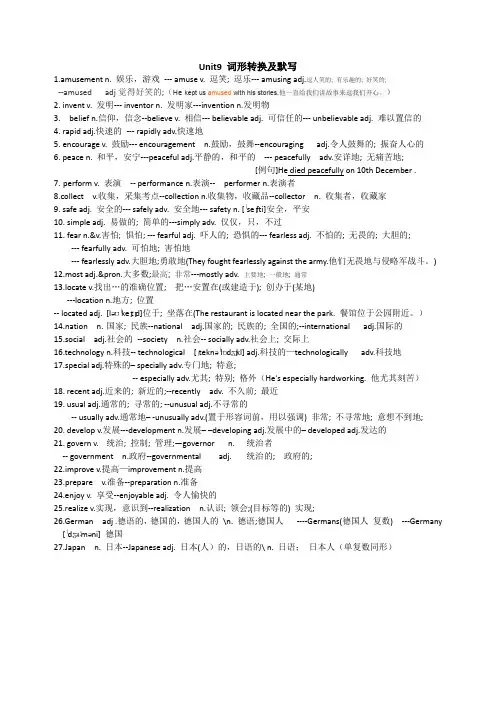
Unit9 词形转换及默写1.amusement n. 娱乐,游戏--- amuse v. 逗笑; 逗乐--- amusing adj.逗人笑的; 有乐趣的; 好笑的;--amused adj觉得好笑的;(He kept us amused with his stories.他一直给我们讲故事来逗我们开心。
)2. invent v. 发明--- inventor n. 发明家---invention n.发明物3. belief n.信仰,信念--believe v. 相信--- believable adj. 可信任的--- unbelievable adj. 难以置信的4. rapid adj.快速的--- rapidly adv.快速地5. encourage v. 鼓励--- encouragement n.鼓励,鼓舞--encouraging adj.令人鼓舞的; 振奋人心的6. peace n. 和平,安宁---peaceful adj.平静的,和平的--- peacefully adv.安详地; 无痛苦地;[例句]He died peacefully on 10th December .7.perform v. 表演-- performance n.表演--performer n.表演者8.collect v.收集,采集考点--collection n.收集物,收藏品--collector n. 收集者,收藏家9. safe adj. 安全的--- safely adv. 安全地--- safety n. [ˈseɪfti]安全,平安10. simple adj. 易做的; 简单的---simply adv. 仅仅,只,不过11. fear n.&v.害怕; 惧怕; --- fearful adj. 吓人的; 恐惧的--- fearless adj. 不怕的; 无畏的; 大胆的;--- fearfully adv. 可怕地; 害怕地--- fearlessly adv.大胆地;勇敢地(They fought fearlessly against the army.他们无畏地与侵略军战斗。
初中英语 人教版八年级下册Unit9单元知识点梳理

1. 学习本课重点单词,短语和句型。
2. 学会谈论过去的经历。
—Have you ever been to the science museum?—Yes, I have. I went to the National Science Museum last year.—Have you ever been to the space museum?—No, I haven’t.重点单词:progress, encourage, collect, safe, fear, whether, whenever短语:on the one hand… on the other hand, thousands of, three quarters 句型:(1)Have you ever been to a science museum?(2)Me neither.难点现在完成时一、单词领读二、重点单词【单词学习】1. progress v. 进步;进展progress还可作名词“进步;进展”,常构成短语:make progress 取得进步。
Mary is progressing in her studies. 玛丽在学习上有进步。
They worked hard for a month and made big progress.他们努力学习了一个月,并取得很大进步。
根据汉语意思完成下句他的学习进步得那么快,简直难以置信。
It’s __________ that his studies _________ __________ so quickly.答案:unbelievable; have progressed2. encourage v. 鼓励;激励常用短语为:encourage sb. to do sth. 意为“鼓励某人去做某事”。
Teachers always encourage us to be brave. 老师们经常鼓励我们要勇敢。
人教版英语八年级下册Unit 9听力原文及翻译

Unit 9 Have you ever been to a museum?Section A, 1bSarah:I’m bored, Claudia. Let’s do something interesting.克劳迪娅,我很无聊。
我们来做些有趣的事儿吧。
Claudia:Have you ever been to a science museum?你去过科学博物馆吗?Sarah:Yes, I have. I went to the National Science Museum last year. Have you ever been to a history museum?是的,去过。
我去年去了国家科学博物馆。
你去过历史博物馆吗?Claudia:No, I haven’t.没去过。
Sarah:Me neither. Let’s go to one tomorrow.我也没去过。
我们明天去吧。
Claudia:Well, that sounds good, but I’m not interested in history.额,听起来不错,但我对历史不感兴趣。
Sarah:Really? I didn’t know that. Well, how about the art museum? Have you been to the art museum?真的吗?我不知道。
那艺术博物馆怎么样?你去过艺术博物馆吗?Claudia:I’ve been to the art museum many times.我去过艺术博物馆很多次了。
Sarah:Me, too. But I’d like to go again. Hmm, let’s see…how about the nature museum?I’ve been there a few times.我也是,但我还想去。
嗯,我看看,自然博物馆怎么样?我去过几次。
Unit9单元讲义人教版八年级英语下册
Unit9 Have you ever been to a museum?单词短语及重点句型一、单词讲解1 somewhere adv.在某处;到某处somewhere 不定副词,意为“某地”。
go somewhere different 意为“去与众不同的某地,去某个独特的地方”。
I want to go somewhere different and live alone. 我想去一个与众不同的地方独自生活。
拓展:由some, any, no, every分别加上where构成的副词叫不定副词。
即:somewhere 某个地方, anywhere 任何地方, nowhere 无处,哪里都不, everywhere 每个地方。
2 invent v.发明;创造1)invent 作动词,意为“发明;创造”。
Edison invented the light bulb. 爱迪生发明了电灯。
2)invent还可以表示“虚构”。
The whole story was invented. 整个故事是虚构的。
3)invent的名词形式有两个,一个是inventor(发明者;发明家),另一个是invention(发明物)。
Edison is a great inventor in history. 爱迪生是历史上伟大的发明家。
辨析:invent和discover的辨析:①invent 意为“发明,发明之物”指“从无到有”。
Alexander Graham Bell invented the telephone in 1876. 亚历山大•格雷厄姆•贝尔在1876年发明了。
②discover 意为“发现”,指“本来就已经存在,但不为人知”的事物。
Columbus discovered America in 1492. 哥伦布在1492年发现了美洲。
3 unbelievable adj.难以置信的;不真实的unbelievable作形容词,意为“难以置信的;不真实的”,是由believable“可相信的;可信任的”加否定前缀un派生而来的。
人教版八年级英语下册Unit9优秀教学案例
(一)知识与技能
1.学生能够掌握Unit9的主要词汇和短语,如“photograph”,“haircut”,“clothes”等,并能够熟练运用这些词汇描述过去和现在的照片。
2.学生能够理解并运用一般过去时和现在完成时,描述自己或他人的过去经历和现在的变化。
3.学生能够通过阅读和听力材料,提高自己的阅读理解和听力技能,更好地理解和运用所学知识。
4.反思与评价:教师通过观察、提问、评价等方式,了解学生对Unit9知识的掌握情况,为后续教学提供依据。同时,教师鼓励学生进行自我反思,总结自己在课堂上的表现和收获,提高自我评价能力。这种反思与评价的方式有助于学生更好地了解自己的学习情况,调整学习策略,提高学习效果。
5.教学策略的综合运用:本节课教师运用了情景创设、问题导向、小组合作、反思与评价等多种教学策略,综合运用了视觉、听觉、口语、写作等多种学习方式。这种综合运用教学策略的方式不仅提高了学生的学习兴趣和参与度,还培养了学生的综合运用能力,促进了学生的全面发展。
4.学生能够通过教师的指导和反馈,不断调整和改进自己的学习方法和策略,提高自己的学习能力和效果。
(三)情感态度与价值观
1.学生能够通过观察和描述照片,培养对过去的回忆和怀念之情,对现在的珍惜和感恩之情。
2.学生能够通过对比过去和现在的照片,认识到时间的流逝和生活的变化,培养对生活的感悟和思考。
3.学生能够通过团队合作和交流,培养对他人的理解和尊重,提高自己的同理心和人文关怀。
在课堂总结环节,我邀请学生分享自己的学习心得和感悟,让他们意识到英语学习的乐趣和实用性。最后,我对课堂进行了简要回顾,提醒学生注意时态的运用,并为下一节课做好铺垫。
在轻松愉快的氛围中学习英语。通过这个案例,我希望能给其他教师提供一种有效的教学模式,共同为提高我国英语教育质量贡献力量。
人教版八年级英语下册Unit9 Have you ever been to a museum知识点梳理及单元复习
Unit 9知识点梳理和单元复习附参考答案1. 单元重点短语归纳:have/has been to曾经去某地;have/has been in+地点待在某地;me neither.我也没;have/has gone to去某地了;somewhere different不同的地方;close to贴近,邻近;encourage sb. to do sth.鼓励某人做某事;thousands of 数以千计的,许许多多的;on the one hand...on the other hand一方面......另一方面......;put up搭建,举起,张贴;take the subway乘地铁;three quarters四分之三;practice doing sth. 练习做某事;have problem doing sth. 做某事遇到困难;2. Have you ever been to a science museum? 你曾经去过科学博物馆吗?【重点】【辨析】have/has been to;have / has gone to ;have/ has been in;(1). have/ has been to 表示“某人曾经去过某地”强调现在已经回来了,不在那里了。
E.g.: We have been to Qingdao. 我们去过青岛。
(现在不在青岛)(2). have gone to表示“某人到某地去了”,强调现在还没有回来,可能在那里或途中。
E.g.: They have gone to Sydney. 他们去悉尼了。
(现在在悉尼或途中)(3). have been in +地点:表示“某人在某地待了很长时间”,常与时间段搭配。
E.g.: I have been in Nanchang for three years. 我在南昌待了3年了。
How long have you been in China? 你在中国待了多长时间?3. 一般过去时与现在完成时的用法比较【重点】&【难点】(1). 一般过去时表示过去某个时间发生的事、存在的状态或经常发生的动作。
人教版八年级下册英语 Unit 9单元知识点提纲
人教版八年级下册英语Unit 9单元知识点提纲Unit 9 Have you ever been to a museum? 一.重点词汇1.Amusement n. 娱乐,游戏[派生词] amuse v. 娱乐,消遣,使发笑amusing adj. 娱乐的amused adj. 逗人笑的;有乐趣的[短语] to one’s amusement 令某人感动娱乐的是...amuse oneself 自我娱乐2.Invention n. 发明;发明物[派生词] invent v. 发明;创造inventor n. 发明家;发明者inventive adj. 善于发明的;有创意的3.Unbelievable adj. 难以置信的;不真实的[拓展]un是反义词的前缀,意为“不...”。
类似的词有:Unlike 不像,uncomfortable 不舒适的;Unknown 未知的;不了解的unable 不能够...的Unimportant 不重要的unfair 不公平的[常见搭配]It’s unbelievable that 令人难以置信的是[派生词] believe v. 相信belief n. 相信;信心;信仰Believable adj. 可相信的,可信任的[常见搭配]Believe it or not! 信不信由你!Believe in sb./sth 相信某人或认可某事Seeing is believing. 眼见为实。
/百闻不如一见。
4.Progress n. 进步;进展v. 取得进步;取得进展;改进[常见搭配] make progress in (doing) sth. 在某方面取得进展注意:progress 前可以有great, much, a little等词修饰。
[派生词]progressive adj. 进步的;先进的;开明的Progression n. 发展;前进;进程5.Rapid adj. 快速的;迅速的Rapidly adv. 迅速地;快速地6.Unusual adj. 不同寻常的[注意]表示一个不同寻常的事/人时,要用不定冠词an,例如:an unusual experience 一次不同寻常的经历[联想] usual adj. 普通的,通常的Usually adv. 通常7.Encourage v. 鼓励,鼓舞[派生词] encouragement n. 鼓舞,鼓励[反义词] discourage v. 使泄气;使沮丧[常见搭配] encourage sb.to do sth 鼓励某人做某事。