
外研版初中英语八年级上Module 1-Module 12全册全套精品教案设计附教学资源
外研版英语八年级上Module 1 How to learn English全模块教案II. Teaching material analyzing 教材分析本模块以“How to learn English”为话题,以学习征求建议、提出建议的方法为主线,介绍了单词分类记忆、根据上下文判断词义;听力细节辨认、反向推理;略读等学习方法。
通过模块学习,学生除了能掌握上述英语学习方法之外,还可以根据同学的建议制定更适合自己的学习计划;同时,模块也复习了一般现在时、现在进行时、一般过去时、一般将来时的用法。
Unit 1 通过听、读、说训练,初步学习给别人提建议的方法。
其中活动1要求将所给表示学习活动的词汇分类;活动2要求根据录音判断对话主题;活动3—5听读包含建议的对话并完成填表、答问等任务。
活动6学习英语中的连读法;活动7根据提示口头练习给别人提建议的方法。
Unit 2 通过读、写训练,学会向别人征求建议或给别人提出建议。
其中活动1要求学生列举自己在语言学习活动中遇到的实际困难。
活动2—4要求学生阅读一语言学习网站“问答专栏”中内容后完成补全句子、回答问题等练习。
活动5—6要求学生根据自己的学习实际,完成一封求助信并征求同学的建议。
Unit 3 对“提供学习建议”的功能项目进行综合训练,并在此基础上完成制定学习计划的任务。
其中活动1、2 要求听取Charlie和Mary的对话,选出所听到的表示建议的句式并完成问答练习。
活动3—5 要求根据所供图片,描述、评论Jack的学习、生活情况,并根据提示问题提出建议。
活动6要求阅读Helen的问题并用所供表达完成Simon的回信。
活动7—9是词汇的拓展训练:其中7要求根据图片写出单词;8用所供词汇组成短语;9用所供词汇完成句子。
Around the world给学生介绍了通过多种渠道学习英语的方法。
Module task 要求学生反思自己的英语学习,通过图标明晰信息,并根据图标信息制定学习计划;然后小组交流,提出修改建议。
III.Class types and periods 课型设计与课时分配Period 1 Listening and speakingPeriod 2 Reading and writingPeriod 3 Integrating skillsPeriod 4 Vocabulary and taskIV. Teaching plans for each period分课时教案Period 1 Listening and speakingLanguage goals 语言目标1.Key vocabulary 重点词汇translate, translation, correct, match, number, repeat, grammar, pronunciation, spelling, term, advice, mistake, notebook, else, radio, newspaper, message, each, excellent, orchestra2.Key structures 重点句式How about …?Why don’t you …?You should …But try (not) to …Ability goals 能力目标Enable students to give advice on English learning.Teaching methods 教学方法Listening and speaking.Teaching aids 教具准备Tape recorder, handout.Teaching procedures and ways 教学过程与方式Step I Warming-up (1: P2)Talk about English learning.T: English is a widely-used language. People in more than one hundred countries speak English. And many more countries take English as second language. Learning English is fun, and of course not an easy job. But what is in English? What are we going to learn (about English)? Do you know?Encourage students to speak out what they have in mind.S: We’ll learn English letters and words.S: We’ll learn to speak English.S: We’ll learn how to talk to foreigners.…T: You are right. We are going to learn a lot about English, such as grammar, pronunciation, vocabulary, and how to listen, speak, write and read English. Now please look at activity 1 on page 2.Ask students to read the words aloud and try to match them with the headings. It’s best if you can tell them something about each of the item. Make sure students understand each of the items (And try to include the words in activity 2 as well!). Take “Grammar” for example:T: Grammar is part of English. It helps us form words and sentences. It helps us check our speaking and writing. For example, you can say “I am Daming.”, but you cannot say “I is Daming.” That’s grammar....Check the answers by asking some students to read the words.Step II Listening (2: P2)First encourage students to tell the meaning of words in activity 2 and try to give some examples for each item, and then ask them to listen to the conversations and match them.T: Next we are going to listen to some short conversations. In the conversations, Daming, Lingling and Miss Li are talking about English learning. Listen carefully and try to match these conversations with the words in the box in activity 2. But before this, can you first tell me the meaning of these words?Ask students to tell the meaning of these words either in Chinese or English and then listen to the conversations.Check the answers. Ask students to try to give the reasons why they choose the words.Step III Listening and reading (3—5: P2—3)ListeningAsk students to listen to the conversation between Ms James and her students carefully with booksclosed. Then ask students to listen again and finish activity 4.Check the answers with the class. Then ask student to listen to the conversation again and finish the following exercises.Show the following.Put the following into English.1.你何不把正确的拼写和语法写在出错的地方?2.课堂上你应该讲英语。
3.还有别的吗?4.每天核查一下生词本是个好主意。
5.可是千万别逐词翻译每个单词。
6.我认为大家都应该找个笔友,而且彼此应经常写电子邮件交流信息。
Sample answers:1.Why don’t you write down the correct spelling and grammar next to the mistakes?2.You should always speak English in class.3.What else?4.I t’s a good idea to check your vocabulary notebook every day.5.But try not to translate every word.6.I think everyone should have a pen friend and write email messages to each other.ReadingAsk students to work in pairs and read the conversation repeatedly and then ask some pairs to act out the conversation. Then ask and answer the questions in pairs.Step IV Speaking (6, 7: P3)Ask students to listen to and repeat the sentences in activity 6.T: When we speak English, we often read some syllables (one ending with consonant and the other beginning with a vowel) together. Now listen to the recording and repeat these sentences. After a few minutes, ask students to work in pairs and ask and answer the questions in activity 7. Sample conversation:S1: What should I do to improve your grammar?S2: You should do more exercises.S1: What else?S2: Try to read more English books and newspapers.S1: I’ll try to.S2: And don’t forget to read some grammar books.S1: Thanks very much.…Step V HomeworkAsk students to1.read the conversation in activity 3 repeatedly.2.finish activities 1-4 on page 112 in Workbook.Period 2 Reading and writingLanguage goals 语言目标1. Key vocabulary 重点词汇send, language, improve, basic, watch, guess, just, yourself, shy, conversation, deep, breath, smile, remember, forget, place, count, wish2. Key structures 重点句式What do you think?This is a good way to …Ability goals 能力目标Enable students to read and write a letter involving asking for and giving advice on English learning.Teaching methods 教学方法Reading and writing.Teaching aids 教具准备A computer and a projector.Teaching procedures and ways 教学过程与方式Step I Warming-up (1: P4)In this procedure, introduce some English newspapers or magazines to the students. Ask if they know the Q & A column, and how they read these newspapers and magazines. Prepare some newspapers and magazines before class.Show some newspapers and magazines, such as 21st Century Teens, English Weekly, etc.T: Hello, everyone. Here are some English newspapers and magazines. Have you ever read them? S: Yes. I have read English Weekly. I like the paper. It helps me a lot.S: I have read 21st Century Teens for j u nior students. It’s great.…T: Well, what questions do you have about understanding real English?S: I can’t understand the native speakers well. What should I do?S: Some sentences are difficult to explain. What do you think?…T: Good. About speaking English, what questions do you have?S: Sometimes I can’t find suitable words to express myself.S: Do we need a very large vocabulary to speak fluent English?…T: Well. How about learning vocabulary?S: I find it hard to remember so many words in a short time.S: Sometimes I find it hard to put them into use.…T: Yes, we do have questions during learning English. If you have any problems in your study, you can write to the papers or magazines and ask for help. Did you know the Q & A column? S: Yes. It’s very interesting and helpful.T: You are right. These newspapers and magazines are popular with middle school students. They help improve our English. And the Q & A is a great column. It gives us advice on how to learn English. It also helps us with some difficulties in learning English.Step II Reading (2—4: P4—5)TaskIn this procedure, students will read some questions and answers about English learning and learn the way to ask for and give advice.T: On page 4 there is a passage about English learning. Now read the passage and fill in the following form.Then ask students to read again and complete activities 3 and 4.Check the answers as follows.T: There are often students asking questions about learning English. These are usually the basic (Write basic on the blackboard) questions. What are the three basic questions about learning English?S: How do you think of watching English films and listening to real English songs?S: I’m shy can’t speak to foreign teachers. What should I do?S: What should I do to remember English vocabulary?T: We learn English for communication. Do you find it easy to have a conversation (Write conversation on the blackboard) in English?S: I find it not easy because I can’t find the suitable words.S: I think it’s easy because I can speak fluently.…T: Well, just take it easy. When we talk with others in English, don’t be afraid to make mistakes. If so, you’d better take a deep breath (Write take a deep breath on the blackboard) and keep yourself calm and confident. Well, what do you often do after you take a deep breath?S: I often do something hard for me.S: I often do so before I begin with something new.T: Right. Sometimes we may feel nervous about something, then the best thing you can do is to take a deep breath. OK, now take a deep breath, and answer my question: Can you count or say the number of words you know?S: Yes, I can. I think it’s easy.S: Yes, but I’m not sure.T: I often hear some of you say, you can remember new vocabulary easily but forget easily too. What about you (point to one student)? Do you forget (Write forget on the blackboard) new vocabulary quickly or do you remember (Write remember on the blackboard) it?S: I forget it quickly. I don’t know why.S: I can remember it because I often use it.T: Great. The best way to remember new vocabulary is to use it in sentences. But if you can’t, do you feel shy (Write shy on the blackboard) about it?S: Sometimes I do.T: Then what makes you shy?S: I often speak broken English. It makes me shy.S: I can’t get high marks in English. It makes me shy.T: But I do think it’s not necessary to feel shy about it. We should face these difficulties with a smile. (Write smile on the blackboard) Here I want to know how you feel when you smile.S: I feel happy.T: After reading the passage, which piece of advice do you think is the best to help you improve your English?S: I think the third piece is the best because I often find it difficult to remember new vocabulary. S: I think the second piece is the best because I like smiling.S: I think the first piece is the best because I enjoy English films and songs.StrategiesT: Great! These are some basic ways of reading. Now look at the screen: Which way(s) did you use?Show the following.1. Find the key words.2. Read the topic sentences.Encourage students to use the above strategies to read the passage again and help them answer the following questions.Show the following.1.There are three questions in the passage. Can you describe them in simple words?2.What are the topic sentences for the fifth and seven paragraphs?Sample answers:1.understanding real English, speaking English, learning vocabulary.2.5th: Take a deep breath and smile when you speak to foreign teachers.7th: Try to remember eight or ten words a day.T: From above, we can see 1) Reading is not going through the whole text word by word or sentence by sentence. 2) Topic sentences are not always at the beginning of paragraphs.Post-readingAsk students to read the questions and answers again and say what advice the writer gives for each questions.Check the answers by asking some students to read the answers.Step III Writing (5—6: P5)Making a listAsk students to list things they’re (not) good at in English.Sample list:Good at:Listening: I can understand the speakers.Speaking: I can speak fluently.Reading: I can read fast and get the main idea of the text.Writing: I write diary in English every day.Vocabulary: I can remember new words easily.Grammar: I find it easy to remember the rules.Translation: I can find the right words quickly.Not good at:Listening: I can’t remember what the speakers say.Speaking: I often make mistakes when speaking English.Reading: I try to find the meaning of each new word in the dictionary.Writing: I can’t write English sentences correctly.Grammar: It’s difficult to put the rules into use.Translation: I can’t find the right words and often put the sentences in wrong orderWriting a letter asking for adviceSample version:Dear Language Doctor,I understand the speakers, but I can’t remember what they say. After listening, I find nothing has left in my mind. Can you help me?Best wishes, LinglingWriting a letter giving advice:Dear Lingling,You can’t expect to remember all things at once. Try to take some notes while listening. And don’t expect to catch every word of the speaker. Remember always be confident with yourself. Language DoctorStep IV HomeworkAsk students to1.work in pairs and practice asking for and giving advice on English learning.2.finish activities 5-8 on page 113 in Workbook.Period 3 Integrating skillsLanguage goals 语言目标1. Key vocabulary 重点词汇borrow, group, mark2. Key structures 重点句式How about …?Why don’t you …?Remember to …Ability goals 能力目标Enable students to listen to and give advice.Teaching methods 教学方法Cooperative learning.Teaching aids 教具准备Tape recorder, handout.Teaching procedures and ways 教学过程与方式Step I Warming-upShow the following situations. Ask students to practice asking for and giving advice.1. Li Ming likes playing computer games. He sleeps late in the evening and is often late for school.2. Jessie is very interested in sports. She takes part in all kinds of sports activities at school. And she often watches the World Cup late in the evening. But she falls far behind others in study. Her parents are worried about that.3. Lucy likes eating snacks but often misses meals. She becomes fat day by day. She feels worried.T: Look at the three situations. What advice would you like to give them?S: Playing games is helpful in developing our minds. But we shouldn’t put all our hearts on it. Li Ming should not spend too much time on it.S: Jessie should spend more time on her study.S: Try not to eat too much snacks and do more exercise.T: Thank you for your advice.Step II Listening (1, 2: P6)Ask students to list the ways of giving advice. Then ask them to listen to the conversation and check the answers.T: Next, we’ll listen to a conversation between Charlie and Mary. Before listening, please read through the seven items in activity 1.Play the tape through and ask students to listen and check the answers.For activity 2, ask students to read through the questions first, and try to guess what the conversation is about. Then listen and write the answers to the questions.Play the tape through for students to complete the answers.Call back the answers from the whole class.Step III Speaking (3—5: P6—7)In this procedure, students will work in pairs and talk about Jack’s daily activities and give him advice, and then practice giving advice according to the problems.First ask students to work in pairs and talk about the pictures.T: Jack is student of your age. What does he do every day? Now look at the pictures and say what he usually does. You can write down your ideas, OK?Sample conversation:S1: What does he do in the evening?S2: He usually watches TV and goes to bed late.After this, ask students to discuss how to be a good student. First ask students to fill in the following blanks.Show the following.T: From the pictures we can see Jack often watches TV and goes to bed late in the evening, and he also gets up late in the morning. During the class, he doesn’t listen to the teacher and he speaks Chinese in English classes, and he can’t do his homework well / write words in groups, so he gets bad marks in the exams. Do you think he’s a good student?S: No.T: Then can you give him some advice?S: He should go to bed on time / early.S: He should get up early.S: Listen to the teacher in class.…T: Good. But how to be a good student? Now please discuss the question.Sample dialogue:S: To be a good student, you should go to bed on time and get up early.S: And listen to the teacher and try to speak more English in class.S: Don’t forget to do your homework well.…T: Well done. To be a good student, you should work hard and form good habits of learning and living. Now please read the problems in activity 5. What advice would you give? Now discuss in pairs.Sample conversation:S1: I have a problem. I can’t remember new words? What should I do?S2: OK. You should read and write them down in groups in your notebook repeatedly.S1: And I can’t find my dictionary.S2: I often leave my homework at home.S1: So w hy don’t we tidy our room s and put our things away?S2: You’re right.S1: By the way, I want a new book to read and I want some information about Beijing. Can you help me?S2: Of course. I want to know where the Beihai Park is. I think we should go to the library or the bookshop, or we can look on the Internet.S1: Good idea!S2: The teacher tells us to watch TV programs in English, but it’s difficult to understand. Do you have any ideas?S1: You should just try to understand the story, not everything you hear.S2: That’s right. I think we should listen to some English music too.S1: Great! How about buying a radio?S2: Well, OK. Start right now. Let’s go.…Step IV Reading (6: P7)Ask students to finish activity 6 individually, and then check the answers by asking different students to read different parts of the completed letter.Step V HomeworkAsk students to1.finish activities 9—13 in Workbook on page 114.2.look on the Internet and find more English learning resources.Period 4 Vocabulary and taskLanguage goals 语言目标1. Key vocabulary 重点词汇club, start, together, hear2. Key structures 重点句式You can learn English from …It’s a good idea to …And don’t forget to …Ability goals 能力目标Enable the students toTeaching methods 教学方法Revision and application.Teaching aids 教具准备A computer and a projector.Teaching procedures and ways 教学过程与方式Step I Warming up and lead-in (7: P8)Check the homework. And then ask students to read Around the world and discuss the content. T: There are many websites for English learning on the Internet. Have you found any?S: BBC World Service —Learning English.S: China Daily —Language tips.…T: Besides these, we can also learn English in the following ways. Now look at the pictures on page 8. But first you’ll have to work out the words for these things.Call back answers from the whole class.T: Yes. We see these things every day. And we can learn English with these things. For example, in picture 1, we can see a notebook. What can we do with a notebook in learning English?S: We can keep new words down in it.S: Make notes in it when listening to teacher.…T: Good. The palest ink is better than the best memory. (好记性不如烂笔头) One way to learn English well is always keep your notebook with you. What can we learn from the other pictures?S: We can read English newspapers.S: Listen to the radio.…Step II Vocabulary (8, 9: P8)Ask students to complete activities 8 on page 8 individually. And then check the answers with the whole class.Then ask students to make as many phrases as possible using the words in activity 9 by having a competition.T: Next, we’ll have a competition. Work in groups of four and make phrases using the words in activity 9. Let’s see which group can produce most phrases.Ask group leaders or representatives to present their results and decide the winner.Step III Writing an English study plan (10—13: P9)In this procedure, ask students to complete the table in activity 10 and then make an English study plan on their own. And then ask them to work in groups and give advice to each other.Sample plan:1. Start with picture dictionaries, study pronunciation, watch TV, and listen to taped conversations, for 1 - 2 hours each day.2. Start to read newspapers / magazines, for 1 - 2 hours each day3. Review grammar and vocabulary once a week.4. Go to the English Corner every week.5. Watch English News on TV every evening.6. Listen to English radio programs every morning.Step IV HomeworkAsk students to1.to review what they have learned in this unit.2.to finish activities 9—15 in Workbook as self-assessment.Teaching resources 教学资源库I. Why learn EnglishLearning to speak English well may be the best thing you can do to improve your life.That's right. Do you think it would be fun to have access to information that other people can't get? Talk and write letters to interesting people that others can't communicate with? Impress people around you whenever you opened your mouth? Make big jumps in your career, leaving others miles behind?You can get this entire if you speak English well.Get access to knowledgeWhat are you interested in? Is it science? Music? Computers? Health? Business? Sports? Today's media — such as the Internet, television, and the press — give you almost unlimited access to knowledge about your favorite subjects. After all, we live in the information age, don't we?There's only one problem. Most of this knowledge is in English.Here are some examples of knowledge you can use if you know English:Most pages on the Web. That's over a billion (1,000,000,000) pages of information! It's amazing that learning just one language gives you access to almost all knowledge on theInternet.∙Books— on any subject, from all over the world. Read books by British or American authors, and books translated from other languages. Whatever you're interested in, you can read about it in English!∙The press. Only English-language magazines and newspapers can be bought in every part of the world. You don't have to search for Time, Newsweek, or the InternationalHerald Tribune!∙Science. English is the key to the world of science. In 1997, 95% of the articles in the Science Citation Index were written in English. Only about 50% of them were fromEnglish-speaking countries like the USA or Britain.∙News reports. Watch international television networks, such as CNN International and NBC. They broadcast news much faster, and more professionally, than smaller, nationalnetworks. And you can watch them everywhere in the world.Communicate with peopleWe like to call English "the language of communication". Why? Because it seems all the people in the world have agreed to use English to talk to each other.∙About 1,500,000,000 people in the world speak English. Another 1,000,000,000 are learning it.∙75% of the world's letters and postcards are written in English.∙Almost all international conferences and competitions are conducted in English. For example, the Olympics and the Miss World contest.∙Diplomats and politicians from different countries use English to communicate with each other. English is the main language of organizations like the United Nations, NATO, and the European Free Trade Association.If you can communicate in English, you can:∙Contact people from all over the world. Talk about your ideas and opinions on Internet discussion groups. Send e-mail to interesting people. Learn about their life and culture.∙Travel more easily. Communicate with people wherever you go — English is spoken in more than 100 countries. Ask directions, have a conversation, or... ask for help. Whoknows, maybe English will save your life someday!Enjoy art like never beforeEnglish lets you feel the culture of the world like no other language. With a good knowledge of the English language, you can do wonderful things:∙Watch American and British films in the original. Once you try it, you'll never go back to dubbed versions!∙Read great books. Every famous book was written in English or it was translated into English. There is an amazing number of titles — from classic plays like Hamlet to modern thrillers like Jurassic Park.∙Enjoy English-language music more. Believe us: music is much better if you can understand the words.Push your career forwardKnowing English will let you:∙Put "excellent knowledge of English" on your CV. Get your dream job, and earn more money.∙Gain technical knowledge. English is the language of technology, especially high technology like computer science, genetics, and medicine. If you're going to read abouttechnology, you'll probably have to do it in English.∙Learn computer science. Read technical articles without difficulty. Or write your own articles!∙Be a world-class businessman (or -woman). It's simple. International business is done in English. And all business today is international. So if you want to play, you have to know English — to contact other businesspeople, go to conferences, read international business newspapers and magazines, etc.∙Become a better scientist. Contact scientists from other countries, go to international conferences, and visit academic centers abroad. Learn about new scientific discoveries by reading papers, books, and magazines.∙Use your computer more effectively. Most computer applications are in English, so you will understand them better — and become a better employee.Learn new skills for your job. The section "Get access to knowledge" explains how English helps you learn.II. 10 Tips for English Learning1. How do you memorize new words?New words should be mastered in several ways. First, pronunciation, if you want to pronounce the word correctly, you'd better listen to it first and practice it again and again by imitation. Second, spelling, if you want to memorize the word how to spell, you'd better learn some knowledge for word building and pronunciation rules. Third, meaning and use, if you want to know the exact meaning and use of the word, you'd better learn it through context and reading. Finally, you should work hard on it.2. How do you improve your reading?First, look at the title of the passage if there is. You can get the general idea of it. Then you pay attention to the first and last sentence of very paragraph of the passage. You can get the main idea of the paragraph. Third, through the context (上下文), you guess the new words that you come across. Finally, note the style and tone in order to the writer's implication in meaning.3. How do you improve your speaking?You can improve your speaking only through practice. Firstly, don't think of too much grammar, when you speak. You try to speak the key words, if you cannot speak the whole sentence, but you must speak the key words clearly and correctly. Secondly, pay attention to the different rhythms (节奏) between English and Chinese. We Chinese tend to stress the words equally, while the English words in the sentence tend to be stressed quite differently. The words with important information are normally stressed. Lastly, try to use your gestures and your facial expressions to go with your verbal communication.4. How do you learn English grammar?The purpose of learning grammar is to help learners to have a better understanding of the language. It is no use remembering grammar rules by rote because there are no rules without exceptions. It is sensible to use English grammar as a tool to help you to understand and master English. You learn grammar only through language phenomena (现象)because it comes from it. So you learn those rules and do some exercises to practise them.。
新外研版八年级上册M1-M12教案打印版2
Module 1 How to learn EnglishUnit 1 Let’s try to speak English as much as possible.一、学习目标:A. 单词和短语:pair, correct, spelling, word, practice, match, meaning, complete, sentence, dictionary, grammar, letter, look up, mistake, make a mistake, understand-understood, advice, should, possible, write down, notebook, forget-forgot, pronounce, aloud, radio, pronunciation, key, main, excellent, agree, agree with sb., vocabulary, ask for, improve, basic, time, advise, shy, conversation, quickly, natural, suggest, placeB.交际用语:1. Ready?2. That’s a good idea.3. What else?4. Thanks a lot!5. Excellent!6. We should always speak English in class.7. Let’s try to speak English as much as possible.8. Why not write down the mistakes in our notebooks?9. It’s a good i dea to spell and pronounce new words aloud.10. How about listening to the radio?11. It’s better not to translate.12. It’s a good idea to check new words every day.二. 教学目标1. Function: Giving suggestions (English study)2. Structure: Giving advice: 1) W e/You should…2) Let’s try to…3) Why not…?4) It’s a good idea to…5) How about…?6) Why don’t we/you…?7) It’s better not to…3. Skills: 1) Listening and understanding familiar topics (English study).2) Talking about problems in English study and giving advice, conductingconversations in several turns.3) Reading and finding specific information about English study.4) Drafting a letter asking for advice about English study, revising throughpair discussion..4. Around the world: English online5. Task: Writing your English study plan.三、重点及难点:Giving advice: 1) We/You should…2) Let’s try to…3) Why not…? 4) It’s a good idea to…5) How about…? 6) Why don’t we/you…? 7) It’s better not to…四、教学设计:Unit 1 Let’s try to speak English as much as possible.ⅠTeaching modelListening and speakingⅡTeaching methodPWP approachⅢTeaching aims1. To understand conversations involving advice on learning English.2. To get information about how to learn English from the conversation.3. To understand the way of giving advice.4. To practise giving advice on English learning.ⅣTeaching Objectives1. Key vocabulary: pair, correct, spelling, word, practice, match, meaning, complete,sentence, dictionary, grammar, letter, look up, mistake, make amistake, understand-understood, advice, should, possible, writedown, notebook, forget-forgot, pronounce, aloud, radio, key, main,excellent, agree, agree with sb., vocabulary2. Key structures: 1) We/You should…2) Let’s try to…3) Why not…? 4) It’s a good idea to…5) How about…? 6) Why don’t we/you…? 7) It’s better not to…ⅤTeaching aidsTape recorder, OHP , videoⅥTeaching StepsStep 1 Warming up1.Elicit the topic: How to learn English well?2. Learn the new words and expressions.Step 2 Listening and vocabulary1. Read the instructions in Activity 1and check(√) the ones you understand.1) Work in pairs. Ask and answer the questions.2) Correct the spelling.3) Listen and check the words you hear.4) Practise saying the words.5) Match the words with the meaning.6) Complete the sentences with the words in the box.Ask the students to compare their answer with a partner.2. Listening1) Ask the students to read the word and expressions in Activity 2.dictionary grammar letter look up make a mistake meaning understand 2) Read through the questions.1) Which word did Daming not understand?2) What mistake did Lingling make?3) How does Daming usually check the spelling of a word?4) Why is it difficult for Daming to check the spelling of cinema?3) Play the recording and ask the students to listen to the recording carefully.4) Listen again and answer the questions. Use the words and expressions from thebox.5) Play the recording again, then they can check their answer with a partner.6) Call back the answer from the whole class and check the answer.Step 3 Listen and read.1. Show some pictures, and ask the students to talk about good ways to learn English.2. Ask the students to read the conversation silently.3. Play the recording and ask the students to listen and read the conversation.4. Work on Activity 3 on page 3.5. Learn “Everyday English〞Ready?That’s a good idea.What else?Thanks a lot!Excellent!Step 4 Language points1. Practise saying the words.practise用作动词,意为“练习〞,后面可跟名词、代词或动词-ing形式作宾语。
外研版英语八年级英语上册精品教案【全册共12个模块】
外研版英语八年级英语上册精品教案【全册共12个模块】模块一:Unit 1 How often do you exercise?教学目标:1. 学生能够理解并运用本单元的词汇和句型,如"How often do you exercise?","I exercise three times a week."等。
2. 学生能够理解并描述自己的运动习惯。
3. 学生能够听懂并理解关于运动习惯的对话。
教学步骤:1. 引入:通过展示图片或视频,引导学生谈论自己喜欢的运动。
2. 词汇学习:教授本单元的词汇,如"exercise","often","week"等。
3. 句型练习:通过小组活动,让学生练习使用"How often do you exercise?"和"I exercise three times a week."等句型。
4. 对话练习:让学生听录音,理解对话内容,并模仿对话进行角色扮演。
5. 家庭作业:让学生调查家庭成员的运动习惯,并准备在下节课分享。
模块二:Unit 2 What's the matter?教学目标:1. 学生能够理解并运用本单元的词汇和句型,如"What's the matter?","I've got a headache."等。
2. 学生能够理解并描述自己的健康状况。
3. 学生能够听懂并理解关于健康问题的对话。
教学步骤:1. 引入:通过展示图片或视频,引导学生谈论健康问题。
2. 词汇学习:教授本单元的词汇,如"matter","headache","toothache"等。
3. 句型练习:通过小组活动,让学生练习使用"What's the matter?"和"I've got a headache."等句型。
外研版初中英语八年级上册全册教学设计教案

外研版初中英语八年级上册全册教学设计教案外研版,初中,英语,八年级,上册,全册,外研版,外研版初中英语八上全册教案及导学案初二英语(上)Module 1 Unit 1 教学设计教学目标:To get to know the key vocabulary.To understand the dialogue 3.To be able to talk about the problems in learning English.教学重点:Key points: translate, correct, grammar, pronunciation, spelling, try to do,教学流程the students to introduce themselves first,1. Introduce themselves first.Grade8 Module1 Unit2Reading and writing本模块为本学期的第一课,教师要充分利用这一模块的内容,培养学生学习的计划性和策略性,从而有效的指导学生学习。
(2)语法巩固已学过的向别人提建议的表达方式和相应答语,能够使用What do you think? What should I do? How about…?进行表达和交流。
能够读懂介绍建议的文章,并且能够用书信的方式提出学习建议。
通过小组合作的方式,提高学生快速掌握文章脉络并且迅速获取有效信息的阅读能力;具有注重培养并逐步形成策略性学习的意识;巩固已学过的向他人提建议的英语表达方式及其答语,使学生会运用该结构进行表达与交流。
通过学习提出建议,掌握与他人交流时语言的得体性,培养学生恰当的向他人提建议的方式,对他人的建议要表示感谢。
1. Warming up andLead in本活动的目的在于激活话题,为课文阅读提供引子,导入课文,通过题目谈论并预测文章内容。
激发学生学习兴趣,调动学习积极性。
外语教学与研究出版社初中英语八年级上册全册教学设计教案
外语教学与研究出版社初中英语八年级上册全册教学设计教案教学设计目标- 帮助学生掌握八年级上册英语的基本语法知识和词汇量- 提升学生听、说、读、写的能力- 培养学生的英语交流和表达能力- 激发学生对英语研究的兴趣和自主研究的能力教学内容安排第一单元:Meeting New Friends- 语言知识:- 重点词汇:greeting, introduce, name, age, hobby, country, etc. - 语法重点:be动词的使用和一般现在时的基本句型- 听力:听取对话并选择正确的答案- 口语:运用所学词汇和句型进行自我介绍和询问他人信息- 阅读:阅读短文并回答相关问题- 写作:写一篇关于自我介绍的短文第二单元:School Life- 语言知识:- 重点词汇:classroom, teacher, subject, homework, test, etc. - 语法重点:there be句型和物主代词的使用- 听力:听取学校活动并选择正确的回答- 口语:描述学校的不同场所和活动- 阅读:阅读有关学校生活的短文并回答相关问题- 写作:写一篇关于学校活动的日记第三单元:Hobbies and Interests- 语言知识:- 重点词汇:hobby, interest, music, sport, game, etc.- 语法重点:动词的ing形式和频度副词的使用- 听力:听取关于不同爱好和兴趣的对话并回答相关问题- 口语:谈论自己和他人的爱好和兴趣- 阅读:阅读有关兴趣爱好的文章并回答相关问题- 写作:写一篇关于自己的兴趣爱好的短文第四单元:Family and Relationships- 语言知识:- 重点词汇:family, father, mother, brother, sister, friend, etc.- 语法重点:所有格的使用和形容词的比较级- 听力:听取有关家庭和关系的对话并回答相关问题- 口语:描述自己的家人和朋友,并表达关系- 阅读:阅读有关家庭和友谊的短文并回答相关问题- 写作:写一篇关于自己家庭和朋友的介绍教学方法- 多媒体教学:利用图片、音频和视频等多媒体资源,激发学生的研究兴趣- 互动式教学:通过小组讨论、合作活动和角色扮演等形式,提升学生的参与度和表达能力- 循序渐进教学:根据学生的实际水平和能力,逐步引导学生研究新的语法知识和词汇量- 多样化评估:通过口语演示、书面作业和小测验等方式,全面评估学生的研究成果教学资源- 《外语教学与研究出版社初中英语八年级上册全册教材》- 多媒体设备和教学软件- 翻译工具和在线词典- 练册和作业本以上是本教学设计教案的内容安排和方法介绍。
外研版八年级英语上册全册教学设计 初二第一学期全套教案
Module 1 How to learn EnglishUnit 1 Let’s try to speak English as much as possible.一、学习目标:A.单词和短语:pair, correct, spelling, word, practice, match, meaning, complete, sentence, dictionary, grammar, letter, look up, mistake, make a mistake, understand-understood, advice, should, possible, write down, notebook, forget-forgot, pronounce, aloud, radio, pronunciation, key, main, excellent, agree, agree with sb., vocabulary, ask for, improve, basic, time, advise, shy, conversation, quickly, natural, suggest, placeB.交际用语:1. Ready?2. That’s a good idea.3. What else?4. Thanks a lot!5. Excellent!6. We should always speak English in class.7. Let’s try to speak English as much as possible.8. Why not write down the mistakes in our notebooks?9. It’s a good id ea to spell and pronounce new words aloud.10. How about listening to the radio?11. It’s better not to translate.12. It’s a good idea to check new words every day.二. 教学目标1. Function: Giving suggestions (English study)2. Structure: Giving advice: 1) We/You sh ould…2) Let’s try to…3) Why not…?4) It’s a good idea to…5) How about…?6) Why don’t we/you…?7) It’s better not to…3. Skills: 1) Listening and understanding familiar topics (English study).2) Talking about problems in English study and giving advice, conductingconversations in several turns.3) Reading and finding specific information about English study.4) Drafting a letter asking for advice about English study, revising throughpair discussion..4. Around the world: English online5. Task: Writing your English study plan.三、重点及难点:Giving advice: 1) We/You should…2) Let’s try to…3) Why not…? 4) It’s a good idea to…5) How about…? 6) Why don’t we/you…? 7) It’s better not to…四、教学设计:Unit 1 Let’s try to speak English as much as possible.ⅠTeaching modelListening and speakingⅡTeaching methodPWP approachⅢTeaching aims1. To understand conversations involving advice on learning English.2. To get information about how to learn English from the conversation.3. To understand the way of giving advice.4. To practise giving advice on English learning.ⅣTeaching Objectives1. Key vocabulary: pair, correct, spelling, word, practice, match, meaning, complete,sentence, dictionary, grammar, letter, look up, mistake, make amistake, understand-understood, advice, should, possible, writedown, notebook, forget-forgot, pronounce, aloud, radio, key, main,excellent, agree, agree with sb., vocabulary2. Key structures: 1) We/You should…2) Let’s try to…3) Why not…? 4) It’s a good idea to…5) How about…? 6) Why don’t we/you…? 7) It’s better not to…ⅤTeaching aidsTape recorder, OHP , videoⅥTeaching StepsStep 1 Warming up1. Show some pictures of school things. Say how to learn English well.2. Read the words after the teacher.3. Introduce the new words.4. Learn the new words.Step 2 Read and check.1. Read the instructions in Activity 1and check(√) the ones you understand.1) Work in pairs. Ask and answer the questions.2) Correct the spelling.3) Listen and check the words you hear.4) Practise saying the words.5) Match the words with the meaning.6) Complete the sentences with the words in the box.3. Ask the students to check their answer with a partner.4. Call back the answer from the whole class and check the answer.Step 3 Listen and repeat.1. Ask the students to read the word and expressions in Activity2.dictionary grammar letter look up make a mistake meaning understand 2. Read through the questions.1) Which word did Daming not understand?2) What mistake did Lingling make?3) How does Daming usually check the spelling of a word?4) Why is it difficult for Daming to check the spelling of cinema?3. Play the recording and ask the students to listen to the recording carefully.4. Listen and answer the questions. Use the words and expressions from the box.5. Play the recording again, then they can check their answer with a partner.6. Call back the answer from the whole class and check the answer.Step 4 Listen and read.1. Show some pictures, and ask the students to talk about them.2. Ask the students to read the conversation silently.3. Play the recording and ask the students to listen and read the conversation.4. Read the conversation.5. Act it out.6. Learn “Everyday English”Ready?That’s a good idea.What else?Thanks a lot!Excellent!7. Tell the students how to learn English well.1) We should always speak English in class.2) Let’s try to speak English as much as possible.3) Why not write down the mistakes in our notebooks?4) Don’t forget to write down the correct answers next to the mistakes.5) It’s a good idea to spell and pronounce new words aloud every day.6) How about listening to the radio?7) How about reading English stories?8) W hy don’t we try to find some English pen friends?Step 5 Writing.1. Read the conversation again.2. Ask the students to write notes about learning English.Listening : listen to the radioSpeaking : ___________________________________________________ Reading : ____________________________________________________ Writing: ____________________________________________________Learning new words: ___________________________________________3. Ask the students to check with a partner.4. Check the answers:Keys:Listening : listen to the radioSpeaking : speak English as much as possibleReading : read an English storiesWriting: write to pen friends, write down our mistakes in our notebooks, write down the correct answers next to the mistakesLearning new words: spell and pronounce new words aloud every dayStep 6 Underline the correct words and expressions.1. Ask the students to read through the passage in Activity 4.Here’s my (1) advice / notebook about learning English. Speak English (2) always / as much as possible in class, and listen to English (3) in the newspaper / on the radio. I (4) agree / forget it’s a good idea to look up n ew worlds in the ( 5) notebook / dictionary. You can find the (6) correct / excellent pronunciation and learn the meaning2. Underline the correct words and expressions.3. Check with a partner.4. Call back the answers from the whole class.Keys: 1. advice 2. as much as possible 3. on the radio 4. agree 5. dictionary 6. correct 5. Read the passage together.Step 7 Listen and repeat.1. Play the recording once without stopping.2. Play the recording again and ask the whole class to repeat.1) We should always speak English in class.2) Let’s try to speak English as much as possible.3) Why not write down the mistakes in our notebooks?4) It’s a good idea to spell and pronounce new words aloud.5) How about listening to the radio?3. Ask the students to listen and mark the intonation.4. Now listen again and repeat.Step 8 Work in pairs.1. Talk about problems and give advice.Problems AdviceI can’t… How / What about …?I don’t know… Why not / don’t you …?2. Read through the example with the class.—I can’t speak English well. What should I d o?—Why don’t you try to talk to our classmates in English?3. Work in pairs.Step 9 Important and difficult points1 Why not write down our mistakes in our notebooks?何不在笔记本上把我们的错误记下来?Why not …? 用来表示提出某种建议,而不是询问为什么不做某事的原因,例如:Why not take a walk in the park ?何不在公园里散散步?我们还可以用下面的表达方式来提建议:Why don’t we drive to the country?我们何不开车去乡下?What / How about going to Europe for a holiday?去欧洲度假怎么样?Write down 或者put down 表示“记下,写下”。
八年级英语上册 全册 Module1-12 教案+辅教资料外研版(付,232)
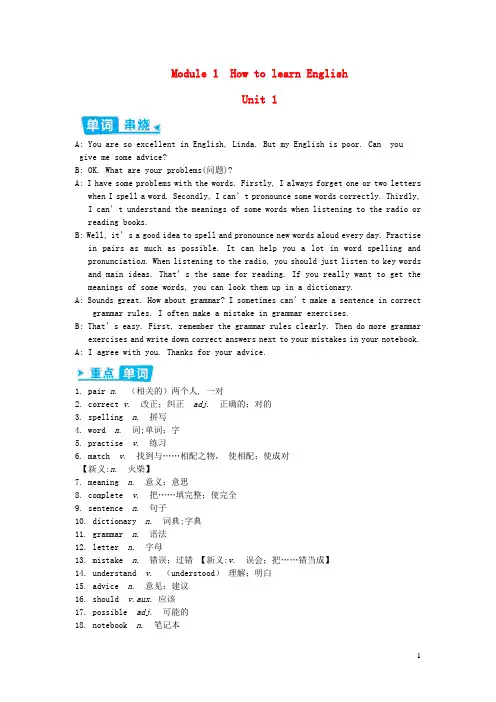
Module 1 How to learn EnglishUnit 1A: You are so excellent in English, Linda. But my English is poor. Can yougive me some advice?B: OK. What are your problems(问题)?A: I have some problems with the words. Firstly, I always forget one or two letters when I spell a word. Secondly, I can’t pronounce some words correctly. Thirdly,I can’t understand the meanings of some words when listening to the radio orreading books.B: Well, it’s a good idea to spell and pronounce new words aloud every day. Practi se in pairs as much as possible. It can help you a lot in word spelling and pronunciatio n.When listening to the radio, you should just listen to key words and main ideas. That’s the same for reading. If you really want to get the meanings of some words, you can look them up in a dictionary.A: Sounds great. How about grammar? I sometimes can’t make a sentence in correct grammar rules. I often make a mistake in grammar exercises.B: That’s easy. First, remember the grammar rules clearly. Then do more gram mar exercises and write down correct answers next to your mistakes in your notebook. A: I agree with you. Thanks for your advice.1. pair n.(相关的)两个人, 一对2. correct v.改正;纠正adj.正确的;对的3. spelling n.拼写4. word n.词;单词;字5. practise v.练习6. match v.找到与……相配之物,使相配;使成对【新义:n.火柴】7. meaning n.意义;意思8. complete v.把……填完整;使完全9. sentence n.句子10. dictionary n.词典;字典11. grammar n.语法12. letter n.字母13. mistake n.错误;过错【新义:v.误会;把……错当成】14. understand v.(understood)理解;明白15. advice n.意见;建议16. should v.aux.应该17. possible adj.可能的18. notebook n.笔记本19. forget v.(forgot)忘;忘记20. pronounce v.发……的音21. aloud adv.大声地;出声地22. radio n.电台;广播23. pronunciation n.发音24. key adj.关键性的,非常重要的【新义:n.钥匙;答案;(钢琴、计算机等的)键】25. main adj.主要的;最大的26. excellent adj.极好的;优秀的27. agree v.赞同1. correct adj.正确的;对的→ correctly ad v.正确地;对地2. mean v.意思是;意味着→ meaning n.意义;意思3. understand v.理解;明白过去式 understood adj.→ understanding 善解人意的4. possible adj.可能的→ possibly ad v.可能地5. forget v.忘;忘记过去式 forgot6. pronounce v.发……的音→ pronunciation n.发音7. agree v.赞同→ agreement n.协议1. practise doing sth. 练习做某事2. match… with… 把……与……匹配/搭配3. look up 查;查找4. make a mistake犯错误5. try to do sth. 尽力做某事6. as much as possible 尽可能多地7. write down写下;记下8. forget to do sth. 忘记做某事9. be good for… 对……有益10. need to do sth. 需要做某事11. get to know 开始认识;逐渐了解12. agree with sb. 同意某人1. 在课堂上我们应该一直讲英语。
Modules1-12教案2021-2022学年外研版八年级英语上册
Module1 How to learn English.类别课时要点重点单词correct, spelling, practise, match, meaning, understand, advice, possible, forget, pronounce, key, main, improve, suggest重点短语look up, make a mistake, agree with sb, get to do sth, be afraid to do sth., smile at, take sb. around, read aloud, in addition to重点句型1.Let’s try to speak English as much as possible.2.Why not write down our mistakes in our notebooks?3.It’s a good idea to spell and pronounce new words aloud every day.4.Many students ask for advice about how to improve their English.5.I also advise you to talk about the films or songs with your friends.教学重难点Grammar: the usage of present simple, past simple, simple future and present continuous课时Unit 1 Let’s try to speak English as much as possible.Unit 2 You should smile at her!Unit 3 Language in use课时分解Unit 1 Let’s try to speak English as much as possible.教学重难点1.Can use the following words and expressions correctly: dictionary, grammar, letter, look up, make a mistake, understand, etc.2.Listen and understand conversations that discuss ways and suggestions for learning English.3.Be able to talk about learning English and make your own suggestions.教学工具PPT courseware, wall chart, tape recorder, classroom exercise table, prizes教学过程Step 1 Warming-upT: English around you. How do you learn English? Do you like English? It is difficult to learn English. Do you think so ?Step 2 Pre-taskT1 : To study English, what will we learn? We should learn …T2: Read the instructions and check the ones you understand.Step 3 While-task1.Play the tape and have the Ss to choose the best answer.2.Play the tape again and ask the question: Besides reading and speaking, what’s Linglingthink is also important?anize the Ss to read the conversation. Write notes about learning English.anize the Ss to read the conversation in groups of three and solve the difficuties.Step 4 Post-taskGive me some advice:You should …Why don’t you…How about …It’s a good idea to …Step 5 SummarySum up the key structures in this unit.Step 6 Home-workWrite a composition about “How to improve our English”.板书设计You should speak English as much as possible.Why don’t you write down the mistakes?How about listening to the English songs?Unit 2 Y ou should smile at her!教学重难点e the following words and phrases correctly: advise, basic, conversation, improve,natural, meaning, suggest, should, ask for2.Be able to use words such as should, advise and suggest to make suggestions.3.Be able to read articles on English learning methods and suggestions and obtain detailedinformation.教学工具PPT courseware, wall chart, tape recorder, classroom exercise table, prizes教学过程Step 1 Warming-upLead-in1.Let the Ss enjoy a song and tell what the song is about.2.Free talk: Have Ss to talk about the problem they have in learning English(Activity 1)Step 2 Pre-readingNew words learning:Show Ss some pictures and have a free talk between T& Ss, teach the new words and expressions.Step 3 While-reading1.ScanningAsk the Ss to scan the passage and find out what it is about.2.SkimmingAsk the Ss to skim the passage.Step 4 Post-reading1.Careful reading(1)Paragraph 2 & 3①Present Ss some statements and ask them to write “T” or “F”,also correct thewrong sentences after reading Paragraph 2&3①Let the Ss read Paragraph 2&3 in groups of four and then find out the difficulties.①Solve the difficulties.(2)Paragraph 4 & 5:① Choose the best answers.①Let the girls read the Paragraph 4&5 , and the boys point out the importance anddifficulties.①Solve the difficulties.(3)Paragraph 6 & 7:①Let the Ss read paragraph 6&7, then answer the questions.①Ask a groups of six students to read Paragraph 6&7. and let the other studentslisten carefully to point out the importance and difficulties.①Solve the difficulties.(4)Ask the whole class to read out the whole passage, make sure that they understand it better.Step 5 Summary1.Get the Ss to sum up the language points.T:What have we learned today?Ss:……2.Let the Ss choose the best group in this lesson.Step 6 HomeworkHave the Ss make some advice of learning English for your class板书设计MODULE 1 How to learn EnglishUnit 2 You should smile at her Ask for …Advise…Should…Suggest…小组评价T1T2Unit 3 Language in use教学重难点Use the knowledge learned to make appropriate suggestions to students' problems or difficulties in learning; Make your own study plan based on other people's suggestions.教学工具Slides, pictures, questionnaires教学过程Step 1 Warming-up1.Teacher can talk with the students about how to improve their English.2.Do the language practice and make sure the students can understand and use the structures in this module.Step 2 While-task1. Ask the students to listen to the tape and then do part1 on page6.2. Ask them to listen again and correct their answers.3. Activity 3: Talk about the pictures with the Ss and have them to give Jack some advice.e.g. Say: Look at Picture 1, what does Jack usually do?4. Activity 5: Have the Ss to read Helen’s question and try to give her some advice. Collect the Ss’ ideas.5. Activity 7: Have the Ss discuss in small groups: How can I improve my reading?Then collect the Ss’ ideas.Step 3 Post-task1. Activity 8: Have the Ss to write down what they are not good at. Then work in groups, giving the advice.2. Have the Ss to make an English study plan, using the information in Activity 8.Step 4 SummarySum up the key structures in this module.Step 5 HomeworkWrite a composition about English study plans.板书设计Unit 3 Language in use1. I want to remember all the words.2. I saw a very good film yesterday.3. I’m going to work hard this year.4. Who is she writing the Email to?Module 2 My home town and my country 类别课时要点重点单词population, million, than, especially, university, low, umbrella, south, area, north, south, west, mountain, countryside重点短语in fact, such as, bring an umbrella with sb, the capital of, be best known for, the population of, in the northeast重点句型1.Some day it will become as busy as Hong Kong.2.What’s the population of Shenzhen?3.I’d like to go there one day4.I come from Cambridge, a beautiful city in the east of England.5.It has a population of about seven and a half million教学重难点Be able to compare the differences between two places and have conversations with classmates.课时Unit 1 It’s taller t han many other buildings.Unit 2 Cambridge is a beautiful city in the east of England. Unit 3 Language in use课时分解Unit 1 It’s taller than many other buildings.教学重难点1.Listen to conversations about my hometown.2.Be able to master sentence patterns:It’s a newer city than Hong Kong. It will become as busy as Hong Kong. Its streets are much wider and cleaner.教学工具PPT courseware, wall chart, tape recorder, classroom exercise table, prizes教学过程Step 1 Warming-up1.Lead-inT:How was your weekend?2.Free talkT: Where is your home town? Is it beautiful?Step 2 Pre-task1. Show Ss some pictures and have a free talk between T& Ss, teach the new words andexpressions.2. Have the Ss to look at the picture, compare two cities and talk about them.Step 3 While-task1.ListeningPlay the tape and choose the best answer(Activity 3).2.Listen and read.Play the conversation and get the Ss to repeat.Step 4 Post-taskRetelling1. Get the Ss to complete the passage about Shenzhen on page 11.2. Have the Ss to compare Shenzhen with their hometown. Write down the notes in Activity 5. Then get them ask and answer in pairs.StepStep 5 Summary1.Get the Ss to sum up the language points.T:What have we learned today?Ss:…2.Let the Ss choose the best group in this lessonStep 6 HomeworkWrite a composition about “your home town”板书设计MODULE 2 My home town and my country Unit 1 It’s taller than many other buildings ShenzhenA big city 小组评价T1T2Unit 2 Cambridge is a beautiful city in the east of England.教学重难点1.Be able to read short passages about Cambridge, London and The UK, understand the main ideas of the articles, and find relevant details.2.Be able to introduce your hometown in the language you have learned.教学工具PPT courseware, teaching wall chart, tape recorder, classroom contact form.教学过程Step1 Warming-upLead-in1.Let the Ss enjoy a song and tell what the song is about.2.Free talk: Have Ss to talk about China.Step2 Pre-reading1.Have Ss to talk about the map of England and learn some new words.(Activity 1).2.New words learning:Show Ss some pictures and have a free talk between T& Ss, teach the new words and expressions.Step3 While-reading1.ScanningAsk the Ss to scan the passage and find out the places introduced in the passage, then choose a title for each picture(Activity 2)2.SkimmingOrganize the Ss to skim the passage and complete the table in Activity 33.Careful reading(1)Paragraph1① Choose the best answers.①Let the Ss read Paragraph 1 in groups of four and then find out the difficulties.①Solve the difficulties.(2)Paragraph 2:① Choose “T” or “F”, correct the wrong sentences.①Let the girls read the Paragraph 2 , and the boys point out the importance and difficulties.①Solve the difficulties.(3)Paragraph3&4:①Let the Ss read paragraph 3&4, then answer the questions.①Ask a groups of six students to read Paragraph 3&4. and let the other students listen carefully to point out the importance and difficulties.①Solve the difficulties.(4)Ask the whole class to read out the whole passage, make sure that they understand it better.Step4 Post-reading1.Have Ss to complete the passage of Activity 4 and read the passage together.2.Have the Ss to retell the passage with the information in Activity3.3.Have Ss to ask and answer the questions in pairs. (Activity 5 )Step5 Summary1.Get the Ss to sum up the language points.T:What have we learned today?Ss:…2.Let the Ss choose the best group in this lesson.Step6 HomeworkHave the Ss write a passage about their home town with the information in Activity 5.板书设计MODULE 2 My home town and my country Unit 2 Cambridge is a beautiful city in the east of England.Cambridge...London...England...小组评价T1T2Unit3 Language in use教学重难点Be able to use the knowledge you have learned to introduce and compare the two places to your classmates教学工具slides, pictures, questionnaires教学过程Step1Lead-in1. Show the word map (Activity 4) on the blackboard, and get the Ss to complete it.2. Show the two pictures of Shenzhen and Hong Kong. Have the Ss to talk about them with comparative adjectives and the word map on the blackboard. And write down some comparative adjectives sentences on the blackboard3. Get the Ss to compare their hometown with Shenzhen or Hong Kong, and talk about the two places.4. Make sure that the Ss understand the sentences on the blackboard.Step2 While-task1. Activity 1. Get the Ss to complete the sentences.2. Activity3. Make a sentence as a model with the information in the table.3. Activities 5, 6. Let the Ss to finish them.Step3 Post-taskLet Ss compare their hometowns with a place in small groups. Write down the information in the following tableShenzhen(or Hong Kongor other cities)HometownLocationHow oldPopulationFamousplacesSpecial thingsStep5 SummaryThe comparative form is used to compare two subjects. The sentence is formed by changing the adjective or adverb into the comparative form, that is, adding more or suffix -er before the adjective or adverb.Step6 HomeworkReview the usage of comparative adjectives.板书设计Shenzhen(or HongKong or other cities)HometownLocationHow oldPopulationFamousplacesSpecial thingsModule 3 Sports类别课时要点重点单词boring, exciting, relaxing, enjoyable, miss, mind, beat, careless, coach, train, usual, better, pleased, loudly, confident重点短语a minute ago, bad luck, be sure about, cheer…on, warm up, play against, be late for, get lost, all the time重点句型1.Some day it will become as busy as Hong Kong.2.What’s the population of Shenzhen?3.I’d like to go there one day4.I come from Cambridge, a beautiful city in the east of England.5.It has a population of about seven and a half million教学重难点Comparative adjective课时Unit 1 Nothing is more enjoyable than playing tennis. Unit 2 This year we are training more carefully.Unit 3 Language in use课时分解Unit 1 Nothing is more enjoyable than playing tennis.教学重难点Can skillfully use the comparative form of adjectives and adverbs to compare different sports events.教学工具PPT courseware, wall chart, tape recorder, physical objects, classroom exercise forms, prizes教学过程Step 1 Warming-upLead in1. Greetings.Free talk: “ Do you like sports? What’s your favourite sport? Why? ”Step 2 Pre-task1.T: What do you think of basketball? Is it easy or difficult?2.Show students some pictures of the sports, and show the new words as well. For example: I like basketball, because it’s exciting.3.Have the students listen and number the sports in Activity 1.Have the students use the words in the box to talk about the sports in Activity 2.Step 3 While -task1. Listen and answer:Have the students listen to the tape and answer the question:What kind of sports are they watching on TV?A.BasketballB.FootballC.Table tennis2.Listen and read:Have the students listen and read the dialogue by themselves and check the true sentences in Activity 2.Then check their answers in pairs, then in class.3.Read and rememberAsk students to read the dialogue in groups and try to find out some important language points by themselves then help them solve the difficult points if necessary.4. Act out the dialogue.Step 4 Post-taskplete the passage.Let the students complete the passage with the words in Activity 1(Activity 5).2.Make a report.In groups ,make a survey about sports and then make a report .Step 5 Summary1.Get the students sum up the language points.T: What have we learned today?Ss:…2.Let the students choose the best team in this lesson.Step 6 HomeworkComplete the sentences with the words in the box(Activity4).板书设计Module 3 SportsUnit 1 Nothing is more enjoyable than playing tennis.Football is more exciting than basketball.Playing table tennis is easier than playing volleyball.Unit 2 This year we are training more carefully.教学重难点1.Be able to read and understand short passages about sports activities.2.Be able to use the comparative form of adjectives to make appropriate comparisons and express personal opinions.教学工具PPT courseware, wall chart, tape recorder, classroom exercise table, prizes.教学过程Step 1Warming-up1.Lead inPlay a piece of music “The cup of life”and then have a free talk with Ss:The song sounds exciting, isn’t it ? Do you like football? Why?Step 2 Pre-reading1.Show students the two pictures of Activity1. Lead the students to describe them and present new words in sentences and teach them as well.eg: The blue team beat the red team because the red team was careless.2.Have students guess:Look at the title-Training hard .Why they train hard? Did Li Daming’s team win last year?Step 3 While-reading1. ScanningAsk students to scan the passage and find out the main idea of it.2. Skimming(1)Ask students to skim the passage and complete the table.T: We know Li Daming’s team tain hard this year.What do they do ? Why ?Read the passage quickly again and complete the table in groups.(2)Call back the answers.3.Careful reading.(1)Paragraph 1&2:①Choose the best answersT: Now, we know they train hard this year.Where and when do they train ? Read Paragraph 1&2 in pairs and choose the best answers to the two questions.①Let the students read Paragraph 1&2 in groups of four and find out difficulties.①Solve the difficulties.T: Why they lost to the other team last year ? Let’s continue learning Paragraph 3.(2)Paragraph 3:①Present some sentences to the students and ask them to write “T” or “F” also correct the wrong sentences after reading Paragraph 3 .①Ask a student to be “a little teacher” to check the answers.① Let one team students read Paragraph 3 and the other students listen carefully to point out important points.①Solve the difficulties.T: We know that it’s good to have many fans around when we ‘re playing the game.So do they! Do you know the reason? Read Paragraph 4 and answer the question.(3)Paragraph 4:①Let the students read Paragraph4 and answer the question in pairs.①Let the students ask and answer in pairs to check their answers.①Ask a group of six students to read paragraph 4. Let the other students listen carefully and find out difficulties.①Solve difficulties.T: Let’s read the letter together.Step 4 Post-reading1.Retell.①Let the students complete the passage with the words in the box in Activity3.①Call back the answersfrom two students thenread the short passagein the whole class .2.Speaking①Put the words in the box into pairs with opposite meanings.①Make sentences with the words.eg: He got up late yesterday,but he got up later this morning.Step 5 Summary1.Get the students tosum up the language points.T: What have we learned today?Ss:……2.Let the students choose the best team in this lesson.Step 6 HomeworkWrite a passage about their school basketball team in Activity5.板书设计Unit2 This year we are training more carefully.play againstas ... as we can...so that...warm upbeat/winIt’s+adj.(for Sb) to do Sth.What a pity!cheer ..onUnit 3 Language in use教学重难点Be able to describe sports and make postcards using adjectives and their comparatives.教学工具Slides, pictures, questionnaires教学过程Step 1 Leading-in1.Show students a short video about different kinds of ball games.2.Have a free talk with students.What’s your favourite sport?Why?Step 2 While-task1.Let the students work in pairs look at the pictures ask and answer in Activity1 like this : -What’s your favourite sport?-My favourite sport is swimming.It’s exciting.2.Have a competition.Work in groups of four, compare the sports to see which group can collect the most sentences.3.Have students look at the blackboard and summary the rules of Comparative adjectives(more).4.Show students two sentences and ask them to find out the usage between adjectives and adverbs .5.Have students make sentences with adjectives and adverbs.Step 3 Post-task1. Have students work in groups and complete the sentences and passage with the words in the brackets of Activity 2-4.2. Call back the answers.3. Ask the students to work in groups talk about their favourite Olympic sports and makea sports poster.Step 4 SummaryAsk the students to conclude the usage of adjectives and adverbs and their comparative. Step 5 HomeworkWrite an email to your best friend about your favourite sport.板书设计Module 3 SportsUnit 3 Language in useTable tennis is more exciting than tennis.Tennis is more expensive than table tennis.more + adjectives(多音节)Tom was careless.He did his homework carelessly.The teacher is careful and he speaks carefully.行为动词+副词系动词+形容词Module 4 Planes, ships and trains类别课时要点重点单词choice, far, close, crowded, accident, except, book, outside, cost, journey, however重点短语far from, a bit dangerous, the same as, take the underground, get there, get crowded, in a hurry, somewhere else重点句型1.There was a road accident, and the traffic was very heavy.2.Maybe I should go to school by taxi.3.He lives the farthest from school, so he takes the underground.4.The more information the better.5.And it takes you about twelve hours to get there.教学重难点The superlative of an adjective or adverb课时t 1 Unit 1 He lives the farthest from school.Unit 2 What is the best way to travel?Unit 3 Language in use课时分解Unit 1 He lives the farthest from school.教学重难点Use adjectives and adverbs in superlative forms to talk about and compare modes of travel and means of transport.教学工具PPT courseware, wall chart, tape recorder, physical objects, classroom exercise forms, prizes教学过程Step 1 Warming-up1.Let the students watch a video, sing the song. “ The train”. Ask Can you guess the name of the song?2 Show some pictures of vehicles on the computer, let the students say them out quickly. The first one to say it is the winner...Then introduce the title.Step 2 Pre-taskTask1 Check the new words.1. Show more pictures and things to get the students to say out new words.2. Ask one little teacher to teach the students to read the new words.Step 3 While-taskTask1 Do activity 1Ask the students to finish Activity One. Match the words in the box with the pictures. Then check the answers quickly.Task 2 Listening(Activity 2)1.Ask the students to listen and match the words in the box with the pictures in Activity 1.2. Guide them answer in this way, Going by bus is cheap.Task3 Listening(Activity 3)1. Play the tape, ask students to listen and choose the best answers to the two questions:① Who lives the farthest from school? (A. Tony B. Lingling C. Daming)① How does Daming go to school? (A. By underground. B. On foot. C. By bus.)2 .Check their answers.Task 4 Reading(Activity 3)1. Ask the students to read the conversation and complete the table in Activity Three.2. Call back the answers.Task 5 Practice reading.1. Organize the students to read the conversation with the video.2.Ask the Ss to work with their groups to read the conversation.3. Organize the students to have a competition: Read the dialogue in groups and choose the best group.Task 6 Solve the language points(1).Organize students to read the conversation again and find the language points. Let them discuss in groups and solve their problems.(2).Ask three little teachers to help the students solve their problems.Task 7 RetellingGet the Ss to retell the conversation with the information in the table in Activity 3.Task 8 Grammar and exercises1. Summary all the sentences of the Superlative adjectives and adverbs. Give more samples.2. Ask the students to complete the sentences with the correct form of the words in the box.(Activity 4)3.Ask the students to go on completing the sentences with the words or expression in thebox. (Activity 5)Step 4 Post-task1. Pair work.Organize them to ask and answer questions about the ways of going to school. Use the words in the box to help them.A:What’s the most expensive way to go to school?B: Going by taxi is the most expensive.A:How about by bus, is it a good way to go to school?B: It is cheap, but so crowded.2.Have the Ss act out the dialogue.Step 5 Summary1.Get the students to sum up the language points.T: What have we learned today?Ss:…2.Let the students to choose the best team in this lesson.Step 6 Homework1.Make an interview.Ask them to interview their friends about How do they go to school every day. Then let them give a report next class.Report: My friend… usually goes to school by bike because her/ his home is the closest to school. My friend … usually goes to school by bus because his/her home is the farthest from school.2.Ask the students to finish the exercises in the workbook of Module 4 Unit 1.板书设计Module 4 Planes, ships and trains 小组评价Unit1 I He lives the farthest from school.1. Lingling’s home is the closest to school. T1 T2 T32. It is the most comfortable waybut it’s the most expensive.3. Tony lives farthest from school.Unit 2 What is the best way to travel?教学重难点1.Be able to understand articles about travel and transportation2.Be able to correctly use the comparative and superlative forms of adjectives and adverbs, write a travel journal, compare the convenience and inconvenience of various means of transportation教学工具PPT courseware教学过程Step 1Warming-up1.Play a game.Ask the every student to write a word of their favorite vehicle on a piece of paper, then let them exchange it with their friend. Then let a student say out the word in his/her hand , those who has the same word must stand up quickly and change theirseat, the one that has no seat is the loser.2.Ask the student to give a report about their interview.Report: My friend… usually goes to school by bike because her/ his home is the closest to school. My friend … usually goes to school by bus because his/her home is the farthest from school.Step 2 Pre-reading1.Check the new words.(1).Show more pictures and things to get the students fill in the blanks with right words. eg: journey, book, outside, choice, however, cost(2)Organize them to read the new words together.2.Free talk.Ask the students to talk about the ways to go to a city that they like to visit in pairs.1. How do you get there?2. What’s the cheapest way to get there?3. What’s the best way to get there?Step 3 While-reading1. ScanningAsk students to scan the passage and find out the main idea for the passage.2. SkimmingAsk students to skim the passage and answer the question.T: What is the best way to travel from London to Amsterdam?3.Careful reading.Paragraph 1(1) Present some sentences to the students and ask them to write “T” or “F”, also correct the wrong sentences①The writer wants to travel from Amsterdam to London.②The writer wants to know the cheapest way of travelling.(2)Let the students read Paragraph One in groups of six and find out difficulties.(3) Ask them to solve difficulties.Paragraph 2 and 3(1)Ask the students to read Paragraph 2 and 3, then answer the following questions.① Which is more relaxing, going by train or going by coach?①What is the most expensive way to travel?①Is parking in Amsterdam very expensive?(2) Ask a student to be “a little teacher” to check the answers.(3) Organize the whole class to read together.(4)Ask some little teachers to solve the difficulties.Paragraph 4, 5and 6(1)Let the students read Paragraph 4,5,6 and fill in the blanks.Going by________is usually the cheapest , but in summer it often gets ________ and ________ you a long time to get there. Going by plane is the ________ and the second ___________ , but you may have to wait for hours at the airport ________ of bad weather.(2) Organize some students to come to the blackboard and show out some difficult language points that they found in these paragraphs.4 Practise reading.Get the students watch a video and read with it, then let them read loudly in groups.Step 4 Post-reading1.Speaking(1)Ask the students to complete the table, find the good points and bad points of travelling, then let them list more about it.(2) Divided the whole class into two groups, then let them have a debate competition.2.Retell(1) Organize the Ss to retell the passage with the information in Activity3.(2)Let the students Complete the passage with the words in the box(2)Call back the answersfrom the whole class thenlet them read the short passage in the whole class .Step 5 Summary1.Get the students tosum up the language points.T: What have we learned today?Ss:……2.Let the students to choose the best team in this lesson.Step 6 HomeworkWrite a passage about ways of travelling from London to Paris. Use the information in Activity 5 and the passage in Activity 2 to help you.板书设计Module 4 Planes, ships and trainsUnit 2 What is the best way to travel?1.What’s the best way to travel from London to Amsterdam?2.The more information, the better.3.This is the most comfortable way to travel but also the most expensive.4.It’s the fastest and the second cheapest.Unit 3 Language in use。
(完整word)新外研版八年级英语上册1-12模块教案
Module 1 How to learn EnglishUnit 1 Let’s try to speak English as much as possible.第1、2课时【学习目标】1、(知识与技能):掌握下列重点单词的意思及用法:translate, correct, match number, advice, mistake, message, each, spelling,pronunciation, newspaper, excellent.掌握下列短语的意思及用法:give sb. some advice, write it/them down, speak English, in class, do some concerts, try (not) to do sth., each other, help sb. with sth.2、(过程与方法):通过本节的学习,培养学生的探究精神和创新意识,提高学生解决实际问题的能力。
3、(情感、态度与价值观)掌握学习英语的方法,提高学习英语的兴趣,懂得与人交流,注意语言的得体性。
【重点难点】1.重点句式:How about listening to the radio and reading a newspaper in English?Try not to translate every word.You should always speak English in class.Why don’t you write down your mistakes?2.难点:提建议的常用表达方法。
【学法指导】课前在熟读单词与短文的基础上认真完成自主学习内容并能把重点单词短语熟记于心,完成探究内容,对未能解答的问题做上标记,课堂上,跟着老师的指导,完成听读训练,学习新的语法知识,并纠正自己在课前完成的任务。
A . Why don’tB . How aboutC . Let’sD . Why not( ) 5 . Don’t forget _________ the door when you leave home .A . closeB . closedC . closingD . to close( ) 6 . __________ playing computer games ?A . Why notB . Shall weC . How aboutD . Why don’t you( ) 7 . It’s better __________ early in the morning .A . startB . to startC . startingD . started( ) 8 . I think English is as ___________ Chinese .A . important asB . important thanC . more important thanD . important ( ) 9 . It’s bad for you to copy others’ homework . __________ do it again .A . Don’t tryB . Not try toC . Try not toD . Try not( ) 10 . It will be sunny soon . You don’t need __________ an umbrella .A . to takeB . takeC . takingD . took二、按要求完成下列各题。
外研版八年级英语上册全册教学设计 初二第一学期全套教案 (2)
Module 1 How to learn EnglishUnit 1 Let’s try to speak English as much as possible.一、学习目标:A.单词和短语:pair, correct, spelling, word, practice, match, meaning, complete, sentence, dictionary, grammar, letter, look up, mistake, make a mistake, understand-understood, advice, should, possible, write down, notebook, forget-forgot, pronounce, aloud, radio, pronunciation, key, main, excellent, agree, agree with sb., vocabulary, ask for, improve, basic, time, advise, shy, conversation, quickly, natural, suggest, placeB.交际用语:1. Ready?2. That’s a good idea.3. What else?4. Thanks a lot!5. Excellent!6. We should always speak English in class.7. Let’s try to speak English as much as possible.8. Why not write down the mistakes in our notebooks?9. It’s a good id ea to spell and pronounce new words aloud.10. How about listening to the radio?11. It’s better not to translate.12. It’s a good idea to check new words every day.二. 教学目标1. Function: Giving suggestions (English study)2. Structure: Giving advice: 1) We/You should…2) Let’s try to…3) Why not…?4) It’s a good idea to…5) How about…?6) Why don’t we/you…?7) It’s better not to…3. Skills: 1) Listening and understanding familiar topics (English study).2) Talking about problems in English study and giving advice, conductingconversations in several turns.3) Reading and finding specific information about English study.4) Drafting a letter asking for advice about English study, revising throughpair discussion..4. Around the world: English online5. Task: Writing your English study plan.三、重点及难点:Giving advice: 1) We/You should…2) Let’s try to…3) Why not…? 4) It’s a good idea to…5) How about…? 6) Why don’t we/you…? 7) It’s better not to…四、教学设计:Unit 1 Let’s try to speak English as much as possible.ⅠTeaching modelListening and speakingⅡTeaching methodPWP approachⅢTeaching aims1. To understand conversations involving advice on learning English.2. To get information about how to learn English from the conversation.3. To understand the way of giving advice.4. To practise giving advice on English learning.ⅣTeaching Objectives1. Key vocabulary: pair, correct, spelling, word, practice, match, meaning, complete,sentence, dictionary, grammar, letter, look up, mistake, make amistake, understand-understood, advice, should, possible, writedown, notebook, forget-forgot, pronounce, aloud, radio, key, main,excellent, agree, agree with sb., vocabulary2. Key structures: 1) We/You should…2) Let’s try to…3) Why not…? 4) It’s a good idea to…5) How about…? 6) Why don’t we/you…? 7) It’s better not to…ⅤTeaching aidsTape recorder, OHP , videoⅥTeaching StepsStep 1 Warming up1. Show some pictures of school things. Say how to learn English well.2. Read the words after the teacher.3. Introduce the new words.4. Learn the new words.Step 2 Read and check.1. Read the instructions in Activity 1and check(√) the ones you understand.1) Work in pairs. Ask and answer the questions.2) Correct the spelling.3) Listen and check the words you hear.4) Practise saying the words.5) Match the words with the meaning.6) Complete the sentences with the words in the box.3. Ask the students to check their answer with a partner.4. Call back the answer from the whole class and check the answer.Step 3 Listen and repeat.1. Ask the students to read the word and expressions in Activity2.dictionary grammar letter look up make a mistake meaning understand 2. Read through the questions.1) Which word did Daming not understand?2) What mistake did Lingling make?3) How does Daming usually check the spelling of a word?4) Why is it difficult for Daming to check the spelling of cinema?3. Play the recording and ask the students to listen to the recording carefully.4. Listen and answer the questions. Use the words and expressions from the box.5. Play the recording again, then they can check their answer with a partner.6. Call back the answer from the whole class and check the answer.Step 4 Listen and read.1. Show some pictures, and ask the students to talk about them.2. Ask the students to read the conversation silently.3. Play the recording and ask the students to listen and read the conversation.4. Read the conversation.5. Act it out.6. Learn “Everyday English”Ready?That’s a good idea.What else?Thanks a lot!Excellent!7. Tell the students how to learn English well.1) We should always speak English in class.2) Let’s try to speak English as much as possible.3) Why not write down the mistakes in our notebooks?4) Don’t forget to write down the correct answers next to the mistakes.5) It’s a good idea to spell and pronounce new words aloud every day.6) How about listening to the radio?7) How about reading English stories?8) W hy don’t we try to find some English pen friends?Step 5 Writing.1. Read the conversation again.2. Ask the students to write notes about learning English.Listening : listen to the radioSpeaking : ___________________________________________________ Reading : ____________________________________________________ Writing: ____________________________________________________Learning new words: ___________________________________________3. Ask the students to check with a partner.4. Check the answers:Keys:Listening : listen to the radioSpeaking : speak English as much as possibleReading : read an English storiesWriting: write to pen friends, write down our mistakes in our notebooks, write down the correct answers next to the mistakesLearning new words: spell and pronounce new words aloud every dayStep 6 Underline the correct words and expressions.1. Ask the students to read through the passage in Activity 4.Here’s my (1) advice / notebook about learning English. Speak English (2) always / as much as possible in class, and listen to English (3) in the newspaper / on the radio. I (4) agree / forget it’s a good idea to look up new worlds in the ( 5) notebook / dictionary. You can find the (6) correct / excellent pronunciation and learn the meaning2. Underline the correct words and expressions.3. Check with a partner.4. Call back the answers from the whole class.Keys: 1. advice 2. as much as possible 3. on the radio 4. agree 5. dictionary 6. correct 5. Read the passage together.Step 7 Listen and repeat.1. Play the recording once without stopping.2. Play the recording again and ask the whole class to repeat.1) We should always speak English in class.2) Let’s try to speak English as much as possible.3) Why not write down the mistakes in our notebooks?4) It’s a good idea to spell and pronounce new words aloud.5) How about listening to the radio?3. Ask the students to listen and mark the intonation.4. Now listen again and repeat.Step 8 Work in pairs.1. Talk about problems and give advice.Problems AdviceI can’t… How / What about …?I don’t know… Why not / don’t you …?2. Read through the example with the class.—I can’t speak English well. What should I d o?—Why don’t you try to talk to our classmates in English?3. Work in pairs.Step 9 Important and difficult points1 Why not write down our mistakes in our notebooks?何不在笔记本上把我们的错误记下来?Why not …? 用来表示提出某种建议,而不是询问为什么不做某事的原因,例如:Why not take a walk in the park ?何不在公园里散散步?我们还可以用下面的表达方式来提建议:Why don’t we drive to the country?我们何不开车去乡下?What / How about going to Europe for a holiday?去欧洲度假怎么样?Write down 或者put down 表示“记下,写下”。
最新外研版八年级英语上册教案全册
最新外研版八年级英语上册教案全册外研版八年级英语上册教案Module 1Module 1 How to learn EnglishUnit 1 Let’s try to speak English as much as possible.一、学习目标:A.单词和短语:pair, correct, spelling, word, practice, match, meaning, complete, sentence, dictionary, grammar, letter, look up, mistake, make a mistake, understand-understood, advice, should, possible, write down, notebook, forget-forgot, pronounce, aloud, radio, pronunciation, key, main, excellent, agree, agree with sb., vocabulary, ask for, improve, basic, time, advise, shy, conversation, quickly, natural, suggest, placeB.交际用语:1. Ready?2. That’s a good idea.3. What else?4. Thanks a lot!5. Excellent!6. We should always speak English in class.7. Let’s try to speak English as much as possible.8. Why not write down the mistakes in our notebooks?9. It’s a good idea to spell and pronounce new words aloud.10. How about listening to the radio?11. It’s better not to translate.12. It’s a good idea to check new words every day.二. 教学目标1. Function: Giving suggestions (English study)2. Structure: Giving advice: 1) We/You should…2) Let’s try to…3) Why not…?4) It’s a good idea to…5) How about…?6) Why don’t we/you…?7) It’s better not to…3. Skills: 1) Listening and understanding familiar topics (English study).2) Talking about problems in English study and giving advice, conductingconversations in several turns.3) Reading and finding specific information about English study.4) Drafting a letter asking for advice about English study, revising through pair discussion..4. Around the world: English online5. Task: Writing your English study plan.三、重点及难点:Giving advice: 1) We/You should…2) Let’s try to…3) Why not…? 4) It’s a good idea to…5) How about…? 6) Why don’t we/you…? 7) It’s better not to…四、教学设计:Unit 1 Let’s try to speak English as much as possible.ⅠTeaching modelListening and speakingⅠTeaching methodPWP approachⅠ Teaching aims1. To understand conversations involving advice on learning English.2. To get information about how to learn English from the conversation.3. To understand the way of giving advice.4. To practise giving advice on English learning.ⅠTeaching Objectives1. Key vocabulary: pair, correct, spelling, word, practice, match, meaning, complete, sentence, dictionary,grammar, letter, look up, mistake, make a mistake, understand-understood, advice, should,possible, write down, notebook, forget-forgot, pronounce, aloud, radio, key, main, excellent,agree, agree with sb., vocabulary2. Key structures: 1) We/You should…2) Let’s try to…3) Why not…? 4) It’s a good idea to…5) How about…? 6)Why don’t we/you…? 7) It’s better not to…ⅠTeaching aidsTape recorder, OHP , videoⅠTeaching StepsStep 1 Warming up1. Show some pictures of school things. Say how to learn English well.2. Read the words after the teacher.3. Introduce the new words.4. Learn the new words.Step 2 Read and check.1. Read the instructions in Activity 1and check(√) the ones you understand.1) Work in pairs. Ask and answer the questions.2) Correct the spelling.3) Listen and check the words you hear.4) Practise saying the words.5) Match the words with the meaning.6) Complete the sentences with the words in the box.3. Ask the students to check their answer with a partner.4. Call back the answer from the whole class and check the answer.Step 3 Listen and repeat.1. Ask the students to read the word and expressions in Activity2.dictionary grammar letter look up make a mistake meaning understand 2. Read through the questions.1) Which word did Daming not understand?2) What mistake did Lingling make?3) How does Daming usually check the spelling of a word?4) Why is it difficult for Daming to check the spelling of cinema?3. Play the recording and ask the students to listen to the recording carefully.4. Listen and answer the questions. Use the words and expressions from the box.5. Play the recording again, then they can check their answer with a partner.6. Call back the answer from the whole class and check the answer.Step 4 Listen and read.1. Show some pictures, and ask the students to talk about them.2. Ask the students to read the conversation silently.3. Play the recording and ask the students to listen and read the conversation.4. Read the conversation.5. Act it out.6. Learn “Everyday English”Ready?That’s a good idea.What else?Thanks a lot!Excellent!7. Tell the students how to learn English well.1) We should always speak English in class.2) Let’s try to speak English as much as possible.3) Why not write down the mistakes in our notebooks?4) Don’t forget to write down the correct answers next to the mistakes.5) It’s a good idea to spell and pronounce new words aloud every day.6) How about listening to the radio?7) How about reading English stories?8) Why don’t we try to find some English pen friends?Step 5 Writing.1. Read the conversation again.2. Ask the students to write notes about learning English.Listening : listen to the radioSpeaking : ___________________________________________________ Reading : ____________________________________________________ Writing: ____________________________________________________ Learning new words: ___________________________________________3. Ask the students to check with a partner.4. Check the answers:Keys:Listening : listen to the radioSpeaking : speak English as much as possibleReading : read an English storiesWriting: write to pen friends, write down our mistakes in our notebooks, write down the correct answers next to the mistakesLearning new words: spell and pronounce new words aloud every dayStep 6 Underline the correct words and expressions.1. Ask the students to read through the passage in Activity 4.Here’s my (1) advice / notebook about learning English. Speak English (2) always / as much as possible in class, and listen to English (3) in the newspaper / on the radio. I (4) agree / forget it’s a good idea to look up new worlds in the ( 5) notebook / dictionary. You can find the (6) correct / excellent pronunciation and learn the meaning2. Underline the correct words and expressions.3. Check with a partner.4. Call back the answers from the whole class.Keys: 1. advice 2. as much as possible 3. on the radio 4. agree 5. dictionary 6. correct 5. Read the passage together.Step 7 Listen and repeat.1. Play the recording once without stopping.2. Play the recording again and ask the whole class to repeat.1) We should always speak English in class.2) Let’s try to speak English as much as possible.3) Why not write down the mistakes in our notebooks?4) It’s a good idea to spell and pronounce new words aloud.5) How about listening to the radio?3. Ask the students to listen and mark the intonation.4. Now listen again and repeat.Step 8 Work in pairs.1. Talk about problems and give advice.Problems AdviceI can’t… How / What about …?I don’t know… Why not / don’t you …?2. Read through the example with the class.—I can’t speak English well. What should I do?—Why don’t you try to talk to our classmates in English?3. Work in pairs.Step 9 Important and difficult points1 Why not write down our mistakes in our notebooks?何不在笔记本上把我们的错误记下来?Why not …? 用来表示提出某种建议,而不是询问为什么不做某事的原因,例如:Why not take a walk in the park ?何不在公园里散散步?我们还可以用下面的表达方式来提建议:Why don’t we drive to the country?我们何不开车去乡下?What / How about going to Europe for a holiday?去欧洲度假怎么样?Write down 或者put down 表示“记下,写下”。