
仁爱版七年级下册英语Unit6Topic1SectonD教学案设计(无答案)
7.What's on the desk? There are soபைடு நூலகம்e model planes on it.
8.How many planes are there? There are three.
自己思考,老师随机抽取学生群里展示。
有困难向老师求助,老师在线解答。
自我完成,核对答案。老师根据预习检测结果进行补讲。
独立完成,课堂展示并说出这样填的原因。
可以翻阅课本查找资料,至少写80个词。钉钉在线提交,老师批阅,点评。
学习流程
【复习巩固】
I写出我们所学的介词。
2.完成下列练习。
1). Don’t play ______ the dog.
(2). What can you see ______ the picture?
(3). You must look______ your watch.
(4). The apples are ______the tree. Now Tom is ______the tree.
(5). I watch TV______ eight______ the morning.
______________________________________________________
3.你知道how many和how much 在对数量的提问上有什么不同吗?
how many_________________________________________
how much__________________________________________
【巩固提升】
读课本2,然后给你的朋友Tom写一封回信,介绍你的家。
【归纳总结】
盘点收获,写出困惑。
教与学的反思:(教师:1、成功之处,2、失败之处,3、改进措施,学生:1、梳理知识框架,2、主要收获,3、主要困惑)
4. ________________ some gifts for our Chinese teacher, Mr. Li.
5. How many letters _______________ in this word?
6. _______________ a river in front of the house?
(6). Tom is standing ______ the left of Jimmy.
(7). Bobby is tall. He sits ______ the back of the classroom.
3.完成课本1.
II.读熟并翻译下列句子。
1.There is a lamp, a computer, some books and so on.
2.There is a computer in Picture B.
3.There are three bedrooms, a large living room…
4.There aren't any trees.
5.Is there a computer in your study? Yes, there is. / No, there isn't.
U nit6OurLocalAreaTopic1SectionD
班级:姓名:时间:2020年2月25日
教学策略
【学习目标】
1.复习巩固介词。
2.复习巩固There be句型
错题订正
(个性补案)
1.1.自己独立写出所学介词,然后和课本中的方框里的介词核对,记忆并巩固。
1.2.独立完成,同学之间核对答案,老师点评,补讲。
There is a book on the desk.
have/has侧重 “_____________” ,表示“___________________”。如:
She has some interesting books.
2.get a letter from sb.=_________________________都可以用来表示:
9.How much water is there? Only a little.
III.看课件There be…句型(一)和(二)
【合作探究】
1.There be 与 have/has 的区别:
There be 侧重 “_____________”, 表示“____________________” 。如:
【合作生成】
用There be 或have/ has填空。
1.We _____________ no classes on Saturdays and Sundays.
2. _______________ a bowl of dumplings on the table.
3. Mr. Li _____________ a pet dog.
仁爱英语教学资源七年级下册教学案例设计Unit6 Topic 1 Section A Section D

Section DSection D needs 1 period. Section D需用1课时。
The main activities are 1 and 5. 本课重点活动是1和5。
Ⅰ. Aims and demands目标要求1. Learn the vowels: / /,/☜☺/, /♋✋/, / /2. (1)Review the prepositions of position.(2)Review the structure of“There be” .3. Review home items.Ⅱ. Teaching aids 教具录音机/图片/单词卡片Ⅲ. Five-finger Teaching Plan 五指教学方案Step 1 Review 第一步复习(时间:6分钟)复习单词。
1. (方案一:听写单词。
把本话题单词按词性归类,然后进行听写活动,旨在加强学生对单词的记忆和运用,为本话题的写作练习奠定基础。
)①(名词和名词短语):floor, bedroom, kitchen, garden, bathroom, grandfather, house, door,lamp, clock, table, key, thing, dad, window, model, river, center, yard, flower, people, mirror, drawer, chair, keyboard, pencil-box, living room, dining room②(介词和介词短语):behind, near, under, next to, in front of, in the center of, on the left, atthe back of③(数词、副词、形容词):second, upstairs, away, beautiful, large, left④(动词短语):come in, talk about, put away(方案二:单词竞赛。
仁爱初一Unit6Topic1详案(仁爱版七年级英语下册教案教学设计)

仁爱初一 Unit6 Topic 1 详案(仁爱版七年级英语下册教案教学设计)Section AMain activities:1a, 2b and 3Teaching priods:1~2Teaching aims and demands:1. Master the structure of “there be” and some prepositions.2. Get to know different rooms in houses.3. Review the present continuous tense.Teaching procedure:Step1 Review1. Perform some actions to review the present continuous tense.2. Show the picture of 1a to the students, asking the following questions:Who is the boy?Who is the girl?What are they doing?Step2 Presentation1. Draw a two-story house with several empty rooms on the blackboard, then show a picture of “study” to the students and teach them to say the new word “study”. Stick the picture into one of the rooms on the second floor, and teach the students to say the sentence “There is a study on the second floor.”2. Teach the names of other rooms to the students, using the same method above. Practice them in “there be” structure.3. Play the tape of 1a for the students, and ask them to answer the following question after listening.“Is there a computer in Jane’s study?”4. Go through the dialog with the students together, and deal with some language points.Write them down on the blackboard.Is there…Are there…Next to…Why not…Can I borrow…Step3 Consolidation1. Play the tape again and ask the students to follow it sentence by sentence, paying attention to the pronunciation and intonation.2. Get the students to practice and act out the dialog. Choose several pairs to act out in the front of the class.Step4 Practice1. Finish 2a and 2b in class.2. Review the present continuous tense.3. Practice 3.4. Choose several pairs to act out their dialog 3.Step5 Project1. Finish 4.2. Suppose a classmate or a friend is visiting your home. Make a dialog with your partner, using “there be” structure and the present continuous tense. List the following suggestion on the blackboard.There is…Is there…? Yes, there is./No, there isn’t.There a re…Are there …? Yes, there are./No, there aren’t.What’s on the first /second floor?What’s your mother/father …doing in the garden?He/she is V-ing…3. Choose several pairs to act out their dialog.Section BMain activities:1a and 3Teaching priods:1~2Teaching aims and demands:1. Learn more preposition of position in “there be” structure.2. Learn wh-question.3. Learn some home items.Teaching procedure:Step1 Review1. Review the main contents of Section A by brainstorming.For example:Does Jane have a nice house?Is there a garden beside he house?Where is the bedroom?2. GameDivide the class into two groups, and ask each group to speak out different rooms and prepositions they have learned one by one without long pause and repetition.Step2 Presentation1. Present the new words, using pictures or real objects.For example:Take out a mirror to teach the new word “mirror”, and put the mirror on the desk to teach the sentence “There is a mirror on the desk.”2. Teach the other home items and preposition, using thesame method above.3. Give the question: Who is playing with the computer? And then play the tape. Ask the students to answer the question after listening.4. Go through the dialog of 1a with the students, and list some key points on the blackboard and give necessary explanation, such as lamp, mirror and clock.Step3 Consolidation1. Play the tape of 1a again, and ask the students to follow it sentence by sentence, paying attention to the pronunciation and intonation.2. Get the students to practice the dialog in pairs, and then choose several pairs to act it out in class.3. Finish 2 in groups and check the answer together with the students. Give explanation if necessary.Step4 Practice1. Finish the rest part of 3 according to the example shown. Choose several pairs to act out their dialog.2. Look at the picture and finish 4.Step5 Project1. Suppose you’ve just moved into a new flat and need to buy many home items. Make a shopping list and then make up a short dialog about shopping. Act out your dialog with your partner in class.2. Classify the home items you have bought to see which items should be put into which room. List the items on the blackboard. Report your answer to the class.Section CMain activities:1a and 2Teaching priods:1Teaching aims and demands:1. Go on learning “there be” structure.2. Go on learning preposition of position.Teaching procedure:Step1 ReviewGuess a riddleThe teacher writes the first letter of a word on the blackboard, and gets the students to guess. Practice the first one whose guess is correct. If nobody can get he answer, the teacher can give some necessary English explanation.Step2 Presentation1. Ask the students to read 1a quickly and then finish the true or false questions.2. Do intensive reading again and ask the students to finish 1b alone. Check the answers in class and give necessary explanation.3. List some key words and sentences on the blackboard, and draw a stick figure on the blackboard. Retell the passage according to the key words and picture to show a model. Get the students to practice in pairs or groups.Step3 Consolidation1. Ask the students to finish 2 with the prepositions “in, on, under, behind, in front of” alone. Then check the answers in class and give necessary explanation.2. Ask the students to work in pairs to find the differences between the two pictures in3. Make a list of differences and then finish the blanks in pairs.Step4 Practice1. Find out the key words and sentences with the students. And then list them on the blackboard. The teacher gives a modelto retell the passage according to the key points, and then ask the students to retell the passage.For example:The curtain in Picture A, In Picture B, There is, In Picture, There is a bookcase, In the bookcase2. Sentence making game.List the following words on the blackboard.Step5 ProjectChain story.Make out a story in class. Everybody should try to make the story interesting and vivid.The teacher can begin the story like this:There is a beautiful girl in front of a big garden.Section DMain activities:1,4 and 5Teaching priods:1Teaching aims and demands:1. Review the main contents of Topic 1.2. Learn consonants.Teaching procedure:Step1 Review1. Use 3a and 3b as a clue to review the main contents of this topic.2. Share the story the students made during the last period.Step2 Presentation1. Put the words in 1 on the blackboard at random, ask the students to classify them according to the pronunciation, and ask them to read after the tape for several times.2. touching game-Hungry Shark1) Stick the following pictures at the bottom of theblackboard, and draw a picture like this:2) Divide the students into two groups and number each student in wither group so that there are two students who have the same number.3) Make enough room for running. The teacher speaks out a word first and then calls a number to see which student can touch the picture faster and correctly.4) The loser must come down one step from the stair.5) Call out different numbers and words faster and faster. The game is over when one group falls down into the mouth of the hungry shark.Step3 Consolidation1. Ask the students to finish the letter in 4 within a limited period, and ask one or two volunteers to read the letter in the front of the class.2. The rest of the class can ask questions according to the content of the letter.Step4 Practice1. Ask the students to draw a picture including the following words:a house, trees, a river, a yard, a boat, birds, a girl, a bridge, a dog, a lake2. Ask the students to describe their pictures orally, choose one or two volunteers to share their picture and passages with the class.Step5 ProjectFinish drawing the picture according to the cassette of 2.~。
仁爱七年级Unit 6,Topic 1四个课时教学设计
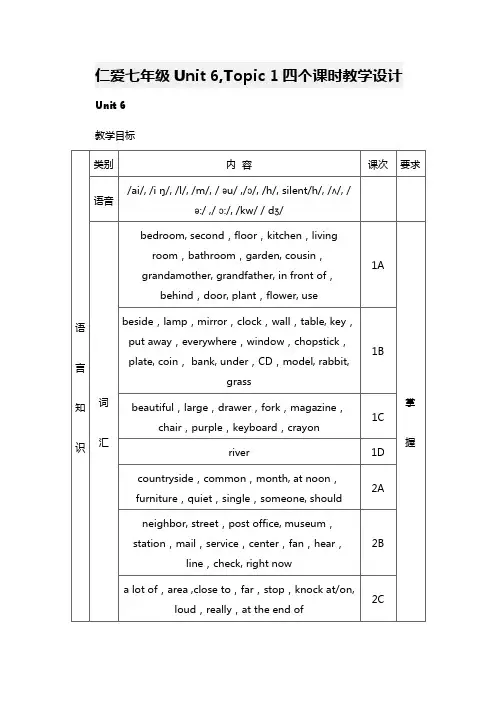
仁爱七年级Unit 6,Topic 1四个课时教学设计Unit 6教学目标1there be 句型There is a small garden in front of my house.There is a lamp, a mirror, a computer and some books on it.There are so many nice books on the shelf.Is there...? Yes, there is. /No, there isn’t.Are there any...? Yes, there are./No, there aren’t.How many...? There are...2Wh- question Wh- 问题What’s on the table? There are some keys on it.Where’s the living room? It’s on the first floor.3on,in,at,behind,under,in front of,near,across, from,nextto,nearTeaching Design for Section A, Topic1 in Unit6 Teaching Aims:1 To learn and use the new words & phrases about different kinds of rooms in our house:e.g. bedroom, kitchen, dining room, living room.And some other new words:e.g. second, floor, upstairs, come in, garden, grandfather, in front of, house, behind, door2 To learn several prepositions of position:e.g. in,on,next to, infront of, behindTo review some other prepositions:e.g., on the left/right, in the center of, near, at the back of3 To learn how to use “there be”e.g. There is a book on the shelfThere are many books on the shelf.Is there/Are there many books on the shelf?Yes, there is./No,there isn’t.Yes, there are./No,there aren’t.4 To learn the sounds/ai/, /i ŋ/, /l/, /m/ with the words.e.g., find, child, high, light, eating, sing, leaf, mad, autumn.Teaching Procedures:Step1. Revision/ using pictures to present the new words about different kinds of rooms in a house.T: (Greeting) what day is it today?Ss: Today is Tuesday.T: What chass are we having:Ss: We are having an English class.T: Where are we now?Ss: We are in the classroom building, and we are on the third floor.T: Now, look here. What’s this?Ss: It’s a living room.T: Is there a bed in the living room?Ss: No, there isn’t.(living room, dining room, kitchen, garden, house)Step2. Listen and match for 2a (P25) to practice new words.And then ask, several questions about 2a.Qs: Is there a bed in the bedroom?Are there two pairs of shoes in the bedroom?Step3. Listen, read and act it out for 1a.Listen and answer the questions:Qs:1. Where is Jane’s bedroom?2. Are there many books on the shelf?Read it and try to act it out.Step4 Listen and read the sounds and words aloud, then summarize the sounds .Finish the exercise in 4b.Step5. Pairwork (Make conversations for 2a),and then try to act it out.Step6. Summary and assignment.Assignment: 1.描述一下你房间里的所有物(There be…)2.描述一下你的家。
仁爱版英语七年级下册Unit6topic1sectionD说课稿
仁爱版英语七年级下册Unit 6 topic 1 section D 说课稿一. 教材分析仁爱版英语七年级下册Unit 6 topic 1 section D 主要讲述了在业余时间,人们喜欢做什么以及不同人喜欢不同的业余活动。
本节课的主要语言点是:一般现在时态的肯定句和否定句以及一般疑问句,特殊疑问词what about和would like to的用法。
通过本节课的学习,学生能够掌握一般现在时态的肯定句和否定句以及一般疑问句的结构和用法,并能够运用特殊疑问词what about和would like to询问别人的业余活动并做出回答。
二. 学情分析面对七年级的学生,他们已经掌握了基本的英语语法知识,如一般现在时态的肯定句和否定句以及一般疑问句的结构和用法。
但是对于特殊疑问词what about和would like to的用法还不够熟悉。
因此,在教学过程中,需要引导学生理解和运用这两个特殊疑问词。
三. 说教学目标1.知识目标:学生能够掌握一般现在时态的肯定句和否定句以及一般疑问句的结构和用法,并能够运用特殊疑问词what about和would like to询问别人的业余活动并做出回答。
2.能力目标:学生能够在日常生活中运用所学知识进行简单的交流,如询问和介绍自己的业余活动。
3.情感目标:通过本节课的学习,学生能够培养对不同业余活动的兴趣,丰富自己的课余生活。
四. 说教学重难点1.教学重点:一般现在时态的肯定句和否定句以及一般疑问句的结构和用法。
2.教学难点:特殊疑问词what about和would like to的用法。
五. 说教学方法与手段在本节课的教学过程中,我将采用情境教学法、交际法以及任务型教学法。
通过创设情境,引导学生进行角色扮演和小组讨论,让学生在实际语境中感知和运用所学知识。
同时,利用多媒体教学手段,如图片、视频等,丰富教学内容,激发学生的学习兴趣。
六. 说教学过程1.导入:通过展示不同业余活动的图片,引导学生谈论自己喜欢的业余活动,为新课的学习营造轻松的氛围。
仁爱版英语七年级下册Unit6topic1sectionD教学设计

仁爱版英语七年级下册Unit 6 topic 1 section D 教学设计一. 教材分析仁爱版英语七年级下册Unit 6 topic 1 section D主要讲述了在业余时间人们喜欢做的活动以及不同人对于活动的不同态度。
本节课的主要语言点是运用情态动词can和must来描述人的能力以及必须做某事的情况。
通过本节课的学习,学生能够掌握情态动词can和must的用法,并能够用英语简单地描述自己在业余时间喜欢做的活动以及对于这些活动的态度。
二. 学情分析七年级的学生已经掌握了基本的英语语法和词汇,对于描述日常生活的句子已经有了一定的理解能力。
但是,对于情态动词can和must的用法还不够熟练,需要通过本节课的学习来进一步掌握。
同时,学生对于描述自己和他人的业余活动还比较陌生,需要通过教师的引导和示范来逐步掌握。
三. 教学目标1.知识目标:–能够掌握情态动词can和must的用法。
–能够用英语描述自己在业余时间喜欢做的活动以及对于这些活动的态度。
2.能力目标:–能够听懂并能够运用情态动词can和must来描述人的能力和必须做某事的情况。
–能够在适当的语境中运用所学知识进行日常交流。
3.情感目标:–培养学生的团队协作精神,鼓励学生在课堂上积极参与,展示自我。
–引导学生正确对待自己的业余生活,培养良好的生活习惯。
四. 教学重难点•情态动词can和must的用法。
•用英语描述自己在业余时间喜欢做的活动以及对于这些活动的态度。
•正确运用情态动词can和must来描述人的能力和必须做某事的情况。
•在适当的语境中运用所学知识进行日常交流。
五. 教学方法1.情境教学法:通过设定日常生活的情境,让学生在实际语境中学习并运用情态动词can和must。
2.交际法:通过小组讨论和角色扮演等方式,让学生在实际交流中运用所学知识。
3.任务型教学法:通过完成各种任务,让学生在实践中掌握情态动词can和must的用法。
六. 教学准备1.教学材料:教材、PPT、黑板、粉笔。
仁爱版七年级下册英语Unit6Topic1SectonD教学案

(3). You must look______ your watch.
(4). The apples are ______the tree. Now Tom is ______the tree.
(5). I watch TV______ eight______ the morning.
6.Are there any shoes under the bed? Yes, there are. / No, there aren't.
7.What's on the desk? There are some model planes on it.
8.How many planes are there? There are three.
【合作生成】
用There be 或have/ has填空。
1.We _____________ no classes on Saturdays and Sundays.
2. _______________ a bowl of dumplings on the table.
3. Mr. Li _____________ a pet dog.
U nit6OurLocalAreaTopic1SectionD
班级:姓名:时间:2020年11月25日
教学策略
【学习目标】
1.复习巩固介词。
2.复习巩固There be句型
错题订正
(个性补案)
1.1.自己独立写出所学介词,然后和课本中的方框里的介词核对,记忆并巩固。
1.2.独立完成,同学之间核对答案,老师点评,补讲。
(完整版)仁爱英语七年级下册Unit6Topic1SectionD教案设计
on the left/right of
在……后面 at the back of
用适当的介词填空。
1. Don ’ t play ______ the dog.
2. What can you see ______ the picture?
3. You must look______ your watch. 4. The apples are ______the tree. Now Tom is ______the tree. 5. I watch TV______ eight______ the morning. 6. Tom is standing ______ the left of Jimmy. 7. Bobby is tall. He sits ______ the back of the classroom.
There are many trees around my house. In front of my house, there is a
beautiful garden. There are many beautiful flowers in it.
I like my home very much.
B. washroom
C. kitchen
D. living room
3. Aunt Li isn ’ t at home. Can you help her _____ her baby?
A. look like C. look around
B. look after D. look for
4. Judy, don ’ t put your keys here. _____, please.
is a computer and a keyboard in my study. I love playing games and
仁爱版英语七年级下册Unit6单元教学设计
1.词汇和短语的学习与运用是本章节的重点,特别是环保相关词汇的掌握,如:pollution, recycle, volunteer等。学生需要能够在实际语境中正确使用这些词汇进行表达。
设想:通过词汇卡片游戏、词汇接龙等活动,让学生在轻松愉快的氛围中学习新词汇,同时结合生活实例,加深对词汇意义的理解。
为了巩固本章节的学习内容,确保学生对环保主题的理解和应用,特布置以下作业:
1.词汇巩固:请学生选择本单元的五个环保相关词汇,用英文解释其含义,并造一个句子来展示其用法。这不仅能帮助学生记忆单词,还能提高他们运用词汇的能力。
2.语法练习:完成一份一般现在时态的练习册,其中包括填空、改错和句型转换等多种题型,旨在让学生通过实际操作,熟练掌握时态的运用。
4.提高学生的阅读理解能力,通过阅读课文,了解环保相关的信息,提取关键信息,完成相应的阅读练习。
5.培养学生的写作能力,能够根据本单元的话题,撰写一篇关于环保的短文,表达自己的观点和建议。
(二)过程与方法
在本章节的学习过程中,教师将采用以下方法引导学生掌握所学知识与技能:
1.采用任务型教学法,设计丰富多样的课堂活动,如小组讨论、角色扮演、调查问卷等,让学生在实践中学习英语,提高语言运用能力。
4.通过学习英语,拓宽学生的国际视野,让他们了解世界各地的环保现状,学会尊重不同文化背景下的环保观念。
5.培养学生积极向上、乐观进取的人生态度,让他们相信自己有能力改变现状,为实现美好未来而努力奋斗。
二、学情分析
针对仁爱版英语七年级下册Unit 6的教学内容,结合学生的实际情况,进行以下学情分析:
1.学生已经具备一定的英语基础知识,能够运用简单的日常用语进行交流,但在词汇量和语法知识方面仍有待提高。因此,在本章节的教学中,应注重词汇和语法的讲解与巩固。
(完整版)仁爱英语七年级下册Unit6Topic1SectionC教案设计
Unit6Topic1Is there a clock on your desk?Section CAims and demands目标要求1. Learn some new words and phrases:in the center of, yard, beautiful, flower, large, left, people, mirror, drawer, chair, keyboard2. Go on learning the prepositions of position (方位介词)and the structure of “There be”.(1)Talk about positions谈论方位.Our bathroom is on the right of the yard.Where are the shoes? They’re under the bed.Where is the computer? It’s on the desk.(2)Talk about existence(存在).There is a small garden in the center of the yard.There are many beautiful flowers in the garden. But there aren’t any trees.At the back of the yard, there is a nice house.Near the house, there is an apple tree.On the left of the yard, there is a kitchen and a dining room.Are there many beautiful flowers in the garden?重点难点:1. 熟练掌握There be 句型2. 方位介词教学过程:Step1 复习There be 句型There is +主语(a/an +可数名词单数或不可数名词)+状语There are + 主语(a/an +可数名词复数)+ 状语翻译句子:1)我家前面有条河。
仁爱版七级英语Unit6Topic1公开课教案
七年级仁爱版Unit6Topic1〔第一课时〕--初中英语“导学-自悟〞教学模式实验曾佩芬2021 、 5、 5一、教学目标:1、知识与技能⑴通过本节课教学,培养学生利用读音规那么拼读单词的能力和有意识记单词的能力。
⑵学会灵活运用 There be结构。
2、过程与方法借助?预习导纲?来培养学生的预习能力,通过设计探究过程,引发认知冲突,积极倡导自主、合作、探究的学习方式,开展学生的思维能力,逐步养成思考、探究的习惯。
通过课堂小组竞赛培养学生的竞争意识和小组合作意识。
3、情感态度与价值观采用情感谢励策略,鼓励学生积极地面对竞争,形成积极的学习态度,将学生自我评价和形成评价有机结合在一起,使学生正确看待自己,不断自我完善。
二、教学重点和难点1、从知识层面上看,这节课的重点在于让学生掌握拼读规那么,提高单词识记效果。
掌握 There be句型的肯定句、否认句、一般疑问句及其肯,否认答复。
这节课的教学难点在于如何归纳总结出拼读规那么;“ There be〞句型中的 be 动词的正确使用;some与 any 在该句型中的使用以及 There be句型和 have/has的区别。
2、从能力层面上看,这节课的教学重、难点在于通过教师有目的引导,培养学生在探究活动中观察、分析、比拟、总结和归纳的能力,培养学生自主学习的能力。
3、从情感态度层面上看,这节课的教学重、难点在于引导学生认识自我、开发潜能、激发学习热情、提高学习效率,取长补短,共同进步。
三、教学过程Step1 竞赛1、在学生预习的根底上,采用必答形式,检查学生拼读本话题简单的单词。
2、采用抢答形式拼读本话题较难的单词。
Step2 导入1、跟读 Section D Part1。
2、归纳 ir , oa ,ight ,or 字母组合在重读音节中的读音,并用抢答形式举出已学过的类似这些发音的单词。
3、用必答形式核对报纸第 2 版“拼读导拨〞,请个别学生归纳发 /?u/音和发 /ju:/ 音的读音规那么。