
高二英语阅读理解(人物故事)(一)解题方法和技巧及练习题
高二英语阅读理解(人物故事)(一)解题方法和技巧及练习题一、高中英语阅读理解人物故事类1.阅读理解When I was 12 years old, I already knew that my teen years were going to be the worst years of my life. I was a total outsider, bullied (欺凌) at school. I felt completely alone in my small town.But by starting to do volunteer work when I was 14, I turned my problem into a passion for helping others. The opportunity to practice kindness made me feel like my life had a greater purpose. The more positive energy I shared, the more kindness and appreciation I received. I realized that my purpose in life would be to reach out to people, specifically teenagers, and help them feel less alone.Books were my true friends back then. I was so thankful that the authors wrote those books. The kindness they offered me with their books saved my life. One of my biggest dreams was to become an author so I could write books that would help other teenagers the way those books helped me.After surviving terrible experiences at school and at home, I made a choice to take the optimistic, positive road in the next steps of my journey. My dream career, one I thought was only possible for the authors I loved, is what I am doing now. I have been a full-time author of teen novels since 2007 and am grateful for this amazing opportunity to reach out to readers every single day.Kindness saved me when I needed help the most. Even small acts of kindness can change someone's life. You never know what someone else is going through. But by practicing daily kindness, you become an architect of positive change.(1)What was the author's life like when he was 12?A.Boring.B.Peaceful.C.Unhappy.D.Meaningful.(2)How did the volunteer work benefit the author?A.It made him popular in his town.B.It helped him find the meaning of life.C.It helped him understand others' lives better.D.It helped to shape his dream career.(3)Why did the author choose writing as his job?A.He was inspired by his teacher.B.He could pass positive energy to readers.C.He wanted to share his school experiences.D.He found he had a talent for writing.(4)What does the author suggest readers do in the last paragraph?A.Say 'no' to bullies bravely.B.Make positive changes in their lives.C.Treat others with kindness in daily life.D.Learn to care more about others' feelings.【答案】(1)C(2)B(3)B(4)C【解析】【分析】本文是一篇记叙文,作者讲述了自己参加志愿活动的经历,告诉人们:一次小善举也可能改变一个人的一生。
(1)考查推理判断。
根据第一段中的“When I was 12 years old, I already knew that my teen years were going to be the worst years of my life.”可知,十二岁时,“我”就意识到青少年时期是“我”一生中最糟糕的阶段;以及“I was a total outsider, bullied at school”,“我”觉得自己是局外人,说明此时的生活是不如意的。
故选C。
(2)考查推理判断。
根据第二段中的“But by starting to do volunteer work when I was 14, I turned my problem into a passion for helping others. The opportunity to practice kindness in the face of so much anger made me feel like my life had a greater purpose.”可知,但是在我14岁的时候开始做志愿者工作,我把我的问题变成了帮助别人的热情。
面对如此多的愤怒,我有机会实践仁慈,这让我觉得我的生活有一个更大的目标。
因此推断参加志愿活动给“我”提供了表达善意的机会,让“我”感觉到生活有更大的意义。
故选B。
(3)考查细节理解。
根据第三段中的“The kindness they offered me with thei r books saved my life. One of my biggest dreams was to become an author so I could write books that would help other teenagers the way those books helped me.”可知,书中作者的善意拯救了“我”的生活,“我”最大的梦想就是成为一名作家,可以写书去帮助其他的青少年,把善意传递给他们。
故选B。
(4)考查推理判断。
根据最后一段中的“Even small ac ts of kindness can change someone's life. You never know what someone else is going through. But by practicing daily kindness, you become an architect of positive change.”可知,作者在提醒我们注意善意的力量,一次小善举也可能改变一个人的一生,平时以善意待人,会让人们成为积极改变的缔造者。
故选C。
【点评】本题考点涉及细节理解和推理判断两个题型的考查,是一篇故事类阅读,考生需要准确捕捉细节信息,并根据上下文进行逻辑推理,从而选出正确答案。
2.阅读理解On a recent trip to the island of Newfoundland, Canada, my husband asked our talkative cab driver what made him most proud to be from there."Our generosity and hospitality (好客)," he replied in a strong local accent. "Your car breaks down in the middle of nowhere, someone will stop to help. People here are kind like that."His answer lingered in my mind during that ride with my husband and teenage kids, as we headed out to explore on the first day of our vacation.Little did I know we were about to experience some of that remarkable Newfoundland kindness for ourselves.We met Alma that same morning at the start of a long hike.Our teenagers hurried ahead, and as we walked behind, admiring the scenery, two women insunglasses and summer hiking gear stopped.They'd heard us discussing different routes, then asked if we'd like suggestions.They looked to be in their 40s, and were both enthusiastic to share their local expertise.We listened eagerly, taking mental notes, until one of the women asked, "You have a car, right?"I explained that there were no cars available during our week on the island, so we had to rely on cabs instead."Oh no," she said, "you need a car." And then, as casually as if offering a piece of chewing gum (口香糖), she said: "Take mine!"Dumbfounded, my husband and I just smiled in disbelief."Why not?" She insisted. "You need a car to get to know all these places.""But you don't even know us," I said."That doesn't matter," she continued with absolute determination.Stunned, I looked over at her friend, who shrugged and said, "That's Alma."Forty minutes of talking later, my family climbed into Alma's car.We spent the rest of our vacation discovering different areas of this beautiful island.But it wasn't the groups of whales we saw, or the vast areas of woodland, that made this place so memorable.Instead, it was the act of kindness from a complete stranger that made us realize how special Newfoundland really was.Next year, there's no doubt where we'll be taking our summer vacation. Who knows what act of kindness we'll meet then?(1)What problem did the author's family have in Newfoundland?A.They couldn't understand the local accent.B.Their car broke down on the first day.C.They got lost during a hike.D.They didn't have a car.(2)The underlined word "dumbfounded" in Paragraph 12 is closest in meaning to ______.A.shockedB.satisfiedC.relievedD.embarrassed(3)What impressed the author most during her stay in Newfoundland?A.The talkative cab driver.B.The whales swimming.C.The beautiful scenery of the island.D.The help from an enthusiastic stranger.(4)What can we infer about the author from the last paragraph?A.She is looking forward to meeting Alma once more.B.She expects to visit Newfoundland again.C.She hasn't decided where to go next year.D.She also wants to be kind to others during vacation.【答案】(1)D(2)A(3)D(4)B【解析】【分析】本文是一篇记叙文,作者最近一次去加拿大的纽芬兰旅行时,被当地人的热情好客深深触动。
(英语)高二英语阅读理解(人物故事)解题技巧及经典题型及练习题(含答案)
(英语)高二英语阅读理解(人物故事)解题技巧及经典题型及练习题(含答案)一、高中英语阅读理解人物故事类1.阅读理解Sometimes just when we need the power of miracles to change our beliefs, they materialize in the places we'd least expect. They can come to us as a great change in our physical reality or as a simple coincidence in our lives. Sometimes they're big and can't be missed. Other times they're so subtle that if we aren't aware, we may miss them altogether. They can come from the lips of a stranger we suddenly and mysteriously meet at just the right instant. If we listen carefully, we'll always hear the right words, at the right time, to dazzle (目眩) us into a realization of something that we may have failed to notice only moments before.On a cold January afternoon in 1989, I was hiking up the trail that leads to the top of Egypt's Mt. Horeb. I'd spent the day at St. Catherine's Monastery and wanted to get to the peak by sunset to see the valley below. As I was winding up the narrow path, I'd occasionally see other hikers who were coming down from a day on the mountain. While they would generally pass with simply a nod or a greeting in another language, there was one man that day who did neither.I saw him coming from the last switchback on the trail that led to the backside of the mountain. As he got closer, I could see that he was dressed differently from the other hikers I'd seen. Rather than the high-tech fabrics and styles that had been the norm, this man was wearing traditional Egyptian clothing. He wore a tattered, rust-colored galabia and obviously old and thick-soled sandals that were covered in dust. What made his appearance so odd, though, was that the man didn't even appear to be Egyptian! He was a small-framed Asian man, had very little hair, and was wearing round, wire-rimmed glasses.As we neared one another, I was the first to speak, "Hello," I said, stopping on the trail for a moment to catch my breath. Not a sound came from the man as he walked closer. I thought that maybe he hadn't heard me or the wind had carried my voice away from him in another direction. Suddenly he stopped directly in front of me on the high side of the trail, looked up from the ground, and spoke a single sentence to me in English, "Sometimes you don't know what you have lost until you've lost it." As I took in what I had just heard, he simply stepped around me and continued his going down the trail.That moment in my life was a small miracle. The reason is less about what the man said and more about the timing and the context. The year was 1989, and the Cold War was drawing to a close. what the man on the trail couldn't have known is that it was during my Egyptian pilgrimage (朝圣), and specifically during my hike to the top of Moses's mountain, that I'd set the time aside to make decisions that would affect my career in the defense industry, my friends, my family, and, ultimately, my life.I had to ask myself what the chances were of an Asian man dressed in an Egyptian galabia coming down from the top of this historic mountain just when I was walking up, stopping before me, and offering his wisdom, seemingly from out of nowhere. My answer to my own question was easy: the odds were slim to none! In a meet that lasted less than two minutes on a mountain halfway around the world from my home, a total stranger had brought clarity and the hint of a warning, regarding the huge changes that I would make within a matter of days. In my way ofthinking, that's a miracle.I suspect that we all experience small miracles in our lives every day. Sometimes we have the wisdom and the courage to recognize them for what they are In the moments when we don't,that's okay as well. It seems that our miracles have a way of coming back to us again and again.And each time they do, they become a little less subtle, until we can't possibly miss the messagethat they bring to our lives!The key is that they're everywhere and occur every day for different reasons, in response to the different needs that we may have in the moment. Our job may be less about questioning the extraordinary things that happen in our daily lives and more about accepting the gifts they bring.(1)Why did the author make a pilgrimage to Mt Horeb in Egypt?A. He was in search of a miracle in his life.B. It was a holy place for a religious person to head for.C. He intended to make arrangements for his life in the future.D. He waited patiently in expectation of meeting a wise person.(2)What does the underlined part "my own question" refer to in paragraph 6?A. For what reason did the man stop before me?B. Why did the Asian man go to the mountain?C. What change would I make within a matter of days?D. What was the probability that others told us the right words?(3)Which of the following is closest in meaning to the underlined word "subtle" in paragraph 7?A. Apparent.B. Delicate.C. Precise.D. Sufficient.(4)The author viewed the meet with the Asian man as a miracle in his life in that ________.A. the Asian man's appearance had a deciding effect on his future lifeB. his words were in perfect response to the need he had at that momentC. what the Asian man said was abundant in the philosophy of lifeD. the Asian man impressed on him the worth of what he had possessed(5)What might be the best title for the passage?A. Can you recognize a miracle?B. Is a miracle significant to us?C. When might a miracle occur?D. Why do we need a miracle?(6)After the encounter of the Asian man, what will the writer probably do immediately?A. Continue walking up to the top of the mountain.B. Have a rest to refresh himself.C. Try to have a heart-to-heart conversation with the Asian man.D. Come down the mountain.【答案】(1)C(2)D(3)B(4)B(5)A(6)D【解析】【分析】本文是一篇记叙文,作者讲述了一次埃及朝圣时,爬到何烈山半山腰时,偶遇了一位正在下山的亚洲陌生人。
高二英语阅读理解(人物故事)的基本方法技巧及练习题及练习题(含答案)含解析
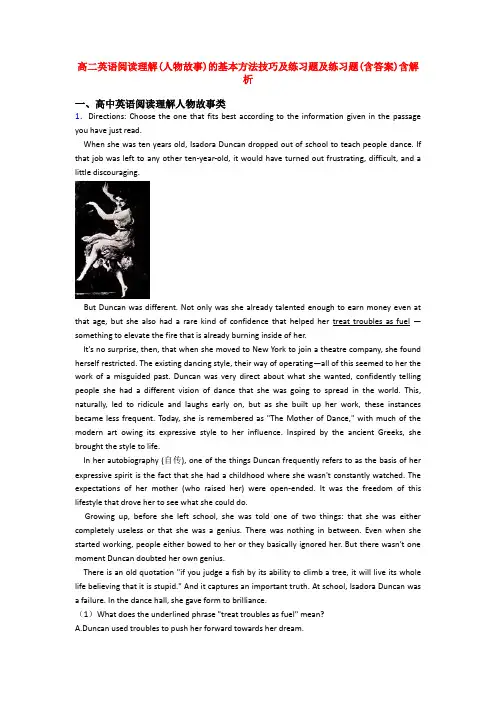
高二英语阅读理解(人物故事)的基本方法技巧及练习题及练习题(含答案)含解析一、高中英语阅读理解人物故事类1.Directions: Choose the one that fits best according to the information given in the passage you have just read.When she was ten years old, Isadora Duncan dropped out of school to teach people dance. If that job was left to any other ten-year-old, it would have turned out frustrating, difficult, and a little discouraging.But Duncan was different. Not only was she already talented enough to earn money even at that age, but she also had a rare kind of confidence that helped her treat troubles as fuel —something to elevate the fire that is already burning inside of her.It's no surprise, then, that when she moved to New York to join a theatre company, she found herself restricted. The existing dancing style, their way of operating—all of this seemed to her the work of a misguided past. Duncan was very direct about what she wanted, confidently telling people she had a different vision of dance that she was going to spread in the world. This, naturally, led to ridicule and laughs early on, but as she built up her work, these instances became less frequent. Today, she is remembered as "The Mother of Dance," with much of the modern art owing its expressive style to her influence. Inspired by the ancient Greeks, she brought the style to life.In her autobiography (自传), one of the things Duncan frequently refers to as the basis of her expressive spirit is the fact that she had a childhood where she wasn't constantly watched. The expectations of her mother (who raised her) were open-ended. It was the freedom of this lifestyle that drove her to see what she could do.Growing up, before she left school, she was told one of two things: that she was either completely useless or that she was a genius. There was nothing in between. Even when she started working, people either bowed to her or they basically ignored her. But there wasn't one moment Duncan doubted her own genius.There is an old quotation "if you judge a fish by its ability to climb a tree, it will live its whole life believing that it is stupid." And it captures an important truth. At school, Isadora Duncan was a failure. In the dance hall, she gave form to brilliance.(1)What does the underlined phrase "treat troubles as fuel" mean?A.Duncan used troubles to push her forward towards her dream.B.Duncan was good at burning away everyday troubles.C.Troubles turned Duncan into a confident girl.D.Troubles lit the fire of dancing in Duncan.(2)Which of the following is TRUE about Duncan?A.Her experience in New York was the foundation of her career.B.Her teaching job when she was little destroyed her confidence.C.Her dancing style was not very well received at the beginning.D.Her mother set higher expectation on her than she could bear.(3)What does the author try to tell the readers in the last paragraph?A.It is useless climbing a tree to catch fish.B.Everybody is a genius in his own way.C.Miseries come from human stupidity.D.Teachers can impact students greatly.(4)What is this passage mainly about?A.Isadora Duncan's childhood and her achievements today.B.Duncan's career development and other dancers' opinions of her.C.Isadora Duncan's early experiences and the reasons for her success.D.Duncan's high status in the dancing world and her unique expressive style.【答案】(1)A(2)C(3)B(4)C【解析】【分析】本文是一篇记叙文,伊莎多拉·邓肯十岁时辍学去教别人跳舞,作者讲述了她的早期的经历以及其取得成功的原因。
【英语】高二英语阅读理解(人物故事)解题技巧和训练方法及练习题(含答案)
【英语】高二英语阅读理解(人物故事)解题技巧和训练方法及练习题(含答案)一、高中英语阅读理解人物故事类1.阅读理解It was at least two months before Christmas when nine-year-old Rose told her father and me that she wanted a new bicycle.As Christmas drew nearer, her desire for a bicycle seemed to fade---or so we thought, as she didn't mention it again. We bought the latest fashionable Baby Sitter's Club dolls, a holiday dress and some beautiful story books. Then, much to our surprise, on December 23rd, she proudly announced that she "really wanted a bike more than anything else."It was just too late, what with all the details of preparing Christmas dinner and buying last-minute gifts. We could only think of the bicycle and the disappointment of our child. "What if I make a little bicycle out of clay and write a note that she could trade the clay model in for a real bike?" Her dad asked. The theory, of course, being that since that is a high-ticket item and she is "such a big girl", it would be much better for her to pick it out. So he spent the next five hours painstakingly working with clay to make a tiny bike.Three hours later, on Christmas morning, we were excited for Rose to open the little heart-shaped package with the beautiful red and white clay bike and the note. Finally, she opened it and read the note aloud.She looked at me and then at her dad and said, "so does this mean that I trade in this bike that Daddy made me for a real one?"Beaming, I said, "Yes."Rose had tears in her eyes when she replied, "I could never trade in this beautiful bicycle that Daddy made me. I'd rather keep this than get a real bike."At that moment, we would have moved heaven and earth to buy her every bicycle on the planet!(1)Rose's parents didn't buy her the bike she wanted because ______.A. they had bought many other wonderful things for herB. they thought she had changed her mindC. they didn't have time to do any shoppingD. they decided to make one for her(2)Why did Dad make the clay bicycle?A. He thought Rose was too young for a real bike.B. He didn't want to disappoint his daughter.C. He thought his daughter would like it.D. He wanted to give his daughter a surprise.(3)From the story, we know that ______.A. Rose's father was an artist with special skillsB. Rose would trade in the clay bike for a real oneC. The parents were moved and proud of the girlD. Rose was a thoughtful and independent girl【答案】(1)B(2)B(3)C【解析】【分析】本文是一篇记叙文,Rose希望圣诞节收到一辆自行车。
高二英语阅读理解(人物故事)解题技巧及练习题(含答案)含解析
高二英语阅读理解(人物故事)解题技巧及练习题(含答案)含解析一、高中英语阅读理解人物故事类1.阅读理解When I was small, my mother and I would walk to our local library in Franklin Square. As we didn't always have access to a reliable car, walking hand in hand was the most convenient way to get anywhere. It was at story time for children that both my mother and I made lasting friendships.Today, I am fortunate to live around the corner from the Cold Coast Public Library in Glen Head and a short walk to the Sea Cliff Children's Library. My 18-imonth-old son, Colin, and I find ourselves in Sea Cliff several times a week, meeting and making friends. Well, that is what many people don't understand-a library is more than books; it's a community.Sure, the library in Franklin Square was the place where I was introduced to Judy Blume novels. But it was also the place where I got my first email address in 1997. At the library, friends and I learned how to research colleges and search for scholarships on the Internet. The library was the place where we sometimes giggled(咯咯笑)too loudly, and where the librarians knew us by name. Their knowing our names wasn't a bad thing. When I came home from my first term at Binghamton University, Mary LaRosa, the librarian at the Franklin Square library, offered me my first teaching job.I now teach reading at Nassau Community College. My students are often amazed that they can check out books via their smartphones and virtually(虚拟地)visit a variety of Long Island libraries. The app used by Nassau and Suffolk county public libraries, as well as the college library, makes their homework easier by helping them find resources. Even though they can't always easily visit their local libraries, the library is always with them.(1)Why does the author consider herself lucky today?A. She has become her mother's best friend.B. She has access to a reliable car now.C. She can meet friends at the library.D. She lives close to libraries.(2)What does the underlined word "that" in Paragraph 2 refer to?A. Socializing in a library.B. Reading books in a library.C. Visiting a library with a family member.D. Building parent-child friendship in a library.(3)What is the author's attitude to her students' way of visiting libraries?A. Cautious.B. Favorable.C. Doubtful.D. Disapproving.(4)Why does the author write the text?A. To discuss why libraries are important.B. To express her deep love for libraries.C. To explain how libraries change.D. To introduce her favorite libraries.【答案】(1)D(2)A(3)B(4)C【解析】【分析】本文是一篇记叙文,作者讲述了从自己小时候到成家生子再到工作教书这一路上图书馆的变化。
(英语)高二英语阅读理解(人物故事)解题技巧及经典题型及练习题(含答案)含解析
(英语)高二英语阅读理解(人物故事)解题技巧及经典题型及练习题(含答案)含解析一、高中英语阅读理解人物故事类1.阅读理解My family lives in Texas. I was born and brought up in Texas and I am a graduate of the University of Texas. However, around my second year in law school, I wanted to make a great change, which was almost unheard of for Texans: I wanted to leave!I realized this after completing my first year-year internship(实习期) I knew I wanted something different and my chance came during the 2011 Super Bowl in Dallas. A snowstorm blanketed the entire city in snow and thousands of people were gathered. I overheard that StubHub, a big company from a great city, San Francisco, was throwing a party next door to my hotel. I thought if l could get an internship, I could leave for the summer and at least see what it was like. Yes, it was a huge leap. I told myself I was ready.There was just one problem: I wasn't invited to the StubHub party. But you know I'm the type of person who goes for something she wants. Needless to say, I crashed the party and found my way to the president. I kindly introduced myself and then asked if they had a legal internship program. Guess what? They accepted my request to be a legal intern, even though no such program existed.Although the legal department didn't have a permanent position for me, the experience has shaped my life. Working for a great company in San Francisco, I'm incredibly happy for making my decision to leave Texas.By leaving Texas, I learned that it is so much more rewarding to try the unfamiliar than to stay in the comfortable. Exploring the unfamiliar is how you'll understand what fits your life. I say, dive in head first.(1)The author went to Dallas to in 2011.A. watch the Super BowlB. meet up with her familyC. flee San FranciscoD. hunt for an internship(2)Which is the biggest lesson that the author learned from the experience?A. You must choose a career that you like.B. Jumping out of your comfort zone is rewarding.C. Accepting who you are makes you realize your strengths.D. You should listen to your family to learn about your potential.(3)Which of the following words best describe the author?A. Patient and modest.B. Supportive and energetic.C. Intelligent and humorous.D. Determined and adventurous.【答案】(1)D(2)B(3)D【解析】【分析】本文是一篇记叙文,作者去达拉斯寻找实习机会,并从中学到了很多。
(英语)高二英语阅读理解(人物故事)技巧和方法完整版及练习题含解析
(英语)高二英语阅读理解(人物故事)技巧和方法完整版及练习题含解析一、高中英语阅读理解人物故事类1.阅读理解Half a DayI walked alongside my father, holding his right hand. All my clothes were new: the black shoes, the green school uniform, and the red cap. They did not make me happy, however, as this was the day I was to be thrown into school for the first time."Why school?" I asked my father. "What have I done?""I'm not punishing you," he said, laughing. "School's not a punishment. It's a place that makes useful men out of boys. Don't you want to be useful like your brothers?"I was not convinced. I did not believe there was really any good to be had in tearing me away from my home and throwing me into the huge, high-walled building.When we arrived at the gate we could see the courtyard, vast and full of boys and girls. "Go in by you," said my father, "and join them. Put a smile on your face and be a good example to others."I hesitated and squeezed his hand firmly, but he gently pushed me from him. "Be a man", he said. "Today you truly begin life. You will find me waiting for you when it's time to leave."I took a few steps. Then the faces of the boys and girls came into view. I did not know a single one of them, and none of them knew me. I felt I was a stranger who had lost his way. But then some boys began to glance at me in curiosity, and one of them came over and asked, "Who brought you?""My father," I whispered."My father's dead," he said simply.I did not know what to say. The gate was now closed. Some of the children burst into tears. The bell rang. A lady came along and said, "This is your new home. There are mothers and fathers here, too. Everything that is enjoyable and beneficial is here. So dry your tears and face life joyfully."Well, it seemed that my misgivings had had no basis. From the first moments I made many friends. I had never imagined school would have this rich variety of experiences.(1)On the way to school, the boy felt .A. happyB. embarrassedC. upsetD. excited(2)About schooling, Father suggested .A. wearing a smileB. tearing himself away from gamesC. waiting for parentsD. throwing himself to studying(3) helped him most on the first day at school.A. Teachers and classmatesB. Courtyards and buildingsC. Father and brotherD. New uniforms and shoes(4)What would probably happen next?A. The school life would turn out to be a failure.B. Boys in the school would watch him curiously.C. He would open up a new journey of colorful life.D. His parents would accompany him at the school.【答案】(1)C(2)A(3)A(4)C【解析】【分析】本文是一篇记叙文,作者第一天去学校的时候并不开心,但是等他到了学校之后,他结交了很多朋友,开始了新的生活。
【英语】高二英语阅读理解(人物故事)解题技巧及经典题型及练习题(含答案)
【英语】高二英语阅读理解(人物故事)解题技巧及经典题型及练习题(含答案)一、高中英语阅读理解人物故事类1.阅读理解Three months after Hurricane Katrina in 2005, Rebecca Sell, then 24, a photojournalist for Fredericksburg photographed a New Orleans couple worriedly examining water-spotted photo albums. As she took the photo, something within her clicked. "I told them I could take the ruined pictures, copy them and give them digitally restored (修复) photos," she recalls. Although a bit sceptical, the couple agreed. Rebecca took their photos home, restored them and took them to the couple at their temporary home. "It felt so good to be able to do that for them," says Rebecca. When her editor, Dave Ellis, saw the photo of the couple, he suggested they go back and restore damaged photos for even more people. So in January 2006, with paid time off from the paper, the two set up shop in Pass Christian. After posting a notice in the community newsletter, Rebecca and Dave received 500 photos in four days. For each, the pair took a new digital picture, then used high-tech software to erase water spots and restore colors. It just so happened that a popular website linked to Dave's blog about the experience, and soon Operation Photo Rescue, as it came to be known, had emails from hundreds of volunteers, including photographers and restoration experts, eager to help.Though digital restoration is a painstaking process, mending irreplaceable family pictures means the world to victims like Emily Lancaster, 71, who took out piles of ruined photo albums after Katrina, never thinking the mess could be saved. But she just couldn't bear to part with a few treasured pictures, including a portrait of her father, who had passed away, and a photo of her husband as a boy. Then she heard about Operation Photo Rescue. "I didn't have a whole lot of hope they could fix them, but they did," Emily says. "Almost every day I think about all the pictures I've lost. I'm so happy to have these two."In the five years since Katrina, Operation Photo Rescue has collected thousands of pictures ruined by floods, hurricanes and tornadoes. Volunteers make "copy runs" to disaster areas across the country to gather damaged photos from survivors; operating costs are covered by donations. "It's great to be able to give people some of their history back," says Rebecca. "One person told me that thanks to us, her grandmother got to see her photos again before she passed away. Moments like that remind me why I do this."(1)When Rebecca took the picture of the New Orleans couple, she decided to .A. take them to their temporary homeB. help with their damaged photosC. set up shop in Pass ChristianD. cover Hurricane Katrina(2)From Paragraph 2, we know that Dave and Rebecca .A. quit their jobs in 2006B. inspired volunteers to join themC. spent four days mending the photosD. made their work known in their newspaper (3)How did Emily Lancaster feel when she first heard about Operation Photo Rescue? A. Excited. B. Hopeless. C. Satisfied. D. Sceptical.(4)What is the best title for the passage?A. Surviving HurricanesB. An Act of GenerosityC. Saving MemoriesD. A Lucky Couple【答案】(1)B(2)B(3)D(4)C【解析】【分析】本文是一篇记叙文,摄影记者丽贝卡塞尔和编辑戴夫·埃利斯通过照片修复,他们让很多人丢失的记忆得到恢复,同时,也赢得了人们的肯定。
(英语)高二英语阅读理解(人物故事)解题技巧和训练方法及练习题(含答案)
(英语)高二英语阅读理解(人物故事)解题技巧和训练方法及练习题(含答案)一、高中英语阅读理解人物故事类1.阅读理解A photography exhibition by French artist San Bartolome entitled Moon Door Dreamers opened in the 798 Art Zone in Beijing on December 10, 2011, presenting a cross-cultural perspective (视角) on ordinary life in the capital city.Bartolome took these photos in August 2008, and produced a video named Two Worlds, One Dream. These works were displayed in Pingyao, an ancient city in Shanxi Province, under the title Beijing Midsummer Night Dream in September 2010.The moon doors serve as a keyhole through which one can catch a glimpse of a slice of Beijing life. He got his inspiration from one cycling trip to the southeastern suburb of Beijing, where he discovered a peculiar street along which a gray brick wall was built to cover the shabby bungalows. These cabins were mostly rented by migrant workers- peddlers, craftsmen, grocers and innkeepers.Born in 1950, Bartolome has worked as a photographer, stage director. Artistic manager, writer and diplomat. A noted Sinophile, Bartolome frequently visits China for photographic subjects. In the fall of 2003, he joined the French Embassy in Beijing as a cultural attache. His work experience in China from 2003 to 2015 further enhanced his awareness of and love for China.Bartolome not only loves Chinese culture but also the Chinese people. He thinks that Chinese people are kind, welcoming and diverse.Back from his bike ride to southeastern Beijing, he decided to shoot pictures about ordinary urban lifestyles. He observed dwellers carefully and made friends with them.After about 30 days and nights that he spent with these common migrants, he created a number of portraits. Meanwhile, he learned more about those rural migrants who earn their living in a city with which they are unfamiliar.He adopted an optimistic perspective to shoot the sights, and he borrowed the title of one of William Shakespeare s comedy works: A Midsummer Night's Dream.(1)What is the main purpose of the exhibition?A. To present Bartolome's photographic skills.B. To tell us Bartolome's work experience in Beijing.C. To show us Bartolome's optimistic view on ordinary life in Beijing.D. To build a cross-cultural communication bridge between China and France.(2)What inspires Bartolome to shoot pictures about ordinary urban styles?A. His bike ride to Southeastern suburb of Beijing.B. His work experience in the French Embassy in Beijing.C. His visit to the ancient city of Pingyao.D. Shakespeare's comedy work: A Midsummer Night's Dream.(3)What does the underlined word "Sinaphile" in paragraph 4 refer to?A. A successful artist.B. A cultural attache.C. A person of status.D. A fan of China.(4)What does the text mainly talk about?A. A French artist tells Chinese stories with his camera.B. A French artist frequently visits China for photography.C. Migrant workers live a simple but happy life in Beijing.D. Moon Doors serve as a window to display China to the world.【答案】(1)C(2)A(3)D(4)A【解析】【分析】本文是一篇记叙文,法国艺术家圣巴托洛姆在北京798艺术区举办的名为"月亮之门梦想家"的摄影展,从跨文化角度呈现了普通城市的生活以及拍摄的原因。
(英语)高二英语阅读理解(人物故事)解题技巧及练习题(含答案)含解析
(英语)高二英语阅读理解(人物故事)解题技巧及练习题(含答案)含解析一、高中英语阅读理解人物故事类1.阅读理解Wilbur and Orville Wright were the two youngest sons of Bishop Milton Wright, Wilbur was born on a farm near Millville and Orville was born in August in the house the family would come to occupy for more than 40 years in Dayton.Orville would discover in later years that he and Wilbur's first interests in flight began when they were children, with powered rubber-band-helicopter toys that their father would bring home for them from trips around the country. Orville and Wilbur would build duplicates(复制品)of these toys and bounce them off the ceiling. They were just crazy about these things for the reasons that they did not yet understand.Both boys loved to solve problems that seemed difficult to others. The more difficult the problem was, the more they saw it as a challenge. Exploring the unknown was such a joy for then that Orville once said, "I can remember when Wilbur and I could hardly wait for the morning to come to get at something that interested us. That's happiness."Putting their gift to work, the boys entered the printing business soon after high school. Orville designed and then built a printing press(印刷机)for this enterprise. At first, they did contract printing for other people, and soon one of their customers during the early 1890s was Father Milton's church. They also tried the newspaper business, and although their two newspapers, the West Side News and The Evening Item were considered to be of high quality, Dayton already had daily newspapers, so the Wrights soon returned to contract printing.Branching out into other areas, they also opened a bicycle business. Bicycling was the fastest growing sport in the country at that time, and their repair shop soon led them into building bicycles of their own design, often with tools of their own construction, such as the lathe(车床)driven by a one-cylinder gasoline engine built by Orville. The bicycle shop would provide the livelihood(生计)that would allow them to carry out their experiments on airplanes.(1)What may inspire Wilbur and Orville Wright to be keen on flight in childhood?A. Their experiences of taking a flight.B. Their wishes to travel by plane.C. The toys their father brought for them.D. Their interest in duplicating toys.(2)What kind of children were the Wright brothers?A. Enthusiastic and curious.B. Quiet and modes.C. Naughty but clever.D. Stubborn but careful(3)What business did Wilbur and Orville enter shortly after high school?A. The toy business.B. The printing business.C. The lathe business.D. The bicycle business.(4)What will possibly be discussed following this text?A. Who guided them a lot on their way to success.B. What trouble they would meet in their business.C. Why they closed their bicycle shop suddenly.D. How the two brothers began to invent planes.【答案】(1)C(2)A(3)B(4)D【解析】【分析】本文是一篇记叙文,介绍了莱特兄弟是怎样的发明飞机的过程。
高二英语阅读理解(人物故事)(一)解题方法和技巧及练习题含解析
高二英语阅读理解(人物故事)(一)解题方法和技巧及练习题含解析一、高中英语阅读理解人物故事类1.阅读理解The great-grandmother is learning English with the help of her family when she is at the age of 91. She hopes to use the language at next year's Olympic Games in Tokyo. Takamizawa was one of the more than 200, 00 people who requested to volunteer for Tokyo's 2020 Games. English is not required for service, but it is a useful skill for volunteers to have.But Takamizawa had not been able to learn the language when she was young. Takamizawa said that she was in high school when World War Two started. She said, "In my second year there, English was banned because it was the enemy language."Takamizawa said her grandchildren helped persuade her that she was not too old to learn. "When I talked to my grandchildren about my wish, they said, 'It's not too late. We will teach you one word a day' ". Natsuko is Takamizawa's granddaughter and main English teacher. Natsuko sends a new English word to her grandmother's phone every day. They also often work together directly on phrases that Takamizawa will need for the Olympics. "Welcome to Tokyo, this is the Olympic stadium, how can I help you?" Takamizawa answers when asked to say an English phrase she has learned. Natsuko explains that she wanted to give her grandmother something to enjoy. "I can clearly see her English is getting better. It's my joy now."The EF English Proficiency Index is a measure of the level of English spoken in a country. Japan ranks 49th among countries where English is not the first language. This situation is slowly changing as younger generations welcome English. However, Takamizawa believes real change will not happen unless Japanese people become more open to the rest of the world. With around 500 days to go until the games begin, the whole Takamizawa family is ready to welcome the world to Tokyo.(1)Why couldn't Takamizawa learn English when she was young?A. Because English was useless.B. Because she was too young to learn English.C. Because English was forbidden to learn.D. Because she was unwilling to learn English.(2)What can we know from the third paragraph?A. Takamizawa gets strong support from her family.B. Takamizawa's grandchildren love her a lot.C. Natsuko is Takamizawa's granddaughter and only English teacher.D. Natsuko teaches Takamizawa English mainly by talking with her.(3)What does the underlined phrase "This situation" in Paragraph 4 refer to?A. English is not the first language in Japan.B. The level of English spoken in Japan is relatively low.C. Younger generations in Japan welcome English.D. Japanese people become open to the rest of the world.(4)What is the main idea of the passage?A. Where there is a will, there is a way.B. It is never too late to learn.C. The early bird catches the worm.D. Two heads are better than one.【答案】(1)C(2)A(3)B(4)B【解析】【分析】本文是一篇记叙文,日本91岁的奶奶Takamizawa为了做好迎接在东京举行的2020奥运会的志愿工作,在孙辈的鼓励和帮助下开始学习英语。