
牛津英语上海版2B教案汇总
Module 1 Using my five sensesUnit 1 What can you see ?教学内容:认知内容: 能听懂会说white/ purple/pink/orange/ brown/black掌握句型I see ...(colour)It is … (colour)能力要求:会用英语与他人交流所见事物的颜色情感态度:我们生活在一个五彩缤纷的世界里,让孩子用色彩来表达对事物直观的感受the second period教学内容:认知内容: 1. 能听懂会说句型What colour is it /are they?It is /They are …能力要求: 1. 能在日常生活中用以上的句型进行对话情感态度:鼓励孩子用所学的句型在公共场合与他人进行交流Module 1 Using my five sensesUnit 2 Touch and feelTeaching aims:Knowledge:1.Learning new words: watch, bag, soft, hard, rough, smooth2.Learning sentence patterns: Is it…? Yes, it. /No. it‟s …Skills:1.Understanding the key words in context.ing the new words and sentence patterns to communicate withothers.Feelings:学生在游戏和表演中学习新的知识, 并能通过有趣的儿歌来巩固新学的词汇及句型。
the second periodTeaching aims:Knowledge:1. Learning the sentence pattern: Is it…? Yes, it. /No. it‟s …2. Using the sentence pattern to express.3. Learning the sounds of the letters: p, b.Language skills:1. Identifying the key words by listening to the pronunciation.2. Understanding the key patterns.3. Identifying the sounds by listening to the pronunciation.Feelings:学生在游戏和表演中学习新的知识, 并通过游戏和表演来巩固新知识,创设良好的活动氛围, 让学生带着愉快的心情去迎接新挑战.Module 1 Using my five sensesUnit 3 What can you hear?教学内容:The first period教学内容:认知内容: 1.单词:train, bus, car, van, bicycle, ship。
2.句型:What can you hear? I can hear…能力要求: 1. 正确朗读、拼写单词。
2. 正确运用句型What can you hear?并回答。
情感态度:学生通过声音来辨别交通工具。
创设情境来提高学生的语言运用能力。
The second period教学内容:认知内容: 1.掌握句型:What can _____ hear?_____ can hear _____.2.学习字母:t d的发音能力要求:学会用所学的句型进行问答,创设简单的情境培养学生的语言运用能力。
学习字母及字母的一般发音规则。
情感态度:通过本课时的学习,让学生对声音的辨别,有悦耳的声音和噪音的区别。
Module 2 My favourite thingsUnit 2 my favourite food教学内容:The first period教学内容:认知内容: New vocabulary: salad carrot fish chicken bananaNew pattern: What do you like eating?I like eating…能力要求:认知食物的单词。
掌握句型What do you like eating? I like eating…并能进行问答。
情感态度:认识常用食品,并能和朋友交流自己喜欢吃的食物。
The second period教学内容:认知内容: 巩固单词salad carrot fish chicken banana巩固句型What do you like eating?I like eating…Sound: h能力要求:掌握句型What do you like eating? I like eating…并能进行问答。
情感态度:通过本课时让学生之间能互相增进友谊,并能互相了解对方喜欢吃什么。
教学过程:Module 2 My favourite thingsUnit 3 Animals I like教学内容:The first period教学内容:认知内容: 1.单词: giraffe, snake, elephant ,zebra2.句型:What are they? They are…能力要求: 1. 正确朗读、拼写单词。
2. 正确运用句型What are they?并回答。
情感态度:通过辨认各种动物,激发学生热爱动物之情。
The second period教学内容:认知内容: 1.掌握句型:What are they? They are…2.学习字母f ,v的发音.能力要求:学会用所学的句型进行对话。
学习字母及字母的一般发音规则。
情感态度:通过本课时的学习,培养学生热爱动物的美好感情。
Module3 Things around usUnit 1 The four season玉屏南路小学王乐勤the first period教学内容:认知内容: 能听懂会说autumn/ winter/cold/cool掌握句型I like doing… ? …in/on …能力要求:会用英语与他人交流所见季节和事物情感态度:我们生活在一个美丽的世界中,自然有四季,我们都要享受和发现Module3 Things around usUnit 2 Rulesthe first period教学内容:认知内容: Pronouncing the key words,phrases and sentences correctly.light/stop/go/wait能力要求: Using imperatives to give simple instructions.情感态度: Know the traffic rules and the importance of safethe second period教学内容:认知内容:Identifying the key words by listening to the pronunciation. 能力要求:Using imperatives to give simple instructions.Using formulaic expressiongs to give suggestions.情感态度:Understanding the imperatives.2008 学年第2学期学科:英语年级:二第3单元课题:Unit 3 My clothes 课型:新授教学目标: 1. New vocabulary: trousers, sweater, shirt, coat 2. New patten: I have…What do you have for …?3.Sound: l,r4. Learn to take care of your friends.教学重点难点:1.To pronounce the words correctly.2. Try to tell the story.教学手段:pictures, cassette player, flash教学时间:2课时Module4 More things to learnUnit 1 ActivitiesTeaching aims:Knowledge: 1. Learning new words: play football play basketball play ping-pong play cards2. Learning sentence patterns:Can he/she…?Yes,he/she can….Sills: 1. Understanding the key words in context. 2. Using new words and sentences patterns to communicate with others. Feeling: 1. 学生在游戏和表演中学习新的词汇及句型。
2.培养学生热爱运动,热爱生活。
The second periodTeaching aims:Knowledge:1.Learning the sentence pattern: Can he/she…?Yes,he/she can….ing the sentence pattern to express。
Skills:1.Identifying the key words by listening to the pronunciation.2.Understanding the key patterns.Feelings:学生在游戏和表演中学习新的知识,并通过游戏和表演来巩固新知识,创设良好的活动氛围,让学生各类运动的说法。
Module4 More things to learn Unit 1 ActivitiesThe first periodTeaching aims:Knowledge: 1. Learning new words: play football play basketball play ping-pong play cards2. Learning sentence patterns:Can he/she…?Yes,he/she can….Sills: 1. Understanding the key words in context. 2. Using new words and sentences patterns to communicate with others. Feeling: 1. 学生在游戏和表演中学习新的词汇及句型。
牛津英语上海版2B教案汇总

Module 1 Using my five sensesUnit 1 What can you see ?教学内容:认知内容: 能听懂会说white/ purple/pink/orange/ brown/black掌握句型I see ...(colour)It is … (colour)能力要求:会用英语与他人交流所见事物的颜色情感态度:我们生活在一个五彩缤纷的世界里,让孩子用色彩来表达对事物直观的感受the second period教学内容:认知内容: 1. 能听懂会说句型What colour is it /are they?It is /They are …能力要求: 1. 能在日常生活中用以上的句型进行对话情感态度:鼓励孩子用所学的句型在公共场合与他人进行交流Module 1 Using my five sensesUnit 2 Touch and feelTeaching aims:Knowledge:1.Learning new words: watch, bag, soft, hard, rough, smooth2.Learning sentence patterns: Is it…? Yes, it. /No. it‟s …Skills:1.Understanding the key words in context.ing the new words and sentence patterns to communicate withothers.Feelings:学生在游戏和表演中学习新的知识, 并能通过有趣的儿歌来巩固新学的词汇及句型。
the second periodTeaching aims:Knowledge:1. Learning the sentence pattern: Is it…? Yes, it. /No. it‟s …2. Using the sentence pattern to express.3. Learning the sounds of the letters: p, b.Language skills:1. Identifying the key words by listening to the pronunciation.2. Understanding the key patterns.3. Identifying the sounds by listening to the pronunciation.Feelings:学生在游戏和表演中学习新的知识, 并通过游戏和表演来巩固新知识,创设良好的活动氛围, 让学生带着愉快的心情去迎接新挑战.Module 1 Using my five sensesUnit 3 Can you hear a train?教学内容:The first period教学内容:认知内容: 1.单词:train, bus, car, van, bicycle, ship。
2B Unit1 period 1(上海版牛津英语教案)1
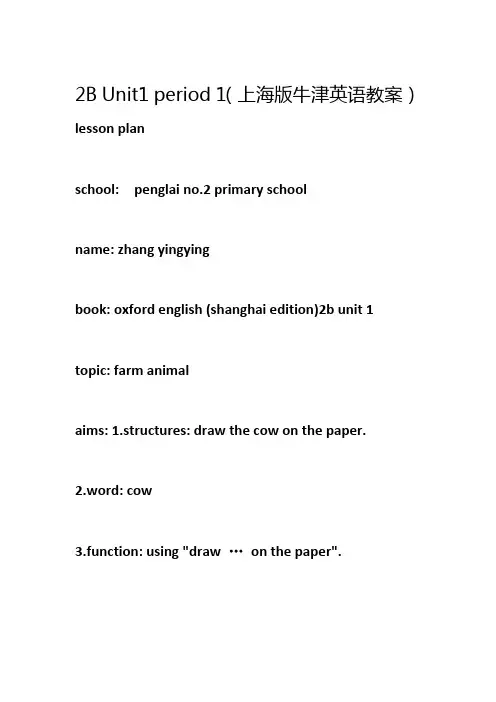
2B Unit1 period 1(上海版牛津英语教案)lesson planschool:penglai no.2 primary schoolname: zhang yingyingbook: oxford english (shanghai edition)2b unit 1topic: farm animalaims: 1.structures: draw the cow on the paper.2.word: cow3.function: using "draw …on the paper".language focus: using imperatives to give simple instructions.aids: pictures, realiaprocedurescontentsmethodspurposei. pre-task preparation1.warming-upps: sing a song about animals.1.通过歌曲,让学生对动物有初步的印象。
2.描述动物,为课文最终的综合练习打下根底。
3.协助学生区分什么是野生动物,什么是农场里动物,丰富学生的学问,进一步激发他们学习的爱好。
2.questions and answerswhich animal do you like best? why?which animal do you have as a pet?do you like …?t: ask pupils to answer the questions.pn: answer.pa: ask questions.pb: answer.3.quick responsetigers, sheep, elephants, crocodiles, ducks, cows(show the pictures)ps: farm animals.ps: wild animals.ii.while-task procedurecontent 1: cow1.introduction:t: elicit ‘cow’from the previous game.what’s this?2.imitation: cow1) t: ask pupils to follow.t-ps2) t: spell the word.pa-pb-pn通过机械性的仿说及拼读,使学生对所学单词根本驾驭。
牛津英语上海版2B教案
牛津英语上海版2B教案教案点拨载体《牛津英语上海版2B》是针对中学生的英语学习教材,本教案重点针对Unit 1-6进行教学设计,总字数不足1200字。
一、教材分析1.教材内容:Unit 1: Sports DayUnit 2: The ZooUnit 3: The WeatherUnit 4: At the Department StoreUnit 5: On the FarmUnit 6: At the Pet Show2.学生年级:中学二年级3.学习目标:掌握与体育活动、动物、天气、购物、农场、宠物展有关的词汇和表达方式。
通过听、说、读、写等综合训练,提高学生的听说能力、语言应用能力和跨文化交际能力。
二、教学设计Unit 1: Sports Day1. Warm-up Activity: Have a class discussion about favorite sports, ask students to share their opinions and reasons.2. Vocabulary: Introduce new vocabulary related to sports, such as running, jumping, swimming, etc. Use flashcards and real objects to help students understand and memorize the words.3. Listening: Play a recording of a sports event, ask students to listen and answer questions about the participants and their performance. Have a class discussion about the sports event.4. Speaking: Organize a mini sports day in the classroom. Divide the class into groups and assign different sports to each group. Students will take turns performing their chosen sports and describing their actions in English.6. Writing: Ask students to write a paragraph about their favorite sports and why they like it. Provide sentence starters and vocabulary to support their writing.Unit 2: The Zoo1. Warm-up Activity: Show students pictures of different animals, ask them to identify the animals and describe their characteristics.2. Vocabulary: Introduce new vocabulary related to animals, such as lion, elephant, giraffe, etc. Use flashcards and real pictures to help students understand and remember the words.3. Listening: Play a recording about a visit to the zoo, ask students to listen and answer questions about the animals seenat the zoo. Discuss the experience as a class.4. Speaking: Organize a group presentation about different animals. Each group will research and present information about an assigned animal, including its physical characteristics, habitat, and behavior.6. Writing: Ask students to write a paragraph about their favorite animal and describe its appearance and characteristics. Provide sentence starters and vocabulary to support their writing.Unit 3: The Weather1. Warm-up Activity: Review previous knowledge about different types of weather. Ask students to share their favorite weather and reasons.2. Vocabulary: Introduce new vocabulary related to weather, such as sunny, rainy, windy, etc. Use flashcards and pictures to help students understand and remember the words.3. Listening: Play a weather report recording, ask students to listen and identify the weather conditions mentioned. Discuss the weather conditions and their impact on activities.4. Speaking: Organize a weather forecast presentation. Each group will research and present a weather forecast for a chosencity, including the current weather conditions and predictionsfor the next few days.6. Writing: Ask students to write a short weather report fora chosen city. Provide sentence starters and vocabulary to support their writing.Unit 4: At the Department Store2. Vocabulary: Introduce new vocabulary related to department store items, such as clothes, shoes, bags, etc. Use flashcards and real objects to help students understand and remember the words.3. Listening: Play a conversation between a customer and a shop assistant in a department store, ask students to listen and answer questions about the customer's needs and the shopassistant's suggestions. Discuss the conversation as a class.4. Speaking: Organize a role play activity where studentsact as customers and shop assistants. They will take turns practicing conversations in a department store setting, focusing on making inquiries and providing suggestions.6. Writing: Ask students to write a short letter to a friend, describing a shopping experience in a department store. Provide sentence starters and vocabulary to support their writing.Unit 5: On the Farm1. Warm-up Activity: Show pictures of different farm animals, ask students to identify the animals and describe their appearances and behaviors.2. Vocabulary: Introduce new vocabulary related to farm animals, such as cow, sheep, chicken, etc. Use flashcards, videos, and real objects to help students understand and remember the words.3. Listening: Play an audio recording about life on a farm, ask students to listen and answer questions about the daily activities and responsibilities of farmers. Discuss therecording as a class.4. Speaking: Organize a class discussion about farming andits importance. Ask students to share their thoughts on why farming is important and the challenges faced by farmers.6. Writing: Ask students to write a diary entry about avisit to a farm. Provide sentence starters and vocabulary to support their writing.Unit 6: At the Pet Show1. Warm-up Activity: Show pictures of different pets, ask students to identify the pets and share their experiences with pets.2. Vocabulary: Introduce new vocabulary related to pets,such as cat, dog, rabbit, etc. Use flashcards and real picturesto help students understand and remember the words.3. Listening: Play a conversation between pet owners at apet show, ask students to listen and answer questions about the pets being shown and their unique features. Discuss the conversation as a class.4. Speaking: Organize a pet show in the classroom. Each student will bring a toy pet and present it to the class, describing its special features and characteristics.6. Writing: Ask students to write a short paragraph about their ideal pet and why they would choose it. Provide sentence starters and vocabulary to support their writing.以上是《牛津英语上海版2B》教学设计的主要内容,根据课程特点和教学目标,选择了适合学生的各种教学活动和评估手段。
上海版牛津英语2B教案
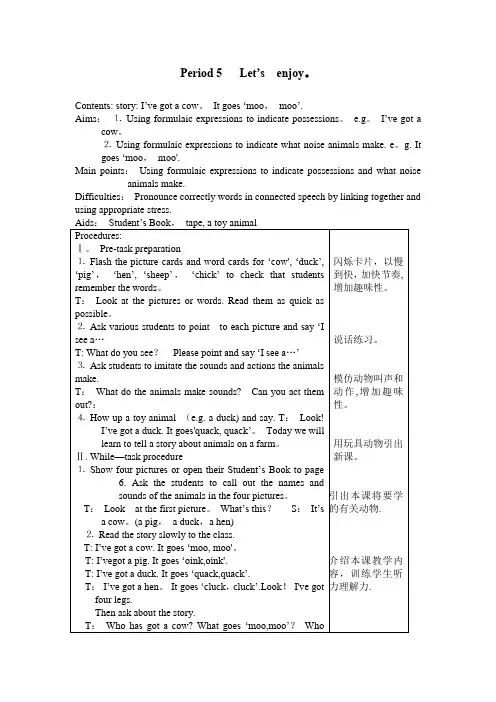
Period 5 Let’s enjoy。
Contents: story: I’ve got a cow。
It goes ‘moo,moo’.Aims:⒈Using formulaic expressions to indicate possessions。
e.g。
I’ve got a cow。
⒉Using formulaic expressions to indicate what noise animals make. e。
g. Itgoes ‘moo,moo'.Main points:Using formulaic expressions to indicate possessions and what noise animals make.Difficulties:Pronounce correctly words in connected speech by linking together and using appropriate stress.2B Unit 1 Farm AnimalsPeriod 1 Let's learnContents: 1.Word: hen,chick, duck,cow,pig2.Letter:N n nose, O o orangeAim: 1。
Using nouns to identify common farm animals。
e.g。
hen,chick2.Learn the above names and sounds of the letters ‘N n,O o'。
3。
Knowning about the farm animals and say something about theanimals you like.Main points: Using nouns to identify common farm animals。
沪教牛津英语2b教案

沪教牛津英语2b教案【篇一:小学牛津英语2b全册教案】unit1 do you like winter?第一课时教学目标:1、能听懂一般疑问句do you like??引导尝试用yes,i do.和no,i don`t.回答。
2、能听懂、会说、初步认读sping、summer、autumn和winter四个单词,发音正确。
3、初步学习歌曲season`s song。
教学重点难点:1、能听懂一般疑问句do you like??引导尝试用yes,i do.和no,i don`t.回答。
2、能听懂、会说、初步认读sping、summer、autumn和winter四个单词,发音正确。
教具准备及辅助活动:录音机、词语卡片、挂图教学过程:a. free talk:1、播放歌曲happy new year,给学生创造新年新气象的愉悦氛围。
2、播放season`s song给学生欣赏,让学生初步了解本歌曲的曲调和节奏。
b、learn to say1、由学生的衣服和颜色引出单词:t: happy new year!(指着某个学生的衣服表示赞美)you look so beautiful! 引导学生用thank you 回答。
t: your blue coat is nice. do you like blue?(根据学生衣服的实际情况引导学生回答)yes,i do./no, i don`t.2、让学生猜猜教师喜欢的颜色,引出单词winter。
t:what do i like?学生说颜色的单词,引导学生尝试用do you like ??的句型来问。
t:i like white. today i`d like to show you a picture of a white winter.教师出示冬天的图片,引出winter,组织学生听单词录音,朗读单词。
3、以相同的方法学习单词sping、summer、autumn。
上海版牛津小学英语2b教案全册 2B教案U9_3
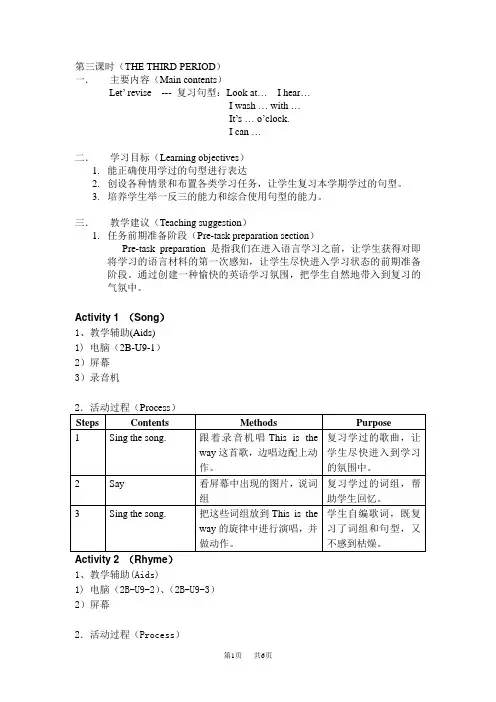
第三课时(THE THIRD PERIOD)一.主要内容(Main contents)Let’ revise --- 复习句型:Look at…I hear…I wash … with …It’s … o’clock.I can …二.学习目标(Learning objectives)1.能正确使用学过的句型进行表达2.创设各种情景和布置各类学习任务,让学生复习本学期学过的句型。
3.培养学生举一反三的能力和综合使用句型的能力。
三.教学建议(Teaching suggestion)1.任务前期准备阶段(Pre-task preparation section)Pre-task preparation 是指我们在进入语言学习之前,让学生获得对即将学习的语言材料的第一次感知,让学生尽快进入学习状态的前期准备阶段。
通过创建一种愉快的英语学习氛围,把学生自然地带入到复习的气氛中。
Activity 1 (Song)1、教学辅助(Aids)1) 电脑(2B-U9-1)2)屏幕3)录音机Activity 2 (Rhyme)1、教学辅助(Aids)1)电脑(2B-U9-2)、(2B-U9-3)2)屏幕2.活动过程(Process)2、任务中期实施阶段(While-task procedure section )While-task Procedure ,这是指语言技能的习得过程。
其中分为机械性操练和意义性操练两部分。
机械性操练:让学生准确地模仿、复说要学习的知识,从模仿到识记,使新知识由感知、理解、模仿直到储存。
Activity 1(Discuss ) 1、教学辅助(Aids) 1) 电脑(2B-U9-4) 2)屏幕Activity 2 (What time is it?) 1、教学辅助(Aids) 1)电脑(2B-U9-5) 2)屏幕完成比较扎实的机械性操练后,就进入了意义性操练阶段。
意义性操练是介于机械性操练和交际性操练之间,起着承上启下的作用,把语言形式的操练转向语言内容的操练,使学生的认知逐步从知识外部特征转向知识内在的联系。
上海版牛津英语2b教案
上海版牛津英语2b教案【篇一:2015年上海版牛津英语2b二年级下册教案(全册)(最新原创)】the allocation for grade 2b2b unit 1 farm animals【单元分析(unit analysis)】一.教材地位(unit position)1.从第一、二单元“动物”的主题来看,本单元教材内容是着重围绕“农场上的动物”这个课题展开。
2.在一年级,学生已会用口语表达i’ve got?以及i see a ?句型,在此基础上,本单元巩固了这些句型,并通过有关动物词汇的累积和问答句的使用丰富了句子表述的语意。
3.在本册教材中,学生将继续识认书写大小写字母。
4.本单元学生将学习农场上常见的六种动物:hen, chick, duck, cow, sheep, pig及其相关表述。
5.结合本单元“农场”、“动物”的主题和语境,无论学生是否熟悉农场的环境,都可以让学生通过听觉和视觉感受农场上最常见的人类驯养的动物和野生动物,并且用习得的语言简单表达出自己的所见所闻。
二.学习目标(learning objectives)1.本单元学习oo 、nn两个字母,字母的教学可与单词教学相结合,要求学生不仅能按字母表顺序背诵字母,能正确认读大小写字母之外,还能正确掌握所学字母大小写的书写。
2.学生应该能够用正确的语音语调表达hen, chick, duck, cow, sheep, pig等动物名称,掌握这些词汇的认读、拼读、简单运用等口语表达;能够正确书写这些单词。
除此之外,可根据学生的学习能力在口语学习中适当增加所学动物的复数表达。
3.培养学生的视听观察能力,能根据实际情况运用what do you see/hear? i see/hear?进行简单的信息交换,表达个人的见闻。
教学资源(teaching resouces)1、现代技术支撑(i.p. support)录音机电脑实物投影机多媒体软件2、视听材料辅助(audio-visual aids)图片实物3、学习材料(materials)学生用书配套练习册四.课时划分(period division)2b unit 1 farm animals【单元分析(unit analysis)】三.教材地位(unit position)1.从第一、二单元“动物”的主题来看,本单元教材内容是着重围绕“农场上的动物”这个课题展开。
上海版牛津英语2B课程教案
Period 5 Let’s enjoy.Contents: story: I’ve got a cow. It goes ‘moo, moo’.Aims: ⒈Using formulaic expressions to indicate possessions. e.g. I’ve got a cow.⒉Using formulaic expressions to indicate what noise animalsmake. e.g. It goes ‘moo, moo’.Main points: Using formulaic expressions to indicate possessions and what noise animals make.Difficulties: Pronounce correctly words in connected speech by linking together and using appropriate stress.Aids: Student’s Book, tape, a toy animal2B Unit 1 Farm AnimalsPeriod 1 Let’s learnContents: 1.Word: hen, chick, duck, cow, pig2.Letter: N n nose, O o orangeAim: ing nouns to identify common farm animals.e.g. hen, chick2.Learn the above names and sounds of the letters ‘N n, O o’.3.Knowning about the farm animals and say something aboutthe animals you like.Main points: Using nouns to identify common farm animals. Difficulties: Pronounce words properly.Aids: 1.T: picture cards, words cards, tape, Student’s Book and Wordbook.P: picture cards (students prepared beforehand )Period 2 Let’s talkContents: What do you see? I see┄What do you hear? I hear┄Aims: 1. Asking ‘wh’questions to find out specific information about a farm.e.g. What do you see /hear?2.Using the simple present tense. e.g. I see/hear a duck.Main Points: Asking and answering the ‘wh’questions. Difficulties: Using the models to communicate with other learners. Aids: the wallchart for page 3, six picture cards and six word cards ,tape , Student’s Book and WorkbookProcedures:ⅠPre-task preparation⒈Show six toy farm animals or pictures of them.Ask students to name in English.⒉Show sixword cards. Ask students to read them.Period 3 Let’s actContents: Draw the cow on the paper. Draw the duck on the ground. Aims: ⒈Using imperatives to give simple instructions. e.g. Draw the cow on the paper.⒉Locating specific information in response to simple instructions.⒊Using modeled phrases to communicate with other learners. Main points: Using imperatives to give simple instructions. Difficulties: Using modeled phrases to communicate with other learners. Aids: plain sheets of paper, toy animals, animal picture cards, tape, Workbook, Student’s BookPeriod 4. Let’s play.Contents: Listen, tick and say: I hear a…Aims: ⒈Using the simple present tense to indicate what you hear. e.g. I hear a sheep.2. Using nouns to refer to farm animals. e.g. cowMain points: Using the simple present tense to indicate what you hear. Difficulties: Recognizing key words of the animals.Aids: Student’s Book and Workbook, tape, word and picture cards2B Unit2 In the circus Period1 Let’s act Teaching aims:1)Locate specific information in response to simple instructions.2)Use imperatives to give simple instructions.3)Learn the sentences: Come here. Go there. Come back . Education aims:Foster the thought of loving animals.Difficult points:Using imperatives to give simple instructions.Materials:Cassette 2B and cassette player.Animal masksTeaching essay2B Unit2 In the circus Period2 Let’s learn Teaching aims:1)Learn the words: horse, bear, elephant, tiger, monkey, panda.2) Pronounce words properly.Education aims:Foster the thought of loving animals.Difficult points:Using nouns to identify animals.e. g. bear, elephantMaterials:Cassette 2B and a cassette player.Wookbook 2B page 6.Animal masks.Teaching essay2B Unit2 In the circus Period3 Let’s talk Teaching aims:1)Learn the sentences: Look at the…It’s…and…2) Use imperatives to draw attention to something.3 ) Use adjectives to describe animals.Education aims:Foster the thought of loving animals.Difficult points:Use imperatives to draw attention to the animals and describe them.Materials:Cassette 2B and a cassette playerWord and picture cards (animals)Wallchart 2BAnimalsTeaching essay2B Unit 2 Period 4 In the circus Letters Basic aim: ing nouns to identify things.. .. e.g. pencil, quilt.2. Learning the letters: Pp , Qq.Difficult point: Writing the lettersTeaching essay2B Unit 2 Period 5 Let’s play Guess Who’s my friend? Basic aim:ing connectives to link two adjectives.e.g. She is little and white.2.Asking “Wh-’’questions to find out specific information abouta person.e.g. Who is she?Developing aims:1.Learn other words. e.g. tail,short.2.Make a riddle.Materials: cassette,player,toys,masks.Teaching procedure:Teaching essayUnit 2 Let’s enjoyPeriod 6 Song Basic aim:ing imperatives to draw attention to somethinge. g. Look at the bear.ing adjectives to describe animalse. g. It’s big and brown.Developing aims:1.Rhyme2.Like animals, like nature.Materials:Cassette, player, pictures, masks.Teaching procedure:Teaching essayUNIT 3 Let’s learnPeriod 1Teaching aims:1.Basic aims: a. To learn the letters: Rr Ss.b. To learn the words: rubber, sweet.c. Add a new word: chocolate.2.Developing aims: using the words to make some sentences, make some dialogues or some rhymes.Main points: To learn the letters and the words.Difficult points: The pronunciation of ‘Rr’.Materials: letter cards, picture cards, cassette.Teaching essayUNIT 3 Let’s learnPeriod 2Teaching aims:1.Basic aims:To learn the seven words: window, door, bed, room, sofa, table, lamp.2.Developing aims: Using the words to describe a room.Main points: To learn the words.Difficult points: Using some English to describe the words. Materials: cassette, picture cards, a big picture of a room.Teaching essayUNIT 3 Let’s actPeriod 3Te aching aims:1.Basic aims: Using imperative to give simple instructions: Close the window, please.2. Developing aims: Using imperative in the correct situation. Main points and difficult points:Use modelled phrases to communicate with other learners. Materials: cassette, picture cards, the picture of ‘my room’Teaching essay2B UNIT 3 Let’s talkPeriod 4Teaching aims:1.Basic aims:(1)Using the simple present tense to indicate facts. E.g. This is myroom.(2)Using introductory ‘There’to express facts. E.g. There is / are…in my room.2. Developing aims: T o describe one place using ‘There is/are…’. Education aims: Let the students to love their homes.Main points and difficult points:Using ‘This is …’‘There is/are …’to express facts. Materials: cassette, the tape of listening( 2parts),the tape of the sounds(the admire and bewail sounds),some pictures, cards. etc.。
上海版牛津英语2b教案全册
Unit 1 Where I LiveTeaching aids:A. Words : letters Aa --Bb , bin , park , road , building , ShanghaiB. Structures : I live in …. I love …. I see …. That’s …C. Functions : Give simple instructions; Refer to specific classroom objects.Material:1. Student's Book 2A page 2--62. Cassette 1A and a cassette player3. Wallcharts4. Photograph page 15. Alphabet CardsTeaching times:5 timesLearning targets:A. Basic aims:1. Be able to identify the letters Aa -- Bb2. Be able to give simple instructions3. Be able to use the simple present tense to indicate facts4. Be able to "point to your home"5. Read the rhymeB. Further aims:1.2.Practise saying a new rhyme substituting 'Shanghai' with another places Language focus:1. Using the definite article to refer to specific classroom objects2. Using the simple present tense to express interests and preferences3. Learning the words: bin , park , road , building , ShanghaiPeriod 1Teaching focus:Using imperatives to give simple instructionsUsing the definite article to refer to specific classroom objectsPeriod 2Teaching focus:Using the simple present tense to indicate factsUsing the simple present tense to express interests and preferencesPeriod 3Teaching focus:Using nouns to identify objectUsing proper nouns to refer to placesPeriod 4Teaching focus:Asking ' Wh-' questions to find out various kinds of specific information about a person Using the simple persent tense to express truthUsing the simple persent tense to express interests and preferencesPeriod 5Teaching focus:Using the simple persent tense to express interests and preferencesUnit 4 Going aboutTeaching designing:Teaching aids:A.Words: letters Gg—Hh, plane, ferry, train, taxi, car, bus, van.B.Structures: Get ……How do you go to……C.Functions: Give simple instructions; Using connectives to add information Material:1.Student’s Book 2A page 17-212.Cassette 1A and a cassette player3.Wall charts4.Photograph page 145.Alphabet CardsTeaching times:5 timesLearning targets:A.B asic aims:1.Be able to identify the letters Gg--Hh2.Be able to give simple instructions3.Be able to introduce oneself using I’m.4.Be able to write the sentence Hello, I’m <name>.5.Sing a song.B.Further aims:ing more information to introduce oneself2.The sorts of the alphabetLanguage focus:ing imperatives to give simple instructions2.Asking How questions to find out means and Using prepositions to indicate meas3.Learning the words: plane……Period 1Teaching focus:Using imperative to give simple instructionsTeaching steps:Period 2Teaching focus:Asking How questions to find out mean Using prepositions to indicate means Using formulaic expressions to take leave Teaching steps:Period 3Teaching focus:Using nouns to identify forms of transport. Teaching steps:Period 4Teaching focus:Using formulaic expressions to indicate how people travel Teaching steps:Period 5Teaching focus:Using nouns to identify different forms of transport Teaching steps:Unit 5 Crossing the roadTeaching designing:Teaching aids:D.Words: letters—Ii Jj, stop, light, go, fast, slow.E.Structures: Look at the light. It’s…, Go! / Stop! / Wait! /F.Functions: Using imperatives to give simple instructions; To give simpleinstructions.Material:6.Student’s Book 2A page 22-267.Cassette 1A and a cassette player8.Wall charts9.Photograph page 1410.Alphabet CardsTeaching times:5 timesLearning targets:C.Basic aims:6.Be able to identify the letters Ii--Jj7.Be able to give simple instructions8.Be able to introduce oneself using I’m.9.Be able to write the sentence Hello, I’m <name>.10.Sing a song.D.F urther aims:ing more information to introduce oneself4.The sorts of the alphabetLanguage focus:ing imperatives to give simple instructionsing adjectives to describe objects6.Learning the words: stop……Period 1Teaching focus:Using imperative to give simple instructionsTeaching steps:Period 2Teaching focus:Using imperative to give simple instructions Using adjectives to describe objectsTeaching steps:Period 3Teaching focus:Using imperatives to give simple instructions Using nouns to identify thingsUsing adjectives to describe objects Teaching steps:Period 4Teaching focus:Using imperative to give instructions Using adjectives to describe coloursTeaching steps:Period 5Teaching focus:Using imperatives to give simple instructions Using adjectives to describe objectsTeaching steps:。
上海版牛津英语2B教案
上海版牛津英语2B教案(总20页)-CAL-FENGHAI.-(YICAI)-Company One1-CAL-本页仅作为文档封面,使用请直接删除Unit 7 Hot SummerPeriod 1 Education Aims:Don’t leave rubbish on the beach.Teaching Aims:1.Basic aims.A: To learn the words: beach, shellsB: To learn the drills.e. g. Let’s go to the beach.2.Developing Aims:A: Say another sentences.e.g. Let’s pick up rubbish.B: Free talk.Materials:Cassette player, pictures, objectsTeaching Procedure:课后小结Unit 7 Hot SummerPeriod 2 Let’s talk Education Aims:To be friendly each other .Teaching Aims:1.Learn the drills.e.g. Summer is hot .2.Learn the dialogue.A: I’m sorry.B: It’s OK.Materials: cassette player, pictures, objects. Teaching Procedure:Unit 7 Hot summerPeriod 3 Let’s learn Education Aims:Don’t eat much ice-cream in summer.Teaching Aims:1.Learn the words: e.g. cloud2.Learn the letter: Y yMaterials: cassette player, word and letter cards.课后小结Period 4 Let’s play Education Aims:Don’t eat too many ice-creams.Teaching Aims:A: Basic Aims.Learn to say the sentences.e.g. The sun is hot.L et’s sit under the umbrella.B: Developing Aims.Free talk about winter.Materials: cassette player, some pictures, cards Ask the pupils to make some pictures before class.课后小结Period 5 Let’s enjoyEducation Aims:To be friendly each other .Teaching Aims:A: Basic Aims:Learn to say the rhyme.B: Developing Aims:Free talk.Materials: cassette player, pictures.。