
初中英语译林牛津版八年级下册Unit6 Sunshine for all单元练习
初中英语译林牛津版八年级下册Unit6 Sunshine for all单元练习一、听力(听力)(共20小题;共20分)听力(共 30 分)一、听对话,从下面各题所给的 A、 B、 C 三幅图片中选择与对话内容相符的图片。
每段对话你将听两遍。
(共5分,每小题1分)1. A. B. C.2. A. B. C.3. A. B. C.4. A. B. C.5. A. B. C.二、听对话或独白,根据对话或独白的内容,从下面各题所给的 A、 B、 C 三个选项中选择最佳选项。
每段对话或独白你将听两遍。
(共15分,每小题1.5分)请听一段对话,完成第 6至第7小题。
6. Where is Betty going?A. To the park.B. To the zoo.C. To the museum.7. How is the weather?A. It's rainy.B. It's snowy.C. It's windy.请听一段对话,完成第8至第9小题。
8. What does Peter's grandma like?A. Art.B. Music.C. History.9. What will Peter get for his grandma?A. A CD.B. A book.C. A mobile phone.请听一段对话,完成第10至第11小题。
10. Why didn't Amy go to school yesterday?A. Because she had a cold.B. Because she hurt her arm.C. Because she went to West Hill.11. When will the bus leave for the trip?A. At 7:00.B. At 7:30.C. At 8:00.请听一段对话,完成第12至第13小题。
12. What does the man do?A. A doctor.B. A reporter.C. A sportsman.13. Why does the man think of talk shows?A. Interesting.B. Exciting.C. Boring.请听一段独白,完成第14至第15小题。
14. What can we learn from the speech?A. We should do more work than we can.B. Interests may help us do volunteer work.C. The first volunteer work must be perfect.15. What is the speech mainly about?A. Reasons for being a volunteer.B. Purposes of being a volunteer.C. Suggestions for being a volunteer.三、听对话,记录关键信息。
本段对话你将听两遍。
(共10分,每小题2分)请根据所听到的对话内容和提示词语,将所缺的关键信息填写在答题卡的相应位置上。
16.17.18.19.20.二、单项选择(共15小题;共15分)21. Thank you for us to your birthday party.A. askB. askedC. askingD. asks22. It was very him to make room for an old person.A. polite forB. polite ofC. polite toD. polite in23. --- Hi, Tom, why are you so unhappy?--- the bad weather, I can't go out.A. Thanks forB. Thanks toC. As forD. Because of24. Our English teacher often says to us, " English well is very important."A. LearnB. LearningC. LearnedD. To learning25. --- Cathy, can you answer the door? I the room.--- I'm coming, mum.A. cleanB. cleanedC. have cleanedD. am cleaning26. is important and necessary for us English well.A. This; to learnB. It; learningC. That; learningD. It; to learn27. --- How about talent show?--- I should say it was great success.A. /; theB. a; theC. the; aD. the; /28. --- Dad, can I go to the movies tonight?--- Sure, but you come back home before 9 o'clock.A. canB. mustC. mayD. might29. They had no trouble to the bus station.A. gotB. gettingC. getsD. to get30. --- How long has Robert ?--- Since 2004.A. been to BeijingB. become a policemanC. joined the art clubD. studied in this school31. The rich man much food the poor families during the hard time.A. provides; toB. provides; withC. provided; withD. provided; for32. Do you want to Mike's birthday party?A. goB. comeC. joinD. take part in33. --- This dress looks beautiful on you. How much is it?--- It me more than a thousand yuan.A. spentB. costC. tookD. paid34. I have a lovely room. It's the in the hotel.A. niceB. nicerC. nicestD. most nice35. You should really smoking. It's a terrible habit.A. set upB. pick upC. give upD. grow up三、完形填空(共10小题;共15分)Bill Brown is an office worker and he lives in New York. At the 36 of 24, he inherited(继承) a million(百万) dollars. He wasn't happy at all 37 he didn't have to look for a job like his college friends. Bill decided to live a simple(简单的) life like everyone else. So he gave $10,000 of his38 to a charity(慈善机构) to help poor children live a better life. Now he is 36. He still39 cheap shoes and clothes and drives a small car only, but he is very happy.Bill helped some children from poor countries all over the world. He sent each of 40 $200 a month. The children used the money for their study, food, medicine and clothes. Every year Bill 41 a report on the children's progress(进步). They can write to each other, but usually the children do not 42 English.When Bill first heard about these children, he wanted 43 them. "It was nothing special," he said. " 44 I went to these countries and met the children I was helping, I didn't know anything about their life." Once Bill went to Africa to meet a little girl there. He said that the meeting was very 45 . "When I met her, I felt very, very happy," he said, "I saw that the money was used for good things. It brought me happiness. I want to do everything I can to go on helping those children."36. A. day B. month C. year D. age37. A. but B. though C. because D. if38. A. money B. time C. clothes D. food39. A. wears B. washes C. rides D. sells40. A. us B. him C. them D. they41. A. sends B. receives C. buys D. writes42. A. say B. talk C. tell D. speak43. A. help B. helps C. helping D. to help44. A. While B. After C. Until D. As soon as45. A. exciting B. excited C. boring D. bored四、阅读理解(共15小题;共30分)AAre you looking for something fun and would you like to help others in you spare time? Then join us to be a volunteer! We're a non-profit organization. We have volunteer jobs of all ages. Anyone, from twelve-year-old children to people in their seventies can become a volunteer.You can help people in many ways. Schools need help with taking care of children while parents are working. Hospitals need to look after children while their parents are seeing a doctor. Animal lovers can help take care of those dogs and cats without homes. There is something for everyone."As a volunteer, I don't want to get anything. Seeing the children's happy faces, I'm happy, too." Said Carlos Domingo, an old woman of 62. "I often played computer games in my spare time before. Now I help older people learn how to use computers." said another volunteer at the age of 18.If everyone helps out a bit, we'll have a better world to live in. Interested? Call us 1-800-555-5756 or visit our website: .46. can be a volunteer.A. ChildrenB. Old womenC. Anyone aged 12-70D. Young people47. Carlos Domingo does volunteer work with .A. animalsB. childrenC. computersD. older people48. We can read such a passage .A. in a newspaperB. in a storybookC. in a picture bookD. in a textbookBDo you know what Street Sense is? It's a newspaper in Washington, D.C. about homeless people and problems that affect them. Homeless, or formerly homeless, Washingtonians write many of the articles. The newspaper's business model is based on homeless sellers who sell the newspaper. You can hear them call out "Street Sense for sale!" near subway entrances, lunch places and other areas around the city.The Street Sense newspaper is housed in an office in a Christian church in Washington. Every other Wednesday about fourteen thousand copies are printed. The newspaper expresses the thoughts and experiences of people who call the streets home.Four staff members work at Street Sense. Two of them are paid. The staff members write the first two pages of the paper. Interns-students working as part of their studies and volunteers help. Homeless writers provide the rest of the material. This includes poems, stories and essays.Street Sense provides training to the homeless people who want to become part of the sales team. After the training, each student is given ten free copies of Street Sense. Once those are sold, trainees become real sales people. They buy papers for thirty-five cents each and sell them for a dollar.Lisa Gillespie is the managing editor of Street Sense. She says the newspaper plays a part in homeless people's lives that other media can not. With the help of the newspaper, a lot of homeless people have become confident again, and their lives have also been improved a lot.49. What does the writer mainly tell us in Paragraph 1?A. Something about Street Sense.B. Homeless people in Washington, D.C.C. How Street Sense solves homeless people's problems.D. Street Sense is very interesting.50. How often is Street Sense printed?A. Once a week.B. Twice a week.C. Twice a month.D. Three times a month.51. What do the staff members mainly do at Street Sense?A. They sell newspapers along the street.B. They write the first two pages of the paper.C. They edit the newspaper after they receive articles.D. They provide the last two pages of the material.52. What can you infer from this passage?A. If you are one of the trainees of Street Sense, you can get ten dollars from selling all of your newspapers.B. There are too many homeless people in Washington, D.C. for the government to help.C. Most articles of Street Sense are about Washingtonians' lives.D. If you become real sales people of Street Sense, you can get thirty-five cents from a copy of the newspaper.53. What does Lisa Gillespie really mean?A. Street Sense is important to homeless people and can encourage them to be confident of their lives.B. More and more homeless people prefer reading Street Sense to watching TV.C. Thanks to the Street Sense, a lot of homeless people can get some money from the newspaper.D. With the help of the newspaper, some homeless people know how important the newspaper is to their lives.CEvery year, more and more students become volunteers. The projects may be with their school, neighborhood, or town, but the work of all volunteers is important. Students find that there are many advantages to volunteering.First, volunteering helps others. Many people complain about problems in our society. Volunteers are part of the solution to our problems! While it is easy to complain about things that are not right, the volunteer takes action rather than complaining. When a student spends time working at a retirement home, cleaning up a park, or teaching a younger student, the volunteer makes the world a better place.Second, being a volunteer makes students feel good about themselves. When a student volunteer knows that his or her efforts have made someone else's life better, the volunteer feels great. Students always hear people saying that everyone should care about other people. Volunteers make it happen. Although some volunteer work is long or tiring, student volunteers end the day knowing they did the right thing. Their parents, teachers, and the public are proud of them. Knowing they did the right thing makes them feel better, even if they are tired.Finally, students learn that volunteering is fun. A group of students might volunteer to clean up a riverbed in early spring. It is fun to be with their friends, to enjoy the weather, and to picnic later in a beautiful, clean area. Other students might read to young children in a playgroup. It is fun to spend time with children and to have them smile and laugh. No matter what their ages or talents are, every student can be a volunteer. The work of student volunteers is a powerful force that makes the world a better place.54. The title of this passage is .A. Free-time JobsB. Daily ActivitiesC. School LifeD. Volunteer Work55. The writer really wants to say that .A. volunteering helps society as well as volunteers themselvesB. it is fun to spend time volunteering in a pre-schoolC. some people complain instead of taking actionD. some volunteer work is long and tiring56. According to the passage, how are volunteers different from other people?A. They never complain.B. They always feel great.C. They take actions.D. They enjoy teaching.DIn a room at Texas Children Cancer Center in Houston, eight-year-old Simran Jatar lay in bed with a drip(点滴) above her to fight her bone cancer. Over her bald(秃的) head, she wore a pink hat that matched her clothes. But the third grader's cheery dressing didn't mask her pain and weary eyes. Then a visitor showed up. "Do you want to write a song?" asked Anita Kruse, 49, rolling a cart equipped with an electronic keyboard, a microphone and speakers. Simran stared. "Have you ever written a poem?" Anita Kruse continued. "Well, yes," Simran said.Within minutes, Simran was reading her poem into the microphone. "Some bird soaring through the sky," she said softly, "Imagination in its head…" Anita Kruse added piano music, a few warbling(鸣, 唱) birds, and finally the girl's voice. Thirty minutes later, she presented Simran with a CD of her first recorded song.That was the beginning of Anita Kruse's project, Purple Songs Can Fly, one that has helped more than 125 young patients write and record songs. As a composer and pianist who had performed at the hospital, Kruse said that the idea of how she could help "came in one flash".The effect on the kids has been great. One teenage girl, curling(蜷缩) in pain in her wheelchair, stood unaided to dance to a hip-hop song she had written. A 12-year-old boy with Hodgkin's disease who rarely spoke surprised his doctors with a song he called I Can Make It."My time with the kids is heartbreaking because of the badness of their illnesses," says Anita Kruse, "But they also make you happy, when the children are smiling, excited to share their CD with their families."Simran is now an active sixth grader and cancer-free. From time to time, she and her mother listen to her song, Always Remembering, and they always remember the "really sweet and nice and loving" lady who gave them a shining moment in the dark hour.57. Simran Jatar lay in bed in hospital because .A. she was receiving treatment for cancerB. most of her hair had fallen outC. she felt depressed and quit from schoolD. she was suffering from a pain in her back58. What do we know about Anita Kruse's project?A. It aims to replace the medical treatment.B. It is supported by singers and patients.C. It helps young patients record songs.D. It offers patients chances to realize their dreams.59. What does the case of a 12-year-old boy suggest?A. Most children are naturally fond of music.B. He was brave enough to put up performance.C. Singing is the best way to treat some illnesses.D. The project has positive effect on young patients.60. What is probably the best title for the passage?A. Singing Can Improve HealthB. Purple Songs Can FlyC. A Shining Moment in LifeD. A Kind Woman—Anita Kruse五、单词拼写(根据中文提示拼写单词)(共10小题;共10分)61. We're (训练) for the basketball match next week.62. Our school soccer team needs more (支持).63. He was (看不见的) before the eye operation. Now he can see things clearly.64. It is (期待) that we will have an English speech contest.65. He is very glad to have a (机会) to practice his English.66. The (任务) was so hard that we didn't finish it in three days.67. Maria often wins first p (奖赏) in the school speech contests.68. My (课题) is about how to learn math.69. Volunteers from different (背景) feel like part of one big family.70. The boy will try his best to (完成,实现) his dream.六、翻译(根据中文提示完成句子)(共10小题;共20分)71. 他们的房子和我们的十分相像,但我们的要大些。
牛津译林版8B Unit6 Sunshine for all Reading课件(共21张PPT)

from all over the world ,with different backgrounds /ˈbækgraʊnd/ 背景
have a chance to show their skills the world. What’s the aim( 目的 ) of the to game?
Choose T or F
T 1. Liu Ming was a volunteer for the 2007 Special
Olympics World Games. /ɪk‘spekt / 期望 F 2. Liu Ming knew what to expect before he became a volunteer.
similar
adults
support
success
Read para. 4 & 5, then answer questions
1. Is it great for volunteers to help athletes achieve their dreams? 2. What did Liu Ming do for the young boy?
F 3. There were only a few events in the 2007 Special
Olympics World Games.
T 4. There were over 40,000 volunteers for the 2007
Special Olympics World Games.
Read para. 2 & 3 , then fill in the blanks
They are an international sports festival for children and _______with intellectual disabilities. About Special The events are _______ to those Olympic in the Olympics. World Lots of volunteers provide Games _______ for the athletes and help make the Games a great _____________.
牛津译林版英语八年级下Unit 6 Sunshine for all单词,短语,句子默写(含答案)
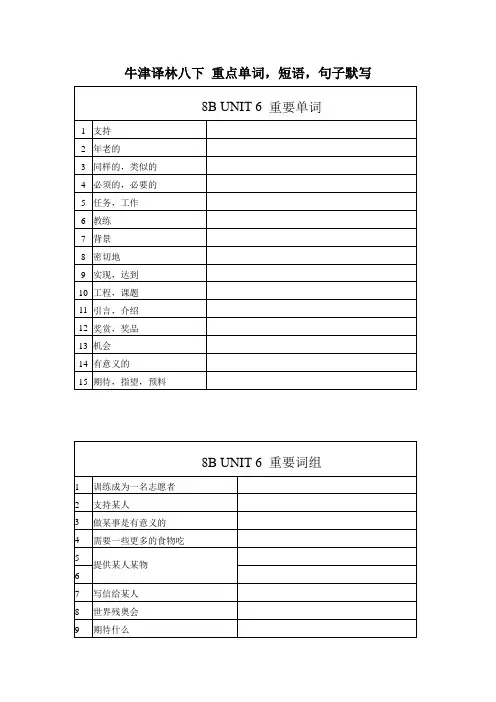
1
用这种方式,他们能够帮组当地人改善生活。
In this way, they can help the local people improve their lives.
2
自从上个月起,他就住院了。
He has been ill in hospital since last month.
25
取得第四名
26
感到更加自信
27
因为
28
齐聚一堂
29
来自不同背景
30
感觉像一个大家庭中的一员
31
亲密地工作
32
实现某人的梦想
33
34
35
没有得到报酬
36
赢得第一名
37
举办
38
做某事是有趣的
39
对做某事感兴趣
40
给老人让座
41
捐钱给慈善机构
42
赢得比赛
43
一对一地做某人的工作
44
没有某人的帮助
45
有一些经验
46
一个大学生
a college student
47
中国西南
south-west China
48
一个志愿者项目
a volunteer project
49
在某人的日常生活中
in one's daily lives
50
采取行动保护环境
take action to protect the environment
4
必须的,必要的
necessary
5
任务,工作
task
6
教练
coach
Unit 6单元复习-八年级英语下册单元复习(牛津译林版)
6….don’t have their own houses to live. 没有地方居住: have no place/nowhere to live 有房子居住: have a house to live in 有笔来写字: have pens to write with
有纸写字:
have paper to write on
句型二:
It is + adj. + for sb. + to do sth.
含义:对某人来说做某事是……的。 注意:该句型中的形容词也是表示不定式所具备的特 征或客观情况,和句型一相同。 此结构可看作是在It is + adj. + to do sth.结构中间插 入了for + sb. (逻辑主语—后面动作的发出者)。
八年级下册
Unit 6 Sunshine for all
1.训练成为一个志愿者:train to be a volunteer
2.支持我:
support me
3.给你:
here you are
4.在上班时:
at work
5.需要更多的食物吃: need more food to eat
6.一个残疾人:
4.I need some more food to eat at work.
ቤተ መጻሕፍቲ ባይዱ
need用法:
(1) need (行为动词) 需要
需要某物、做某事: need sth/to do sth
不需要某物、做某事:do/does/did not need sth/to do sth
(2) need (情态动词) 需要 需要做某事/不需要做某事:need do sth/needn’t do sth
牛津译林版英语八下Unit 6《Sunshine for all》单元教学设计
牛津译林版英语八下Unit 6《Sunshine for all》单元教学设计一. 教材分析牛津译林版英语八下Unit 6《Sunshine for all》以“阳光照耀所有人”为主题,通过介绍残疾人运动、教育、生活等方面的平等权利,让学生了解和关注弱势群体,培养他们的社会责任感和关爱他人的意识。
本单元包括两个阅读文本、一个听力文本和一个语法项目,内容丰富,贴近生活,具有很强的现实教育意义。
二. 学情分析八年级的学生已经具备了一定的英语基础,对日常生活话题有较好的认知。
但他们在语言表达、文化背景知识等方面还存在不足,需要通过教师的引导和启发,不断提高自己的综合语言运用能力。
此外,学生对弱势群体的关注程度不同,教师应充分利用教材内容,激发他们的同情心,培养关爱他人的品质。
三. 教学目标1.知识目标:学生能掌握本单元的重点词汇、句型和语法项目,正确运用所学知识进行交流。
2.能力目标:学生能提高阅读理解能力,听懂有关弱势群体的相关信息,并进行适当的口头和书面表达。
3.情感目标:学生能关注弱势群体,培养关爱他人、尊重平等的价值观。
四. 教学重难点1.重点:本单元的重点词汇、句型和语法项目。
2.难点:对文本内容的深入理解,以及对弱势群体的关注和关爱。
五. 教学方法1.任务型教学法:通过完成各种任务,激发学生的学习兴趣,提高他们的参与度。
2.情境教学法:创设真实情境,让学生在实际环境中运用所学知识。
3.情感教学法:引导学生关注弱势群体,培养他们的社会责任感和关爱他人的意识。
六. 教学准备1.教材:牛津译林版英语八下Unit 6《Sunshine for all》及相关教辅资料。
2.课件:根据教学内容设计的课件。
3.教学资源:有关弱势群体的图片、视频等。
七. 教学过程1.导入(5分钟)利用图片或视频引入弱势群体的话题,激发学生的兴趣,引导学生思考和讨论。
2.呈现(10分钟)呈现本节课的主题,让学生明确学习目标。
牛津译林版八年级下册Unit6《Sunshineforall》说课稿8
牛津译林版八年级下册Unit 6《Sunshine for all》说课稿8一. 教材分析《Sunshine for all》是人教版牛津译林八年级下册的一篇文章,主要讲述了一个关于贫穷和帮助他人的故事。
通过这个故事,让学生了解到帮助他人的重要性,并学会如何去关爱他人。
教材内容丰富,插图生动,语言简单易懂,适合学生学习。
二. 学情分析八年级的学生已经具备了一定的英语基础,对于日常生活中的基本词汇和句型已经有了一定的了解。
但是,他们在阅读理解方面还存在一定的问题,对于一些复杂的情境和抽象的概念还不能很好的理解。
因此,在教学过程中,我需要注重培养学生的阅读理解能力,帮助他们更好地理解文章的内容。
三. 说教学目标1.知识目标:让学生掌握文章中的基本词汇和句型,理解文章的大意。
2.能力目标:通过阅读文章,培养学生的阅读理解能力,提高他们的英语水平。
3.情感目标:让学生学会关爱他人,体会到帮助他人的快乐。
四. 说教学重难点1.重点:让学生掌握文章中的基本词汇和句型,理解文章的大意。
2.难点:培养学生的阅读理解能力,帮助他们理解文章中的抽象概念。
五.说教学方法与手段在教学过程中,我会采用任务型教学法,让学生在完成任务的过程中,自然而然地学习到文章中的词汇和句型。
同时,我会运用多媒体教学手段,如图片、视频等,帮助学生更好地理解文章的内容。
六. 说教学过程1.导入:通过提问方式,引导学生思考什么是阳光,为什么阳光对人们重要。
2.阅读理解:让学生阅读文章,回答相关问题,检查他们的理解程度。
3.词汇学习:通过对文章中的生词进行讲解,让学生掌握新词汇。
4.句型练习:让学生模仿文章中的句型,进行口语练习。
5.小组讨论:让学生分组讨论文章中的主题,培养他们的合作意识。
6.总结:对文章进行总结,强调关爱他人的重要性。
七.说板书设计板书设计主要包括文章标题《Sunshine for all》、主要词汇和句型。
通过板书,让学生对文章内容有一个清晰的认识。
牛津译林版8B Unit6 Sunshine for all Reading课件(共26张PPT)

智障
A story about a boy called Sufects him to be a confident person.
be sure of one's ablities
He wants to be an athlete and take part in the Special Olympics World Games.
Skim the article and answer the following questions.
1. Who is a volunteer? Liu Ming. 2. What do volunteers need to do for the Special Olympics World Games? They need to provide support for the athletes and help make the event a great success. important thing
1. Liu Ming was a volunteer in the 2007 Special Olympics World Games. ____ T 2. Liu Mingdidn’t knew know what to expect before he became a volunteer. ____ F 3. There were only manya few events in the 2007 Special Olympics World Games. _____ F
特奥会
n.运动员
adj.必须的 It's necessary for him to get some training before the Games.
牛津译林版八年级英语下册Unit 6 Sunshine for allIntegrated skil
(6)E_n__g_li_sh__ and Maths teaches them (7) s_o_n_g_safter class gives them a lot of (8) _b_o_o_k_s_
What she thinks: meaningful to learn more about (9) t_h_e__p_o_o_r_a_r_e_a_s__ of China helpful to (10) _t_e_a_c_h__ the children there
Peter is writing about Judy and the village school in his diary. Help him complete his diary entry with the information in Parts A1 and A2.
My cousin Judy has taken part in a (1) __v_o_lu_n_t_e_e_r_p_r_o_j_e_c_t in her college. She works as a primary school (2) _te_a_c_h_e_r_ in North-west China for (3) o_n_e__y_e_a_r. The school is very (4) _sm__a_l_l . There are only (5) _si_x_c_l_a_s_sr_o_o_m__s_ in the school. Most of the students live (6) f_a_r_a_w__a_y__ and they have to walk for more than (7) _a_n__h_o_u_r_ to get to school.
牛津译林版8B Unit6 Sunshine for all Task课件(共27张PPT)
1. He has been ill in hospital since last month. 他从上个月开始生病住院了。 本句用的是现在完成时,表示从过去某 一时间开始一直持续到现在的动作或事 情。 e.g. They have worked here since 1975. 他们从1975年开始就在这工作了。
1. Who needs help? 2. How do these people probably feel? 3. What do these people need? 4. How can we help these people? 5. What can we give them? 6. How can we raise money for them? 7. What can we do with this money? 8. What can we ask others to do for these people? 9. Who should we write to?
Read Peter’s letter and answer the questions.
1. How does Peter write such a letter? 2. What is the main idea of each paragraph in Peter’s letter?
Paragraph 1: Xiao Wei needs Introduction our help. Paragraph 2: Information about Xiao Wei. Paragraph 3: Xiao Wei’s family Main body need money. Paragraph 4: We can donate money.
牛津译林版八年级下册Unit 6《Sunshine for all》教学设计1
牛津译林版八年级下册Unit 6《Sunshine for all》教学设计1一. 教材分析牛津译林版八年级下册Unit 6《Sunshine for all》主要讲述了一个关于阳光的故事。
通过这个故事,学生可以了解到阳光对人们的重要性,学会用英语表达阳光的相关概念。
本单元的主要语言点包括一般现在时态的运用、描述天气的词汇和短语、以及如何表达祝愿。
本节课的教学内容为故事部分,通过阅读故事,学生能够理解故事内容,运用所学语言点进行相关表达。
二. 学情分析八年级的学生已经具备了一定的英语基础,能够听、说、读、写简单的英语句子。
但是,对于一般现在时态的运用和描述天气的词汇还需加强练习。
此外,学生对于阳光的重要性可能没有深刻的认识,需要通过本节课的学习,让他们了解到阳光对人们生活的影响。
三. 教学目标1.知识目标:学生能够听懂、读懂Unit 6《Sunshine for all》的故事内容,掌握故事中的核心词汇和短语,学会用英语描述天气和表达祝愿。
2.能力目标:学生能够运用一般现在时态描述阳光的重要性,进行相关的口语和书面表达。
3.情感目标:学生能够认识到阳光对于人们的重要性,学会关爱他人,传递正能量。
四. 教学重难点1.教学重点:学生能够听懂、读懂Unit 6《Sunshine for all》的故事内容,掌握故事中的核心词汇和短语。
2.教学难点:学生能够运用一般现在时态描述阳光的重要性,进行相关的口语和书面表达。
五. 教学方法1.情境教学法:通过设定阳光情境,让学生在实际情境中运用英语描述阳光和表达祝愿。
2.任务型教学法:通过小组合作完成任务,提高学生的口语表达能力和团队协作能力。
3.情感教学法:引导学生关注阳光对人们的重要性,培养学生的关爱他人意识。
六. 教学准备1.教学课件:制作Unit 6《Sunshine for all》的故事课件,包含图片、视频等素材。
2.学习材料:准备相关阳光主题的阅读材料,以便进行拓展学习。
牛津译林版英语八年级下册《Unit 6 Sunshine for all Welcome to th
牛津译林版英语八年级下册《Unit 6 Sunshine for all Welcome to the unit》教学设计7一. 教材分析本单元的主题是“阳光照耀所有人”,主要讲述了一个阳光男孩帮助一个盲人找到回家的路的故事。
通过本单元的学习,学生能够掌握一般过去时的被动语态,以及如何运用情态动词来表达可能性。
教材内容丰富,插图生动,有助于激发学生的学习兴趣。
二. 学情分析八年级的学生已经具备了一定的英语基础,对于一般过去时和情态动词有一定的了解。
但部分学生对被动语态的运用还不够熟练,需要通过大量的练习来提高。
此外,学生对于实际生活中的助人为乐的行为还有一定的了解,但对于如何在英语中表达这一概念可能还不够清晰。
三. 教学目标1.能够听懂、说出一般过去时的被动语态。
2.能够运用情态动词表达可能性。
3.能够理解并运用本单元所学词汇描述人物特征。
4.培养学生的同情心,鼓励他们在生活中助人为乐。
四. 教学重难点1.一般过去时的被动语态。
2.情态动词的运用。
3.如何用英语描述人物特征。
五. 教学方法1.任务型教学法:通过设定各种任务,让学生在实践中学习和运用语言。
2.情境教学法:通过设定生动的情境,让学生在真实的环境中学习英语。
3.交际法:鼓励学生积极参与课堂交际活动,提高他们的口语表达能力。
六. 教学准备1.PPT课件:制作与本单元主题相关的PPT课件,包括图片、视频等。
2.教材:牛津译林版英语八年级下册。
3.录音机:用于播放听力材料。
4.黑板:用于板书重点知识点。
七. 教学过程1.导入(5分钟)利用PPT展示一张阳光明媚的图片,引导学生谈论阳光。
然后引入本课主题“阳光照耀所有人”。
2.呈现(10分钟)播放课文动画视频,让学生初步感知故事内容。
之后,老师简要介绍课文情节,引导学生关注故事中的人物特征和情节发展。
3.操练(10分钟)让学生分组,根据课文内容进行角色扮演。
鼓励学生大胆开口,注意语音、语调的准确性。