
牛津译林版八年级英语下册Unit 5 Good manners单元综合测试卷
) 17. Which of the following signs can you often see beside a lake?
A. B.
C.
听力材料
A.根据所听内容选择合适的图片
1 It means “we can’t take photos there”.
2.You can’t put all your eggs in one basket.
3.It’s a good manner for students. We should try to obey.
4.We can do this in the library.
5.British people greet close friends in this way.
B 据问句选择正确的答语。
6.Don’t keep water running when you wash hands.
7. I was careless and didn’t pass the exam yesterday.
8. I’m very old and can’t study well.
9. I hope you can help me clean the classroom after school.
10. What do you think of British people?
C、根据所听短文判断正误。
(正确的写T, 错误的写F)
People use different ways to communicate. They not only use words but also body language to communicate with others. Body language is very important in our daily life. Through it we can know what other people are saying. For example , if your head is down ,this could mean that you are sad or not feeling well. If there is always a smile on your face, it may express kindness and politeness. The person who is talking with you always looks at your eyes and this means he or she is interested in your subjects. Sometimes , hitting a pencil in your hand again and again means you are nervous. Someone who points at you while talking means he or she is angry with you.
1-5 C C A D B 6-10 C C B A B 11-15 F F T T F。
牛津译林版八年级下册Unit 5《Good manners》单元综合试题
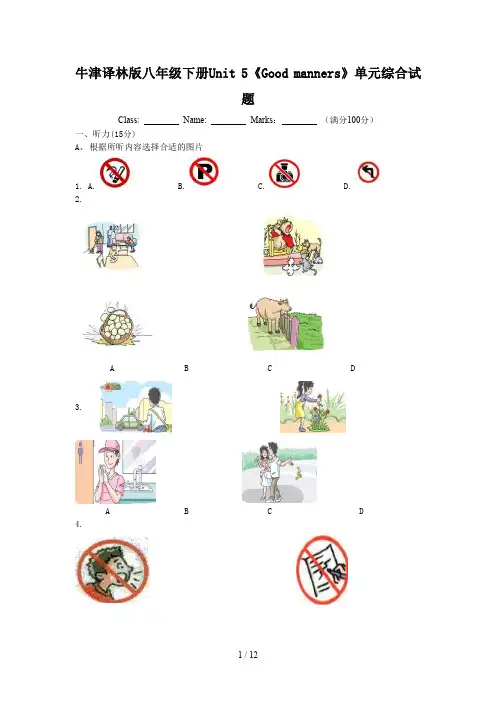
牛津译林版八年级下册Unit 5《Good manners》单元综合试题Class: Name: Marks:(满分100分)一、听力(15分)A、根据所听内容选择合适的图片1. A. B. C. D.2.A B C D3.A B C D4.A B C D5.A B C DB、根据问句选择正确的答语。
6 ( ). A. I hope so B. I’m afraid not C. Sorry, I won’t D. It’s nothing7 ( ) A Don’t say that. B You are too careless.C I’m sorry to hear that.D Don’t lose confidence.8 ( ) A It’s useless for you to study. B You’re never too old to learn.C It must be fun.D Just do as I tell you.9 ( ) A Sorry, I’m afraid not. B Yes, I am busy.C It doesn’t matter.D Certainly not.10 ( ) A It’s interesting. B They are polite and kind.C I like their good manners.D Glad to hear that.C、根据所听短文判断正误。
(正确的写T, 错误的写F)12 ( ) Body language is more important than words in our daily life.13 ( ) Sometimes we can know what other people are saying through body language.14 ( ) If he or she is interested in your subjects, he may look at eyes when talking.15 ( ) Someone who points at you while talking means he or she is happy with you.Ⅰ. 单项选择(每小题1分,共15分)( ) 16.— Would you please not speak so loudly in public?— Sorry. I will remember to speak in lower voice.A. the; aB. /; aC. the; theD. /; /( ) 17. Which of the following signs can you often see beside a lake?A. B. C. D.( ) 18. —Excuse me, sir. But you’re my way.—Sorry. I didn’t know you were passing by.A. onB. byC. withD. in( ) 19. The of new inventions should be to make life easier, not to make it harder.A. rulesB. subjectsC. secretsD. purposes( ) 20. I have spent on this job. I think I can finish it this afternoon.A. sometime; sometimeB. sometimes; some timeC. some time; sometimeD. some times; some time( ) 21. —Boy, didn’t you see people were waiting in line? Don’t in!— I am sorry, sir.A. pushB. pullC. putD. carry( ) 22. Jim always keeps the tap running he finishes washing his face.A. sinceB. whileC. asD. till( ) 23. — Sir, please put out your cigarette (香烟).— Sorry. I the sign.A. don’t noticeB. didn’t noticeC. haven’t noticedD. won’t notice( ) 24. Checking answe rs before handing in your paper can help you mistakes.A. makeB. provideC. avoidD. advise ( )25. You’d better repair the machine I have told you. Otherwise, you maymake more problems.A. likeB. withC. asD. follow ( )26. Jack is always to wait for a long time without getting angry.A. too patientB. patient enoughC. enough patientD. very patient( )27. I this free life on the land now although(尽管) I hate it .A. used to; used toB. used to; be used toC. am used, be used toD. am used to, used to( )28. There are many flowers and trees on ______ sides of the Century Road. A. each B. every C. both D. all( )29. — Do you think the question too hard ?—I don’t think so. He can answer it easily.A. of Jim to answerB. of Jim to answer itC. for Jim to answerD. for Jim to answer it( )30. — Mrs Green. Do you think I can get an “A” in the final exam if I start working hard now?— Of course. .A. Better late than neverB. Many hands make light workC. You cannot burn the candle at both sidesD. Actions speak louder than wordsⅡ. 完形填空(每小题1分,共10分)Today we are going to hold a talk ____31___ table manners. The purpose of the talk is ____32___ rules for eating. It will ____33____ at 10:00 on May 12th, at the scho ol hall. There ____34____ a lot of ____35____ on table manners. We hope you will find them useful. Above all, when you are sitting at the table , you should not start eating ____36___ everyone is ready. It’s ____37____ to make much noise while ____38___ or drinking. You should not eat with your mouth open or talk with food in your mouth. You should wait for everyone to finish _____39___. These ____40___( )31. A. about B. on C. of D. with( )32. A. to teach B. teaching C. teach D. teaches( )33. A. happen B. happened C. take place D. took place( )34. A. would be B. will have C. will be D. is going to have ( )35. A. tip B. idea C. worries D. advice( )36. A. after B. when C. as D. until( )37. A. impolite B. impatient C. impossible D. unnecessary( )38. A. reading B. eating C. waiting D. talking( )39. A. either B. recently C. instead D. finally( )40. A. places B. informatio n C. rules D. discussionsⅢ. 阅读理解(每小题1分,共10分)APerhaps you’ve seen the English letters “WC” in your city. They show public toilets. But do you know it is far from elegant(优雅的) English? In fact, foreigners from English-speaking countries rarely use the letters.Workers in our city are changing “WC” signs all over the city. The government is spending much money changing all the bad English on signs and restaurant menus. Many other places i n China are following our steps.“WC, or water closet, is old-fashioned English. It sounds dirty to me,” “Gents/Men” and “Ladies/Women”.“I see lots of poor English in everyday life, and not only on signs,” he says. “I know what they mean. But they are Chinglish, not real English. For example, when someone says to me ‘My hometown is Henan Province’, I know he should say: ‘My hometown is in Henan Province’. ‘Hometown’ is a smaller place in a province.”(通常的) mistakes include “Not Entry”, which should be “No Entry”, “Direction(方向) of Airport” should be changed to “To the Airport”. And it is “room rate(房价)”, not “room price”. And remember to “Keep off the grass”, rather than “Care of t he green”.( )41. What does the writer think of the use of “WC”?A. He doesn’t think it means water closet.B. He doesn’t think it old-fashioned English.C. He doesn’t think it proper for a sign.D. He thinks it elegant English.( )42. The underlined word “rarely” means .A. sometimesB. seldomC. often D . always( )43. Charlie Shifflet .A. is a Chinese living in AmericaB. thinks Chinese people are sometimes using incorrect EnglishC. likes to hear or see ChinglishD. sometimes uses Chinglish( )44. Which of the following signs does NOT use Chinglish(中国式英语)?A. B.C. D.( )45. The last paragraph is about .A. why there are so many Chinglish signsB. examples of ChinglishC. where Chinglish signs areD. who uses Chinglish signsBPeople use their mouths for many things. In the English language, there are many expressions using the word “mouth”. But some of them are not so nice.Sometimes, people say something to a friend or a family member. Later they regret because it hurts that person’s feelings. Or they tell the person something they didn’t mean(打算) to tell. The speaker might say: “I really put my foot in my mouth this time.”Sometimes when one person is speaking, he says the same thing that his friend is going to say. When this happens, the friend might say: “You took the words right out of my mouth!”Sometimes a person has a bad or sad experience with another person. He might s ay that experience “left a bad taste in my mouth.” Or the person possibly has a very frightening(可怕的) experience, like having an angry dog running after him. He might say: “I had my heart in my mouth.” Some people have lots of money because they were bo rn into a very rich family. You might say the person “was born with a silver spoon (银勺) in his mouth”. He is the opposite of a person living from “hand to mouth”. This person is very poor and only has enough money for the most important things in life, like food.( )46. The underlined word “regret” may mean .A. feel sorryB. feel excitedC. feel proudD. feelsurprised( )47. When a man says “I had my heart in my mouth”, usually he means he was .A. excitedB. afraidC. surprisedD. happy( )48. Your best friend Tony has said what you are going to say, you might say: “!”A. You were born with a silver spoon in your mouthB. You really put my foot in my mouthC. You really left a bad taste in my mouthD. You took the words right out of my mouth( )49. Tom says that he is living from hand to mouth. He means he is living a life.A. busyB. hardC. easyD. rich( )50. Which of the following might be the best title for this passage?A. Different Uses of MouthB. People and Their MouthsC. Expressions about MouthD. The Importance of MouthⅣ. 填空(每小题1分,共15分)A. 根据所给汉语意思或者首字母提示,用合适的单词填空。
牛津译林版八年级英语下册 Unit 5 Good manners 单元测试题
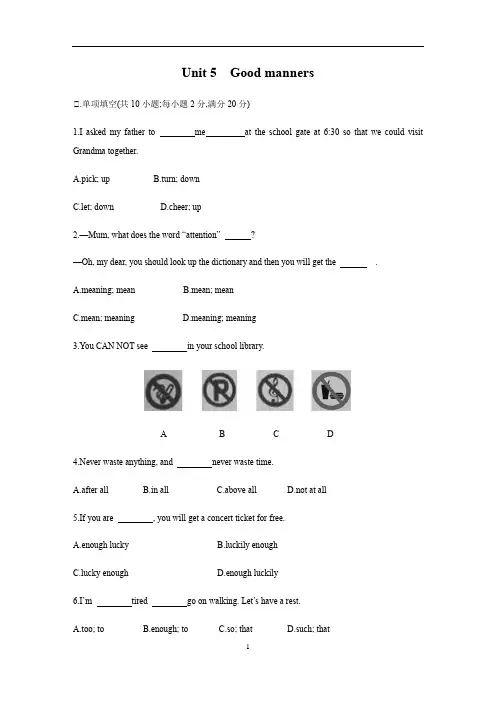
Unit 5Good mannersⅠ.单项填空(共10小题;每小题2分,满分20分)1.I asked my father to me at the school gate at 6:30 so that we could visit Grandma together.A.pick; upB.turn; downC.let; downD.cheer; up2.—Mum, what does the word “attention” ?—Oh, my dear, you should look up the dictionary and then you will get the .A.meaning; meanB.mean; meanC.mean; meaningD.meaning; meaning3.You CAN NOT see in your school library.A B C D4.Never waste anything, and never waste time.A.after allB.in allC.above allD.not at all5.If you are , you will get a concert ticket for free.A.enough luckyB.luckily enoughC.lucky enoughD.enough luckily6.I’m tired go on walking. Let’s have a rest.A.too; toB.enough; toC.so; thatD.such; that7.—Why doesn’t the surgeon stop lunch?—Because he is busy a dying patient in the operation room.A.to have; to saveB.having; to saveC.to have; savingD.having; saving8.The headmaster warns us the school rules, or we’ll be punished.A.to breakB.not to breakC.breakingD.don’t break9.They built a wall to soil being washed away.A.makeB.provideC.avoidD.advise10.—I have spent several nights preparing for the coming exam.—It’s bad for you to stay up too late. As the saying goes, “”A.You are never too old to learn.B.Actions speak louder than words.C.You can’t burn the candle at both ends.D.You can’t put all your eggs in one basket.Ⅰ.完形填空(共15小题;每小题2分,满分30分)“Today I will give you a special test,” said the English teacher with a smile on his face.All the students sat up straight and 11for the test to begin. The teacher began to 12 the test papers to all the students. 13he finished handing out the test papers, he asked them to begin.The students were very 14to see that there was not a question but a black dot(圆点) in the centre of the paper. The teacher 15the students’ surprise and said, “I want you to 16 down what you see there.”At the end of the class, the teacher took all the students’ answer sheets(答题纸) and read the answers. 17of them described the black dot. After reading all the answers, the teacher said, “Here everyone only paid attention to the black dot, 18no one wrote about the white paper.” The whole class listened 19, because they were afraid to fail in the exam.Then the teacher said, “Don’t worry about your 20for this test. I just want you to think about our life. The white paper is like our whole life and the black dot in the centre of the paper 21problems in our daily life.”Our life is a 22given to us by God(上帝), with love and care. 23, we just pay attention to the problems like illnesses and poverty(贫穷), and never see that these problems are very 24compared with everything else we have in our life.So we should try to take our eyes off our problems and 25each moment life gives us.11.A.searched B.looked C.voted D.waited12.A.email B.sell C.give D.donate13.A.After B.Before C.Until D.While14.A.happy B.surprised C.excited D.sad15.A.forgot B.remembered C.noticed D.hated16.A.talk B.write C.hear D.learn17.A.All B.None C.Some D.Many18.A.because B.although C.if D.but19.A.silently B.angrily C.happily D.quickly20.A.presents B.marks C.suggestions D.tasks21.A.helps B.finds C.represents D.solves22.A.problem B.gift C.moment D.door23.A.Still B.Also C.Besides D.Then24.A.serious B.big C.small D.important25.A.refuse B.stop C.waste D.enjoyⅠ.阅读理解(共5小题;每小题2分,满分10分)Few words are spoken more often every day on the streets of Britain than “I’m sorry”. This phrase has become such a common response (反应) that it has taken on a lot of meanings.Saying “Sorry” means to apologize(道歉). This is simple and easy to understand. We learn it both as a native speaker and as a student of foreign languages.But in Britain, it takes on another meaning. It is a cultural expression. Imagine this: a man walks down the street, looking down at his phone. A woman is walking in the opposite direction, towards the man. She sees him, but she can’t get out of the way in time. The man bumps(碰撞) into the woman. Who should say sorry? Naturally, the man should say sorry, because it was he who wasn’t looking where he was going. Yet in Britain, it is common for both to apologize.It is known that British people, like most people, do not enjoy conflict(冲突). So to quickly calm the situation, British people will apologize to each other.Other times it may sound funny to hear “sorry”. Some of my friends say it at restaurants, as they ask the waiter, “Sorry, but can I order another drink?” It is not to apologize, but just to express that we need the waiter. In Britain, sorry doesn’t always mean exactly what you think.26.According to the passage, “saying sorry” is a cultural expression in .A.the USAB.the UKC.the WWFD.the UN27.What does the underlined phrase “take on” mean in Paragraph 1?A.从事B.雇佣C.呈现D.拿起28.The example in the third paragraph is used to .A.describe a situation that people should avoidB.describe how “sorry” has another meaning in BritainC.explain why people should say sorry to each otherD.show how polite British people are29.The restaurant example shows that “sorry” can be used to .A.apologizeB.calm a situation downC.explain what you’re thinking aboutD.ask a waiter to bring something30.What might be a good title for the passage?A.“I’m Sorry” Is More Than just an ApologyB.Traditional British MannersC.How to Best Catch Others’ AttentionD.Finding a Way out of a Difficult SituationⅠ.用所给单词的适当形式填空(共5小题;每小题2分,满分10分)31.We’d better not leave rubbish (care) in order to protect the environment in the tourist attractions.32.Jim (call) you as soon as he gets to Beijing.33. Daniel was too nervous to express (he) clearly at that time.34. When you talk with an Englishman, you should avoid (ask) about his family.35. It’s very important to get to the heart of the (discuss).Ⅰ.根据汉语意思完成句子(共5小题;每小题2分,满分10分)36.戴维花了许多时间给我们解释这些交通规则。
牛津译林版八年级英语下册Unit5Goodmanners单元综合测试卷
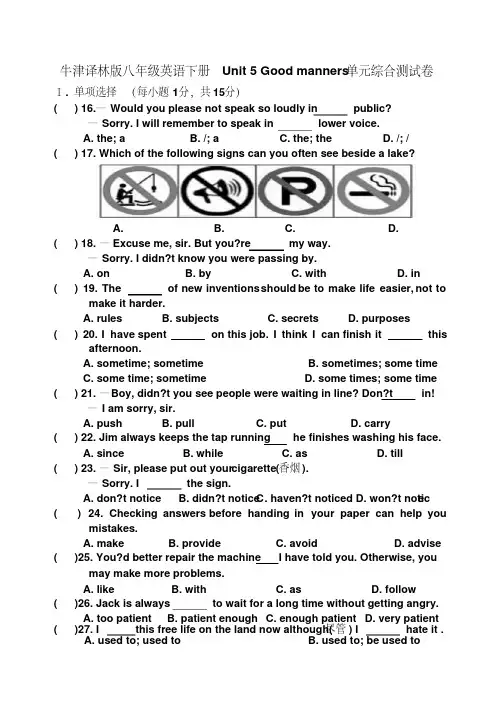
牛津译林版八年级英语下册Unit 5 Good manners单元综合测试卷Ⅰ. 单项选择(每小题1分,共15分)( ) 16.— Would you please not speak so loudly in public?— Sorry. I will remember to speak in lower voice.A. the; aB. /; aC. the; theD. /; /( ) 17. Which of the following signs can you often see beside a lake?A. B. C. D.( ) 18. —Excuse me, sir. But you?re my way.—Sorry. I didn?t know you were passing by.A. onB. byC. withD. in ( ) 19. The of new inventions should be to make life easier, not to make it harder.A. rulesB. subjectsC. secretsD. purposes( ) 20. I have spent on this job. I think I can finish it this afternoon.A. sometime; sometimeB. sometimes; some timeC. some time; sometimeD. some times; some time ( ) 21. —Boy, didn?t you see people were waiting in line? Don?t in!— I am sorry, sir.A. pushB. pullC. putD. carry( ) 22. Jim always keeps the tap running he finishes washing his face.A. sinceB. whileC. asD. till( ) 23. — Sir, please put out your cigarette (香烟).— Sorry. I the sign.eA. don?t noticeB. didn?t noticeC. haven?t noticedD. won?t notic ( ) 24. Checking answers before handing in your paper can help you mistakes.A. makeB. provideC. avoidD. advise ( )25. You?d better repair the machine I have told you. Otherwise, you may make more problems.A. likeB. withC. asD. follow ( )26. Jack is always to wait for a long time without getting angry.A. too patientB. patient enoughC. enough patientD. very patient ( )27. I this free life on the land now although(尽管) I hate it .A. used to; used toB. used to; be used toC. am used, be used toD. am used to, used to( )28. There are many flowers and trees on _____ sides of the Century Road.A. eachB. everyC. bothD. all( )29. — Do you think the question too hard?—I don?t think so. He can answer it easily.A. of Jim to answerB. of Jim to answer itC. for Jim to answerD. for Jim to answer it( )30. —Mrs Green. Do you think I can get an “A” in the final exam if I start working hard now?— Of course. .A. Better late than neverB. Many hands make light workC. You cannot burn the candle at both sidesD. Actions speak louder than wordsⅡ. 完形填空(每小题1分,共10分)Some people bring out the best in you in a way that you might never have fully realized on your own. My mom was one of those people.My father died when I was nine months old, making my mom a singlemother at the age of eighteen. While I was growing up, we lived a very 1life. We had little money, but my mom gave me a lot of love. Each night, she satme on her lap and spoke the words that would ___2____ my life, “Kemmons, you are certain to be a great man and you can do anything in life ifyou work hard enough to get it.”At fourteen, I was hit by a car and the doctors said I would never 3again. Every day, my mother spoke to me in her gentle, loving ____4___, tellingme that no matter what those doctors said, I could walk again if I didn?t wantto be bad enough. She drove that message ___5___deep i nto my heart that Ifinally believed her. A year later, I returned to school-walking on my own!When the Great Depression(大萧条)hit, my mom lost her job. Then I leftschool to support __6__ of us. At that moment, I decided never tobe____7_____again.Over the years, I experienced various(不同类别的)levels of business success. But the real turning point happened on a vacation I took with my wifeand five kids in 1916. I was unhappy with the second-class hotels for familiesand was ____8_____ that they charged(收费)an extra(额外的)$2 for eachchild. That was too 9 for most American families. I told my wife that Iwas going to open a hotel for families that would never charge extra for 10 .There were plenty of doubters at that time.Not 11 , mom was one of my strongest s upporters. She worked behind thedesk and even designed the room style. As in any business, we experienced a lot(扎根)in my heart, Iof hard time. But with my mother? s words deeply rooted12 doubted(怀疑)we would succeed. Fifteen years later, we had the largest13 system in the world - Holiday Inn . In 1979 my company had 1,759 inns(客栈)in more than fifty countries with an income of $1 billion a year.You may not have started out life in the best situations. But if you can find a14 in life worth working for and believe in yourself, 15 can stop you.( )1. A. quiet B. boring C. hard D. strange( )2. A. accept B. change C. disturb D. check( )3. A. study B. speak C. listen D. walk( )4. A. voice B. sound C. noise D. talk( )5. A. so B. such C. very D. quite( )6. A. all B. both C. every D. most( )7. A. excited B. brave C. patient D. poor( )8. A. sad B. happy C. tired D. angry( )9. A. expensive B. fantastic C. different D. special( )10. A. husband B. parents C. children D. wife( )11. A. successfully B. surprisingly C. interestingly D. importantly( )12. A. always B. sometimes C. almost D. never( )13. A. restaurant B. theatre C. library D. hotel( )14. A. task B. hotel C. company D. word( )15. A. nothing B. everything C. something D. anythingⅢ. 阅读理解(每小题1分,共10分)APerhaps you?ve s een the English letters “WC” in your city. They showpublic toilets. But do you know it is far from elegant(优雅的) English? In fact,foreigners from English-speaking countries rarely use the letters.Workers in our city are changing “WC” signs all over the city. The government is spending much money changing all the bad English on signs and restaurant menus. Many other places in China are following our steps.“WC, or water closet, is old-fashioned English. It sounds dirty to me,” says Charlie Shifflet, a young man from the US. The old sign will become“Gents/Men” and “Ladies/Women”.“I see lots of poor English in everyday life, and not only on signs,”“I know what they mean. But they are Chinglish, not real English. For example,when someone says to me ,My hometown is Henan Province?, I know he shouldsay: ,My hometown is in Henan Province?. ,Hometown? i s a smaller place in a province.” The common(通常的) mistakes i nclude “Not Entry”, which shouldshould be changed to “To thebe “No Entry”, “Direction(方向) of Airport” Airport”. And it is “room rate(房价)”, not “room price”. And remember torather than “Care of the green”.“Keep off the grass”,( )41. What does the writer think of the use of “WC”?A. He doesn?t think it means water closet.B. He doesn?t think it old-fashioned English.C. He doesn?t think it proper for a sign.D. He thinks it elegant English.( )42. The underlined word “rarely” means .A. sometimesB. seldomC. often D . always( )43. Charlie Shifflet .A. is a Chinese living in AmericaB. thinks Chinese people are sometimes using incorrect EnglishC. likes to hear or see ChinglishD. sometimes uses Chinglish( )44. Which of the following signs does NOT use Chinglish(中国式英语)?A. B.C. D.( )45. The last paragraph is about .A. why there are so many Chinglish signsB. examples of ChinglishC. where Chinglish signs areD. who uses Chinglish signsBPeople use their mouths for many things. In the English language, there aremany expressions using the word “mouth”. But some of them are not so nice.Sometimes, p eople say something to a friend or a family member. Laterthey regret because it hurts that person?s feelings. Or they tell the person something they didn?t mean(打算) to tell. The speaker might say: “I really put my foot in my mouth this time.” Sometimes w hen one person is speaking, he says the same thing that hisfriend is going to say. When this happens, the friend might say: “You too words right out of my m outh!” Sometimes a person has a bad or sad experiencewith another person. He might say that experience “left a bad taste in myfrightening (可怕的) experience, like mouth.” Or the person possibly has a veryhaving an angry dog running after him. He might say: “I had my heart in my Some people have lots of money because t hey were born into a very mouth.” silver spoon (银勺) inrich family. You might say the person “was born with ahis mouth”. He is the opposite of a person living from “hand to mouth”. person is very poor and only has enough money for the most important thingsin life, like food.( )46. The underlined word “regret” may mean .A. feel sorryB. feel excitedC. feel proudD. feel surprised( )47. When a man says “I had my heart in my mouth”, usually he means he was .A. excitedB. afraidC. surprisedD. happy( )48. Your best friend Tony has said what you are going to say, you might say: “!”A. You were born with a silver spoon in your mouthB. You really put my foot in my mouthC. You really left a bad taste in my mouthD. You took the words right out of my mouth( )49. Tom says he?s living from hand to mouth. He means he is living a life.A. busyB. hardC. easyD. rich( )50. Which of the following might be the best title for this passage?A. Different Uses of MouthB. People and Their MouthsC. Expressions about MouthD. The Importance of MouthⅣ. 填空(每小题1分,共15分)A. 根据所给汉语意思或者首字母提示,用合适的单词填空。
Unit5 Good manners单元检测卷(有答案) 牛津译林版英语八年级下册
牛津译林版八年级下册Unit5 Good manners单元检测一、单项选择。
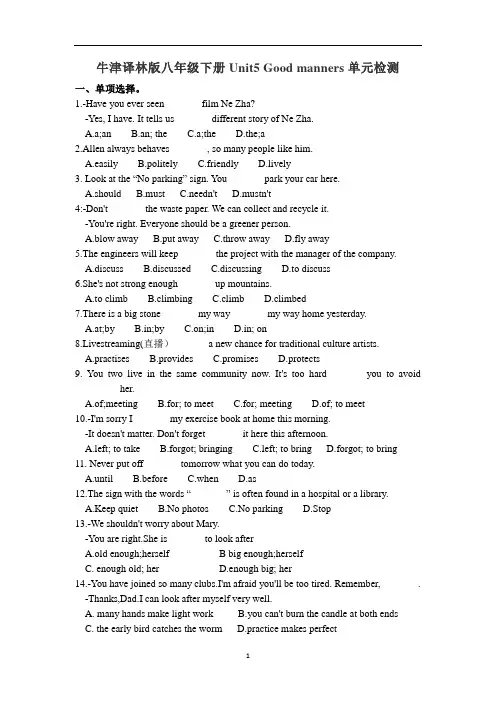
1.-Have you ever seen _______film Ne Zha?-Yes, I have. It tells us _______different story of Ne Zha.A.a;anB.an; theC.a;theD.the;a2.Allen always behaves _______, so many people like him.A.easilyB.politelyC.friendlyD.lively3. Look at the “No parking” sign. You _______park your car here.A.shouldB.mustC.needn'tD.mustn't4:-Don't _______the waste paper. We can collect and recycle it.-You're right. Everyone should be a greener person.A.blow awayB.put awayC.throw awayD.fly away5.The engineers will keep _______the project with the manager of the company.A.discussB.discussedC.discussingD.to discuss6.She's not strong enough _______up mountains.A.to climbB.climbingC.climbD.climbed7.There is a big stone _______my way _______my way home yesterday.A.at;byB.in;byC.on;inD.in; on8.Livestreaming(直播)_______a new chance for traditional culture artists.A.practisesB.providesC.promisesD.protects9. You two live in the same community now. It's too hard _______you to avoid _______her.A.of;meetingB.for; to meetC.for; meetingD.of; to meet10.-I'm sorry I _______my exercise book at home this morning.-It doesn't matter. Don't forget _______it here this afternoon.A.left; to takeB.forgot; bringingC.left; to bringD.forgot; to bring11. Never put off _______tomorrow what you can do today.A.untilB.beforeC.whenD.as12.The sign with the words “_______” is often found in a hospital or a library.A.Keep quietB.No photosC.No parkingD.Stop13.-We shouldn't worry about Mary.-You are right.She is _______to look after _______A.old enough;herself B big enough;herselfC. enough old; herD.enough big; her14.-You have joined so many clubs.I'm afraid you'll be too tired. Remember, _______. -Thanks,Dad.I can look after myself very well.A. many hands make light workB.you can't burn the candle at both endsC. the early bird catches the wormD.practice makes perfect15.-Must I wear the school uniform on school days?- _______. It's one of the school rules.A. It's beautifulB.I don't think soC.I'm afraid soD.It fits you well二、完形填空。
牛津译林版八年级下册第五单元Good manners综合测试卷(有答案)
一、根据句意和汉语提示,在空白处填入一个适当的单词。
1.Just when I was ready to leave the __________ (停车)place, another car crashed into mine.2.To _________ (避免)the heavy traffic,he goes to work early and drives home late.3.Do you know the saying "Practice makes _________ (完美的)"?4.There is ________ (垃圾)everywhere; you should do some cleaning.5.-Come on,Sandy.Everybody will be lucky or ________ (成功的)sometime in his life.-Thanks. I'll try again.6.The boy wants to choose one of his favourite __________ (话题)to talk about.7.The boy!s mother always uses a morning _________ (亲吻)to wake him up.8.Please make everything in its _________ (适当的)place.9.He lighted a _________ (蜡烛)and walked into the dark room.10.My mum was very _________ (亲密的)to Judy's. I heard they used to be classmates.11.The man has good manners, and he is waiting at the gate __________ (礼貌土也)。
牛津译林版八年级下册Unit 5《Good manners》综合测试
牛津译林版八年级下册Unit 5《Good manners》综合测试一. 单项选择(每小题1分,共15分)( ) 1.— Would you please not speak so loudly in public?— Sorry. I will remember to speak in lower voice.A. the; aB. /; aC. the; theD. /; /( ) 2. Which of the following signs can you often see beside a lake?A. B. C. D.( ) 3. —Excuse me, sir. But you’re my way.—Sorry. I didn’t know you were passing by.A. onB. byC. withD. in( ) 4. The of new inventions should be to make life easier, not to make it harder.A. rulesB. subjectsC. secretsD. purpose s( ) 5. I have spent on this job. I think I can finish it this afternoon.A. sometime; sometimeB. sometimes; some timeC. some time; sometimeD. some times; some time( ) 6. —Boy, didn’t you see people were waiting in line? Don’t in!— I am sorry, sir.A. pushB. pullC. putD. carry( ) 7. Jim always keeps the tap running he finishes washing his face.A. sinceB. whileC. asD. till( ) 8. — Sir, please put out your cigarette (香烟).— Sorry. I the sign.A. don’t noticeB. didn’t noticeC. haven’t noticedD. won’t notice( ) 9. Checking your answers before handing in your paper can help you mistakes.A. makeB. provideC. avoidD. advise( )10. You’d better fix the machine I have told you. Otherwise, you may make more problems.A. likeB. withC. asD. follow( )11. Jack is always to wait for a long time without getting angry.A. too patientB. patient enoughC. enough patientD. very patient ( )12. —You’ve spelt the word wrong again, Judy.—Sorry. Maybe I am used to the mistake to think of the right one.A. soB. veryC. quiteD. too( )13. — Mum, can you give me some advice on how to behave myself at the table?— Well, I do have some advice. , please keep quiet while eating.A. In al lB. Of allC. At allD. Above all( )14. — Do you think the question too hard ?—I don’t t hink so. He can answer it easily.A. of Jim to answerB. of Jim to answer itC. for Jim to answerD. for Jim to answer it( )15. —Mrs Green. Do you think I can get an “A” in the final if I start working hard now?— Of course..A. Better late than nev erB. Many hands make light workC. You cannot burn the candle at both sidesD. Actions speak louder than words二. 完形填空(每小题1分,共10分)Pearl necklaces (珍珠项链) are very beautiful. Can you believe that t hese shining pearls 16 a kind of lit tle animal named oyster? The animal lives in a shell (壳), deep down at the bottom 17 the sea. 18 do these beautiful pearls form (形成) inside an oyster? A grain (颗粒) of sand enters an oyster’s shell. Thi s makes the oyster 19 . Just as 20 some dustenters your eyes, your eyes will water and the tears (眼泪) from your eyes will try to 21 out the dust!But when a grain of sand enters an oyster’s shell, it can’t wash it out. 22 , the oyster’s body keeps building a white 23 “coat” around the annoying sand. The coat covers the sand and 24 that makes a pearl.Today people raise pearls on a pearl farm. Th ey 25 the oysters’ shells softly and place some sand inside them. When a pearl is made, people get it out again. ( )16. A. turn into B. take in C. get married( )17. A. for B. of C. on D. over( )18. A. How B. Where C. Why D. What( )19. A. happy B. shy C. upset D. silly( )20. A. before B. when C. unless D. though( )21. A. wash C. pull D. throw( )22. A. Inside B. Perhaps C. Instead D. Besides( )23. A. dirty B. serious C. shining D. dangerous( )24. A. typically B. recently C. suddenly D. finally( )25. A. break B. open C. save D. protect三. 阅读理解(每小题1分,共10分)APerhaps you’ve seen the English letters “WC” in your city. They show public toilets. But do you know it is far from elegant(优雅的) English? In fact, foreigners from English-speaking countries rarely use the letters.Wor kers in our city are changing “WC” signs all over the city. The government is spending much money changing all the bad English on signs and restaurant menus. Many other places in China are following our steps.“WC, or water closet, is old-fashioned English. It sounds dirty to me,” “Gents/Men” and “Ladies/Women”.“I see lots of poor English in everyday life, and not only on signs,” he says. “I know what they mean. But they are Chinglish, not real English. For example, when someone says to me ‘My hometown is Henan Province’, I know heshould say: ‘My hometown is in Henan Province’. ‘Hometown’ is a smaller place in a province.” “Not Entry”, which should be “No Entry”, “Direction of Airport” should be changed to “To the Airport”. And it is “room rate”, not “room price”. And remember to “Keep off the grass”, rather than “Care of the green”. ( )26. What does the writer think of the use of “WC”?A. He doesn’t think it means water closet.B. He doesn’t think it old-fashioned English.C. He doesn’t think it prope r for a sign.D. He thinks it elegant English.( )27. The underlined word “rarely” means .A. sometimesB. seldomC. oftenD. always( )28. Charlie Shifflet .A. is a Chinese living in AmericaB. thinks Chinese people are sometimes using incorrect EnglishC. likes to hear or see ChinglishD. sometimes uses Chinglish( )29. Which of the following signs does NOT use Chinglish?A. B.C. D.( )30. The last paragraph is about .A. why there are so many Chinglish signsB. examples of ChinglishC. where Chinglish signs areD. who uses Chinglish signsBPeople use their mouths for many things. In the English language, there are many expressions using the word “mouth”. But some of them a re not so nice.Sometimes, people say something to a friend or a family member. Later they regret because it hurts that person’s feelings. Or they tell the person something they didn’t mean to tell. The speaker might say: “I really put my foot in my mouth this time.”Sometimes when one person is speaking, he says the same thing that his friend is going to say. When this happens, the friend might say: “You took the words right out of my mouth!”Sometimes a person has a bad or sad experience with another person. He might say that experience “left a bad taste in my mouth.” Or the person possibly has a very frightening(可怕的) experience, like having an angry dog running after him. He might say: “I had my heart in my mouth.”Some people have lots of money because they were born into a very rich family. You might say the person “was born with a silver spoon (银勺) in his mouth”. He is the opposite of a person living from “hand to mouth”. This person is very poor and only has enough money for the most important things in life, like food.( )31. The underlined word “regret” may mean .A. feel sorryB. feel excitedC. feel proudD. feel surprised ( )32. When a man says “I had my heart in my mouth”, usually he means he was .A. excitedB. afraidC. surprisedD. happy( )33. Your best friend Tony has said what you are going to say, you might say: “!”A. You were born with a silver spoon in your mouthB. You really put my foot in my mouthC. You really left a bad taste in my mouthD. You took the words right out of my mouth( )34. Tom says that he is living from hand to mouth. He means he is living a(n) life.A. busyB. hardC. easyD. rich( )35. Which of the following might be the best title for this passage?A. Different Uses of MouthB. People and Their MouthsC. Expressions about MouthD. The Importance of Mouth四. 填空(每小题1分,共15分)A. 根据所给汉语或英文提示,用合适的单词填空。
【牛津译林版】八年级英语下册《Unit5Goodmanners》单元综合测试
《Unit 5 Good manners 》一、词形变换或根据汉语提示填入合适的单词:(io分)1. People in our country often queue ______________ (patient) while waiting in public places.2. Mrs Lin is too busy _ (expla in) any of the long sentences right now.3. To play won derfully tomorrow, she is try ing her best to practice ______ (play) thevioli n.4. It ' s a long way ,so it ' s necessary for us to take turns ______________ (drive)5. We should stop the pollutio n _____________ (live) a happier life now.6. If you don' t warm up before taking exercise, you will risk ____________________ (hurt) yourself.7. The museum is ope n to the ________ ( 民众)at the weeke nd8. He didn ' t know the ______ _____ (话题,主题)about the report9. We should wait for our turns to get on the bus ( _____ 礼貌地).10. The boy had a ______ ( 疼痛)in his head and had to see a doctor.二、单项选择:( —( )1. ___ is really hard for them to climb so high.A This__B ItC . ThatD . What( )2. The ______ of new inven ti ons should be to make life easier, not to make it harder.A. rulesB. subjectsC. secretsD. purposes( )3. I have spe nt ______ on this job. I think I can finish it ______ t hisafter noon.A. sometime; sometimeB. sometimes; some timeC. some time; sometimeD. some times; some time( )4. —Sir, please put out your cigarette ( 香烟). —Sorry. I _____ the sig n.A. don ' t no tic eB. did n ' t no ticeC. have n ' t no ticedD. won' tn otice( )5. Check ing your an swers before handing in your paper can help you ___ mistakes.A. makeB. provideC. avoidD. advise( )6. Jack is always ____ to wait for a long time without gett ing an gry.A. too patie ntB. patie nt eno ughC. eno ugh patie ntD. very patie nt( )7. —Mum, can you give me some advice on how to behave myself at the table?—Well, I do have some advice. _______ , please keep quiet while eat ing.A. After allB. Of allC. At allD. Above all( )8. —Do you think the question too hard __ ? —I don ' t thi nk so. He can an swer it easilyA. of Jim to an swerB. of Jim to an swer itC. for Jim to 「an swerD. for Jim to an swer it( )9. There used to be a small pretty river ______ . Now it has turned into tall build in gs.A. at a timeB. all the timeC. at one timeD. from time to time( )10. Remember, boys and girls, _____________ you work, ________ result you will get.A. the better; the harderB. the harder; the goodC. the hard; the betterD. the harder; the better( )11. The film is ________ i n terest ing ___ everyone in our school wants to see it.A. too; thatB. so; thatC. such; thatD. eno ugh; to( )12. The room is __________ small for us _______ .A. so; to live inB. too; to liveC. too; to live inD. so; to live( )13. —You' ve spelt the word wrong aga in, Judy.—Sorry. Maybe I am _____ used to the mistake to think of the right one.A. soB. veryC. quiteD. too( )14. I found her greatly _________ after watchi ng the _____TV programme.A. excited; excitedB. excit ing; excitedC. excit ing; excit ingD. excited; excit ing( )15. —You didn ' t catch the train, did you?— _____ , though I tried my best to get there on time.A. No, I didn ' tB. Yes, I didC. No, I didD. Yes, I didn ' t三、完形填空:(15分)Sometimes you may envy(嫉妒)others when they do a ______ 1__ job than you. It is not strange.If you treat envy in a right way, it can __ 2__ you to move ahead. But if you are always __3__others, the n it is __ 4 __ , because much envy may make you __ 5__ your own life in the end and you have __6 __ time to do somethi ng you are good at. __ 7 __ do you waste time to envy others? Envy _8 ____ cannot cha nge anything. Why not spe nd more time and try your best to __ 9__others? It is up to you. Of course it is easier said than__10__. Maybe you hope not to envy others, to do it, Maybe you tried many times but (制定目标)for 13 , and work hard to realize Whenyou __ it is also very ()1.A bad _ ()2.A. stop ()3. A. movi ng ()4. A. Lucky ()5. A. have ()6. A. much ()7. A. What ()8. A. Them ()9. A. catch ()10. A. thought B. made ()11. A. know ()12. A. No B. less C. hardly ()13. A. others B. the others C. You D. yourself ()14. A. are happy B. work hard C. succeed D. fail aga in ()15. A. possible B. importa nt C. useless D. dan gerous 四、阅读理解:(20分) 12 failed. it. any 13 14 __ , you don ' t need to envy others __15 ___ t o you. B.good B. help C. make B. help ing C. envying D. Stopp ing B. good C.da ngerous D. badly C. lose C. a little C. Why C. themselves B. to have B. more B. When C. worse B. it B. catch up with( C. stopped B. don ' t know but you ___ 11__how Please don ' t lose heart. Set a goal Then you have no time to envy others, more, Isn ' t it true? Believe yourself, D. better D. let D. to lost D. no D. How D. itself 赶上)C. fall behi nd D. help D.done C. wan ted to know D. really knew D. Always (A) On a hot African( 非洲)morning, Leila was lying on her stomach and an elephant was walk ing towards her. Leila waited. Then she pushed the butt on ( I got my best photo of an elephant ever, by lying under my car, ” to get close to the elephants, but of course this was dangerous; they had their babies with 按钮)on her camera. “And Leila expla in ed. “ I wan ted them. So every morning I used to park my car in the ope n air n ear the path. They used to take the same path every morning when they left the water hole. After a week, they were used to see ing my car. So the n ext m ornin g, I lay un der it and got my photo! ” Many of the best wildlife photos come from good planning. In Africa, photographers (摄影师)set up their hides near water holes. They also set up hides near forest paths, as animals use the same paths every night. For bird-watching, many lakes have hides. the hides, bird-watchers can watch all day out of the wind and rain. Good wildlife photos are n eeded for books, postcards, magaz ines and n ewspapers. But a success rate of 1 in 20 is good. ( In side )1.Leila got her best photo of an elepha nt __________ . A. n ear a lake B. un der her car C. in a hole D. in side the hides )2.Photographers in Africa set up hides n ear forest paths, because __________ .A. ani mals take the same pathsB. the hi r des are out of the wind and rainC. they must park their cars thereD. the paths are safe for them)3. Which of the followi ng is true?A. The success rate of taking wildlife photos is 50% at most.B. The elepha nt was frighte ned whe n she saw Leila.C. Bird-watchers usually watch birds n ear forest paths in Africa.D. About 5% of good wildlife photos will be accepted by a magaz ine. )4. How can photographers take good photos from the passage? A By making good preparatio n. B. By using a good camera. C. By sett ing their hides . D. By lying un der the cars. )5. What does the un derli ned word hides mean?A.隐匿处 In most cultures it is usual to greet she first arrived , school one day , she 洞穴 住所 C. 帐篷 (B ), when you meet people you know for the first time during a day them .Once a young woman from England went to Hong Kong to work she knew little about the Chin ese culture of Ian guage B. D. .When . On her way to went to a bank to get some money. To her surprise , the bank clerk asked her if she had had her lunch . She was surprised at such a question because in the British culture it would mean an invitation to lunch . Between unmarried young people it can also mean the young man's interest in dating ( 禾口... 约会)the girl . Since this bank clerk wasa stranger to the British woman , she was very puzzled , and quickly answered that she had eaten already . After this she went on to school and was even more surprised when one of the teachers asked her the same questi onBy now she understood that it could not be an invitation but was puzzled (困惑的)about why they asked it . In the following days, she was asked the same question again and again and she spent many hours trying to work out why so many people kept asking her this . At last she thought that these people must be concerned about (关心)her health . She was rather thin at the time , and she thought they must be worrying that she was not eating well! In fact, the questi on like that has no real meaning at all ——it is only a greeti ng ()6.Accord ing to the writer, whe n we meet a stra nger, it is ___to greet him or her. A. in terest ing B. com mon C. importa nt D. gen erous ()7.From the passage, we can know that the writer knowA. a lot ()8 」n China, a stra nger will sayA. How are you? D. Nice to meet you? () 9.ln the writer ' s opinion,B. a little a ___ about Chin ese culture.C. littleD. much when he meets you for the first time. B. How do you do? D. Have you had lunch? the Chinese greeting for the first time means “ A. popular B. meanin gful C. manners D. in vitati on ()10. The writer ' s main purpose in writing this passageA. show himself to be in terested in Chin ese greeti ngB. advise people to follow the Chin ese greet ingC. compla in about ( 抱怨)the Chin ese greeti ngsD. point out the differe nces of the greeti ngs betwee n the differe nt cultures五、任务型阅读(共l0空;每空I 分,计10分) Writi ng a tha nk-you letter can be a great way to express tha nks for a favor ( 恩惠)some one did for you. Con sider ( 考虑)the follow ing steps whe n writi ng your letter,which will help make your thank-you letter more meaningful and sincere ( 真诚的).Before you start, buy some special stati on ery, such as nice paper or bla nk cards. The since even one-dollar card can be very nice. And or (是..还是...) write it by yourself. while a printed (打印的) thank-you letter looks is most probably to 帮助; stationery doesn ' t have to be expensive, you must decide whether you prefer to type your letter Handwriting has a more personal feeling, more professi on al ( 专业的). Now, you can start writing. You should express your purpose from the beginning. Start your letter by thanking the person for the gift or service he or she provided. Then you should ex plain how you plan to use the gift or service, or explain how the gift or service has already been used. What' s more, you can also express your feelings on the gift or service by say ing that “ It was a won derful birthday prese nt …” It also helps to men ti on a pers onal feeling such as “I was just so happy with the party. ” In the end, you should mention that you want to see or talk to the pers on aga in soon. For close relatives and frien ds, you can also tell them how much you miss them and express regret ( 遗憾)that their Sign your tha nk- you letter pers on ally or “Take care ” In this way, you will always maintain ( friends and relatives. and with a heart. Try Love in stead ( 代替)of “ Sin cerely ” as it is more for bus in ess. 维持)a pleasant relationship ( visit was short. “Yours truly ” 关系)with your 1 ______ 23 4 ______ 5 ___________ 6 ______ 7 8 9 ______ 10六、短文填空:阅读下面的短文,根据所给首字母提示,用合适的单词填空。
牛津译林版八年级下册 Unit5 Good manners 单元测试卷
8B Unit5 Good manners单元测试卷前进中学一、单项选择(每小题1分,满分10分)1. The second Sunday of May is _____ Mother's Day. It's _____ special day for children to show their love for their mothers.A. a;theB. the; aC. /;aD. /; the2. -He's already been back from Japan, ______? -______. He is on a visit to Shenzhen.A. isn't he; NoB. hasn't he; YesC. isn't he; YesD. hasn't he; No3. —Boy, didn’t you see people were waiting in line? Don’t______ in!—I am sorry, sir.A. pushB. pullC. putD. carry4. -Could you look after my pet dog for me while I am away? - _______.A. No, thanksB. It's my pleasureC. I'm sure you willD. With pleasure5. 一You've spelt the word wrong again, Judy.一Sorry. Maybe I am ______ used to the mistake to think of the right one.A. soB. veryC. quiteD. too6. Checking your answers before _______ in your paper can help you ______ mistakes.A. handing; makeB. hand; makingC. handing; avoidD. hand; avoiding7. Jack is ______funny_______ make us happy after class.A so; thatB too; toC / ; enough toD enough; to8. The room is ______ small for us ______.A. so; to live inB. too; to liveC. too; to live inD. so; to live9. Checking your answers before handing in your paper can help you _____ mistakes.A. avoidB. provideC. makeD. advise10. I have spent ______ on this job. I think I can finish it ______ this afternoon.A. some time; sometimeB. sometimes; some timeC. sometime; sometimesD. some times; some time二、完型(每小题1分,满分10分)Do you know a little boy named Ryan Wang? If not, let me introduce him to you. Ryan Wang is from Vancouver, Canada. He made a 1 for himself with his fantastic music talent. On The Ellen Show, his 2 skills made everyone surprised. And then the talented and cute boy 3 became very popular and famous. People started to 4 him piano genius (天才). The small pianist gave a performance at the famous Carnegie Hall in March, 2013. He was only five years old then. When Ellen asked how he 5 playing at Carnegie Hall, he said, “I just love it, because I love to perform in front of many people.”It’s hard to believe that Wang learned the piano 6 only 18 months. Wang’s mother said, “I was thinking he was 7 young to play the piano. He cannot even 8 the notes (音符). But he liked it. To my 9 , every time he practiced playing the piano, he almost forgot 10 and put his heart into it. In a short time, he remembered music pieces and played the piano very well.”Everyone has something different from others. Maybe you’re also Ryan Wang if you are hard-working enough and put your heart into it.1. A. promise B. success C. mistake D. pressure2. A. violin B. guitar C. piano D. drum3. A. quickly B. probably C. carefully D. seriously4. A. tell B. call C. ask D. laugh5. A. forgot B. finished C. kept D. enjoyed6. A. since B. for C. in D. after7. A. so B. as C. much D. too8. A. read B. see C. hear D. speak9. A. surprise B. opinion C. advice D. question10. A. something B. anything C. nothing D. everything三、阅读理解(每小题2分,满分20分)ABill finds a job on a farm. He is the strongest and youngest. He eats more, sleeps more, but works less. He doesn’t like to use his head, so he knows little. He has to do some unskilled (无需特殊技能的) work. He always says he’s tired and hopes to have a good rest. So he gets less money than others.Winter is coming. The workers are getting ready for the next year. Only Bill does nothing. The farmer tells him to cut down some trees in the forest. The young man has to go there with a chair. He feels lonely in the forest and is afraid of the animals. So he looks around and sings loudly. Nobody knows what he’s singing. After three days, Bill doesn’t cut down any trees. The farmer feels strange. He wants to find out how the young man is working there. To his angry, Bill is sitting on the chair, cutting the tree. “Why are you sitting here to cut the trees?” asks the farmer. “Because I can’t work if lying , sir.”1. Bill doesn’t like to use his head, so ________.A. he has little knowledgeB. he is young and strongC. he tries to be a farmerD. he finds a job on a farm2. Bill gets less money because ________.A. he sleeps moreB. he does some unskilled workC. he isn’t polite to the farmerD. he eats more3. Bill has to cut down the trees because ________.A. he can do nothing except itB. he likes to stay in the quiet forestC. he can’t get on well with othersD. he is very strong4. Bill is ________ to stay in the forest.A. gladB. angryC. safeD. afraid5. Bill hopes to ________.A. make the farmer happyB. get helpC. lie down in the forestD. cut down more treesBIn most cultures,when you meet people you know for the first time during a day,it is usual togreet them. Once a young woman from England went to Hong Kong to work. When she first arrived,she knew little about the Chinese culture of language. On her way to school one day,she went to a bank to get some money. To her surprise,the bank clerk asked her if she had had her lunch. She was surprised at such a question because in the British culture it would mean an invitation to lunch. Between unmarried young people it can also mean the young man's interest in dating (和...约会) the girl. Since this bank clerk was a stranger to the British woman,she was very puzzled,and quickly answered that she had eaten already. After this she went on to school and was even more surprised when one of the teachers asked her the same question.By now she understood that it could not be an invitation but was puzzled (困惑的) about why they asked it. In the following days, she was asked the same question again and again and she spent many hours trying to work out why so many people kept asking her this. At last she thought that these people must be concerned about(关心) her health. She was rather thin at the time,and she thought they must be worrying that she was not eating well!In fact, the question like that has no real meaning at all —it is only a greeting.6.According to the writer, when we meet a stranger, it is ______ to greet him or her.A. interestingB. commonC. importantD. generous7.From the passage, we can know that the writer know _______ about Chinese culture.A. a lotB. a littleC. littleD. much8.In China, a stranger will say “__________” when he meets you for the first time.A. How are you?B. How do you do?D. Nice to meet you? D. Have you had lunch?9.In the writer’s opinion, the Chinese greeting for the first time means “________”.A. popularB. meaningfulC. mannersD. invitation10.The writer’s main purpose in writing this passage is most probably to _________.A. show himself to be interested in Chinese greetingB. advise people to follow the Chinese greetingC. complain about (抱怨) the Chinese greetingsD. point out the differences of the greetings between the different cultures四、词汇检测(每小题1分,满分20分)A) 根据下列句子及所给汉语注释或通过上下文,写出空缺处各单词的正确形式。
牛津译林版八年级下册Unit 5《Good manners》单元综合测试
牛津译林版八年级下册Unit 5《Good manners》单元综合测试一、词形变换或根据汉语提示填入合适的单词:(10分)1.People in our country often queue (patient) while waiting in publicplaces.2.Mrs Lin is too busy _ (explain) any of the long sentences right now.3.To play wonderfully tomorrow, she is trying her best to practice ________ (play)the violin.4.It’s a long way,so it’s necessary for us to take turns_________(drive)5.We should stop the pollution ______________(live) a happier life now.6.If you don’t warm up before taking exercise, yo u will risk _________ (hurt)yourself.7.The museum is open to the_________ (民众)at the weekend8.He didn’t know the ___________ (话题,主题)about the report9.We should wait for our turns to get on the bus (礼貌地).10.The boy had a________(疼痛) in his head and had to see a doctor.二、单项选择:(15分)( )1.____ is really hard for them to climb so high.A ThisB It C.That D.What( )2.The ______ of new inventions should be to make life easier, not to make it harder.A. rulesB. subjectsC. secretsD. purposes( )3.I have spent ______ on this job. I think I can finish it ______ this afternoon.A. sometime; sometimeB. sometimes; some timeC. some time; sometimeD. some times; some time( )4.— Sir, please put out your cigarette (香烟). — Sorry. I _____ the sign.A. don’t noticeB. didn’t noticeC. haven’t noticedD.won’t notice( )5.Checking your answers before handing in your paper can help you _____ mistakes.A. makeB. provideC. avoidD. advise( )6.Jack is always ______ to wait for a long time without getting angry.A. too patientB. patient enoughC. enough patientD. verypatient( )7.— Mum, can you give me some advice on how to behave myself at the table?— Well, I do have some advice. ______, please keep quiet while eating.A. After allB. Of allC. At allD. Above all( )8.— Do you think the question too hard ___? —I don’t think so.He can answer it easilyA. of Jim to answerB. of Jim to answer itC. for Jim to answerD. for Jim to answer it( )9.There used to be a small pretty river _______. Now it has turned into tall buildings.A. at a timeB. all the timeC. at one timeD. from time to time( )10.Remember, boys and girls, _________ you work, ________ result you will get.A. the better; the harderB. the harder; the goodC. the hard; the betterD. the harder; the better( )11.The film is ____interesting ____everyone in our school wants to see it.A. too; thatB. so; thatC. such; thatD. enough; to( )12.The room is ______ small for us ______.A. so; to live inB. too; to liveC. too; to live inD. so; to live( )13.—You’ve spelt the word wrong again, Judy.— Sorry. Maybe I am _____ used to the mistake to think of the right one.A. soB. veryC. quiteD. too( )14.I found her greatly _____ after watching the _____ TV programme.A. excited; excitedB. exciting; excitedC. exciting; excitingD.excited; exciting( )15.—You didn’t catch the train, did you?—______, though I tried my best to get there on time.A. No, I didn’tB. Yes, I didC. No, I didD. Yes, I didn’t三、完形填空:(15分)Sometimes you may envy(嫉妒) others when they do a ___1__ job than you. It is not strange. If you treat envy in a right way, it can ___2__ you to move ahead. But if you are always __3__others, then it is ___4___ , because much envy may make you ___5__ your own life in the end and you have __6___time to do something you are good at.___7___do you waste time to envy others? Envy ___8___ cannot change anything. Why not spend more time and try your best to ___9__others? It is up to you.Of course it is easier said than__10__. Maybe you hope not to envy others, but you ___11__how to do it, Maybe you tried many times but___12__failed. Please don’t lose heart. Set a goal (制定目标) for ___13___, and work hard to realize it. Then you have no time to envy others, When you ___14___, you don’t need to envy others any more, Isn’t it true? Believe yourself, it is also very___15____to you.( ) 1. A bad B. good C. worse D. better( ) 2.A. stop B. help C. make D. let( ) 3. A. moving B. helping C. envying D. Stopping( ) 4. A. Lucky B. good C.dangerous D. badly( ) 5. A. have B. to have C. lose D. to lost( ) 6. A. much B. more C. a little D. no( ) 7. A. What B. When C. Why D. How( ) 8. A. Them B. it C. themselves D. itself( ) 9. A. catch B. catch up with(赶上) C. fall behind D. help( ) 10. A. thought B. made C. stopped D. done( ) 11. A. know B. don’t know C. wanted to know D. really knew( ) 12. A. No B. less C. hardly D. Always( )13. A. others B. the others C. You D. yourself( ) 14. A. are happy B. work hard C. succeed D. fail again( ) 15. A. possible B. important C. useless D. dangerous四、阅读理解:(20分)(A)On a hot African(非洲) morning, Leila was lying on her stomach and an elephant was walking towards her. Leila waited. Then she pushed the button (按钮) on her camera. “And I got my best photo of an elephant ever, by lying under my car,” Leila explained. “I wanted to get close to the elephants, but of course this was dangerous; they had their babies with them. So every morning I used to park my car in the open air near the path. They used to take the same path every morning when they left the water hole. After a week, they were used to seeing my car. So the next morning, I lay under it and got my photo!”(摄影师) set up their hides near water holes. They also set up hides near forest paths, as animals use the same paths every night. For bird-watching, many lakes have hides. Inside the hides, bird-watchers can watch all day out of the wind and rain. Good wildlife photos are needed for books, postcards, magazines and newspapers. But a success rate of 1 in 20 is good.( )1.Leila got her best photo of an elephant ___________.A. near a lakeB. under her carC. in a holeD. inside the hides ( )2.Photographers in Africa set up hides near forest paths, because ___________.A. animals take the same pathsB. the hi des are out of the wind and rainC. they must park their cars thereD. the paths are safe for them( )3. Which of the following is true?A. The success rate of taking wildlife photos is 50% at most.B. The elephant was frightened when she saw Leila.C. Bird-watchers usually watch birds near forest paths in Africa.D. About 5% of good wildlife photos will be accepted by a magazine.( )4. How can photographers take good photos from the pass age?A. By making good preparation.B. By using a good camera.C. By setting their hides .D. By lying under the cars.( )5. What does the underlined word hides mean?A. 隐匿处B.住所C.帐篷D.洞穴(B)In most cultures,when you meet people you know for the first time during a day,it is usual to greet them.Once a young woman from England went to Hong Kong to work.When she first arrived,she knew little about the Chinese culture of language.On her way to school one day,she w ent to a bank to get some money.To her surprise,the bank clerk asked her if she had had her lunch.She was surprised at such a question because in the British culture it would mean an invitation to lunch.Between unmarried young people it can also mean the young man's interest in dating (和...约会) the girl.Since this bank clerk was a stranger to the British woman,she was very puzzled,and quickly answered that she had eaten already.After this she went on to school and was even more surprised when one of the teachers asked her the same question.By now she understood that it could not be an invitation but was puzzled (困惑的) about why they asked it.In the following days, she was asked the same question again and again and she spent many hours trying to work out why so many people kept asking her this.At last she thought that these people must be concerned about(关心) her health.She was rather thin at the time,and she thought they must be worrying that she was not eating well!In fact, the question like that has no real meaning at all — it is only a greeting.( ) 6.According to the writer, when we meet a stranger, it is ______ to greet him or her.A. interesting C. important D. generous( ) 7.From the passage, we can know that the writer know _______ about Chinese culture.A. a lotB. a littleC. littleD. much ( ) 8.In China, a stranger will say “__________” when he meets you for the first time.A. How are you?B. How do you do?D. Nice to meet you? D. Have you had lunch?( ) 9.In the writer’s opinion, the Chinese greeting for the first time means “________”.A. popularB. meaningfulC. mannersD. invitation( ) 10.The writer’s main purpose in writing this passage is most probab ly to _________.A. show himself to be interested in Chinese greetingB. advise people to follow the Chinese greeting抱怨) the Chinese greetingsD. point out the differences of the greetings between the different cultures五、任务型阅读(共l0空;每空l分,计l0分)Writing a thank-you letter can be a great way to express thanks for a favor (帮助;恩惠) someone did for you. Consider (考虑) the following steps when writing your letter, which will help make your thank-you letter more meaningful and sincere(真诚的).Before you start, buy some special stationery, such as nice paper or blank cards. The stationery doesn’t have to be expensive, since even one-dollar card can be very nice. And you must decide whether you prefer to type your letter or (是..还是...) write it by yourself. Handwriting has a m ore personal feeling, while a printed (打印的) thank-you letter looks more professional (专业的).Now, you can start writing. You should express your purpose from the beginning. Start your letter by thanking the person for the gift or service he or she provided. Then you should ex plain how you plan to use the gift or service, or explain how the gift or service has already been used. What’s more, you can also express your feelings on the gift or service by saying that “It was a wonderful birthda y present…” It also helps to mention a personal feeling such as “I was just so happy with the party.” In the end, you should mention that you want to see or talk to the person again soon. For close relatives and friends, you can also tell them how much you miss them and express regret(遗憾) that their visit was short.Sign your thank-you letter personally and with a heart. Try “Love”, “Yours truly”, or “Take care” instead (代替) of “Sincerely” as it is more for business.In this way, you will always maintain (维持) a pleasant relationship(关系) with your friends and relatives.Title: How to Write a 1 Letter.9 letters.1 2 3 4 56 7 8 9 10六、短文填空:阅读下面的短文,根据所给首字母提示,用合适的单词填空。
牛津译林版英语八年级下册 Unit5 Good manners单元检测卷含答案
Test for Unit 5 of 8B一、单项填空(15%)( ) 1. I can’t remember when exactly the Robinsons left _______ city. I only remember it was _______ Sunday.A. the; aB. a; theC. a; aD. the; the( ) 2. —Mum, can I help you with the cleaning?—Thank you, dear. But you are _______ now. You must wait till you are _______.A. too young; too oldB. too young; enough oldC. so young; enough oldD. too young; old enough( ) 3. There aren’t many tickets left for the match. You’d better _______ that you get one today.A. make sure ofB. make a decisionC. make sureD. make plans( ) 4. Why not leave the door _______? I think the air in the room smells bad.A. openingB. openedC. openD. to open( ) 5. —What do you think of the show in this year’s Spring Gala?—I think it’s _______. But my father thinks it’s much too _______.A. wonderful enough; boredB. enough wonderful; boringC. wonderful enough; boringD. enough wonderful; bored( ) 6. We young people shouldn’t _______ think about the failure (失败) in the past. Instead, we should be _______ to face the future.A. usually; enough braveB. seldom; enough braveC. sometimes; brave enoughD. always; brave enough( ) 7. —Mum, I’ve got a new job in Beijing!—Really? It just sounds _______ to be true.A. so wellB. too goodC. good enoughD. too well( ) 8. She was too busy at that time _______ with me. I was unhappy about that.A. to talkingB. talkingC. talkedD. to talk( ) 9. —Your 12-year-old son doesn’t know much about shopping online, _______ he?—_______, but in fact, shopping online is popular with teenagers these days.A. does; NoB. does; YesC. doesn’t; NoD. doesn’t; Yes ( ) 10. You two live in the same community now. It’s too hard ________ you to avoid __________ her.A. of; meetingB. for; to meetC. for; meetingD. of; to meet ( ) 11. —How many tips did Jim offer on the talk about manners?—_______. He said _______.A. Nothing; nothingB. Nothing; noneC. None; nothingD. None; none ( ) 12. As we know, man’s understanding of nature is developing _______.A. at the right timeB. for the first timeC. from time to timeD. all the time( ) 13. —A homeless man won a big prize. He became rich over night. —_______.A. Better safe than sorryB. The early bird catches the wormC. Every dog has its dayD. Actions speak louder than words( ) 14. The little girl _______ the kite in the tree, but she was not tall enough to _______ it.A. reached for; reachB. reached for; reached outC. reached out; reached forD. reached; reached for( ) 15. —My classmates are playing on the playground. Can I join them, Miss Lin?—_______ Not until you have completed the Maths exercises.A. Why not?B. Will you?C. I hope so.D. I’m afraid not.二、完形填空(10% )On the evening of last Sunday while I was reviewing my lessons in my room, it suddenly began to rain. 1 as usual, I stopped to listen to the rhythm (韵律) of the rain. For many years, whenever it rains, I couldn’t 2 listening to it and thinking of the garden where I spent my childhood in my hometown.When I was a little girl, my family lived in a big house with a big garden in the countryside. The garden was full of flowers and 3 , with some bamboo in front of the wall. Whenever it rained, I 4 to sit in the front of the house, listening to the rhythm of the rain and watching the 5 raindrops.When small drops of rain fall from the heaven (天国) in a row, they became a curtain made up of pearls (珍珠); when the raindrops 6 the ground, a lot of small sprays (水花) will splash (溅出) and then 7 slowly.I have 8 been interested in watching such a scene. As the Indian poet wrote in his novel, “The raindrops kissed the earth and whispered. We are the homesick children, Mother; we come back to you from the heaven.”Listening to the rhythm of the rain, I feel peaceful in my heart. This feeling makes me think a lot about life. We are the 9 of the earth, and one day we will embrace (拥抱) our earth and stay with her forever (永远). Life is short and we should treasure it. Listening to the rhythm of the rain, I learn to understand the 10 of life.( ) 1. A. Surprised B. Sad C. Excited D. Angry( ) 2. A. stand B. stop C. like D. think( ) 3. A. leaves B. animals C. children D. trees( ) 4. A. happened B. wanted C. wished D. used( ) 5. A. falling B. singing C. dancing D. breaking( ) 6. A. see B. get C. reach D. cover( ) 7. A. come B. disappear (消失) C. cause D. rise( ) 8. A. always B. never C. sometimes D. seldom( ) 9. A. children B. owner C. friends D. master( )10. A. length B. meaning C. number D. quality三、阅读理解(20%)(A)I entered a university after years of hard study. I thought my life would be full of happiness and knowledge. But my life in the university is not as what I had expected. Then I became lazy and silent, even puzzled (困惑). I don’t know what my future would be like.Four years in the university is only a short period. And a half of it has passed already. This year, many people, such as my parents and my friends, asked me what I wanted to do and they all told me to make a plan for my life with their thought. I don’t want to take their advice. I want my own style. So I think carefully.I have been a young volunteer for five years. It has been a happy time and it is a big thing for me. Then I have a dream to join the University Student V olunteer Go West Program. I think I can bea teacher in the west. I would like to try my best to help them. I want to see the world clearly. To make it come true, I will work harder in the next two years. There is an old saying “Where there is a will, there is a way”. I think my dream will come true in the near future.At last, I want to say to everybody, “Never give up your dreams, no matter how big or small they are. The path to dream may not be smooth and wide. Even there are some difficulties you will face. But hold on to the end, you can find there is no greater happiness than making our dream come true.”( ) 1. What is the writer?A. A teacher.B. A doctor.C. A college student.D. A reporter. ( ) 2. Why is the writer puzzled?A. Because he is too young.B. Because he is lazy.C. Because he doesn’t know how his future will be.D. Because he is silent.( ) 3. The writer _______ what his friends advised.A. wants to do asB. doesn’t want to do asC. agrees toD. is happy with ( ) 4. The writer wants to be _______ after leaving university.A. a mangerB. a hostC. a famous personD. a teacher ( ) 5. What does this passage mainly tell us?A. Never give up your dreams.B. To listen to others often.C. To be happy when facing difficulties.D. To work harder when needed.A. To list the services offered by Association.B. To make an advertisement for theflats.C. To ask the residents to follow the rules.D. To tell people against possible dangers.( ) 7. According to the text, which of the following is done once a week?A. Rubbish collection.B. Drying the washing.C. Cleaning the main stairs.D. Changing the lights.( ) 8. People should dry their washing on the washing lines _______.A. at the car parkB. in the ground floor flatsC. in the hallwaysD. in the garden ( ) 9. The Association will talk with you if _______.A. lights are not workingB. you make too much noiseC. you let strange people inD. you park your car on the road( ) 10. We can learn from the text that _______.A. people should leave the broken chairs on the stairsB. the Association is always ready to help the residentsC. one can park the car at any numbered parking spaceD. the lights will be on whenever you pass the main stairs四、词形变化(5%)1. Thanks to the local businessmen’s support, the show was really _______________ (success).2. Would you just behave more _______________ (polite) in public places?3. She refused to join our _______________ (discuss) and finished her paper alone.4. I drove around the shopping centre for three times but I couldn’t find a _______________ (park) place.5. As the ________________ (say) goes,“Seeing is believing.”五、单词拼写(10%)1. The farmers were busy _______________ (摘) apples off the trees when we arrived there.2. People like to cut pumpkins into funny faces and put _______________ (蜡烛) inside.3. It’s hard for us to start a _______________ (谈话) when we meet some people for the first time.4. Amy and I always share secrets with each other since we are _______________ (亲密的) friends.5. I think I will go to Brazil for travelling ____________ (在某时) next spring.6. My mum had to take me to hospital last night because I couldn’t take the _______________ (疼痛) any more.7. They have talked about this _______________ (话题) for a few days but still they can’t draw a conclusion.8. He took the _______________ (客人) to the train station and saw them off.9. You should remember British people usually don’t greet people with a ________________ (亲吻).10. Why did he ______________ (冒险做) losing all his money to save this company?六、动词填空(10%)1. This cake ______________ (smell) great, but I have to lose weight.2. —Why didn’t you hear the doorbell?—Because I ______________ (explain) a math problem to my daughter.3. Everything seemed _______________ (happen) so fast before I realized the danger.4. The plate ____________ (drop) from her hands when someone walked past her.5. Why can’t you just understand? I _______________ (tell) you about it so many times!6. You can never think of the fun that we had ________________ (chat) with each other.7. Look! The whole class ________________ (listen) to the teacher carefully.8. People are wondering why the price of flats in big cities_______________ (rise) so fast in the past few months.9. Well, that’s another way I could think of ______________ (share) the same idea with them,10. I believe Tom, my best friend, _______________ (become) the School Best Singer again next year.七、任务型阅读(10%)Taboos (禁忌) of different people’s cultureA taboo (忌讳,禁忌) is a social action that is not allowed. Every culture in the world has its own taboos. The breaking of a taboo sometimes makes people feel uncomfortable. I learned this through my own experience.Last weekend, Wang Lin and I showed two foreigners (外国人) around our city. Mr Singh was from India and Mr. White from USA. When I held out my left hand to shake hands with him, Mr. Singh seemed to be unhappy. Mr. White, however, was quite casual (随意). He said hello to me with a big smile and a wave of his hand.In the evening, we stopped at a restaurant for dinner. I noticed that Mr. Singh didn’t tou ch the beef and Mr. White seemed not to like chickens’ claws (爪). During the meal, Wang Lin said sorry to Mr. Singh and continued to explain that we didn’t know it was a taboo in India to shake one’s left hand. Mr. Singh explained that since oxen (牛) are sacred (神圣的) in India, people don’t eat beef there. Mr. White joined in and said that it was not usual in the USA for people to eat chickens’ claws. He went on to say that Americans don’t usually get into each other’s personal (私人的) space.1. 他们要举办一场有关餐桌礼仪的讲座,真是足够友好。