
青少版新概念英语1B-unit16-18复习资料
U n i t16_____________________ Ⅰ.Grammer:
本单元主要学习some ,any的用法。
1.some,any的基本用法
some,any可与复数可数名词和不可数名词连用。
some一般用于肯定句中;any一般用于否定句、疑问句和条件句中。
例:I have some science books. (我有一些科技书)
There is some ink in the botttle. (瓶子里有一些墨水)
2.some,any的特殊用法
(1)在疑问句中,一般不用some.只有当问句表示一种邀请或者请求,或期待一个肯定回答才用some
Will you have some tea? 你喝茶吗?(表邀请)
Would you like some more orange? 你们还要些橙汁吗?
习题:Complete the sentences with some/any.
1) Ann has________ candies.
2) Bill doesn't have________ money.
3) Sue will give us________ information.
4) There is________ milk in the fridge.
5) There isn't________ beer.
6) There aren't________ boys in my family.
7) Bill won't give me________ help.
8) Ann shouldn't smoke________ cigarettes.
9) Sue must do________ homework tonight.
10) My brother can't speak________ Chinese.
Unit 17 _____________________
Ⅰ.Grammer:
Can的用法我们已经接触过一些,现在我们来了解下它的具体用法。
Can是情态动词,不能在句中单独做谓语,必须与其它动词原形一起构成谓语。
情态动词没有人称和数的变化,也就是说,不管主语是第几人称,是单数还是复数,can都没有变化。
Can既可以表示能力,也可以表示可能性。
我们来看一个小口诀,帮助大家记住can的用法:can的用法很重要,千变万化都知道。
肯定用can加原形,否定把can变can’t,疑问can就往前提,原形留在主语后。
细心体会多练习,保证不会犯错误。
含有can的句子否定句在can后加not,可以缩写成can’t;一般疑问句就直接把can提前即可。
如:I can bring the football here. 否定句:I can’t bring the football here.
疑问句:Can you bring the football here?
习题:选择题
1.Can you ____them ?
A.seeing
B.see
C.look
D.looking
2.Can you see a cup on the table?________.
A.yes,I can’t
B.No,I can
C.Yes ,I can
D.No,I am.
3.Can a dog ______?
A.swim
B.swimming
C.swims .
4.____he cook ?
A.can
B.could
C. must .
5. Can you ___China on the map .
A. sees
B.saw
C.seeing
D.see.
二.填空题。
1. I can ______(skate)
2. I can’t ______ (dive)
3. I can _______(basketball)
4. She can _______ (swim)
5. We can _______(teach)
Unit 18 _____________________
Ⅰ.Grammer:
语法:不可数名词:物质名词和抽象名词成为不可数名词。
简单的说就是这个物质不管怎么样拆分,还是原来的物质。
本质没有改变,例如:我们把面包中间来一刀,变成两块,那么切下的另一块还是面包,有如我们把水分出一部分,它还是水。
并没有因分离而改变。
我们就把这样的名词称为不可数名词。
不可数名词的口诀:茶水米面雨肉奶,(tea,water,rice,bread,fish,meat,mlik)
果食钱饭雨雪纸(fruit,food,money,三餐,rain,snow,paper)
光头时空作桔糖,(light,hair,time,air,homework,orange,suger)
习题一.用a,an,some,any填空。
1.Here is ____ cup .there is _____ water in the cup .
2.There is ____ pencil on the desk.but there isn’t ______ paper there.
3.The cat is drinking ______ milk.
4.There is _____ orange and _______ apple in my bag.
5.Give me ______ piece of paper,_____ pen and _____ ink,please.
6.I haven’t _______ coffee,but I have _____ tea.Would you like ______ tea ? 7.。
新概念英语青少版 1B
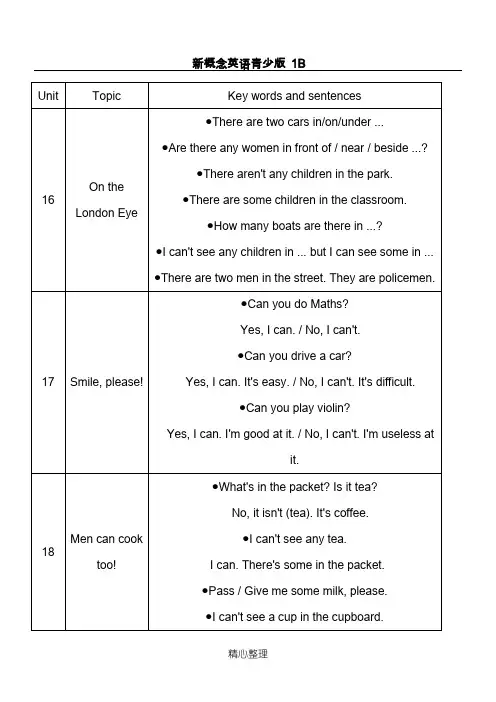
新概念英语青少版1BUnit Topic Key words and sentences16On theLondon Eye●There are two cars in/on/under ...●Are there any women in front of / near / beside ...?●There aren't any children in the park.●There are some children in the classroom.●How many boats are there in ...?●I can't see any children in ... but I can see some in ...●There are two men in the street. They are policemen.17 Smile, please!●Can you do Maths?Yes, I can. / No, I can't.●Can you drive a car?Yes, I can. It's easy. / No, I can't. It's difficult.●Can you play violin?Yes, I can. I'm good at it. / No, I can't. I'm useless atit.18Men can cooktoo!●What's in the packet? Is it tea?No, it isn't (tea). It's coffee.●I can't see any tea.I can. There's some in the packet.●Pass / Give me some milk, please.●I can't see a cup in the cupboard.No, there isn't one.●I can't see any tea in the cupboard.No, there isn't any.19 You must eat!●There's a lot of / lots of fish ...There are a lot of / lots of peaches ...●Is there any fish ...?Yes, there is, but there isn't any meat.●Are there any peaches ...?Yes, there are, but there aren't any grapes.●Buy some bread / peaches, please.Why? There are a lot ...●Don't buy any bread / peaches.Why not? There aren't any ...●You must eat.20What asurprise!●What time is it?It's a quarter past two / half past two / a quarter tothree.●What time's / When's your English lesson?At one o'clock. / At a quarter past two. / At half past two. / At a quarter to six.●I / We must hurry.●Come on! Hurry up!21Breakfastblues●Have you got any tea?Yes, I have. / No, I haven't.●Have we got any coffee?Yes, we have. / No, we haven't.●They've got some bread, but they haven't got anycake.●How much coffee have you / we got?I / We haven't got much.●Do you want any ...?No, I don't want any ...●I don't want any ..., but I want some ...22Watching theneighbours●Paul has got a lot of friends.●They haven’t got a lot of spare time.●He can introduce her to them.●How many CDs has Paul got?23An expensivecamera●Has he / she got a British camera?Yes, he / she has. / No, he / she hasn't.●What kind of camera has he / she got?He's / She's got a Japanese one.●Claire wants a camera. She doesn't want a CD player.●He / She likes Japanese cameras.●What kind of bag do you want?I want a leather one. I like leather bags.24 A light dinner●Do you like vegetables?Yes, I do. / No, I don't.●Do you like tea?Yes, I do, but I don't want any now.●I / We / They don't like vegetables very much.●I love vegetables!I hate them!25The weekendshopping ●I want a bag of sugar / a bottle of wine / a packet oftea ...●She / He needs some sugar.●How much (sugar) does she / he need?●She / He needs one / a box of chocolates.●Irregular noun plural: a / one loaf - two loaves26A self-servicerestaurant●Has Karen got a coat / any gloves?No, she hasn't. Show her that one / those.●Show it / them / that one / those to Karen.●Give me / her / him that one / those.●Pass me / her / him that one / those.●Take her / him that one / those.●I don't want a coat / any gloves. I've already got one /some.27 Toothache●What day is it?It's Sunday.●When is / When's your appointment?It's on Sunday.●When can the dentist see you?He can see me at four o'clock on Sunday.●How does Robert feel / look?He feels awful. He looks miserable.●What's the matter with Robert?He has got / He's got toothache."28Every day isdifferent! ●What's the weather like in spring / summer / autumn /winter?●Is it ever fine and warm in spring (in England)?●It's often/usually/sometimes/always/never fine andwarm in spring.●The sun often shines. / It rains sometimes. / Itsometimes snows.●Which season do you like?I like winter.29 Many happyreturns of theday!●Which is the first / last month of the year?January / December.●Which month comes after / comes before January? -February / December.●What's the date?It's the second of February. / It's February thesecond.●When is Linda's birthday?It's in January.It's on the ninth of January / on January the ninth.●How old is Linda?She's 42. / She's 42 years old.30Aninternationalevent●Where does he / she come from?He / She comes from Australia.●Where do they / you come from?They / We / I come from China.●Where does he / she live?He / She lives in Sydney.●What language does he / she speak?He / She speaks English.Unit16:On the London Eye1:Teaching objectives复习一般现在时学习Some和any的用法2:Language focus:Fun, believe, bridge, really, pass, binoculars, any ,ship3:Teaching procedureGreeting: 介绍自己,同时要求学生做自我介绍,内容包括Name, (My name is…or I am…)Age, (I am …years old or I am a girl or a boy of …years old)Gender,Hobbies (I like doing …)等几个方面。
新概念英语青少版1B-词汇语法知识要点
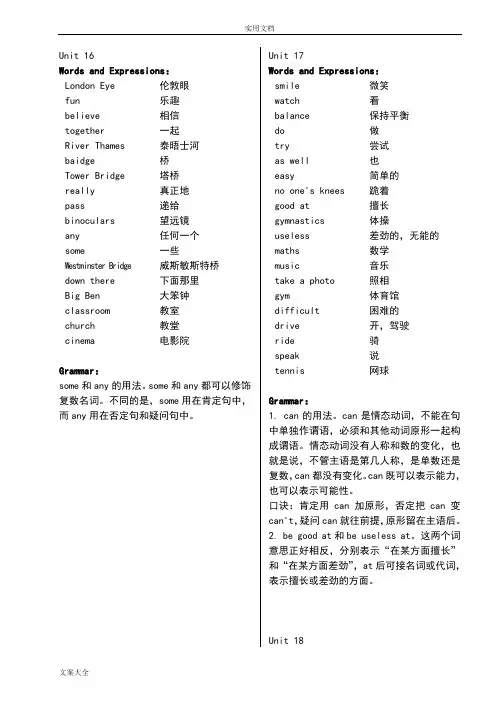
Unit 16Words and Expressions:London Eye 伦敦眼fun 乐趣believe 相信together 一起River Thames 泰晤士河baidge 桥Tower Bridge 塔桥really 真正地pass 递给binoculars 望远镜any 任何一个some 一些Westminster Bridge 威斯敏斯特桥down there 下面那里Big Ben 大笨钟classroom 教室church 教堂cinema 电影院Grammar:some和any的用法。
some和any都可以修饰复数名词。
不同的是,some用在肯定句中,而any用在否定句和疑问句中。
Unit 17Words and Expressions:smile 微笑watch 看balance 保持平衡do 做try 尝试as well 也easy 简单的no one's knees 跪着good at 擅长gymnastics 体操useless 差劲的,无能的maths 数学music 音乐take a photo 照相gym 体育馆difficult 困难的drive 开,驾驶ride 骑speak 说tennis 网球Grammar:1. can的用法。
can是情态动词,不能在句中单独作谓语,必须和其他动词原形一起构成谓语。
情态动词没有人称和数的变化,也就是说,不管主语是第几人称,是单数还是复数,can都没有变化。
can既可以表示能力,也可以表示可能性。
口诀:肯定用can加原形,否定把can变can't,疑问can就往前提,原形留在主语后。
2. be good at和be useless at。
这两个词意思正好相反,分别表示“在某方面擅长”和“在某方面差劲”,at后可接名词或代词,表示擅长或差劲的方面。
Unit 18文案大全Words and Expressions:cook 做饭菜,烹调dinner 晚餐rice 大米pan 平底锅chop 切开onion 洋葱spoon 勺子fork 叉子drawer 抽屉wet 湿的You see,…你看,……restaurant 餐馆,饭店must 必须jug 罐子dry 干燥的sugar 糖食milk 牛奶scanner 扫描仪computer 电脑packet 小包coffee 咖啡tea 茶叶bottle 瓶子orange juice 橙汁fridge 冰箱sea 海Grammar:可数名词和不可数名词。
新概念青少版1B词汇1
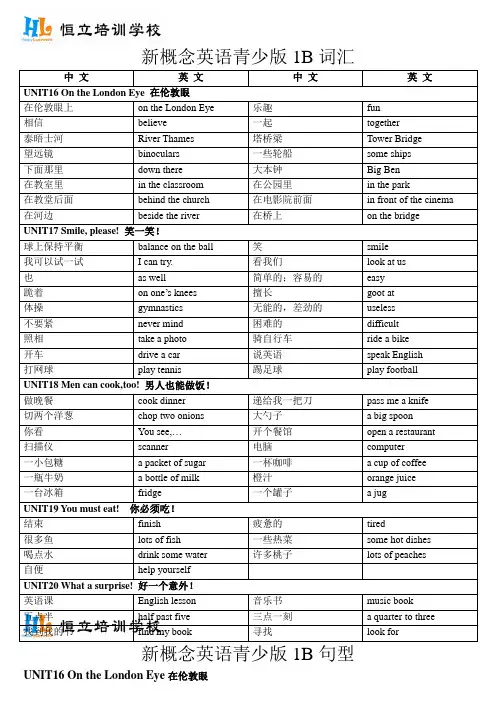
新概念英语青少版1B词汇新概念英语青少版1B句型UNIT16 On the London Eye在伦敦眼1、看看这些桥!Look at all the bridges!2、真的吗?Is it really?3、把望远镜给! Pass me the binoculars!4、你能看到那里有轮船吗?我可以看到一艘。
Can you see any ships there? I can see one.5、公园里有一些孩子。
There are some children in the park.6、河上没有小船。
There aren’t any boats on the river.UNIT17 Smile, please! 笑一笑!1、你们很擅长体操,可是我很差劲。
You’re both good at gymnastics, but I’m useless.2、你的数学和音乐很好,而我就做不到。
You can do Maths and Music and I can’t.3、用你的手机拍张照片。
Take a photo on your mobile.4、罗伯特不会说汉语。
Robert can’t speak Chinese.UNIT18 Men can cook, too! 男人也可以做饭!1、你可以帮助我。
You can help me.2、请给我一些大米。
Give me some rice, please.3、那个罐子里有些大米。
There’s some rice in that jar.4、我不能又拿勺子又切洋葱。
I can’t get a spoon and chop an onion.5、架子上有几个盘子。
There are some plates on the shelf.6、我的手是湿的。
My hands are wet.7、男人也能做饭。
Man can cook, too!8、什么在袋子里?是茶吗?不,是咖啡。
青少版新概念1B复习讲义

《青少版新概念》1B出现的时态一般现在时:表示经常的,习惯性的动作或客观事实、真理等。
am,are,is;/ do,doeseg: I 'm a student. You are right. He is sad.The earth goes around the sun.I go to school every day.He watches TV on Sat. .There be 句型1. 定义:There be句型表示某处存在某物或某人存在某处。
2. 结构:(1) There is + 单数可数名词/不可数名词+ 地点状语. (2) There are + 复数名词+ 地点状语.there是引导词,在句中不充当任何成分,翻译时也不必译出。
谓语动词be要与主语(某人或某物)的数保持一致。
当主语是两个或两个以上的名词时,谓语动词要与跟它最近的那个名词一致。
(就近原则)eg:There is a bird in the tree. 树上有一只鸟。
否定?一般疑问句?特殊疑问句(a / bird)?There is a teacher and many students in our classroom.我们教室里有一位老师和许多学生。
(就近原则)There are two boys and a girl under the tree.树下有两个男孩,一个女孩。
(就近原则)Have/has got的用法:1. 定义:它表示某物归某人所有,是一种所属关系, 主语为人,只有“拥有”的意思。
2. 转换:have got,has got(第三人称单数),3. 句型:I have got three sisters.He has got a bike.否定句一般疑问句?特殊疑问句(three/ sisters)?比较:There be 和Have/ has goteg: There are some apples in the fridge.We have got some apples in the fridge.some 和any 的用法1) 一般情况,some用在肯定句中,any用在否定句和疑问句中eg:There are some students in the classroom。
新概念1BUnit16--18重点总结及练习

Unit16-18单元知识点归纳及练习姓名:班级:理解程度:Unit161.重点单词(翻译及写出词性)乐趣相信递给一些任何一个2.重点句型语法(1)否定疑问句:(翻译下列句子)Isn’t this fun?Isn’t it grey?Isn’t it great?Isn’t London just great?(2)名词的单数变复数类别中特殊变化man woman childPeople sheep fish (3)some与any 的用法。
1.There are (some/any )people on the bridge.2.Are there (some/any) sheep on the field?3.There isn’t (some /any) milk in the glass.Unit171.重点单词积累(翻译并写出词性)微笑看保持平衡做尝试也容易的擅长差劲的照相数学音乐2.重点句式语法(1)情态动词can的用法肯定句:主语+can+V原形eg:I can swim.否定句:主语+can’t +V原形eg:I can’t swim.一般疑问句:Can +主语+V原形eg:Can you swim? Yes,I can./No,I can’t.(2)区别watch 和look atWatch指观看,是一个延续性动词,可以持续一段时间的。
Look at 指看到,表示目光的迁移,转移。
练习:1. (watch/ look at)TV.2. (watch/ look at)the basketball.(3)类比be good at/be useless atbe good at 含义:造句:be useless at 含义:造句:(4)区别too和as wellToo和as well的相同点:不同点:Unit181重点词汇(翻译并写出词性)做饭晚餐帮忙食糖湿的必须干燥的开办3.重点句型语法(1)祈使句:由动词原形开头,表达命令及请求的句子,叫做祈使句。
青少版新概念1B(Unit16-18)
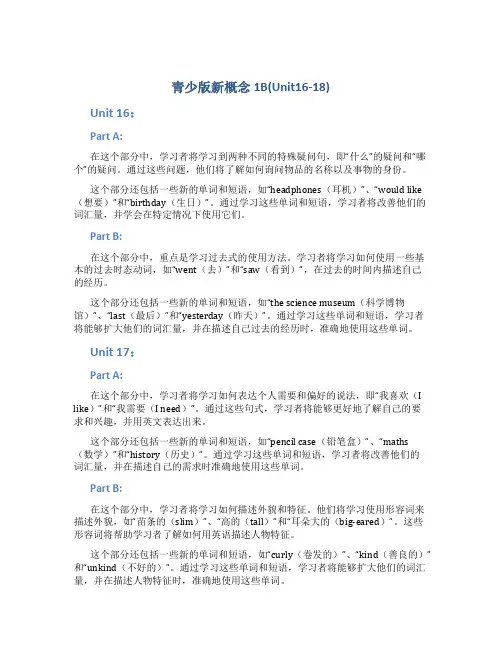
青少版新概念1B(Unit16-18)Unit 16:Part A:在这个部分中,学习者将学习到两种不同的特殊疑问句,即“什么”的疑问和“哪个”的疑问。
通过这些问题,他们将了解如何询问物品的名称以及事物的身份。
这个部分还包括一些新的单词和短语,如“headphones(耳机)”、“would like (想要)”和“birthday(生日)”。
通过学习这些单词和短语,学习者将改善他们的词汇量,并学会在特定情况下使用它们。
Part B:在这个部分中,重点是学习过去式的使用方法。
学习者将学习如何使用一些基本的过去时态动词,如“went(去)”和“saw(看到)”,在过去的时间内描述自己的经历。
这个部分还包括一些新的单词和短语,如“the science museum(科学博物馆)”、“last(最后)”和“yesterday(昨天)”。
通过学习这些单词和短语,学习者将能够扩大他们的词汇量,并在描述自己过去的经历时,准确地使用这些单词。
Unit 17:Part A:在这个部分中,学习者将学习如何表达个人需要和偏好的说法,即“我喜欢(I like)”和“我需要(I need)”。
通过这些句式,学习者将能够更好地了解自己的要求和兴趣,并用英文表达出来。
这个部分还包括一些新的单词和短语,如“pencil case(铅笔盒)”、“maths(数学)”和“history(历史)”。
通过学习这些单词和短语,学习者将改善他们的词汇量,并在描述自己的需求时准确地使用这些单词。
Part B:在这个部分中,学习者将学习如何描述外貌和特征。
他们将学习使用形容词来描述外貌,如“苗条的(slim)”、“高的(tall)”和“耳朵大的(big-eared)”。
这些形容词将帮助学习者了解如何用英语描述人物特征。
这个部分还包括一些新的单词和短语,如“curly(卷发的)”、“kind(善良的)”和“unkind(不好的)”。
通过学习这些单词和短语,学习者将能够扩大他们的词汇量,并在描述人物特征时,准确地使用这些单词。
新概念英语青少版1B.docx
Unit 16 On the London EyeDaisy: Oh, Jack! Isn ' t this fun? Can yoιbelieve it?We' re all together On the London Eye!Jack: Yes, honey . ISn ' tgteat? Look, Claire!That ' S the RiVer Thames.Claire: Yes, Dad. IS n g'y?itDaisy: Well, grey and silver!It ' S beautiful. Look at all the bridges!Claire: Hey, Mom, I Can See T ower Bridge.It ' S open! Jack: IS it really? PaSS me the bin oculars!Jack: Can you See any ShiPS there?Claire: I Can See one.There are some boats, too.Daisy: Look, Jack!That ' S WeStminSter Bridge down there.There are some people On the bridgeJack: There are some CarS and buses, too.Claire: Hey, Dad! That ' S Big Ben!It ' twelve o' clock!Daisy: Din g-do ng, din g-do ng; Din g-do ng, din g-d ong!Oh, Jack! ISn ' t London just great?London Eye PrOPer n .伦敦眼fun n.乐趣believe V.相信together adv. (ma nner) —起RiVer ThameS PrOPer n . 泰晤士河bridge n.桥梁Tower Bridge PrOPer n. 塔桥really adv. (ma nner) 真正地PaSS v. (ditra nsitive) 递给bino CUIarS pl. n.望远镜any quantifier 任何一个ShiP n.轮船some quantifier ——些WeStminSterBridge PrOPer n .威斯敏斯特桥dow n there adv. (PIaCe) 下面那里Big Ben PrOPer n .大本钟Unit 17 Smile, please!Flora :WatCh this, Lucy!I Can bala nce On this ball! Can you do it?LUCy : I Can try.LUCy : Oh, yes!I Can balance On a ball as well.It ' S easy! Look at us, Vikki!Flora : Look at me now, Lucy!I ' m On my knees! Can you balance like this? LUCy : Yes, I Can do that, too. It fun! 'sFlora : Come on, Vikki!Can you bala nce On a big ball like us?Vikki : No, I Can ' t.You ' re both good at gymnastics,but I ' IUSeIeSS . I Can ' t do it.LUCy : NeVer mind, Vikki!You Can do MathS and MUSiC an d I Can ' t!I ' m USeIeSS at Maths.Flora : And you Can take a photo of us!Come on! Take a photo On your mobile.Vikki : OK.Ready? One, two, three!Smile, please! smile v.微笑WatCh v.看balance V.保持平衡do v.做try V.尝试as well adv. ( focus) 也Unit 18 MerI Can cook, too!William: Let ' S COOk dinnJeIRObert. YOU Can help me. GiVe me SOme rice, please. There ' S SOme ricehiaitljar . PUt SOme Water inthe pan, and PaSS me a knife, please.Robert: WhiCh one?William: That One On the table. 。
(完整版)新概念英语青少版1B
Unit 16 On the London EyeDaisy: Oh, Jack! Isn’t this fun? Can you believe it?We’re all together on the London Eye!Jack: Yes, honey. Isn’t it great? Look, Claire!That’s the River Thames.Claire: Yes, Dad. Isn’t it grey?Daisy: Well, grey and silver!It’s beautiful. Look at all the bridges! Claire: Hey, Mom, I can see T ower Bridge.It’s open! Jack: Is it really? Pass me the binoculars!Jack: Can you see any ships there?Claire: I can see one.There are some boats, too.Daisy: Look, Jack!That’s Westminster Bridge down there.There are some people on the bridgeJack: There are some cars and buses, too.Claire: Hey, Dad! That’s Big Ben!It’s twelve o’clock!Daisy: Ding-dong, ding-dong; Ding-dong, ding-dong!Oh, Jack! Isn’t London just great?London Eye proper n. 伦敦眼fun n. 乐趣believe v. 相信together adv. (manner)一起River Thames proper n. 泰晤士河bridge n.桥梁Tower Bridge proper n.塔桥really adv. (manner)真正地pass v. (ditransitive)递给binoculars pl. n.望远镜any quantifier任何一个ship n. 轮船some quantifier一些WestminsterBridge proper n. 威斯敏斯特桥down there adv. (place)下面那里Big Ben proper n. 大本钟its possessive adj. 它的Unit 17 Smile, please!Flora:Watch this, Lucy!I can balance on this ball! Can you do it? Lucy: I can try.Lucy: Oh, yes!I can balance on a ball as well. It’s easy! Look at us, Vikki!Flora: Look at me now, Lucy!I’m on my knees! Can you balance like this? Lucy:Yes, I can do that, too. It’s fun!Flora: Come on, Vikki!Can you balance on a big ball like us? Vikki: No, I can’t.You’re both good at gymnastics,but I’m useless. I can’t do it.Lucy: Never mind, Vikki!You can do Maths and Music an d I can’t!I’m useless at Maths.Flora: And you can take a photo of us! Come on! Take a photo on your mobile.Vikki: OK.Ready? One, two, three!Smile, please! smile v. 微笑watch v. 看balance v. 保持平衡do v.做try v. 尝试as well adv. ( focus)也easy adj.简单的,容易的on one’s knees adv. phrase跪着good at adj. + prep. 擅长gymnastics n. 体操useless adj.差劲的,无能的Maths proper n. (BrE., Math AmE.)数学Music proper n.音乐take v. 照(相)take a photo fixed phrase照相gym n.体育馆Unit 18 Men can cook, too!William: Let’s cook dinner, Robert. You can help me. Give me some rice, please. There’s some rice in t hat jar. Put some water inthe pan, and pass me a knife, please.Robert: Which one?William: That one on the table.。
青少版新概念1B Unit 16-18复习课
Homework: 1. 完成练习卷,复习U16-18 2. 预习U19
Thanks!
Hale Waihona Puke 快乐答答答规则:根据问题抢答,答对的一分;若该组没有答对,该组则失 去下一题抢答的机会。 1. There __ a knife in the drawer.(在横线上填上适当的词) 2. There are 80 boats over there. (对划线部分提问) 3. He can see 10 men in front of the cinema.(对划线部分提问) 4. Can you see any people beside the river?(作肯定和否定回答) 5. She can see Tower Bridge down there. (改成否定句) 6. 把望远镜递给我.(用2种方法翻译句子) 7. 他们用膝盖跪着。(翻译句子) 8. You can take a photo with us. (改成一般疑问句) 9. Which river is grey and silver?( 根据课文回答问题) 10.23:45 (用最难的英语表达)
Unit16-18 复习课 --Nicky
Are you ready? Go!
100秒不NG. 规则: 每个小组,选取一篇文章有感情朗 读,中间不可以有读错或不连贯的 地方,如有则需重头开始读。若在 规定时间内读完,则可加2分;若 不能完成,则不能加分。
记忆大挑战 规则:每组成员在3分钟之内写出 unit19-21的单词,越多越好。最 后由该组一名队员拼出及说出中文 意思,再抽签。抽到多少分就得多 少分。
超级辨辨辨
规则;写出并读出下列单词中红色字母的发音,答对 一题得一分
1. man can make fan 2. men bed Ken key 3. kick fix knife Nicky 4. no not know note 5. nut cute mud cut 6.nice kind side sit 7. face case wait father 8.how house mouth Halloween
新概念英语青少版1B.doc
Unit 16 On the London EyeDaisy: Oh, Jack! Isn’t this fun? Can you believe it?We’re all together on the London Eye!Jack: Yes, honey. Isn’t it great? Look, Claire!That’s the River Thames.Claire: Yes, Dad. Isn’t it grey?Daisy: Well, grey and silver!It’s beautiful. Look at all the bridges! Claire: Hey, Mom, I ca n see Tower Bridge.It’s open! Jack: Is it really? Pass me the binoculars!Jack: Can you see any ships there?Claire: I can see one.There are some boats, too.Daisy: Look, Jack!That’s Westminster Bridge down there.There are some people on the bridgeJack: There are some cars and buses, too.Claire: Hey, Dad! That’s Big Ben!It’s twelve o’clock!Daisy: Ding-dong, ding-dong; Ding-dong, ding-dong!Oh, Jack! Isn’t London just great?London Eye proper n. 伦敦眼fun n. 乐趣believe v. 相信together adv. (manner)一起River Thames proper n. 泰晤士河bridge n.桥梁Tower Bridge proper n.塔桥really adv. (manner)真正地pass v. (ditransitive)递给binoculars pl. n.望远镜any quantifier任何一个ship n. 轮船some quantifier一些WestminsterBridge proper n. 威斯敏斯特桥down there adv. (place)下面那里Big Ben proper n. 大本钟its possessive adj. 它的Unit 17 Smile, please!Flora:Watch this, Lucy!I can balance on this ball! Can you do it? Lucy: I can try.Lucy: Oh, yes!I can balance on a ball as well. It’s easy! Look at us, Vikki!Flora: Look at me now, Lucy!I’m on my knees! Can you balance like this? Lucy:Yes, I can do that, too. It’s fun!Flora: Come on, Vikki!Can you balance on a big ball like us? Vikki:No, I can’t.You’re both good at gymnastics,but I’m useless. I can’t do it.Lucy: Never mind, Vikki!You can do Maths and Music and I can’t!I’m useless at Maths.Flora: And you can take a photo of us! Come on! Take a photo on your mobile.Vikki: OK.Ready? One, two, three!Smile, please! smile v. 微笑watch v. 看balance v. 保持平衡do v.做try v. 尝试as well adv. ( focus)也easy adj.简单的,容易的on one’s knees adv. phrase跪着good at adj. + prep. 擅长gymnastics n. 体操useless adj.差劲的,无能的Maths proper n. (BrE., Math AmE.)数学Music proper n.音乐take v. 照(相)take a photo fixed phrase照相gym n.体育馆Unit 18 Men can cook, too!William: Let’s cook dinner, Robert. You can help me. Give me some rice, please. There’s some rice in that jar. Put some water inthe pan, and pass me a knife, please.Robert: Which one?William: That one on the table.。