
新人教版七年级英语上册 第五单元 SectionA课件
Ask your friends do you have a …? Then make a report.
Names Alice basket ball ping-pang Volley ball
√
√
×
Survey: Do you have a …? have(√) don’t have(×)
Names basket ball ping-pang Volley ball
us
我们(we的宾格)
让我们(一起)
let’s = let us
sound
good
听起来
良好的;令人满意的
greatplay美 Nhomakorabea的,伟大的
参加(比赛或运动);玩耍
late
迟到
Listening
3
1
4
2
New Sentences
Let’s go. 我们走吧。
◆这是一个以动词Let 开头的祈使句,表示建议。
Group work:ask and answer like this:
A: Do you have a/an _____? B: No, I don’t. I have a/an…. A: Do you have a/an ______? C: Yes, I do.
Does she have a …? Yes, she does. No, she doesn’t .
ping-pong bat
Do you have a
ping-pong bat?
×
No, I don’t.
I don’t have a ping-pong bat.
•
•Listening
1b Listen and circle the words you hear
ping-pong bat volleyball soccer ball ping-pong ball
1.play+球类名词/棋类名词,名词前不用冠词
eg. play basketball
play chess下棋
2.play+the+乐器,表示弹奏某种乐器
eg. play the piano 弹钢琴
play the guitar 弹吉他
New Sentences That sounds good. 句中的sound 为系动词,其后接形容词 good 作表语。 当主语是第三人称单数时, 在一般现在 时的肯定句中, 动词后要加s, 构成动词的 第三人称单数形式。
Do you have a soccer ball?
Yes, I do.
Tennis ball
Do you have a tennis ball? Yes, I do.
√
I have a tennis.
basketball
Do you have a basketball?
√
Yes, I do. I have a basketball.
Does he have a …? Yes, he does. No, he doesn’t.
Grammar Focus
Do you have…?你有……吗? Yes, I do. No, I don’t.
Do you have a ping-pong ball?
这是一个现在时行为动词(do) 的一般疑问
1. do (第三人称单数形式does) 用于构成否定句和一般疑问句;做;干 2. have 有(第三人称单数形式has)
ping-pong 乒乓球
volleyball 排球 basketball 篮球
bat (乒乓球等的)球拍
My Room
I have a soccer ball .
Soccer ball
Yes, do. it Yes, they is.
Look at the things in the picture. Ask your partner if he or she has these things. 看图中物品。问问你的同伴是否有 这些物品。
A: Do you have a …? B: Yes, I do.
用来表示请求、命令的句子叫祈使句。
祈使句以动词原形开头,一般不用主语,省略主语you。
Go and see. Look at the picture. Stand up,please. Let’s go. Let’s play.
为使语气委婉,显得礼貌,常在句首或句尾加please。
Sit down,please. Please come in.=Come in,please.
I have a soccer ball. Do you have a soccer ball? He has a soccer ball. Does he have a soccer ball?
Grammar Focus
Do you have a soccer ball? Yes, I do. Do you have a basketball? No, I don’t. Does he have a ping-pang ball? Yes, he does. Does he have a volley ball? No, he doesn’t.
Alice
√
√
×
Report :I have a basket ball and a ping-pang ball . I don’t have a volley ball.Alice has a basket ball and a volley ball.She does’nt have a ping-pang ball .
回答用“Sorry, I …”, “No, I …”,等来回答。
New Sentences
例如: Let’s have a cup of coffee. 我们喝咖啡吧。 OK. 好吧。 Let’s sing A B C song. 让我们唱字母歌吧。 Sorry, I can’t sing it. 对不起,我不会唱。 Let him come in. 让他进来吧。 All right./Yes, please. 好吧。/是,请进。
Practice
Do you have a tennis bat? Where is the tennis bat?
Yes, I do. It’s under the sofa.
Practice
Does Tom Is the have a basketball under his bed? basketball?
Revision
Does Mary have a computer? No, she doesn’t.
Revision
Do you have books?
Yes, I do.
Revision
Do they have tennis bats? Yes, they do.
Words
let 允许;让
Unit 5 Do you have a soccer ball?
Section A (1a-1c)
你知道多少“球”?
basketball
baseball
volleyball
soccer ball
tennis ball
football
ping-pong ping-pong bat
足球 football /soccer 篮球
Exercise :
根据首字母补写单词 1 Do you have a tennis r acket ? 2 I have a s occer ball .
Explanation 即:一般现在时态第三人称单数形式。 如: He has a basketball. have 当动词“有”的意思时, 句式是: 陈述句:I have a nice bag. 疑问句:Do you have a nice bag? Yes, I do. / No, I don’t. 否定句:I don’t have a nice bag.
New Sentences We are late. 我们迟到了。 be late 迟到,be 随主语变化。 eg. He is late. 他迟到了。 I am late.我迟到了。
You are late. 你迟到了。
New Sentences Let’s play basketball.
play的用法:
Explanation
Yes, I do. 这是个肯定的简略回答形
式。其中do为动词, 用来避免动词的重复。
No. I don’t. 这是个否定的简略回答
形式, 其中don’t是do和not的缩写形式。
Explanation Yes, he/she does. 这是个肯定的简略回答 形式。主语是第三人称代词,所以动词用does (does 为do 的第三人称单数形式)。 No. he/she doesn’t. 这是个否定的简略回 答形式, 其中doesn’t是does和not的缩写形式。
句,其中have 是实义动词, 表示“某人拥有”。
句中do为助动词,没有实际意义。只是帮助构 成句式。
Explanation
Do you have a watch? 你有手表吗?
主语have是英语中很有用的动词,基本含义
是“有”。如课文中的I have a soccer ball. have
在he, she, it 后面要变成has。
Yes, he No, it does. isn’t.
Practice
Does Mary Is the volleyball have a under her bed? volleyball?
合集下载
Unit5SectionA(1a-2d)课件人教版七年级英语上册

Listen again. Match the pictures in 2a with the balls.
3
2
4
1) Paul _d_o_e_s_n_’_t_h_a_v_e___ a soccer ball. 2) Mike _h_a_s___________ a basketball. 3) Jane _d__o_es_n_’_t_h_a_v_e___ a tennis ball. 4) Dale __d_o_e_sn_’_t_h_a_v_e___ a volleyball.
Is this your ________? 4
No, it isn’t.
2
Listen to the conversation and match the things with their right places.
baseball baseball bat Helen’s jacket
on the chair in Helen’s bag Bill has it.
Do you have a_____?
开始/ 停止
Yes,I do./ No, I don’t
Practice the conversation with your partner. Then ask and answer questions about the things in the picture below.
[ˈtenɪs]
volleyball
[ˈvɒlibɔːl]
What's missing
soccer ball
[ˈsɒkə(r)] [bɔːl]
ping-pong bat [bæt] ping-pong ball
英语人教版七年级上册 Unit5_SectionA(1a-1c)精品课件1
Section A 1a-1c
➢ Language Goals
To learn to talk about ownership.
To learn new words: do, have, tennis, ball, soccer, volleyball, basketball, let, us, go, we, late, has, get…
Homework
1. Write down all the sports things you have.
2. Recite the conversations in this class.
A: Do you have a ping-pong bat? B: Yes, I do. A: Do you have a ping-pong ball? A: No, I don’t.
Do you have a … ?
No, I don’t. I don’t have a…
Yes, I do. I have a… Do you have a …
Draw the following things in your group. football basketball badminton volleyball baseball bat
1c Practice the conversation with your partner.
Then ask and answer questions about the things in the picture above.
a baseball bat
a tennis ball
a tennis racket
a ping-pong ball a ping-pong bat
➢ Language Goals
To learn to talk about ownership.
To learn new words: do, have, tennis, ball, soccer, volleyball, basketball, let, us, go, we, late, has, get…
Homework
1. Write down all the sports things you have.
2. Recite the conversations in this class.
A: Do you have a ping-pong bat? B: Yes, I do. A: Do you have a ping-pong ball? A: No, I don’t.
Do you have a … ?
No, I don’t. I don’t have a…
Yes, I do. I have a… Do you have a …
Draw the following things in your group. football basketball badminton volleyball baseball bat
1c Practice the conversation with your partner.
Then ask and answer questions about the things in the picture above.
a baseball bat
a tennis ball
a tennis racket
a ping-pong ball a ping-pong bat
人教英语七年级上册Unit5Section A 3a—3c(共28张PPT)
Does he have a …? Yes, he does. / No, he doesn’t. Does she have a …?
Yes, she does. / No, she doesn’t.
Make a survey. Write down the things you have and ask your partner what things she / he have.
Unit 5
Section A Period 2 (3a-3c)
Revision
Does Mary have a soccer ball?
No, she doesn’t.
Do you have a baseball?
No, I don’t.
Do you have a tennis ball?
Yes, I do.
_D__o_ they __a_v_e_ a volleyball? Yes, they _d__o_. /No, they _d_o_n_’_t.
have 和 has的用法
have和has与主语搭配:
I
She
We
He
You
have … It
has…
They
The boy
Tony and Jenny
Jenny
现在时态里,主语为第三人称单数时用has, 其余人称都用have。
用have / has填空。 1.A dog _h_a_s__ four legs. A bird _h_a_s_ two legs. 2.Our school __h_a_s_ a library. 3.We _h_a_v_e37 chairs in our classroom. 4.My sister _h_a_s_ a nice toy car. 5. --- Do Tom and his brother _h_a_v_e_ a big
人教版英语七年级上册Unit5 SectionA教学课件
元音
(3)双元音 /eɪ/ /aɪ/ /ɔɪ/ /əʊ/
/aʊ/ /ɪə/ /eə/ /ʊə/
Can you read the sounds?
Let’s review.
/iː/meat /e/ pet /ɜː/ burn /ɑː/ dark /ɔː/ forth /ɪ/ list /æ/ bad /ə/brother /ʌ/ but /ɒ/ block /uː/ rule /eɪ/ bay /ɔɪ/ boy /aʊ/ bow /eə/ share /ʊ/ book /aɪ/ vice /əʊ/ load /ɪə/ hear /ʊə/ tour
exactly /ɪɡˈzæktlɪ/ adv. 正是如此;准确地
drum /drʌm/ n. 鼓
ability /əˈbɪlətɪ/ n. 能力;才能
paint /peɪnt/ v. 用颜料画;在……上刷油漆
n. 油漆;涂料
Warming up
Let’s review.
44个音素
20个元音
24个辅音
/ ˈæpl / /ræ bɪt//'wɔːtə(r)/ /'ɡɑːdn/ /blæk/ /'taɪɡə(r)/ /'ɒfɪs/ /'evri/
apple rabbit water garden black tiger office every
Pronunciation
Read the words and pay attention to the red letters. /p/ park peach happy apple /b/ black bad rabbit hobby /t/ talk best little pretty /d/ need band middle riddle /k/ keep key back pick camp coin school
人教版英语七年级上册Unit5 SectionA Grammar Focus课件
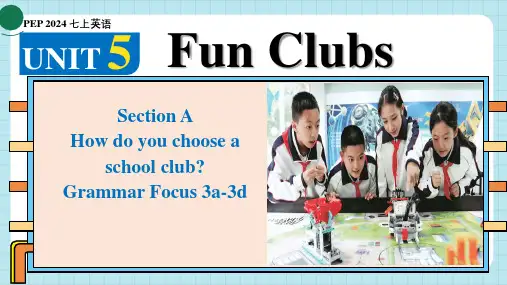
You cWanhdaotsathb.out our friJeonindas?club!
Ability
Club
I (can / can') play the guitar/piano/ violin. □the music club
I (can/can't) sing well.
I (can/can't) swim.
Music club Science club Chess club Sport club Art club
Circle can or can’t with your own information and tick the club(s) you want
to join. Then share with us.
Ru□leth1e:sport club
I (can /can't) run fast. I (can/can't) play chess.
We use _c_a_n_ to talk about abilitEy.mma (M□eathneicnhges)s club
I (canI/ccaann't)pplaaiyntmwuelsli.c, so I want toTh□e nthTeeeganargtticvFlueeb(i 否定) form
I can’t swim. She can’t play any musical instruments.
Negative sentence :主语+can’t+动词原形(+其他).
否定句
I can play the guitar, but I can’t play the violin.
Unit5 第1课时(Section A 1a-2d)课件 人教版英语七年级上册
A: _D__o_e_s_ Mike have a basketball? B: Yes, _h_e__d_o_e_s_____.
Exercises
I.单项选择。
1 —Does Jane have a ball?
—Yes, _______D_____
A .I am
B. it is
C. you do
1a
Match the words with the things in the picture.
1.tennis ball __a___
2.ping-pong bat __f__
3.soccer ball __c__ 4.volleyball ___e__
5.basketball __d___
6.baseball bat __b__
Does
2. Do you have a baseball racket?
bat
3. He have a bookcase.
has
4. Do you have a basketball? Yes, you have.
I
Summary
1. —Do you have a ...? —Yes, I do. I have.../ No, I don’t. I don’t have a...
A. Yes, he does.
B. No, he doesn’t.
C. No, I don’t.
Listen again and fill in the blanks.
Conversation 1: Bob: Do you have a soccer ball, Paul? Paul: _N__o_, _I_d_o_n_’_t__. Bob: Does your brother Alan _h_a_v_e_ one? Paul: Yes, he _d_o_e_s__.
人教七年级上__Unit5__SectionA参考课件
basketball
A: Do you have a basketball? B: Yes, I do. / No, I don’t.
volleyball
A: Do you have a volleyball? B: Yes, I do. / No, I don’t.
tennis
tennis ball
Unit 5 Do you have a soccer ball? Section A参考课件
racket VS bat
tennis racket
ping-pong bat
badminton racket
baseball bat
A: Do you have a … ? B: Yes, I do. / No, I don’t.
Homework
Write a passage about your friend’s hobby
Jane’s father
A: Does Jane’s father have a … ? B: Yes, he does. / No, he doesn’t.
Jane’s parents
A: Do Jane’s parents have a … ? B: Yes, they do. / No, they don’t.
Ask and answer freely using
Do you have a …? Does she/he have a …?
Yes, I do. ( √ ) No, I don’t . ( X )
Yes, she/he does. ( √ ) No, she/he doesn’t . ( X )
第一人称 第二人称 第三人称
Unit+5+Section+A+课件+2024-2025学年七年级人教版英语上册
5. exactly adv. →exact (形 容词) 确切的;精确的 6. ability n. →able (形容词) 能够;有才能的 →talent (近义词) 天赋;才 能
Section A
重点单词
重 12. more adj. & pron. 点 更多(的) 单 词
词汇拓展
续表
熟词生义 drama 作名词,还可意为“激 动;兴奋;刺激”。
Section A
二 重点词汇 1. join v. 参加;加入 教材原句 教材P53 What club do you want to join? 你 想参加什么社团?
Section A
join 作动词,意为“参加;加入”,通常指参加某种固 定的组织、团队、军队等,强调成为其中一员。 其后 常见 还可接表示人的名词或代词,表示和某人一起(参加 用法 活动)。 其可构成短语:join sb. in doing sth.“与某人 一起做某事”。
Section A
四 重点语法 情态动词 can 的用法 教材原句 教材P55 I can run fast, but I can’t swim. 我 跑得快,但是我不会游泳。 教材 P55 Can you play ping-pong? 你会打乒乓球吗? 教材 P53 What instruments can you play, Teng Fei? 你 会弹奏什么乐器,腾飞?
例句 Here comes the bus. 公共汽车来了。
Section A
拓展提升 与这个句型相似的副词除了 here/ there,还有表示时间 的副词 now/ then,表示地点和方向的副词、介词 away/ out/ off/ up/ down/under 等。 如:Now comes your turn. 现 在到你了。 Under your book lies a pen.你的书下面有一支钢笔。
初中英语人教版七年级上册《Unit5 SectionA(2a-2d)》课件
have a _t_e_n_n_is__b_a_ll_, Jane? Jane: Sorry, I don’t.
Conversation 4 Frank: Do you h_a_v_e__a_v_o_l_le_y_b_a_l_l, Dale? Dale: No, I don’t. But my brother does.
Helen: OKI,_h_a__v_e_m__y__j_a_c_k_e_t_a__n_d__h_a.tLet'sgo !
2a Listen and number the pictures
1
2
3
4
2b Listen again. Match the pictures in 2a with the balls.
Task2
2.作不及物动词,意为“去;走”_g_o____,其反义词 _c_o_m__e_.第三人称单数情势__g_o_es_。表示“去某地”用 __g_o__to_+_地__点__名__词___,当后跟地点副词时结构为 _go_+__地__点__副__词__。 3.作及物动词,意为“拿”___g_e_t_,后接名词或人称代 词__宾__格__作宾语。
Task3
4.作形容词,意为“迟到”__la_t_e__,其反义词_e_a_r_l_y_.意为 _早__的__。固定短语__b_e_l_a_t_e_f_o_r._.._,意为____“__…_…__迟__到__”__。
Cindy: Hey. Helen, let's go!W__e_’_r_e__la_t_e_!
Match the things with their right places.
the baseball the baseball bat Helen’s jacket
Conversation 4 Frank: Do you h_a_v_e__a_v_o_l_le_y_b_a_l_l, Dale? Dale: No, I don’t. But my brother does.
Helen: OKI,_h_a__v_e_m__y__j_a_c_k_e_t_a__n_d__h_a.tLet'sgo !
2a Listen and number the pictures
1
2
3
4
2b Listen again. Match the pictures in 2a with the balls.
Task2
2.作不及物动词,意为“去;走”_g_o____,其反义词 _c_o_m__e_.第三人称单数情势__g_o_es_。表示“去某地”用 __g_o__to_+_地__点__名__词___,当后跟地点副词时结构为 _go_+__地__点__副__词__。 3.作及物动词,意为“拿”___g_e_t_,后接名词或人称代 词__宾__格__作宾语。
Task3
4.作形容词,意为“迟到”__la_t_e__,其反义词_e_a_r_l_y_.意为 _早__的__。固定短语__b_e_l_a_t_e_f_o_r._.._,意为____“__…_…__迟__到__”__。
Cindy: Hey. Helen, let's go!W__e_’_r_e__la_t_e_!
Match the things with their right places.
the baseball the baseball bat Helen’s jacket
初中英语人教版七年级上册《Unit5 SectionA(Grammar Focus-3c)》课件
Do you have Yes, I do. No, I don’t. a basketball? I have a … I don’t have a…
Thank you!
You’re welcome.
Goodbye!
Task2
2.及物动词,意为“打;踢”p__la_y__,其后接表示球类运动 的名词时,结构为_p_l_a_y_+_球___。 及物动词,意为“弹奏”,其后接表示乐器的名词时,结 构为_p_l_a_y_+_t_h_e_+_乐__器__。 不及物动词,意为“玩耍”,常用短语:和某人一起玩 __p_la_y__w_i_th__s_b.; 玩某物__p_la_y__w_i_th__s_th_.__。
句式转换 He have a soccer ball.
否定句:H__e_d_o_e_s_n_’_t_h_a_v_e__a_s_o_c_c_e_r_b_a_l.l 一样疑问句:D_o_e_s_h_e__h_a_v_e_a__s_o_cc_e_r__b_a_ll?
肯定回答:Y__es_,_h_e__d_o_e_s.
A: __D_o_ your friends have a basketball? B: Yes, they _d_o__. They have two basketballs. A: Well, let’s play basketball. B: That sounds good.
Remember the things in Bob’s room. Then close your books and ask and answer questions with a partner.
_Y__es____, __t_h_e_y__ _d__o_. 4. Does Mr. Smith have a brother? (作否定回答)