
新人教选修8 Unit5 Reading
Homes Caves, perhaps with skins to keep out the cold
Tools Dress Scrapers, axe-heads, bone needles Animal skins sewn together with needles and thread, necklaces
Descriptions Relics of the relics Caves Fireplaces in the centre of the caves ______ Layers of ash almost six metres thick No doors
Conclusions They might have hung animal skins at the cave ____ mouth to keep out the cold. Tigers and bears might have been their most dangerous enemies.
3. Which of the following shows us the earliest people and the modern people have something in common? A. People hung animal skins to keep out the cold B. People never grew their own crops C. People use science D. People care about their appearance
课标人教实验版 高二 Module 8
Unit 5
Reading
Pre-reading
What is it?
Possible answer
Tell what you have known about Zhoukoudian Caves. Zhoukoudian is a relic of primitive culture, 48 kilometers southwest of downtown Beijing, where Longgushan (dragon skeleton mountain) is standing. Several decades ago, local farmers
4. What did they use for doors? The archaeologist thinks they may have used animal skins. 5. What did they eat? They ate animal meat, such as tigers and bears, and fish from the lake nearby. They also picked fruit when it was ripe.
mined lime-stone in Zhoukoudian, came upon some bone fossils and called them “the Dragon Bones”. Zhoukoudian became known as “Dragon Bone Mountain”. Drugstores purchased the bones as a medical ingredient. The news about the “magic bones” drew attention of scientists.
Skimming
Tell the 3 topics that the archaeologist talked about.
Stage 1 Life in the cave Stage 2 What we can learn from a needle Stage 3 What we can learn from a necklace
9. What did the earliest people use fire for? They used fire to keep them warm, cook the food and scare the animals.
10. What’s the main idea of the text? A brief introduction of the life and habits of the earliest people in Zhoukoudian.
III. Read the text carefully and choose the best answer.
1. Where do the caves lie? A. In the forest. B. On the seaside. C. At the foot of the hill. D. Higher up the hill.
Relics
Descriptions of the relics
ConclusionsFra bibliotekA needle At most three centimetres long Made of bone ____.
Perhaps they cut animal skins and sewed the pieces together to make ______. clothes A Made of There was _____ trade necklace animal bones between them or they and shells travelled to the seaside ______ on their journeys.
Conclusions Early people lived in the caves. They used fire to keep warm, cook food and scare wild animals away. ____ They might have kept the fire burning all _______ winter
II. Answer the following questions after a careful reading.
1. Why have the English students come to the Zhoukoudian caves? The students want to find out about how early people lived. There are no such sites in England while the Zhoukoudian caves provide an excellent example of a site where early people lived.
2. Which of the following is the correct order about how early people made clothes? a. clean the fat and meat from the skin b. cut up the animals c. rub salt inside the skin d. remove the skin e. sew the pieces together A. b-d-c-a-e B. b-d-a-c-e C. b-a-d-c-e D. b-a-c-d-e
6. What animals were their most dangerous enemies? Tigers and bears were their most dangerous enemies.
7. How did they make clothes? Their clothes were made from animal skins. They used sharpened stone tools to cut up the animals and remove their skin. Then smaller scrapers were used to clean the fat and meat from them. They had to rub an ample amount of salt inside the skin to make it soft enough. Finally, they would have cut it and sewn the pieces together with needles made of animal bones.
humans, and bones of animals they
hunted are on display at a museum near
the site of the discovery. With the steadily increased number of visitors from all over the world, Zhoukoudian has become a scenic spot of Beijing. Now read the dialogue aloud please.
In 1929 these lime-stone caves became
world famous with the discovery of a skull and two teeth dating back 200,000 to 500,000 years. They were named Peking Man. But the fossils were lost during World War II. Many of the implements used by those early
8. What can we learn from the necklace they wore?
Some of the necklace beads were made of animal bones but some were made of shells, which tell us that all the fields around here used to be part of a large shallow lake. Perhaps there was trade between early people or they traveled to the seaside on their journeys.
人教版英语选修八第五单元课文翻译

Unit5 周口店洞穴参观记
一群英国学生(学)来到周口店洞穴参观。有一位考古学家(考)正领着他们参观。
考:欢迎到中国来参观周口店洞穴。很高兴见到你们这些从英国来的对考古学感兴趣的学生。你们想必都很清楚,正是在这个地方,我们找到了世界上居住在这个地方最早人类的证据。我们在这儿进行的挖掘工作已经很多年了,而且……
学1:哇,他们穿的衣服全都是用兽皮做的吗?他们那些衣服是怎样做成的?我确信它们裁剪并缝起来又厚又重。
考:我们有证据表明,他们的确穿的是用兽皮制的衣服。我们不断发现一些磨削其他工具用的工具。看样子他们可能是用磨尖的石器来切割野兽并剥皮,再用小一些的刮子把皮上的脂肪和肉去掉。然后,他们可能在兽皮上擦上大量的盐,使皮变柔软。最后进行剪裁,缝起来就成了。确实是既难又脏的活!现在来看看这个吧。(指着一串项链)
学1:
对不起,打断一下你的讲话,请问他们是怎么住在这个地方的呢?这儿只有石头和树木。考:问得好。你是个敏锐的观察者,在高山上的那些洞穴里我们找到了人骨和兽骨,还有工具和其他物品因此,我们有理由认为他们不顾严寒,就住在这些洞穴里。
学2:那他们是怎样取暖的呢?他们不可能像我们现在这样有垫子、毯子和被子。想必是很不舒服的了。
考:我们发现在洞穴中央有生火用的地炉。他们用地炉里的火来取暖、做饭,还可以用火来吓跑野兽。我们一直在挖掘一层层的积灰,几乎有六米厚,这意味着他们可能整个冬天都在烧火。我们还没有找到门,但我们认为在天寒地冻的冬季他们可能是用兽皮挂在洞口来防寒的。
学3:在那以前有些什么野兽吗?考:嗯,我们在洞里发现了老虎和熊的骨头。我们认为这些野兽对他们来讲是最危险的敌人了。现在,你们看这个东西能告诉我们有关早期人类生活的什么情况呢?(指着一张有针线的照片让大家看)
高二英语人教版新课标选修第8册Unit 5 Meeting your ancestors全单元单词课件完整版28张PPT

identification n.鉴定,辨认,确定身份,证明 identification card身份证. identifiable adj.可辨认的 identifier n.鉴定人,检验人 identical adj.相同的 be identical to /with……与……一模一样的
32.delete vt.删除 Your name has been deleted from the list. 你的名字已
从名单上删掉。
deletion n.删除 He made several deletions to the manuscript. 他在原
稿上删去了好几处。
33. album n.相册,集邮册,唱片
acute appendicitis 急性阑尾炎 Dogs have an acute sense of smell. 狗的嗅觉灵敏。 Her judgement is acute. 她的判断敏锐。 acutely adv.剧烈地,尖锐地 cute adj. 可爱的;漂亮的;聪明的,伶俐的
10.assume vt.假定,设想,承担
a photo album 相册 the band‘s latest album 这个乐队的最新专辑 debut album 首张专辑;处女专辑 stamp album n. 集邮册
34. scratch n.(刮,抓,划的)痕迹,搔,挠
vt.搔,抓,擦伤,刮坏 Try not to scratch. 尽量别挠。 John yawned and scratched his chin. 约翰打个哈欠, 挠挠下巴。 start from scratch 从头开始;白手起家;从起跑线开 始
新课标人教版选修八Book8 Unit5 using language
A: I really appreciate your help. I ut you. 我真的很感激有你的帮助。没有你我永远也不会成功。 B: Don’t mention it. It’s my pleasure. 不必客气。这是我的荣幸。
3 她猛得坐下,结果却被她那大笑大叫的妹妹搂抱起来。
Abruptly she sat down, only to be scooped up by her laughing, shouting sister.
only to 引导的非谓语动词短语作状语,表示意料之外的结果。 4.快到达目的地的时候,一阵香气扑鼻,她停下来,不往前 走了。
If only 引导虚拟语气的句子, 意思是:要是…就好了
练习
1.The little baby arrested the little girl’s attention.
AAD
Don’t mention it. 不必客气。 【疯狂短评】 当中国人对你致以谢意的时候,我们都知道该说声“不用 谢”;但当外国人对你说“Thank you”时,你就不能 以“no thank you”来回应了,而应该说“Don’t mention it”或“You’re welcome”、“ Sure”、“My pleasure”、“Forget it”,这些都是口语要素的精髓。 “appreciate”是“感谢;感激”的意思,它用来表示 比较正式的感谢。
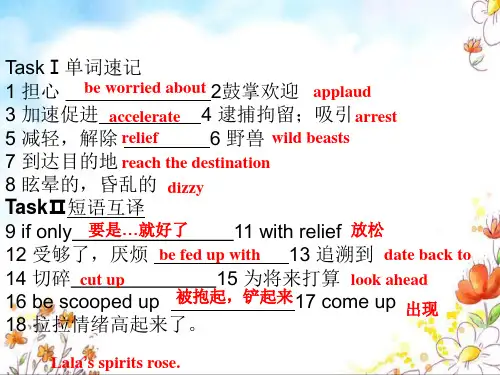
TaskⅠ单词速记 1 担心 be worried about 2鼓掌欢迎 applaud 3 加速促进 accelerate 4 逮捕拘留;吸引 arrest 5 减轻,解除 relief 6 野兽 wild beasts 7 到达目的地 reach the destination 8 眩晕的,昏乱的 dizzy TaskⅡ短语互译 9 if only 要是…就好了 11 with relief 放松 12 受够了,厌烦 be fed up with 13 追溯到 date back to 14 切碎 cut up 15 为将来打算 look ahead 16 be scooped up 被抱起,铲起来 17 come up 出现 18 拉拉情绪高起来了。
新课标人教版选修八Book8 Unit5 Language points
--- 周末有空吗? --- 对不起, 我有大量的事要做 — Are you free this weekend? — I’m sorry, but l have lots of work to do.
His research was interrupted by war.
8. 他们用这火取暖、做饭, 还能用火吓 跑野兽。 That would have kept them warm, cooked the food and scared wild beasts away as well. 1) would 表示猜测, 译为 “想必……”、 “肯定会……”。
2) keep them warm为keep+宾语+宾语 补足语的结构意为 “使......处于某种状 态(情况)”。用作宾语补足语常见的 词有现在分词、过去分词、形容词、副 词以及介词短语。 他使我等了半个小时。 He kept me waiting for half an hour.
3. 我们在山的比较高的洞穴里发现了动 物和人类的骨头以及工具和其他物品。
We have found human and animal bones in those caves higher up the hill as well as tools and other objects.
as well as 1) conj. as well as 可以用来连接两个相 同的成分, 如名词, 形容词, 动词, 介词, 通 常不位于句首。意为“不但......而且”。
b. 句中 “ which” 用来引导非限制性定语 从句, 先行词为其前的句子。 c. suggest vt. to make evident indirectly; imply 意为“暗示, 意味, 表明” 她苍白的脸色表明她病了。 Her pale face suggests that she was ill.
Reading
Para7-8:
1. Is it easy to apply for a patent? The criteria are so strict that it is difficult for new ideas to be accepted unless they are truly novel. 2. Decide whether each of them can get patents or not? Give your reasons.
True or False
1. In this passage, the writer want to encourage
the readers to consider carefully the problems
in daily life. T 2. The writer was successful to catch the snakes in the second attempt. F 3. An inventor can easily get the patent for the invention.
Part II
(Para 2-3):
Part III
(Para4-6):
Part IV):
(Para7, 8
Read the text fast and answer questions. 1. What is the main idea of the text?
The text narrates the problem _______of the snakes and presents the procedures _________of a patent catching them and applying for_______.
高中英语 人教版新课标选修第8册第5单元meeting your ancestors第1篇课文逐段分析 共17张ppt
• —What has happened to George?—I don‘t know. He may have got lost.—乔治发生 了什么事?——我不知道,他可能迷路了。
• There is nowhere to find them. Where can they have gone? 到处找不到他们, 他们可能到什么地方去呢?
• 四、 “could+have+done”是虚拟语气,表示对过去事情的假设,意思是本来能 够做某事而没有做。
• He could have passed the exam, but he was too careless. 本来他能够通过考试, 但是他太粗心。
2020/5/21
4
4.have been doing 是现在完成进行时,
• 表示动作从过去开始持续到现在,并且很可能持续下去 • 其结构为have/has been doing • It has been raining for 3 days. • 过去完成进行时表示动作从过去某一时刻开始,一直持续
• 六、 2020/5/21 “might+have+done”表示对过去事情的推测,might与may意思相同,但 7
• 七、 “would+have+done”虚拟语气,表示对过去事情的假设,意思是“本 来会做”。
• 1. I would have told you all about the boy‘s story, but you didn’t ask me. 我本来 会告诉你这个小男孩的故事,但是你没有问我。
人教版高中英语选修8_Unit 5课件
选修8Unit 5Meeting your ancestorsPart A.模仿朗读请听课文录音,并跟读课文,注意语音、语调和停顿Part B.角色扮演角色:John and Professor Wang, an archaeologist情景:英国学生John向考古学家王教授询问有关信息。
任务:请你扮演John,根据中文提示提出问题,请你的同桌扮演Professor Wang,根据课文内容回答你的提问。
1.早期人类住在哪里?_____________________________________________2.他们怎样保暖?_______________________________3.他们吃什么?____________________________________ 4.他们会缝衣服吗?________________________________5.他们在意外表吗?___________________________________答案:1.Q:Where did the earlist man live?A:They lived in caves.2.Q:How did they keep warm?A:They used fur from animals for clothes and had fires burning all winter.3.Q:What did they eat?A:They ate animal meat,such as tigers and bears,and fish from the lake nearby. They also picked fruit when it was ripe.答案:4.Q:Could they make clothes?A:Yes. We've found a needle made of bone,which suggests they might make clothes.5.Q:Did they care about their appearance?A:I think so. Look at this necklace. It's lovely and it tells us that early people did care about their looks.Part C.故事复述请结合上述问题答案,用自己的话复述课文。
人教版高中英语配套ppt课件:选修8 unit 5 Meeting your ancestorsperiod 1
Tanzania in 1960.
Homo erectus With skeletons very similar to those of modern humans,
they were probably the first to use fire. They lived 30,000~
Period 1 Warming Up,Pre-reading & Reading
Ⅰ.单词识记
1.________v. to stop someone from continuing what they
are saying or doing suddenly 2.________adj. dirty or untidy 3.________n. the quality of being correct or true 4.________v. to think that something is true, although
Unit 5 Meeting your ancestors
More than 3 million years ago, our ancestors(祖先) were already on the march, rising on two legs to search for food, seek greener lands and, above all, to grow in body and brain. Let's meet some of them:
Homo Neanderthal
Their brains were at least as large as the average
modern humans', while their smaller bodies helped them deal with cold climates. They lived 30,000~230,000 years ago. Fossils have been found in France and Iraq since 1856.
高中英语《Unit 5 Reading》教案 新人教版选修8
吉林省长春市实验中学高中英语《Unit 5 Reading》教案教学重点1. I’m sorry to interrupt you, but how could they live here?2. We have been excavating layers of ash almost six meters thick, which suggest that they might have kept the fire burning all winter.3. Talk about Peking man in Zhoukoudian Caves.Step I Revision and Lead-inThe Ss will how their information about Zhoukoudian Caves in the following steps and talk about the pictures on the screen.Step II Lead in Ask the Ss to identify the picture in the pre-reading part. (skullcap) 1.Ask Ss to assume what Peking man might have done and use thousands of years ago. Step III Reading1. Play the tape once, and ask the Ss what they have learned about Zhoukoudian Caves2. Scanning (Ask them to write down the three ways in which the life of early peoplediffers from modern ones. Ask them to work in pairs and discuss the questions.3. Careful reading(Fill in the blanks according to what is mentioned in the text) Stage 1: Life in the caveStage 2: What we can learn from a needle Stage 3: What we can learn from a necklace Step IV Post-readingAsk Ss to fill in the chart on the life and habits of Peking man on page 37 and compare it with the list they made in the pre-reading.Step V. Discussion1.What are the differences between our life and our ancestors’?2.What do you think is the main language points in the test?Step VI. Exercises about the language points in the text.Step V Homework1.Go over the text.2.Write a brief introduction to the Zhoukoudian Cave.3.。
高中英语(人教版选修8)教师用书:Unit 5 Section_Ⅱ Warming Up - Reading — Language Points(含答案)
Section_ⅡWarming Up & Reading — Language Points(一)选出与画线部分意思相同或相近的选项1.I wanted to go out, but I had no money. I had no alternative but to stay at home.A.chance B.choiceC.income D.method2.After three days without food, the men were close to starvation.A.start B.starC.hunger D.thirsty3.I can only give a tentative opinion, for I’m not sure which one is the best.A.tent B.fixedC.tension D.unfixed4.Let us assume for a moment that the plan succeeds.A.believe B.supposeC.support D.advise5.We now have ample money for the journey.A.example B.littleC.enough D.some6.Primitive man made tools from sharp stones and animal bones.A.Fresh B.FemaleC.Male D.Ancient7.When the summer crop is ripening,_the autumn crop has to be sowed.A.roping B.fullgrownC.gathering D.watering8.These form an independent category.A.sort B.landC.nature D.department答案:1~5 BCDBC 6~8 DBA(二)根据所给词性和汉语意思写出单词9.preserve vt.保持;保存→preserver n.保护者;保护物10.specific adj.特定的;具体的;确切的→specifically adv.确切地;具体地;特定地11.botany n.植物学→botanical adj.植物学的12.accuracy n.精确;准确→accurate adj.精确的;准确的→accurately adv. 精确地;准确地13.interrupt vt.打断(话);中断等→interruption n.打扰;中断(时间)14.sharpen vi.&vt. (使)锋利;尖锐;清晰→sharpener n. 磨具;削具→sharp adj. 锋利的;尖锐的;清晰的15.messy adj. 凌乱的;脏的→mess n. 杂乱,混乱16.analysis n.分析→analyses(复数)→analyze vt. 分析1.alternative[教材原句] Can you think of the alternatives we would use today?你能想到我们今天可供利用的办法吗?(1)n.[C]可能的选择;供选择的东西①You have the alternative of riding or w alking.你可以在骑车和步行中选择一种。