
人教版PEP小学英语五年级下册教案-第二单元
人教版PEP小学英语五年级下册教案-第二单元单元教材分析本单元主要谈论自己喜欢的季节,四会掌握季节单词:spring, summer, fall, winter, season; 季节性活动的单词和短语:swim, fly kites, skate, make a snowman, plant trees, sleep.有关询问所喜欢的季节的句型:What’s your favourite season? I like… Which season do you like best? I like…best. Why do you like…? Because I can…学会询问别人所喜欢的季节及其原因,表达自己所喜欢的季节及原因.字母组合环air, ear在单词中的发音以及sp, sk的发音训练.同时在教授新单词和let’s chant时渗透一些发音规律.听懂一些表达所喜欢季节及其原因的单句、对话和一段完整的语篇,根据关键信息完成一些相应的听力练习.能和他人交谈或向他人介绍有关季节的信息内容,并介绍自己最喜爱的季节及原因.读懂对话或短文,培养一些基本的阅读技能,如如何快速查找关键信息,根据上文猜词等.规范书写四会单词和句子,并能根据图片和提示语写一段话介绍自己最喜爱的季节及原因,养成良好的书写习惯和写作习惯.单元教学目标1.能力目标(1)能够就所喜欢的季节及原因进行问答,如:What’s your favourite season?/ Which season do you like best? Summer/Winter… Why do you like…? Because I can…(2)能够就天气情况进行问答,如:“What’s the weather like in…? Sunny.”(3)能够听懂、会唱歌曲“What’s Your Favourite Season?”和本单元的歌谣.2.知识目标(1)认读A、B部分Let's learn、Let's talk中的单词和句子,并掌握四会单词.(2)掌握Read and write中的四会句子,读懂对话内容,并完成阅读理解检测题.(3)能够理解并开展Let’s start, Make a survey, Take time等部分的内容.(4)能够了解Pronunciation中字母组合air, ear, sp, sk 的发音规则,能朗读相关的例词.(5)了解Good to know, Story time等部分的内容.3.情感、策略、文化等有关目标(1)情感态度:让学生有兴趣用英语表达,能积极参与课堂活动.(2)学习策略:引导学生注重小组合作学习,培养沟通和交流的能力.(3)文化目标:让学生了解有关全球天气差异的常识.五年级下册unit 2Period 1Specific vocabulary:能听、说、读、写四个季节类单词“spring, summer, fall, winter”Specific target sentences:在实际情景中,能恰当地使用句型“What’s yourfavourite season?”“My favourite is _______.”Specific functional exponents:学生能询问某人喜爱的季节.Source of material:教师准备教学多媒体课件教师准备单词卡片、录音机、教学录音带学生每人准备单词卡片一套Assumptions and Anticipated problems:本节课重点讲解四个季节类单词“spring, summer, fall, winter”和“What’s your favourite season? My favourite season is ______.”句型,在情境中进行教学.(一) Warm-upT: Good morning, boys and girls. What’s the weather like today?S: It’s warm. It’s sunny.T: Yes, it’s warm and sunny. What a nice day. And look the flowers are beautiful. And the trees are green. The birds are singing on the trees. Spring’Do you like spring? (show the picture of spring by CAI)(设计意图:在教学中以旧引新,这样既能相应地降低教学的难度,也能带领学生温故而知新.)( 二 ) Presentation1.T: How many seasons are there in a year? 板书season.: spring, summer, fall, winter.2. 通过图片以及教师的介绍了解四季的特色.Spring: It’s warm and sunny. The flowers are beautiful. And the trees are green.Summer: It’s sunny and hot. We can go swimming.Fall: It’s windy and cool. The trees are yellow. There are many fruits.Winter: It’s windy and cold. In some places. It snows.(设计意图:在轻松的教学环境中学生学得主动,放松,培养他们学习英语的兴趣.)(三)Practice1.Game1: mouth guessing.2. page18 Let’s play.(设计意图:在紧张刺激的游戏中,学生的注意力高度集中,学习效果更加明显.设计这样的游戏把学生从集体活动中解放出来,让学生自主地消化掌握学习的内容,同时培养学生相互沟通和交流的能力.活动类型: A)3. Let’s talk1.sing the song of the seasons.P24T: there are 4 seasons in a year. So what’s your favourite season?Ask and answer in pairs:What’s your favourite season?Winter. (可适当让学生说说季节的特征)(设计意图:这一系列活动的设计,是为了更好地巩固本课时的教学成果.通过情景交际活动,在说中运用巩固单词,达到在“学中用”,在“用中学”的效果,培养学生用英语进行交际活动的能力.活动类型: C)(五)Sum up说说一年的四个季节,let’s chant P14.(六)Homework(2)听课文的录音两次.读读记记季节的单词.把季节的词语每个写两行.(设计意图:作业是课堂教学的延伸,让学生回家后听、读、认、写,巩固本课的内容,为下节课的运用做好准备.)Period 2Specific vocabulary:学生能够在句型中运用季节的词语..Specific target sentences:学生能够运用句型:which season do you like best?Ilike… best. 来谈论自己喜欢的季节.Specific functional exponents:学生能够询问并回答有关自己喜欢的季节并能灵活运用于实践.Source of material: 1、教师准备多媒体课件.2、教师准备录音机和录音带.3、教师准备相关单词卡片、句子卡片.Assumptions and Anticipated problems:五年级的学生学习能力较强,思维活跃,肯动脑筋,能积极参与讨论、发表自己的观点.对于学生来说谈论他们喜爱的季节比较简单,教师要为学生创设真实的语言环境,让学生在自然的交流中逐步掌握主句型,并以此初步培养学生的语音、语调,建立语感,逐步发展学生的语言能力.并且注意引导学生能说说这些季节的特点.(一)Warm-up1.Let’s chant(P14):Spring is green with flowers and songs.Summer is hot and the days are long.Fall is golden and farmers are busy.Winter is white and the year is gone.(设计意图:全班一起朗读歌谣能活跃课堂气氛,并且通过师生之间的歌谣式的问答让学生复习季节的词语以及季节的特色. 学生轻松融入学习英语的氛围中.并且由此引入新课的学习.)(二)Presentation1. Ask and answer :T: What’s your favourite season?S: winter. S: Fall. ……2. let’s try.What are their favourite seasons?Mike Chen Jie Amy3. Listen and find out Zhang Peng and Mike’s favourite season.4. Watch the VCD:Mike likes fall. Zhang Peng likes winter.5. Watch again and tell why?( 三 ) PracticeRead the dialogue after the tape.Practice in pairs.Make a new dialogue.(设计意图:通过情景交际活动,培养学生用英语进行交际的能力,人人参与到调查活动中来,体现了教学面向全体,关注全体的教学理念.)(四)Homework①找同伴表演本课时对话,听课文录音十分钟.②学生背诵并抄写本课时对话并且创造一个新的对话.(设计意图:通过与同学合作表演对话加强同学间课后的互动,在班上形成良好的学习英语的氛围.课后的复习对掌握知识尤为重要.)Period 3Specific vocabulary: leaf- leaves, Halloween, ThanksgivingSpecific target sentences: Which season do you like best? I like winter best.Summer is good, but fall is my favourite season.Specific functional exponents:在实际情景中正确运用所学的对话Can…? Yes, Ican. No, I can’t.Source of material:教师准备教学多媒体课件教师准备录音机,录音带,教学VCDAssumptions and Anticipated problems:通过前两个课时的学习学生已经掌握了关于季节的单词,并且能说会用句型“Which season do you like best? I like summerr best.来讨论自己喜爱的季节.学生在理解read and write 的基础上,综合运用句型“ Which season do you like best? I like … best.”(一)Warm- up1.学生齐唱歌曲“what’s your favourite season?”(设计意图:孩子们喜爱唱歌,优美的歌声能营造快乐轻松的英语氛围,使孩子迅速进入英语学习的状态.歌曲的内容也与本单元的语言知识紧密结合,对上课时所学的内容是一个很好的回顾复习.)2. Free talkWhat’s your favourite season?Which season do you like best?(二)Presentation1. Read the dialogue and tell the students’ favourite seasons.(1) which season does Zhang Peng like best?(2) Which season does Mike like best?(3) How about Amy?2. Show the sentences and tell why they like the seasons.Mike: Summer is good, but fall is my favourite season.( The sky is very blue. The leaves are colourful.)Zhang Peng: I like winter best. ( We go up north. We play with the snow.)Amy: I like summer best.( I like to swim in the sea.)(设计意图:真实呈现让学生在发现中学习,学习的热情高涨.活动类型: R) 3.Read the dialogue again and try to read it.4. Watch the vedio and try to understand it.(五)Sum up用英语口头介绍自己喜爱的季节,完成同步相关的练习.(六)Homework1. Part C Task Time(1)写一写自己喜爱的季节.(2)听录音,读短文三次.(设计意图:开放性的作业的设计,引导学生养成自主学习英语、用英语交流的习惯,体现了学生学习方式的转变,并使语言学习成为一种技能,使其与生活相“连接”,自然地把教学内容延伸到生活实践.)Period 4Specific vocabulary:能听、说、读、写单词“swim, fly kites, skate, make asnowman, plant trees”Specific target sentences: Which season do you like best?Winter. I can make a snowman.Specific functional exponents:学生能介绍在某个季节里面可以做什么.I can…Source of material: 教师准备教学多媒体课件教师准备单词卡片、录音机、教学录音带Assumptions and Anticipated problems: 学生在谈论自己喜爱的季节并且能用句型“I can…”说说在该季节的活动,初步接触句型“ Whatwould you like to do? I’d like to…”一、Warm up1. Sing the song“What’s your favourite season?”2. Tell what season is it?T: It’s warm and windy. We can fly kites. Ss: Spring.It’s hot and sunny. We can swim in the sea. Ss: ....It’s warm. The weather is nice. Sometimes it’s rainy. We can plant trees. Ss:… It’s always cool and sunny. We can go hiking. Ss: …It’s cold. We can skate. We can make a snowman. Ss: …二、Presentation1.teach and show the words. Try to read it once.(设计意图:在轻松的学习氛围中感受新知,提高了学生学习的积极性、主动性.)2. read after the tape3. “Bomb”game4. guessing the actions三、Practice1. read the words by themselves2. Ask and answer:A: Which season do you like best?B: Winter. I can make a snowman. ...四、Add-activityT: Your group is going out together. Make a survey to find out your group’s favourite activitiesActivity Number of peopleClimb mountainsPlant treesFly kitesPlay sports(设计意图:这一系列活动的设计,是为了更好地巩固本课时的教学成果.通过情景交际活动,培养学生用英语进行交际活动的能力.)五、Sum upRead the words and try to remember it六、Homework:1. copy the words2. 听录音,读单词十分钟.Period 5Specific vocabulary: 听说掌握单词why和 becauseSpecific target sentences: 听懂、会说:Why do you like…? Because I can …等句型并能在情景中熟练运用.Specific functional exponents: 在实际情景中正确运用所学的对话What’s yourfavourite season? Why do you like…? Because I can …Source of material:教师准备和收集相关的物品,包括多媒体课件,录音机、磁带、单词卡片等.Assumptions and Anticipated problems :通过前面的学习学生已经掌握了关于季节性的活动词组fly kites, plant trees等,并且会运用句型What’s your favourite season? Which season do you like best? I like…best.来讨论、表达自己喜欢的季节.在本课时进一步提供更加多的季节性活动,让学生掌握句型:Why do you like…? Because I can …以及在实际情景中正确运用对话.1、Warm-up: 热身活动a)Miss Time: How many seasons are there in a year? What are they?b) Miss Time: What’s the weather like in four seasons?Students: Spring. Spring, Spring, warm and rainy.Summer, Summer, Summer, hot and sunny.Fall, fall, fall, cool and windy.Winter. Winter, Winter, cold and snowy.c) Miss Time: What do you wear in spring/ summer / fall / winter?Students: Spring is warm. I wear shirts.Summer is hot. I wear shorts.Fall is cool. I wear jackets.Winter is cold. I wear coats.d) Miss Time: What can you do in spring/ summer/ fall/ winter?Students: Spring is rainy. I can plant trees.Summer is sunny. I can go swimming.Fall is windy. I can fly kites.Winter is snowy. I can go skating.c) Miss Time: What’s the characteristic of the four seasons? 见(Unit 2, Let’s start.)(设计意图:通过创设情景,让学生复习相关的季节内容,为下面的学习做好辅垫.活动类型C/R)2、Presentation: 新课呈现Miss Time: What season is it now?Teacher: Yes, it’s spring. We all know spring is green with flowers and songs. Can you sing a song for Miss Time? OK! Let’s sing.Sing a song, 通过演唱歌谣复习学过的单词, 同时呈现本课重点句子:“What’s your favourite season?”.“Why do you like …?”教师通过多媒体课件展示,师生之间互问最喜欢的季节及其喜欢的原因,练习对话.3、Practice: 趣味操练a) Game:连句接龙(Say the sentence in a train)A:What’s your favourite season?B: Fall.A: Why do you like fall?B: Because I can swim in the sea.b) 重点操练“because”c) Pair work.(设计意图:为let’s talk作好铺垫和过渡,把学生拉近谈论的话题.活动类型A) 4、Listening Exercise: 听力练习, Let’s try.(设计意图:让学生对新句型在听觉上有所感知,为新课学习做铺垫.活动类型C)5、Task 1 : Miss Time wants to know what your favourite season is. Why? Let’s help her to make a survey.Task 2: Give the feedback. 活动反馈学生在自由组合的方式下进行采访活动,之后来到展示台前向全班同学展示他的采访结果.(设计意图:在采访,汇报采访结果中让学生更好地掌握运用所要学习的句型.活动类型A)6、Task 3: Draw a picture. 画出自己最喜欢的季节,并写出原因.例:It’s spring. I like spring, because the weather is warm in spring. I can plant trees. I can wear shirts.(设计意图:培养学生的动手和创新能力.活动类型:A)7、Task 4: Make a season book. Show out the books. 制作图书.展示.(设计意图:提高学生学习英语的兴趣,并为学生创设了一个展示自我的平台.活动类型A)8、Consolidation: 课堂总结教师总结本课时重、难点,并以song结束本课教学.9、Extension: 课外活动(1)、进一步完成故事书.(2)、录音介绍你最喜欢的季节,并说说喜欢的原因.Period 6Specific vocabulary:Specific target sentences:学生能够听、说、读、写句型:Why do you like summer? Because I can swim in the lake. Why do you like winter? Because I can sleep a long time.并能在情景中正确运用.Specific functional exponents:学生能够运用句型Why do you like…?Because I can…Source of material:教师准备教学多媒体课件教师准备学生阅读材料若干教师准备教学单词卡、教学录音带Assumptions and Anticipated problems:学习本课前,学生已经熟练掌握一年四季,天气,季节的活动等词汇,能够简单描述各个季节的特征,并能运用以下句型进行围绕季节这个主题的对话:Which season do you like best?/ What’s your favourite season? I li ke… best./ Why do you like(summer)? Because I can…等. 如何更有深度地对各个季节的优点进行描述并写出一篇介绍自己认为最好的某个季节的文章,这是学生在本节课的学习困难.一.Warm-upListen and do: e.g. If you can swim , stand up.(设计意图:设计了一个If 听力游戏进行热身以及把相关的季节内容放在听力内容中,既调动了学生的学习热情,又为下面的阅读环节复习了必要的相关知识.活动类型C)二. Guessing gameInvite one student to describe a season, then guess what season it is.(设计意图:使学生对四季的特征有了更清楚的认识,为下面的阅读提供了充分的知识准备.活动类型:A/R.)三. Presentation1.猜测(1)Open their books, observe观察 the pictures and tell what they can see in the pictures.(2)Predict猜测—what is the story about?2.Read for the first time快读Read the text for 15 seconds, underline the key words and tell: the story is about… 3.Read for the second time细读(1) Read the text and True or False1.Zip likes summer because it is very hot in summer. T F2.Zoom and Zip eat many fruits in fall. T F3.Zoom likes sleeping very much. T F4. T F(2) Share the answers in the class. Teach a lot, wake up.4.Read the text aloud together.5. Work in groups of 6 to raise some questions. Then each group chooses onequestion for the other groups to answer.e.g. What’s Zip’s favourite season ? Why?Which season does Zoom like best? Why?(设计意图:引导学生能够运用阅读中的Predicting(预测),Scanning(快速浏览),Intensive reading (精读)等阅读技巧,培养学生学习能力,强调学生的学习策略,使学生能很好理解文章意义,获得相关知识.活动类型:A/R/C )四.Extension1.Encourage Ss to talk about things we can do in four seasons.2..Divid the class into 4 groups, read a passage---Seasons in ChinaChina!(设计意图:激发了学生的学习热情,又为下面的写作环节做了很好的铺垫.活动类型:A )Supplementary ReadingSeasons in ChinaChina?In Spring, the weather is nice. It’s always warm and windy. We can plant trees and flowers. We can go to Kunming in spring. Kunming is very beautiful. It’s called (被称为) “Spring City” because it’s spring all the year. There are a lot of colorful flowers in Kunming.In summer, it’s always sunny and hot. We can go to swim in summer. We can go to Sanya. The sea is very beautiful. It’s very blue. You can play on the beach(沙滩). Oh, this summer we have Olympic Games in Beijing! How exciting(真令人兴奋)! Let’sgo to Beijing this summer together!In fall, the weather is very nice. It’s always windy and cool. You can see many colorful leaves. We can go hiking or go to the fruit garden! There are many fresh and sweet fruit. Oh. The Mid-Autumn Day(中秋节) is in fall. We eat moon-cakes(月饼) and watch the moon at night. We like this holiday very much!In winter, it’s very cold. It snows in the north. IChina in winter, we can go to Harbin together! When it snows, the trees are white. The roads are white. Everything is white. It’s so beautiful! Oh, we can go skating (滑冰) and go skiing(滑雪). It’s so much fun.China3. Let’s writeWrite a passage: 用英语写出自己喜欢的季节,为什么喜欢这个季节,在这个季节能做的活动.(1)Giving instructions and Ss begin to write.(2)Invite some Ss to share their written work in the class. Correct the mistakes(3) Correct each other’s passage.(设计意图:培养学生写作的能力,通过互相批改作文,提高学生的写作技巧.活动类型: A)五.Homework1. Copy the correct passage.2. Read the passage to your parents.。
pep五下英语第二单元精品教案

pep五下英语第二单元精品教案本教案是针对pep五下英语第二单元的精品教案,旨在帮助学生掌握本单元的重点知识和技能,提高英语听说读写能力。
一、教学目标1.能听懂并正确运用本单元的重点词汇和短语。
2.能听懂并正确运用本单元的重点句型。
3.能正确运用本单元的语法知识,如一般现在时、there be句型等。
4.能在实际情境中运用本单元所学的知识和技能。
二、教学重难点1.本单元的语法知识,如一般现在时、there be句型等。
2.本单元的重点词汇和短语的听、说、读、写能力。
三、教学步骤1.导入新课。
通过展示图片和物品,引导学生学习本单元的重点词汇和短语,如pen, pencil, ruler, eraser, book等。
2.教授本单元的语法知识。
通过讲解和练习,让学生掌握一般现在时和there be句型的用法和构成。
3.通过听、说、读、写等综合训练,让学生掌握本单元的重点句型和短语。
同时,通过练习,强化学生的语言表达能力和语法应用能力。
4.在实际情境中进行语言交际练习。
通过角色扮演、口语交流等活动,让学生在实际情境中运用所学的知识和技能。
5.总结本节课的重点内容。
让学生对本节课学习的知识点进行总结,并进行适当的复习练习。
四、教学方法1.多媒体互动教学法:通过展示图片和视频等多媒体资源,引导学生学习和理解本单元的知识点。
2.交际式教学法:通过模拟实际情境,让学生在实践中运用所学的知识和技能。
3.任务型教学法:通过给学生指定任务,让他们在完成任务的过程中巩固所学的知识和技能。
五、教学资源1.教材:pep五下英语第二单元2.多媒体教学资源:图片、视频等3.其他教学资源:课件、练习册等六、教学评估1.通过课堂听、说、读、写等综合活动,对学生的英语口语、读写能力进行评估。
2.通过给学生布置的作业,对他们的课后复习和巩固进行评估。
七、教学反思本教案采用了多种教学方法,如多媒体互动教学法、交际式教学法和任务型教学法等,能够有效提高学生的学习兴趣和学习效果。
人教版PEP小学英语五年级下册Unit2教案

Design of vocabulary practice activities
Activity 2: Role playing and dialogue
Divide students into groups and choose a season for role-playing. They need to describe the characteristics, activities, and related vocabulary of the season. Then, different groups engage in dialogue and exchange, sharing the interesting aspects of their respective seasons.
Key vocabulary explanation and example sentences
Vocabulary 2: Spring
Example sentence: In spring, the flowers start to bloom and the weather gets warmer
techniques
Positive sentence to negative sentence
Add don't or don't before the verb, pay attention to the verb changes in the third person singular.
Design of vocabulary practice activities
Activity 1: Vocabulary pairing
Prepare a series of seasonal related pictures and corresponding English word cards. Students need to pair English words with the correct pictures.
人教版(PEP)小学英语五年级下册教案_第二单元
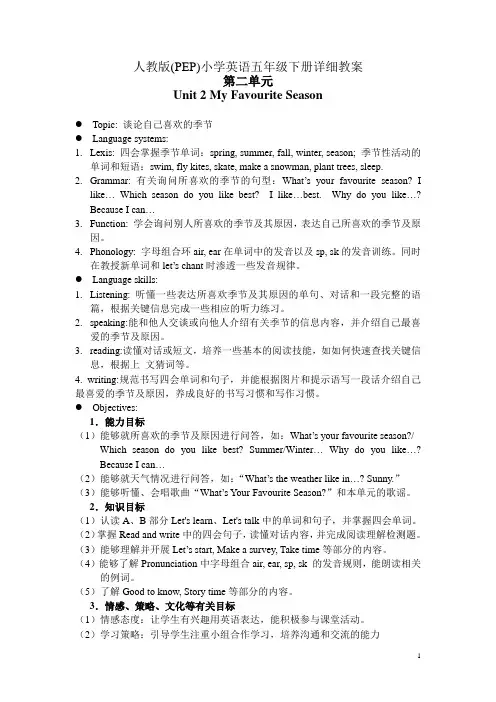
人教版(PEP)小学英语五年级下册详细教案第二单元Unit 2 My Favourite Season●Topic: 谈论自己喜欢的季节●Language systems:1.Lexis:四会掌握季节单词:spring, summer, fall, winter, season; 季节性活动的单词和短语:swim, fly kites, skate, make a snowman, plant trees, sleep.2.Grammar: 有关询问所喜欢的季节的句型:What’s your favourite season? Ilike…Which season do you like best? I like…best. Why do you like…?Because I can…3.Function:学会询问别人所喜欢的季节及其原因,表达自己所喜欢的季节及原因。
4.Phonology: 字母组合环air, ear在单词中的发音以及sp, sk的发音训练。
同时在教授新单词和let’s chant时渗透一些发音规律。
●Language skills:1.Listening: 听懂一些表达所喜欢季节及其原因的单句、对话和一段完整的语篇,根据关键信息完成一些相应的听力练习。
2.speaking:能和他人交谈或向他人介绍有关季节的信息内容,并介绍自己最喜爱的季节及原因。
3.reading:读懂对话或短文,培养一些基本的阅读技能,如如何快速查找关键信息,根据上文猜词等。
4. writing:规范书写四会单词和句子,并能根据图片和提示语写一段话介绍自己最喜爱的季节及原因,养成良好的书写习惯和写作习惯。
●Objectives:1.能力目标(1)能够就所喜欢的季节及原因进行问答,如:What’s your favourite season?/ Which season do you like best? Summer/Winter…Why do you like…?Because I can…(2)能够就天气情况进行问答,如:“What’s the weather like in…? Sunny.”(3)能够听懂、会唱歌曲“What’s Your Favourite Season?”和本单元的歌谣。
人教版PEP五年级英语下册第二单元《My favourite season》教案
Unit 2 My favourite season教案一、Teaching Contest:本课时教学重点是人教版PEP小学英语五年级下册第二单元《My favourite season》第四课时Let's talk的教学部分。
二、Teaching Objectives:1.Knowledge and Ability:能够在图片和教师的帮助下理解对话大意;能够按照正确的语音、语调及意群朗读对话,并能进行角色表演;能够在情景中运用句型Why?Because I …询问并回答喜欢某个季节的理由。
2.Process and Methods:利用中国古诗和图片呈现Let's talk中的内容;通过Free talk、Pair work、Role-play等形式操练本节课重点句型;最后通过观看四季相关的视频,感知四季之美。
3.Emotion、Attitude and Value:本课通过讨论季节,让学生感受生活之美,培养学生热爱生活的积极态度。
三、Important & difficult points:1.重点:能够在情景中运用句型Why?Because I …询问并回答喜欢某个季节的理由。
2.难点:熟练掌握重点句型,并能够分角色表演或重新编排情景对话。
四、Teaching methods:Free talk、Pair work、Role-play等五、Teaching aids:关于四季季节的图片、诗句、音频和视频六、Teaching procedures:Step 1 Warm up1.--Good morning, class!Today, we'll learn Unit 2 My favourite season.Before the class,let's sing a song about season,OK?--OK...(Teacher&Students sing together.)--Wow,you are so great! Clap hands for yourself.2.Next Let's do a revision.--Which season do you like best?--Spring/Summer/...--Good job? And which season do you like best?--I like summer best.--I like summer, too.Step 2 Presentation and Practice1.Presentation:T:As we know, there are many poems about seasons in China. For example,《春晓》、《春夜喜雨》、《绝句》。
PEP小学英语五年级下册《Unit2-My-Favourite-Season》教案
PEP小学英语五年级下册《Unit2-My-Favourite-Season》教案PEP小学英语五年级下册《Unit2MyFavouriteSeaon》教案一、学情分析在学会准确说出表示四季的单词以及用句型描述自己喜欢的季节的基础上,学生会自然而然地产生表述喜好原因的需求,这正是他们遇到的难题之一。
因此,教师应针对该难点,分层次为学生设计完整的语言情境和操练活动,激发并满足学生获取的欲望。
此外,学生在学习本课之前已经有关于气候、温度、色彩等词汇的知识储备,应该帮助学生建立前后知识的关联,构建系统的知识框架。
三、教学目标1.能力目标(1)能够就所喜欢的季节及原因进行问答,如:Which eaondoyoulikebetSummer/Winter...WhyBecaueIcan (2)能够就天气情况进行问答,如:What’theweatherlikein…Sunny.(3)能够听懂、会唱本单元的歌曲What’yourfavouriteeaon和歌谣。
2.知识目标掌握pring,ummer,autumn,winter如:WhicheaondoyoulikebetWhyBecaueIcan…3.情感、策略、文化目标(1)情感态度:让学生有兴趣用英语表达,能积极参与课堂活动。
(2)学生策略:引导学生关注小组合作学习,培养沟通与交流的能力。
(3)文化目标:让学生了解有关全球天气差异的常识。
A第一课时一、教学内容与目标1.教学内容: A.Let’learn2.教学目标:a.能够听、说、读、写单词:eaon,pring,ummer,autumn,winter.b.能够使用句型:Whicheaondoyoulikebet提问,并能够根据实际情况回答二、教学重、难点1.本课时的重点是正确书写五个名词并运用句型:What’theweatherlikein…进行问答。
2.难点是听、说、读、写单词pring,ummer,autumn,winter和eaon.三、教学步骤1.热身(Warm-up/Reviion)问好互动,看视频引出今天的主题eaon→用黑板上课前画的四棵不完整的树代表四个分组。
人教版pep五年级下册英语第2单元教案
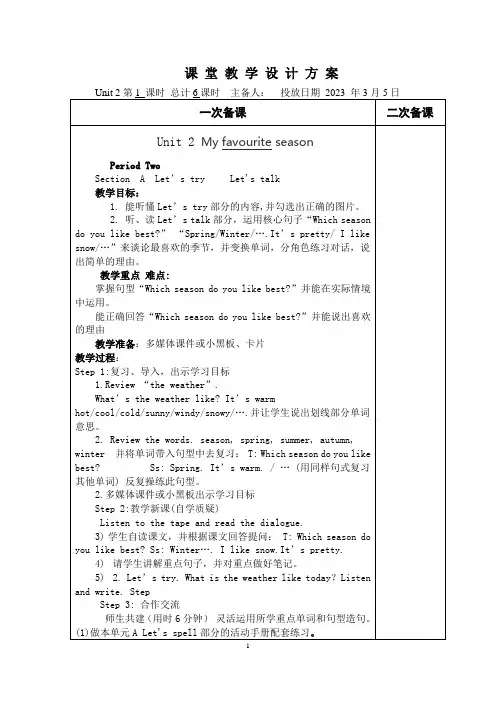
课堂教学设计方案Unit 2第1 课时总计6课时主备人:投放日期2023 年3月5日一次备课二次备课Unit 2 My favourite seasonPeriod TwoSection A Let’s try Let's talk教学目标:1. 能听懂Let’s try部分的内容,并勾选出正确的图片。
2. 听、读Let’s talk部分,运用核心句子“Which seasondo you like best?”“Spring/Winter/….It’s pretty/ I likesnow/…”来谈论最喜欢的季节,并变换单词,分角色练习对话,说出简单的理由。
教学重点难点:掌握句型“Which season do you like best?”并能在实际情境中运用。
能正确回答“Which season do you like best?”并能说出喜欢的理由教学准备:多媒体课件或小黑板、卡片教学过程:Step 1:复习、导入,出示学习目标1.Review “the weather”.What’s the weather like? It’s warmhot/cool/cold/sunny/windy/snowy/….并让学生说出划线部分单词意思。
2. Review the words. season, spring, summer, autumn,winter 并将单词带入句型中去复习: T: Which season do you likebest? Ss: Spring. It’s warm. / … (用同样句式复习其他单词) 反复操练此句型。
2.多媒体课件或小黑板出示学习目标Step 2:教学新课(自学质疑)Listen to the tape and read the dialogue.3)学生自读课文,并根据课文回答提问: T: Which season doyou like best? Ss: Winter…. I like snow.It’s pretty.4)请学生讲解重点句子,并对重点做好笔记。
人教版PEP小学英语五年级下册Unit2教案
Unit2 My favourite season单元分析一、单元教学分析本单元学习的主题是描述最喜欢的季节并陈述原因。
在内容上和四年级下册第四单元有相似之处,描述天气情况的形容词,如:cool,cold,riny, windy,snowy,suny等单词皆已学过,因此教师在教学过程中可以以旧带新,降低学习难度,又做到滚动复习语言知识。
课本中的主情景图通过在美术教室,Amy,John,Zoom和zip的对话场景呈现了本单元要学习的部分核心词汇。
这既可以作为对B部分对话的后续复习,又可以用来导入 Lets learn部分的新词学习。
教学时,教师可以利用教材情境图和相关视频,帮助学生感知和理解语言运用的情境。
本单元的学习重点是问答某人最喜欢的季节并陈述原因,其内容与学生的生活实际、休闲活动联系紧密。
因此,课堂教学要从学生的生活实际出发,鼓励学生积极参与活动,真实地表达对季节的喜好及原因。
在对话和读写教学中,可以渗透以wh开头的疑问词的用法这一语法点,并且在单元总结中再一次强化这一知识点。
本单元将学习字母组合br和gr的发音规则,通过听音拼读、书写等活动培养学生的语音意识,帮助学生借助语音知识提升认读和识记单词的效果。
同时要求学生在单线上完成抄写句子的活动,做到书写规范。
C部分的 Story time综合呈现了本单元的主要词汇和句型,同时还渗透了白色圣诞节的习俗和南北半球气候存在差异的常识。
学生在完成阅读、理解故事的基础上,可以分小组对故事内容进行分角色模仿表演。
二、单元教学目标(一)知识与能力目标:1.句型目标:(1)能够听、说、读、写句型Which season do you like best? Winter. Why? Because I like summer vacation!(2)能够在情景中运用句型 Which season do you like best? Winter.Why? Because I like summer vacation!询问并回答对季节的喜好,并简单陈述喜欢某个季节的理由。
人教版(PEP)小学英语五年级下册教案_第二单元(五篇模版)
人教版(PEP)小学英语五年级下册教案_第二单元(五篇模版)第一篇:人教版(PEP)小学英语五年级下册教案_第二单元Unit Two My favourite seasonPeriod oneTopic: Talk about your favourite season.Teaching contant: Part A Let’s learn and Read and match Teaching objectives: 1.Grasp the words about season:spring、summer、autumn/ fall、winter、season.2.Learn the sentences about how to ask someone’s favourite season:What’s your favourite season? I like… Which season do you like best? I like…best.I can… Teaching important points: 1.Listen、speak、read and write the words:spring、summer、autumn/ fall、winter、season.2.Learn how to ask someone’s favourite season, and use them in the specific situation.Teaching difficult points: Learn how to ask someone’s favourite season,and use the sentences.Source of material: Multimedia courseware、word cards、pictures.Teaching process I.Warm-up T: Good afternoon, boys and girls.Do you like to listen to music? S:Yes.T:Please listen to the music carefully.Let students listen to the music.Teacher leads in the new class whit the music.T:Do you want to know, what’s the music’s name ? S:Yes.T:The Four Seasons(四季).T oday ,we’ll learn a new unit about seasons.The topic is my favourite season.Write down the topic on the blackboard.II.Pre sentation Part A Let’s learn.Step1 Learn the new words.1.Learn the word season.Show the word card season, and put it up on the black board.First, let students try to read it.Then, teacher leads the st ,let students read together.3.Learn words: spring, summer, autumn/fall, winter.T: How many seasons are there in a year? S:Four.T:What arethey? You can answer in Chinese.Let students answer.Through the pictures and cards to learn the four seasons’ words.(1)Learn the word spring.First, teacher shows a picture and ask what season it is.Then, let students say out the season, and teacher show the words card.Let students try to read.Teacher gives necessary help, and then teacher leads the st ,students practice the pronunciation of the word by reading loudly.(2)The method of learning the rest seasons’ words as above.4.Practice.Game: Let’s guess.Teacher plays the multimedia courseware.Let students guess which season it is.Step 2 Learn how to ask someone’s favorite season.T:Now,Zhang Peng wants to kn ow Mike’s favorite season.Let’s listen to the recording carefully, and find out how Zhang Peng asks.Let students answer what they heard.T:You are great.Yes , If we want to know someone’s favorite season, we can ask: which season do you like best? Teacher and students learn the word which and extend into what、when、who and so on.Teacher leads the reading and students read after her.T:Do you want to know how to answer Mike? S:Yes.T:Please listen to the recording carefully.You can find out the answer.Let students answer what they heard.Teacher shows the answer ,then leads the reading and students read after her.Let students ask and answer in pairs.III.Practice 1.Teacher extends asking someone’s favourite season into another way:What’s your favourite season? And the answer.Show the multimedia courseware to let students practice.Then, let students act out their dialogue.2.Part A Read and match Let students open the books and do the exercise Read and match on page 15 individually.Teacher show the exercise.Then, check the answers together.And teacher tells how to do exercise.And then, students say out the new words and teacher gives necessary help.Letstudents listen to the recording.Then, translate together.Listen again and try to chant.IV.Homework 1.Recite the words we learned today and copy them two lines each word.2.Ask your friends’ favourite season with the sentences we learned today.Unit 2 My favourite season(人教版(PEP)小学英语五年级下册)榆中县小康营学区深沟小学金卓2015-3-28第二篇:(PEP)小学英语五年级下册第二单元第二课时教案人教版(PEP)小学英语五年级下册教案Unit 2 My favourite season第二课时Specific vocabulary: 学生能够在句型中运用季节的词语。
人教版小学英语PEP五年级下册第二单元
1. Greetings; 2. Daily
activities :
------How’s the w is it ?
------What’s the date today ?
3. Enjoy the song 《What time is it ? 》 3. Listen and sing this song
学生已掌 握的相关
知识
1. 基本掌握时间的整点表达法; 2. 基本能对自己在周几做什么事情进行简单的描述; 3. 基本掌握辅音字母 c , l, p 的发音;
学情分析
学生可能 遇到的学 习问题
1. 对于频度副词: often, always, usually, 的意义和区别容易混淆;
2. 把时间和短语放在一起综合运用; 3. 用本单元句型描述自己的日常生活;
点句型,并运用其完成询问他人的能力及介绍自己能力的交际, 形成良好的语言交往能力。 情感态度:1.引导学生养成良好的作息习惯,能够理解尊重从事不同职业人; 2. 训练学生的角色扮演能力,引导他们学会思考如何安排作息间 1. 四会词组:eat breakfast, do morning exercises, have---class, play sports, eat dinner, go for a walk, go 单元重点 shopping , clean my room, take a dancing class. 1、重点句型:----When do you ____?------I often-----------. 4. 语音知识:掌握字母组合 cl, pl 的发音。
单元难点 1. 掌握四会词组以及重点句型; 2. 能熟练使用频度副词表达日常生活;
整理文本
人教pep小学英语五下第二单元教学计划
人教pep小学英语五下第二单元教学计划Unit 2 Teaching Plan。
Objective: By the end of this unit, students should be able to understand and use the vocabulary related to daily routines, and be able to talk about their daily activities and the time they occur.Key Vocabulary:Wake up, get up, have breakfast, go to school, have lunch, go home, do homework, have dinner, go to bed。
Warm-up Activity:Begin the class by asking the students about their daily routines. Encourage them to share what they do from the moment they wake up until they go to bed. Write down their responses on the board.Introduction:Show the students pictures of different daily activities and ask them to identify what is happening in each picture. Use this opportunity to introduce the key vocabulary words and their meanings.Activity 1: Vocabulary Practice。
Divide the students into pairs or small groups and give each group a set of flashcards with the vocabulary words. Ask them to match the words with the corresponding pictures. Monitor their progress and provide assistance when needed.Activity 2: Listening Comprehension。