
湘少版六年级英语下册第九单元
Read Part A, and answer the questions below:
2.Why are they running?
They are running to catch a bus home.
3.How much money does Anne have? 4.Who walks up to them?
一个男孩走向她们,他拿着玲玲的钱包,他把钱包还 给玲玲。 Walk up to : 向……走去,走进 Eg : The horse walks up to its mother.
return…… to……..: 归还 Eg : Peter returns the ruler to Anne.
Anne : Thank you very much. Boy: You are welcome.
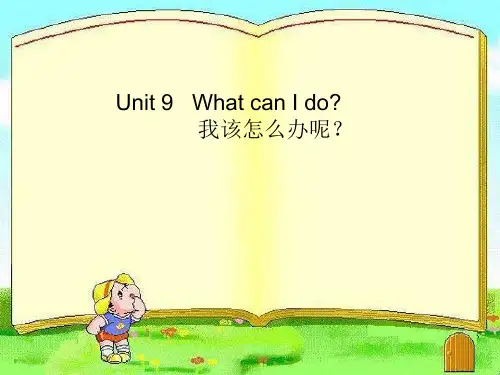
Unit 9 What can I do? 我该怎么办呢?
notice [ˈnəutis]
bus fare [bʌs] [fɛə]
Never mind [ˈnevə
catch a bus home [kæ tʃ]
catch
notice
Never mind
bus fare bus fare
catch
Analysis of the text 分析课文
Anne and Lingling are coming out of their school. They are running to catch a bus home.
玲玲和安妮从学校出来,她们跑去赶一辆回家 的公共汽车。 be+v-ing : 动作正在进行 come out of:出来 catch a bus home:赶一辆回家 的公共汽车
.
Anne:
I’ m sorry, lingling. I only have one yuan.
Lingling : Never mind. I can walk home. 对不起,玲玲。我只有一元钱。 没关系,我可以走回家。
Only: 仅仅,只有; Never mind: 没关系
A boy walks up to them,He is holding lingling’s purse. He returns it to lingling.
Let’s chant!
I’m too fat. I’m too fat. What can I do? What can I do? Do more exercises. Do more exercises.
Let’s chant!
I’m too fat / tired / thirsty / ill / cold. What can I do? -- Do more exercises. --Have a rest. --Drink some water. --See a doctor. --Put on your clothes.
Lingling’s purse drops out of her bag, She does not notice it.
玲玲的钱包从她的书包里掉出来,她没有注意到。 drop out of: 从……中掉出来
Eg: Anne’s book drops out of her schoolbag.
notice:注意 Eg: Don’t notice it.
Lingling : I haven’t got any money for the bus fare. 我没钱坐公共汽车。
Have got: 有,拥有; Haven’t got: 没有;
Eg: I haven’t got enough food.
bus fare :公共汽车费 Eg : The bus fare is one yuan.
谢谢!…地方出 来) • run to (跑去) • catch a bus (赶公交车) • drop out of (从…掉出来) • notice (注意) • bus fare(公交车费)
1.Where are Anne and Lingling?
5.What is he going to do?
He is going to return the purse to Lingling. A boy walks up to them. She has only one yuan.
Lingling: What can I do? 我该怎么办?
5. -- I’m cold. What can I do? -- Put on your clothes.
新单词:
too fat 太胖了 tired 疲劳的 Thirsty 口渴的 ill 生病的 cold 寒冷的
1. I feel sick. what can I do ? You can ( C ). 2.My clothes are dirty.what can I do? You can( B) . 3.I am thirsty. what can I do ? You can ( A )
A drink some water C go and see a doctor
B put them in the washing machine
例句仿写。 Example: Linda is tired.(go to bed) She can go to bed. 1. Anne is too fat. (do more exercises) do more exercises She can ________________. 2.Mingming is thirsty. (drink some water ) drink some water He can ________________. 3.Ken made his hands dirty. (clean them ) clean them He can ________________.
What can +主语+do? What can I do ? What can Anne do? What can they do ?
1. -- I’m too fat. What can I do? -- Do more exercises. 2. -- I’m tired. What can I do? -- Have a rest. 3. -- I’m thirsty. What can I do? -- Drink some water. 4. -- I’m ill. What can I do? -- See a doctor.
无法播放动画请点击左边符号
There will be more answers than questions. Help each other, the world will be better! 办法总比困难多! 互爱互助,世界更美好!
Thank you!
湘少版六年级英语下册第九单元
He is going to return the purse to Lingling. A boy walks up to them. She has only one yuan.
Lingling: What can I do? 我该怎么办?
.
Anne:
I’ m sorry, lingling. I only have one yuan.
Lingling : Never mind. I can walk home. 对不起,玲玲。我只有一元钱。 没关系,我可以走回家。
Only: 仅仅,只有; Never mind: 没关系
A boy walks up to them,He is holding lingling’s purse. He returns it to lingling.
5. -- I’m cold. What can I do? -- Put on your clothes.
新单词:
too fat 太胖了 tired 疲劳的 Thirsty 口渴的 ill 生病的 cold 寒冷的
1. I feel sick. what can I do ? You can ( C ). 2.My clothes are dirty.what can I do? You can( B) . 3.I am thirsty. what can I do ? You can ( A )
Analysis of the text 分析课文
Anne and Lingling are coming out of their school. They are running to catch a bus home.
新湘少版六年级英语下册Unit 9
Unit 9 Look at the beautiful places in the world.教学目标:1、能听懂、会说、认读、会写新单词the Eiffel Tower, the Golden Gate Bridge, travel, The Great Wall, Big Ben, places of interest。
2、能听懂、会说、认读短语travel to London, take pictures。
3、能够运用句型“I went to…”“I travelled to…”“I saw…”“I enjoyed…”描述自己的旅游见闻,能用“I want to…”表达自己的旅游愿望。
4、能听懂、会说A部分对话。
教学重难点:重点:能听懂、会说、认读、会写新单词the Eiffel Tower, the Golden Gate Bridge, travel, The Great Wall, Big Ben, places of interest。
能够运用句型“I went to…”“I travelled to…”“I saw…”“I enjoyed…”描述自己的旅游见闻,能用“I want to…”表达自己的旅游愿望。
难点:能在图片的帮助下复述课文A部分。
教学过程:Step 1 Warning up1.Greetings.2.Revision. (复习国家名称,以接龙形式,看谁接的最多)Step 2 Presentation1.New words(1) 学习travel to London, take pictures, Big Ben(出示单词卡片)T: Look at this picture. It’s very famous. What can you see in the picture?Ss: I can see a clock.T: Yes, it’s Big Ben.(板书并带读)T:Who can tell us about it?T::It’s a clock. It’s very cold. But the clock is still working.(2)学习 tower, the Eiffel TowerT: (出示图片)Look at this picture, we can see a tower. It’s the Eiffel Tower.(板书并带读)T:Where is it?Ss: It’s in France.(3)学习the Golden Gate BridgeT:(出示图片)This is the Golden Gate Bridge.(板书并带读)How do you think of the Golden Gate Bridge?S1: It’s very beautiful.S2: It’s nice.T: Yes, it’s over the sea. It’s very b eautiful at night.(4)学习go to places of interest.T: They are all places of interest in the world.(板书places of interest并带读)T:I want to go to places of interest.( 补充板书go to places of interest).I want to travel to the USA. I want to see the Golden Gate Bridge. How about you?Ss:…(5)学习the Great WallT:(出示长城图片)Where is it?Ss: It’s the Great Wall.T: Yes, it’s the Great Wall.(带读新单词)Last summer, I went to the Great Wall. I saw the Great Wall. It’s very cold and long. I enjoyed walking on the Great Wall.(板书句型“I went to… ” “I saw…”)T:Where did you go during your holidays?S1: I went to…T: What did you see?S1: I saw…T: How about you?S2: I went to…I saw…用下列句型分组谈论自己的旅游见闻,并抽几组向全班介绍。
六年级英语下册课件-Unit 9 Look at these beautiful places in the world(99)-湘少版

1、Where did Peter go last year? Peter went to Eiffel Tower.
2、Where did Anne go last winter? Anne went to the Golden Gate Bridge.
3、Where did Lingling go last week? Lingling went to the Grate Wall.
They are the Eiffel Tower(埃菲尔铁塔)、 the Golden Gate Bridge(金门大桥)、 the Great Wall(长城) 、 Big Ben(大本钟).
Read and answer 1、Where did Peter go last year? 2、Where did Anne go last winter? 3、Where did Lingling go last week? 4、Where did Mingming go last year?
Australia(澳大利亚)
America(美国)
Canada (加拿大)
Toronto(多伦多)
Which place (哪个地方) do you want to go ? Why ?
根据下列提示,小组讨论。
I want to go to…(the USA / France /London/ Beijing)
4、Where did Mingming go last year? Mingming went to Big Ben.
Listen again and answer Where are they? Answer: The Eiffel Tower is in France The Golden Gate Bridge is in the USA The Great Wall is in Beijing Big Ben is in London
六年级下册英语课件-Unit 9Look at these beautiful places in the world4_湘少版
France 法国
the Eiffel Tower
埃菲尔铁塔
the Golden Gate Bridge 金门大桥
the USA 美国
金门桥(the Golden Gate Bridge)是世界著名的桥梁
之一,也是近代桥梁工程的一项奇迹。大桥雄峙于美国加利福尼亚州长 1900多米的金门海峡之上,历时4年和10万多吨钢材,耗资达3550万美 元建成,由桥梁工程师约瑟夫·施特劳斯(Joseph .Struss, 1870—1938 年)设计。
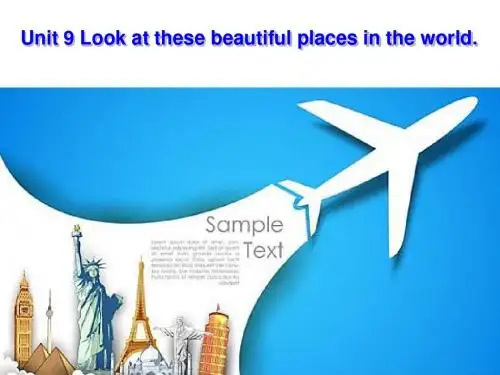
Unit 9 Look at these beautiful places in the world.
Big Ben 大本钟
London 伦敦
伊丽莎白塔,旧称大本 钟,(BIG BEN),即 威斯敏斯特宫钟塔, 世界上著名的哥特式 建筑之一,英国国会 会议厅附属的钟楼 (Clock Tower)的 大报时钟的昵称。是 坐落在英国伦敦泰晤 士河畔的一座钟楼, 是伦敦的标志性建筑 之一。钟楼高95米, 钟直径7米,重13.5吨。 每15分钟响一次,敲 响威斯敏斯特钟声。
China 中国 长城 the Great Wall
She went to London. She travelledቤተ መጻሕፍቲ ባይዱto London.
travel
旅行
places of interest
风景名胜
Thank you
湘少版六年级英语下册Unit9 China is a great country

第1学时
教学目标 1.能用所学词语或句子谈论国家和风景名胜等。 2.能听懂并会用所学句型I will never forget the Great Wall. I will always love the beautiful
Hunan silk. 和Who can forget such a beautiful place? 等进行对话交流和表述,掌握课文中出现的生 词。 3.培养学生热爱祖国大好河山和风景名胜的情感。 教学内容 词汇: forget such Terra-cotta Warriors chairman Tian ’anmen Square The Great Wall Hunan silk The Pearl Tower 句型: I will never forget the Great Wall. I will always love the beautiful Hunan silk. Who can forget such a beautiful place?
3.任务2的教学:
( 1 ) 教 师 让 学 生 看 Listen and say 的 教 学 内 容 , 带 领 学 生 朗 读 Tian’anmen Square, The Great Wall, Hunan silk, The Pearl Tower, Zhangjiajie, Terracotta Warriors这几个单词和短语,或让学生齐声朗读这几个单词和短语。
(4)让学生把自己以前游览过风景名胜名称,在哪个省或直辖市,感觉这些风景名 胜怎么样。(教师可以提供一些描述性词语,供学生小组谈论时参考。 另外,教师 可以告诉学生,所有中国省份和城市名称,均用汉语拼音拼出。)
(5)教师展示自己制作的课件,课件中展示了一些风景名胜画面,画面旁边用英语 标注了名称和所在省份或城市。两个学生就画面中风景名胜在进行谈论和表述。课 件中有声音,有文字,声像并茂,向学生展示了所学的重点词语和句型,既可起到 复习、巩固作用,也为学生进行问答对话起了示范作用。
最新六年级英语下册(湘少)Unit 9 Look at these beautiful places in the world
32
回到首页
Read and think
Which place do you want to go? Why?
33
回到首页
34
回到首页
35
回到首页
36
回到首页
37
回到首页
Talk about your travelling:
30
回到首页
Read and answer
1. Where did Peter go last year? He went to France. 2. Where did Anne go last winter? She went to the USA. 3. Where did Lingling go last week? She went to Beijing. 4. Where did Mingming go?
38
回到首页
39
回到首页
1. What did you do during the holiday? 2. Where did you go? 3. What did you do there? 4. What did you see?
参考句型: 1. I went to… 2. I took a picture of… 3. I saw… 4. It was…. 5. Many people enjoyed…
17
回到首页
London Bridge
伦敦桥
18
回到首页
Big Ben
大本钟
19
回到首页
China France
Australia
the UK Canada
六年级英语湘少版(三起点)下册Unit9_单元总览
Unit9 单元总览一、教学目标二、单元分析1. 学习链接(1) 词汇:①几个世界著名风景名胜的名称是本单元学习的重点。
其他单词如travel to London,只要求听懂、会说,不要求掌握。
②有关在旅途中的活动的词汇曾在以前的教材中学过,如take pictures曾在五年级下册第十二单元中学习过,the Great Wall其实也曾在五年级下册第十二单元后的Let’s Know More中出现过。
结合本单元的学习可以达到复习巩固的目的。
③关于国家名称的单词曾在四年级下册第五单元中重点学习过,在本单元的学习中达到复习巩固的目的。
(2) 句型:①“I went to...”“I saw...”这两个句型曾在五年级下册第十二单元中重点学习过,学生已经很熟悉,能够非常流利地运用。
②“I enjoy...”这个句型在六年级上册第四单元中学习过,学生也很熟悉,并能非常熟练地运用。
③为了丰富学生的语言交流,结合本单元的话题语言内容,可运用句型“Where did you go?” “What did you do?” “What did you see?”,这些句型曾在五年级下册第十二单元中学过。
2. 话题解读本单元的话题为旅游(Travelling)。
此话题贴近学生的日常生活,学生们都有旅游经历,在旅游的过程中会看到一些美丽的风景,做一些难忘的事情。
因此,伴着美好的回忆,学生很有兴趣向同伴们介绍自己的旅游见闻。
也会乐意听一听他人的旅游见闻,了解一些风景名胜,并开阔自己的眼界。
在学习本单元的知识时,,可以让学生拿出一些自己旅游时拍下来的照片,向同学介绍自己所见过的风景名胜,聊一聊自己的旅游见闻。
有条件的学校可以让学生做一个关于某景点介绍的PPT, 以报告会的形式向全班介绍自己的旅游见闻,效果会更好。
3. 难点分析(1) 用“I went to...”“I saw…”“I want to go to...”表达旅游见闻时,教师可以出示一些提示性词组,丰富基础较弱的学生的语言输出;对于基础较好的学生可以多鼓励他们大胆发言,教师及时纠正出现的错误,但要注意维护学生说的自信心。
六年级下册英语课件-Unit 9Look at these beautiful places in the world8_湘少版
take pictures 拍照/teik/ /'pi Nhomakorabeatʃəz/
travel to London 去伦敦旅行
/'træ vəl/ /'lʌndən/
travel to . . .
placgeostoof interest
/'pleisiz/ /'intrist/
去风景名胜
the Great Wall
/greit/ /wɔ:l/
长城
the Eiffel Tower
埃菲尔铁塔
/'aifəl/ /tauə/ 埃菲尔铁塔,也称为巴黎铁塔,是位于法国巴黎战神广场的铁制镂空
塔,世界著名建筑,巴黎最高建筑物,也是法国的文化象征之一。
Big Ben
大本钟
大 钟/b本直ig钟径/是9/英b伦e尺敦n,的/重标13志.5性吨建。筑大之本一钟。从钟18楼59高年9就7米为,
伦敦城报时,每隔一小时敲响一次,至今将近 一个半世纪。
the Golden Gate Bridge 金门大桥
/'gəuldən/ /geit/
金门大桥是世界著名的桥
/bridʒ/
梁之一,是近代桥梁工程
的一项奇迹。大桥雄峙于
美国加利福尼亚州宽1900
多米的金门海峡之上。桥
总长2737米,宽28米。
Unit 9 Look at these beautiful places in the world.
Free talk.
What did you do yesterday?
•
Where did you go last weekend?
Guess: Where did I go last weekend? I went to the park .
(湘少版)六年级英语下册《unit 9》教学设计设计
(湘少版)六年级英语下册《unit 9》教学设计教学背景本教学设计针对的是六年级下册的英语教学,课程内容为《unit 9》。
根据教材内容,本单元主要涵盖了有关旅游的基本知识和表达方式。
教学目标为培养学生的听、说、读、写四个方面的英语语言能力,提升学生的各项综合能力。
教学目标1.听力理解:听懂自我介绍、问路和旅游方面的基本交流内容。
2.口语表达:能够运用所学知识,进行自我介绍、问路和旅游方面的基本交流。
3.阅读理解:能够理解旅游指南、景点介绍等简单的英文阅读材料。
4.写作能力:能够根据所学知识,进行写作,如旅游日记、旅游计划等。
教学重点1.旅游方面的基本英语表达方式。
2.听、说、读、写四项基本语言能力的培养,提高学生综合语言能力。
教学难点1.听力和口语能力的培养,如良好的英语发音和听力理解。
2.提高学生的英语书写能力和阅读理解能力。
教学内容及方法教学内容1.生词学习:让学生掌握一些生词和表达方式。
2.课文教学:主要教授单元中的对话和文章,帮助学生熟悉旅游方面的知识和基本表达方式。
3.学习技巧:指导学生如何更好地学习英语语法、词汇和表达方式,提升学习效率。
教学方法1.演示法:通过教师或其他资源实际演示旅游场景,加深学生对英语表达方式的理解。
2.交际法:让学生通过语言交流的方式,培养口语和听力能力。
3.阅读法:让学生通过阅读旅游指南、景点介绍等英语材料,提高英语阅读理解能力。
4.写作法:让学生通过写作旅游日记、旅游计划等方式,提高英语书写能力。
教学流程第一步:导入1.调动学生学习英语的兴趣,通过带生动的图片、影片等方式激发学生的学习欲望。
第二步:新授课1.教师通过讲解和演示的方式,介绍本单元的重点知识和表达方式。
2.进行英语对话和交流,提高学生的口语和听力能力。
3.通过阅读旅游指南和景点介绍等文章,提高学生英语阅读和理解能力。
4.通过教师布置作文任务,提高学生英语写作能力。
第三步:练习及检验1.针对所学内容,进行听力、口语、阅读、写作的训练及测试,检验学生英语语言能力。
湘少版(XS)六年级英语下册Unit 9
kangaroo
Sydney Opera House
koala r
A Let's Listen and Say
重点讲解 1. My family went there last year.
我们全家去年去了那里。
last 作形容词,意思是“上一个的,最近的”。 例:I went to the park last week.
the Eiffel Tower
Big Ben
the Great Wall
the Golden Gate Bridge
travel to London
take pictures go to places of interest
C Let's Practise
D Let's Read
重点讲解
Unit 9 Look at these beautiful
places in the world
XS六年级下册
Do you like travelling? Where did you travel to? Look at the pictures. Do you know them?
Triumphal Arch
1. What did you do during the holiday? 2. Where did you go? 3. What did you do there? 4. What did you see?
我上周去了公园。
2. It’s very old but the clock is still working. 它非常古老,但钟仍在走。
此处work作动词,意思是“工作;(机器)运转”。 例:My watch doesn’t work.