
译林版七年级上册第四单元Welcome to the unit
get up
1:40 p.m.
have breakfast 4:30 p.m.
have lessons 5:40 p.m.
do morning
exercises
7:00 p.m.
have lunch have a rest
7:30 p.m. 9:00 p.m.
have lessons do after-school activities
do after-school activities
She does after-school activities at 4:00 p.m. She has (a lot of ) fun.
Millie’s day
4:30p.m. go home
She goes home by bus at 4:30 p.m.
Unit 4
Studying aims
1.To be able to read and spell some new words and useful phrases.
(会朗读拼写一些新单词和有用的短语)
2.To be able to talk about your day.
(能谈论你的一天生活)
1. wake up
比一比,看谁先记住我!
2. Is it time for breakfast?
Is it time to have breakfast?
3. Shall we go walking in the hills?
Hello, everyone! I’m … I often get up at …
get up have breakfast have lessons do morning exercises have lunch have other lessons do after-school activities
don’t know how to have fun.
取乐
Eddie’s Day
get up have breakfast go to sleep have lunch go to sleep
Task 5 –Reading and repeating
埃迪和霍波对话啦, 听一听谁模仿的声音最像!
Task 6 -Reading
Read the dialogue on Page 42 by yourselves. Try to find out something difficult.
(自读对话,找出疑难点.)
智者善于动脑, 勇者敢于提问!
1.wake up 醒过来,叫醒
拓展和延伸
叫醒他/我/我们___w_a_k_e_h_i_m_/_m_e_/_u_s_u_p__(_代_词__置__中__)
Shall we//I do sth?
Shall 与第一人称(I, we)
连用,表示提出或征求意见
4.Some dogs just don’t know how to have fun.
疑问词+ to do作宾语
我不知道去哪里。I don’t know ___w_h_e_r_e_to__g_o____. 她不知道做什么。She doesn’t know _w_h_a_t_to__d_o____.
叫醒李华__w_a_k_e_L_i_H_u_a__u_p_//_w_a_k_e_u_p__L_i_H_u_a__
2.Is it time for breakfast? 该是吃早饭的时候了吗?
该是干某事的时候了。
_I_t_’s__t_im_e__t_o__d_o_s_t_h_.__//__I_t_’s__t_im__e_f_o_r__s_th_._____ 该上学了。__It_’s__ti_m_e_t_o_g_o_t_o_s_c_h_o_ol_.__
3.To be able to write about your day.
(能写你的一天生活)
4.To love life and have good habits.
(热爱生活,养成好习惯)
Quicken your mind(脑筋急转弯)
What is the first thing you do in a day? Opening eyes
Millie’s Day
Millieg_e_t_s_ up at 6:30 a.m. She e__a_t_s_ breakfast at 7:00 a.m. Then she _g__o_e_sto school. At 8:00 a.m. she d__o_e_s_ morning exercises. After that, she _h_a_s__ lessons at 8:25 a.m. She _e_a_t_s_ lunch at 11:50a.m. At 1:30 p.m. she _h_a_s_ lessons again. At 4:00 p.m. shed_o_e__s_ after-school activities. She _g_o_e__s home at 4:30 p.m. She _d_o_e_s_ her homework at 5:30 p.m.
eat supper
watch TV
do homework go to bed
Free talk
Talk about your school life in pairs.
A: Hello, …! When do you get up every day? B: I usually get up at 6:00. I’m never late for school. A: Good. What time do you start lessons? B: At 7:30. A: Do you enjoy school? B: Yes. I enjoy it very much. It’s fun.
She e__a_t_s_ supper at 6:30 p.m. At 7:00 p.m. shew__a_t_c_h_e_s TV. At 9:30 p.m. she _g_o_e_s_ to bed.
Task 4 ----
Does Eddie get up early? What’s Eddie going to do after breakfast or lunch?
We go to bed at 9:00 p.m. We never watch TV on weekdays.
自 学 (1)
Read by yourselves loudly . 放开声音自己读.
wake up
醒过来;叫醒
have a good rest
好好休息一下
have breakfast/lunch /dinner 吃早饭/午 饭/ 晚饭
do morning exercises
She does morning exercises at 8:00a.m.
Millie’s day
8:15 a.m.
a quarter past eight
have lessons She has lessons at 8:15 a.m.
Millie’s day
watch TV
do morning exercises
go to bed
have breakfast do homework
Task –Group work. Filling in the form 完成表格
6:00 a.m.
6:40 a.m. 7:30 a.m. 9:10 a.m. 11:10a.m. 12:00a.m.
have lessons
上课
do morning exercises
做早操
do after-school activities
做课外活动
do homework
做家庭作业
watch TV
看电视
read books
看书
get up
have lessons
do after-school activities
get up have lessons have dinner go to bed
have breakfast have lunch watch TV do hetition
Talk about your daily activities in English. 用英语谈谈你的日常活动
7:30a.m.
We usually start lessons at 7:30 a.m. 通常,经常
We have lunch at 11:15 .
a quarter past eleven
We do after-school activities at four o’clock in the afternoon.
She watches TV at 7:00 p.m.
Millie’s day
7:30 p.m.
do homework
She does her homework at 7:30 p.m.
Millie’s day
9:30 p.m. go to bed
She goes to bed/sleep at 9:30 p.m.
___________I_t’_s_t_im__e_fo_r__sc_h_o_o_l._____ 该吃晚饭了。 ____I_t’_s _ti_m_e__to_h_a_v_e_//_f_o_r_s_u_p_p_er_/_d_in_n_e_r.___________
3.Shall we go walking in the hills? 我们去山上散步好吗?
have dinner do homework go to bed
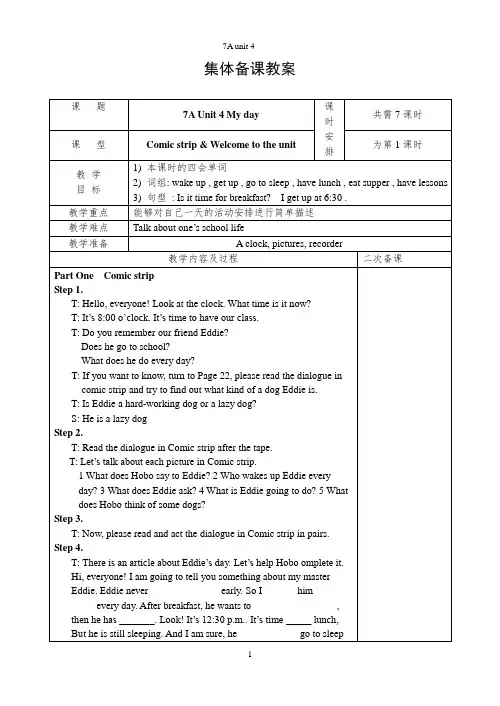
译林版英语七年级上册Unit 4教案
2. Passage 4 To 5
Read them louglythen do TIF question ,e.g.
(1)Millie seldom chats with her friendsafter class.
(2)Millie only goes to the Reading Club On Tuesday.
(3)Millie is a member of the school swimming team.
3. Read the e-mail again and do Ex on p45 B1, P42,B3, step5. post—reading
Do you want to be the best football player in the team?
(The Ss’answer)
Then the teacher say:
I think you shouldpracticehard after school. I wish yousullies.
教学难点
To help the students improve the abilities of listening , speaking reading and writing.
教学准备
Task—based approach
教学内容及过程
二次备课
Step1. warm up
Have a free talk.
2. Have an Interview
Let one of the students act the role of Millie.The other students can ask any question about her school.
Unit 4 Welcome to the unit 课件2024-2025学年译林版七年级英语上册

have English/…lessons do morning exercises When do you usually do these activities? 6:00 p.m
8:05 a.m five past eight in the morning
9:45 a.m
six o’clock
(1)nine forty-five
in the afternoon
(2)fifteen/a quarter to ten
Read, ask and answer
Pair work A: What time does Millie get up? B: She _______________ at _____________. A: What does she do at 7:20 a.m.? B: She_______________________________. …
Homework
1. Finish the exercises; 2. Review the reading p44 3. To share the best part of school days.
THANKS!
Unit 4 Schoot
Lead-in
School is a good place for learning. Learning is the key to unlocking(解锁) the world.
In this unit, we will…
View and speak
What are students doing? do some sports
have lessons
Running
do morning exercises
牛津译林版七年级上册(2024)Unit 4 School day 语言点和语法点整理
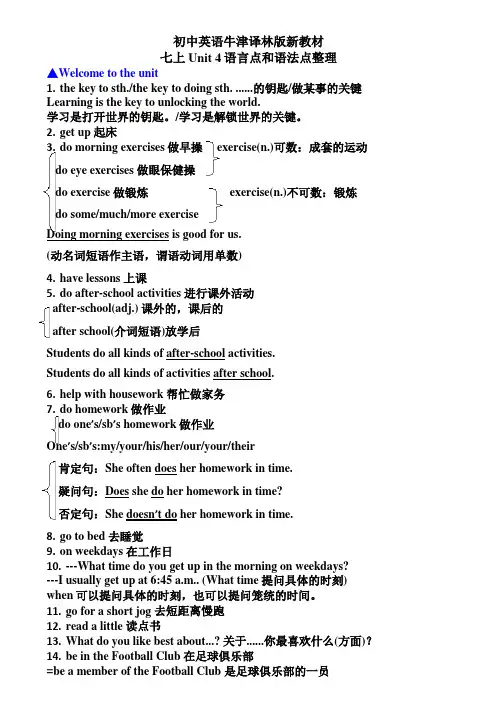
初中英语牛津译林版新教材七上Unit 4语言点和语法点整理▲Welcome to the unit1.the key to sth./the key to doing sth. ......的钥匙/做某事的关键Learning is the key to unlocking the world.学习是打开世界的钥匙。
/学习是解锁世界的关键。
2.get up 起床3.do morning exercises做早操 exercise(n.)可数:成套的运动 do eye exercises 做眼保健操do exercise 做锻炼 exercise(n.)不可数:锻炼do some/much/more exerciseDoing morning exercises is good for us.(动名词短语作主语,谓语动词用单数)4.have lessons 上课5.do after-school activities 进行课外活动after-school(adj.) 课外的,课后的after school(介词短语)放学后Students do all kinds of after-school activities.Students do all kinds of activities after school.6.help with housework 帮忙做家务7.do homework做作业do one’s/sb’s homework做作业One’s/sb’s:my/your/his/her/our/your/their肯定句:She often does her homework in time.疑问句:Does she do her homework in time?否定句:She doesn’t do her homework in time.8.go to bed 去睡觉9.on weekdays 在工作日10.---What time do you get up in the morning on weekdays?---I usually get up at 6:45 a.m.. (What time提问具体的时刻) when可以提问具体的时刻,也可以提问笼统的时间。
译林版七年级上册单元短语
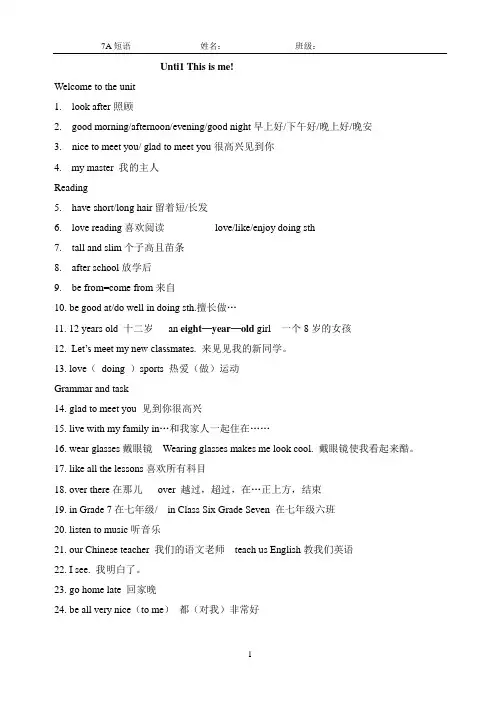
Unti1 This is me!Welcome to the unit1. look after照顾2. good morning/afternoon/evening/good night早上好/下午好/晚上好/晚安3. nice to meet you/ glad to meet you很高兴见到你4.my master 我的主人Reading5. have short/long hair留着短/长发6. love reading喜欢阅读love/like/enjoy doing sth7. tall and slim个子高且苗条8. after school放学后9. be from=come from来自10. be good at/do well in doing sth.擅长做…11. 12 years old 十二岁an eight—year—old girl 一个8岁的女孩12.L et’s meet my new classmate s. 来见见我的新同学。
13. love(doing )sports 热爱(做)运动Grammar and task14. glad to meet you 见到你很高兴15. live with my family in…和我家人一起住在……16. wear glasses戴眼镜Wearing glasses makes me look cool. 戴眼镜使我看起来酷。
17. like all the lessons喜欢所有科目18. over there在那儿over 越过,超过,在…正上方,结束19. in Grade 7在七年级/ in Class Six Grade Seven 在七年级六班20. listen to music听音乐21. our Chinese teacher 我们的语文老师teach us English教我们英语22. I see. 我明白了。
Unit 4 Welcome to the unit 课件-译林版(2024)英语七年级上册
Complete the table with your own daily
activities.
listen and answer
Q1:What time does Simon get up in the morning on weekdays?
New words and phrases
In the evening, we go home and have dinner at home.
We often help with housework.
have dinner 吃晚饭
help with housework 帮忙做家务
go to bed 去睡觉
do morning exercises
做早操
have lessons 上课
At school, we do morning exercises and
have lessons.
New words and phrases
have lunch 吃午饭
After lunch, we have lessons.
Millie is a hard-working student. She g__e_t_sup at 7:00 a.m.. She goes to s_c_h_o_o_l at 7:40. Before the first lesson starts, Millie and all her
classmates do morning __e__x_e_r_c_i_s_e_s_. She has lunch at ten to _tw__e_l_v_e. The school finishes at four p.m.. Then it’s time for after-school _a_c_t_iv__it_i_e.s She always has fun. After dinner, Millie usually helps her parents _w_i_t_h___ housework. Then she needs to do her _h_o__m__e_w__o_r_k_. She always does it
译林版七年级上册单元短语默写
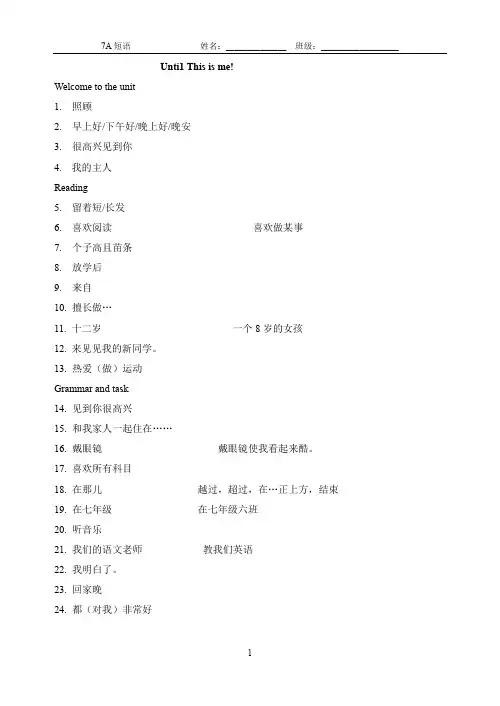
Unti1 This is me!Welcome to the unit1. 照顾2. 早上好/下午好/晚上好/晚安3. 很高兴见到你4.我的主人Reading5. 留着短/长发6. 喜欢阅读喜欢做某事7. 个子高且苗条8. 放学后9. 来自10. 擅长做…11. 十二岁一个8岁的女孩12.来见见我的新同学。
13. 热爱(做)运动Grammar and task14. 见到你很高兴15. 和我家人一起住在……16. 戴眼镜戴眼镜使我看起来酷。
17. 喜欢所有科目18. 在那儿越过,超过,在…正上方,结束19. 在七年级在七年级六班20. 听音乐21. 我们的语文老师教我们英语22. 我明白了。
23. 回家晚24. 都(对我)非常好Unit 2L et’s play sports.Welcome to the unit1. 喜爱散步2. 走向我的碗3. 一天许多次一次两次三次4. 打网球5. 你最喜欢的体育运动是什么?6. 你呢?跳舞怎么样?7. 喜欢游泳8. 每周Reading9. 读书俱乐部的一名成员10. 看起来强壮11.打得好,玩得好一名优秀的运动员12. 在某人的空闲时间(my/ your/ our/ her/ his/ their)13. 让他(感到)快乐使某人(变得)怎么样14. 想要做某事15. 实现我希望他的梦想成真。
16. 学习英语他空闲时学英语。
17. 参加下一届世界杯18. 他的梦想他想要成为一名老师。
(2)19. 她/许多人最喜欢的足球运动员20. 希望做某事hope sb / sth to do sth(×)Grammar21. 舞跳得好22. 当然(2)23. 在电视上观看比赛23.在周末24.呆在家中到家走回家Integrated skills to task25. 我的许多学生26. 还有其他什么别的东西/人27. 让我感觉很棒让某人做某事28. 阅读有趣。
牛津译林版七年级英语上册unit4全单元教案
38 牛津译林版七年级英语上册牛津译林版七年级英语上册Periods :031Date : : Prepare – Oct.15th Title : Unit 4 My day Comic strip & Welcome to the unitTeaching aims: Students can master the following in this class.1.words :wake shall seldom activity quarter2.phrases :wake up, go out, do after-school activities, do homework, have fun,be late for , go to bed 3.sentences :I seldom go out .I’m never late for it .At a quarter past eight . Difficult points:Words about daily life .Students can use the words and sentences learned in this class to describe daily life .Procedures :Step1 Free talkLead-inT: What time does your school day begin ?S: It begins at 6:45.T: Oh, it starts at 6:45. You start our school day at 6:45. So you need to wake up very early. (teach wake up and start )Show some pictures of clock.T: It is six o ’clock in the morning. What does ….do? Can you guess ?(Teach have breakfast /have lunch /have dinner; need; rest ;go out ; have fun )Step2 PracticeT: Hobo wants to know something about you. He would like to ask the questions below. Please answer them.(1) What time do you wake up?(2) Do you often go out to play games /have dinner .have fun ?(3) Do you often have breakfast ?(4) Where do you have lunch ?(5) Do you always have a rest after lunch?According to the students ’ answers, present “seldom ”and “never ”at the right time.Step3 PresentationT: Do you remember our friend Eddie ? What does he do every day? Can you guess ?Now let’s listen to the conversation between Eddie and Hobo and check if you are right. (Teach hill )T: What does Hobo think of dogs like Eddie ?Step 4 PracticePractise the conversation and act it out.Step 5 ExtentionHere’s Hobo ’s diary. Please help him complete it.It is sunny today. I would like to go________. I like sports and I always go walking in the ____________. But my friend Eddie is lazy. He ___________does sports. He _________up very late.And then he wants to have __________. After it, he sleeps again. When he finishes his lunch, he says he ________a good _______ once more.Oh, my God ! His life is eating and sleeping. I think some dogs ________don’t know how to have____________.Step 6 PresentationT: Do you want to be lazy like Eddie? What time do you wake up every morning ? What time do you have breakfast / lunch / dinner /every day ? Why do you get up so early ?(Teach quarter, past, get up and be late for, have lessons/have classes. do after-school activities, do homework, go to bed …)Step 7 PractiseLook at the table of Millie’s day. Answer some questions.Look at the times on the blackboard. Please tell me your activities at these times.6:30 a.m 7:00 a.m 8:00 a.m 11:50 a.m4:30 p.m 6:00 p.m 8:00p.m 9:00 p.mMake sentences with “I _________________ at_____________.”Step 8 PresentationPart BT: Millie is busy every day. Now, she is telling her aunt about her school life. Let’s listen to their conversation and answer my question: Is Millie often late for school ?S: No. She is never late for school.T: Millie is a good student. She is never late for school. What about you? Are you often late for school? Are you never late for school?Step 9 PractiseRead Part B and practice it .T: Are your daily activities the same as Millie’s ? Now, you can complete the table on the right with your own information.…….T: Now time for you. I’d like you to work in groups of four to discuss your own day. You can use Millie and her aunt’s conversation as a model.Homework :1. Learn the new words by heart.2.Finish the exercisesAfterthoughts :Periods :032-033Date : : Prepare – Oct.15thTitle: Unit 4 My day ReadingTeaching aims:1. Students can master new words and expressions.2. Students can learn some new phrases: chat with best wishes have a good time3. Students can learn some new sentences:Our school starts at eight in the morning from Monday to Friday.Usually we do morning exercises first.Procedures :Step1 Free talk1.Do you have a full(充实的)充实的) and busy day?2.What do you usually do every day?Step2 PresentationListen to the passage and choose a title for this e-mail.Step3 ScaningRead the passage quickly and silently and do “T” or “F” questions in pairs.(partB2)Setp4 SkimmingRead the article again and do more exercises. (partB1)Step5 RetellingRetell Millie’s school life . Fill in the blanks.( partB3)Step6 Language pointsSome language points :a lot of = lots ofSometimes , some times , sometime , some timehave a good timeHomework :1. Learn the new words by heart.2.Finish off the exercises.Afterthoughts :Periods :034-035Date : : Prepare – Oct.18thTitle: Unit 4 My day GrammarTeaching aims:1. Students can use the prepositions correctly.2. Students can use the adverbs of frequency correctly.Difficult points: the usage of the prepositionsProcedures :Step1 Presentation1. Free talk .Use some questions to lead the usage of the prepositions .eg: What time do you go to school?When is your birthday?2. P47表格,教师归纳总结,领读例句。
【2024秋】最新版译林版七年级上册英语第四单元Unit4《单词+短语+句子》默写专项练习(含答案)
【2024秋季】最新版译林版七年级上册英语第四单元Unit4《单词+短语+句子》默写专项练习(含答案)Unit 4 School daysWelcome to the unit核心单词1. n. 家务事2. n. 家庭作业3. n. 周工作日4. adv. 通常地单词变形1. health—(形容词)2. activity—(复数)3. my—(反身代词)核心短语1. 做早操2. 进行课外活动3. 帮助做家务4. 起床5. 慢跑一小段6. 在工作日7. 一点,少量8. 玩得痛快9. 交朋友重点句型1. do you get up in the morning on weekdays?你在工作日早上几点起床?2. What do you about your school day?你最喜欢上学日的什么?3. I'm .我在足球俱乐部。
4. Club activities are and make friends.俱乐部活动是我愉悦自己和交朋友的一个很好的方式。
Reading核心单词1. n. 学期2. vi. (从……)开始vt. & vt. 开始,着手n. 开头,开端3. n. 语言4. adj. 令人大为惊奇的5. n. 生物学6. n. 大自然;天性7. vi. & vt. 训练;练习8. n. 田,地;领域9. n. 旅行10. vi. & vt. 离开;vt. 使保留11. vt. 采,摘;挑选12. adj. 活着的,活的单词变形1. one—(序数词)2. write—(名词,作家)3. well—(最高级)4. class—(复数)5. work—(复数,著作)核心短语1. 野外考察,实地考察2. 动身去,到……地方去3. 学校足球队4. 说一点儿汉语重点句型1. The Chinese language .汉语言真的令人惊叹。
2. are great fun too!课后活动也很有趣!3. Tomorrow morning we will to pick apples there.明天上午我们将动身前往一个农场,在那里采摘苹果。
牛津译林版七年级英语上册《nit 3 Welcome to our school Welcome to the unit》精品课课件_4
Acting
1. Boys & girls (男生扮演Hobo,女生扮演Eddie ) 2. Group work (两组朗读) 3. Pair work (两组搭档展示对话)
Who is the lucky dog?
12
3
4
5
67
8
大声读出下列句子:
-Which of the subjects do you like best? -I like English best.
恭喜你!获得红包一个!
Wang Tao lost(遗失) his pen,
_______ he wants to buy a new
one.
A. but
B. so
C. where D. and
正确朗读下面两个单词。
Geography Biology
根据汉语提示写出单词。 1. _W__h_ic_h_(哪一个)of
Music
PE
Maths
History
Art
Chinese
Geography
English
Biology
subjects:
Maths English History 数学 英语 历史
Chinese Art
Biology
语文
PE
体育
美术
Music
音乐
生物
Geography
地理
Which of the subjects do you like best?
-I like Maths/ English / PE...best.
Work in group of six
译林版(2024)七年级英语上册Unit1 Welcome to the unit课件
Let’s learn
知识点学习
初次见面时的打招呼用语,应 答时常用Nice/Glad to meet you too!,意为:也很高兴见到你!
glad adj. 高兴,与happy 同义 be glad to do sth.(=be happy to do sth.)
做某事很高兴
Let’s learn
Unit 1 This is me ! welcome to the unit
Learning objectives:
1. To master some greetings: Hello,Hi,Good morning/afternoon/evening. 2. To learn how to greet others and make new friends. 3. To learn how to introduce ourselves.
......is My Chinese/English name. ......是我的中文名/英文名。
Let’s learn
和他人见面时的问候语有哪些?你还知道哪些问候语?
Good morning! 早上/上午好! Good afternoon! 下午好! Good evening! 晚上好!
在非正式场合及日常口 语中,熟人之间常用 Morning! Afternoon! 或 Evening!进行问候。
知识点学习
相当于How about....?,其中about 为介词,后接名词、代词 或动词-ing形式。 用法1:用于询问某人/物的情况。
I can play the guitar.What about you,John? 用法2:用来征询对方的意见或提出建议等,此时常用 good idea(好主意) sounds great(听起来很棒)等作肯定回答。