
最新注会cpa英语班讲义
二、增值税常用计算公式的英文表达及应用如果出口企业有进料加工业务,“免、抵、退”税采用七步计算法:第一步:计算免抵退税不得免征和抵扣税额的抵减额免抵退税不得免征和抵扣税额抵减额= 免税购进原材料价格×(出口货物征税率-出口货物退税率)免税购进原材料包括从国内购进免税原材料和进料加工免税进口料件,其中进料加工免税进口料件的价格为组成计税价格。
进料加工免税进口料件的组成计税价格=货物到岸价+海关实征关税和消费税第二步:剔税:计算不得免征和抵扣税额第三步:抵税:计算当期应纳增值税额第四步:计算免抵退税额抵减额免抵退税额抵减额=免税购进原材料价格×出口货物退税率第五步:算尺度:计算免抵退税额第六步:比较确定应退税额第七步:确定免抵税额免、抵、退exemption, deduction and refund of tax不得抵扣的税额Non-creditable tax不得免征的税额Non-exempt tax进料加工processing with imported materials近义词或同义词:出口退税VAT Refund for exported goods出口退税export tax rebate (tax refund )出口退税tax reimbursement for export【例题·综合题】某自营出口的生产企业为一般纳税人,适用的增值税税率17%,退税率15%。
2002年11月和12月的生产经营情况如下:(1)11月份:外购原材料、燃料取得增值税专用发票注明支付价款850万元、增值税额144.5万元,材料、燃料已验收入库;外购动力取得增值税专用发票注明支付价款150万元、增值税额25.5万元,其中20%用于企业基建工程;以外购原材料80万元委托某公司加工货物,支付加工费取得增值税专用发票,注明价款30万元、增值税额5.1万元,支付加工货物的运输费用10万元并取得运输公司开具的普通发票。
内销货物取得不含税销售额300万元,支付销售货物运输费用18万元并取得运输公司开具的普通发票;出口销售货物取得销售额500万元。
(2)12月份:免税进口料件一批,支付国外买价300万元、运抵我国海关前的运输费用、保险费和装卸费用50万元,该料件进口关税税率20%,料件已验收入库;出口货物销售取得销售额600万元;内销货物600件,开具普通发票,取得含税销售额140.4万元;将与内销货物相同的自产货物200件用于本企业基建工程,货物已移送。
【要求】(1)采用“免、抵、退”法计算企业2002年11月份应纳(或应退)的增值税。
(2)采用“免、抵、退”法计算企业2002年12月份应纳(或应退)的增值税。
(2003年)【答案及解析】(1)11月份:①进项税额:外购材料、燃料=144.5(万元);外购动力=25.5×(1-20%)=20.4(万元)委托加工业务=5.1+10×7%=5.8(万元);销售货物运输费=18×7%=1.26(万元)进项合计=144.5+20.4+5.8+1.26=171.96(万元)Input tax=144.5+20.4+5.8+1.26=171.96(万元)②免抵退税不得免征和抵扣税额=500×(17%-15%)=10(万元)The total of non-exempt tax and non-creditable tax =500×(17%-15%)=10(万元)③应纳税额=300×17%-(171.96-10)=-110.96(万元)Tax payable for November=300×17%-(171.96-10)=-110.96(万元)④出口货物“免抵退”税额=500×15%=75(万元)The total of exemption, deduction and refund of tax=500×15%=75(万元)⑤应退税额=75(万元)VAT refund for exported goods=75(万元)⑥留抵下月抵扣税额=110.96-75=35.96(万元)Creditable tax for next month=110.96-75=35.96(万元)(2)12月份:①免税进口料件组成计税价格=(300+50)×(1+20%)=420(万元)(注释:真题答案如此)Composite assessable price of tax-exempt imported materials=(300+50)×(1+20%)=420(万元)②免抵退税不得免征和抵扣税额抵减额=420×(17%-15%)=8.4(万元)Deductible amount of non-exempt tax and non-creditable tax=420×(17%-15%)=8.4(万元)③免抵退税不得免征和抵扣税额=600×(17%-15%)-8.4=3.6(万元)Non-exempt tax and non-creditable tax=600×(17%-15%)-8.4=3.6(万元)④应纳税额=[140.4÷(1+17%)+140.4÷(1+17%)÷ 600×200]×17%-(0-3.6)-35.96=-5.16(万元)Tax payable for December=[140.4÷(1+17%)+140.4÷(1+17%)÷600×200]×17%-(0-3.6)-35.96=-5.16(万元)⑤免抵退税额抵减额=420×15%=63(万元)Deductible amount of exemption, deduction and refund of tax=420×15%=63(万元)⑥出口货物免抵退税额=600×15%-63=27(万元)Exemption, deduction and refund of tax=600×15%-63=27(万元)⑦应退税额=5.16(万元)VAT Refund for exported goods=5.16(万元)⑧当期免抵税额=27-5.16=21.84(万元)The total of Tax exemption and tax deduction=27-5.16=21.84(万元)。
三、增值税主观题英文解题同步演练及解析【例题·综合题】位于城市市区的一家电视机生产企业(以上简称甲企业)和一家百货商场(以下简称乙商场)均为增值税一般纳税人。
2009年3月份发生以下业务:(1)甲企业销售给乙商场一批电视机,不含税销售额为70万元,采用托收承付方式结算,货物已经发出,托收手续已经办妥,但尚未给乙商场开具增值税专用发票。
甲企业支付销货运费4万元并取得运输发票。
2015最新注会综合考试课件讲义,双网校同步更新,另提供注会注税初级中级会计等各种考试课件,详情联系qq1154798154(2)因乙商场2008年12月份从甲企业购进一批电视机的货款10万元、增值税1.7万元尚未支付,经双方协商同意,本月乙商场以一批金银首饰抵偿此笔债务并由乙商场开具增值税专用发票,乙商场该批金银首饰的成本为8万元,若按同类商品的平均价格计算,该批首饰的不含税价格为10万元;若按同类商品最高销售价格计算,该批首饰的不含税价格为11万元。
(3)甲企业本月依据乙商场上年销售电视机的销售额按1%的比例返还现金5.85万元,甲企业未开具红字发票。
乙商场收到返还的现金后,向甲企业开具了普通发票。
(4)甲企业购进一台气缸容量为2.4升的小汽车,取得增值税专用发票,支付金额为20万元、增值税3.4万元。
(5)甲企业本月购进原材料取得增值税专用发票,支付金额18万元、增值税3.06万元。
(6)因甲企业管理不善,从乙商场取得的金银首饰被盗40%。
(7)乙商场零售金银首饰取得含税销售额10.53万元,其中包括以旧换新首饰的含税销售额5.85万元。
在以旧换新业务中,旧首饰作价的含税金额为3.51万元,乙商场实际收取的含税金额为2.34万元。
(8)乙商场销售粮食、食用植物油、鲜奶取得含税销售额22.6万元,销售家用电器取得含税销售额58.5万元。
(9)乙商场采购商品取得增值税专用发票,注明的增值税额合计为3.5万元。
(说明:有关票据在本月均通过主管税务机关认证并申报抵扣;增值税月初留抵税额为0;金银首饰的消费税税率为5%)【要求】根据上述资料,按下列序号计算回答问题,每问需计算出合计数。
要求列出计算步骤。
(1)计算甲企业3月份的增值税进项税额。
(2)计算甲企业3月份应缴纳的增值税。
(3)计算甲企业3月份应缴纳的城市维护建设税和教育费附加。
(4)计算乙商场3月份以金银首饰抵偿债务应缴纳的消费税。
(5)计算乙商场3月份以金银首饰抵偿债务的增值税销项税额。
(6)计算乙商场3月份零售金银首饰应缴纳的消费税。
(7)计算乙商场3月份零售金银首饰的增值税销项税额。
(8)计算乙商场3月份应缴纳的增值税。
(9)计算乙商场3月份应缴纳的城市维护建设税和教育费附加。
(新制度,10分)(2009年)【中文答案及解析】(1)甲企业3月份的增值税进项税额=4×7%+1.7+3.06-1.7×40%=4.36(万元)(2)甲企业3月份应缴纳的增值税=70×17%-4.36=7.54(万元)(3)甲企业3月份应缴纳的城市维护建设税和教育费附加=7.54×(7%+3%)=0.75(万元)(4)乙商场3月份以金银首饰抵偿债务应缴纳的消费税=11×5%=0.55(万元)(抵偿债务应按最高价计算消费税)(5)乙商场3月份以金银首饰抵偿债务的增值税销项税额=10×17%=1.7(万元)(抵偿债务应按平均价计算增值税销项税额)(6)乙商场3月份零售金银首饰应缴纳的消费税=(10.53-5.85)÷1.17×5%+2.34÷1.17×5%=0.3(万元)(7)乙商场3月份零售金银首饰的增值税销项税额=(10.53-5.85)÷(1+17%)×17%+2.34÷(1+17%)×17%=1.02(万元)(8)乙商场3月份应缴纳的增值税=1.7+1.02+[22.6÷(1+13%)×13%+58.5÷1.17×17%]-(3.5-5.85÷(1+17%)×17%)=11.17(万元)(9)乙商场3月份应缴纳的城市维护建设税和教育费附加=(0.55+0.3+11.17)×(7%+3%)=1.20(万元)。
注册会计师考试英语讲义

注册会计师考试英语讲义一、相关背景1、2007年注册会计师考试在英语测试选考的同时,将在会计和审计两门课程中直接增加10分的英语附加题。
这一变化主要是为了满足中国经济和行业发展对国际人才的需要。
财政部CPA考试委员会将根据今年的考试情况进一步研究如何将英文附加题逐步推广到其他考试科目中。
据此看来,在CPA各科考试中加重英语的分量将是一个趋势。
2、增加英语附加题后,会计、审计总分为110分,及格分仍为60分,总体考试时间不变。
英语附加题要求用英语回答,所以考生朋友们一定要根据本人英语水平选择作答。
有一定英语基础(大学英语四、六级水平,掌握一定的财经英语词汇),打算选答英语附加题的考生朋友更应该合理规划和安排时间,在考试时认真阅读试卷首页的特别提示和答题导语,争取尽可能多的在英语附加题上拿分。
英语基础较差的考生朋友不要慌乱,心态要放平和,力争前面的100分,如果时间允许可尝试做英语附加题。
二、可能的题型因为只有10分的英语题,所以估计出客观题的可能性不大,很有可能是主观题,并且是专业题。
题型可能包括:名词解释,英汉互译,问答(理论性的或业务性的)。
三、会计英语讲解会计报表中英文对照Accounting1. Financial reporting(财务报告)includes not only financial statements but also other means of communicating information that relates, directly or indirectly, to the information provided by a business enterprise’s accounting system----that is, information abo ut an enterprise’s resources, obligations, earnings, etc.2. Objectives of financial reporting: 财务报告的目标Financial reporting should:(1) Provide information that helps in making investment and credit decisions.(2) Provide information that enables assessing future cash flows.(3) Provide information that enables users to learn about economic resources, claims against those resources, and changes in them.3. Basic accounting assumptions 基本会计假设(1) Economic entity assumption 会计主体假设This assumption simply says that the business and the owner of the business are two separate legal and economic entities. Each entity should account and report its own financial activities.(2) Going concern assumption 持续经营假设This assumption states that the enterprise will continue in operation long enough to carry out its existing objectives.This assumption enables accountants to make estimates about asset lives and how transactions might be amortized over time.This assumption enables an accountant to use accrual accounting which records accrual and deferral entries as of each balance sheet date.(3) Time period assumption 会计分期假设This assumption assumes that the economic life of a business can be divided into artificial time periods.The most typical time segment = Calendar YearNext most typical time segment = Fiscal Year(4) Monetary unit assumption 货币计量假设This assumption states that only transaction data that can be expressed in terms of money be included in the accounting records, and the unit of measure remains relatively constant over time in terms of purchasing power.In essence, this assumption disregards the effects of inflation or deflation in the economy in which the entity operates.This assumption provides support for the "Historical Cost" principle.4. Accrual-basis accounting 权责发生制会计5. Qualitative characteristics 会计信息质量特征(1) Reliability 可靠性For accounting information to be reliable, it must be dependable and trustworthy.Accounting information is reliable to the extend that it is:Verifiable: means that information has been objectively determined, arrived at, or created. More than one person could consider the facts of a situation and reach a similar conclusion. Representationally faithful: that something is what it is represented to be. For example, if a machine is listed as a fixed asset on the balance sheet, then the company can prove that the machine exists, is owned by the company, is in working condition, and is currently being used to support the revenue generating activities of the company.Neutral: means that information is presented in accordance with generally accepted accounting principles and practices, and without bias.(2) Relevance 相关性Relevant information is capable of making a difference in the decisions of users by helping them to evaluate the potential effects of past, present, or future transactions or other events on future cash flows (predictive value) or to confirm or correct their previous evaluations (confirmatory value).(3) Understandability 可理解性Understandability is the quality of information that enables users who have a reasonable knowledge of business and economic activities and financial reporting, and who study the information with reasonable diligence, to comprehend its meaning.(4) Comparability 可比性Comparability: suggests that accounting information that has been measured and reported in a similar manner by different enterprises should be capable of being compared because each of the enterprises is applying the same generally accepted accounting principles and practices. Consistency: suggests that an entity has used the same accounting principle or practice from oneperiod to another, therefore, if the dollar amount reported for a category is different from one period to the next, then chances are that the difference is due to a change like an increase or decrease in sales volume rather than being due to a change in the method of calculating the dollar amount.(5) Substance over form 实质重于形式Substance over form emphasizes the economic substance of an event even though its legal form may provide a different result.It requires that business enterprise should perform accounting recognition, measurement and reporting in accordance with the economic substance rather than the legal form of an event or transaction.(6) Materiality 重要性Information is material if its omission or misstatement could influence the resource allocation decisions that users make on the basis of an entity’s financial report. Materiality depends on the nature and amount of the item judged in the particular circumstances of its omission or misstatement. Deciding when an amount is material in relation to other amounts is a matter of judgment and professional expertise.(7) Conservatism 谨慎性Conservatism dictates that when in doubt, choose the method that will be least likely to overstate assets and income, and understate liabilities and expenses.(8) Timeliness 及时性Timeliness means having information available to decision makers before it loses its capacity to influence decisions. If information becomes available only after the time that a decision must be made, it has no capacity to influence that decision and thus lacks relevance.6. Basic accounting elements 基本会计要素(1) Asset 资产An asset is a resource that is owned or controlled by an enterprise as a result of past transactions or events and is expected to generate economic benefits to the enterprise.(2) Liability 负债A liability is a present obligation arising from past transactions or events which are expected to give rise to an outflow of economic benefits from the enterprise.A present obligation is a duty committed by the enterprise under current circumstances. Obligations that will result from the occurrence of future transactions or events are not present obligations and shall not be recognized as liabilities.(3) owners’equity 所有者权益Owners’ equity is the residual interest in the assets of an enterprise after deducting all its liabilities.Owners’ equity of a company is also known as shareholders’ equity.(4) Revenue 收入Revenue is the gross inflow of economic benefits derived from the course of ordinary activities that result in increases in equity, other than those relating to contributions from owners.(5) Expense 费用Expenses are the gross outflow of economic benefits resulted from the course of ordinary activities that resul t in decreases in owners’ equity, other than those relating to appropriations of profits to owners.(6) Profit 利润Profit is the operating result of an enterprise over a specific accounting period. Profit includes the net amount of revenue after deducting expenses, gains and losses directly recognized in profit of the current period, etc.7. Five measurement attributes 会计计量属性(1) Historical cost 历史成本Assets are recorded at the amount of cash or cash equivalents paid or the fair value of the consideration given to acquire them at the time of their acquisition. Liabilities are recorded at the amount of proceeds or assets received in exchange for the present obligation, or the amount payable under contract for assuming the present obligation, or at the amount of cash or cash equivalents expected to be paid to satisfy the liability in the normal course of business.(2) Current replacement cost 现时重置成本Assets are carried at the amount of cash or cash equivalents that would have to be paid if a same or similar asset was acquired currently. Liabilities are carried at the amount of cash or cash equivalents that would be currently required to settle the obligation.(3) Net realizable value 可实现净值Assets are carried at the amount of cash or cash equivalents that could be obtained by selling the asset in the ordinary course of business, less the estimated costs of completion, the estimated selling costs and related tax payments.(4) Present value 现值Assets are carried at the present discounted value of the future net cash inflows that the item is expected to generate from its continuing use and ultimate disposal. Liabilities are carried at the present discounted value of the future net cash outflows that are expected to be required to settle the liabilities within the expected settlement period.(5) Fair value 公允价值Assets and liabilities are carried at the amount for which an asset could be exchanged, or a liability settled, between knowledgeable, willing parties in an arm’s length transaction.8. Financial statements 财务报表(1) Balance sheet 资产负债表A balance sheet is an accounting statement that reflects the financial position of an enterprise at a specific date.(2) Income statement 损益表An income statement is an accounting statement that reflects the operating results of an enterprise for a certain accounting period.(3) Statement of cash flows 现金流量表A cash flow statement is an accounting statement that reflects the inflows and outflows of cash and cash equivalents of an enterprise for a certain accounting period.(4) Statement of changes in owners’equity 所有者权益变动表A statement of changes in owners’ equity reports the changes in owners’ equity for a specif ic period of time.(5) Notes to financial statements 财务报表附注Notes to the accounting statements are further explanations of items presented in the accounting statements, and explanations of items not presented in the accounting statements, etc.9. Accounting entry 会计分录Debit: CashCredit: Common Stock10. Basic accounting equation 基本会计等式Assets = Liabilities + owners’ equity11. List of present and potential users of financial information 财务信息的使用者investors, creditors, employees, suppliers, customers, and governmental agencies.四、审计英语讲解Auditing1. Assurance engagements and external audit◇Materiality, true and fair presentation, reasonable assuranceMateriality is the magnitude of an omission or misstatement of accounting information that, in the light of surrounding circumstances, makes it probable that the judgment of a reasonable person relying on the information would have been changed or influenced by the omission or misstatement. An auditor must consider materiality both in (1) planning the audit and designing audit procedures and (2) evaluating audit results.◇Appointment, removal and resignation of auditors◇Types of opinion: standard unqualified opinion, Unqualified with additional explanatory language, qualified opinion, adverse opinion, disclaimer of opinion◇Professional ethics: independence, objectivity, integrity, professional competence, due care, confidentiality, professional behavior◇Engagement letter2. Planning and risk assessment◇General principles○Plan and perform audits with an attitude of professional skepticism○Audit risks = inherent risk ×control risk ×detection risk(1) Inherent risk refers to the likelihood of material misstatement of an assertion, assuming no related internal control. This risk differs by account and assertion.(2) Control risk is the likelihood that a material misstatement will not be prevented or detected ona timely basis by internal control. This risk is assessed using the results of tests of control.(3) Detection risk is the likelihood that an auditor’s procedures lead to an improper conclusion that no material misstatement exists in an assertion when in fact such a misstatement does exist. The auditor’s substantive tests are primarily relied upon to restrict detection risk.○Risk-based approach◇Understanding the entity and knowledge of the businessThe CPA should obtain a level of knowledge of the client’s business that will enable effective planning and performance of the audit in accordance with generally accepted auditing standards. This knowledge helps the auditor in(1) Identifying areas that may need special consideration(2) Assessing conditions under which accounting data are produced, processed, reviewed and accumulated(3) Evaluating accounting estimates for reasonableness (e.g., valuation of inventories, depreciation, allowance for doubtful accounts, percentage of completion of long-term contracts)(4) Evaluating the reasonableness of management representations(5) Making judgments about the appropriateness of the accounting principles applied and theadequacy of disclosures◇Assessing the risks of material misstatement and fraud○Materiality (level), tolerable error◇Analytical proceduresAnalytical procedures are normally used at three stages of the audit: (1) planning, (2) substantive testing, and (3) overall review at the conclusion of an audit. They are required during the planning and overall review stages.Analytical procedures used for 3 purposes:(1) Planning nature, timing, and extent of other auditing procedures(2) Substantive tests about particular assertions(3) Overall review in the final stage of audit◇Planning an audit◇Audit documentation: working papers◇The work of others○Rely on the work of experts○Rely on the work of internal audit3. Internal controlInternal control is a process effected by an entity’s board of directors, management, and other personnel—designed to provide reasonable assurance regarding the achievement of objectives in the following categories: (1) reliability of financial reporting, (2) effectiveness and efficiency of operations, and (3) compliance with applicable laws and regulations.Five components of internal control(1) control environment(2) risk assessment(3) control activities(4) information and communication(5) monitoring◇The evaluation of internal control systems○Tests of control○Substantive procedures (time, nature, extent)◇Transaction cycles: revenue, purchases, inventory, etc.4. Audit evidence◇Obtain sufficient, appropriate audit evidence◇Assertions contained in the financial statements: completeness, occurrence, existence, measurement, presentation and disclosure, rights and obligations, valuation◇The audit of specific items○Receivables: confirmation○Inventory: counting, cut-off, confirmation of inventory held by third parties○Payables: supplier statement reconciliation, confirmation○Bank and cash: bank confirmation◇Auditing sampling5. Review◇Subsequent events◇Going concern◇Management representations◇Audit finalization and the final review: unadjusted differences6. Reporting审计1.鉴证业务和外部审计◇重要性,真实、公允反映,合理保证◇注册会计师的聘用,解聘和辞职◇审计意见类型:标准无保留意见,带解释段的无保留意见,保留意见,否定意见,无法表示意见◇职业道德:独立、客观和公正,专业胜任能力,应有的关注,保密性,职业行为◇审计业务约定书2.审计计划和风险评估◇一般原则○计划和执行审计业务应保持应有的职业怀疑态度○审计风险=固有风险×控制风险×检查风险○风险导向型审计◇了解被审单位◇估计重大错报或舞弊的风险○重要性水平,可容忍误差◇分析性复核程序◇制定审计计划◇审计记录:工作底稿◇利用其他人的工作○利用专家工作○利用内部审计人员的工作3.内部控制◇内部控制系统评价○控制测试○实质性程序(时间,性质,范围)◇交易循环:收入循环、采购循环、存货循环,等等。
CPA 注册会计师 会计 讲义 会计英语 第五章 股份支付
2019年注册会计师考试辅导会计英语第五章股份支付随着各公司股权激励机制的推行,股份支付的会计处理成为近年考试的热点。
从历年专业阶段考试情况来看,主要会考查两种股份支付方式下对报表项目的影响,具有一定的综合性。
在复习时应重点把握权益结算的股份支付和现金结算的股份支付以及集团内股份支付的处理。
I. 权益结算的股份支付的确认和计量Recognition and Measurement of Equity-settled Share-based Payments以权益结算的股份支付换取职工提供服务的,应当以授予职工权益工具的公允价值计量。
The equity-settled share-based payment in return for employee services shall be measured at the fair value of the equity instruments granted to the employees.II. 现金结算的股份支付的确认和计量Recognition and Measurement of Cash-settled Share-based Payment以现金结算的股份支付,应当按照企业承担的以股份或其他权益工具为基础计算确定的负债的公允价值计量。
A cash-settled share-based payment shall be measured in accordance with the fair value of liability assumed by the enterprise which is calculated and recognized based on the shares or other equity instruments.III. 集团股份支付的处理Accounting Treatment of Group Share-based Payments企业集团(由母公司和其全部子公司构成)内发生的股份支付交易,应当按照以下规定进行会计处理:Share-based payment transactions which occur within the group (parent company and all its subsidiaries) should follow the accounting treatments below:(一)结算企业以其本身权益工具结算的,应当将该股份支付交易作为权益结算的股份支付处理;除此之外,应当作为现金结算的股份支付处理。
CPA注册会计师会计讲义会计英语第十四章第十五章合并讲解
CPA注册会计师会计讲义会计英语第十四章第十五章合并讲解第十四章/第十五章合并讲解第14章资产负债表日后事项本部分内容在近几年专业阶段考试中也是主观题的热门考点,其经常通过与或有事项、资产减值、销售退回、前期差错等内容结合考查。
复习时应当重点注意日后调整事项与非调整事项的判断,日后调整事项的会计处理以及报表调整。
I. 资产负债表日后事项的分类Classification of Events after Balance Sheet Date资产负债表日后事项包括资产负债表日后调整事项和资产负债表日后非调整事项。
The events after the balance sheet date include the adjusting events and non-adjusting events after the balance sheet date.II. 资产负债表日后调整事项Adjusting Events after the Balance Sheet Date企业发生资产负债表日后调整事项,应当调整资产负债表日的财务报表。
An enterprise shall adjust its financial statements on the balance sheet date for any adjusting event occurring after the balance sheet date.III. 资产负债表日后非调整事项资产负债表日后发生的非调整事项,不应当调整资产负债表日的财务报表,应当在报表附注中披露每项重要的资产负债表日后非调整事项的性质、内容,及其对财务状况和经营成果的影响。
无法作出估计的,应当说明原因。
An enterprise may not adjust the financial statement on the balance sheet date for any non-adjusting event occurring after the balance sheet date while the nature, content and influence on financial position and operational result relating to materialnon-adjusting events which occur after balance sheet date should be disclosed in the notes to accounts, if the estimates could not be made, the reasons should be explained.第15章长期股权投资和企业合并本部分既是重点内容又是难点内容,从考试情况看,其经常在专业阶段的主观题中进行考查,所占分值较大,考生应全面熟练掌握。
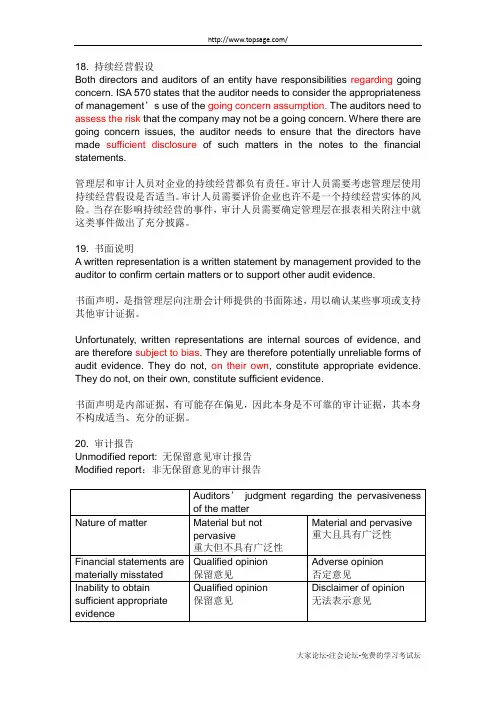
注会综合·英语专题班·第八讲
18. 持续经营假设Both directors and auditors of an entity have responsibilities regarding going concern. ISA 570 states that the auditor needs to consider the appropriateness of management’s use of the going concern assumption. The auditors need to assess the risk that the company may not be a going concern. Where there are going concern issues, the auditor needs to ensure that the directors have made sufficient disclosure of such matters in the notes to the financial statements.管理层和审计人员对企业的持续经营都负有责任。
审计人员需要考虑管理层使用持续经营假设是否适当。
审计人员需要评价企业也许不是一个持续经营实体的风险。
当存在影响持续经营的事件,审计人员需要确定管理层在报表相关附注中就这类事件做出了充分披露。
19. 书面说明A written representation is a written statement by management provided to the auditor to confirm certain matters or to support other audit evidence.书面声明,是指管理层向注册会计师提供的书面陈述,用以确认某些事项或支持其他审计证据。
Unfortunately, written representations are internal sources of evidence, and are therefore subject to bias. They are therefore potentially unreliable forms of audit evidence. They do not,on their own, constitute appropriate evidence. They do not, on their own, constitute sufficient evidence.书面声明是内部证据,有可能存在偏见,因此本身是不可靠的审计证据,其本身不构成适当、充分的证据。
CPA 注册会计师 会计 讲义 会计英语 第六章 或有事项

2019年注册会计师考试辅导会计英语第六章或有事项本部分在历年专业阶段考试中涉及分数较少,但在2009年也独立考核过主观题,并可以选用英文作答。
本章内容比较简单,在复习中应熟练掌握或有事项的处理原则,争取在考试中对这部分题目做到“手到擒来”。
I.或有负债和或有资产或有负债无论是现时义务,还是潜在义务均不符合负债的确认条件,因而不能确认,只能在附注中披露。
No matter it is a current obligation or a potential obligation , contingent liability couldn’t be recognized because the liability recognition criteria are not met. It only can be disclosed in note.或有资产,是潜在资产,不符合资产的确认条件,因而不能确认,只有在很可能导致经济利益流入企业时才能在附注中披露。
Contingent asset is potential asset and should not be recognized because it is not satisfying the asset recognition criteria and will be disclosed in the notes once it would most likely lead to economic benefit flowing into the business.II. 预计负债的确认 Recognition of provision与或有事项相关的义务同时满足下列条件的,应当确认为预计负债:The obligation pertinent to a contingency shall be recognized as provision when the following conditions are satisfied simultaneously:(1)该义务是企业承担的现时义务;That obligation is a current obligation of the enterprise;(2)履行该义务很可能导致经济利益流出企业;It is likely to cause any economic benefit to flow out of the enterprise as a result of performance of the obligation;(3)该义务的金额能够可靠地计量。
CPA会计英语教学课件8

Accounting English
Type 1---Apportioning recorded costs
Rent Expense Prepaid rent
580 580
1a.
Prepaid rent expired, $580.
Accounting English
Type 1---Apportioning recorded costs
Accounting English
Type 3--- Accruing unrecorded expenses
3b. Accrued advertising expense at the end of this month, $1,000.
Advertising Expense Accounts Payable
Accounting English
Based upon accrual accounting
Why is the adjusting step of the accounting cycle necessary?
Accounting English
Part 2 Presentation ---Purpose of adjusting (Why)
Accounting English
Lesson Eight
Adjusting Procedures
Lesson one
Steps in the accounting cycle
Close temporary accounts
Prepare financial statements
Adjust the general ledger accounts
Prepare adjusted trial balance
综合阶段英语学习讲义-注册会计师(CPA-)第12讲
5.、Porter‟s diamondPorter tried to answer the following questions:Why does a nation become the home base (总部, 根据地) for successful international competitors in an industry? Germany is renowned for car manufacture; Japan is prominent in consumer electronics (消费性电子产品).Why are firms based in a particular nation able to create and sustain competitive advantage against the world‟s best competitors in a particular field?Why is one country often the home of so many of an industry‟s world leaders? Porter called the answers to these questions the determinants (决定因素) of national competitive advantage. He suggested that there are four main factors which determine national competitive advantage and expressed them in the form of a diamond.迈克尔·波特识别出国家竞争优势的四个决定因素,构建了钻石模型。
Favorable factor conditions: physical resources such as land, minerals and weather;capital; human resources; knowledge and infrastructure.There must be a strong home market demand for the product or service.The success of an industry can be due to its suppliers and related industries. Organization goals can be determined by ownership structure.1. BenchmarkingBenchmarking is the process of systematic comparison of a service, practice or process. Its use is to provide a target for action in order to improve competitive position. 基准分析是企业和竞争对手在劳务、实践或流程等方面系统进行比较的过程。
注会英语课件
第一讲会计英语的常用术语授课内容和教学目标:在第一个专题中向大家介绍会计领域中经常用到的最基本的术语以及它们的应用,使学生在头脑中建立起一个框架并对会计专业英语有一个直观的了解。
这些内容将构成以后几个专题学习的基础。
1.accounting n.会计;会计学account n..账,账目a/c;账户e.g.T-account: T型账户;account payable应付账款receivable 应收账款);accountant n.会计人员,会计师CPA (certified public accountant)注册会计师2.Accounting concepts 会计的基本前提1)accounting entity 会计主体;entity 实体,主体2)going concern 持续经营3)accounting period 会计分期financial year/ fiscal year 会计年度(financial adj.财务的,金融的;fiscal adj.财政的)4)money measurement货币计量人民币RMB¥美元US$ 英镑£法国法郎FFr*权责发生制accrual basis.accrual n.本身是应计未付的意思,accrue v.应计未付,应计未收,e.g.accrued liabilities,应计未付负债3.Quality of accounting information 会计信息质量要求(1)可靠性reliability(2)相关性relevance(3)可理解性understandability(4)可比性comparability(5)实质重于形式substance over form(6)重要性materiality(7)谨慎性prudence(8)及时性timeliness4.Elements of accounting会计要素1)Assets: 资产– current assets 流动资产cash and cash equivalents 现金及现金等价物(bank deposit)inventory存货receivable应收账款prepaid expense 预付费用– non-current assets 固定资产property (land and building)不动产, plant 厂房, equipment 设备(PPE)e.g.The total assets owned by Wilson company on December 31, 2006 was US$1,500,000.2)Liabilities: 负债funds provided by the creditors. creditor债权人,赊销方– current liabilities 当期负债non-current liabilities 长期负债total liabilitiesaccount payable应付账款loan贷款advance from customers 预收款bond债券(由政府发行, government bond /treasury bond政府债券,国库券)debenture债券(由有限公司发行)3)Owners’ equit y: 所有者权益(Net assets)funds provided by the investors. Investor 投资者– paid in capital (contributed capital)实收资本– shares /capital stock (u.s.)股票retained earnings 留存收益同时记住几个单词dividend 分红beginning retained earnings ending retained earnings– reserve 储备金(资产重估储备金,股票溢价账户)e.g.The company offered/issued 10,000 shares at the price of US$2.30 each.4)Revenue: 收入sales revenue销售收入interest revenue利息收入rent revenue租金收入5)Expense: 费用cost of sales销售成本, wages expense工资费用6)Profit (income, gain):利润net profit, net income5.Financial statement 财务报表1)balance sheet 资产负债表2)income statement 利润表3)statement of retained earnings 所有者权益变动表4)cash flow statement 现金流量表6.Accounting cycle1)journal entries 日记账general journal总日记账general ledger总分类账trial balance试算平衡表adjusting entries 调整分录adjusted trial balance调整后的试算平衡表Financial statements 财务报表closing entry 完结分录2)Dr.—Debit 借Cr.—Credit 贷Double-entry system 复式记账7.Exercise 练习1)purchases of inventory in cash for RMB¥3,000 现金人民币3,000元购买存货Dr.inventory 3,000借:存货3,000Cr.cash 3,000 贷:现金3,0002)sales on account of US$10,000 赊销方式销售,收入10,000美元Dr.account receivable 10,000借:应收账款10,000Cr.sales revenue 10,000 贷:销售收入10,0003)paid RMB¥50,000 in salaries & wages 支付工资人民币50,000元Dr.wages & salaries expense 50,000 借:职工薪酬50,000Cr.bank deposit 50,000贷:银行存款50,0004)cash sale of US$1,180 销售收入现金1,180美元Dr.cash 1,180 借:现金1,180Cr.sales revenue 1,180贷:销售收入1,1805)pre-paid insurance for US$12,000 预付保险费12,000美元Dr.prepaid insurance 12,000借:预付保险12,000Cr.bank deposit 12,000贷:银行存款12,000第二讲存货授课内容和教学目标:本专题主要讲授与存货有关的英文术语,如期初和期末的存货的表达方式,以及不同的企业中的各种存货形式。
CPA(英文介绍) PPT课件
About the exam
• Examination system
• The state shall unified national examination system certified public accountants. The unified national examination certified public accountants, formulated by the financial department of the state council formulated by the Chinese institute of certified public accountants implementation.
Founded in 1988, the China association of certified accountants is under the leadership of the Treasury a national association, and also the only one in China accounting professional groups. Since 1991, our country of a registered accountant unified national examination system. Since 1993, held once a year, has held 18 times,
• The examiners unit
• The Treasury was registered accountant exam commission , the organization leadership for the unified national examination certified public accountants. The Treasury will test committee set up a CPA examination committee office, organize the implementation of the unified national examination certified public accountants.
CPA 注册会计师 会计 讲义 会计英语 第一章 固定资产和无形资产
第一章固定资产和无形资产考前串讲目录01 总体考情分析02 讲解方法03 授课内容总体考情分析一般选择主观题第1题要求选用英文作答,若用英文作答完全正确,则在原题满分的基础上多加5分。
对于《会计》科目来讲,主观题的知识点分布可能性很大,知识面比较广,所以对于常见的综合性知识点,均需要关注如何转化为英文作答的形式。
讲解方法在本次教学中,总共分为三部分进行讲解——第一部分知识重点、第二部分常用句型、第三部分专业词汇。
其中第一部分知识重点,老师将会按照专题的形式,分别使用中文与英文进行讲解,并帮助学员提炼相关专业词汇;常用句型和专业词汇方面,老师将会汇总经典的句型和词汇,帮助学员提高应试能力。
授课内容第一部分知识重点第1章固定资产和无形资产有关固定资产和无形资产的内容在注会考试中属于非常重要的基础知识,可能并不单独以主观题形式进行考查,但是专业阶段主观题所考查的知识点中一般都会穿插其相关内容。
如与借款费用、会计估计变更及差错更正等内容的结合。
因此,要给予一定的重视。
I.固定资产的初始计量Initial Measurement of Fixed Assets购买固定资产的价款超过正常信用条件延期支付,实质上具有融资性质的,固定资产的成本以购买价款的现值为基础确定。
If the payment for a fixed asset is delayed beyond the normal credit conditions and it is of financing nature in effect, the cost of the fixed asset shall be ascertained based on the present value of the purchase price.会计分录:Journal entry:借:固定资产(购买价款的现值)未确认融资费用(差额,应在信用期内采用实际利率法进行摊销)贷:长期应付款等(实际应支付价款)Dr:Fixed assets (the present value of the purchase price)Unrecognized financing expenses(the balance,which should be amortized within the credit period using the effective interest method)Cr:Long-term payable(the actual purchase price that should be paid)II.固定资产的后续计量Subsequent Measurement of Fixed Assets企业应当根据与固定资产有关的经济利益的预期消耗方式,合理选择折旧方法。