
牛津深圳版英语八年级下册Unit1知识点语法精讲精练 学案
Module 1 Social communication
Unit 1 Helping those in need
(1)Words
raise v. 筹募,增高,增加permission n.准许,不可数名词ask permission报请批准disabled adj.丧失能力的able adj. 有能力的be able to = can
offer v.主动提出offer to do sth.主动提出做某事,serious adj. 严重的–ly adv.
organize v. 组织organization n. lonely adj. 孤独的alone
difficulty n.困难difficult adj. 困难的
hurt v.伤害hurt oneself 伤了自己(hurt , hurt )
pay v. 付费pay for 与take cost spend 的区别
(2)Phrases
in need 需要帮助的voluntary work 义务工作ask permission 报请批准
suffer from 因…受苦raise one’s spirits 使振奋= cheer up in order to 目的在于
so that 为的是与so …that的区别make friends with …与…交朋友
look after = take care of = care for 照顾because of 因为与because 的区别
talk to / with / about 谈论teach sb. to do sth. 交某人做某事
offer to do sth 主动提出做某事take photos of 照相help sb. do / with sth. 帮助某人做某事continue to do sth. 继续做某事need to do sth. 需要做某事in good health 身体健康
be afraid of + n. / pron / doing害怕…enjoy oneself / doing 玩的愉快/喜欢做某事
decide to do sth. 决定做某事
(3)Sentences
1 I met a girl called Cindy.我遇见一个叫森迪的女孩。
过去分词作后置定语called = named
2 We taught them to tell stories .我们教他们讲故事。
tell talk speak say 的区别
tell “告诉,讲述”,把某事/ 信息传达给别人tell stories tell a lie
talk “交谈,讲话”,talk to / with sb. talk about sth.
speak “说,发言”,+ 语言
say “说”,强调说话的内容。
3 We spent time with a girl called Vivien . 我们和一个叫薇薇安的女孩共度时光。
spend “花费”主语(人)+ spend(s) + money / time + (in)doing sth. / on + n.
4 I taught them to sing because music can bring then joy and peace .
我教他们唱歌是因为音乐可以给他们带来快乐和宁静。
teach sb. to do sth.教某人做某事
bring take get carry 的区别
bring “带来”+ 双宾语 -》来 Remember to bring me the pictures.
take “带到,去”去-》 I won’t take you here .
get 去某处将某人/ 物带到说话人处 Please get some paper for me .
carry 强调负重或搬运 Hecarried a baby on his back .
5 One of them had difficulty walking . 其中有一位病人行走困难。
One of + 可数名词复数/ 代词复数谓语动词用单数
One of + the + 形容词最高级 + 复数名词“最…之一”
6 He used to love sport until he hurt his legs in an accident .
他过去热爱运动,直到他在一起事故中双腿受伤。
until “直到…才”
a until 与延续性动词连用时,动词用肯定形式。
e.g.We walked until it got dark .
b until 与非延续性动词连用时,动词用否定形式。
e.g.The little girl didn’t stop crying until she saw her mother .
(4)Grammar 动词不定式
结构: to + 动词原形(有时to可省略)
用法:
1 作宾语(作及物动词的宾语,不作介词宾语) Remember to post the letter .
2 作宾补放在宾语后,表示宾语是什么或怎么样。
ask , tell , like , love , hate , would like , teach , want , etc.
e.g.The doctor wanted him to have a good rest .
3 作目的状语常用逗号与句子隔开,在末尾时,则不用。
e.g.To get there on time , we set out at five in the morning .
He goes there to enjoy the fresh air .
(5)Practice
millions of …数百万的 be unable to…不能 be able to…能 = can since then 从那时以来 close to …靠近 in order to …为了
in hospital生病住院 in the hospital在医院
(6)Exercise
用括号中所给单词的适当形式填空。
1 I plan ____________ (go) to Canada this summer .
2 Did they enjoy __________ (them) in the park ?
3 He decided _________ (live) in another city .
4 It took us two hours _________ (get) to Beijing by train .
5 A restaurant needs lots of water for _________ (wash) the dishes .
6 What do we use ___________ (clean) toilets ?
7 My father is too tired . He needs __________ (rest) .
8 Thank you for ___________ (look) after my sister .
9 Don’t forget ___________ (close) the window when you leave .
10 It is very bad ___________ (pollute) the groundwater .
11 They offered to __________ (help) those in need .
12 He is ___________ (disabled) to swim in the river .
13 Jack was __________ (serious) hurt in the accident .
14 Tom didn’t come to school today because he was ___________ (illness) .
15 I like _____________ (organize) parties .It is very interesting .
16 She fell onto the ground and felt very __________ (pain) .
17 Last night , my parents went out . So I watched TV ___________ (lonely) .
18 Miss White has no friends , so she often feels ___________ (lonely) .
19 The new neighbour is very ____________ (friendship) .
20 This book is very _____________ (difficulty) for me .
Unit 1 Helping those in need
一.重点词汇详解:。
深圳牛津八年级下unit1知识点归纳和练习
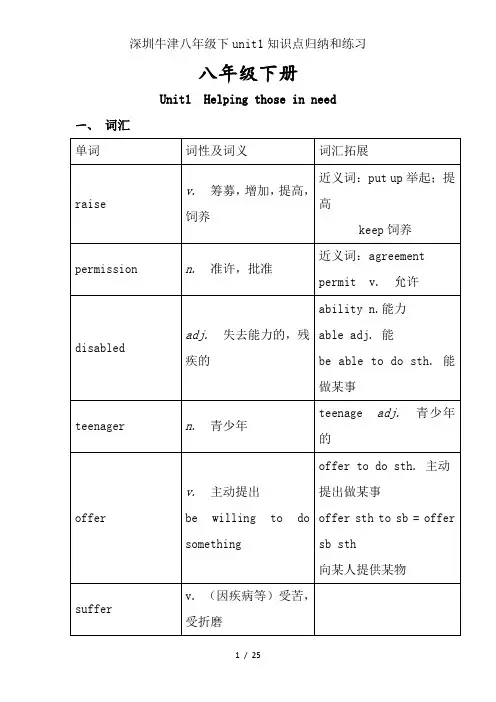
八年级下册Unit1 Helping those in need 一、词汇二、词组三、句型1. We spent time with a girl called Vivien 我们和一个叫维维恩的女孩在一起。
此句中,spend time with sb意为“和某人一起度过”。
例如:Some young people don't want to spend time with the old.一些年轻人不想和老人在一起。
I met a girl called Cindy.called 被叫做 =named 名为The girl called Lucy is one of the best students in our school. 那个被叫做Lucy的女孩是我们学校最好的学生之一2. I went there and took some photos of it.take photos/pictures of 表示“给……拍照”take pictures/photos 意为“拍照”They took many photos of the winner. 他们拍了许多获胜者的照片。
Although I love holidays, I hate to take photos. 尽管我喜欢度假,但我却讨厌照相。
3.This helps them express their feelings.help sb (to )do sth.意为“帮助某人做某事”,help 后做宾补的不定代词可以带to ,也可以不带to ,本结构及help sb. with sth .意思相同。
拓展:help oneself to sth. 随便吃某物 Help yourself to the fish.express 及物动词,意为“表露,表达”Bill is not afraid to express his opinions.拓展:expression 名词,意为“表达,表示;表情”Her expression suggested anger. 她露出愤怒的表情。
牛津深圳版八年级下册Unit 1 Heping those in need 语法讲解与练习
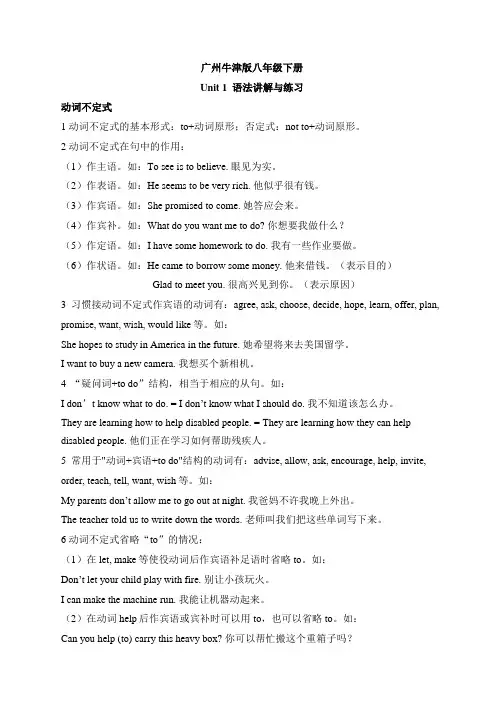
广州牛津版八年级下册Unit 1 语法讲解与练习动词不定式1 动词不定式的基本形式:to+动词原形;否定式:not to+动词原形。
2 动词不定式在句中的作用:(1)作主语。
如:To see is to believe. 眼见为实。
(2)作表语。
如:He seems to be very rich. 他似乎很有钱。
(3)作宾语。
如:She promised to come. 她答应会来。
(4)作宾补。
如:What do you want me to do? 你想要我做什么?(5)作定语。
如:I have some homework to do. 我有一些作业要做。
(6)作状语。
如:He came to borrow some money. 他来借钱。
(表示目的)Glad to meet you. 很高兴见到你。
(表示原因)3 习惯接动词不定式作宾语的动词有:agree, ask, choose, decide, hope, learn, offer, plan, promise, want, wish, would like等。
如:She hopes to study in America in the future. 她希望将来去美国留学。
I want to buy a new camera. 我想买个新相机。
4 “疑问词+to do”结构,相当于相应的从句。
如:I don’t know what to do. = I don’t know what I should do. 我不知道该怎么办。
They are learning how to help disabled people. = They are learning how they can help disabled people. 他们正在学习如何帮助残疾人。
5 常用于"动词+宾语+to do"结构的动词有:advise, allow, ask, encourage, help, invite, order, teach, tell, want, wish等。
沪教牛津版本八年级下册英语unit1教案(深圳)
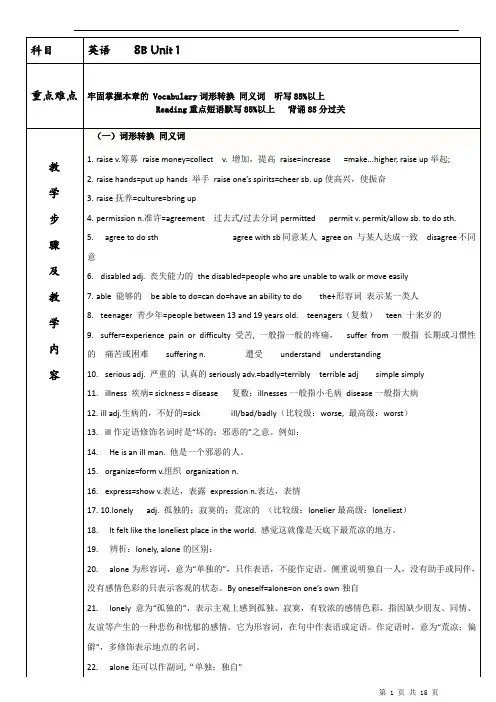
( ) 11. _______ is difficult to work out the maths problem.A.ThisB. ThatC. It( )12. We decided _______ at the end of this month.A. travelB. not start outC. to leave( )13. Let him _______ a rest. I think he must be tired after the long walk.A.hasB. haveC. to have( )14. _______the computer is a problem.A.How to useB. What to useC. Where to use9.I haven’t decided wha t (draw) for my cartoon book.10. Children under 18 years old are not allowed (drive).11. What he said made us deeply _____. (move )12. As a result of my laziness, I failed ________( finish ) my work in time.13. I am sorry ______ (not have) written you a letter at the time.14. Will you lend him a magazine _________ (read)?15. I feel tired and sleepy. Why not stop _______ (rest) for a while?语法填空Dear Mum,I’m writing this letter to talk about my worry about you. I can’t stop linking about my Dad’s death and both of us are suffering sadness. In fact, I really want to ask you (14) ____________ (not give) up being alive. All of us know that you and Dad loved each other so much. You always got up early (15) ____________ (look) after him when he was in hospital. My Dad has been away for half a year. But you still can't believe in this综合训练一、完形填空My name is Feng Guixiang. I want to tell you about the China Children and Teenagers' Fund(CCTF) and how it __1__ me.One of the CCTF's special __2__ is the Spring Bud Project. In 1989, 4.8 million children in the country, aged from seven to fourteen, were too __3__ to attend school. Eighty-three percent of them were __4__. Because of this, the CCTF launched the Spring Bud Project to help them. Since then, the project has helped millions of girls __5__ to school. It has also built a lot of schools.The very first Spring Bud class was here in Guangxi in 1989. The Spring Bud Project __6__ me to attend that class. It also rented a 7 close to the school for me. I could live in it without paying money.Before the project started, I stayed at home and helped my mother with the __8__. Going to school changed my life __9__. I learnt to read and write and do many other things.Now I __10__ a teacher at a Spring Bud school here in Guangxi. I wish to help other girls the way the Spring Bud Project helped me.1. A. hated B. helped C. accepted D. treated2. A. spirit B. difficulties C. lessons D. activities3. A. unusual B. disabled C. poor D. free4. A. girl B. students C. boys D. adults5. A. fail B. decide C. return D. walk6. A. looked for B. waited for C. lasted for D. paid for7. A. shop B. room C. car D. book8. A. housework B. teamwork C. homework D. network9. A patiently B. greatly C. carefully D. luckily10. A learn from B. care for C. talk with D. work as二、阅读理解Carly Harris is a student at University of Utah. She was travelling with her cousin in December when she saw a video on the media about a camp called Camp Moria in Greece. Then they decided to be volunteers in this camp.They tried to contact the organizer of the camp, but failed. At last, they got to the camp by themselves.Camp Moria used to be a military barrack(军营) with 700 people, but nearly 2, 000 lived there when Harris arrived in December. There, Harris’s job was to give the drenched people hot tea and dry clothes. One day, a young man in the camp told her she was very kind and thanked her very much. Harries later knew his name is Soufiane El Yassami. He is from Morocco. Many North African refugees(难民), like El Yassami, travelled across the ocean to Europe for a better life, but finally, they arrived in Lesbos as refugees, not immigrants (移民) .Harris is Mormon(摩门的), and El Yassami is Muslim(穆斯林的). They are very different in many ways. However, on Harris's last day in the camp, when El Yassami asked if he could make friends with her, she said yes. Then they became good friends and kept in touch with each other for a long time…1. What was Carly Harris doing when she saw the video about the campA. V olunteering in another refugee camp.B. Studying at University of Utah.C. Working in a social medium company.D. Travelling with her cousin.2. The underlined word "drenched" in Paragraph 4 probably means __________ in English.A. wetB. weakC. poorD. old3. What can we know about El Yassami from the passage?A. He is not Muslim.B. He thought Harris was very kind.C. He would like to work with Harris.D. He got to lesbos as an immigrant at last.4. Which of the following is true according to the passage?A. Harris had graduated from University of Utah.B. Harris succeeded in contacting the organizer of Camp Moria.C. Camp Moria should be very crowded.D. Harris didn’t want to make frien ds with el Yassami.5. In what order did the following events take place?a. El Yassami arrived in Lesbos as a refugee.b. Harris gave hot tea and dry clothes to the people in the camp.c. Harris made friends with El Yassami.d. Harris saw the Greek camp from a video on social media.e. El Yassami expressed his thanks to Harris.A. a-b-e-d-cB. a-d-b-e-cC. d-b-a-c-eD. d-a-b-c-e三、根据短文内容,从选项中选出能填入文中空白处的最佳选项,选项中有一项为多余选项。
牛津深圳版八年级下unit1知识点与练习(最新整理)
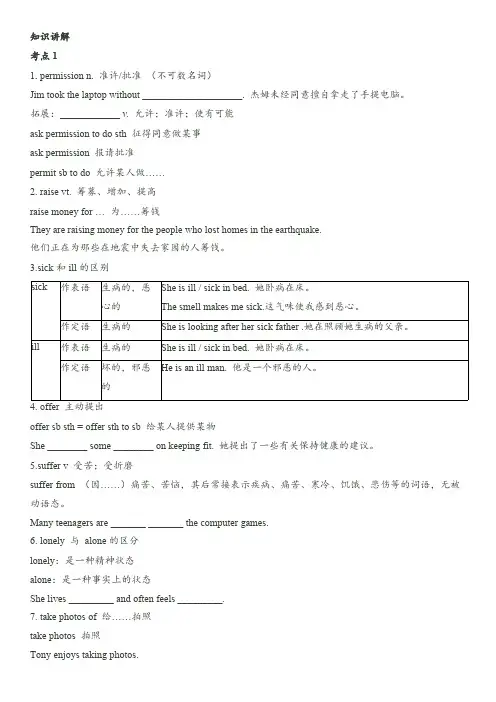
His uncle took lots of photos of animals in danger.拓展:make friends with 和……交朋友exchange seats交换座位shake hands with与……握手take turns to do sth.轮流做某事join hands with与……联系/合作8. help sb.(to)do sth.帮助某人做某事=help sb. with sth.He often helps me(to)study English.=He often helps me with my English.拓展:help oneself to sth.随便吃某物Help yourself to some fish,children.can’t help doing…禁不住做……She can’t help laughing.9.spend vt,度过,消磨He spent his holiday in the country with his girlfriend.复习:话费How much money do you spend each week?常见搭配sb.+spend(s)+money/time+(in)doing sth.某人花费时间/金钱做某事sb.+spend(s)+money/time+on sth.某人在某事、某物上花费金钱/时间They spend a lot of time watching TV every day.He doesn’t spend a lot of money on food.人+ spend(s)+钱/时间+(in)doing sth./on sth.10.die vi.死第三人称单数:dies过去式:died现在分词:dying形容词:dead名词:death注意:die为非延续性动词,不能与表示一段时间的状语连用,但可以转换成be dead. He died 3 years ago.He has been dead for 3 years.11.need 1 实义动词,意为“需要” +名词、代词或不定式2) I ________ you to go.3) I _______you’ll be better soon.4) I________I were ten years younger.5) I_________ you a happy New Year!6) –Tomorrow it’ll be sunny, won’t it?-I_______ so.考点21.(1)+to do(宾语)want(想) agree(同意) offer(提供) promise(承诺)plan(计划) decide(决定) pretend(假装) try(努力)wish/hope(希望) fail(失败)【记忆】某人想同意提供承诺计划,但却决定假装努力,所以他的希望失败了!(2)+sb to do(宾补)want(想) force/get(使) tell/ask/order(叫/命令),remind(提醒) advise(建议) encourage(鼓励) persuade(说服),【记忆】(想死叫命令)想使,叫命令;提醒建议,鼓励说服2.注意:动词不定式符号“to” 的省略的情况:(1) 在使役动词have, let, make之后。
牛津深圳版八年级英语下册Unit1 Helping those in need- More Prac
广州市八年级英语下册Unit1 More Practice 部分知识点讲解与巩固1.ask sb. (not) to do sth. 叫某人(不)做某事p8【用法】注意not是直接写的,不需要添加助动词。
如:My mother asks me not play foot ball on the road.【拓展】此处的ask可以换成tell。
【练习】(1)你能叫你的孩子不在这个时候敲鼓吗?(鼓:drum)Can you _____________________________________________________ at this time of the day?(2)为什么不邀请Tom参加晚会呢?Why not _________ Tom ________ _________ ___________ __________ the party?2. That would be very kind of you. 那就真是太感谢你了!【用法】用于表达感激之情。
3. think about (doing)sth. 考虑(做)某事【辨析】think of 想起,想到,想出think over 思考4. in order to do sth. 为了做某事p12【用法】用于表示目的。
例子:In order to help the disabled child, we raised much money.【拓展】in order that 为了,后接从句,从句中往往含有情态动词。
例子:In order that e can help the disabled child, we raised much money.【练习】用两种方式翻译以下句子。
为了保持河水干净,我们已经在河的两边种植了很多树。
_______________________________________, we ____________________________________ along the river._______________________________________, we ____________________________________ along the river.5. tell sb. about sth. 告诉某人关于某事(详细介绍)【拓展】tell sb. sth. = tell sth. to sb. 把某事告诉某人(点到即止)6. aged adj. 年纪…的如:She is a girl aged 18. 她是一个18岁的女孩子。
牛津深圳版英语八年级下unit_1《helping_those_in_need》word重点内容汇编教案

《世界的人种、语言和宗教》教案教学目标一、知识与技能1.通过学习记住世界三个主要人种及地理分布;2.了解汉语、英语、俄语、法语、西班牙语、阿拉伯语的分布地区;3.通过看各种图片了解宗教建筑,并记住主要宗教(基督教、伊斯兰教、佛教)及建筑物。
二、过程与方法培养学生通过阅读“世界人种的分布”和“世界语言的分布”图,获取相关知识的能力。
通过看各种图片了解宗教建筑,并记住主要宗教(基督教、伊斯兰教、佛教)及建筑物。
三、情感态度和价值观通过学习,树立正确的种族观,能够正确对待宗教信仰的差别,培养唯物史观,树立无神论观念。
教学重点世界主要人种、语言和宗教及主要分布地区。
教学难点运用地图,掌握世界三大人种、六大语言和三大宗教的分布地区。
教学方法合作探究法、图导图练法、读图分析法、总结归纳法课前准备课件、课前学案课时安排一课时教学过程一、导入新课出示图片(包括白种人、黄种人和黑种人),白种人黄种人黑种人提问:从体质的外部特征上,他们有什么差别?你能描述他们的外部特征吗?描述外部特征应从哪几方面着手?(皮肤、毛发、面部特征)他们主要分布在哪儿?(板书)第三节世界的人种、语言和宗教。
(学乐师生”拍照\录像\录音,收集学生典型成果,在“授课”系统中展示。
)二、新课学习1.世界的人种(展示)“世界人种分布图”做读图填表:相当隔离地生活在不同的地理环境下的缘故。
朗读“阅读材料”了解环境对人种的影响。
(展示)“世界人种分布图”,做练习1)非洲北部、亚洲西部和印度北部主要分布着什么人种?(白种人)2)除亚洲外,还有哪几洲黄种人较多?(北美洲北部、南美洲)3)印度南部分布着哪两个人种?(白种人和黑种人)4)我国有没有白种人分布的地方?是什么民族?(新疆;维吾尔族、哈萨克族)(过渡)不同的种族分布在不同的地方。
长期的生活,形成了他们独特的生活方式,也形成了他们特有的语言。
他们的存在,构成了世界的丰富多彩。
下面我们就听一听他们的语言,谁知道这是那种外语?用录音机分别录一小段英、俄、日、法、西班牙广播或歌曲,让同学们猜或让学生模仿。
牛津深圳版(广州沈阳通用)八年级下册英语教案:Unit1
Module 1 Unit 1Helping those in need◆教材分析Through this part of the study.Let students effectively consolidate and master the imprortant words and key phrases and sentences of voluntary activities. This unit is to learn the grammar of the unit, the infinitive as the object.In this period ,we can use the short passage and dialogue by moderate to difficult practice so that students can learn the grammar correctly. The infinitive as the object is a very important role in the English learning. According to the listening materials of the fund-raising activities, this period is training students' listening ability. On the basis of the first three classes and the vocabulary of the language training, the students are familiar with the related topic. And teachers are aimed to conduct oral conversation in class and effectively train the students' application ability. As a whole unit of the compre hensive exercise class this class is mainly to read the passage of the exercises, to guide the training, as well as the contents of the five classes to review, strengthen the memory, enhance the application.◆教学目标【知识目标】1.Get students to learn the useful words and expressions in this period.nursing home,hospital,orphanage,health recovery centre for ,the disabled,raise,teenager,offer,suffer,serious,illness,organize,express,pain,lonely,friendship,difficulty,joy,peace,hurt,courage,spirits;in need,voluntary work,suffer from,raise one’s spirits2.Help students to learn about useful expressions..【能力目标】To be able to read a short passage and answer some question.【情感目标】1.Help them understand more about voluntary work.2.Develop students' sense of cooperative learning.【教学重点】How to train their ability step by step.【教学难点】1.Develop students' ability.2.Help students understand the difficulties.Multimediastep1 Getting ready1.1) Look at the cartoon and answer the questions.What did Hi mean by his words?What did Lo do?Did Lo understand what Hi mean?2) Think and sayWhat is voluntary work?step2. Brainstorm1)Brainstorm1Have you ever done any voluntary work ?Where can we do voluntary work ?nursing homehospitalorphanagehealth recovery centre forthe disabled2)MatchWhat kind of people can we help at these places?nursing home people who have difficulty moving, seeing, hearing, etc. orphanage the oldhospital people who are badly illhealth recovery centre for the distabled children without parents3)Brainstorm 2How can we do voluntary work ?help old peoplehelp raise moneyvisit sick children in a hospital4).What do you know about … ?There are many kinds of voluntary work. Can you match the activities with thePictures below? Write the correct letters in the boxes.a helping disabled peopleb helping raise moneyc visiting an oid people’s homed visiting sick children in a hospitalstep3. Before you read1).Read the title, introduction and the writers’ names on page 3. Then answer the following questions.What are the names of the three teenagers?What did they offer to do during the school holidays?2).Look at the pictures, the writers’ names and the first sentence of each report on page 3. Write the correct names in the blanks.1. I talked to chidren without parents.2. I helped sick children .3. I taught disabled children to sing.I did some voluntary work in a chidren’s hospital.There are many children without parents.I wanted to help disabled children.Step4. While you read1.Read the first paragraph of Betty’s report and answer the following.I did some vountary work in a children’s hospital.The children there all suffer fromserious illnesses.We organized a painting competition for them.Where did Betty do voluntary work?What is wrong with the children there?What did Betty and other volunteers do for the children?2.Read the first paragraphs of Mark’s and Annie’s reports and complete the tables. There are many children without parents.I met some of these children with my mother. We taught them to tell stories. This helps them express their feelings. One child said,"My friends don't understand my pain".I wanted to help disabled children.They have difficulty walking or moving.I taught them to sing because music can bring them joy and peace.3.Mark’s voluntary work4.Annie’s voluntary work5.Read the second paragraph of Betty’s report and answer the questions.Whom did Betty help the most、What did Cindy want to do?How did Betty help Cindy?6.Read the second paragraphs of Mark’s and Annie’s reports and complete the sentences.visit Vivien.I met a boy called Tim.He hurt his legs in an accident,but he has lots of courage. we need to help children like Tim and raise their spirits.I will continue to do voluntary work, in the future.Step5. After you readRead the passage aloud.Three teenagers offered to do some voluntary work during the school holidays. They wrote the following reports.I did some voluntary work in a children’s hospital. The children there all suffer from serious illnesses. We organized a painting competitio n for them.I met a girl called Cindy. She wanted to paint a picture of the park near her home.I went there and took some photos of it. Cindy used them for her painting.B ettyThere are many children without parents. I metsome of these children with my mother. Wetaught them to tell stories. This helps them express their feelings. One child said, “My friends don’t understand my pain.”We spent time with a girl called Vivien. Herparents died in a car accident, and she is unhappy and very lonely. She needs friendship. My mother and I will continue to visit Vivien.M arkI wanted to help disabled children. They have difficulty walking or moving.I taught them to sing because music can bring them joy and peace.I met a boy called Tim. He hurt his legs in an accident, but he has lots of courage. We need to help children like Tim and raise their spirits. I will continue to do voluntary work in the future.A nnieStep6. VocabularyC1 The words in italics are from the reports on page 3. Circle the correct answers to complete these sentences.1. When spmething is serious,it is .a bad or dangerousb good or safe2. If you have an illness ,you are a person .a in good healthb in bad health3. If you have an illness ,you are .a nervousb not worried or excited4.A person with courage is usually of something dangerous or difficult.a afraidb not afraid5 If you raise something ,you .a make it lowerb move it higher6 If you are in high spirits,you have a good .a feelingb abilityStep7. Homework1.抄写单词和短语:raise,disabled,teenager,offer,suffer,serious,illness,organize,express,pain,lonely,friendship,difficulty,joy,peace,hurt,courage,spirits;in need,voluntary work,suffer from,raise one’s spirits。
牛津深圳版八年级下册英语Unit 1 Helping those in need语法点 课件
【Unit 1 知识点归纳】 一、不定式的用法与构成 1.不定式的基本形式:to do 或 not to do
2.不定式的主要作用:具有动词的性质,本身可以带宾语和状语, 也可作宾语,宾语补足语,状语等。 The driver failed to see the other car in time. 司机没能及时看见另一辆车。 I happen to know the answer to your question. 我碰巧知道你那道问题的答案。
4.动词不定式做宾语补足语 (1)后接带 to 的不定式做宾语补足语的动词有 ask,want,tell,
wish,would like,teach,invite,advise,allow,order, encourage,warn 等。
My friend invited me to join the art club,and I accepted it with pleasure. 我的朋友邀请我参加艺术团,我高兴地加入了。 He told his son not to watch the football match because of the exam. 他告诉他儿子考试了,不要看足球比赛。
▲“It is+形容词+of sb.to do sth.”意为“做某事对某人来说 是……的”。其中句中的形容词用于描述人的性格、品质,如 kind,good,nice,right,wrong,clever,careless,polite, foolish 等。 It’s very kind of you to help me.你人真好,帮助了我。
5.动词不定式做定语 (1)动词不定式做定语时位于被修饰词语之后,做后置定语。 The best way to raise the money is to sell newspapers. 要筹募资金最好的方法是卖报纸。
牛津深圳版八年级下册 unit 1语法 讲解+练习 (答案不全)
8B Unit1 Helping those in need 语法课Grammar:动词不定式动词不定式由“to+动词原形”构成,有时可以不带to。
它没有人称和数的变化,其否定式是在to前加上not。
它在句中可作宾语、宾语补足语和状语等。
具体用法见下表:用法例句作宾语offer, plan, hope, choose, refuse, decide, learn,wish等动词之后作宾语:Finally he offered to go shopping with me. 最后他主动提出跟我一起购物。
I have decided not to think about it.我已决定不去想它。
我们也可以在know.decide,learn和remember等动词之后用“疑问词+动词不定式”作宾语I don't want to stay at home, but I don't know where to go.我不想呆在家里,但是我不知道去哪里作宾语补足语teach,ask,allow,invite,order,advise等动词之后用不定式作宾补:You should ask him to turn off the light. 你应该要求他关掉灯。
My parents allow me to play computer games at weekends.我父母允许我周末玩电脑游戏。
let,make和have之后用省略to的不定式:My mother often makes me clean the windows.我妈妈常常让我擦窗户。
作状语动词不定式表示目的。
They are working hard to save the injured tiger.他们正在努力工作营救那只受伤的老虎。
【基础知识巩固训练】1. The workers want us ______ together with them.A. workB. workingC. to workD. worked2. There isn’t any difference between the two. I really don’t know _________.A. where to chooseB. which to chooseC. to choose whatD. to choose which3. The teacher told them ____make so much noise.A. don’tB. notC. will notD. not to4.He gave us some advice on how____ English.A. learning B . learned C. to learn D . learn5.I’m thirsty. Would you please give me something ________.A .drunkB .to drinkC .to be drunkD .for drinking6.Tom is the first _____ to school.A . getB . to get C. getting D . Got7. The boy wanted to ride his bicycle in the street, but his mother told him ______.A. not toB. not to doC. not do itD. do not to8. I saw him _______ out of the room. A. go B. had gone C. has gone D. goes9.---_______ more about tomorrow’s weather, call 121. ---OK, I will. Thank you.A. KnowB. KnowingC. To knowD. Known10.We must do everything we can ____ waste water from running into rivers.A. keepB. keptC. to keepD. keeping11.Let’s ____ play in the street. Father tells me __ do so.A. not to;not toB. not;not toC. don’t;to notD. not to;don’t12.When I came into the room, he pretended ____ his homework.A. to doB. be doingC. doingD. to be doingCBDC BBAA CCBA二.用括号中动词的适当形式填空。
牛津深圳版八年级下册 unit 1词汇 讲解+练习 (答案不全)
8B Unit1 Helping those in needKey words and Phrases:1. raise v. 筹集;提升;增加raise = keep 有“饲养,抚养”的意思常见搭配:raise one’s voice 提高嗓门raise a family 养家糊口raise money 筹款;raise price 提高价格;raise one’s spirits 打起精神raise children(抚养孩子)辨析:raise, rise(rise--rose--risen)的区别(1) 这两个词都有“提高,上升,增加”的意思,但其用法不同。
raise是及物动词,其主语通常是人;而rise是不及物动词,其主语通常是物。
例如:The sun rises and bathes the earth. 太阳升起,普照大地。
(2) raise和rise用于同一事物时含义不同。
例如:The price of TV sets has been raised recently. 最近电视机提价了。
(政府或厂家主动行动)The price of TV sets has risen recently. 最近电视机提价了。
(市场调节)2. permission n. = agreement 准许;批准Write a letter to the head teacher to ask permission to raise money.给校长写一封信请求允许筹钱。
同根词:permit v. = allow许可,准许;默许常用短语:permit/allow sb. to do sth.The guards permitted me to bring my camera and tape recorder.卫兵允许我带照相机和录音机。
3. disabled adj. 有伤残的;丧失能力的;不中用I taught disabled children to sing. 我教残疾的孩子唱歌。