
新人教必修3_Unit1_Grammar情态动词]
3. may 与might
1). 表示“许可”或“请求”,在这样的句中,might比m 语气更委婉,客气。 肯定回答用may或can,否定 回答时用mustn't或can't,表示“不可以”或“禁止”。 Eg: --- May I come in ? 我可以进来吗? --- Yes, you may/can. 可以,请进来。 --- No, you mustn’t/can't. 不,你不能。
4. 用于祈使句表祝愿。
Eg: May you succeed! May God bless you!
5. may have done 和might have done 表示 对过去的推测。
1. Sorry I'm late. I _____ A have turned off the alarm clock and gone back to sleep again. A. might C. can B. should D. will
二、表示对过去所发生事情的遗憾或责备
1. should/ought to have done “过去本该做而没做” eg: I really regretted wasting the hours when I should have studied hard, but it was too late. 2. shouldn’t/oughtn’t to have done “过去不该做的事却做了” eg: I’m very sorry for the words I shouldn’t have said to you at that moment. 3. could/might have done “本来能够做的事却没做” eg: He could have worked out the problem.
情态动词 ( modal verbs)
一、定义
情态动词主要用来表说话人的看法、意愿、
态度等。从用法上来说,它有如下几个特点:
1. 情态动词本身都有一定的词义;
2. 情态动词不能单独做谓语;
3. 情态动词没有人称和数的变化; 4. 情态动词后接不带to的不定式(除ought to 和used to 外),即接动词原形。
4). 表示“许可”,可与may 换用。
You can go home now.
5). 用于疑问句或否定句或感叹句中时,表猜测、惊讶、 不相信等,“可能、能够”。could猜测的可能性更小。 I believe that he can't be so rude. He is an honest man, he couldn't be telling lies. 6). can’t/ couldn’t +have + done 表示对过去情况的否定推测 "不可能"
6. can’t
用来表示由于特定事实或环境某事肯定不会发生。 Eg: 1) ---Listen, someone is knocking at the door, who can it be? --- It can’t be Tom, he has gone abroad.
2) --- Can/ could they have finished the work? --- No, they can’t have finished the work so soon.
Eg: No matter what I said, he won’t listen to me.
5. shall , should, ought to
1). shall 用于第一和第三人称,用来征求对方意见 或向对方请示。 Eg: 1) What shall we do this evening? 2) When shall he be able to leave the hospital? 2). shall 用于二三人称,表示说话人命令、警告、 许诺和威胁。 Eg: 1) You shall fail if you don't work hard. 2) He shall be punished.
1. Michael ____ B be a policeman, for he’s much too short. A. needn’t B. can’t C. should D. may 2. Mr. Bush is on time for everything. How ____ A it be that he was late for the opening ceremony? A. can B. should C. may D. must 3. ---- I stayed at a hotel while in New York. ---- Oh, did you? You ____ A with Barbara. A. could have stayed B. could stay C. would stay D. must have stayed 4. My sister met him at the Grand Theater yesterday afternoon, so he ____ A your lecture. A. couldn’t have attended B. needn’t have attended C. mustn’t have attended D. shouldn’t have attende
2). 回答 must 所在的一般疑问句时,否定回答用 “needn’t” 或“don’t have to”. Eg: ---Must we fiu needn’t/ don’t have to, but you must finish it in three days. 3). 表推测,用于肯定句,意为“一定”“务必”。
2). 表示可能性,多用于陈述句,否定用may not 表示“可能不” 。might 比 may可能性小。
Eg: 1) It might be true. 2) It may be a trick. 3) He may not come today.
3). may/ might as well + 动词原形 “…还是…的好” Eg: You may as well go and have a look.
2. can 和 be able to
1) can 只有现在时和过去时could,而be able to 有更多 的时态变化。 2) can 一般指只身具有的能力,be able to 表示经过 一段的时间努力后所具有的 能力,相当于manage to do或succeed in doing. This time I failed in the exam, but I'll be able to pass the exam next time. 3) 在否定结构中,was/were be able to和could 没有区别。 She ran fast but she couldn't/wasn't able to catch the bus.
Susan can’t have written a report like this. 7). could + have + done “本应该” 表示对过去能做而未做的事情感到惋惜,遗憾 It’s a pity. Your class could have got the first prize.
3). should 表示劝告、建议、命令,同义词ought to; shouldn't have done 表示不该做却做了。“本不该” Eg: 1) You should keep your promise. 2) You shouldn't have told him this news. 2) Sam suggested that we should go for a swim. 4). should和ought to 表示推测、可能,含有按道理应当。 Eg: 1) The roads should be less crowded today. 2) They should be at home by now for they have been away for two hours.
情态动词 + have done
这是历年高考热点之一, 可表示“推测、责备、怀疑” 等多种意义。
一、表示对过去事情的推测或估计
1. must have done “想必或肯定已经做了某事” eg: The ground is rather wet, so it must have rained last night. 2. may/might have done “可能/大概已经做了某事” eg: Tom may have gone to shanghai, but I still not sure about it. 3. can’t/couldn’t have done “不可能已经做了某事” eg: The ground is very dry, so it can’t have rained last night 注:在疑问句中 can/could 表示对过去情况的疑问性 推测,“可能已经…了吗?” eg: Someone must have broken into our bedroom, Who could have done it?
2) Would you like a cup of tea?
2). 用于表示意志、意愿和决心。 would 指过去的意愿和决心。
Eg: 1) I’ll never do that again. 2) They said that they would help us.
3).表示习惯性动作或某种倾向。 译作 “总是、惯于” would 指过去。
人教版高一英语必修三 unit1 grammar --情态动词
4. 情态动词表推测时应注意的几个问题:
1) 完全否定推测用can’t be(“不可能”): 肯定 推测用must be(“肯定,一定”)
He can’t be Peter. Peter has gone abroad. 2) 疑问句中的推测用can…be:
3. He is black and blue all over. His father _m__u_st__h_a_v_e_b_e_a_t_e_n__ (beat) him.
4. The train started an hour ago. Now it _m__u_s_t_b_e_t_r_a_v_e_ll_in__g_ (travel) on the great plain.
16
7.Lily came to school last Sunday. She __n_e_e_d_n’_t_h_a_v_e _g_o_n_e___ to school. (本来没必要上学) 8. You __c_o_u_l_d h_a_v_e__do_n_e____ your homework better last time. (本来可以做得更好) 9. _M__a_y__ I open the window, Mr Wang? (可以) 10. I __s_h_a_ll beat you if you tell me a lie. (我会打你的)
18
16. You n__ee_d_n__’t _ come to school this afternoon.(不必)
1t7h.Yisoauft_e_rn_o_doonn_.’_(t_n_不e_e必d__t)o___ come to school
人教版高一英语必修三 unit1 grammar 情态动词课件
e.g: He must/can/may/might know the answer to the question.
表推测的 三种句式
2. 否定句:can't/couldn't (不可能),may not/might not (可能不)
e.g: It can't/ couldn't be the Miss Lin. She has gone to America.
The boy can’t be Jim. He’s can可能 much taller.
can’t不可能 这个男孩不可能是吉姆。他 要高很多。
2. 常见情态动词
原形
用法
含义
例句
(过去式)
may
(might)
Tony may know the way.
表示可能性(可 与maybe互换)
可能
=Maybe Tony knows the way.
2. 常见情态动词
原形
用法
(过去式)
表示能力(= be able to)
含义
例句
能;会
Tom can swim. =Tom is able to swim.
汤姆会游泳。
can
(could)
(疑问句中)表示 请求
可以 Could you give us a hand?
你可以帮我们一下吗?
(否定句、疑问 句中)表示可能 性
• can 不肯, may 不问,must 不否问
注释: can表示推测通常不用于肯定句 may表示推测通常不用于疑问句 must表示推测通常不用于否定句和疑问句
肯定猜测的语气强弱:must>can> could>may>might
人教版高中英语必修三语法总结
人教版高中英语必修三语法总结高中英语必修三语法主要考点有情态动词、名词性从句、同位语从句等,下面是具体的高中英语必修三语法,仅供参考。
1英语必修三有哪些语法要学考点一情态动词(unit1,unit2)一、情态动词的特点:1.没有人称和数的变化。
2.有些情态动词有过去式的变化:e.g.will→would,can→could,may→might,dare→dared二、情态动词的否定式:情态动词+not+动词原形cannot:can’t,mustnot:mustn’t,neednot:needn’t三、情态动词的用法及相互区别,是考试的内容之一1.can,beabletobeableto表示经过努力后,能够做到;beableto有多种形式的变化。
can1).表示体力或脑力方面的能力;2).表示允许、可能性。
could是can的过去式,表示过去有能力及过去存在的可能性;用于疑问句表示委婉地提出问题。
1)Thefirespreadthroughthehotelveryquicklybuteveryone____getout.(NMET97)A.hadtoB.wouldC.couldD.wasableto2)-Willyoustayforlunch?-Sorry,__.Mybrotheriscomingtoseeme.(NMET99)A.Imustn’tB.Ican’tC.Ineedn’tD.Iwon’t2.may表示询问或说明一件事可不可做;表示某事有可能发生。
might是may的过去式;用在疑问中比may委婉、客气。
1)-MayItakethisbookoutofthereading-room?-No,youmustn’t.(Yes,youmay.)2)-MightImakeasuggestion?-Yes,youmay.3.must1).表示必须要做的事:必须2)表示很有把握的推断:一定,准是。
have(has)to:have(has)gotto必须,不得不。
高中英语人教版必修3 Unit1 GRAMMAR

GRAMMAR情态动词(一)【观察】请仔细观察下列句子中情态动词的用法,并归纳总结。
1. ①Even top students can make mistakes in exams.②Anna may know Tom’s address.③If you’re not careful, you could get into trouble.④Do you think Mr. Smith might be here on time?⑤—It must be our headmaster.—No, it can’t be him. He has gone to Beijing. It may be Mr. Zhang.⑥The rescue team should arrive by 5 o’clock this afternoon.2. ①She can speak five languages.②I couldn’t get tickets; they were sold out.3. ①You can have my seat. I’m going now.②Could I have a drink of water, please?③—May I smoke here?—Yes, of course.④Will / Would you please lend me your car tonight?⑤Shall we go out and have a walk after dinner?⑥Shall Tom go there with me tomorrow?4. ①Ask, if you will, who the owner is.②I would ask such questions when I was at school.5. ①You shall be punished if you break the rule.②Tell her that she shall have the bike tomorrow.6. ①We should take good care of our children.②You should give up smoking and drinking.7.①All passengers must wear seat belts.②You mustn’t move any of the books in my bag.【自我归纳】1. can / could, may / might, must / can’t, should都可表示可能性。
高一英语人教版必修3(第1.3Grammar:情态动词)
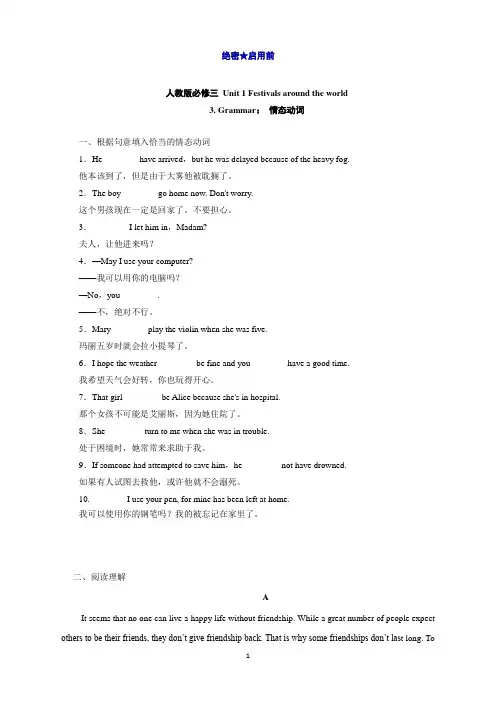
绝密★启用前人教版必修三Unit 1 Festivals around the world3. Grammar:情态动词一、根据句意填入恰当的情态动词1.He ________have arrived,but he was delayed because of the heavy fog.他本该到了,但是由于大雾他被耽搁了。
2.The boy________ go home now. Don't worry.这个男孩现在一定是回家了。
不要担心。
3.________ I let him in,Madam?夫人,让他进来吗?4.—May I use your computer?——我可以用你的电脑吗?—No,you ________.——不,绝对不行。
5.Mary________ play the violin when she was five.玛丽五岁时就会拉小提琴了。
6.I hope the weather ________ be fine and you________ have a good time.我希望天气会好转,你也玩得开心。
7.That girl ________ be Alice because she's in hospital.那个女孩不可能是艾丽斯,因为她住院了。
8.She ________ turn to me when she was in trouble.处于困境时,她常常来求助于我。
9.If someone had attempted to save him,he ________ not have drowned.如果有人试图去救他,或许他就不会溺死。
10. ________I use your pen, for mine has been left at home.我可以使用你的钢笔吗?我的被忘记在家里了。
二、阅读理解AIt seems that no one can live a happy life without friendship. While a great number of people expect others to be their friends, they don’t give friendship back. That is why some friendships don’t las t long. Tohave a friend, you must learn to be one. You must learn to treat your friend the way you want your friend to treat you. Learning to be a good friend means learning three rules: be honest; be generous; be understanding.Honesty is where a good friendship starts. Friends must be able to trust one another. If you do not tell the truth, people usually find out. If a friend finds out that you haven’t been honest, you may lose your friend’s trust. Good friends always depend on one another to speak and act honestly.Generosity means sharing and sharing makes a friendship grow. You do not have to give your lunch money or your clothes. Naturally you will want to share your ideas and feelings. These can be very valuable to a friend. They tell your friend what is important to you. By sharing them, you help your friend know better.Sooner or later everyone needs understanding and help with each other. Something may go wrong at school. Talking about the problem can make it easier to solve. Turning to a friend can be a first step in solving the problem. So to be a friend you must listen and understand. You must try to put yourself in your friend’s place so that you can understand the problem better.No two friendships are exactly alike. But all true friendships have three things in common. If you plan to keep your friends, you must practice honesty, generosity and understanding.11.Some friendships don’t last long because ________.A. there are too many people who want to make friendsB. those who give others friendship receive friendship from othersC. some people receive friendship but don’t give friendship backD. they don’t kno w friendship is something important12.According to the passage, honesty is ________.A. something impossibleB. more important than anything elseC. as important as moneyD. the base of friendship13.Which of the following isn’t talked about in the p assage?A. You should tell your friends the truth.B. A friend who gives you his lunch money is a true friend. ]C. Discussing your problems with your friends often helps to solve the problem.D. Sharing your mind with your friends is valuable.14.The best title of this passage is ________.A. Honesty Is the Best PolicyB. A Friend in Need Is a Friend indeedC. Three Important Points in LifeD. How to Be FriendsBDanielle Steel, America’s sweetheart, is one of the hardest working women in t he book business. Unlike other productive authors who write one book at a time, she can work on up to five. Her research before writing takes at least three years. Once she has fully studied her subjects, ready to dive into the book, she can spend twenty hours nonstop at her desk.Danielle Steel comes from New York and was sent to France for her education. After graduation, she worked in the public relations and advertising industries. Later she started a job as a writer which she was best fit for. Her achievements are unbelievable: 390 million copies of books in print, nearly fifty New York Times best-selling novels, and a series of “Max and Martha” picture books for children to help them deal with the real-life problems of death, new babies and new schools. Her 1998 book about the death of her work shot to the top of the New York Times best-selling list as soon as it came out. Twenty-eight of her books had been made into films. She is listed in the Guinness Book of World Records for one of her books being the Times best-seller for 381 weeks straight.Not satisfied with a big house, a loving family, and a view of the Golden GateBridge, Danielle Steel considers her readers to be the most important resource and has kept in touch with them by e-mail. While she is often compared to the heroines of her own invention, her life is undoubtedly much quieter. But, if she does have anything in common with them, it is her strength of will and her inimitable (独特的) style. There is only one Danielle Steel.15.Danielle Steel is different from other writers because ________.A. she can write several books at the same timeB. she often does some research before writing a bookC. she is one of the most popular American women writersD. she can keep writing for quite a long time without a break16.Children who have read “Max and Martha” picture books may know ________.A. how to deal with affairs at schoolB. what to do if Max and Martha dieC. what to do when new babies are born into their familiesD. how to solve the difficult problems in their writing classes17.One of Danielle Steel’s achievements is that ________.A. some TV plays were based on her booksB. her picture books attracted a lot of young menC. one of her books became a best-seller in 1998D. she wrote the Guinness Book of World Records18.We can learn from the passage that Danielle Steel ________.A. lives an exciting lifeB. values her readers a lotC. writes about quiet womenD. is pleased with her achievements三、完形填空阅读下面短文,掌握其大意,然后从第21—40 各题所给的四个选项(A、B、C 和D)中,选出最佳选项。
人教版高中英语必修3unit1_grammar_ (共39张) PPT课件 图文
e.g. Could you lend me your dictionary? Could I use your bike?
3) can和could接动词的完成形式,表 示可能已经做某事。can用在否定和疑 问句中, 表示不相信、怀疑等态度。
e.g. They can't have gone out because the light is still on.
will和would:
1. will是助动词或是情态动词? will用于构成将来时是助动词。用于
表示“意志”“决心”“请求”是情态 动词。would亦同理。
e.g. I will tell you something important. 我要告诉你一些重要的事。
(助动词)
Will you tell her that I'm here? 请您告诉她说我在这儿,好吗? (情态动词) 2. 在疑问句中用于第二人称,提出请 求或询问。
I shall go at once. 我必须立即去。 (表 “决心”,情态动词)
shall可以用于第一、三人称的疑问句, 表示征求意见或许可;还可用于第二、 三人称的陈述句中,表示允诺、警告、 命令或威胁等。如: You shall be punished if you break the rule.
4. must表示“偏要, 硬要”, 指做令人不 快的事情
He must come and worry her with question, just when she was busy cooking the dinner. Of course,after I gave her my advice,she must go and do the opposite.
人教版高中英语Book 3 Unit 1 Grammar ---情态动词复习教学课件 (共22张PP
知识三情态动词+have done
.表示对过去已完成情况的推测
•1. Must +have done 对过去已经发生的
行为进行推测,意为“想必/准是/一定作 了某事”。
He must have gone to Beijing. 他一定已经去北京了。
He must have waited here for a long time. • 他一定在这里等了很长时间了。
• 2..(2014·江西卷)Life is unpredictable; even the poorest ________ become the richest.
• 3.(2013·新课标全国卷Ⅱ)Since nobody gave him any help, he ________ have done the research on his own.
知识一 情态动词表示请求、 允诺、许可
• 1.can表示允许或许可(口语中常用) 用 于第一,二人称疑问句。
• Can you do me a favor? • Can I use your phone? • ——Yes,of course you can. • — (No, I'm afraid not.) .
4.might(may)+have done表示“有可 能做过某事”
They may have finished their homework. Mary might have learned some Chinese before.
5.should/ought to+have done,表示“本 该做某事而实际上没做”,用于否定句 时,则表示“不该做的事反而做了”。
month. • 区分:should 也表示责任和义务 ‘应
人教版高一英语英语必修3Unit1语法情态动词 (共35张)
1 Children under 12 years of age in that
country ____ be under adult
supervision when in a public library.
(2004 上海)
A. must
B. may
C. can
D. need
2 — What’s the name? — Khulaifi. _____ I spell that for you?(2006 北京) A. Might B. Would C. Can D. Shall
Modal Verb I
may/might can/could will/would shall/should must/can’t
7/30/2021
6
can和could
can的主要用法是:
1. 表示能力: eg. The girl can dance very well.
2. 表示说话者的推测﹑事物的可能性: eg. Can the news be true?
should 用法
1. 应该=ought to (劝告、建议) You should study hard. You should read his new book.
2. 表估计,可译为“按理应当”、“估计”。 Try phoning Robert, he should be home
now.
should 用法 3. 用于第一人称,询问意愿,语气温和委婉
can(could)和be able to都可以表示能力,意思 上没有区别。但can只有现在式和过去式, 而be able to则有更多的形式。如:
Those bags look really heavy, are you sure you’ll be able to carry them on your own?
必修3unit1 grammar
4. satisfy
vt. 使满意
Nothing satisfies him; he is always complaining. The government tries its best to satisfy people’s needs.
satisfaction n. 满意、令人满意的人/物 satisfied (人)满意的 satisfying/ satisfactory令人满意的 The teacher was satisfied with his satisfying/ satisfactory answer.
5. harm : 1) n. damage, injury 损坏,伤害 do harm to …= harm Smoking does harm to our health. do more harm than good弊大于利 If we try to solve the problem in this way, it will do more harm than good. • vt. cause harm to The event harmed his reputation. come to harm 受到伤害 I will go with her to make sure she comes to no harm. 我要跟她一同去以免她受到伤害。
Must , can/could, may/might 的用法
must
1.Must 表示推测时, 只能用于肯定句。 这个电脑肯定出了问题。 There must be something wrong with the computer.
你努力学了一整天, 一定累了吧 You have worked hard all day. You must be tired.
高一英语英语必修3Unit1语法情态动词课件精选
高一英语英语必修3Unit1语法情态动词课件精选一、教学内容本节课选自高一英语必修3 Unit1的语法部分,主要讲解情态动词的用法。
具体内容包括:1. 情态动词的定义与分类2. 常用情态动词的用法:can, may, must, shall, will, should, might, could, would, ought to等3. 情态动词的疑问句、否定句构成4. 情态动词在句子中的功能及意义二、教学目标1. 掌握情态动词的定义、分类及常用情态动词的用法。
2. 能够运用所学情态动词进行提问、回答及构建句子。
3. 提高学生的英语表达能力,使其能够在实际情景中熟练运用情态动词。
三、教学难点与重点1. 教学难点:情态动词的用法及意义,特别是不同情态动词之间的区别。
2. 教学重点:常用情态动词的用法,情态动词疑问句、否定句的构成。
四、教具与学具准备1. 教具:PPT、黑板、粉笔2. 学具:课本、练习本、文具五、教学过程1. 导入:通过展示一组含有情态动词的图片,引导学生观察并尝试用英语描述图片内容,自然引出情态动词的话题。
2. 新课内容呈现:a. 讲解情态动词的定义、分类及用法。
b. 通过例句展示常用情态动词的用法,让学生跟读并模仿。
c. 讲解情态动词疑问句、否定句的构成,并进行示例。
3. 实践活动:分组讨论,每组选一个情态动词,用该情态动词编写一个对话,展示给全班同学。
4. 例题讲解:针对情态动词的用法,选取几个典型例题进行讲解。
5. 随堂练习:布置一些关于情态动词的练习题,让学生当堂完成,并及时给予反馈。
六、板书设计1. 情态动词的定义、分类2. 常用情态动词的用法3. 情态动词疑问句、否定句构成4. 例题及答案七、作业设计1. 作业题目:a. 根据所给情景,用适当的情态动词完成句子。
b. 将下列句子改为情态动词疑问句。
c. 用所学的情态动词编写一个对话。
2. 答案:见课后附答案。
八、课后反思及拓展延伸1. 反思:本节课学生对于情态动词的掌握程度,以及教学过程中的不足之处。