
新人教版八年级英语下册知识点梳理
二、话题
1.人的相貌及性格 2.天气及季节 3.看病与健康 4.假期
三、 句 子
简单句 并列句 复合句 选择问句 特殊疑问句 感叹句 一般疑问句 否定句 祈使句
简单句 This is an orange bike. 并列句 He knows me and I know him. 复合句 When I was 5, I could swim. 选择问句 Did you live here or there? 特殊疑问句 What did they learn just now? 感叹句 What a heavy rain it is! 一般疑问句 Does Tom speak French? 否定句 I don’t understand it. 祈使句 Stand (Don’t) up.
时
for /since so far
+V过去分
词
一般过去 yesterday..., just now, ...ago, this morning,
过去式
When I was young,
否定句、一般疑问句的结构
一般现在时有be 的变法
否定句 只在其后+not (some-any)
一般疑问句 将其放到句首...+?
I have got a
catch a cold
headache . stomach ache . toothache.
fever. cough. cold.
2) 就此病症提出合理建议
• Take / Have some / these medicine three times a day.
• Drink more water and stay in
He says that Tom is a good student.
直接引语变间接引语与宾语从句的关系
3.一般疑问句引导的宾语从句
e.g.
1. She said, “ Do you often come here to read newspaper? ” She asked if (whether) I often came here to read newspaper.
用and, when, because, but, or, so, though before, after, if, 填空
10. _W_h_e_n__ the teacher came in, I was thinking about the game.
11. _If_ you know him, why not go and meet Jim instead of me, Kate?
5. _T_h_o_u_g__h___it is raining heavily, the farmers are still working in the field.
6. I can help you __if_ I have time.
用and, when, because, but, or, so, though before, after, if, 填空
八年级下册
知识梳理
一、语法 1.动词时态 2.并列复合句 3.宾语从句
1、动词时态
名称
特征词
肯定句的动词
一般现在 sometimes, usually, often 原形
always, every...,
第三人称单数
现在完成 ever, already , just ,yet have /has
1. He asked, “Where do you live?”
He asked where I lived.
2. “How can we get to the post-office?” he asked.
He asked how they could get to the post-office.
collecting fans/tickets.
collecting stamps/model cars.
回答爱好: writing.
My hobby is
playing basketball. swimming.
running. singing.
5. 提问人的相貌:
What does...look like?
等时,其后的宾语从句为否定句时,常将否定词not从从 句中移到主句中,构成否定转移
5.如果从句说的是客观现象或真理,无论主句是什 么时态,从句都用一般现在时。
直接引语变间接引语与宾语从句的关系
1.陈述句变为引导的宾语从句
e.g. 1. He said, “You are younger than I ”. He said that I was younger 2. tHheasnayhsi,m“T.om is a good student ”.
bed for a few days.
• It’s nothing serious. You’ll be
/ get / become OK / well soon/ in one or two days.
• Don’t be so tired.
4.提问某人的爱好:
What ‘ s your hobby?
形容词、副词的使用
修饰名词
形
容
They are clever boys.
转折关系用but
3、宾语从句
1.引导词的选择
陈述句充当宾语从句 一般疑问句充当宾语从句
that if/whether
特殊疑问句充当宾语从句 疑问代词或疑问副词
2.语序
陈述句语序
3.时态
主 一般现在时 从 按实际情况用相应时态
句 一般过去时 句 过去的某种时态
4.当主句谓语动词为think,suppose, expect,believe
7. _A__ft_e_r_ getting up, I always listen to the radio for a while. 8. We must be quick, _o_r_ we can’t follow them. 9. To catch the early bus, _s_o_ I got up very early this morning.
6.形容词、副词
形容词 与副词 的转换
在词尾处+ ly y结尾时,去y + ily
有的e结尾的单词,需去y
+ ly,有的则直接+ly。
1.quick—quickly 3.terrible-terribly 5.brave-bravely
2. easy--easily 4. true-truly 6. careful-carefully
Did they...? Yes, they did. No, they didn’t.
Have you...? Yes, I have . No. I haven’t.
Were they...? Yes, they were. No, they weren’t.
Was he...? Yes, he was. No, he wasn’t.
everything everybody / everyone
nothing
nobody / no one
5. 连词
1. and
7. when
2. but 8. before
3. or
9. after
4. so
10. as
5. though 11. if
6. because
用and, when, because, but, or, so, though before, after, if, 填空
3.不定代词
1. other, others, the other, the others,
another, One..., the other..., any other
2. one, ones, one’s
3. something somebody / someone
anything
anybody / anyone
四、句型 (及交际用语)
1.对某人来说做某事是怎么样的:
It is +adj. for/of sb. + to do sth.
2. 提问看病的:
What can I do for you ? Can I help you ? What’s wrong? What’s the matter?
3.回答生病情况:1)
Has she …? Yes, she has. No, she hasn’t.
2、并列复合句
并列复合句—是由并列词and ,but ,or 等把两 个或者两个以上的简单句连在一起而构成的 句子。
并列复合句的构成:简单句+并列连词+简单 句。
并列连词前后简单句之间的关系。 (1.)并列关系用and (2.) 选择关系 用or (3.)
一般过去式的句子结构:
动词
否定句
一般疑问句
过去式 主语+didn’t+动 Did+动词原形+其他? 词原形+其他。
一般疑问句回答:
Is he...?
Yes, he is. No, he isn’t.
Do you ...? Yes, I do.
No, I don’t.
Does...she ? Yes she does. No, she doesn’t.
He enjoys watching TV.
Jim makes me laugh.
I wanted to see it again.
2.系动词 (+形容词的动词)
look
初二英语下册知识点归纳人教版
初二英语下册知识点归纳人教版一、Unit 1 What's the matter?1. 重点短语。
- have a cold 感冒。
- have a stomachache 胃痛;腹痛。
- have a sore back 背痛。
- lie down 躺下。
- take one's temperature 量体温。
- have a fever 发烧。
- take breaks (take a break) 休息。
- get off 下车。
- to one's surprise 使……惊讶的是;出乎……意料。
- right away 立即;马上。
- get into 陷入;参与。
- be used to 习惯于……;适应于……- take risks (take a risk) 冒险。
- run out (of) 用尽;耗尽。
- cut off 切除。
- get out of 离开;从……出来。
- be in control of 掌管;管理。
2. 重点句型。
- What's the matter? = What's wrong? = What's the trouble? 怎么了?- Should I put some medicine on it? 我应该在它(伤口)上敷些药吗?- You should lie down and rest. 你应该躺下休息。
- He hurt himself in P.E. class. 他在体育课上伤到了自己。
- Aron Ralston is an American man who is interested in mountain climbing. 阿伦·罗尔斯顿是一个对登山感兴趣的美国人。
3. 语法。
- 情态动词should的用法:should表示“应该”,用来提出建议或劝告,后接动词原形。
例如:You should see a dentist. 否定形式为shouldn't,例如:You shouldn't go to school late.二、Unit 2 I'll help to clean up the city parks.1. 重点短语。
新人教版|八年级下册英语所有知识点大汇总
新人教版|八年级下册英语所有知识点大汇总!Unit1 what' s the matter?1. It’s +形容词+ for sb. + to do sth. 做某事对某人来说是…的。
It’s important to do sth. 做某事很重要。
It’s important for me to eat a balanced diet. 平衡饮食对我来说是很重要的.It’s easy to do sth. 做某事是容易的。
It’s easy for us to find out the answer. 找出答案对我们来说是容易的。
2. 情态动词should的用法should是情态动词,它的基本用法是必须和其他动词一起构成谓语。
意为"应该......"。
should(应当,应该)用于所有人称,表示劝告或建议。
eg. ---I have a very bad cold. 我感冒很厉害。
---You should lie down and have a rest. 你应该躺下,多喝水。
3. maybe与may be(1)maybe是副词,译为“也许、可能”,相当于“perhaps”。
如:Maybe he can answer the question. 也许他能回答那个问题。
He maybe is from the USA, too. 他可能也来自美国。
(2)may be中的may为情态动词,译为“可能是......”。
如:He may be from the USA, too. 他可能也来自美国。
She may be our English teacher. 她可能是我们的英语老师。
4. few、a few、little、a little的区别和联系:(1)few / a few用来修饰可数名词,few表示否定意义,没有,几乎没有;a few表示肯定意义,有几个。
例如:He has few friends here, he feels lonely. 他这里没朋友,他感觉寂寞。
最新人教版八年级英语下册第一单元知识点汇总
最新人教版八年级英语下册第一单元知识点汇总Unit 1 What’s the matter?一、基础知识1.我感冒了。
可以表达为I had a cold、catch a cold或have the flu。
have a fever表示发烧,have a cough表示咳嗽,have a stomachache或肚子疼表示胃疼,have a toothache表示牙疼,have a headache表示头疼。
2.将身体部位和ache(疼痛)结合起来构成新的复合词,如stomach+ache=stomachache,head+ache=headache,tooth+ache=toothache,back+ache=backache,表示相应的疼痛。
3.“怎么啦?出什么事情了?”可以表达为What’ s the matter。
也可以用What’ s the trouble with you?或What’ s wrong with you。
matter和trouble为名词,其前可加the或形容词性物主代词,而wrong是形容词不能加the。
用于询问某人有什么病或遇到什么麻烦、问题,其后跟询问对象时,与介词with连用,如What’s the matter with sb。
= What’s your trouble?= What’s up?= What happens to sb。
举例来说,当问到“What’s the matter with you?”时,回答可以是“I have a bad cold.”4.maybe表示“或许”,常用于句首,表示可能性,后加句子。
例如Maybe you are right。
may be是情态动词+be的结构,意为“可能,也许”,后加名词、代词或形容词。
例如He maybe angry。
sound like可以和名词、代词以及从句结合使用,如It sounds like you don’t know the truth.It sounds like a good idea。
(完整版)最新人教版八年级下册英语全册知识点大全

最新人教版八年级下册英语全册知识点大全Unit 1重点短语:have a stomachache have a cold lie downtake one’s temperature have a fever go to a doctorto one’s surprise agree to (do sth.)get into troublebe used to take risks run out (of)cut off get out of be in control ofkeep on ( doing sth.)give up语言知识归纳:1. What’s the matter (w ith you)?此句用来询问别人的病情。
类似的句子还有:What’s wrong with you?/ What’s the trouble?matter作动词用,意为“要紧”“有关系”,主要用于疑问句和否定句。
What does it matter? It doesn’t matter.【例题】Does it ________ if we can’t finish it today?A. mindB. mindsC. matterD. matters2. I have a sore throat.have “患病”,常用“have a /an+ 名词”.have a cold have a fever have a sore backhave a stomachache have a cough【例题】( )---Does he often have ______ cold? ---Yes. He also _____a cough and a sore throat.A. a; hasB. /; hasC. a; haveD. /; have3.Lie down and rest! 躺下休息lie down 躺下4.That’s probably why. 那可能就是原因。
人教版八年级英语下册重要语法知识点汇总
人教版八年级英语下册重要语法知识点汇总人教版八年级英语下册重要语法知识点汇总1. 否定句型1) 一般否定句I dnt knw this. N news is gd news.There is n persn (ske)/nt a persn/nt any persn (ske) in the huse.2)特指否定He went t his ffie, nt t see hi.I a srry fr nt ing n tie.I dnt think/believe/suppse/feel/iagine yu are right.3)部分否定All the answers are nt right//All is nt gld that glittersI dnt knw all f the.//I ant see everybdy/everything.Bth f the are nt right.4)全体否定Nne f y friends ske.//I an see nthing/nbdy.Neither f the is right.//Nthing an be s siple asthis.5) 延续否定yu didnt see hi, neither/nr did I.yu dnt knw, I dnt knw either.He desnt knw English, let alne/t say nthing f/nt t speak f (更不用说) Frenh.6) 半否定句e seld/hardly/sarely/barely hear suh fine singing.I knw little English. I saw few peple.7) 双重否定yu ant ake sething ut f nthing.//hats dne annt be undne.There is n sweet withut sweat.//N gain withut pains.I ant help /keep/ laughing whenever I hear it.N an is s ld but (that) he an learn.8)排除否定Everyne is ready exept yu.//He did nthing but play.But fr yur help, I uldnt d it.9)加强否定I wnt d it at all.//I ant see it any re.//He is n lnger a by.2. 判断句型1) 一般判断句It is iprtant fr us t learn English.It is kind f yu t help e sinere eans hnest.The by is alled/naed T.e regarded/nsider it as an hnr.2)强调判断It is English that we shuld learn.//It is he wh helped e a lt.3)弱式判断yur sentene desnt sund/lk/appear/feel right.yu lk/see as if/as thught yu had been there befre.aybe/Perhaps/ she is ill.He is prbably ill.//He is likely ill. //It is pssible that he is late4) 注释判断He an reeber s any English wrds, that is (t say) he is a living ditinary.(活字典)5) 正反判断That sunds all right, but in fat it is nt.6) 比较判断It is re a piture than a pe.7) 互斥判断He r yu are wrng. Either he is right r I a.3. 祝愿祁使句式1) 一般句式Study hard and keep fit. Be brave! Dnt be shy! Get ut f here.2)强语式D tell e. Never tell a lie.3) 委婉祈使句Please tell e the true. uld/ill/nt d e a favr?uld/D yu ind y sking? hat/Hw/ abut ging n ft?4)建议祈使句Let us g. Let us knw the tie. Dnt let the fire ut.Lets nt waste the tie. yud better start early.Shall we listen t se usi? hy dnt yu get sething t drink?Suppse/suppsing yu pik e up at abut six?I suggest we (shuld) take the train.5)祝愿句Suess t yu! //ish yu a gd urney.ay yu have a happy arriage. //Heres t yur suess!Allw e t prpse a tast t ur friendship!4. 感叹句型Hw well he speaks! //Hw kind she is! //hat a nie weather it is!Here he es! //Suh is life! //nderful! // Help!5. 疑问句型1) 一般疑问句Is he a dtr?//D yu the way t the statin?2)反意疑问句He is a teaher, isnt he?//It is quite heap, dnt yu think?3) 特殊疑问句hat is the distane/width/size/ppulatin/teperature/fare?h is he? hat is he?(干什么的)//hat is he like? // Hw is he?Hw d yu like hi? //hat d yu think f hi?hat ever d yu ean by saying this?4)选择疑问句He is a dtr r a nurse?5)间接疑问句D yu knw hw ld he is? //Tell e if (whether) yu like it.hat d yu think/say/suppse I shuld d?6. 数词句型1) 表数目It is exatly ten lk.//It is five iles away fr here.He is re than/ver/ at least nt less than 20.He is under/at st/n re than 20.2)表年月日He was brn n April 22 1994/in 1994 n the rning f t.1.3)表年龄He is 20 years ld/years f age.//He is at the agef 10.4)表倍数It is fur ties that f last years.This is fur ties as big (again) as that ne.This is fur ties bigger than that ne.The ine is duble what it was.The utput f al was 200% greater than in 1998.5)表计量It is 10 eters lng/wide/high.//It sts e 100 yuan.I spent 10 hurs t finish it.//It tk e 10 days t finish it.It is wrth 100 yuan.7. 关联指代句型1)两项关连I have tw bks, ne is hinese; the ther English.I have five bks, ne is hinese; the thers English.T say is ne thing, but/and/ t d is anther.ne the ne hand, I a yur teaher, and n the ther hand, I a als yu friend.Se like t play ftball, thers are fnd f basketball.2)先后顺序First/firstly, I wish gd health, send/sendly suess in yur study, third/thirdly gd luk in everything.First stp, then lk, finally rss.At first/in the beginning/ he wrd hard. Later/Afterwards he is nt s diligent.3)修饰限制This is the sae bk as I lst yesterday.This is the sae bk that I lst yesterday.(同一本书)Dnt trust suh a an as ver praise yu.He/ne/Thse/They wh shuld e failed t appear.A an/A persn/The ne/Anyne/Peple wh saw her liked her very uh.The day/tie/ent will e when hina is strngest in the wrld.4) 两项连接He an speak nt nly English but als Frenh.The bk is bth interesting and instrutive.It is neither ld nr ht.Please either e in r g ut.The ld wrker has experiene and knwledge as well.5)加和关系Besides literature, we have graar and writing.Apart fr xygen, there are se ther gases in the air.In additin t "if", there is any ther nuntins that an intrdue nditinal lauses.I ust g nw, inidentally, if yu want that bk.yu see t like tea, s d I.8. 比较句型1)等比句He is as tall as I. // He is the sae height as I.She is n less diligent than he. The lab is n better than a ttage.2) 差比句I speak English wrse than he des.//He is nt s/astall as I a.ur knwledge is uh inferir t their.3) 极比句He is the tallest f all in the lass.Nne/N ne/ is s blind as thse that wnt see.Nthing is s easy as this.4)比例句The re a an knws, the re he feels his ignrane(无知).5) 择比句He is taller than any ther by in the lassIt is better late than never.//They wuld die than live as slavesHe prefers ding t talking//He prefers t d rather than t talk.He prefers atheatis t English.//Id rather stay here.6)对比句yu think e idle, but n the ntrary, I a busy.They are wrking hard while yu are wasting yur tie.9. 比喻句型e ust wrk like hi.//He behaves as his father des.He speaks English as if/thugh he was a freigner.10. 条件假设句1) 一般事实If we sueed, what will the peple say?Suppse it rains, what shall we d?Persevere(坚持) and yull sueed.2)虚拟条件句If I were yu, I wuld g.//If yu had seen it, yu wuld have been ved.3)反条件句Unless yu try, yull never sueed.//Dnt ve, r/else/therwise Ill sht.4)唯一条件句If nly I have anther hane, I shall d better.nly in this way an we learn English well.S/As lng as we dnt lse heart, well sueed.5)推论条件句Sine that is s, there is n re t say.Nw that yu are grwn up, yu ust stp this behavir.11. 时间句型1)一般时hen I see hi, Ill tell hi.2) 表同时yull grw wiser as yu grw lder.rk while yu wrk, play while yu play.He wrked, at the sae/in the eantie he listened t the usi.3)限制时Every/eah tie when I went t his huse, he was ut.By the tie that we gt there, he was ut.4)交替时Seties he sings, seties he danes.At ne tie the baby ries, at anther it talks.5)先时I stpped he befre he began t talk with e.6)后时Ill tell yu after I finish it.7)紧接时As sn as I see hi, Ill tell hi.ne yu begin, yu ust ntinue.The (very) ent/instant (that) I saw hi, I regnized hi.n hearing the news, she bust int tears.Hardly had I seen the light, when I heard a lud thundering.8)延续时I havent seen hi sine I ae here.A friend is never knw till/until a an have need.12. 地点句型1) 一般地点here have yu been?here there is a will, there is a way.2)方位Hebei lies in the east f hina.apan is lies t the east f hina.The huse faes (t) the suth.He is sitting at the frnt f the lassrHe is standing in frnt f/befre e.He is sitting at the bak f/behind e.He is sitting in the bak f/at the rear f the lassr. He is sitting next t/besides e.He is sitting lse t/near e.At the tp f/n tp f the shelf, there are se bks. He is sitting n the left/right.The untain yu see t the right is the Purple untain.13. 原因句型He didnt g t shl beause he was ill.Sine we are all here, lets begin ur eeting.It ight rain yesterday, fr the grund was wet.Nw (that) we have finished the wrk, we an g he.I a glad t eet yu.I a srry that I hear that.Thank yu fr yur help.That is why he failed t e.He didnt e beause f/n aunt f the weather.He went ut f urisity.I sueeded thanks t his help.This failure is due t the fat they lak experiene.wing t ur int effrts, the task was fulfilled.hat are studying English fr?Fr what reasn did yu hse this?hats the pint f asking his t d that?Hw e yu never tld e abut it?hat with the wind and what with the rain, ur walk was spiled.14. 目的句型He stpped aside s that she uld g in.He sits in the frnt in rder that he an see wrds learly.He gets up early s as t/in rder t have tie t d exerises.He repeated it fr fear that there shuld be any istake.15. 结果句型It was very ld, s that the river frze.They st a lt f ney, s/therefre we use the arefully.He is suh a gd an that every ne likes hi.He ran s fast that n ne uld ath hi.He hurried t the huse nly t find that it was epty.I was aught in the rain. As a result, I had a bad ld.16. 程度句型Hw ften d yu write t yur parents?Hw lng d yu stay at he?It is s beautiful that we all lve it.It is t big fr yu.He is t exited t speak.He is nt ld enugh t knw this.The letter ust be sent as sn as pssibleyu ust wrk as hard as yu an.As far as I knw, I an speak nly English.17. 让步句型Thugh/Althugh he is rih, (yet/still) he desnt shw ff.yang as he is, he knw a lt f things.Even if/thugh he sueeded, he was nt prud.N atter what yu say, Ill still try t d it.keep al, whatever happens.In spite f this, we ust g ahead with ur plans.Regardless f all the diffiulties, well fight it ut t the end.18. 转折句型I searhed everywhere but uld nt find hi.yu ay g, nly return quikly.He is seriusly ill, still there is hpe f his revery.It lked like rain, hwever it was lear in the afternn.He is still yung, yet he is high up in the psitin.He didnt tell e the truth, I knw it, thugh.19. 省略句I think/say/suppse/expet/believe/hpe s.hy nt e earlier next tie?。
人教版八年级英语下册各单元知识点总结完整版
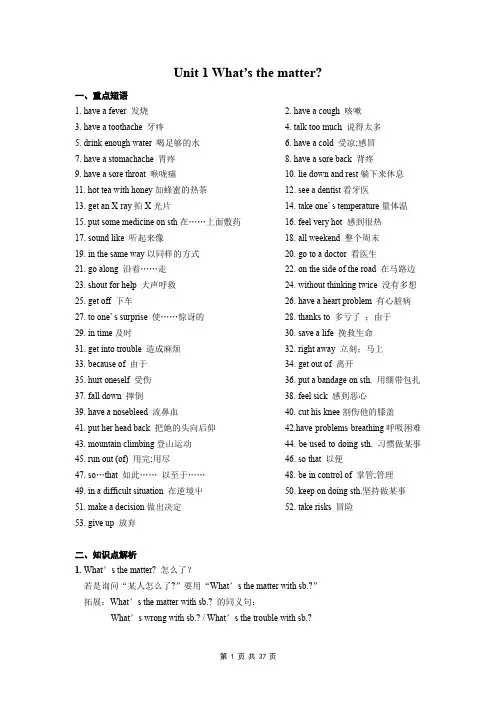
Unit 1 What’s the matter?一、重点短语1. have a fever 发烧2. have a cough 咳嗽3. have a toothache 牙疼4. talk too much 说得太多5. drink enough water 喝足够的水6. have a cold 受凉;感冒7. have a stomachache 胃疼8. have a sore back 背疼9. have a sore throat 喉咙痛10. lie down and rest躺下来休息11. hot tea with honey加蜂蜜的热茶12. see a dentist看牙医13. get an X-ray拍X光片14. take one’ s temperature量体温15. put some medicine on sth在……上面敷药16. feel very hot 感到很热17. sound like 听起来像18. all weekend 整个周末19. in the same way以同样的方式20. go to a doctor 看医生21. go along 沿着……走22. on the side of the road 在马路边23. shout for help 大声呼救24. without thinking twice 没有多想25. get off 下车26. have a heart problem 有心脏病27. to one’ s surprise 使……惊讶的28. thanks to 多亏了;由于29. in time及时30. save a life 挽救生命31. get into trouble 造成麻烦32. right away 立刻;马上33. because of 由于34. get out of 离开35. hurt oneself 受伤36. put a bandage on sth. 用绷带包扎37. fall down 摔倒38. feel sick 感到恶心39. have a nosebleed 流鼻血40. cut his knee割伤他的膝盖41. put her head back 把她的头向后仰42.have problems breathing呼吸困难43. mountain climbing登山运动44. be used to doing sth. 习惯做某事45. run out (of) 用完;用尽46. so that 以便47. so…that 如此……以至于……48. be in control of 掌管;管理49. in a difficult situation 在逆境屮50. keep on doing sth.坚持做某事51. make a decision做出决定52. take risks 冒险53. give up 放弃二、知识点解析1. What’s the matter? 怎么了?若是询问“某人怎么了?”要用“What’s the matter with sb.?”拓展:What’s the matter with sb.? 的同义句:What’s wrong with sb.? / What’s the trouble with sb.?2.疾病类短语:have a +疾病. e.g. :have a fever 发烧have a cold 感冒have a cough 咳嗽.have a +身体部位-ache. e.g.: have a headache 头痛have a toothache 牙痛.have a sore+身体部位. e.g.: have a sore throat咽喉痛have a sore back背痛例题:Mom, I____________.I’m sorry to hear that, dear. We must go to see the dentist right away.A. have a headacheB. have a stomachacheC. have a toothacheD. have a fever3. lie down 躺下V. 躺,平躺。
人教版八年级下册英语——知识点语法归纳总结
人教版八年级下册英语——知识点语法归纳总结Unit 1 What’s the matter?1. 短语归纳①have a cold/ fever/ stomachache…感冒、发烧、胃疼……②lie down 躺下③too much 太多④get an X-ray 拍片⑤take one’s temperature量体温⑥sound like 听起来像……⑦take breaks (take a break) 休息⑧go to a doctor 看医生⑨get off 下车⑩on the side of…在……边上have a heart problem 患心脏病wait for 等待to one’s surprise 使……惊讶的;出乎意料? thanks to 多亏;由于in time 及时think about 考虑,认为right away 立刻,马上get into trouble 陷入麻烦fall down 摔倒a few 几个,一些21 have problems breathing 呼吸困难22 get sunburned 晒伤23 look up 查阅24 be interested in…对……感兴趣25 be used to doing…习惯于做某事26 take risks (take a risk) 冒险27 lose one’s life 丧生28 became of 因为29 run out (of) 用尽,耗尽30 be ready to do sth. 准备做某事31 cut off 切除32 climb down 爬下33 get out of 离开;从……出来34 tell of 讲述35 the importance of (doing sth.) (做某事的)重要性36 be in control of 掌管,管理37 make a decision 做决定38 keep on doing sth. 坚持做某事39 give up 放弃40 cut/ hurt oneself 使自己受伤2. 典句必背①What’s the matter?②I have a stomachache.③What should I do?④Should I take my temperature?⑤I think you should lie down and rest.⑥If your head and neck still hurt tomorrow, then go to a doctor.⑦His love for mountain climbing is so great that he kept on climbing mountains even after this experience.3. 用法集萃(1) 当别人心情不好,身体不适或遇到麻烦时,我们可以用如下表达表示关心:What’s the matter?What’s the matter with you?What’s wrong with …?What’s the trouble\problem with …?(2) 英语中常用have描述身体的不适,此时have意为“患有”,常用结构:①have a + 疾病例:have a cold 感冒;have a fever 发烧;have a cough 咳嗽②have a + 身体部位-ache例:have a headache 头痛;have a toothache 牙痛③have a sore + 身体部位例:have a sore throat 咽喉痛;have a sore back 背痛(3) lie down躺下;tell lies/a lie 说谎含义过去式过去分词躺;平躺lay lain位于撒谎;说谎lied lied(4) maybe & may be①maybe,“或许”,常用于句首,表示可能性,后加句子。
人教版八年级英语下册各知识点归纳总结
千里之行,始于足下。
人教版八年级英语下册各知识点归纳总结
人教版八年级英语下册的各知识点归纳总结如下:
1. 职业和家庭:学习如何描述职业、谈论家庭成员和家庭活动,如询问职业、描述人物、说明工作地点等。
2. 爱好和兴趣:学习如何描述爱好和兴趣,如谈论体育运动、音乐、电影、读书等。
3. 交通和旅行:学习如何描述交通工具、问路和旅行方面的话题,如描述公共交通工具、询问路线、购买车票等。
4. 环保与保护:学习如何描述环保和保护环境的行为,如讨论环境问题、讨论减少污染的方法、倡导保护野生动植物等。
5. 书信和便条:学习如何写书信和便条,如写自我介绍信、道歉信、邀请信等。
6. 教育和学习:学习如何描述学校和学习,如谈论学校设施、描述学习方法、讨论学业压力等。
7. 健康和饮食:学习如何描述健康和饮食,如谈论健康习惯、讨论饮食结构、询问健康问题等。
8. 动物和自然:学习如何描述动物和自然景观,如描述动物的特征、描述自然场景、讨论保护动物和自然的重要性等。
第1页/共2页
锲而不舍,金石可镂。
9. 文化和传统:学习如何描述文化和传统活动,如讨论节日、描述传统习俗、谈论文化差异等。
10. 社会问题和解决方案:学习如何描述社会问题和提出解决方案,如谈论青少年问题、讨论解决社会问题的方法等。
以上是人教版八年级英语下册的各知识点的归纳总结,供您参考。
人教版八年级下册英语必考知识点梳理(期末复习必备)
人教版八年级下册英语必考知识点梳理(期末复习必备)八年级下册英语知识点Unit 1 What’s the matter?【重点短语】1.have a fever 发烧2.have a cough 咳嗽3.have a toothache 牙疼4.talk too much 说得太多5.drink enough water 喝足够的水6.have a cold 受凉;感冒7.have a stomachache 胃疼8.have a sore back 背疼9.have a sore throat 喉咙痛10. take risks 冒险11.hot tea with honey 加蜂蜜的热茶12.see a dentist 看牙医13.get an X-ray 拍X 光片14.take one’s temperature 量体温15.put some medicine on sth. 在……上面敷药16. give up 放弃17. sound like 听起来像18. all weekend 整个周末19. in the same way 以同样的方式20. go to a doctor 看医生21. go along 沿着……走22. on the side of the road 在马路边23. shout for help 大声呼救24. without thinking twice 没有多想25. get off 下车26. have a heart problem 有心脏病27. to one’s surprise 另某人惊讶的是28. thanks to 多亏了;由于29. in time 及时30. make a decision 做出决定31. get into trouble 造成麻烦32. right away 立刻;马上33. because of 由于34. get out of 离开;从……出来35. keep on doing sth. 继续或坚持做某事36. put a bandage on sth. 用绷带包扎37. fall down 摔倒38. feel sick 感到恶心39. have a nosebleed 流鼻血40. cut his knee 割伤他的膝盖41. put her head back 把她的头向后仰42. have problems breathing 呼吸困难43. mountain climbing 登山运动44. be used to doing sth. 习惯做某事45. run out (of) 用完;用尽46. so that 以便47. so...that... 如此……以至于...…48. be in control of 掌管;管理49. in a difficult situation 在闲境中【重点句型】1. What's the matter with you?= What'the trouble with you? = What's wrong with you? 你怎么了?2. What should she do? 她该怎么办呢?3.Should I take my temperature? 我应该量一下体温吗?4.You should lie down and rest. 你应该躺下休息一会儿。
人教版英语八年级下册全册知识点总结
Unit1What ’s the matter?【重点单词】matter[ˈmætə]v.重要,要紧,有关系What’s the matter?怎么了?出什么事了?sore[sɔ:(r)]adj.疼痛的,酸痛的have a cold感冒stomach['stʌmək] n.胃,腹部stomachache['stʌməkeɪk]n.胃痛,腹痛have a stomachache胃痛foot(复数feet)[fu:t] n. 脚neck[nek]n.颈,脖子throat[θrəʊt]n.喉咙fever['fi:və]n.发烧,发热lie[laɪ]v.躺,平躺lie down躺下rest[rest]n.剩余部分,其余;放松,休息cough [kɒf]n.&v.咳嗽X-ray['eksreɪ]n.X 光,X射线toothache [ˈtu:θeɪk]n.牙痛take one's temperature量体温headache[ˈhedeɪk]n.头痛have a fever发烧break[breɪk]n.&v.休息,暂停;打破take breaks(take a break)休息hurt[hə:t] v.伤害,损害,使受伤passenger['pæsɪndʒə] n.乘客,旅客off[ɒf] adv. prep.离开(某处);从…去掉get off下车to one's surprise使…惊讶,出乎…意料onto [ˈɒn tə]prep.向,朝trouble[ˈtrʌb l]n.麻烦,烦扰,问题hit[hit] n.&v.碰撞,打,打击right away立即,马上get into陷入,参与herself[hə:ˈself]pron.她自己,她本身(she 的反身代词)bandage['bændɪdʒ]n.&v.绷带;用绷带包扎sick[sɪk]adj.患病的,不适的knee[ni:]n. 膝盖nosebleed[ˈnəʊz bli:d]n.鼻出血breathe[bri:ð]v.呼吸sunburned[ˈsʌn bɜ:nd]adj.晒伤的ourselves[ɑ:ˈselvz]pron.我们自己(we的反身代词)climber[ˈklaɪmə(r)]n.登山者be used to习惯于…适应于…risk[rɪsk]n. &v.风险,危险;冒险take risks(take a risk)冒险accident[ˈæksidən t]n.意外事件;事故situation[ˌsitjuˈeiʃən]n.状况,形式,情况kg=kilogram[ˈkɪləgræm]n.公斤,千克rock[rɔk] n. 岩石run out(of)用尽,耗尽knife[naif]n.刀,餐刀cut off切除blood [blʌd]n. 血mean[mi:n]v.意味着,意思是,意欲get out of离开,从…出来importance [ɪmˈpɔ:tns]n.重要性decision[dɪ'sɪʒn]n.决心,决定,抉择control[kən'trəʊl] v.控制,支配,操纵be in control of掌管,管理spirit['spɪrɪt]n.勇气,意志death [deθ] n.死亡give up放弃nurse[nə:s]n.护士【重点短语】1.have a fever发烧2.have a cough咳嗽3.have a toothache牙疼4.talk too much说得太多5.drink enough water喝足够的水6.have a cold受凉;感冒7.have a stomachache胃疼8.have a sore back9.have a sore throat 背疼喉咙痛10.take risks冒险11.hot tea with honey加蜂蜜的热茶12.see a dentist13.get an X-ray 看牙医拍X 光片14.take one’s temperature 量体温15.put some medicine on sth.16.give up放弃在……上面敷药17.sound like18.all weekend 听起来像整个周末19.in the same way20.go to a doctor以同样的方式看医生21.go along沿着……走22.on the side of the road在马路边23. shout for help大声呼救24.without thinking twice25. get off下车26. have a heart problem没有多想有心脏病27.to one’s surprise 另某人惊讶的是28.thanks to多亏了;由于29. in time及时30.make a decision31.get into trouble 做出决定造成麻烦32.right away立刻;马上33.because of由于34. get out of离开;从……出来35.keep on doing sth.继续或坚持做某事36.put a bandage on sth.37.fall down摔倒38. feel sick感到恶心用绷带包扎39. have a nosebleed流鼻血40.cut his knee割伤他的膝盖41.put her head back把她的头向后仰42. have problems breathing呼吸困难43.mountain climbing44.be used to doing sth.登山运动习惯做某事45.run out(of)用完;用尽46.so that以便47. so...that...如此……以至于...…48. be in control of掌管;管理49. in a difficult situation在闲境中【重点句型】1.What's the matter with you?= What'the trouble with you? =What's wrong with you?你怎么了?2.What should she do?她该怎么办呢?3.Should I take my temperature?4.You should lie down and rest.我应该量一下体温吗?你应该躺下休息一会儿。