
人教版八年级英语下册第四单元学案
人教版八年级英语下册第四单元学案Unit4 He said I was hard-working Section A教师寄语:There will be no regret and sorrow if you fight with all your strength. (只要全力拼搏了,就没有遗憾,没有后悔。
)一、学习目标:1) mad, anymore, message, suppose, hard-working2) watch soap operas, be supposed to do, first of all, pass on, sth. happen on …3) Important Sentences①She said she was mad at Marcia. ②She said she was having a party for Lana.③What happened on “Young Lives”last night? ④You are supposed to meet at the bus stop to return it.4) Grammar: 直接引语和间接引语二、重点难点:1.直接引语与间接引语之间的转化;2.区分bring/take;三、学习过程:Step1单元语法讲解:(直接引语和间接引语)(一) 直接引语和间接引语的含义:引述别人的话时,一般采用两种形式:一是引用别人的原话,两边用引号标出,称为直接引语;二是用自己的语言转述别人的话,称为间接引语。
间接引语在句中实际上就是宾语从句。
(二) 直接引语变间接引语的方法:1. 从句人称的变化:由直接引语变间接引语时,从句的主语人称要遵循一主、二宾、三不变的原则。
1)直接引语的主语是第一人称时,变为间接引语时要和主句的主语保持一致。
eg:①They said,“We will go there by bus”他们说“我们将乘公共汽车去那儿”。
→They said they would go there by bus. 他们说他们将乘公共汽车去那儿。
②He said,“I am visiting my aunt next week.”→He said that he was visiting his aunt next week. 2)如果直接引语的主语是第二人称,变为间接引语时要与主句的宾语保持一致。
eg:①She said to me,“Are you interested in science?”她对我说:“你对自然科学感兴趣吗?”→She asked me if /whether I was interested in science.她问我是否对自然科学感兴趣。
②He said to me,“You are hard-working.”→He told me that I was hard-working.3)如果直接引语的主语是第三人称时,变为间接引语时人称保持不变。
eg: His mother said to me,“He can’t go to school.”他的妈妈对我说:“他不能去上学”。
→His mother told me that he couldn’t go to school. 他妈妈告诉我他不能去上学了。
2. 从句时态的变化:1)如果主句是一般现在时或一般将来时,直接引语变间接引语时,从句的时态保持不变。
eg: He says,“I am visiting my aunt next week.”他说:“我下周要去看望我的姑姑”。
→He says that he is visiting his aunt next week.2)如果主句的时态为一般过去时,从句的时态要做相应的变化。
①一般现在时改为一般过去时;②现在进行时改为过去进行时;③一般将来时改为过去将来时。
注意:如果直接引语为客观真理、客观事实、自然现象时,变为间接引语时,时态不做变化。
The teacher said to us ,“Light travels faster than sound”.老师告诉我们:“光传播的速度要比声音传播的速度要快”。
→The teacher told us that Light travels faster than sound.3. 句型的变化:1)如果直接引语是陈述句,变为间接引语时要用that来引导,that可省略。
eg: He said,“I like watching TV.”他说:“我喜欢看电视”。
→He said that he liked watching TV.2)如果直接引语是一般疑问句,变为间接引语时,需用if或whether来引导,且用陈述句语序。
eg: He asked me,“Will you buy the red coat?”他问我:“你要买那件红外套吗?”→He asked me if/whether I would buy the red coat.3)如果直接引语是特殊疑问句,变为间接引语时,引导词就是特殊疑问词,且用陈述句语序。
eg: She asked me,“Where are you from?”她问:“你从哪里来的?”→She asked me where I was from.4)如果直接引语是祈使句,变间接引语时,要将祈使句的动词变为不定式如:tell( ask , order ,…) sb. (not) to do sth.eg: “Open the door.”The teacher said to me. →The teacher told me to open the door. “Don’t open the door.”The teacher said to me. →The teacher told me not to open the door. 语法针对性练习:1.She said she ______ sorry for being late. A.is B.was C.were D.are2.I asked her ______.A.why does she want to copy my homework.B.why did she want to copy my homework.C.why she wants to copy my homework.D.why she wanted to copy my homework.3.My father told me the earth ______ round. A.is B.was C.will be D.would be4.She asked me ______ she could use my mobile phone. A.that B.for C.weatherD.if5.He told us ______ he would buy a new car. A.which B. that C. what D. ifStep2 Learn the new words预习导学:1.mad adj.①生气的;气愤的构成结构:be mad at sb.=_________意为“生某人的气”eg: 我妈妈很生我的气,因为我没有完成家庭作业。
My mother is ______ ______ me because I didn’t finish my homework.②疯狂的;着迷的相当于crazy,构成短语:be mad to do sth.eg: 你开车这么快,一定是疯了。
You must be mad ______ ______ so fast.2.not …anymore 不再;再也不eg: 我将再也不是你最好的朋友了。
I_____ be your best friend______.他不再住这儿了。
He ____ live here ______ .3.first of all 首先= __________4.message cn. 消息;信息;口信拓展:给某人捎口信________给某人留口信_______发短信_________5.pass on 传递试译:传递给某人某物__________________________= pass on sth. to sb. eg: 请把钢笔传递给Tom. ____________________________________这是Tom的钢笔,请传给他。
____________________________6.suppose v. 假定;认为;期望短语:be supposed to do sth. = should do sth. 译作:__________be not supposed to do sth. = shouldn’t do sth. 译作:__________eg: 你应该认真听讲。
You _____ _____ _____ _____ carefully.你不应该上课迟到。
You ____ _____ _____ _____ late for class.7.hard-working adj. 勤勉的;努力工作的eg: 他是一个努力工作的人。
He is a _________ person. 你很努力。
You are _________. 预习自测:根据首字母或汉语提示完成单词或短语:1.He left a m______ on your table.2.Don’t ______(生气) her. She is still too young.3.They both ______(传递)their sticks at the same time.4.He ______(归还) my MP3 to me yesterday.5.They will ______(举办一个惊喜的晚会) for Tom.Step 3 课文重点知识讲解:1. You are supposed to meet at the bus stop this morning to return it.精讲:return v.①“归还”相当于give back 短语:换给某人某物return sb. sth.= ___________________= give sth. back to sb. eg: 请把伞还给我。
_____________________________________ ②return to someplace “返回某地”相当come/go back to some place.eg: 他就要回上海了。
人教版英语八年级下册第4单元导学案
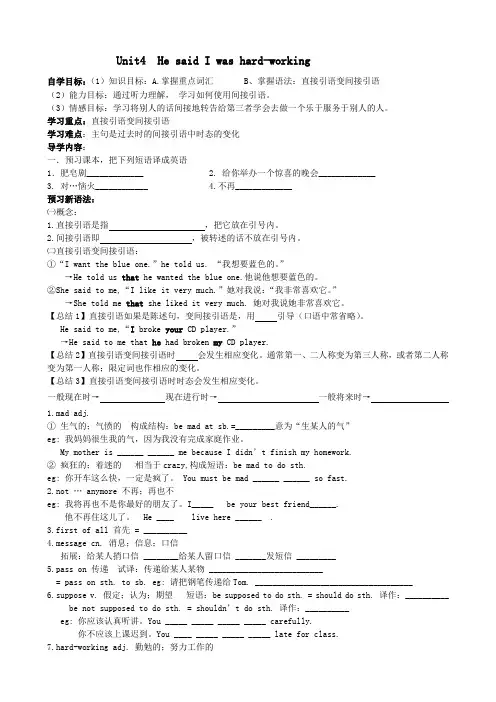
Unit4 He said I was hard-working自学目标:(1)知识目标:A.掌握重点词汇 B、掌握语法:直接引语变间接引语(2)能力目标:通过听力理解,学习如何使用间接引语。
(3)情感目标:学习将别人的话间接地转告给第三者学会去做一个乐于服务于别人的人。
学习重点:直接引语变间接引语学习难点:主句是过去时的间接引语中时态的变化导学内容:一.预习课本,把下列短语译成英语1.肥皂剧_____________ 2. 给你举办一个惊喜的晚会_____________3. 对…恼火____________4.不再_____________预习新语法:㈠概念:1.直接引语是指,把它放在引号内。
2.间接引语即,被转述的话不放在引号内。
㈡直接引语变间接引语:①“I want the blue one.”he told us. “我想要蓝色的。
”→He told us that he wanted the blue one.他说他想要蓝色的。
②She said to me,“I like it very much.”她对我说:“我非常喜欢它。
”→She told me that she liked it very much. 她对我说她非常喜欢它。
【总结1】直接引语如果是陈述句,变间接引语是,用引导(口语中常省略)。
He said to me,“I broke your CD player.”→He said to me that he had broken my CD player.【总结2】直接引语变间接引语时会发生相应变化。
通常第一、二人称变为第三人称,或者第二人称变为第一人称;限定词也作相应的变化。
【总结3】直接引语变间接引语时时态会发生相应变化。
一般现在时→现在进行时→一般将来时→1.mad adj.①生气的;气愤的构成结构:be mad at sb.=_________意为“生某人的气”eg: 我妈妈很生我的气,因为我没有完成家庭作业。
最新人教版八年级英语下册第四单元Unit4导学案
最新人教版八年级英语下册第四单元Unit4导学案导学案Unit 2 Maybe you should learn to relax【学习目标】知识与能力:1、新单词及新短语:2、句型:1)They might find it difficult to plan things for themselves sb +find + it+ adj. +to do sth. + (for sb.)2)Parents see other children doing a lot of things.See +sb./sth.+doing sth.3)The tired children don't get home until 7pm.4)Most Children take part in after-class job.5)Doctors say many children are under too much pressure.3、训练提高阅读能力,学习阅读技巧过程与方法:自学导入-新知呈现-练习巩固-知识迁移-总结反馈由浅入深,设置情景、学习阅读策略。
情感态度价值观:Pressure is a serious problem . We should find ways to relax【学习重、难点】学会使用词典查找单词; 难点:培养学生阅读习惯【学习过程】Step1. 自主学习单词互译:足球到…为止适合,适应包括,包含推动,督促派遣,打发(反身代词)他们自己自由pressure complain pushy comparecrazy adult organized短语互译:找到时间(做某事)尽可能…各种各样的一方面另一方面三个孩子的妈妈参加课后俱乐部竞争从很小年纪就开始了我发现/感到/认为做某事很难压力太大和---比较有组织的活动直到…才翻译句子a) 孩子们直到写完作业才上床睡觉。
b) 在海伦到来前我不会离开。
人教八年级下册英语Unit4教学设计
(五)总结归纳,500字
1.教师引导学生回顾本节课所学内容,总结一般过去时态的用法、词汇的含义和用法。
2.学生分享自己在课堂上的收获和感受,教师给予肯定和鼓励。
3.教师布置课后作业,包括复习词汇、完成短文写作等,并提醒学生预习下一节课的内容。
1.任务型教学法:教师通过设计任务,引导学生参与课堂活动,提高学生的英语实际运用能力。
2.情境教学法:教师创设情境,让学生在真实的语境中学习英语,提高学生的学习兴趣和积极性。
3.小组合作学习:教师组织学生进行小组讨论、展示等活动,培养学生的合作精神和团队意识。
4.自主学习:教师鼓励学生课前预习、课后复习,培养学生自主学习的能力。
1.学生在八年级上册及本册前三个单元的学习中,已经掌握了基本的英语语法、词汇和句型,具备了一定的英语听说读写能力。
2.在此之前,学生已经学习过一般过去时态,但对于一些不规则动词的过去式变化仍需巩固。
3.学生在阅读方面,对于故事性较强的文章能够产生兴趣,但部分学生在提取关键信息、理解文章深层含义方面存在一定困难。
(2)在篇章层面,如何使文章结构清晰,逻辑性强。
(3)口语表达中,如何使语言流畅、自然,富有表现力。
(二)教学设想
1.教学方法:
(1)采用情景教学法,通过图片、视频等多媒体手段,创设真实语境,帮助学生更好地理解词汇和语法。
(2)运用任务型教学法,设计各种听说读写任务,引导学生主动参与,提高实际运用能力。
(1)形成性评价:关注学生在课堂上的表现,包括参与度、合作精神、口语表达等。
(2)终结性评价:通过单元测试、作文、口语测试等形式,全面评估学生的学习成果。
人教版八年级英语下册第四单元学案
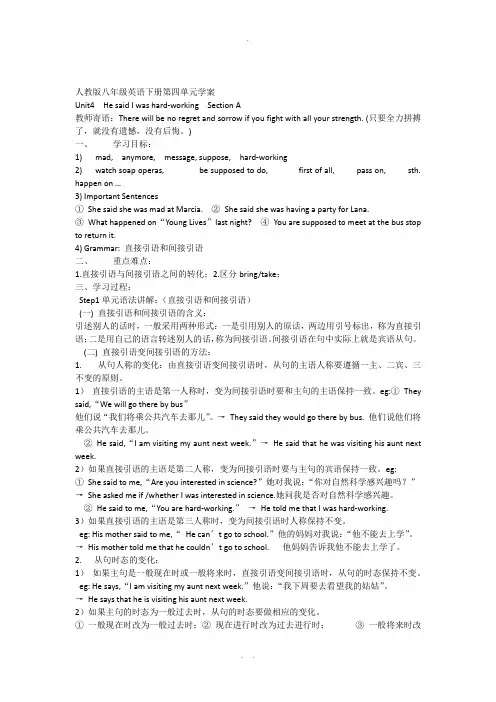
人教版八年级英语下册第四单元学案Unit4 He said I was hard-working Section A教师寄语:There will be no regret and sorrow if you fight with all your strength. (只要全力拼搏了,就没有遗憾,没有后悔。
)一、学习目标:1) mad, anymore, message, suppose, hard-working2) watch soap operas, be supposed to do, first of all, pass on, sth. happen on …3) Important Sentences①She said she was mad at Marcia. ②She said she was having a party for Lana.③What happened on “Young Lives”last night? ④You are supposed to meet at the bus stop to return it.4) Grammar: 直接引语和间接引语二、重点难点:1.直接引语与间接引语之间的转化;2.区分bring/take;三、学习过程:Step1单元语法讲解:(直接引语和间接引语)(一) 直接引语和间接引语的含义:引述别人的话时,一般采用两种形式:一是引用别人的原话,两边用引号标出,称为直接引语;二是用自己的语言转述别人的话,称为间接引语。
间接引语在句中实际上就是宾语从句。
(二) 直接引语变间接引语的方法:1.从句人称的变化:由直接引语变间接引语时,从句的主语人称要遵循一主、二宾、三不变的原则。
1)直接引语的主语是第一人称时,变为间接引语时要和主句的主语保持一致。
eg:①They said,“We will go there by bus”他们说“我们将乘公共汽车去那儿”。
人教版八年级英语下册unit4 导学案
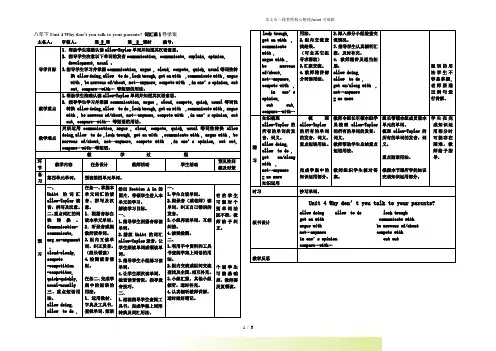
主备人:审核人:第 5 周第 2 课时编号:导学目标1.帮助学生准确认读allow-Taylor单词并知道其汉语意思。
2. 指导学生注意以下单词的发音communication, communicate, explain, opinion,development, usual 。
3.指导学生学习并掌握communication, argue , cloud, compete, quick, usual等词性转换 allow doing,allow to do ,look trough, get on with ,communicate with , argue with , be nervous of/about, not…anymore, compete with ,in one’s opinion, cut out, compare…with…等短语的用法。
教学重点1.帮助学生准确认读allow-Taylor单词并知道其汉语意思。
2. 指导学生学习并掌握communication, argue , cloud, compete, quick, usual等词性转换 allow doing,allow to do ,look trough, get on with ,communicate with , argue with , be nervous of/about, not…anymore, compete with ,in one’s opinion, cut out, compare…with…等短语的用法。
教学难点灵活运用communication, argue , cloud, compete, quick, usual等词性转换 allow doing,allow to do ,look trough, get on with ,communicate with , argue with , be nervous of/about, not…anymore, compete with ,in one’s opinion, cut out, compare…with…等短语。
人教版八年级下册英语Unit4单元教案

教学
环节
教学活动
设计意图
(或复备建议)
教师活动
预设学生活动
Step 1Greeting
Check homework
Coach
Step 2
Ask: Do you have any problems? How do you deal with them?
Present 3a and give tasks
人教版八年级下册英语Unit4单元教案
年级
八年级
学科
英语
主备教师
复备教师
课题
Unit 4 Why don’t you talk to your parents ?
课型
课时
教材及课标分析
通过确定目标语言,采用听说读写自我检测等手段,有效提高语言习得者学习效率
有利于语言输出,体现了以学生为主体的思想。
学情分析
Review
教学活动过程设计(第3课时)
教学
环节
教学活动
设计意图
(或复备建议)
Hale Waihona Puke 教师活动预设学生活动Greeting
Step 1Check homework
Ask Ss say their answers
Step 2 (1a 1b )
Ask;When you have stress, what do you do?
Page 32 3b
Self check 2
Discuss and complete 2a
Listen carefully and understand
Read and answer the questions
Read and translate
人教版八年级下册英语单元复习学案:unit-4-Why-don’t-you-talk-to-your
Unit 4 Why don’t you talk to your parents?默写1 Section A 1a~2d一、默写课文中的单词。
1.允许;准许v. __________________2.有毛病;错误的adj. ____________________3.猜测;估计v. __________________4.协议;交易n. _________________________二、默写课文中的短语。
1.空闲时间_______________________2.闲逛3.课外辅导班_____________________4.和……打架___________________________5.睡觉___________________________6.给某人写信___________________________7.为了;以便于___________________8.快速查看;浏览________________________9.归还___________________________ 10.生……的气__________________________11.重要的事____________________________________________________________________12.成功地发展;解决_____________________________________________________________13.没问题;别客气_______________________________________________________________三、根据汉语提示完成下列句子。
1.为什么不和你的父母谈谈呢?______ ______ you talk to your parents?2.我的父母不允许我和我的朋友们闲逛。
My parents don’t ______ me ______ ______ ______ with my friends.3.你应该和他谈谈,以便于你可以说你很抱歉。
人教版八年级下册英语unit4教案及教学反思
人教版八年级下册英语unit4教案及教学反思全文共3篇示例,供读者参考篇1Unit 4 of the People's Education Press Eighth Grade English textbook is focused on the theme of "Hobbies". This unit aims to help students talk about their own hobbies and interests, as well as learn how to express preferences and opinions.Teaching Objectives:1. Enable students to talk about their hobbies and interests in English.2. Introduce vocabulary related to different hobbies.3. Teach students how to express preferences and opinions.4. Improve students' listening, speaking, reading, and writing skills.Teaching Procedures:1. Warm-up activity: Start the lesson by asking students to share their hobbies with the class. This will help to activate their prior knowledge and create a positive learning atmosphere.2. Vocabulary introduction: Introduce key vocabulary related to hobbies, such as "painting", "cooking", "playing sports", etc. Use pictures, gestures, and realia to help students understand and remember the new words.3. Listening comprehension: Play a listening passage where people talk about their hobbies. Students listen and then answer comprehension questions to check their understanding.4. Speaking practice: Divide the class into pairs or groups and ask them to discuss their own hobbies, using the vocabulary they have learned. Encourage students to ask questions and share their opinions with each other.5. Reading activity: Give students a reading passage about different hobbies and ask them to identify key information, such as the benefits of each hobby and how to get started.6. Writing task: Ask students to write a short paragraph about their favorite hobby, describing why they enjoy it and how it makes them feel. Provide feedback on their writing to help improve their language skills.7. Role-play activity: Divide students into pairs and give them a role-play scenario where they discuss their preferencesfor different hobbies. This will help them practice expressing opinions and using the target vocabulary.8. Review and assessment: End the lesson with a review of key vocabulary and concepts covered in the unit. Administer a quiz or speaking activity to assess students' understanding and progress.Teaching Reflection:Overall, teaching Unit 4 on Hobbies was engaging and effective. The activities helped students practice speaking, listening, reading, and writing skills in a fun and interactive way. However, one area for improvement is to provide more opportunities for students to use the target language in real-life contexts. For example, incorporating project-based learning tasks where students create a hobby-themed presentation or video could further enhance their language proficiency.In conclusion, Unit 4 provided a valuable opportunity for students to explore their interests and hobbies in English. By incorporating a variety of activities and assessments, teachers can help students achieve the learning objectives and improve their English language skills.篇2Unit 4 of the People's Education Edition eighth grade English textbook covers the topic of "Wild Animals". In this unit, students will learn vocabulary related to wild animals, practice reading and listening skills through various texts, and improve their ability to describe animals and discuss their habitats.Lesson 1:- Warm-up: Start the lesson by asking students to name different wild animals they know.- Vocabulary: Introduce new vocabulary words related to wild animals such as lion, elephant, tiger, etc.- Reading: Read a short passage about different wild animals and ask students comprehension questions.- Listening: Play a recording of different animal sounds and ask students to match the sound with the correct animal.- Speaking: Have students describe their favorite wild animal and why they like it.Lesson 2:- Warm-up: Review the vocabulary words from the previous lesson by playing a matching game.- Reading: Read a longer passage about a safari trip and ask students to identify the animals mentioned in the text.- Grammar: Introduce comparatives and superlatives using examples related to wild animals (e.g. The elephant is bigger than the giraffe).- Speaking: Have students work in pairs to discuss which animal they think is the most interesting and why.Lesson 3:- Warm-up: Play a game of charades where students act out different wild animals for their classmates to guess.- Reading: Read a passage about endangered animals and discuss why it is important to protect them.- Writing: Have students write a short paragraph about what they can do to help protect endangered animals.- Speaking: Conduct a class debate on whether or not zoos are good for wild animals.Lesson 4:- Warm-up: Review the vocabulary and grammar concepts learned in the previous lessons through a quiz.- Project: Have students work in groups to create a poster about a specific wild animal, including information about its habitat, diet, and interesting facts.- Presentation: Have each group present their poster to the class and answer questions from their classmates.Teaching Reflection:Overall, the unit was engaging and interactive for students. The variety of activities helped to keep students interested and motivated throughout the lessons. The vocabulary and grammar concepts were presented in a clear and concise manner, allowing students to grasp the new material easily. The project at the end of the unit provided students with an opportunity to apply what they had learned and showcase their creativity. However, I would like to incorporate more opportunities for students to practice speaking and listening skills in future lessons to further develop their language proficiency.篇3Unit 4 of the eighth-grade textbook by People's Education Press focuses on the theme of "Wild animals". In this unit, students will learn about various wild animals and their habitats, as well as the importance of wildlife conservation.The unit is divided into several sections, including reading, listening, speaking, and writing tasks. The reading passages describe different wild animals such as lions, elephants, and pandas, providing students with essential information about these creatures. The listening activities help students improve their listening skills by practicing comprehension and understanding spoken English. Speaking tasks encourage students to express their opinions and share information about wild animals with their peers. Writing tasks require students to write short paragraphs or essays about their favorite kind of wild animal or the importance of wildlife conservation.To begin the unit, teachers can introduce the topic of wild animals by showing pictures or videos of different types of wildlife. This can generate interest and curiosity among students, prompting them to learn more about these fascinating creatures. Teachers can also engage students in group discussions or debates about wildlife conservation and the impact of human activities on the environment.During the reading and listening activities, teachers should provide support and guidance to students as they work through the text and audio materials. Encouraging students to ask questions, make predictions, and summarize key points can helpthem better comprehend the information presented. Teachers can also incorporate vocabulary-building exercises, such as word matching or crossword puzzles, to reinforce new words and concepts.For the speaking and writing tasks, teachers can encourage students to use creative expression and critical thinking skills. Providing opportunities for role-playing, storytelling, and collaborative writing can enhance students' language abilities and boost their confidence in using English. Teachers can also assign group projects or presentations that require students to research and present information about specific wild animals or conservation efforts.In conclusion, Unit 4 of the eighth-grade textbook by People's Education Press offers a comprehensive and engaging exploration of wild animals and wildlife conservation. By incorporating a variety of teaching strategies and activities, teachers can facilitate students' learning and language development in a meaningful and enjoyable way. Through active participation and interaction, students can deepen their understanding of the natural world and cultivate a sense of responsibility towards protecting our environment and its inhabitants.。
最新人教版八年级下册英语第四单元导学案
Unit 4 W hat’s the best movie theat e r?第一课时Sectio n A1a-2d一、学习目标知识目标:学会使用下列单词和短语:theate r, comfor table, seat, screen, close, ticket, worst, cheapl y, song, choose, carefu lly, report er, fresh, comfor tably, so far 。
句子:What’sthebestc lothe s storein town? I thinkMiller’sisthebest.能力目标:初步理解并运用最高级,掌握最高级的构成规则。
情感目标:学会通过比较确定自己最喜欢的事物;身动、心动、神动,做课堂的主人。
激情投入,体会成功的快乐。
教学重点:词汇及最高级的构成规则。
教学难点:最高级在语言环境中的运用。
二、预习展示1.单词theate r____________ 使人舒服的___________seat____________ close_____________ 票__________ worst___________便宜地_____________小心地______________ report er_____________ comfor tably________________ 2.短语so far_________ be closeto______________看电影______________欢迎来……_________________三、合作探究(一)合作学习Task 1 小组合作完成1a discuss。
Task 2 完成1b, 2a, 2b听力。
2024年人教版八年级英语下册教案Unit 4 第4课时Section B (2a—2e)
第四课时Section B(2a—2e)教学目标通过本课的学习,学生能够:1.在阅读语篇创设的情境中,正确理解和掌握课文中的新词汇,增加词汇量;学会从文章中找出作者的观点和支持理由,从中学会表达自己的看法和观点并给出能支持该观点的理由。
(获取信息)2.了解中西方家长对待孩子参加课外活动和课外学习班的态度与做法。
(梳理整合)3.在教师的帮助下,通过思维导图、辩论等策略,增进对语篇的理解和分析能力,提高思维的逻辑性、批判性和创新性。
(内化应用)4.在阅读有关中西方家长对待孩子参加课外活动和课外学习班的态度与做法的文章,的理解基础上总结出中西方家庭共同存在的问题,并能用自己的语言来阐述文中不同人的观点和看法,进一步巩固和内化本单元所学的语言知识。
(迁移创新)语篇研读What:本课语篇介绍了一些中西方家长对孩子们业余活动和课外学习的安排以及想法。
Why:阅读技能的训练不仅能帮助学生进一步巩固和内化本单元所学的语言知识,还让学生通过关联生活发现和感受中西方文化的异同。
How:语篇通过介绍一些中西方家长对孩子们业余活动和课外学习的安排以及想法,总结出这些家庭共同存在的问题,并阐述自己的观点和看法。
同时,引导学生体验丰富多彩的课外生活。
教学过程设计理念:以新课标核心素养为导向,以单元主题为引领,基于语篇的育人理念,体现新课标“学思用创”的英语学习活动观和“教—学—评”一体化设计理念。
教学目标学习活动效果评价Lead-in通过问题导入本课主题——青少年是否应该参加业余活动,为新课程的学习做好引导和铺垫1.The teacher shows the students thequestions below,and asks them tohave a discussion.(1)Do you have after-school activities?(2)What are they?Do you like them?2.Ask a few students to show theiropinions.教师根据学生回答问题的表现预判学生的能力,了解学生的兴趣,同时根据学生的回答情况给予帮助和鼓励设计意图通过问题导入本课主题,引起学生的思考。