
人教版七年级英语上册Unit 4-Unit 6知识点总结及习题
2、以特殊疑问词 where 开头的特殊疑问句及回答。 句式:1.询问地点——Where + is + 单数物品?
答语 It is+ 表位置的介词短语. Where + are + 复数物品? 答语 They are + 表位置的介词短语. —Where’s my backpack? —It’s under the table. —Where are your books? —They’re on the chair. 2.询问某物是否在某地的句型及答语 —Is the baseball on the sofa?—No,it isn’t. It’s under the chair. —Are they on the bed? —No,they’re not. 3.倒装句——Here + be 动词 + 主语 Here is my pen.
It_________(be)__________(interest).
10)My parent _______(not like)______(play)________(sport).Because it’s _________(bore) 11._________(他们)___________(not play) sports every day.
5)You ___________( not ,have) ______(sport) every day. 6)She ___________( not watch TV) in the evening. She _________(study) English every day. 7)Let’s_________(play) volleyball with ______(she).She ________(play) every day. 8)Let your sisiter _______(play) the computer game. 9)We _________(have) a __________(sport)_____________(collect).
Unit 4 Where’s my schoolbag? 词汇:1.本单元出现的家具类词汇:
桌子
书橱,书柜
椅子
书桌
床
沙发
房间
时钟
重点短语:
在桌子上
在桌子底下
在他的头上
在他的文具盒里
在沙发上
在我们的房间里
watch TV
在我的书包里
where’s =
在书柜里
重点语法:1、介词 on(在…上), in(在…里), under(在…下)的用法。
人称单数时,动词要变成“三单”形式)
句式:1.Do 引导的一般疑问句 —Do you have a TV?—Yes,I do. / No,I don’t. —Does he have a tennis racket? —Yes,he does. / No,he doesn’t.
2.祈使句——Let’s do sth. Let’s play ping-pong. 3.主系表结构——主语 + 系动词 + 形容词 That sounds good.
Here are some apples.
1)_______(this) are my parents. 2)_______(that) are his friends. 3)Is this his father? No,_______ isn’t. A.it B.this C.he 4)Is his mother your friend? Yes,________is. A.he B.she C.you 5)Thanks _________your interesting book. A.for B. very much C.a lot 6)There _______(be) a photo of my friends.
1) _______his parents _______(have) a ping-pang ball?
-----Yes,________________. 2) _________our English teacher ______(have) a basketball?-------No,_________________. 3) My friend ____________(看电视) every day. 4) ______(他弟弟)______(有)many__________(sport)_________(club).
Unit 5 Do you have a soccer ball?
词汇:1.球类名词小结
英式足球 乒乓球
网球
排球
篮球
棒球
2.重点短语:
play soccer
let’s =
play tennis
பைடு நூலகம்
play tennis
play sports
乒乓球拍
play basketball
every day
doesn’t =
on TV
3.play + 名词 结构的短语
打排球
play sports 参加体育运动 play computer games 玩电脑游戏
“play + 球类名词”结构的短语 play ping-pong 打乒乓球 play tennis 打网球
4.watch TV 看电视 on TV 在电视上,通过电视
_____(they) only _____(watch)_____(they)____(in\on\with\by)TV. 12.-------_______(let)______(he)_____(play)_______(the\a\an\\) baseball.
--------_________(sound) good.
5.常用的描述某物或某事的形容词:
interesting 有趣的 fun 有趣的 relaxing 轻松的 boring 无聊的 difficult 困难的
重点语法:1、以助动词 do,does 开头的一般疑问句。 2、一般现在时态。(表现在的状态,或经常的、习惯性的动作,或
主语具备的性格和能力等。) 3、动词的三人称单数形式(在一般现在时态中,当句子主语是第三
人教版英语七年级上册Unit 4-6单词和语法整理
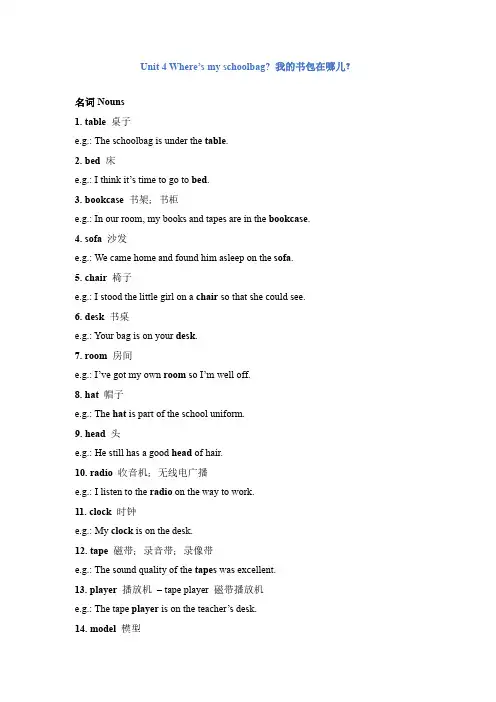
Unit 4 Where’s my schoolbag? 我的书包在哪儿?名词Nouns1. table 桌子e.g.: The schoolbag is under the table.2. bed床e.g.: I think it’s time to go to bed.3. bookcase书架;书柜e.g.: In our room, my books and tapes are in the bookcase.4. sofa 沙发e.g.: We came home and found him asleep on the sofa.5. chair 椅子e.g.: I stood the little girl on a chair so that she could see.6. desk 书桌e.g.: Your bag is on your desk.7. room房间e.g.: I’ve got my own room so I’m well off.8. hat帽子e.g.: The hat is part of the school uniform.9. head头e.g.: He still has a good head of hair.10. radio收音机;无线电广播e.g.: I listen to the radio on the way to work.11. clock时钟e.g.: My clock is on the desk.12. tape磁带;录音带;录像带e.g.: The sound quality of the tapes was excellent.13. player播放机– tape player 磁带播放机e.g.: The tape player is on the teacher’s desk.14. model模型e.g.: This model was two years in the making.15. plane飞机– model plane 飞机模型e.g.: The white model plane is hers.动词Verbs1. come 来;来到– come on 快点儿e.g.: It was very good of you to come.2. think认为;想;思考e.g.: I think we should go back to first principles.3. know知道;了解e.g.: I don’t know what you’re on about.形容词Adjectives1. tidy 整洁的;井井有条的e.g.: They sat in her neat and tidy kitchen.副词Adverbs1. where在哪里;到哪里e.g.: Where did you go to school?2. everywhere处处;到处;各个地方e.g.: Gina’s books are everywhere – on her bed, on the sofa and under the chair.3. always总是e.g.: I always think of you as one of the family.代词Pronouns1. their他(她、它)们的e.g.: They both had some right on their side.2. our我们的e.g.: It’s time to put our plan into operation.介词Prepositions1. on在……上e.g.: There’s a mark on your skirt.2. under在……下e.g.: The English books are under the radio.连词Conjunctions1. but但是e.g.: Her job is hard work, but the pay is good.感叹词Interjections1. yeah是的;对e.g.: Do you want to go through it all? ------ Yeah, if you want.Grammar Points 语法点1. Where疑问句2. 介词on, in, under3. 连词andWhere’s the map? It’s in your grandparents’ room. Where are my books? They’re on the sofa.Where’s his pencil box? It’s in his schoolbag.Where’s your ruler? It’s under the chair.Where are their keys? They’re on the table.Where’s = Where isUnit 5 Do you have a soccer ball? 你有足球吗?名词Nouns1. tennis 网球e.g.: I’m not much good at tennis.2. ball球e.g.: Please give me my ball back.3. ping-pong乒乓球e.g.: I like ping-pong. It’s easy for me.4. bat 球棒;球拍e.g.: Tom has a baseball, but he doesn’t have a baseball bat.5. soccer (英式)足球– soccer ball (英式)足球e.g.: I don’t have a soccer ball, but my brother Alan does.6. volleyball 排球e.g.: I have two soccer balls, two volleyballs, four basketballs and five baseballs.7. basketball篮球e.g.: I enjoy playing basketball.8. TV (= television) 电视;电视机e.g.: We’re buying a new TV with the money.9. sport体育运动e.g.: I like most sports, but tennis is my first love.10. class班级;课e.g.: In this class, students will learn how to speak English.11. classmate同班同学e.g.: I play ping-pong with my classmates after class.动词Verbs1. have 有e.g.: I don’t have that much money on me.2. let允许;让– let’s = let us 让我们(一起)e.g.: Next time you’re here let’s have lunch together.3. go去;走e.g.: I didn’t want to go to a large university.4. has(have 的第三人称单数形式)有e.g.: The latest model has over 100 new features.5. get去取(或带来);得到e.g.: It will be months before we get the results.6. play参加(比赛或运动);玩耍e.g.: You’ll have to play inside today.7. sound听起来好像e.g.: It sounds as if you have grown apart from Tom.8. watch注视;观看– watch TV 看电视e.g.: I could sit and watch the river all day long.9. like喜欢;喜爱e.g.: You’ll like her once you get to know her.形容词Adjectives1. late迟到e.g.: As often as not (往往), he’s late for work.2. great美妙的;伟大的e.g.: We’ll have a great time, you’ll see.3. interesting有趣的e.g.: That looks like an interesting book.4. boring没趣的;令人厌倦的e.g.: She found her job very boring.5. relaxing轻松的;令人放松的e.g.: It’s a relaxing car to drive long distance.6. same相同的e.g.: I’d like one the same as yours.7. easy容易的;不费力的e.g.: This is not an easy task.副词Adverbs1. only只;仅e.g.: There’s only one sure way to do it.代词Pronouns1. us(we的宾格)我们e.g.: It was a testing time for us all.2. we我们e.g.: We’ll be there in less than no time.3. them(they的宾格)他(她、它)们e.g.: I can probably make the time to see them.介词Prepositions1. with和……在一起;带有;使用e.g.: I had a long conversation with her the other day.感叹词Interjections1. hey嘿;喂e.g.: Hey, that’s an idea! And we could get a band, as well.兼类词Words with multiple part of speech1. do (第三人称单数形式does)aux v. & v.用于构成否定句和疑问句;做;干e.g.: What are you doing this evening?2. fun adj.有趣的;使人快乐的n.乐趣;快乐e.g.: We had a lot of fun at that party.3. love v. & n.爱;喜爱e.g.: He said he would love her forever.4. after prep. & conj.在……以后e.g.: I’ve told you time after time not to do that.其他(专有名词、地名、人名等)1. Bill 比尔(男名)Grammar Points 语法点1. 一般现在时to have2. Yes/No一般疑问句及简短回答3. 肯定句与否定句4. 性质形容词5. 连词butDo you have a baseball? Yes, I do. / No, I don’t. I have a volleyball.Do you have a ping-pongYes, I do. / No, I don’t. I have a ping-pong ball.bat?Does she have a tennis ball? Yes, she does. / No, she doesn’t. She has a baseball. Does he have a soccer ball? Yes, he does. / No, he doesn’t. He has two ping-pong bats. Do they have a basketball? Yes, they do. / No, they don’t. They have a volleyball. don’t = do not doesn’t = does notUnit 6 Do you like bananas? 你喜欢香蕉吗?名词Nouns1. banana 香蕉e.g.: I don’t bananas, but I like oranges and apples.2. hamburger汉堡包e.g.: She was eating a hamburger.3. tomato西红柿e.g.: The tomato hit the wall with a splat.4. ice-cream 冰激凌e.g.: Today you can buy hundreds of flavors of ice-cream.5. salad 沙拉e.g.: John likes salad, and it’s his birthday.6. strawberry 草莓e.g.: I think John likes strawberries and apples.7. pear梨e.g.: There are lots of pear trees near the house.8. milk牛奶e.g.: Do you take milk in your tea?9. bread面包e.g.: Could you stop by the store on the way home for some bread?10. birthday生日e.g.: John’s birthday dinner is next week.11. dinner(中午或晚上吃的)正餐e.g.: I’d like to take you out to dinner tonight.12. week周;星期e.g.: I could come next week, or the week after.13. food食物e.g.: They are at the end of their food supply.14. burger (= hamburger) 汉堡包e.g.: You can have a burger, but you can’t have fries as well.15. vegetable蔬菜e.g.: I hope to have a vegetable plot.16. fruit水果e.g.: We buy our fruit and vegetables at the market.17. apple苹果e.g.: The apple is full of worms.18. egg蛋;鸡蛋e.g.: Eggs are graded from small to extra-large.19. carrot胡萝卜e.g.: Would you like some more carrot?20. rice大米;米饭e.g.: We eat rice every singe day.21. chicken鸡肉e.g.: I like chicken for dinner.22. breakfast早餐;早饭e.g.: What do you like for breakfast?23. lunch午餐e.g.: I’m ready for some lunch.24. star明星;星星e.g.: She was the star of many popular TV series.25. habit习惯e.g.: David asks the volleyball star, Cindy Smith, about her eating habits.26. question问题e.g.: I spent most time on the first question.动词Verbs1. eat 吃e.g.: I like ice-cream, but I don’t eat it.2. want需要;想要e.g.: You don’t want to do it like that.3. be变成e.g.: He wants to be a pilot when he grows up.形容词Adjectives1. right 正确的;适当的e.g.: I sincerely believe that this is the right decision.2. healthy健康的e.g.: Mary gave birth to a healthy baby girl.副词Adjectives1. sure当然;肯定;一定e.g.: I’m sure you’ll get there in the end.2. then那么e.g.: Right then, where do you want the table to go?3. well好;令人满意地e.g.: The kids all behaved well.4. really真正地e.g.: They are not really my aunt and uncle.连词Conjunctions1. so(引出评论或问题)那么e.g.: So, what have you been doing today?短语Expressions1. think about 思考;思索e.g.: I’ll think about it nearer the time.2. How about…?(提出建议)……怎么样?e.g.: How about burgers, vegetable salad, and some fruit?Grammar Points 语法点1. 一般现在时to like2. Yes/No一般疑问句及简短回答3. 肯定句与否定句Do you like salad? Yes, I do. / No, I don’t.Do they like pears? Yes, they do. / No, they don’t.Does she like tomatoes? Yes, she does. / No, she doesn’t.I like oranges. I don’t like bananas.We like rice. We don’t like hamburgers.He likes ice-cream. He doesn’t like vegetables.4. 可数与不可数名词Countable nouns Uncountable nouns Countable anduncountable nounshamburgers, eggs, oranges, bananas, apples, pears, carrots, vegetables, tomatoes, strawberries milk, bread, rice food, fruit, ice-cream, salad,chicken。
人教版七年级英语上册知识点总结及习题
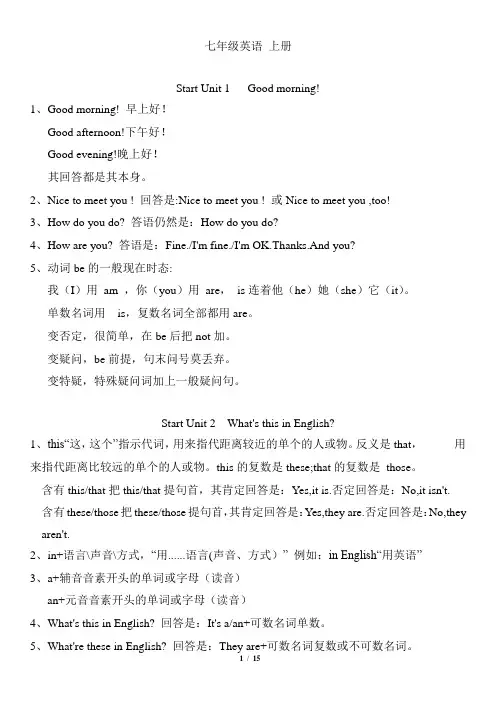
七年级英语上册Start Unit 1 Good morning!1、Good morning! 早上好!Good afternoon!下午好!Good evening!晚上好!其回答都是其本身。
2、Nice to meet you ! 回答是:Nice to meet you ! 或Nice to meet you ,too!3、How do you do? 答语仍然是:How do you do?4、How are you? 答语是:Fine./I'm fine./I'm OK.Thanks.And you?5、动词be的一般现在时态:我(I)用am ,你(you)用are,is连着他(he)她(she)它(it)。
单数名词用is,复数名词全部都用are。
变否定,很简单,在be后把not加。
变疑问,be前提,句末问号莫丢弃。
变特疑,特殊疑问词加上一般疑问句。
Start Unit 2 What's this in English?1、this“这,这个”指示代词,用来指代距离较近的单个的人或物。
反义是that,用来指代距离比较远的单个的人或物。
this的复数是these;that的复数是those。
含有this/that把this/that提句首,其肯定回答是:Yes,it is.否定回答是:No,it isn't.含有these/those把these/those提句首,其肯定回答是:Yes,they are.否定回答是:No,they aren't.2、in+语言\声音\方式,“用......语言(声音、方式)” 例如:in English“用英语”3、a+辅音音素开头的单词或字母(读音)an+元音音素开头的单词或字母(读音)4、What's this in English? 回答是:It's a/an+可数名词单数。
5、What're these in English? 回答是:They are+可数名词复数或不可数名词。
七年级上册人教知识点英语

七年级上册人教知识点英语
以下是七年级上册英语(人教版)各单元的部分知识点:
- Unit 1: Good morning! 重点学习英文字母和打招呼的基本表达。
- Unit 2: What’s this in English? 学习如何用英语确认物体以及拼写单词。
- Unit 3: What color is it? 学习颜色的表达以及如何询问和描述物体的颜色。
- Unit 4: My name’s Gina. 学习如何询问和介绍姓名。
- Unit 5: This is my sister. 学习家庭成员的称谓和介绍家庭成员的基本表达。
- Unit 6: Do you like bananas? 学习食物名称和表达喜好。
- Unit 7: How much are these socks? 学习询问价格和购物用语。
- Unit 8: When is your birthday? 学习日期的表达和庆祝生日的相关用语。
- Unit 9: My favorite subject is science. 学习课程名称和表达喜好。
新人教版七年级上册英语4--6单元知识点复习与巩固课件
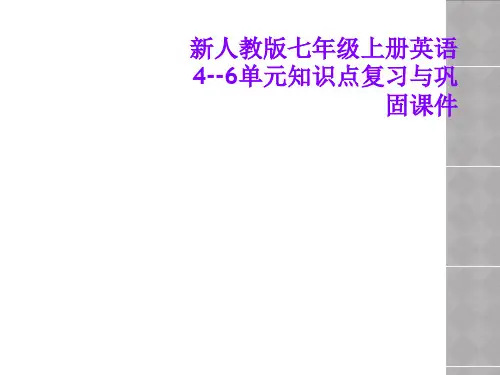
Unit 4┃ 能力提பைடு நூலகம்训练
Ⅱ.单项选择
( C )1.—________this a bag? —Yes, ________.
A. is; it's
B. Is; it's
C. Is; it is D. is; it is
( C )2. —Is this a ruler? —________.It's a pencil.
Unit 4┃ 能力提升训练
( D )5. —Where's the CD? —Sorry,________. A. I can B. I'm not C. it isn't D. I don't know ( A )6. —Where is the football? —________. A. It's under the desk B. It's in the pencil box C. It's in the eraser D. It's big
Unit 4┃ 基础知识梳理
3. “你的书在哪儿?” “它们在椅子上。”
—___W__h_e_r_e___ __a_r_e___ your books? —They are _o_n__ the chair.
4. 钥匙在书架上。
The keys ___a_re__ __i_n_ the bookcase.
Unit 4┃ 基础知识梳理
9. 知道 ___k_n_o_w____ 10. 收音机 __r_a_d_io____ 11. 模型 ____m_o_d_e_l____
12.hat __帽__子__ 13.tape ___磁__带__;__录__音__带____ 14.tidy __整__洁__的______ 15.but __但__是___ 16.always __总__是____ 17.everywhere __到__处__;__处__处____ 18.think ___想__;__思__考_______ 19.clock __时__钟____
Unit6+单元重点知识总结+2024-2025学年人教版英语七年级上册+

新人教版七上Unit6一、短语默写充分利用时间在你的空闲时间一点四十五分穿好衣服刷牙读点书值日/值班课前一名学校记者大约五点上床睡觉在九点半上课她上学日的日常在上学日帮他妈妈做家务看电影一会儿二、句型1. I live with my parents in … 我和父母一起住在……2. After breakfast, I walk to school. 早饭后,我步行去学校。
3. Each lesson is 45 minutes long, and there is a break between lessons. 每节课时长45分钟,课与课之间有一段休息时间。
4. At 9:30, it’s time for me to go to bed. 在9:30,我该去睡觉了。
5. Then I prepare my schoolbag for the next day. 然后我为第二天准备我的书包。
三、单元重点知识总结1. dress动词,意为“穿衣服”。
dress表示“穿,戴”时,宾语是人(通常是人称代词或反身代词),而不是衣服wear表示“穿着,戴着”的状态put on表示“穿,戴”的动作2.sometimes、sometime、some time和some timessometimes有时=at times用于一般现在时和一般过去时中sometime某时(时间点)用于一般将来时或一般过去时中some time一段时间可用于多种时态(指时间段)some times几次,几倍表示次数或倍数3.ask sb. about sth. 表示"询问某人某事",ask sb. for sth. 表示"向某人要某物"。
4.prepare 意思为“准备;把......预备好”prepare for... 为......做准备prepare to do sth. 准备去做某事5.work/jobwork作名词,意为“工作”,泛指从事的体力或脑力劳动,指代各种工作,是不可数名词。
人教版七年级英语上册Unit4-Unit6知识点总结及习题[知识点总结]2
![人教版七年级英语上册Unit4-Unit6知识点总结及习题[知识点总结]2](https://360docs-1393072327.cos.ap-beijing.myqcloud.com/f4fcb0c2f01dc281e53af0bc.webp)
Unit 4 Where ' my schoolbag?2句式:1.询问地点 ---- W here + is +单数物品?答语It is+表位置的介词短语Where + are +复数物品?答语They are +表位置的介词短语.—Where ' s my backpack — It ' s under the table.1) ______ (this) are my parents. 2) _______ (that) are his friends. 3) Is this his father? No, _______ isn ' A.it B.this C.he4) Is his mother your friend? Yes, ________ i s. A.he B.she C.you 5) Tha nks _______ your in teresti ng book. A.for B. very much C.a lot 6) There ______ ( be ) a photo of my frie nds.—Where are your books ) — They 2•询问某物是否在某地的句型及答语—Is the baseball on the sofa — No , —Are they on the bed? —No ,re on the chair. it isn ' t. It 's under -the chair. they ' re not. Here is my pen. Here are some apples.Unit 5 Do you have a soccer ball?play sports 参加体育运动 play computer games 玩 电脑游戏“ play +球类名词”结构的短语 play ping-pong 打乒乓球play tennis 打网球 4. watch TV 看电视 on TV 在电视上,通过电视 5•常用的描述某物或某事的形容词: interesting 有趣的fun 有趣的relaxing 轻松的boring 无聊的difficult 困难的重点语法:1、以助动词do , does 开头的一般疑问句。
人教版英语七年级上册各单元知识点测试(附答案) Unit4-Unit6
人教版英语七年级上册各单元知识点测试(附答案)Unit 4-Unit 6Unit4 Where’s my schoolbag?重点短语e on2.tape player3.model plane4.under the table5.on the bed6.in the schoolbag7.talk about重点句型1—_________________________________?我的书在哪儿?—_________________________________.它们在沙发上。
2.—_________________________________.英语书在收音机底下1.—_________________________________?钥匙在沙发上吗?—No, they aren’t. _________________________________. 不,它们不在。
它们在桌子上。
2.—_________________________________? 在你的桌子上吗?3.—It’s not under the chair. 它不在你的椅子下面。
4.—_________________________________.它在你祖父母的房间。
5.—_________________________________.我有一个钟6.—_________________________________. 这个白色的飞机模型是她的。
7.—_________________________________?我的钥匙在哪儿?重点语法1.Where 引导的特殊疑问句2.介词on, in, under 的用法3.连词and/but的用法Unit 5 Do you have a soccer ball?重点短语1.ping-pong ball/bat2.soccer ball3.play basketball4.watch TV5.play sports6.after class重点句型1—_________________________________?你有乒乓球拍吗?2—Yes, I do.是的,我有。
人教版七年级英语上册Unit4知识点及练习题
Unit4知识与练习重点词汇解析1.where adv. 在哪里;到哪里【经典例句】Where are you?你在哪?【考点聚焦】where是特殊疑问词,用来引导特殊疑问句。
当我们不知道某东西在什么地方时,常用Where is/are...?来询问。
2.table n. 桌子【经典例句】There is a dog under the table.桌子下面有一条狗。
【考点聚焦】常用词组:at table在吃饭;at the table在桌旁【易混辨析】table与deskdesk表示“桌子”的意思。
指供读书、写字、办公用的桌子,一般带有抽屉。
例如:There are forty desks and chairs in the classroom. 教室里有四十张桌子和椅子。
There are two books on the desk.桌上有两本书。
table 意思是“桌子”。
侧重于指供吃饭、喝茶、游戏或其它用途的桌子,通常没有抽屉。
例如:Our football is under the table. 我们的足球在桌子底下。
Where is the table?桌子在哪儿?3.on prep. 在……(紧贴着某物,有接触面)例如:on his desk“在他的书桌上”,on the floor“在地板上”,on the bed“在床上”,on the wall“在墙上”等等。
4. under prep. 在……下面,例如:under my chair“在我的椅子下面”,under the desk“在书桌下面”,under kate’s bed“在凯特的床下面”等。
重点句型1.Where is my pencil box? 我的铅笔盒在哪?-It’s in your schoolbag. 在你的书包里面。
2.Where are my books? 我的书在哪?-They are on the sofa. 它们在沙发上。
人教版七年级英语上册各单元知识点总结
人教版英语七年级上册知识点归纳Starter Unit 1 Good Morning!知识点:1.短语归纳:good morning 早上好good afternoon 下午好good evening 晚上好name list 名单an English name 英文名字2.必背典句:(1)Good morning, Alice! 早上好,艾丽斯!(2)Good afternoon! 下午好!(3)Hi, Bob! 你好,鲍勃!(4)Hello, Frank! 你好,弗兰克!(5)Good evening 晚上好!(6)—How are you? 你好吗?—I’m fine, thanks. How are you? 我很好,谢谢。
你好吗?—I’m OK. 我很好。
3.英语中常见的问候语在英语中,见面时的问候语有很多常用的有:①Hello! “你好!”是比较随便、不分时间的一种问候语,通常用于打招呼、打电话。
表示惊讶或引起对方注意。
对方应答仍用Hello!②Hi! “你好!”的使用比hello!更随便,在青年人中使用更为普遍。
③Nice to meet you! “很高兴见到你!”是两个初次见面、经介绍相识的人互相打招呼的用于。
回答时可以说Nice tomeet you, too.或者Me, too.表示“见到你很高兴”④How do you do? “你好!”用于初次见面,是非正式的打招呼用语。
对方应答语应是“How do you do?”How are you? 表示问候How are you? 意为“你好吗?”,为询问对方身体状况的问候语,应答语一般是“I’m fine. Thank you. / I’m very well. Thank you. / I’m OK.How are you? 的其他用法:习惯上回答完别人的问候后,常可反问对方的身体状况,此时可用How are you?也可用And you? “你呢?”3.大写字母的用法:①在英语中,句子的第一个单词的第一个字母都应大写。
+Unit+4+知识点梳理+-2024-2025学年人教版英语七年级上册
(人教版) 2024七年级上册Unit 4 知识点梳理Section A1a 掌握不同学科的表达拓展:1.history 历史a long history 悠久的历史in history 历史上2.English (国家) England1c 拓展1.hard =difficult (反义词) easy2.fun名词have fun doing sth. 玩得开心........eful 有用的a useful book (u字母的发音为辅音音素)4.exciting 令人兴奋的(用于说明事物) It’s ______________(令人兴奋的电影)excited 兴奋的(用于说明人) I’m ____________(兴奋的听到) the good news.5.boring 令人兴奋的(用于说明事物) It’s ______________(令人乏味的电影)bored 兴奋的(用于说明人) The trip makes me____________(觉得无聊)Pronunciation1 策略:双元音是作为一个音节,用一次呼气发出来的两个元音的连缀。
双元音的两个成分中只有第一个读得比较重,长和清晰,第二个则要读得比较轻、短和含糊。
2.wake him up 唤醒他You're going to __________(迟到).2a 1.What's our ____________(下节课)?2.It's __________(interest) to learn about the past.(了解过去)3.past ①[名词] 过去;过去的事情in the past 在过去②[形容词] 过去的in past years 在过去的岁月③[介词]晚于; 在...…之后half past two 2点半4. It's useful, and my English teacher is _________(real) nice.5.I like all the subjects, ________ my favourite is maths.6.I'm good ____________ numbers. 我擅长和数字打交道。