
外研版高中英语必修一Module2MyNewTeachers教案
Module 2 My New Teachers Ⅰ. 模块教学目标Ⅱ. 目标语言Ⅲ. 教材分析和教材重组1. 教材分析本模块以My new teachers为话题, 介绍了几位具有不同教学风格和个性特征的教师,旨在通过模块的教学使学生学会描述教师及校园生活,并能运用所学词汇、句型来表达自己的喜好,同时通过学习制定好教师的标准使师生之间相互了解。
1.1 INTRODUCTION 首先介绍描述人物个性特征的形容词,再通过听说训练使学生在运用中熟练掌握这些形容词。
1.2 READING AND VOCABULARY 中的课文分为三部分,从学生的角度对三位不同年龄,不同风格的教师作了介绍。
从文中读者可了解三位教师的性格特征、授课方式及学生的评价。
文后设置了完成句子、写词、问答及讨论等阅读理解题,检测学生对课文的理解,培养学生获取信息、猜测词义等能力。
1.3 GRAMMAR 讲解了本模块的语法项目v?鄄ing形式。
1.4 SPEAKING 是课文内容及本模块话题的延续,要求学生通过口头练习运用所学语法知识描述自己喜爱的教师、科目及喜欢的原因。
1.5 LISTENING AND VOCABULARY分为六部分来进行。
Activities 1, 2 && 3分别以问答和听力练习的形式让学生就有关校园生活的词汇进行练习。
Activity 4要求学生表述自己对英语学习的看法并阐述原因,既巩固了所学生词,又运用了本模块的语法V?鄄ing 形式。
Activity 5 给出八组有联系的词,要求学生解释它们之间的联系。
Activity 6 回归课文,复习旧词汇,并表述对Mr Stanton的看法。
1.6 PRONUNCIATION 以听读的方式学习单词重音,为听力的提高奠定基础。
1.7 FUNCTION AND SPEAKING 列举了表达喜好的句式,要求学生以问答方式就自己所学科目进行对话练习。
1.8 EVERYDAY ENGLISH通过补全对话的形式学习一些日常用语。
1.9 WRITING学习标点符号的应用,尤其是逗号的用法,使学生学会断句,了解英语句子结构。
1.10 CULTURAL CORNER介绍西方国家的学校种类与不同的师生关系。
1.11 TASK要求学生介绍自己喜欢的老师并陈述理由,并在讨论后写出好教师的标准说明理由。
2. 教材重组2.1 将INTRODUCTION, READING AND VOCABULARY和WORKBOOK中的V ocabulary部分整合成一节阅读课。
2.2 将GRAMMAR, SPEAKING, FUNCTION AND SPEAKING及WORKBOOK 中的Grammar整合成一节口语课。
2.3 LISTENING AND VOCABULARY与PRONUNCIATION, EVERYDAY ENGLISH整合成一节听力课。
2.4 将WRITING 与WORKBOOK 中的Speaking and writing整合成一节写作课。
2.5 将CULTURAL CORNER与WORKBOOK中的Reading, Listening and speaking 以及TASK整合为一节综合实践课。
3. 课型设计与课时分配1st Period Reading2nd Period Speaking3rd Period Listening4th Period Writing5th Period Integrating SkillsⅣ. 分课时教案The First Period ReadingTeaching goals教学目标1. Target language目标语言a. 重点词汇和短语amusing, energetic, intelligent, nervous, organized, patient, avoid, appreciate, admit, scientific, literature, joke, summary, respect , make sure, so that, make progress, as a result, in fact, fall asleep, tell jokesb. 重点句式(P12)She is also very serious and doesn’t smile much.Some ..., but most of us really appreciate her ... well organized and clear.There are few students ... who keep coming to class late...2. Ability goals能力目标Enable the students to learn expressions used to describe a teacher and his / her personality.3. Learning ability goals 学能目标Help the students learn to describe their teachers.Teaching important points教学重点How to describe different teachers.Teaching difficult points教学难点Enable the students to describe the teachers they like and tell the reasons.Teaching methods教学方法Discussion, reading, questions-answers and cooperative learning.Teaching aids教具准备Some pictures, a projector and some slides.Teaching procedures && ways教学过程与方式Step ⅠGreetings and Lead-inNow since the students have been familiar with their teachers, show some pictures of their teachers. Students work in groups of four to describe the pictures. After their discussion, ask one student to describe one of the pictures, and the others guess who he / she is describing. Itis a practice of the words in Activity 1 on P11 at the same time.T: Do you know this man / woman?Show a picture of the teacher himself / herself.Ss: It’s you!T: Right! What’s your impression of me? Can you describe me in one or two sentences?S1: You’re a slim and warm-hearted teacher.S2: You can explain what we don’t understand clearly by showing us interesting examples.S3: You are energetic, so we are full of energy in your class, especially when we are playing games.S4: I’m very lucky to be your student, because you never scold us but always smile. That encourages us a lot.T: Thank you very much. I’ll keep on working hard and I believe we can make great progress together.Show some pictures of other teachers.T: Look at these pictures. Do you know them? Yes, they are your teachers. Describe one of them with your partners and try to use the words in Activity 1 at the same time.A few minutes later.T: OK. Now I’d like one of you to describe a teacher in class while the others guess who it is. Attention, don’t mention the teacher’s name. Just guess according to your description.S1: Let me try. She is a little shy. Sometimes she speaks in a low voice, so we can’ t hear her clearly. But she is very patient and explains everything till we understand them. Who is she? Ss: Miss He.S2: None of us dares to come to her class late. And we have to hand in our homework on time, or you’ll be found reciting a text in her office. She is very strict, but we all like her, especially those who lack self- control.Ss: Mrs Wang.S3: We are all very nervous in his class, because he keeps on asking questions. If you don’t review the last lesson and can’t answer his questions, you’ll feel very stupid.Ss: Mr Zhang.S4: This teacher is humorous and popular with us. When we are tired, he will tell jokes. But his classes are not well organized, he always jump from one topic to another.Ss: Mr Du.S5: She is very careful, and always returns our home-work on time and corrects our mistakes carefully.Ss: Miss Li.Students may give different descriptions.T: Excellent! In your opinion, what’s a good teacher like? Tick the statements that you agree with in Activity 3, P11.Students read and tick the statements.T: I am sure different students have different criteria. Let’s listen to the tape and see what criteria Alex has. Tick the statements that he agrees with in Activity 3.Students listen and tick the statements. Let the students compare his / her criteria with Alex’s.Step ⅡFast readingT: In this period, I am going to introduce you another three teachers. First, turn to P12 and look at their pictures. They are Mrs Li, Mrs Chen and Mr Wu. Let’s answer the following questions before reading according to the pictures.Questions:1. What’re your impressions of each teacher?2. Which teacher do you think the students like a lot?3. Who is a very good teacher but serious and strict?4. What subjects does each teacher teach?S1: According to the picture, Mrs Li is young and energetic. The students must like her a lot. I think she is an English teacher.S2: Mrs Chen must be very strict with her students. Form the picture we can see she is very serious. So I think not all of her students like her. Maybe she is a historyteacher.S3: I guess Mr Wu is very handsome and amusing. His lessons must be very interesting. And the students are likely to like him a lot. I think he teacheschemistry.T: Very bold guessing! But we need to read the text to see whether what you said is true or false. Now let’s read the text quickly and find the true answers.After the students read the text, ask some to tell their answers.T: Any differences between your first impressions and the facts? Who’d like to tell us the facts about the teachers?Sample answers:1. Mrs Li is kind and patient. Mrs Chen is strict and her teaching is well organized and clear. Mr Wu is energetic and amusing.2. Mrs Li and Mr Wu.3. Mrs Chen.4. Mrs Li teaches English, Mrs Chen teaches physics and Mr Wu teaches Chinese.Words and phrasesT: Now let’s deal with some new words in the text. Look at the box in Activity 2 on P13. Please complete the sentences using the words from the box. Change the form where necessary.After the students finish it, check their answers in class.T: Please read the definitions in Activity 3 on P13 first to make sure you understand them and then find words and phrases from the text My New Teachers that match them. Students read and do the match. Then check the answers.ExplanationsT: Wonderful! Now, let’s deal with some language points. If you have any questions, please raise your hands.S: Can you explain this sentence “There are a few students in our class who keep coming to class late but they are always on time for Mrs Chen’s lessons.”?T: The writer wants to tell us Mrs Chen is very strict with her students. Some students are always late for lessons, but they are on time for Mrs Chen’s lessons. “Who”refers to “a few students”.T: Pay attention to this sentence “Mr Wu’s only been teaching us for two weeks and he’s already very popular.”Here, “Mr Wu’s”equals to “Mr Wu has”and “he’s”means “he is”. “Have been teaching us for two weeks”means Mr Wu has taught us for two weeks and now he is still teaching us. Any other questions?Step ⅢCareful readingIn this part, the students will read the passage again and work together with their partners tolearn the way the author describes a teacher. Then show a table on the screen. Give them a few minutes to fill in the table about the whole text. Check the answers with the whole class. T: The author describes the three teachers so vividly as if they were just around us.Can you tell me in which aspects the writer describes the three teachers? Discusswith your partners, please.After discussion.S: in each paragraph, the author describes the teachers’ personalities, subjects theyteach and their ways of teaching. He / she gives examples to support his / herpoints. In the third paragraph, the teacher’s appearance is also described.T: You are quite right. Now let’s try to get a general understanding of the passage. Fill in the table on the blackboard after reading the text again.Draw a table on the blackboard.Sample answers:Step ⅣRetellingGive the students several minutes to prepare for retelling. After they retell the passage, theywill understand deeply how the author describes a teacher, and master the way of descripting people.T: Among the three teachers, which do you like best and why? Choose one of them and describe him /her by retelling the passage. You may refer to the table above.Samples of retelling:S1: I like Mrs Chen because she is strict with her students. Her teaching is well organized and clear. And during scientific experiments, she explains exactly what is happening. I’m interested in physics but I don’t know how to learn it well. Also, I have a bad habit of wasting time playing games. I think that I would do well in physics with the help of Mrs Chen.S2: Good teachers are always very kind. I like Mrs Li because she is kind and patient and she explains grammar clearly. Just as the writer, I hate making mistakes in class, so I am a little nervous when a teacher asks me to answer questions, especially when I can’t answer them. Sometimes I can’t focus my attention on learning but expect the lesson is over as soon as possible. Mrs Li understands her students as she just smiles and avoids making her students feel stupid. I would be brave enough to answer questions in class and make rapid progress, if I were a student of Mrs Li.S3: I prefer Mr Wu. In my opinion if a teacher is full of energy and devotes himself to the lesson, his / her students will be interested in the lesson and follow the teacher to learn new knowledge. None of the students can fall asleep and all are eager to learn more about the subject. An amusing and interesting teacher is also very popular. I always fall asleep in class. An interesting class can draw our attention.Step ⅤVocabularyT: Now there is a little time left. Let’s come to V ocabulary on P74.If time is limited, it can be finished after class.Step ⅥHomework1. Collect more information about your teachers and fill it in the table on the blackboard. In next period, I’ll ask some of you to introduce one of your teachers. Try to use some of the words we have learnt in this period.2. Try to find out the structures about expressing preference.The Second Period SpeakingTeaching goals教学目标1. Target language目标语言a. 重点词汇和短语admit, avoid, consider, dislike, enjoy, finish, hate, keep, imagine, like, love, practice, stop, suggest, would rather, would preferb. 重点句式... really likes working with her. P14... hated making mistakes or pronouncing a word incorrectly ... P14... who keep coming to class late ... P14... really enjoys teaching ... P14I prefer ... P14I’d prefer to do ... P17I’d rather do ... P17I’d rather do ... than ... P172. Ability goals 能力目标Enable the students to express preference.Enable the students to use verbs followed by -ing.3. Learning ability goals 学能目标Help the students learn how to express preference and explain the reasons.Teaching important points 教学重点How to express preference and use verbs followed by -ing.Teaching difficult points教学难点Understand the patterns used to express preference.Teaching methods教学方法Speaking, discussion and cooperative learning.Teaching aids教具准备A projector.Teaching procedures && ways教学过程与方式Step ⅠRevision and Lead-inCheck the students’ homework by asking some of them to introduce their teachers. And write verbs followed by-ing included in their talk on the blackboard.T: Good morning/afternoon, boys and girls. Any volunteers to introduce your teachers?S1: Let me have a try. I’ll never forget my mathematics teacher Mrs Wang. She looks like a little girl, though she has been a teacher for six years. She is very kind and patient. And her teaching is well organized and clear. What’s more, she likes giving us some interesting examples to help us understand some difficult points. I hated learning mathematics, but now I find it interesting.S2: I’ll describe a teacher who I don’t like. She is well-known in our school for her strictness. All of us are afraid to have her lessons. If you can’t give right answers in class, she will stare at you, which tells you how stupid you are. Most of us make rapid progress. But many students are no longer interested in her lessons. I hope that she can be patient and kind.S3: My favorite teacher is a beautiful young lady. She is full of energy and introduces different cultures to us. We listen to foreign songs, watch world famous films and enjoy listening to English at the same time. At first we disliked learning English. But now we all admit liking it.Step ⅡGrammarWhile the students give their talks, write a few sentences on the blackboard in which verbs followed by-ing are included. Show the following sentences on the blackboard.She likes giving us some interesting examples.I hated learning mathematics.We enjoy listening to English.We disliked learning English, but now we all admit liking it.T: Please look at the blackboard. What do you notice about the verbs?Ss: The verbs like, hate, enjoy, dislike and admit are all followed by-ing.T: Exactly! These-ing forms act as nouns. We can say “I like playing football.”and “I like football.”They have the same meaning. Please turn to P14, Activity 2, Grammar. Look at the words in the box. Can all of them be followed by-ing? If you are not sure, please turn to your dictionary. Then complete the sentences with words from the box. There may be more than one answer. Change the forms where necessary.Check their answers in class and correct any mistakes if there are.T: Excellent! Now, please work in pairs to make sentences about yourselves, using the words in the box. It will be better to make a paragraph.Students work in pairs to make sentences.T: Are you ready?S1: I enjoy playing piano. And I practice playing it every morning.S2: I admit liking listening to pop music, but my sister hates it. She said it’s too noisy. She suggests my listening at school.S3: I enjoy writing, and always imagine being an excellent writer....Step ⅢSpeakingIn this part the students will talk about their favorite teachers, and the parts of school life they enjoy most. Task 1 Talk about your favorite teachersT: Teachers, just like friends, some will be forgotten after you graduate, while some will be remembered forever because they are our favorite teachers. Please work in groups and describe your favorite teachers. Read the example of Activity 1 in SPEAKING first.A few minutes later.T: Are you ready?S1: Miss Li, our English teacher, is my favorite teacher. I like her classes very much because she often plays games in her classes. She has many ways to make her lessons lively and interesting. One day, she brought a big bag in which we found different kinds of fruit. We mastered the new words about fruit at once.S2: We all enjoy having maths lessons. Mr Wang, our maths teacher, can make us confident. When we find out the way of working out a problem, we are proud of ourselves.S3: My favorite teacher is Mrs Zhang, our history teacher. I love her classes very much because we need not worry about answering questions. We can just follow her and imagine living in ancient times or enjoy different cultures. We get a lot in her classes.Task 2 InterviewT: Work in pairs. One acts as a journalist, and the other a student. Talk about the parts of school life you enjoy most and why. Read the example of Activity 2 first.Samples:1. S1: Which subject do you like, mathematics or English?S2: Neither of them. I like PE most.S1: Why is that?S2: Because I’m good at playing football.2. S1: My favorite subject is geography.S2: Why?S1: Because I can learn why and where earthquakes happen and some other interesting things. What about you?S2: I prefer physics and chemistry because I find it interesting to do experiments.S1: Do you enjoy English?S2: I don’t like English very much. I like reading, but I am not good at listening and speaking.3. S1: The subject that I study more is English. My favorite subject is art because I am good at it. What about you?S2: I don’t like physics because it is complex. I prefer music and Chinese.Step ⅣFunction and SpeakingGet the students to know how to express preference. Give two examples to help them learn the structures and show more structures on the screen. Then let them work in pairs to discuss the subject they prefer to learn.T: Please turn to P17. Look at Activity 1. What does “I’d”in the sentences stand for? I would or I had? And any differences between “I’d prefer”and “I’d rather”in usage? Look at the statements and choose the correct answers.After the students finish Activity 1, check the answers, and then give them more structures about expressing preference. Write down these structures on the blackboard:I prefer apples.Father preferred our house painted white.She prefers to be alone.We prefer Mrs Li to teach us English.I prefer reading to playing basketball.I prefer to watch TV rather than play games.He preferred that nothing should be said about his coming.He’d rather begin at once.I’d rather go to the beach than stay at home.Then let the students complete Activity 2 on P17 and check the answers.T: Jane, which subject would you prefer to have, English or Chinese? Why?Jane: I’d rather study English than Chinese because I can watch my favorite English movies without looking at the caption.T: Very good. But you need to work very hard on it. OK, now let’s do Activity 3 on P17. Work in pairs and tell your partners which subject you would prefer to have and explain why? Don’t forget to use the structures we just learnt.Samples:1. S1: Which subject would you prefer to have, English or Russian?S2: I prefer to study English because I have learned English for several years and Russian is more difficult to learn, especially the pronunciation and grammar.2. S1: Would you prefer physics or chemistry?S2: I’d rather study chemistry than physics because it’s wonderful to watch the change in experiments and I want to know the reason.3. S1: I would rather study IT than biology. What about you?S2: I prefer biology because I can learn a lot about human, plants and animals.Step ⅤHomework1. Finish Exercises 1, 2, 3 and 4 on P73, Grammar.2. Explain the new words on P15 in English and make sentences with them.The Third Period ListeningTeaching goals教学目标1. Target language目标语言a. 重点词汇和短语headmaster, headmistress, period, revision, translation, timetable, topic, vacation, take a look,a couple, up tob. 重点句式(P16)Which ... is the most difficult for you and which is the easiest?If you do well in an exam you will pass; if you do badly you will fail.2. Ability goals能力目标Get the students to learn to describe school life and learn about stressed sound in words.3. Learning ability goals 学能目标Help the students to learn how to use news words describing school life.Help the students learn how to use stressed sound in spoken English.Teaching important points教学重点How to describe school life.Teaching difficult points教学难点How to use stressed sound in spoke English.Teaching methods教学方法Listening, speaking and discussion.Teaching aids 教具准备A recorder.Teaching procedures && ways教学过程与方式Step ⅠRevisionCheck the answers to Homework 1 and answer any questions they may ask.Step ⅡVocabularyLearning vocabulary is one of the big challenges for the students. By explaining new words in English and reading the examples, the students can master new words easily and make correct use of them. At the same time, the students can form a good habit of turning to a dictionary when they meet a new word.Task 1 QuizT: Have you previewed the new words? Can you explain these words in English? Let’s have a try. Each student explains one word.Words and their English definitions:headmaster / headmistress: principal man or woman in a school, responsible for organizing itchoice: act of choosing between two or more possibilitiestopic: subject of a discussion or talktimetable: list showing the time at which certain events will take placetranslation: expressing in another languageexam: testing of knowledge or ability by means of questions, practical exercises, etc. library: room or building where books are keptrevision: preparation for an examinationperiod: length of timevacation: holidayTask 2 PracticeAsk and answer questions in Activity 1 on P15 so that the students can be more familiar with the new words.Sample answers:1. We do some exam revision. Generally, we spend two or three weeks.2. Yes. At the beginning of our English classes we often translate some sentences, new words and phrases.3. Yes. We have a free period on Thursday afternoons.4. A headmistress.5. About one hour every week. We don’t have enough free time.6. Yes. We have different topics in our English classes, such as English around the world, festivals, sports, famous scientists, travel and so on.7. No, we have no choice but English.8. We have summer vacation and winter vacation.Ask the students to list language areas on the blackboard together and then tell their difficulties in English learning.T: How many areas can English language learning be divided into? Think about it and make a list.Write their answers on the blackboard:grammar, conversation, vocabulary, reading, writing, listening, translationT: Which of the areas is the most difficult for you and which is easiest? Why?S1: I find listening really hard. Sometimes it’s just impossible to understand the materials. T: Who can give him some advice?S2: I will. If you keep on practicing everyday, you can make rapid progress. The more you listen to English, the easier it becomes.T: Discuss in groups of four. Tick the easiest and the most difficult, then ask for help or give advice.Samples:1. S1: My writing is not very good. There are always so many errors. Who can help me?S2: Why not write five sentences everyday and get an English pen friend? Practice makes perfect.S1: Thank you for your advice. I’ll have a try.2. S1: I dislike conversations. It’s very hard to express myself in English.S2: You’d better watch some English programmer on TV and try to imitate the speakers.S1: That’s a good idea.3. S1: The teacher always praises you for your vocabulary. But I find it impossible to remember so many new words. Can you give me some suggestions?S2: Well, take a look at this little book. It includes all the words that we should memorize. Whenever you are free, take it out and memorize some words. In this way, you’ll find you can memorize new words easily.S3: Reading is another way to help you with your vocabulary. Keep reading a story a day. You will enrich your vocabulary.T: Really nice advice and suggestions. Exchange your ideas about language learning and you will benefit a lot. Don’t you agree? Next, let’s come to Activity 5. Explain the connection between these words and phrases. Study the example first and finish the rest.Check their answers in class.Step ⅢListening and DiscussionT: Look at Activity 2 on P15. First fill in the blankswith the words in bold in Activity 1 before you listen to the tape. Then we will listen to the tape to check your answers.Play the tape and then check the answers. Play the tape for a second time and let the students finish Activity 3. After the students listen to the tape for the third time, get them to describe Mr Stanton, and discuss with their partners whether they would like to have Mr Stanton as their teacher and list their reasons.T: I think Mr Stanton must be a popular teacher. Do you agree with me? Write some words to describe Mr Stanton by finishing the table on the blackboard.Students try to finish the table on the blackboard.Positive (+) Negative (-)Suggested answers:T: Well done! Would you like to have Mr Stanton as your teacher? Why or why not? Tell your partners.After their discussion, ask some students to tell their opinions in class.S1: In my opinion, this class is wonderful. Mr Stanton is a good friend of his students. Every student will express his own idea, so the students can learn English happily.S2: I like to be a student of Mr Stanton. In his class, the students have equal chance of choosing topic according to their own interest.S3: I don’t agree with them. According to the conversation, the students need not prepare anything for this lesson. So I don’t think they can master what they will learn. Also the class is not organized, and he wastes a lot of time in announcing something that is not connected with the class. Maybe some students want to know what the headmaster will tell them but not what they will revise.Step ⅣEveryday EnglishDictate the expressions in everyday English. Explainthem if necessary. Then complete the conversations with these expressions.T: We’ll have a dictation. Listen carefully and write down the expressions.After dictation, ask some students to explain the expressions. Give some help when necessary.Sample explanations:Kids: boys and girlsIt’s up to you: It’s left to you to decide.That’s settled: The choice is made.A couple of things: A few thingsTake a look: Have a look.Have you got that: Understand?T: Now please turn to P18 and complete the conversations with the expressions above.After the students finish them, check their answers in class.T: Let’s make another conversation with these expressions.A sample conversation:S1: Attention, kids. There are a couple of things to tell you. We have a new timetable. Take a look after class. We’ll start our classes at 2:30. Don’t be late tomorrow. Have you got that?S2: Yes.S1: We will decorate our classroom this weekend. I’ve prepareda couple of pictures. Take a look at the screen. Which one would you like to choose? It’s up to you.S2: We prefer to draw pictures by ourselves. Do you agree?S1: Great! Do what you like. That’s settled. Now let’s turn to the text.Step ⅤPronunciationT: Turn to P16, Pronunciation. Pay attention to the stressed sound of the words in the table in Activity 1. Now let’s listen.Students listen and read after the tape.T: Underline the stressed sound in the words in Activity 2 first and check your answers after listening.After listening, show the following sentences on the screen. Underline the stressed words, while the teacher is reading them.1. I am so glad to see you again.2. I can’t find my passport.3. What can I do for you?4. He said he might be able to come.Step ⅥHomeworkDo Exercises 6 && 7 on P74.The Fourth Period WritingTeaching goals教学目标1. Target language目标语言a. 重点词汇和短语favorite, energetic, amusing, funny, intelligent, kind, lively, nervous, organized, patient, popular, serious, shy, strict, discipline, stupid。
外研版高一英语必修一Module 2 My New Teachers教案

外研版高一英语必修一Module 2 My New Teachers教案Teaching Aims:Train the students' reading ability. Learn some useful words and expressions:amusing, energetic, intelligent, nervous, make progress keep doing sth and so on. Teaching Important Points.Help the students to understand the passage better.Learn and master some important words and phrases in this period.Teaching Difficult Points:How to help the students improve their reading and understand the passage better. Teaching Methods:Fast reading to get the general idea of the text.Careful reading to understand the passage better.Discussion to help the students understand what they've learned better.Teaching procedure.Step 1 Lead --in基础梳理:选词填空amusing patient serious strict impression avoid immediately appreciate admit scientific1 Although her father loved her deeply, he was _____ with her.2.You must be ______about your job.3.If the shop is untidy, it makes a bad _____on the customers.4.The microscope is a ______ instrument.5.The ______story made them laugh.6.A healthy diet will help you _______heart disease.7.John ______making mistakes.8.The children went out to play ______after they had eaten.9.Try to be _____with your daughter.10.I would ________it if you would like to help me.Step 2 Reading comprehension.Fast reading: Read the passage quickly and answer the question.1) Which teacher do students like a lot?Careful reading: 根据课文填空My first 1 of Mrs. Li was that the was nervous and shy. But now the class really likes working with her. She’s kind and 2 .She explains English grammar so clearly that even I can understand it !—She avoids making you feel stupid. When I make mistakes, she just smiles. I think maybe she goes a bit too slowly for the faster students, but for me it’s wonderful. I feel I’m going to make 3 with her.Mrs. Chen is almost sixty . She’s very strict and serious. Some of our class don’t like her, but most of us really 4 her because her teaching is so well 5 and clear. And a few students 6 liking her. During 7 experiment she explains exactly what is happening and as a result my work is improving. I think that I’ll do well in the exam with Mrs.Chen teaching me.Mr.Wu’s only been teaching us for two weeks and he’s already very popular. He’s got so much 8 ,this is one class you do not fall asleep in! He’s really amusing and tells jokes when he think we’re getting 9 . I 10 him a lot. Post reading : Finish some exercises当堂检测(5分钟满分10分)1.He is an _______(精力充沛) boy and he enjoys sports.2.It’s not true at all. He is ______(完全) wrong.3.First, you should have your job ______(有组织的)4.I felt very n_________when I went into the headmaster’s office5.My general i_________was that he seems a pleasant man6.Our teacher is s_________and we have to do what she saysStep 3 HomeworkDo Workbook Exercises bout the readingStep 4 SaummaryIn this period we have learned some vocabulary and we should try tokeep them in mind after class. After reading we learned about some new wordsand three new teachers.It is important for students to learn some useful wordsto describe teachers or other people.。
外研版高一英语必修一Module2MyNewTeachers教学设计
《外研版高一英语必修一Module 2 My New Teachers》教学设计课时教学目标鉴于上述分析,形成以下课时教学目标:1.知识目标:学习掌握新词汇和短语,归纳和整理描述人的词汇、短语。
2.阅读技能目标:通过浅层、深层阅读,学会略读、查读文章的阅读能力。
3.情感目标:通过文章学习,使师生关系更加融洽。
教学过程教师活动引导以小组形式进行学生讨论,后以适度点拨,予以评价。
引导学生把文章的内容转换为自己的语言进行叙述,倡导小组合作,教师及时进行鼓励和引领。
通过头脑风暴让学生列举描述人的形容词,激发学生的兴趣。
引导学生结合《导学案》自主预习课文,把握文章大意,完成词汇的识读和结合课文的浅层阅读任务,教师巡视指导、点拨。
给出文章概要,要求学生通过细读、查读等阅读要求找出相关内容,引导学生把握文章结构和主要信息。
能力拓展提升,思维碰撞,集体讨论,完成用英语为文章补充一个结尾。
激情投入,充分预热。
课前预习,学习内容了然于胸。
结合《导学案》自主学习,理解并掌握课文主旨大意,完成预习案和导学案的相关内容,班内展示学习成果。
小组合作完成文章内容的简要总结(以填空的形式)。
小组成员合作学习,共同完成四个精细阅读教学任务。
对文章结构和主要信息能够有意识地进行分析和归纳。
学生活动Teaching process:Step 1: leading- in( 4 min')Let the students list some words to describe people. Use the words mentioned above to talk about your favorite teachers.( 通过引导学生列举描述人的形容词并用这些词来描述自己自喜欢的老师导入课文) Step 2: Skimming ( 5 min')Let the students find the key word of each paragraph through going through the first sentence of each paragraph.Task 1: Read the passage quickly with the following questions in your mind and at the same time check whether your first impressions on the three teachers are in agreement with the descriptions in the passage.1.Who are the teachers mentioned in the passage and what subjects are they teaching now?2.Which teacher are students most afraidof ? Who is the kindest teacher and who is the most popular teacher?( 通过让学生快速阅读,寻找段落关键词、理清文章篇章结构,弄清文章段落大意,培养学生跳读和概括归纳能力)Step 3: Scanning (18 min')Read the passage in detail and answer the following questions paragraph by paragraph.Read para1 answer the following questions. subject impression teaching________ First impression- Shewas_____________she is kindand ________ She _______English grammar so clearly. She ______making you feel stupid.Generally speaking, the class really likes________with her. Personally speaking, I feel I'm going to make __________with her. Read para2 answer the following questions.1. The author's first impression of Mrs. Chen was ______.A. enthusiasticB. kind and friendlyC. strict and serious2. What's the meaning of the phrase “as a result“?A. becauseB. soC. because ofD. result from 3. Fill in the blanks, using the correct form of the word. (1) A few students even admit _______ (like) her.(2) I'll do well in the exam with Mrs. Chen _______(teach)me.4. Which sentence can replace(代替)the one below?We are afraid of speaking if Mrs. Chen doesn't allow it.Read para3 carefully and answer the true or false questions: 1. Mr. Wu is ordinary-looking and boring.2. He's so energetic that every student doesn't fall asleep in his class.3. He talks loudly and fast, and waves his hands about a lot when students are getting bored.4. Personally speaking, I respect him a lot.(通过问题的设计,帮助学生归纳整合段落内部信息,达到训练学生寻读、查读的能力;通过判断正误问题的设计,帮助学生获取有效的信息。
高中英语Module2MyNewTeachers教案1外研版必修1(new)
Module 2 My New Teachers1.教学课题(Teaching topic):MODULE2 Reading and vocabulary2。
教学内容(Teaching contents):(1)words and expressions (2)reading comprehension (3)exercises3。
教学目标(Teaching aims):1)Understand the dialogue and the text of the introduction to the relationship of the students and the teachers; Obtain information and understand the viewpoints of the writer.2) Be able to identify the new words and phrases while reading; Be able to use the v-ing forms and the structures which can be expressed favoritism to a teacher. And can read and understand the passage related to the topic。
3) Be able to describe your favourite teacher with the learned words, phrases and expressions in this unit;Can describe the teacher’s teacher feature and discuss discus a standard of a good teacher。
4.教学重点(Important points):1)Cultivate the students’ ability to read.2) Master the new words and phrases and can write a composition with the expressions and sentence structures.5.教学难点(Difficult points): Write an article about a favorite teacher。
高一英语 Module 2 My New Teachers教案 外研版必修1
高一英语 Module 2 My New Teachers教案外研版必修1Period 1Teaching content:INTRODUCTION+ SPEAKING + EVERYDAY ENGLISHTeaching Aims and Demands:1.New words: amusing, energetic, funny, intelligent, lively, nervous, organized,patient, popular, serious, shy, stri ct, stupid…2.Speaking: Expressing preference3.Everyday English: Have you got that? Take a look, kids.That’s settled. It’s up to you.Affection and attitudes:Understanding how to make a description of a new teacher in Senior High and forming positive attitudes towards the new teachers and their methods of teaching.Teaching Procedures:Step1: Introduction1. Revision1) Brainstorming: Try to bring out as many adjectives used to describea person as possible.2) Help the Ss to use the adjectives to describe their favourite teachers, and then get the meaning of the positive adjectives or negative adjectives.2.Lead in the study of the adjectives: Ask each of the groups to write down their positive adjectives and negative adjectives and check the answers themselves.3.Go to Wb. Vocabulary p74.5.Step2: Speaking1.Pre-task: Ask the Ss to describe their favourite teachers, using the adjectives they have just learned and tell the reasons why.2.Pair work: Ask the Ss to talk about the parts of school life you enjoy most and why.Guidance: I like… better than…, because I ….3.Pair work: Make a dialogue, using the expressions of describing their likes:I enjoy…, because….I prefer…I am not good at … because….4.Exercises about the description of likes.I’d prefer, I’d rather, you would prefer, would also prefer, would preferJason: Hi, Mary. Do you have an English class this morning?Mary: Oh, yes, Jason. This is our first English lesson. I hope that my new teacher is a young girl. (1) ________ to have a beautiful and lively English teacher.Jason: Oh really? (2) _________ learn from an older teacher, because an older teacher is more intelligent I think.Mary: No, I don’t think so. (3) _______ to talk with an energetic and amusing young girl, because I will become nervous if the teacher is strict.(4) ________ to have a relaxed class.Jason: Perhaps you are right. I know Miss Li is a very popular teacher on this campus. Many students (5) ________ to learn from her. If she can teach us, (6) ________ learn from her.Mary: But I think you (7) ________ to follow an older teacher?Jason: Well, I guess that a popular teacher (8) ________ to teach popular students like me.Step3: Everyday English1.Revi se the adjectives and the description of “I prefer…”.2.Group work: Ask the Ss to complete the conversations with the expressions.3.Ask the Ss to describe the meanings of the expressions, matching the following explanations with the expressions given.have a look take a lookchildren kidsHave you been told about that? Have you got that?several things a couple of things It’s now decided that’s settled4.Pair work:Read the short dialogues aloud.Step4: Homework:1.Make a description of the following pictures of teachers, using theadjectives used to describe a person and tell the reasons why.Module 2 My New TeachersPeriod 2Teaching content: Reading and vocabularyTeaching Aims and Demands:1. New words: nervous, patient, serious, amusing, admit, appreciate, avoid, scientific, physics, literature, summaries, respect…2.Grammar: verbs followed by V–ingReading skillUnderstanding how to describe a personAffection and attitudesUnderstanding new teachers and forming positive attitudes towards the studies of all subjects in senior high.Teaching ProceduresⅠ. RevisionHelp students to revise words that is learnt in Period One of this module by answering questions:1. Who was your favorite teacher in Junior High?2. What adjectives will you use to describe your favorite teacher in Junior High?Ⅱ. Pre-reading activitiesLead in the study of the text by carrying out the following activities.1.What adjectives will you use to describe me –- your new Englishteacher? What about other teachers?(Ask students to speak out as many words as they can)2. Look at the pictures. What are your first impressions of the three teachers? (Prediction)(Ask students to write down the adjectives and check with their partners)Ⅲ. Fast readingHelp students to grasp the main idea of the text by doing the task..1.Read the text fast and check your prediction.Mrs. Li _______________Mrs. Chen _______________Mr. Wu _______________2. Answer the following questions.1) Who is the most popular teacher?2) Who is the kindest teacher?3) Which teacher are students most afraid of?Ⅳ. Careful readingMake sure students get the detailed information by doing the following.1)What first impression did Mrs. Li give to the writer? Why?2)Why don’t you feel completely stupid in her class?3)Guess what faster students think of her class?4)Are all the students on time for Mrs. Chen’s class? Why?5)Why don’t some of the class li ke her?6)What is Mr. Wu’s teaching style?7)Why is he very popular among his students?Ⅴ. Dealing with expressions1. Read the text again and underline all the verbs followed by V –ing.Make sure students understand the meaning of each sentence.2. Find words and phrases in the text that match the definitions below. (Act3, p13)3. Pay attention to these sentences.A.but Mrs. Li just smiles, so that you don’t feel completely stupid! (Line 8, Para.1)1)All the people laughed at me, so that I felt embarrassed.2)The girl practiced playing the violin very hard, so that she did a very good job at the concert.3)The next morning my uncle got up early, so that he was able to catch the first bus.Discussion: What does so that + clause show? Time, reason, purpose or result?B. I’ll do well in the exam with Mrs. Chen teaching me. (the last sentence of Para.2)1)I’ll make more progress in my English study with you helping me.2)He really couldn’t work with a baby crying in the next room.3)They walked on with the white snow shining under the sun. …… Questions: 1)Do you understand these sentences?2) Can you rewrite each sentence?Ⅵ. Language use1. Retell the text according to the key words in the table1) Of the three teachers which one do you like best? Why?2) Would you like Mrs. Chen to be your physics teacher? Why or why not?3. Ask students to describe their new teachers in groups of four and then give a presentation.The following key words are given to help them:name, appearance/character, teaching style, their goals in the new term Homework1.Exercises 2 and 4 (Textbook P13)2.Exercise 5 (Workbook P74)Module 2 My New TeachersPeriod 3Teaching Content:(Reading and vocabulary for revision, Grammar and Writing)Teaching Aims and Demands:Language knowledge1. New words: nervous, patient, serious, amusing, admit, appreciate, avoid, scientific, physics, literature, summaries, respect…2.Grammar: verbs followed by V–ing3. Writing: punctuation usage in writingAffection and attitudesUnderstanding new teachers and forming positive attitudes towards the studies of all subjects in senior high.Teaching ProceduresⅠ. Revision1.Help students to revise words that is learnt in Period Two of this module by doing Activity 2 P13.2.Help the students to review the adjectives used to describe a person by doing Exercise 5 (Workbook P74).Ⅱ. Grammar learningLead in the study of grammar by carrying out the following activities. 1.What verbs have you found that can be followed by V-ing from the passage you’ve just read?(Ask students to speak out the verbs like “like, avoid, hate, keep, admit ,enjoy”)2.Look at the passage again. Ask the students to find the sentences with the verbs followed by V-ing.(Ask students to underline the sentences in the passage and then Teacher shows them on the screen with the verbs underlined. ) 3.Encourage the students to find out themselves why the sentences are written in this way by asking “What do you notice about the verbs that follow the underlined verbs?”(The students may work in pairs.)4.Collect the answers from the students.( The verbs are followed by the gerund rather than the infinitive used as the object of the verbs underlined.)5.Help the students to sum up the words they’ve learned which can be followed by V-ing.Ⅲ. Language useHelp students to learn to use the verbs followed by V-ing as object.1. Activity 2 P14.2. Get the students to work in pairs introducing each other by using the verbs in Activity 2.And then ask several pairs to act it out in class.3. Activity 3 P14.( Ask the students to write down 3 more true sentences about themselves using the words and then show their work on the screen.)IV. Writing1.As k the students to read any paragraph in “Reading and Vocabulary”again first.2.Gi ve the students each a piece of paper with the paragraph they’ve just read but without any punctuations or any capitalized words. And ask the students to punctuate this paragraph, using full stops, capital letters, question marks and commas where necessary.( Show the students’ work on the screen and see if the students can do it correctly. There might be some differences from the punctuations used in the passage, but if they are acceptable, they are O.K.) 3.Get the students to discuss why they punctuate the passage like this by asking some questions.a)Why do you punctuate your passage like this?b)Why are punctuations important in writingc)What is also important besides punctuations in writing?( Help the students to sum up by themselves how to use punctuations in a passage. And remind them of the importance of punctuation marks and capital letters.)V. Practice1.Ask the students to punctuate the passage on P18.(Get the students to work on this individually and then check in pairs and Teacher can show two or three students’ work on the screen, so the students may have a discussion about whose is better and why. In doing this t hey can practise what they’ve learned just now.)2. If time is allowed, Teacher may prepare another passage withoutpunctuations or capital letters to give the students more practice.3. Ask the students to write a short description of their favouriteteacher. Remind the students to use capital letters, commas and full stops where necessary.( If there is still time in class, Teacher can show some students’ work on the screen, or else in the next period.)VI. Summary1.Give the students some time to rec all what they’ve learned in this class.( Ask the students to think by themselves first, then discuss in pairs and finally share in class.)2.Ask the students to call out as many verbs as possible which can befollowed by V-ing.3.Get the students to say the adjectives used to modify a person. VII. A test1.To check the verbs followed by V-ing.( Maybe a blank-filling.) 2.To check the adjectives to modify a person.( Maybe orally, for example ask the students to describe their favourite winners of the Olympic gold medals or maybe film stars.)Homework1.Prefer to the dictionary and try to get more adjectives used to modifya person.2.Sum up the verbs which can be followed by V-ing and write them down in notebooks.3.Write a short passage describing their favourite sports stars or film stars, pay attention to punctuations and capital letters.Module 2 My New TeachersPeriod 4Teaching aims:Listening and Vocabulary + PronunciationStressed soundExpressing preference-----I’d prefer to do… / I’d rather do …(than) do….To study the following words and expressions: choice, exam, headmaster, headmistress, timetable, topic, period, revision , translation, vocation, firstly, at presentTeaching procedures:Step 1 RevisionAsk the students to show the class the dialogue they prepared in Everyday English on Page 18.Step 2 Pre—pronunciationAsk “What do you like to do before an exam, do some revision or do some translation?”Make the students choose their answers and ask them to pay attention to the following words and word formation.revise→ revision translate → translation choose→ choiceStep 3 Pronunciation –Stressed soundOpen the books of Page 16.1. Ask the students to listen and repeat the words and find thestressed sound in the words of Activity 1.2. Listen again and check the answers.3. Ask the students to underline the stressed sound in Activity 2.Then listen and check.Step 4 Learning to learnAsk the students to read “Learning to learn” on Page 16 and answer this question: “What do you rem ember when you listen to spoken English?Why?”Step 5 Listening and vocabulary* Activity 1→ⅰ.Read the words in the box and have the students repeat them after you, paying particular attention to stress.ⅱ.Ask the students to work in pairs to find the meaning of the wordsin the box first and then do questions and answers.ⅲ. Check the answers in class.* Activity 2→ⅰ.Read the sentences and make sure they understand the words.ⅱ. Ask the students to decide which words might go into the spaces.If necessary, explain the words or expressions.ⅲ. Check the answers in class by listening to the conversation and aska few students to write their answers on the blackboard.* Activity 3→ⅰ. Play the tape again, and ask them to choose the right answers individually, and then check with their partners in group of four. ⅱ. Then ask the groups to give their answers in class.ⅲ. If necessary, play the tape once more for a final check and ask them to pick out the sentences which begin with “ I’d …”.e.g. I’d rather do translation than revision.I’d like to do translation.So the rest of you would prefer to do revision.I’d rather do Life in the Future.I’d prefer to do Travel.Step 6 Homework1. Finish Activity 4, 5 and 6 on Page 16.2. Preview “Cu ltural Corn er”.。
外研版必修一高中英语教案Module 2 My New Teacher Teaching plan
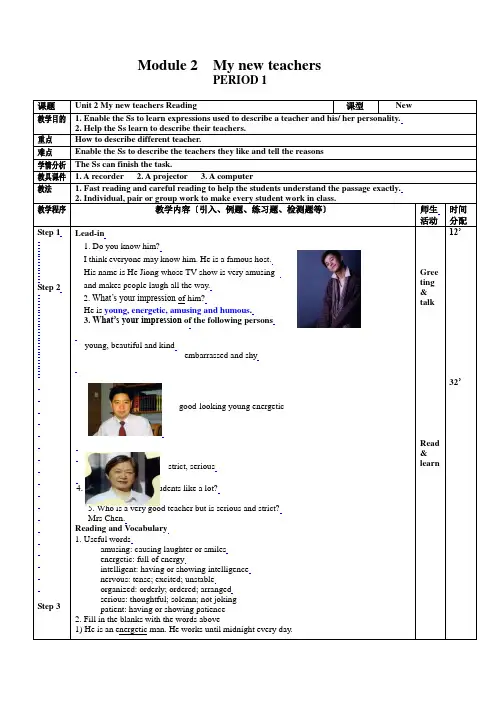
Module 2 My new teachersPERIOD 1课题 教学目的 重点 难点 学情分析 教具课件 教法 教学程序Step 1Step 2Unit 2 My new teachers Reading课型New1. Enable the Ss to learn expressions used to describe a teacher and his/ her personality. 2. Help the Ss learn to describe their teachers. How to describe different teacher.Enable the Ss to describe the teachers they like and tell the reasonsThe Ss can finish the task.1. A recorder 2. A projector 3. A computer1. Fast reading and careful reading to help the students understand the passage exactly. 2. Individual, pair or group work to make every student work in class.教学内容〔引入、例题、练习题、检测题等〕师生 活动Lead-in1. Do you know him?I think everyone may know him. He is a famous host.His name is He Jiong whose TV show is very amusingand makes people laugh all the way.2. What’s your impression of him? He is young, energetic, amusing and humous. 3. What’s your impression of the following personsGree ting & talk时间 分配 12’young, beautiful and kind embarrassed and shy32’ good-looking young energeticstrict, seriousStep 34. Which teachers do students like a lot? Mrs Li, Mr Wu. 5. Who is a very good teacher but is serious and strict? Mrs Chen.Reading and Vocabulary 1. Useful wordsamusing: causing laughter or smiles energetic: full of energy intelligent: having or showing intelligence nervous: tense; excited; unstable organized: orderly; ordered; arranged serious: thoughtful; solemn; not joking patient: having or showing patience 2. Fill in the blanks with the words above 1) He is an energetic man. He works until midnight every day.Read & learn2) Small children are often shy of meeting anyone they do not know.3) I have amusing/interesting piece of news you may not have heard of.4) He is a good teacher. He is very strict in his work.strict be strict with 对某人要求严格be strict in 对某事要求严格(1) They were always strict with their children.(2) We should be strict in our work and study. strictly speaking 严格来说(3) Strictly speaking, the book is not a novel, but a short story. 5) Elephants are intelligent/ clever animal. 6) Don’t be nervous. The doctor just wants to help you. 3. Skimming 1) What’s that girl’s first impression of Mrs Li?Lear n& pract iceHer first impression of Mrs Li was that she was nervous and shy.2) What subject do you think Mrs Li is teaching? English.3) What subject does Mrs Chen teach? Physics.4) What do students think of Mrs Chen?She’s very strict and serious and doesn’t smile much.5) What subject does Mr Wu teach? Chinese.4. True or False1) Mrs Li wasn’t nervous at her first lesson. (F)2) Mrs Li explains grammar clearly and I can follow her. (T)3) She makes me feel stupid when I make mistakes. (F)4) With her help, I begin to do better in English. (T)5. Fill in the blanksMrs Chen is very strict and also very serious and doesn’t smile much. Those who are often latefor class are always on time for her lessons. But most of us really appreciate her because herteaching is well organized and clear. During some scientific experiments, she gives exactexplanations. Although physics is not my favorite lesson, I think I will make progress.1’6. Explanation1) My first impression of Mrs Li was that she was nervous and shy. 我对李老师最初的印象是她既紧张又害羞。
外研版高中英语必修一Module2MyNewTeachers教案

Module 2 My New Teachers Ⅰ. 模块教学目标Ⅱ. 目标语言Ⅲ. 教材分析和教材重组1. 教材分析本模块以My new teachers为话题, 介绍了几位具有不同教学风格和个性特征的教师,旨在通过模块的教学使学生学会描述教师及校园生活,并能运用所学词汇、句型来表达自己的喜好,同时通过学习制定好教师的标准使师生之间相互了解。
1.1 INTRODUCTION 首先介绍描述人物个性特征的形容词,再通过听说训练使学生在运用中熟练掌握这些形容词。
1.2 READING AND VOCABULARY 中的课文分为三部分,从学生的角度对三位不同年龄,不同风格的教师作了介绍。
从文中读者可了解三位教师的性格特征、授课方式及学生的评价。
文后设置了完成句子、写词、问答及讨论等阅读理解题,检测学生对课文的理解,培养学生获取信息、猜测词义等能力。
1.3 GRAMMAR 讲解了本模块的语法项目v?鄄ing形式。
1.4 SPEAKING 是课文内容及本模块话题的延续,要求学生通过口头练习运用所学语法知识描述自己喜爱的教师、科目及喜欢的原因。
1.5 LISTENING AND VOCABULARY分为六部分来进行。
Activities 1, 2 && 3分别以问答和听力练习的形式让学生就有关校园生活的词汇进行练习。
Activity 4要求学生表述自己对英语学习的看法并阐述原因,既巩固了所学生词,又运用了本模块的语法V?鄄ing 形式。
Activity 5 给出八组有联系的词,要求学生解释它们之间的联系。
Activity 6 回归课文,复习旧词汇,并表述对Mr Stanton的看法。
1.6 PRONUNCIATION 以听读的方式学习单词重音,为听力的提高奠定基础。
1.7 FUNCTION AND SPEAKING 列举了表达喜好的句式,要求学生以问答方式就自己所学科目进行对话练习。
1.8 EVERYDAY ENGLISH通过补全对话的形式学习一些日常用语。
Module2 My New Teachers 教案 外研版高中英语必修一
Lesson PlanModule 2 My New TeachersTopic: the reading part of module! book one-My New Teachers(17 minutes)Contents: reading in module two (My new teachers)Teaching aims:(1)Knowledge aims:Help students to find out some detailed information about the three teachers and (Personalities, teaching subjects, teaching styles) have a general understanding of this reading.(2)Ability aims:Enable the students to learn expressions used to describe their teachers and personality.(3)Emotion aims:Help teachers know students' requirements and preferences for subjects and teachers7 personalities.Teaching key points:How to describe different teachersTeaching difflcult points:Enable the students to describe the teachers they like and tell the reasons.Teaching methods:Task-based approach communicative approachTeaching aids:Pictures projectors slidesTeaching procedures:Step one Greeting and lead-in (2 minutes)Good morning, dear students. Today we will learn the reading in module two. At first, I will show you a short video. (American Dreams in China will be shown to students) T: did you watch the movie.S: yes.T: what it tells about?S: three teachers' story.T: yes, this movie is adapted from a real story. Do you like the three teachers? Why? SI: yes, I like, because they are handsome and intelligent.T: XXX, how about you?S2: I like them, too, because they are brave and strong-willed. Their classes are interesting.T: Yes, indeed they are handsome. Maybe our teachers are not as handsome as them.But they have their merits and teaching styles.Step two fast reading (4 minutes)T: Now, please look at the three pictures and tell me your impression of them, (3 pictures from reading passage will be shown).S: the left one is beautiful, young. The middle one is strict and the right one is handsome. T: but do you know what the writer \ opinion is. Please read the passage as quickly as possible and find out the writer's opinion. At the same time, think about the main idea of each paragraph. (Ss will be given 3 minutes)(In 3 minutes)T: shall we check now.S: Mrs. Li is young, beautiful and kind. Mrs. Chen is serious and strict. Mr. Wu is good-looking, young and energetic.T: now can you answer these questions:Who is the kindest teacher?Which teacher are students most afraid of?Who is the most popular teacher?Ss are required to answer these questions one by one.T: this text is simple. And now can you match the paragraphs and their main ideas. S: Paragraph one (information about Mrs. Li)Paragraph two (information about Mrs. Chen)Paragraph three (information about Mr. Wu)T: yes, this text is made up of three paragraphs and each paragraph tells one teacher, so it's easy to get the main idea.Step three Careful reading (5 minutes)(Ss are supposed to read the text again and find out the answers.)T: let's deal with the text in order. At first, please read paragraph one and find out the answers.1 - What is the writer's first impression of Mrs. Li?Ss: Her first impression of Mrs< Li was that she was nervous and shy.2-What subject do you think Mrs. Li is teaching?Ss: EnglishT: now read paragraph two and find the details about Mrs. Chen and answer questions.3.Why do most students in the class like Mrs. Chen?Ss: Her teaching is well organized and clear.What subject does Mrs. Chen teach?4.Ss: PhysicsT: after reading paragraph three and answer these questions.How old is Mr. Wu and how is he?5-Ss: He is about 28. He is energetic and rather good-looking.What does he do when he gets excited?6.Ss: He talks loudly and fast, and waves his hands about a lot when he gets excitedWhat does he do when his students get tired?7.Ss: He tells jokes when the students get tired.Step four a better understanding of the text (3 minutes)Now we have a general understanding of this text, so we will summary it by fillStep five Discussions (2 minutes)T: Do you have any problem for this passage.S: noT: ok, if you don't have any problem. Please tell us something about your teachers and if you want to be a teacher, what kind teacher you will be? Now you can talk with your classmates.(In one minute)T: XXX, can you share your ideas?SI: my math teacher is…I want be a teacher who is...in the futureS2: my history teacher is…I want to be a ...teacher in the future.Step six Summary and Homework (1 minute)T: in the past, most of the teachers are knowledgeable, humorous and simplicity. But now the teachers are tending to be handsome, beautiful and fashionable. Anyway, every teacher has different styles and shining points and they deserve being respected. You have been studying at senior high school more than two weeks, and I guess that your parents or friends want to know something about your new teachers. So today's homework is to write a letter to your parents or friends and tell them something about your teachers. Blackboard design:Module 2 my new teachersPersonalities Teaching styleMrs. LiMrs. Chen:M E W U:Teaching reflection: omitted。
高中英语-Module2-My-New-Teachers教学设计-外研版必修1
Module 2 My New Teachers一、设计思路上课之前大家一起唱节奏欢快的英文歌曲,使学生迅速进入英语课堂,营造一种轻松活泼的教学氛围。
再以轻松愉快的聊天形式导入新课,使学生迅速进入本节课的学习,形成轻松活泼的课堂氛围。
课堂由浅入深,引导学生充分想象自己已经学过的描述人物的单词,再通过阅读本篇文章导出更多表达方法,由外貌描述到性格描述的词汇,再进入串词成句引导学生对课文进行大致复述。
运用已知词汇造句、作文,对学生进行能力的提升。
通过前面的铺垫要求学生描述自己的老师,以此表达对老师的热爱,对教师这一职业的理解与感悟。
二、教材分析本课学习的内容是外研版新课标B1M2 My New Teachers的reading的一个课时。
课本内容包括:通过阅读学习一些描述人物的词汇;学习用这些词汇描述自己熟悉的人物;利用所学词汇描述自己喜欢的老师从而尽可能充分调动学生的积极性,课后要求学生把对自己喜欢的老师的描述写下来,达到听、说、读、写的教学目的。
三、学情分析学生思维比较活跃,敢于提出不同见解,学生已经储备了一定的英语知识,能较好地展开话题讨论,各抒己见。
采取多媒体教学,运用多种教学方法和手段激发学生交流和学习的兴趣,希望学生始终处于积极、主动的思考、探究的状态中,创造充满活力的课堂气氛。
四、教学目标1.语言知识目标:掌握描述人物特点的形容词。
2.语言技能目标:运用描述人物特点的形容词进行描述和交流。
3.情感态度:学生能自如地表达自己的思想,情感;理解教师这一职业的艰辛,理解并尊重老师。
4.学习策略:在情景中进行交流,培养学生的交际策略。
五、教学策略1、认知策略总结和运用新学词汇短语,注意发现语言的规律并能加以运用2、调控策略根据问题锻炼查读能力,把握学习的主要内容,积极参与课堂讨论3、交际策略在课堂活动中能够用英语余同学交流六、教学设计七、课堂教学过程设计:ReadingTeaching goals教学目标1. Target language目标语言a. 重点词汇和短语amusing, energetic, intelligent, nervous, organized, patient, avoid, appreciate, admit, scientific, literature, joke, summary, respect , make sure, so that, make progress, as a result, in fact, fall asleep, tell jokesb. 重点句式 (P12)She is also very serious and doesn’t smile much.Some ..., but most of us really appreciate her ... well organized and clear.There are few students ... who keep coming to class late...2. Ability goals能力目标Enable the students to learn expressions used to describe a teacher and his / her personality.3. Learning ability goals 学能目标Help the students learn to describe their teachers.4.Moral goals 德育目标To understand and respect the teacher5.Teaching important points教学重点How to describe different teachers.6.Teaching difficult points教学难点Enable the students to describe the teachers they like and tell the reasons.7.Teaching methods教学方法questions-answers ,reading, discussion and cooperative learning.8.Teaching aids教具准备Multi-media, a projector9.Teaching process 教学过程Step 1 Preparation(准备阶段)Enjoy a piece of music(Before class, let Ss enjoy a piece of music----trouble is a friend)Step 2 lead-in(导入)T: How long have you been here?S: About two weeks.T: Do you feel happy for being here?S: Yes.T: How do you think of our school?S1: It is beautiful.S2: The teachers are very excellent and friendly.T: Yes, excellent! So today we will talk about -----My new teachers!Step 3 Warming-up(热身活动)T: We usually use some adjectives to describe persons. E.g. You are _____?Ss: clever .T: Yes. Here I will give you some pictures and you just give me the adjectives that you can think of from it, ok?(幻灯片)看着第二张幻灯片学生说出一两个外貌描述的词汇后链接按钮进入第三张,同法进入第四张;第四张幻灯片两个外貌描述词汇后链接按钮1进入第五张;学生阅读课文。
高中英语 Module2 My new teachers单元教案 外研版必修1 教案
Module2 My New Teachers 单元教案Teaching Aims: 1.Knowledge and Skilla. Speaking: express one’s attitude or views about their teachers and describe what their teachers look likeb Reading: understand the meanings of certain words in context applying to guessing meaning skills.c. Writing: develop the ability of using commasd. Listening: Grasp the ability of listening for specific facts 2.Emotion and Values a.Improve the relationship between the teachers and the students by comparing the relationship between teachers and the students in other countries. b.To help them set the correct and all-the-round thinking away, and enforce to control the directions of thinking. c.To encourage the Ss to be active and cooperative in the class 3. Cross-cultural awareness: a.To help them learn about different relationship between teachers and students in other countries.4. Character-building: a.To help them know more about their teachers and love the teachers deeply in order to make their relationship more harmonious.. b.To let them know the importance of cooperating with others in a group Difficulties and Importance:a. Master the usage of –ing form.b. Improve the student’s ability of grasping the general idea of the passage. Teaching Method: a.Task-based methodologyb. pair-work& group-work Teaching Procedures: Period 1Teaching Content: Vocabulary and listening Everyday EnglishActivity 1. Ask the Ss to write”+” for positive adjectives, and “-”for negative adjectives. (Some words will have a positive and a negative meaning, depending on the context.)Activity 2. Ask the students to describe their teachers they know, using the words given above. For example: Our science teacher is very energetic and intelligent. I am fond of Mr. Li’s classes. They are never boring.Our English teacher is serious but his teaching style is well organized. ______________________________________________________________________________________________________ Activity 3 Pair workDiscuss the following sentences True or False according to your own experiences. And share your opinions with your partner.1. All good teachers talk a lot.2. I think teachers need to be strict.3. I like teachers who are amusing and can laugh with their students.4. The most popular teachers are always very kind.5. Good teachers make sure that everyone in the class understands.6.Good teachers always return homework quickly.7. You should be able to ask your teacher questions at any time during a lesson. 8.It doesn’t matter if a teacher is not organized.Activity 4 Listening.Listen to Alex, and English student, and tick the sentences above that he agrees with. Compare your choices with Alex and have a discussion with your classmates what makes a good teacher. Activity 5 Everyday English a.Make sure the students know the meaning of the following expressions.Have you got that take a look kids that’s settled a couple of things it’s up to you b.Complete the conversations with these expressions. Activity 5 Homework 1. Memorize the adjectives we have learned in the class.2.You should know some adjectives have positive or negative meanings or both.Period 2Teaching Content: Reading and Vocabulary Activity 1. Warming-up( brainstorming)Try to find out the positive adjectives to describe the three teachers in the textbook. Activity 2 Pre-reading(prediction)Look at the pictures given in the textbook, make predictions about which subject do you think they may teach.Listen to the text and check your prediction. Mrs. Li _______________ Mrs. Chen _______________ Mr. Wu _______________ Activity 3 Intensive reading a.skimming and scanning: Read the text silently and quickly to get the general idea. Then answering the following questions. 1.Which teachers do the students like a lot?2. Who is a very good teacher but is serious and strict?b. detail reading: Answer the following questions according to the article.1.Which paragraphs tell us what the teachers look like? 2. What subjects does each teacher teach? 3. Who is the most popular teacher? 4. Who is the kindest teacher?5.Which teacher are students most afraid of? 6. Which teachers explain things clearly?Activity 4 Post-readingInterview: Interview some of your classmates about which teacher they would like to have and ask them to give specific reasons to support their own idea. Activity 5. Key points of the passage 1. so…thatadjectives/adverbadj.+a/an+n(singlular)so thatmany/few+n.(plural)many/little+n.(uc.)e.g. He ran quickly that we couldn’t keep up with him. Bob is so tall a man that he can almost reach the ceiling. I’ve had so many falls that I’m black and blue all over.There was so little water left that only small children and patients were given some. 2. working with her 跟她学习3. avoid +doing appreciate+doingenjoy +doing hate +doingadmit +doing mind +doing这些动词常用ing形式做宾语。
外研版高一英语必修一Module 2 My New Teachers教案
外研版高一英语必修一Module2My New Teachers教案Teaching Aims:Train the students“ reading ability. Learn some useful words and expressions:amusing, energetic, intelligent, nervous,make progress keep doing sth and soon.Teaching Important Points.Help the students to understand the passage better.Learn and master some important words and phrases in this period.Teaching Difficult Points:How to help the students improve their reading and understand the passage better.Teaching Methods:Fast reading to get the general idea of the text.Careful reading to understand the passage better.Discussion to help the students understand what they“ve learned better.Teaching procedure.Step 1Lead --in基础梳理:选词填空amusingpatientseriousstrictimpressionavoidimmediatelyappreciateadmitscientif ic1 Although her father loved her deeply, he was _____ with her.2.You must be______about your job.3.If the shop is untidy, it makes a bad _____on the customers.4.The microscope is a ______ instrument.5.The ______story made them laugh.6.A healthy diet will help you _______heart disease.7.John ______making mistakes.8.The children went out to play ______after they had eaten.9.Try to be _____with your daughter.10.I would ________it if you would like to help me.Step 2Reading comprehension.Fast reading: Read the passage quickly and answer the question.1) Which teacher do students like a lot?Careful reading:根据课文填空My first1of Mrs. Li was that the was nervous and shy. But now the classreallylikesworkingwithher.She’skindand2.SheexplainsEnglishgrammarsoclearlyth atevenIcanunderstandit!—Sheavoidsmakingyoufeelstupid. When I make mistakes, she just smiles. I think maybe she goes a bit too slowlyforthefasterstudents,butformeit’swonderful.IfeelI’mgoingtomake3with her.Mrs. Chen is almost sixty . She’s very strict and serious. Some of our class don’tlikeher,butmostofusreally4herbecauseherteachingissowell5andclear.Andafewst udents6likingher.During7experimentsheexplains exactly what is happening and as a result my work is improving. I think thatI’ll do well in the exam with Mrs.Chen teaching me.Mr.Wu’s only been teaching us for two weeks and he’s already very popular. He’sgot so much8,this is one class you do not fall asleep in! He’s re ally amusingand tells jokes when he think we’re getting9. I10him a lot.Post reading :Finish some exercises当堂检测(5分钟满分10分)1.He is an _______(精力充沛) boy and he enjoys sports.2.It’s not true at all. He is ______(完全) wrong.3.First, you should have your job ______(有组织的)4.I felt very n_________when I went into the headmaster’s office5.My general i_________was that he seems a pleasant man6.Our teacher is s_________and we have to do what she saysStep 3 HomeworkDo Workbook Exercises bout the readingStep 4 SaummaryIn this period we have learned some vocabulary and we should try tokeep them in mind after class. After reading we learned about some new wordsand three new teachers.It is important for students to learn some useful wordsto describe teachers or other people.板书设计Module2My New Teachers1) be patient with sb对某人有耐烦be patient of sth能忍受某事2)so……that…如此……以至于……3)be strict with sbbe srict in sthstrictly speaking严格说来知识体系拓展延伸1 My father is lively and energetic, but he is not very patient.译文:我的父亲风趣而充满活力,但他不太有耐烦patientadj耐烦的词组:1) be patient with sb对某人有耐烦2) be patient of sth能忍受某事patiencen忍耐,耐烦;忍耐力be out of patience with对。