
2019考研英语二写作解析
2019考研英语二写作解析
跨考教育英语教研室张海英备受期待的2019考研英语已在12月22号下午5点落下帷幕,英语二大作文不出意料,考到了重点讲到的柱状图——分析本科毕业生毕业去向2013-2018对比图。
一. 审题
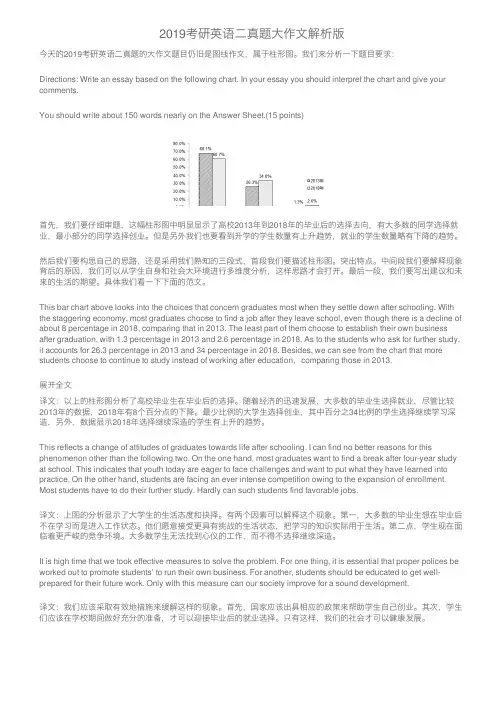
该图表反应毕业生毕业后的选择,这幅图表想要告知我们的是从2013-2018年大学毕业生选择升学和创业的比例都升高了,而选择就业的比例就相对减少了。
关于此类话题,在作文冲刺班课程中已经重点提及过,相关的主题词就业search for a job,升学pursue further study,创业start a business等都是我们课堂上讲解过得,自己翻译起来应该还是比较简单的。
二.谋篇布局
第一段:描述图表。
针对这种柱状图,我们在写作课堂上,屡次给大家提到了柱状图的分析思路和可直接套用的模板。
只要大家按照模板,再结合主题词的翻译,可以在很短的时间内搞定第一段。
另外,第一段一个很重要的部分就是标题文字翻译,可以翻译为choices after graduation for undergraduates in 2013 and 2018。
第二段:分析原因。
图表所呈现的现象是本科毕业生毕业后的选择,越来越多会去求学和创业。
引起这种现象的原因很明显,可以从两个角度去展开分析:
1. 社会的发展,以及目前对于教育的重视,和对于高学历人才的需求增多
2.国家经济和个人财富的发展,对于创业有了更多的资本以及国家对于创业和追求高学历的政策支持。
第三段:提出自身见解,加以合理展望。
第三段简单介绍下这种趋势的发展情况,预测这种趋势还会这样持续下去。
总而言之,跨考教育英语教研室张海英老师认为2019年的英语二大作文,继续延续了历年的出题特点,难度适中,结合模板的套用比较简单。
最后祝大家考研金榜题名!
来源:跨考教育
作者:英语教研室张海英。
2019考研英语二真题大作文解析版
2019考研英语⼆真题⼤作⽂解析版今天的2019考研英语⼆真题的⼤作⽂题⽬仍旧是图线作⽂,属于柱形图。
我们来分析⼀下题⽬要求:Directions: Write an essay based on the following chart. In your essay you should interpret the chart and give your comments.You should write about 150 words nearly on the Answer Sheet.(15 points)⾸先,我们要仔细审题,这幅柱形图中明显显⽰了⾼校2013年到2018年的毕业后的选择去向,有⼤多数的同学选择就业,最⼩部分的同学选择创业。
但是另外我们也要看到升学的学⽣数量有上升趋势,就业的学⽣数量略有下降的趋势。
然后我们要构思⾃⼰的思路,还是采⽤我们熟知的三段式,⾸段我们要描述柱形图。
突出特点。
中间段我们要解释现象背后的原因,我们可以从学⽣⾃⾝和社会⼤环境进⾏多维度分析,这样思路才会打开。
最后⼀段,我们要写出建议和未来的⽣活的期望。
具体我们看⼀下下⾯的范⽂。
This bar chart above looks into the choices that concern graduates most when they settle down after schooling. With the staggering economy, most graduates choose to find a job after they leave school, even though there is a decline of about 8 percentage in 2018, comparing that in 2013. The least part of them choose to establish their own business after graduation, with 1.3 percentage in 2013 and 2.6 percentage in 2018. As to the students who ask for further study, it accounts for 26.3 percentage in 2013 and 34 percentage in 2018. Besides, we can see from the chart that more students choose to continue to study instead of working after education,comparing those in 2013.展开全⽂译⽂:以上的柱形图分析了⾼校毕业⽣在毕业后的选择。
2019考研英语(二)真题及答案解析(完整版).doc
2019考研英语真题及答案解析(二)(完整版)参考答案在最后Directions:Read the following text. Choose the best word (s) for each numbered blank and mark A, B, C or D on the ANSWER SHEET. (10 points)Weighing yourself regularly is a wonderful way to stay aware of any significant weight fluctuations ・ 1 ,when done too often, this habit can sometimes hurl more than it 2 .As for me, weighing myself every clay caused me to shift my focus from being generally healthy and physically active to focusing 3 on the scale・ That was bad to my overall fitness goals. I had gained weight in the form of muscle mass, but thinking only of 4 the number on the scale, I altered my training program. That conficted with how I needed to train to 5 my goals.I also found that weighing myself daily did not provide an accurate 6 of the hard work and progress I was making in the gym .It takes about three weeks to a month to notice any significant changes in your weight 7 altering your training program・ The most 8 changes will be observed in skill leveLstrength and inches lostFor these 9 , I stopped weighing myself every day and switched to a bimonthly weighing schedule 10 . Since weight loss is not my goal, it is less important for meto_ 11 _ my weight each week. Weighing every other week allows me to observe and 12 any significant weight changes. That tells me whether I need to 13 my training program.I use my bimonthly weigh-in 14 to get information about my nutrition as well. If my training intensity remains the same, but Fm constantly 15 and dropping weight, this is a 16 that I need to increase my daily caloric intake・The 17 to stop weighing myself every day has done wonders for my overall health, fitness and well-being. I'm experiencing increased zeal for working out since I no longer carry the burden of a 18 morming weigh-in. Fve also experienced greater success in achieving my specific ftness goals, 19 Im training according to those goals, not the numbers on a scale.Rather than 20 over the scale, turn your focus to how you look, feel how your clothes fit and your overall energy level.1.[A] Besides [B] Therefore [C]Otherwise [D] However2.[AJ helps [BJcares [CJwarns [D] reduces3.[A] initially [B] solely [C] occasionally [D] formally4・[A] recording [B] lowering [C] explaining fD] accepting5.[A] modify [BJ set [CJreview |D] reach6.[A] definition [B] depiction [C] distribution [D] prediction7.[A] due to [Bjregardless of [C] aside from [D] along with8.[A] orderly [B] rigid [C] precise [D] immediate9.[A] claims [Bjudgments [C] reasons [D] methods10.[A] instead [B|though [CJagain [DJindeed11.[A] report [B] share [C] share [D] share12.[A] depend on fB]approve of [C]hold onto [D]account for13.[A] prepare [BJshare [C]share [D] share14.[A] results [BJfeatures [C]rules [D]tests15.[Aj bored [BJanxious [CJhungry [D] sick16.[A] principle |B]secret [C]belief [D]sign17.fA] request [Blnecessity [C]decision [D]wish18.[A] disappointing [BJsurprising [C]restricting [D]consuming19.[A] if because [B]unless [CJuntil [D]consuming20.[A] obsessing [BJdominating ICJpuzzling [DJtriumphingSection II Reading ComprehensionPart ADirections:Read the following four texts. Answer the questions below each text by choosing A, B, C or D. Mark your answers on the ANSWER SHEET. (40 points)Text 1Unlike so-called basic emotions such as sadness, fear, and anger, guilt emerges a little later, in conjunction with a chilcfs growing grasp of social and moral norms. Children aren't bom knowing how to say "I,m sorry”; rather, they learn over time that such statements appease parents and friends - and theirown consciences. This is why researchers generally regard so-called moral guilt, in the right amount, to be a good thing・In the popular imagination, of course, guilt still gets a bad rap. It is deeply uncomfortable- ifs the emotional equivalent of wearing a jacket weighted with stones. Yet this understanding is outdated. "There has been a kind of revival or a rethinking about what guilt is and what role guilt can serve/' says Amrisha Vaish, a psychology researcher at the University of Virginia, adding that this revival is part of a larger recognition that emotions aren't binary 一feelings that may be advantageous in one context may be harmful in another. Jealousy and anger, for example, may have evolved to alert us to important inequalities・ Too much happiness can be destructive.And quilt, by prompting us to think more deeply about our goodness, can encourage humans to make up for errors and fix relationships. Guilt, in other words, can help hold a cooperative species together. It is a kind of social glue.Viewed in this light, guilt is an opporlunity. Work by Tina Malti , a psychology professor at the University of Toronto .suggests that guilt may compensate for an emotional deficiency. In a number of studies, Malti and others have shown that guilt and sympathy may represent different pathways to cooperation and sharing. Some Kids who are low in sympathy may make up for that shortfall by experiencing more guilt, which can rein in their nastier impulses. And vice versa : High sympathy can substitute for low guilt.In a 2014 study, for example, Malti looked at 244 children. Using caregiver assessments and the children's self-observations, she rated each child's overall sympathy level and his or her tendency to feel negative emotions after moral transgressions. Then the kids were handed chocolate coins, and given a chance to share them with an anonymous child. For the low-sympathy kids, how much they shared appeared to turn on how inclined they were to feel guilty. The guilt-prone ones share more, even though they hadn't magically become more sympathetic to the other child's deprivation.“That's good news,' Malti says, "Wc can be prosocial because we caused harm and we feel regret/721.Researchers think that guilt can be a good thing because it may help _________ ・A.regulate a child's basic emotionsB.improve a child's intellectual abilityC.foster a child's moral developmentD.intensify a child's positive feelings22.According to Paragraph 2, many people still consider guilt to be _________ ・A.deceptiveB.burdensomeC.addictiveD.inexcusable23.Vaish holds that the rethinking about guilt comes from an awareness that__________ .A.emotions are context-independentB.emotions are socially constructiveC・ emotio nal stability can ben efit healthD. an emotion can play opposing roles24.Malti and others have shown that cooperation and sharing ________ ・A.may help correct emotional deficienciesB.can result from either sympathy or guiltC・ can bring about emotional satisfactionD. may be the outcome of impulsive acts25.The word "transgressions^ (Line 4, Para. 5) is closest in meaning to _________ ・A.teachingsB.discussionsC・ restrictionsD. wrongdoingsText 2Forests give us shade, quiet and one of the harder callenges in the fight against climate change ・Even as we huma ns count on forests to soak up a good share of the carb on dioxide we produce, we are threatening their ability to do so.The climate change we are hastening could one clay leave us with forests that emit more carbon than they absorb.Thankfully, there is a way out of this trap - but it involves striking a subtle balance・ Helping forests flourish as valuable n carbon sink s” long into the future may require reducing their capacity to absorb carbon now・ Califormia is leading the way, as it does on so many climate efforts, in figuring out the details・The state's proposed Forest Carbon Plan aims to double efforts to thin out young trees and clearbrush in parts of the forest. This temporarily lowers carbon-carrying capacity・ But the remaining trees draw a greater share of the available moisture, so they grow and thrive, restoring the forests capacity to pull carbon from the air. Healthy trees are also better able to fend off insects. The landscape is rendered less easily burnable. Even in the event of a fire, fewer trees are consumed.The need for such planning is increasingly urgent. Already, since 201(),drought and insects have killed over 100 million trees in California, most of them in 2016 alone, and wildfires have burned hundreds of thousands of acres.California plans to treat 35,000 acres of forest a year by 2020, and 60,000 by 2030 - financed from the proceeds of the state* s emissions- permit auctions• That r s only a small share of the total acreage that could benefit, about half a million acres in all, so it will be vital to prioritize areas at greatest risk of fire or drought.The strategy also aims to ensure that carbon in woody material removed from the forests is locked away in the form of solid lumber or burned as biofuel in vehicles that would otherwise run on fossil fuels. New research on transportation biofuels is already under way.State governments are well accustomed to managing forests, but traditionally they've focused on wildlife, watersheds and opportunities for recreation. Only recently have they come to see the vital part forests will have to play in storing carbon・ Califormi^s plan, which is expected to be finalized by the governor next year, should serve as a model.26.By saying “one of the harder challenges /5the author implies that ___________ ・A.global climate change may get out of controlB.people may misunderstand global warmingC・ extreme weather conditions may ariseD. forests may become a potential threat27.To maintain forests as valuable “carbon sinks/ we may need to_____________ ・A.preserve the diversity of species in themB.accelerate the growth of young treesC.strike a balanee among different plantsD.1 ower their present carbon-absorbing capacity2& California^ Forest Carbon Plan endeavors to ________ ・A.cultivate more drought-resistant treesB.reduce the density of some of its forestsC・ find more effective ways to kill insectsD. restore its forests quickly after wildfires29.What is essential to California's plan according to Paragraph 5?A.To handle the areas in serious danger first.B.To cairy it out before the year of 2020.C.To perfect the emissions-permit auctions・D.To obtain enough financial support・30.The author's attitude to California^ plan can best be described as __________.A.ambiguousB.tolerantC.supportiveD.cautiousText 3American farmers have been complaining of labor shortages for several years now. Given a multi-year decline in illegal immigration, and a similarly sustained pickup in the U.S. job market, the complaints are unlikely to stop without an overhaul of immigration rules for farm workers.Efforts to create a more straightforward agricultural-workers visa that would enable foreign workers to stay longer in the U.S. and change jobs within the industry have so far failed in Congress・ If this doesn^t change, American businesses, communities and consumers will be the losers・Perhaps half of U.S. farm laborers are undocumented immigrants. As fewer such workers enter the U.S., the characteristics of the agricultural workforce are changing. Today's farm laborers, while still predominantly born in Mexico, are more likely to be settled, rather than migrating, and more likely to be married than single. They are also aging. At the start of this century, about one-third of crop workers were over the age of 35・ Now, more than half are. And crop picking is hard on older bodies.One oft-debated cure for this labor shortage remains as implausible as it has been all along: Native U.S. workers won't be returning to the farm.Mechanization is not the answer either 一not yet at least. Production of corn, cotton, rice, soybeans and wheat have been largely mechanized, but many high-value,labor-intensive crops, such asstrawberries, need labor. Even dairy farms, where robots currently do only a small share of milking, have a long way to go before they are automated・As a result, farms have grown increasingly reliant on temporaiy guest workers using the H-2A visa to fill the gaps in the agricultural workforce. Starting around 2012, requests for the visas rose sharply; from 2011 to 2016 the number of visas issued more than doubled・The H-2A visa has no numerical cap、unlike the H-2B visa for nonagricultural work, which is limited to 66,000 armually. Even so, employers frequently complain that they aren5t allotted all the workers they need・The process is cumbersome, expensive and unreliable・One survey found that bureaucratic delays led H-2A workers to arrive on the job an average of 22 days late. And the shortage is compounded by federal immigration raids, which remove some workers and drive others underground・In a 2012 survey,71 percent of tree-fruit growers and nearly 80 percent of raisin and berry growers said they were short of labor. Some western growers have responded by moving operations to Mexico. From 1998-2000, 14.5 percent of the fruit Americans consumed was imported. Little more than a decade later, the share of imported fruit had increased to 25.8 percent.In effect, the U.S. can import food or it can import the workers who pick it・31 ・What problem should be addressed according to the first two paragraphs?A.Discrimination against foreign workers in the U.S.B.Biased laws in favor of some American businesses.C.Flaws in U.S. immigration rules for farm workers・D.Decline of job opportunities in U・S・ agriculture ・32.One trouble with U.S. agricultural workforce is ________ ・A.the rising number of illegal immigrantsB.the high mobility of crop workersC.the lack of experienced laborersD.the aging of immigrant farm workers33.What is the much-argued solution to the labor shortage in U.S. farming?A. To attract younger laborers to farm work・B・ To get native U.S. workers back to farming.C.To use more robots to grow high-value crops・D.To strengthen financial support for farmers.34.Agricultural employers complain about the H-2A visa for its ____ .A.slow granting proceduresB.limit on duration of stayC.tightened requirementsD.control of annual admissions35.Which of the following could be the best title for this text?A.U.S. Agriculture in Decline?B.Import Food or Labor?C.America Saved by Mexico?D.Manpower vs. Automation?Text 4Arnold Schwarzenegger, Dia Mirza and Adrian Grenier have a message for you: Ifs easy to beat plastic・ TheyYe part of a bunch of celebrities starring in a new video for World Environment Day 一encouraging you, the consumer, to swap out your single-use plastic staples like straws and cutlery to combat the plastics crisis.The key messages that have been put together for World Environment Day do include a call for governments to enact legislation to curb single-use plastics. But the overarching message is directed at individuals.My concern with leaving it up to the individual, however, is our limited sense of what needs to be achieved. On their own, taking our own bags to the grocery store or quitting plastic straws, for example, will accomplish little and require very little of us. They could even be detrimental, satisfying a need to have "done our bit M without ever progressing onto bigger, bolder, more effective actio ns — a kind of H moral licensi ng” tha t allays our con cer ns and stops us doing more and asking more of those in charge ・While the conversation around our environment and our responsibility toward it remains centered on shopping bags and straws, vveYe ignoring the balance of power that implies that as"consumers” we must shop sustainably, rather than as "citizens" hold our governments and industries to account to push for real systemic change・It's important to acknowledge that the environment isn't everyone's priority 一or even most people's. We shouldn f t expect it to be. In her latest book, Why Good People Do Bad Environmental Things, Wellesley College professor Elizabeth R・ DeSombre argues that the best way to collectively change the behavior of large numbers of people is for the change to be structural.This might mean implementing policy such as a plastic tax that adds a cost to environmentally problematic action, or banning single-use plastics altogether. India has just announced it will "eliminate all single-use plastic in the country by 2022.H There are also incentive-based ways of making better envi 「onmental choices easier, such as ensuring recycling is at least as easy as trash disposal.DeSombre isn f t saying people should slop caring about the environment. Ifs just that in dividual actio ns are too slow, she says, for that to be the only, or even primary, approach to changing widespread behavior.None of this is about writing off the individual. If s just about putting things into perspective. We don't have time to wait. We need progressive policies that shape collective action (and rein in polluting businesses), alongside engaged citizens pushing for change・36.Some celebrities star in a new video toA.demand new laws on the use of plasticsB.urge consumers to cut the use of plasticsC.invite public opinion on the plastics crisisD.disclose the causes of the plastics crisis37.The author is concerned that "moral licensing" mayA.mislead us into doing worthless thingsB.prevent us from making further effortsC.weaken our sense of accomplishmentD.suppress our desire for success38.By pointing out our identity as u citizens/\the author indicates thatA: our focus should be shifted to community welfareB: our relationship with local industries is improvingC: We have been actively exercising our civil rightsD: We should press our government to lead the combat39.DeSombre argues that the best way for a collective change should beA: a win-win arrangementB: a self-driven mechanismC: a cost-effective approachD: a top down process40.The author concludes that individual effortsA: can be too aggressiveB: can be too inconsistentC: are far from sufficientD: are far from rationalPart BDirections:You are going to read a list of headings and a text. Choose the most suitable heading from the list A-G for each numbered paragraph (41-45). Mark your answers on the ANSWER SHEET・(10 points)Five ways to make conversation with anyoneIn choosing a new home, Camille McClain's kids have a single demand: a backyard・McClain's little ones aren^t the only kids who have an opinion when it comes to housing, and in many cases youngsters" views weigh heavily on parents' real estate decisions, according to a 2018 Harris Poll survey of more than 2,000 U.S. adults.While more families buck an older-generation proclivity to leave kids in the dark about real estate decisions, realty agents and psychologists have mixed views about the financial, personal and long-term effects kids,opinions may have・The idea of involving children in a big decision is a great idea because it can help them feel a sense of control and ownership in what can be an overwhelming process, said Ryan Hooper, a clinical psychologist in Chicago."Children may face serious difficulties in coping with significant moves, especially if it removes them from their current school or support system/' he said.Greg Jaroszewski, a real estate brokers with Gagliardo Realty Associates, said he's not convincedthat kids should be involved in selecting a home ― but their opinions should be considered in regards to proximity to friends and social activities, if possible・Younger children should feel like they're choosing their home ― without actually getting a choice in the matter, said Adam Bailey, a real estate attorney based in New York.Asking them questions about what they like about the backyard of a potential home will make them foel like they^re being included in the decision-making process, Bailey said.Many of the aspects of homebuying aren't a consideration for children, said Tracey Hampson, a real estate agent based in Santa Clarita, Calif. And placing too much emphasis on their opinions can ruin a fantastic home purchase."Speaking with your childre n before you make a real estate decision is wise, but I would n't base the purchasing decision solely on their opinions.n Hampson said.The other issue is that many children - especially older ones - may base their real estate knowledge on HGTV shows, said Aaron NoiTis of The Norris Group in Riverside ,Calif ・“They love Chip and Joanna Gaines just as much as the rest of us,” he said. "HGT V has seriously changed how people view real estate. It,s not shelter , it's a lifestyle・ With that mindset change come some serious money consequences.MKids tend to get stuck in the features and the immediate benefits to them personally, Noiris said.Parents need to remind their children that their needs and desires may change over time, said Julie Gumer, a real estate analyst with ."Their opinions can change tomorrow/9 Gumer said. "Harsh as it may be to say, that decision should likely not be made contingent on a child's opinions, but rather made for them with great consideration into what home can meet their needs best - and give them an opportunity to customize it a bit and make it their own."This advice is more relevant now than ever before, even as more parents want to embrace the ideas of their children, despite the current housing crunch.A. remarks that significant moves may pose challenges to children.A.remarks that significant moves may pose challenges to childreru41.Ryan HooperB.says that it is wise to leave kids in the dark about real estate decisions・42.Adam BaileyC- advises that home purchases should not be based only on children's opinions.43.Tracey HampsonD.thinks that children should be given a sense of involvement in homebuying decisions・44.Aaron NorrisE.notes that aspects like children's friends and social activities should be considered upon homebuyin g.45・ Julie GurnerF.believes that homebuying decisions should be based on children's needs rather than their opinions.G.assumes that many children's views on real estate are influenced by the media.Section III Translation46.Directions:Translate the following text into Chinese・ Write your translation neatly on the ANSWER SHEET.(15 points)It is easy to underestimate English writer James Heriot. He had such a pleasant, readable style that one might think that anyone could imitate it. How many times have I heard people say T could write a book・ I just haven't the time.11 Easily said. Not so easily done・ James Herriot, contrary to popular opinion, did not find it easy in his early days of, as he put it/'having a go at the writing game"・ While he obviously had an abundance of natural talent, the final, polished work that he gave to the world was the result of years of practisin g・ re-writi ng and read in g・ Like the majority of authors, he had to suffer many disappointments and rejections along the way, but these made him all the more determined to succeed・ Everything he achieved in life was earned the hard way and his success in the literary field was no exception・Section IV WritingPart A47、Directions: Suppose you have to cancel your travel plan and will not be able to visit professor Smith, write him an email toSuppose Professor Smith asked you to plan a debate on the theme of city traffic. Write him an email to1)suggest a specific topic with your reasons, and2)tell him about your arrangements・You should write about 100 words on the ANSWER SHETE.Do not use your own name. Use "Li Ming H instead (lOpoints)Part B48 > Directions: Write an essay based on the chart below .In your writing , you should1)interpret the chart, and2)give your commentsYou should write about 150 words on the ANSWER SHEET・(15 points)【完型填空答案】 1. [D] However 2. [A] helps 3. [B] solely4. [B] lowering5. [D] reach6. [B] depiction7. [A] due to8. [D] immediate 9. [C] reasons 10. [A] instead 11. [A] track 12. [D] account for13. [B] adjust14. [A] results15. [C] hungry16. [D] sign17. [C] decision18. [A] disappointing19. [Al because20. [A] obsessing 参考答案某高校2013年和2018年本科毕业生去向统计Section I Use of English70 0% J j 60.0% J ISUg -J I40.0% j30.0% 420,0% -j10.0% ]I0.0% 4—68.1%就业 升学创业■ 2013 □ 2018Section II Reading Comprehension (50 points)Part A【阅读答案】Text 121. [C] foster a child's moral development22. ⑻burdensome23. [D] an emotion can play opposing roles24. IB] can result from either sympahty or guilt25. |D1 wrongdoingsText 226. [D] forests may become a potential threat27. ID] lower their present carbon-absorbing capacity28. IB] reduce the density of some of its forests29. [A] To handle the areas in serious danger first30. [C] supportiveText 331. [C] Flaws in U. S. immigratinon rules for farm workers.32. [D] the aging of immigrant farm workers33. [B] To get native U.S. workers back to farming.34. [A] slow graning procedures.35. IB] Import Food or Labor?Text 436. [B] urge consumers to cut the use of plastics37. [B] prevent us from making further efforts3& [D] We should press our government to lead the combat39. |D1 a top down process40. [C] are far from sufficientPart B【新题型答案】41 ・[A] remarks that significant moves may pose challenges to children42.[D] thinks that children should be given a sense of involvement in homebuying decision43.[C] advises that home purchases should not be based only on children^ opinions44.[G] assumes that many children's views on real estate are influenced by the media45.[F] believes that homebuying decisions should be based on children's needs rather than their opinions.Section IH Translation【翻译答案】我们很容易低估英国作家吉米•哈利。
2019年考研英语(二)真题及答案解析

2019年考研英语二真题SectionⅠUse of EnglishDirections: Read the followingthe best word(s)for each numbered blank and mark[A],[B],[C]or[D]on theANSWER SHEET.(10points)Weighing yourself regularly is a wonderful way to stay aware of any significant weight fluctuations.1,when done too often,this habit can sometimes hurt more than it2.As for me,weighing myself every day caused me to shift my focus from being generally healthy and physically active to focusing3on the scale.That was bad to my overall fitness goals.I had gained weight in the form of muscle mass,but thinking only of4the number on the scale,I altered my training program.That conflicted with how I needed to train to5my goals.I also found that weighing myself daily did not provide an accurate6of the hard work and progress I was making in the gym.It takes about three weeks to a month to notice any significant changes in weight7altering your training program.The most8changes will be observed in skill level,strength and inches lost.For these9,I stopped weighing myself every day and switched to a bimonthly weighing schedule10. Since weight loss is not my goal,it is less important for me to11my weight each week.Weighing every other week allows me to observe and12any significant weight changes.That tells me whether I need to13my training program.I use my bimonthly weigh-in14to get information about my nutrition as well.If my training intensity remains the same,but I’m constantly15and dropping weight,this is a16that I need to increase my daily caloric intake.The17to stop weighing myself every day has done wonders for my overall health,fitness and well-being.I’m experiencing increased zeal for working out since I no longer carry the burden of a18morning weigh-in.I’ve also experienced greater success in achieving my specific fitness goals,19I’m training according to those goals,not the numbers on a scale.Rather than20over the scale,turn your focus to how you look,feel,how your clothes fit and your overall energy level.1.[A]Besides[B]Therefore[C]Otherwise2.[A]helps[B]cares[C]warns3.[A]initially[B]solely[C]occasionally4.[A]recording[B]lowering[C]explaining5.[A]modify[B]set[C]review6.[A]definition[B]depiction[C]distribution7.[A]due to[B]regardless of[C]aside from8.[A]orderly[B]rigid[C]precise9.[A]claims[B]judgments[C]reasons10.[A]instead[B]though[C]again11.[A]report[B]track[C]overlook12.[A]depend on[B]approve of[C]hold onto13.[A]share[B]adjust[C]confirm14.[A]results[B]features[C]rules15.[A]bored[B]anxious[C]hungry16.[A]principle[B]secret[C]belief17.[A]request[B]necessity[C]decision18.[A]disappointing[B]surprising[C]restricting19.[A] B ecause[B]unless[C]until20.[A]obsessing[B]dominating[C]puzzling [D]However [D]reduces [D]formally [D]accepting [D]reach [D]prediction [D]along with [D]immediate [D]methods [D]indeed [D]conceal [D]account for [D]prepare [D]tests [D]sick [D]sign [D]wish [D]consuming [D] if[D]triumphingSection II Reading ComprehensionPart ADirections:Read the following four texts.Answer the questions below each text by choosing[A],[B],[C]or[D].Mark your answers on the ANSWER SHEET.(40points)Text1Unlike so-called basic emotions such as sadness,fear,and anger,guilt emerges a little later,in conjunction with a child's growing grasp of social and moral norms.Children aren’t born knowing how to say“I’m sorry”;rather,they learn over time that such statements appease parents and friends--and their own consciences.This is why researchers generally regard so-called moral guilt,in the right amount,to be a good thing.In the popular imagination,of course,guilt still gets a bad rap.It is deeply uncomfortable--it’s the emotional equivalent of wearing a jacket weighted with stones.Yet this understanding is outdated.“There has been a kind of revival or a rethinking about what guilt is and what role guilt can serve,”says Amrisha Vaish,a psychology researcher at the University of Virginia,adding that this revival is part of a larger recognition that emotions aren't binary--feelings that may be advantageous in one context may be harmful in another.Jealousy and anger,for example,may have evolved to alert us to important inequalities.Too much happiness can be destructive.And guilt,by prompting us to think more deeply about our goodness,can encourage humans to make up for errors and fix relationships.Guilt,in other words,can help hold a cooperative species together.It is a kind of social glue.Viewed in this light,guilt is an opportunity.Work by Tina Malti,a psychology professor at the University of Toronto,suggests that guilt may compensate for an emotional deficiency.In a number of studies,Malti and others have shown that guilt and sympathy may represent different pathways to cooperation and sharing Some Kids who are low in sympathy may make up for that shortfall by experiencing more guilt,which can rein in their nastier impulses.And vice versa:High sympathy can substitute for low guilt.In a2014study,for example,Malti looked at244children Using caregiver assessments and the children’s self-observations,she rated each child’s overall sympathy level and his or her tendency to feel negative emotions after moral transgressions.Then the kids were handed chocolate coins,and given a chance to shared them with an anonymous child.For the low-sympathy kids,how much they shared appeared to turn on how inclined they were to feel guilty.The guilt-prone ones shared more,even though they hadn’t magically become more sympathetic to the other child’s deprivation.“That’s good news,”Malti says.“We can be prosocial because we caused harm and we feel regret,”21.Researchers think that guilt can be a good thing because it may help_______.[A]regulate a child’s basic emotions[B]improve a child’s intellectual ability[C]foster a child’s moral development[D]intensify a child’s positive feelings22.According to Paragraph2,many people still consider guilt to be________.[A]deceptive[B]burdensome[C]addictive[D]inexcusable23.Vaish holds that the rethinking about guilt comes from an awareness that________.[A]emotions are context-independent[B]emotions are socially constructive[C]emotional stability can benefit health[D]an emotion can play opposing roles24.Malti and others have shown that cooperation and sharing_______.[A]may help correct emotional deficiencies[B]can result form either sympathy or guilt[C]can bring about emotional satisfaction[D]may be the outcome of impulsive acts25.The word“transgressions”(Line4,Para.5)is closest in meaning to_______.[A]teachings[B]discussions[C]restrictions[D]wrongdoingsText2Forests give us shade,quiet and one of the harder challenges in the fight against climate change.Even as we humans count on forests to soak up a good share of the carbon dioxide we produce,we are threatening their ability to do so.The climate change we are hastening could one day leave us with forests that emit more carbon than they absorb.Thankfully,there is a way out of this trap-but it involves striking a subtle balance.Helping forests flourish as valuable“carbon sinks”long into the future may require reducing their capacity to sequester carbon now.California is leading the way,as it does on so many climate efforts,in figuring out the details.The state’s proposed Forest Carbon Plan aims to double efforts to thin out young trees and clear brush in parts of the forest,including by controlled burning.This temporarily lowers carbon-carrying capacity.But the remaining trees draw a greater share of the available moisture,so they grow and thrive,restoring the forest’s capacity to pull carbon from the air.Healthy trees are also better able to fend off insects.The landscape is rendered less easily burnable.Even in the event of a fire,fewer trees are consumed.The need for such planning is increasingly urgent.Already,since2010,drought and insects have killed over100 million trees in California,most of them in2016alone,and wildfires have burned hundreds of thousands of acres.California’s plans treat35,000acres of forest a year by2020,and60,000by2030-financed from the proceeds of the state’s emissions-permit auctions.That’s only a small share of the total acreage that could benefit,about half a million acres in all,so it will be vital to prioritize areas at greatest risk of fire or drought.The strategy also aims to ensure that carbon in woody material removed from the forests is locked away in the form of solid lumber or burned as biofuel in vehicles that would otherwise run on fossil fuels.New research on transportation biofuels is already under way.State governments are well accustomed to managing forests,but traditionally they’ve focused on wildlife, watersheds and opportunities for recreation.Only recently have they come to see the vital part forests will have to play in storing carbon.Califormia’s plan,which is expected to be finalized by the governor next year,should serve as a model.26.By saying“one of the harder challenges,”the author implies that________.[A]global climate change may get out of control[B]people may misunderstand global warming[C]extreme weather conditions may arise[D]forests may become a potential threat27.To maintain forests as valuable“carbon sinks,”we may need to_______.[A]preserve the diversity of species in them[B]accelerate the growth of young trees[C]strike a balance among different plants[D]lower their present carbon-absorbing capacity28.California’s Forest Carbon Plan endeavors to________.[A]cultivate more drought-resistant trees[B]reduce the density of some of its forests[C]find more effective ways to kill insects[D]restore its forests quickly after wildfires29.What is essential to California’s plan according to Paragraph5?[A]To handle the areas in serious danger first.[B]To carry it out before the year of2020.[C]To perfect the emissions-permit auctions.[D]To obtain enough financial support.30.The author’s attitude to California’s plan can best be described as________.[A]ambiguous[B]tolerant[C]supportive[D]cautiousAmerican farmers have been complaining of labor shortages for several years now.Given a multi-year decline in illegal immigration,and a similarly sustained pickup in the U.S.job market,the complaints are unlikely to stop without an overhaul of immigration rules for farm workers.Efforts to crate a more straightforward agricultural-workers visa that would enable foreign workers to stay longer in the U.S.and change jobs within the industry have so far failed in Congress.If this doesn’t change.American munities and consumers will be the losers.Perhaps half of U.S.farm laborers are undocumented immigrants.As fewer such workers enter the U.S.,the characteristics of the agricultural workforce are changing.Today’s farm laborers,while still predominantly born in Mexico,are more likely to be settled,rather than migrating,and more likely to be married than single.They are also aging.At the start of this century,about one-third of crop workers were over the age of35.Now,more than half are. And crop picking is hard on older bodies.One oft-debated cure for this labor shortage remains as implausible as it has been all along:Native U.S.workers won’t be returning to the farm.Mechanization is not the answer either—not yet at least.Production of com,cotton,rice,soybeans and wheat has been largely mechanized,but many high-value,labor-intensive crops,such as strawberries,need labor.Even dairy farms,where robots do a small share of milking,have a long way to go before they are automated.As a result,farms have grown increasingly reliant on temporary guest workers using the H-2A visa to fill the gaps in the agricultural workforce.Starting around2012,requests for the visas rose sharply;from2011to2016the number of visas issued more than doubled.The H-2A visa has no numerical cap,unlike the H-2B visa for nonagricultural work,which is limited to66,000 annually.Even so,employers frequently complain they aren’t allotted all the workers they need.The process is cumbersome,expensive,and unreliable.One survey found that bureaucratic delays led H-2A worker to arrive on the job an average of22days late.And the shortage is compounded by federal immigration raids,which remove some workers and drive others underground.In a2012survey,71percent of tree-fruit growers and nearly80percent of raisin and berry growers said they were short of labor.Some western growers have responded by moving operations to Mexico.From1998-2000,14.5percent of the fruit Americans consumed was imported.Little more than a decade later,the share of imported fruit had increased to25.8percent.In effect,the U.S.can import food or it can import the workers who pick it.31.What problem should be addressed according to the first two paragraphs?[A]Discrimination against foreign workers in the U.S.[B]Biased laws in favor of some American businesses.[C]Flaws in U.S.immigration rules for farm workers.[D]Decline of job opportunities in U.S.agriculture.32.One trouble with U.S.agricultural workforce is________.[A]the rising number of illegal immigrants[B]the high mobility of crop workers[C]the lack of experienced laborers[D]the aging of immigrant farm workers33.What is the much-argued solution to the labor shortage in U.S.farming?[A]To attract younger laborers to farm work.[B]To get native U.S.workers back to farming.[C]To use more robots to grow high-value crops.[D]To strengthen financial support for farmers.34.Agricultural employers complain about the H-2A visa for its________.[A]slow granting procedures[B]limit on duration of stay[C]tightened requirements[D]control of annual admissions35.Which of the following could be the best title for this text?[A]U.S.Agriculture in Decline?[B]Import Food or Labor?[C]America Saved by Mexico?[D]Manpower vs.Automation?Arnold Schwarzenegger,Dia Mirza and Adrian Grenier have a message for you:It’s easy to beat plastic.They’re part of a bunch of celebrities staring in a new video for World Environment Day—encouraging you,the consumer,to swap out your single-use plastic staples like straws and cutlery to combat the plastic crisis.The key messages that have been put together for World Environment Day do include a call for governments to enact legislation to curb single-us plastics.But the overarching message is directed at individuals.My concern with leaving it up to the individual,however,is our limited sense of what needs to be achieved.On their own,taking our own bags to the grocery store or quitting plastic straws,for example,will accomplish little and require very little of us.They could even be detrimental,satisfying a need to have“done our bit”without ever progressing onto bigger,bolder,more effective actions—a kind of“moral licensing”that allays our concerns and stops us doing more and asking more of those in charge.While the conversation around our environment and our responsibility toward it remains centered on shopping bags and straws,we’re ignoring the balance of power that implies that as“consumers”we must shop sustainably,rather than as“citizens”hold our governments and industries to account to push for real systemic change.It’s important to acknowledge that the environment isn’t everyone’s priority-or even most people’s.We shouldn’t expect it to be.In her latest book,Why Good People Do Bad Environmental Things,Wellesley College professor Elizabeth R.DeSombre argues that the best way to collectively change the behavior of large numbers of people is for the change to be structural.This might mean implementing policy such as a plastic tax that adds a cost to environmentally problematic action, or banning single-use plastics altogether.India has just announced it will“eliminate all single-use plastic in the country by2022.”There are also incentive-based ways of making better environmental choices easier,such as ensuring recycling is at least as easy as trash disposal.DeSombre isn’t saying people should stop caring about the environment.It’s just that individual actions are too slow,she says,for that to be the only,or even primary,approach to changing widespread behavior.None of this is about writing off the individual.It’s just about putting things into perspective.We don’t have time to wait.We need progressive policies that shape collective action(and rein in polluting businesses),alongside engaged citizens pushing for change.36.Some celebrities star in a new video to.[A]demand new laws on the use of plastics[B]urge consumers to cut the use of plastics[C]invite public opinion on the plastics crisis[D]disc lose the causes of the plastics crisis37.The author is concerned that“moral licensing”may[A]mislead us into doing worthless things[B]prevent us from making further efforts[C]weaken our sense of accomplishment[D]suppress our desire for success38.By pointing out our identity as“citizens,”,the author indicates that[A]our focus should be shifted shifted to community welfare[B]our relationship with local industries is improving[C]We have been actively exercising our civil rights[D]We should press our government to lead the combat39.DeSombre argues that the best way for a collective change should be.[A]a win-win arrangement[B]a self-driven mechanism[C]a cost-effective approach[D]a top down process40.The author concludes that individual efforts[A]can be too aggressive[B]can be too inconsistent[C]are far from sufficient[D]are far from rationalPart BDirections:Read the following text and answer the questions by choosing the most suitable subtitles from the list A-G for each numbered paragraph(41-45).There are two extra subtitles which you do not need to use.Mark your answers on the ANSWER SHEET.(10points)Five ways to make conversation with anyoneIn choosing a new home,Camille McClain’s kids have a single demand:a backyard.McClain’s little ones aren’t the only kids who have an option when it comes to housing,and in many cases youngsters’views weigh heavily on parents’real estate decisions,according to a2018Harris Poll survey of more than 2000US adults.While more families buck an older-generation proclivity to leave kids in the dark about real estate decisions, reality agents and psychologists have mixed views about the financial,personal and long-term effects kids’opinions may have.The idea of involving children in a big decision is a great idea because it can help them feel a sense of control and ownership in what can be an overwhelming process,and Ryan Hooper,a clinical psychologist in Chicago.“Children may face serious difficulties in coping with significant moves,especially if it removes them from their current school or support system,”he said.Greg Jaroszewski,a real estate brokers with Gagliardo Realty Associates,said he’s not convinced that kids should be involved in selecting a home---but their options should be considered to regards to proximity to friends and social activities,if possible.Younger children should feel like they’re choosing their home---without actually getting a choice in the matter, said Adam Bailey,a real estate attorney based in New York.Asking them questions about what they like about the backyard of a potential home will make them feel like they’re being included in the decision-making process,Bailey said.Many of the aspects of home buying aren’t a consideration for children,said Tracey Hampson,a real estate agent based in Santa Clarita,Calif.And placing too much emphasis on their opinions can ruin a fantastic home purchase.“Speaking with your children before you make a real estate decision is wise,but I wouldn’t base the purchasing decision solely on their opinions.”Hampson said.The other issue is that many children-especially older ones-may base their real estate knowledge on HGTV shows,said Aaron Norris of The Norris Group in Riverside,Calif.“They love Chip and Joanna Gaines just as much as the rest of us,”he said.“HGTV has seriously changed how people view real estate.It’s not shelter,it’s a lifestyle.With that mindset change come some serious money consequences.”Kids tend to get stuck in the features and the immediate benefits to them personally,Norris said.Parents need to remind their children that their needs and desires may change over time,said Julie Gurner,a real estate analyst with .“Their opinions can change tomorrow,”Gurner said.“Harsh as it may be to say,that decision should likely not be made contingent on a child’s opinions,but rather made for them with great consideration into what home can meet their needs best-and give them an opportunity to customize it a bit and make it their own.”This advice is more relevant now than ever before,even as more parents want to embrace the ideas of their children,despite the current housing crunch.A.remarks that significant moves may pose challenges to children.41.Ryan Hooper B.says that it is wise to leave kids in the dark about real estate decisions.42.Adam Bailey C.advises that home purchases should not be based only on children’s opinions.43.Tracey Hampson D.thinks that children should be given a sense of involvement in homebuying decisions.44.Aaron Norris E.notes that aspects like children’s friends and social activities should be considered uponhomebuying.45.Julie Gurner F.believes that homebuying decisions should be based on children’s needs rather than theiropinions.G.assumes that many children’s views on real estate are influenced by the media.SectionⅢTranslation46.Directions:Translate the following text into Chinese.Write your translation neatly on the ANSWER SHEET.(15points) It is easy to underestimate English writer James Heriot.He had such a pleasant,readable style that one might think that anyone could imitate it.How many times have I heard people say,“I could write a book,I just haven’t the time”Easily said.Not so easily done.James Herriot,contrary to popular opinion,did not find it easy in his early days of,as he put it,“having a go at the writing game”.While he obviously had an abundance of natural talent,the final,polished work that he gave to the world was the result of years of practicing,re-writing and reading.Like the majority of authors, he had to suffer many disappointments and rejections along the way,but these made him all the more determined to succeed.Everything he achieved in life was earned the hard way and his success in the literacy field was no exception.SectionⅣWritingPart A47.Directions:Suppose you have to cancel your travel plan and will not be able to visit professor Smith,write him an email to Suppose Professor Smith asked you to plan a debate on the theme of city traffic.Wrote him an email to1)suggest a specific with your reasons,and2)tell him about your arrangements.You should write about100words on the ANSWER SHETE.Do not use your own e“Li Ming”instead(10points)Part B48.Directions:Write an essay based on the chart below.In your writing,you should1)interpret the chart,and2)give your commentsYou should write about150words on the ANSWER SHEET.(15points)2019年全国硕士研究生入学统一考试英语(二)试题答案详解Section I Use of English1、【答案】[D]However【解析】此处考察逻辑关系。
2019年考研英语(二)真题完整版(附答案及详细解析)
2019 年全国硕士研究生入学统一考试英语(二)试题完整版附答案详解Section I Use of EnglishDirections:Read the following text. Choose the best word (s) for each numbered blank and mark A, B, C or D on the ANSWER SHEET. (10 points)Weighing yourself regularly is a wonderful way to stay aware of any significant weight fluctuations. 1 , when done too often, this habit can sometimes hurt more than it 2 .As for me, weighing myself every day caused me to shift my focus from being generally healthy and physically active to focusing 3 on the scale. That was had to my overall fitness goats. I had gained weight in the form of muscle mass, but thinking only of 4 the number on the scale, I altered my training program. That conflicted with how I needed to train to 5 my goals.I also found that weighing myself daily did not provide an accurate 6 of the hard work and progress I was making in the gym. It takes about three weeks to a month to notice any significant changes in your weight 7 altering your training program. The most 8 changes will be observed in skill level, strength and inches lost.For these 9 , I stopped weighing myself every day and switched to a bimonthly weighing schedule 10 . Since weight loss is not my goal, it is less important for me to 11 my weight each week. Weighing every other week allows me to observeand 12 any significant weight changes. That tells me whether I need to 13 my training program.I use my bimonthly weigh-in 14 to get information about my nutrition as well. If my training intensity remains the same, but I’m constantly 15 and dropping weight, this is a 16 that I need to increase my daily caloric intake.The 17 to stop weighing myself every day has done wonders for my overall health, fitness and well-being. I’m experiencing increased zeal for working out since I no longer carry the burden of a 18 morning weigh-in. I’ve also experienced greater success in achieving my specific fitness goals, 19 I’m training according to those goals, not the numbers on a scale.Rather than 20 over the scale, turn your focus to how you look, feel how your clothes fit and your overall energy level.1.[A]Besides [B]Therefore [C]Otherwise [D]However2.[A]helps [B]cares [C]warns [D]reduces3.[A]initially [B]solely [C]occasionally [D]formally4.[A]recording [B] lowering [C]explaining [D]accepting5.[A]modify [B]set [C]review [D]reach6.[A]definition [B]depiction [C]distribution [D]prediction7.[A]due to [B]regardless of [C]aside from [D]along with8.[A]orderly [B]rigid [C]precise [D]immediate9.[A]claims [B]judgments [C]reasons [D]methods10.[A]instead [B]though [C]again [D]indeed11.[A]track [B]overlook [C] conceal [D]report12.[A]depend on [B]approve of [C]hold onto [D]account for13.[A]share [B]adjust [C]confirm [D] prepare14.[A]results [B]features [C]rules [D]tests15.[A]bored [B]anxious [C]hungry [D]sick16.[A]principle [B]secret [C]belief [D]sign17.[A]request [B]necessity [C]decision [D]wish18.[A]disappointing [B]surprising [C]restricting [D]consuming19.[A]if because [B]unless [C]until [D]consuming20.[A]obsessing [B]dominating [C]puzzling [D]triumphing Section II Reading ComprehensionPart ADirections:Read the following four texts. Answer the questions below each text by choosing A,B,C or D.Mark your answers on the ANSWER SHEET.(40 points)Text 1Unlike so-called basic emotions such as sadness, fear, and anger, guilt emerges a little later, in conjunction with a child’s growing grasp of social and moral norms. Children aren’t born knowing how to say “I’m sorry”; rather, they learn over time that such statements appease parents and friends—and their own consciences. This is why researchers generally regard so-called moral guilt, in the right amount, to be a good thing.In the popular imagination, of course, guilt still gets a bad rap. It is deeply uncomfortable—it’s the emotional equivalent of wearing a jacket weighted with stones. Yet this understanding is outdated. “There has been a kind of revival or a rethinking about what guilt is and what role guilt can serve,” says A mrisha Vaish, a psychology researcher at the University of Virginia, adding that this revival is part of a larger recognition that emotions aren’t binary—feelings that may be advantageous in one context may be harmful in another. Jealousy and anger, for example, may have evolved to alert us to important inequalities. Too much happiness can be destructive.And guilt, by prompting us to think more deeply about our goodness, can encourage humans to make up for errors and fix relationships. Guilt, in other words, can help hold a cooperative species together. It is a kind of social glue.Viewed in this light, guilt is an opportunity. Work by Tina Malti, a psychology professor at the University of Toronto, suggests that guilt may compensate for an emotional deficiency. In a number of studies, Malti and others have shown that guiltand sympathy may represent different pathways to cooperation and sharing. Some kids who are low in sympathy may make up for that shortfall by experiencing more guilt, which can rein in their nastier impulses. And vice versa: High sympathy can substitute for low guilt.In a 2014 study, for example, Malti looked at 244 children. Using caregiver assessments and the children’s self-observations, she rated each child’s overall sympathy level and his or her tendency to feel negative emotions after moral transgressions. Then the kids were handed chocolate coins, and given a chance to share them with an anonymous child. For the low-sympathy kids, how much they shared appeared to turn on how inclined they were to feel guilty. The guilt-prone ones shared more, even though they hadn’t magically become more sympathetic to the other child’s deprivation.“That’s good news,” Malti says. “We can be prosocial because we caused harm and we feel regret.”21.Researchers think that guilt can be a good thing because it may help______.A)regulate a child's basic emotionsB)improve a child's intellectual abilityC)foster a child’s moral developmentD)intensity a child's positive feelings22.According to paragraph 2, many people still consider guilt to be______.A)deceptiveB)burdensomeC)addictiveD) deception23. Vaish hold that the rethinking about guilt comes from an awarenessthat______.A)emotions are context-independentB)emotions are socially constructiveC)emotional stability can benefit healthD)an emotion can play opposing roles24. Malti and others have shown that cooperation and sharing _______.A. may help correct emotional deficienciesB. can result from either sympathy or guiltC. can bring about emotional satisfactionD. may be the outcome of impulsive acts25. The word “transgressions” (Line 4, Para.5) is closest in meaning to _______.A. teachingsB. discussionsC. restrictionsD. wrongdoingsText 2Forests give us shade, quiet and one of the larder callenges in the fight against climate change. Even as we humans count on forests to soak up a good share of the carbon dioxide we produce, we are threatening their ability to do so. The climate change we are hastening could one day leave us with forests that emit more carbon than they absorb.Thankfully, there is a way out of this trap-but it involves striking a subtle balance. Helping forests flourish as valuable “carbon sinks” long into the future may require reducing their capacity to absorb carbon now. California is leading the way, as it does on so many climate efforts, in figuring out the details.The state’s proposed Forest Carbon Plan aims to double efforts to thin out young trees and clear brush in parts of the forest. This temporarily lowers carbon-carrying capacity. But the remaining trees draw a greater share of the available moisture, so they grow and thrive, restoring the forest’s capacity to pull carbon from the air. Healthy trees are also better able to fend off insects. The landscape is rendered less easily burnable. Even in the event of a fine, fewer trees are consumed.The need for such planning is increasingly urgent. Already, since 2010, drought and insects have killed over 100 million trees in California, most of them in 2016 alone, and wildfires have burned hundreds of thousands of acres.California plans to treat 35,000 acres of forest a year by 2020, and 60,000 by 2030- financed from the proceeds of the state’s emissions- permit auctions. That’s only a small share of the total acreage that could benefit, about half a million acres in all, so it will be vital to prioritize areas at greatest risk of fire or drought.The strategy also aims to ensure that carbon in woody material removed from the forests is locked away in the form of solid lumber or burned as biofuel in vehicles that would otherwise run on fossil fuels. New research on transportation biofuels is already under way.State governments are well accustomed to managing forests, but traditionally they’ve focused on wildlife, watersheds and opportunities for recreation. Only recently have they come to see the vital part forests will have to play in storing carbon. California’s plan, which is expected to be finalized by the governor next year, should serve as a model.26. By s aying “one of the harder challenges,” the author implies that _______.A. global climate change may get out of controlB. people may misunderstand global warmingC. extreme weather conditions may ariseD. forests may become a potential threat27. To maintain forests as valuable “carbon sinks,” we may need to _______.A. preserve the diversity of species in themB. accelerate the growth of young treesC. strike a balance among different plantsD. lower their present carbon-absorbing capacity28. Califo rnia’s Forest Carbon Plan endeavors to _______.A. cultivate more drought-resistant treesB. reduce the density of some of its forestsC. find more effective ways to kill insectsD. restore its forests quickly after wildfires29. What is essential to California’s plan according to Paragraph 5?A.To handle the areas in serious danger first.B.To carry it out before the year of 2020.C.To perfect the emissions-permit auctions.D.To obtain enough financial support.30. The author’s attitude to California’s plan can best be described as _______.A. ambiguousB. tolerantC. supportiveD. cautiousText 3American farmers have been complaining of labor shortages for several years. The complaints are unlikely to stop without an overhaul of immigration rules for farm workers.Congress has obstructed efforts to create a more straightforward visa for agricultural workers that would let foreign workers stay longer in the U.S. and change jobs within the industry. If this doesn’t change, American businesses, communities, and consumers will be the losers.Perhaps half of U.S. farm laborers are undocumented immigrants. As fewer such workers enter the country, the characteristics of the agricultural workforce are changing. Today’s farm laborers, while still predo minantly born in Mexico, are more likely to be settled rather than migrating and more likely to be married than single. They’re also aging. At the start of this century, about one-third of crop workers were over the age of 35. Now more than half are. And picking crops is hard on older bodies. One oft-debated cure for this labor shortage remains as implausible as it’s been all along: Native U.S. workers won’t be returning to the farm.Mechanization isn’t the answer, either—not yer, at least. Production of corn, cotton, rice, soybeans, and wheat has been largely mechanized, but many high-value, labor-intensive corps, such as strawberries, need labor. Even dairy farms, where robots do a small share of milking, have a long way to go before they’re automated.As a result, farms have grown increasingly reliant on temporary guest workers using the H-2A visa to fill the gaps in the workforce. Starting around 2012, requests for the visas rose sharply; from 2011 to 2016 the number of visas issued more than doubled.The H-2A visa has no numerical cap, unlike the H-2B visa for nonagricultural work, which is limited to 66,000 a year. Even so, employers complain they aren’t given all the workers they need. The process is cumbersome, expensive, and unreliable. One survey found that bureaucratic delays led the average H-2A worker to arrive on the job 22 days late. The shortage is compounded by federal immigration raids, which remove some workers and drive others underground.In a 2012 survey, 71 percent of tree-fruit growers and almost 80 percent of raisin and berry growers said they were short of labor. Some western farmers have responded by moving operations to Mexico. From 1998 to 2000, 14.5 percent of the fruit Americans consumed was imported. Little more than a decade later, the share of imports was 25.8 percent.In effect, the U.S. can import food or it can import the workers who pick it.31. What problem should be addressed according to the first two paragraphs?A. Discrimination against foreign workers in the U.S.B. Biased laws in favor of some American businesses.C. Flaws in U.S. immigration rules for farm workers.D. Decline of job opportunities U.S. agriculture.32. One trouble with U.S. agricultural workforce is .A. the rising number of illegal immigrantsB. the high mobility of crop workersC. the lack of experienced laborersD. the aging of immigrant farm workers33.What is the much-argued solution to the labor shortage in U.S. farming?A. To attract younger laborers to farm work.B. To get native U.S. workers back to farming.C. To use more robots to grow high-value crops.D. To strengthen financial support for farmers.34. Agricultural employers complain about the H-2A visa for its .A. slow granting proceduresB. limit on duration of stayC. tightened requirementsD. control of annual admissions35. Which of the following could be the best title for this text?A. U.S. Agriculture in Decline?B. Import Food or Labor?C. America Saved by Mexico?D. Manpower vs. Automation?Text 4Amold Schwarzenegger. Dia Mirza and Adrian Grenier have a message for you. It’s easy to beat plastic. They’re part of a bunch of celebrities starring in a new video for World Environment Day—encouraging you, the consumer, to swap out your single-use plastic staples like straws and cutlery to combat the plastics crisis.The key messages that have been put together for World Environment Day do include a call for governments to enact legislation to curb single-use plastics. But the overarching message is directed at individuals.My concern with leaving it up to the individual, however, is our limited sense of what needs to be achieved. One their own, taking our own bags to the grocery store orquitting plastic straws, for example, will accomplish little and require very little of us. They could even be detrimental, satisfying a need to have “done our bit” without ever progressing onto bigger, bolder, more effective actions—a kind of “moral licensing” that allays our concerns and stops us doing more and asking more of those in charge.While the conversation around our environment and our responsibility toward it remains centered on shopping hags and straws, we’re ignoring the balance of power that implies that as “consumers” we must shop sustainably, rather than as “ citizens” hole our governments and industries to account to push for real systemic change.It’s important to acknowledge that the environment isn’t everyone’s priority-or even most people’s. We shouldn’t expect it to be. In her latest book, Why Good People Do Bad Environmental Things. Wellesley College professor Elizabeth R. DeSombre argues that the best way to collectively change the behavior of large numbers of people is for the change to be structural.This might mean implementing policy such as a plastic tax that adds a cost to environmentally problematic action, or banning single-use plastics altogether. India has just announced it will “eliminate all single-use plastic in the country by 2022.” There are also incentive-based ways of making better environmental choices easier, such as ensuring recycling is at least as easy as trash disposal.DeSombre isn’t saying people should stop caring about the environment. It’s just that individual actions are too slow, she says, for that to be the only, or even primary, approach to changing widespread behavior.None of this is about writing off the individual. It’s just about putting things into perspective. We don’t have time to wait. We need progressive policies that shape collective action (and rein in polluting businesses), alongside engaged citizens pushing for change.36. Some celebrities star in a new video toA. demand new laws on the use of plasticsB. urge consumers to cut the use of plasticsC. invite public opinion on the plastics crisisD. disclose the causes of the plastics crisis37.The author is concerned that “moral licensing” mayA. mislead us into doing worthless thingsB. prevent us from making further effortsC. weaken our sense of accomplishmentD. suppress our desire for success38. By pointing out out identity “citizens”, the author indicates thatA. our focus should be shifted to community welfareB. our relationship with local industries is improvingC. We have been actively exercising our civil rightsD. We should press our government to lead the combat39. DeSombre argues that the best way for a collective change should beA. a win-win arrangementB. a self-driven mechanismC. a cost-effective approachD. a top down process40. The author concludes that individual effortsA.can be too aggressiveB. can be too inconsistentC. are far from sufficientD. are far from rationalPart BDirections:You are going to read a list of headings and a text. Choose the most suitable heading from the list A-G for each numbered paragraph(41-45). Mark your answers on the ANSWER SHEET.(10 points)Five ways to make conversation with anyoneIn choosing a new home, Camille McClain’s kids have single demand: a backyard.McClain’s little one aren’t the only kids who have an opinion when it comes to housing, and in many cases youngsters’ views weigh heavily on parents’ real estate decisions, according to a 2018 Harris Poll survey of more than 2,000 U.S. adults.While more families buck an older-generation proclivity to leave kids in the dark about real estate decisions, realty agents and psychologists have mixed views about the financial, personal and long-term effects kids’ opinions may have.The idea of involving children in a big decision is a great idea because it can help them feel a sense of control and ownership in what can be an overwhelming process, said Ryan Hooper, clinical psychologist in Chicago.“Children may face serious difficulties in coping with significant moves, especially if it removes them from their current school or support system,”he said.Greg Jaroszewski, a real estate brokers with Gagliardo Realty Associates, said he’s not convinced that kids should be involved in selecting a home—but their opinions should be considered in regards to proximity to friends and social activities, if possible.Yo unger children should feel like they’re choosing their home—without actually getting a choice in the matter, said Adam Bailey, a real estate attorney based in New York.Asking them questions about what they like about the backyard of a potential home will make them feel like they’re being included in the decision-making process, Bailey said.Many of the aspects of homebuying aren’t a consideration for children, said Tracey Hampson, a real estate agent based in Santa Clarita, Calif. And placing too much emphasis on their opinions can ruin a fantastic home purchase.“Speaking with your children before you make a real estate decision is wise, but I wouldn’t base the purchasing decision solely on their opinions.”Hampson said.The other issue is that many children-especially older ones-may base their real estate knowledge on HGTV shows, said Aaron Norris of The Norris Group in Riverside, Calif.“They love Chip and Joanna Gaines just as much as the rest of us,” he said. “HGTV has seriously changed how people view real estate. It’s not shelter, it’s a lifestyle. With that mindset change come some serious money consequences.”Kids tend to get stuck in the features and the immediate benefits to them personally, Norris said.Parents need to remind their children that their needs and desires may change over time, said Julie Gurner, a real estate analyst with .“Their opinions can change tomorrow,”Gurner said.“Harsh as it may be to say, that decision should likely not be made contingent on a child’s opinions, but rather made for them with great consideration into what home can meet their needs best-and give them an opportunity to customize it a bit and make it their own.”This advice is more relevant now than ever before, even as more parents want to embrace the ideas of their children, despite the current housing crunch.Section Ⅲ Translation46. Directions:Translate the following text into Chinese. Write your translation neatly on the ANSW ER SHEET. (15 points)It is easy to underestimate English writer James Heriot. He had such a pleasant, re adable style that one might think that anyone could imitate it. How many times have I heard people say “I could write a book. I just haven’t the time.” Easily said. Not so ea sily done. James Herriot, contrary to pupular opinion, did not find it easy in his early days of, as he put it, “having a go at the writing game”. While he obviously had an ab undance of natural talent, the final, polished work that he gave to the world was the re sult of years of practising, re-writing and reading. Like the majority of authors, he had to suffer many disappointments and rejections along the way, but these made him all the more determined to succeed. Everything he achieved in life was earned the hard w ay and his success in the literary field was no exception.Section IV WritingPart A47. Directions: Suppose you have to cancel your travel plan and will not be able to visit professor Smith, write him an email toSuppose Professor Smith asked you to plan a debate on the theme of traffic. Write him an email to1) Suggest a specific topic with your reasons, and2) Tell him about your arrangements.You should write about 100 words on the ANSWER SHETE.Do not use your one name. Use “Li Ming” instea d. (10 points)Part B48. Directions: Write an essay based on the chart below. In your writing, you should1) interpret the chart, and2) give your commentsYou should write about 150 words on the ANSWER SHEET. (15 points)某高校2013年和2018年本科毕业生去向统计2019 年全国硕士研究生入学统一考试英语(二)试题答案详细解析1-20参考答案及解析:1. [答案] 【D】 However[解析] 此处是逻辑关系考点。
2019年英语二小作文解析及范文

2019考研英语二大小作文解析及范文——跨考教育英语教研室Part A47.Directions:Suppose professor Smith asked you to plan a debate on the theme of city traffic. Write him an email to1)Suggest a specific topic with your reasons, and2)Tell him about your arrangements.You should write neatly on the ANWSER SHEET.Do not sign you own name at the end of the letter, use “Li Ming ” instead.Do not write the address. (10 points)解析:今年的英语二小作文又考察了书信的形式,还是在意料之中的。
从历年来的考查形式来看:无论是英语一还是英语二,小作文考查书信类和告示类两种。
其中,从近年的考频来说,书信是考查的重点。
在英语二中,小作文考查了10年,其中,9年都考查到了书信。
但从内容来说今年的英语二的小作文有点难度。
再次考察了介绍性的内容为主的信。
英语二之前的小作文虽然考过介绍性的信,但都是内容相对单一的话题,如17年考察的介绍中国文化的演讲内容的介绍,这一次不仅有安排介绍,还要给出建议的主题和原因,内容比较多样,不像之前的建议话题那样单一。
写作时,按照一般顺序。
第一段写过渡性内容和写信目的;第二段具体给出拟定的讨论话题并给出理由和讨论的安排;第三段表达客套性内容和期待。
本文的三段内容可以这样安排:。
一段中因为本文的收信人是教授,属于稍正式的信件,但毕竟是认识的人,所以在第一段就不写自我介绍了,表达很开心接到这个任务并会认真完成,之后说明写信目的。
第二段具体给出一个讨论的主题并给出原因和安排。
(完整word)2019考研英语二大作文真题解析
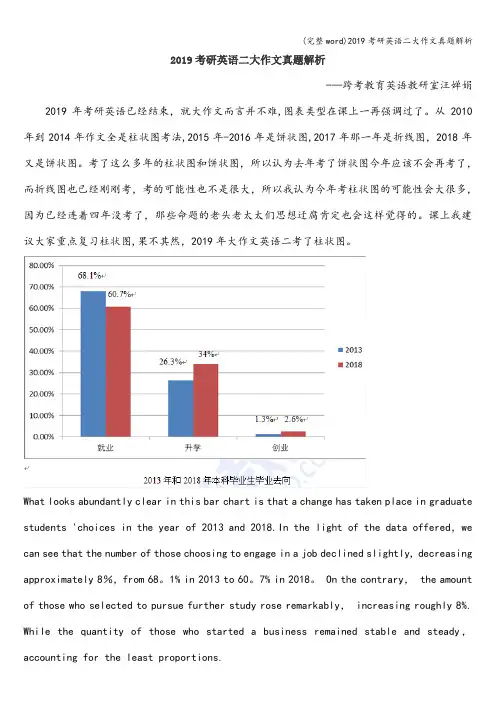
2019考研英语二大作文真题解析-—跨考教育英语教研室汪婵娟2019年考研英语已经结束,就大作文而言并不难,图表类型在课上一再强调过了。
从2010年到2014年作文全是柱状图考法,2015年-2016年是饼状图,2017年那一年是折线图,2018年又是饼状图。
考了这么多年的柱状图和饼状图,所以认为去年考了饼状图今年应该不会再考了,而折线图也已经刚刚考,考的可能性也不是很大,所以我认为今年考柱状图的可能性会大很多,因为已经连着四年没考了,那些命题的老头老太太们思想迂腐肯定也会这样觉得的。
课上我建议大家重点复习柱状图,果不其然,2019年大作文英语二考了柱状图。
What looks abundantly clear in this bar chart is that a change has taken place in graduate students 'choices in the year of 2013 and 2018.In the light of the data offered,we can see that the number of those choosing to engage in a job declined slightly, decreasing approximately 8%, from 68。
1% in 2013 to 60。
7% in 2018。
On the contrary, the amount of those who selected to pursue further study rose remarkably, increasing roughly 8%. While the quantity of those who started a business remained stable and steady,accounting for the least proportions.It is of no difficulty for us to come up with some factors responsible for these changes。
2019英语二大小作文真题详细解析
2019考研英语二大小作文真题详细解析——跨考教育英语教研室李波2019级考研英语二结束之后,我看到大家发的状态非常好,这也反映出了今年英语二试卷的难易程度。
整体来看,英语二的试卷偏向于简单,写作也是如此。
横向与英语一对比,英语二试卷比英语一简单太多,纵向和历年真题对比,今年的英语二试卷也是比较简单的。
下面跨考教育英语教研室李波老师全面给大家解析英语二的大小作文。
首先,小作文。
今年英语二小作文的题目是:Suppose Professor Smith asked you to plan a debate on the theme of city traffic. Write him an email to 1)Suggest a specific topic with your reasons, and 2)Tell him about your arrangements. 对于这个题目而言,大家会觉得很熟悉,因为,考查的是电子邮件,电子邮件的写法和书信的写法一样。
但是,大家又会觉得非常陌生,因为这个这种类型的书信平时大家很少写。
尤其是有些同学不认识debate这个单词,那就麻烦啦,这个词今年已经上了微博热搜了。
那么,这种介绍信到底该怎么写呢?其实不难!这个辩论赛的安排与活动类的通知很相似。
按照书信的基本结构,分成三段来写。
第一段写写3句话。
第一句是背景介绍。
这个背景是一定要写的,要不然直接写写信目的话会感觉很唐突。
背景介绍这样写:很高兴收到这个辩论赛策划的任务。
第二句是写信目的。
写信目的是每篇书信小作文中都必须写的。
写信目的这样写:我写这封信的目的是提出这个关于交通辩论赛的主题,即交通的堵塞与疏通。
第三句写选这个主题的原因,可以这样写:交通堵塞是目前城市中很严重的问题,选择这个主题对选手们很容易发挥,一定会非常精彩。
第二段大概写4句话。
第一句是段落主题句。
所谓段落主题句就是统领这一段,主旨句可以这样写:此次辩论赛具体安排如下。
2019考研英语二真题及参考答案解析-启航考研
2019全国研究生考试英语二真题及参考答案解析Section I Use of EnglishDirections:Read the following text. Choose the best word(s) for each numbered blank and mark A, B, C or D on the ANSWER SHEET. (10 points)Weighing yourself regularly is a wonderful way to stay aware of any significant weight fluctuations. 1 , when done too often, this habit can sometimes hurt more than it 2 . As for me, weighing myself every day caused me to shift my focus from being generally healthy and physically active to focusing 3 on the scale. That was bad to my overall fitness goals. I had gained weight in the form of muscle mass, but thinking only of 4 the number on the scale, I altered my training program. That conflicted with how I needed to train to 5 my goals.I also found weighing myself daily did not provide an accurate 6 of the hard work and progress I was making in the gym. It takes about three weeks to a month to notice significant changes in weight 7 altering your training program. The most 8 changes will be observed in skill level, strength and inches lost.For these 9 , I stopped weighing myself every day and switched to a bimonthly weighing schedule 10 . Since weight loss is not my goal, it is less important for me to 11 my weight each week. Weighing every other week allows me to observe and 12 any significant weight changes. That tells me whether I need to 13 my training program.I also use my bimonthly weigh-in 14 to get information about my nutrition as well. If my training intensit y remains the same, but I’m constantly 15 and dropping weight, this is a 16 that I need to increase my daily caloric intake.The 17 to stop weighing myself every day has done wonders for my overall health, fitness and well-being. I am experiencing increased zeal for working out since I no longer carry the burden of a 18 morning weigh-in. I’ve also experienced greater success in achieving my specific fitness goals, 19 I’m training according to those goals, instead of numbers on a scale.Rather than 20 over the scale, turn your focus to how you look, feel, how your clothes fit and your overall energy level.1. A. Therefore B. Otherwise C. However D. Besides2. A. Cares B. warns C. reduces D. helps3. A. Solely B. occasionally C. formally D. initially4. A. Lowering B. explaining C. accepting D. recording5. A. Set B. review C. reach D. modify6. A. Depiction B. distribution C. prediction D. definition7. A. Regardless of B. aside from C. along with D. due to8. A. Rigid B. precise C. immediate D. orderly9. A. judgments B. reasons C. methods D. claims10. A. Though B. again C. indeed D. instead11. A. Track B. overlook C.conceal D. report12. A. Approval of B. hold onto C. account for D. depend on13. A. Share B. adjust C. confirm D. prepare14. Features B. rules C. tests D. results15. A. Anxious B. hungry C. sick D. bored16. A. Secret B. belief C. sign D. principle17. A. Necessity B. decision C. wish D. request18. A. Surprising B. restricting C. consuming D. disappointing19. A. Because B. unless C. until D. if20. A. Dominating B. puzzling C. triumphing D. obsessingSection II Reading ComprehensionPart ADirections:Read the following four texts. Answer the questions after each text by choosing A, B, C or D. Mark your answers on the ANSWER SHEET. (40 points)Text 1A few years ago, researchers in Germany set out to plumb the moral consciences of small children. They invited a series of 2- and 3-year-olds to play with a marble track in a lab. Close to the track—inauspiciously close—was a block tower that one of the adult experimenters claimed to have painstakingly constructed. Just before turning her back, she asked them not to damage it. Needless to say, the game was rigged. After a few runs, a marble would knock over part of the tower, at which point the experimenter responded with what the resulting journal article described as a “mildly sad” tone. “Oh no,” she would say, then ask what had happened. In some versions of the experiment, the child seemed to be to blame; in others, an adult who was helping with the experiment toppled the tower. The kids’ reactions revealed a lot about how social-emotional development progresses during these key years. While many of the 2-year-olds seemed sympathetic to the researcher’s plight, the 3-year-olds went beyond sympathy. When they believed that they’d caused the accident, they were more likely than the 2-year-olds to express regret and try to fix the tower. In other words, the 3-year-olds’ behavior varied depending on whether they felt responsible.Their actions, according to Amrisha Vaish, the University of Virginia psychology researcher who led the study, de monstrate “the beginnings of real guilt and real conscience.” Vaish is one of a number of scholars studying how, when, and why guilt emerges in children. Unlike so-called basic emotions such as sadness, fear, and anger, guilt emerges a little later, in con junction with a child’s growing grasp of social and moral norms. Children aren’t born knowing how to say “I’m sorry”; rather, they learn over time that such statements appease parents and friends—and their own consciences. This is why researchers generally regard so-called moral guilt, in the right amount, to be a good thing: A child who claims responsibility for knocking over a tower and tries to rebuild it is engaging in behavior that’s not only reparative but also prosocial.In the popular imagination, o f course, guilt still gets a bad rap. It evokes Freud’s ideas and religious hang-ups. More important, guilt is deeply uncomfortable—it’s the emotional equivalent of wearing a jacket weighted with stones. Who would inflict it upon a child? Yet this understa nding is outdated. “There has been a kind of revival or a rethinking about what guilt isand what role guilt can serve,” Vaish says, adding that this revival is part of a larger recognition that emotions aren’t binary—feelings that may be advantageous in one context may be harmful in another. Jealousy and anger, for example, may have evolved to alert us to important inequalities. Too much happiness (think mania) can be destructive.And guilt, by prompting us to think more deeply about our goodness, can encourage humans to atone for errors and fix relationships. Guilt, in other words, can help hold a cooperative species together. It is a kind of social glue.Viewed in this light, guilt is an opportunity. Work by Tina Malti, a psychology professor at the University of Toronto, suggests that guilt may compensate for an emotional deficiency. In a number of studies, Malti and others have shown that guilt and sympathy (and its close cousin empathy) may represent different pathways to cooperation and sharing. Some kids who are low in sympathy may make up for that shortfall by experiencing more guilt, which can rein in their nastier impulses. And vice versa: High sympathy can substitute for low guilt.In a 2014 study, for example, Malti and a colleague looked at 244 children, ages 4, 8, and 12. Using caregiver assessments and the children’s self-observations, they rated each child’s overall sympathy level and his or her tendency to feel negative emotions (like guilt and sadness) after moral transgressions. Then the kids were handed stickers and chocolate coins, and given a chance to share them with an anonymous child. For the low-sympathy kids, how much they shared appeared to turn on how inclined they were to feel guilty. The guilt-prone ones shared more, even though t hey hadn’t magically become more sympathetic to the other child’s deprivation.“That’s good news,” Malti says. “We can be prosocial because of our empathetic proclivity, or because we caused harm and we feel regret.”Malti describes guilt as a self-directed emotion, elicited when you act in a way that’s out of keeping with your conscience. Sympathy and empathy are other-directed. A child who isn’t inclined to feel bad for a classmate whose toy car she stole might nevertheless feel uncomfortable with the idea of herself as a thief—and return the toy. Guilt can include sympathy, Malti says, but it doesn’t have to. She’s agnostic about which of the two paths children take, so long as they treat one another well.This is a provocative idea at a moment when parents and educators have come to almost fetishize empathy—when a child’s ability to put herself in another’s shoes seems like the apex of goodness. Parents encourage children to consider how their peers feel when they don’t share their toys. Presc hool teachers instruct students to consider one another “friends,” implying that good behavior is predicated on affection. Elementary schools base anti-bullying curricula around altruistic concepts like love and kindness.When it comes to helping kids mana ge relationships and tamp down aggression, “schools and programs have almost exclusively focused on empathy promotion,” Malti says. “I think it’s incredibly important to nurture empathy, but I think it’s equally important to promote guilt.”If you still fi nd the idea of guilting your child unpalatable, keep in mind that we’re talking about a very specific kind of guilt. This is not telling your child that her disobedience proves she’s unworthy, or describing how painful it was to give birth to her. This is not pressuring your grown son or daughter to hurry up and have babies before you die. In short, this is not your grandmother’s guilt-trip.You don’t want a child to feel bad about who she is (that’s called shaming) or responsible forthings outside her control (which can give rise to maladaptive or neurotic guilt; see the child who feels guilty for her parents’ divorce). Malti points out that a child’s age and disposition are also important considerations; some may be temperamentally guilt-prone and require a lighter touch. The point is to encourage both goodness and resilience. We all make mistakes, and ideally we use them to propel ourselves toward better behavior.Proper guilting connects the dots between your child’s actions and an outcome—without suggesting anything is wrong or bad about her—and focuses on how best to repair the harm she’s caused. In one fell swoop it inspires both guilt and empathy, or what Martin Hoffman, an emeritus professor at NYU known for his extensive work on empathy, has termed “empathy-based guilt.” Indeed, you may already be guilting your child (in a healthy way!) without realizing it. As in: “Look, your brother is crying because you just threw his Beanie Boo in the toilet.” Hopefully, the kid is moved to atone for her behavior, and a parent might help her think through how to do that.Work by Renee Patrick, a psychology professor at the University of Tampa, shows that it’s important for parents to express themselves in a warm and loving way: A parent who seems chastising or rejecting can induce anxiety in a child, and do nothing to encourage healthy behavior. Patrick’s work also shows that kids whose parents used a strategy intended to elicit “empathy-based guilt” during their adolescence tended to see moral concepts like fairne ss and honesty as more central to their sense of themselves. (A related technique that’s been found effective in adolescents involves what Patrick calls “parental expression of disappointed expectations”—which is as harrowing as it sounds.)Joan Grusec, a psychologist and researcher in parenting and children’s development, and a colleague of Malti’s at the University of Toronto, says it’s important to make the what-you-can-do-about-it part a discussion between parent and child, instead of a sermon. Forcing a child to behave morally may prevent her from internalizing the lesson you’re trying to impart. And, she says, such a conversation may work better “once everybody has simmered down,” rather than in the heat of a dispute. She points to research on what aca demics call reminiscence, which suggests that discussing a transgression after the fact may better help children understand what they did wrong.Of course, knowing when to feel bad and what to do about it are things we could all benefit from. Malti’s resea rch may focus on kids, but guilt is a core human emotion—an inevitability for people of every age. And she believes that it has the potential to be especially helpful now, in a world that is growing more divided and atomized.She argues that guilt may have the ability to bring us together, not despite but because of its focus on the self. The proposition is radical. What if the secret to treating one another better is thinking about ourselves not less, but more?21. Researchers think that guilt can be a good thing because it may help__________.A. regulate a child’s basic emotionsB. improve a child’s intellectual abilityC. intensify a child’s positive feelingsD. foster a child’s moral development22. According to Paragraph 2, many people still guilt to be _________.A. deceptiveB. addictiveC. burdensomeD. inexcusable23. Vaish holds that the rethinking about guilt comes from an awareness that________.A. an emotion can play opposing rolesB. emotions are socially constructiveC. emotional stability can benefit healthD. emotions are context -independent24. Malti and others have shown that cooperation and sharing_______.A. may help correct emotional deficienciesB. can bring about emotional satisfactionC. can result from either sympathy or guiltD. may be the outcome of impulsive acts25. The word “transgressions” (line4 para5) is closest in meaning to________.A. wrongdoingsB. discussionsC. restrictionsD. teachingsText 2Forests give us shade, quiet and one of the harder challenges in the fight against climate change. Even as we humans count on forests to soak up a good share of the carbon dioxide we produce, we are threatening their ability to do so. The climate change we are hastening could one day leave us with forests that emit more carbon than they absorb.Thankfully, there is a way out of this trap—but it involves striking a subtle balance. Helping forests flourish as valuable "carbon sinks" long into the future may require reducing their capacity to sequester carbon now. California is leading the way, as it does on so many climate efforts, in figuring out the details.The state's proposed Forest Carbon Plan aims to double efforts to thin out young trees and clear brush in parts of the forest, including by controlled burning. This temporarily lowers carbon-carrying capacity. But the remaining trees draw a greater share of the available moisture, so they grow and thrive, restoring the forest's capacity to pull carbon from the air. Healthy trees are also better able to fend off bark beetles. The landscape is rendered less combustible. Even in the event of a fire, fewer trees are consumed.The need for such planning is increasingly urgent. Already, since 2010, drought and beetles have killed more than 100 million trees in California, most of them in 2016 alone, and wildfires have scorched hundreds of thousands of acres.California's plan envisions treating 35,000 acres of forest a year by 2020, and 60,000 by 2030 —financed from the proceeds of the state's emissions-permit auctions. That's only a small share of the total acreage that could benefit, an estimated half a million acres in all, so it will be important to prioritize areas at greatest risk of fire or drought.The strategy also aims to ensure that carbon in woody material removed from the forests is locked away in the form of solid lumber, burned as biofuel in vehicles that would otherwise runon fossil fuels, or used in compost or animal feed. New research on transportation biofuels is under way, and the state plans to encourage lumber production close to forest lands. In future the state proposes to take an inventory of its forests' carbon-storing capacity every five years. State governments are well accustomed to managing forests, including those owned by the U.S. Forest Service, but traditionally they've focused on wildlife, watersheds and opportunities for recreation. Only recently have they come to see the vital part forests will have to play in storing carbon. California's plan, which is expected to be finalized by the governor early next year, should serve as a model.26. “One of the harder challenges” implies ___A. global climate change may get out of controlB. forests may become a potential threatC. people may misunderstand global warmingD. extreme weather conditions may arise27. To maintain forests as valuable "carbon sinks", we may need to _A.preserve diversity of speciesB. lower their present carbon-absorbing capacityC. accelerate the growth of young treesD. strike a balance among different plants28.California's Forest Carbon Plan endeavors to ___A. restore its forests quickly after wildfires.B. cultivate more drought resistant trees.C. find more effective ways to kill insectsD. reduce the density of some of its forests29. What is essential to California's plan according to para. 5?A. To obtain enough financial supportB. To carry it out before 2020C. To handle the areas in the serious danger firstD. To perfect the emission-permit auctions30.the author's attitude toward California's plan can be best described as ____A. supportiveB. ambiguousC. tolerantD. cautiousText3American farmers have been complaining of labor shortages for several years now. The complaints are unlikely to stop without an overhaul of immigration rules for farm workers.Efforts to create a more straightforward agricultural-workers visa that would enable foreign workers to stay longer in the U.S. and change jobs within the industry have so far failed in Congress. If thisdoesn't change, American businesses, communities and consumers will be the losers.Perhaps half of U.S. farm laborers are undocumented immigrants. As fewer such workers enter the U.S., the characteristics of the agricultural workforce are changing. Today's farm laborers, while still predominantly born in Mexico, are more likely to be settled, rather than migrating, and more likely to be married than single. They are also aging. At the start of this century, about one-third of crop workers were over the age of 35. Now, more than half are. And crop picking is hard on older bodies.One oft-debated cure for this labor shortage remains as implausible as it has been all along: Native U.S. workers won't be returning to the farm.Mechanization is not the answer either----not yet at least. Production of corn, cotton, rice, soybeans and wheat have been largely mechanized, but many high-value, labor-intensive crops, such as strawberries, need labor. Even dairy farms, where robots currently do only a small share of milking, have a long way to go before they are automated.As a result, farms have grown increasingly reliant on temporary guest workers using the H-2A visa to fill the gaps in the agricultural workforce. Starting around 2012, requests for the visas rose sharply; from 2011 to 2016 the number of visas issued more than doubled.The H-2A visa has no numerical cap, unlike the H-2B visa for nonagricultural work, which is limited to 66,000 annually. Even so, employers frequently complain that they aren't allotted all the workers they need. The process is cumbersome, expensive and unreliable. One survey found that bureaucratic delays led H-2A workers to arrive on the job an average of 22 days late. And the shortage is compounded by federal immigration raids, which remove some workers and drive others underground.In effect, the U.S. can import food or it can import the workers who pick it. The U.S. needs a simpler, streamlined, multi-year visa for agricultural workers, accompanied by measures to guard against exploitation and a viable path to U.S. residency for workers who meet the requirements. Otherwise growers will continue to struggle with shortages and uncertainty, and the country as a whole will lose out.31. What problem should be addressed according to the first two paragraphs?A. Discrimination against foreign workers in the U.S.B. Biased laws in favor of some American businesses.C. Flaws in U.S. immigration rules for farm workersD. Decline of job opportunities in U. S. agriculture32. One trouble with U.S. agricultural workforce is ?A. the rising number of illegal immigrantsB. the high mobility of crop workersC. the lack of experienced laborersD. the aging of immigrant farm workers33. What is the much-argued solution the labor shortage in U.S. farming?A. To attract younger laborers to farm work.B. To get native U.S. workers back farmingC. To use more robots to grow high-value cropsD. To strengthen financial support for farmers.34. Agricultural employers complain about the H-2A visa for itsA .slow granting proceduresB. limit on duration of stayC. tightened requirementsD. control of annual admissions35. Which of the following could be the best title for this text?A. U.S. Agriculture in Decline?B. Import Food or Labor?C. America Saved by Mexico?D. Manpower VS. Automation?Text 4Arnold Schwarzenegger, Dia Mirza and Adrian Grenier have a message for you: It’s easy to beat plastic. They’re part of a bunch of celebrities staring in a new video for World Environment Day-encouraging you, the consumer, to s your single-use Plastic staples to combat the plastic crisis.If only I’d realized that we can buy our way out of the problem except we can’t.The key messages that have been put together for World Environment Day do include a call for governments to enact legislation to curb single-us plastics. But the overarching message is directed at individuals: Lead with your wallets.The problem of perpetuating this individualistic narrative is that it's not going to get us very far and the plastics crisis we face is immense. Our oceans are blighted by the stuff. It's in our drinking water (including bottled water), and we could even be breathing it in.I'm not dismissing individual actions like ordering straw-free drinks at bars, or opting for a reusable water bottle over a cup that's going in the trash as soon as you've used it. I can't imagine not at least trying to minimize my own plastics footprint, whether it's lugging home my newly-refilled gallon bottle of washing-up liquid every few months, or buying packaging-free food, clothing and toiletries where possible.On their own, however, none of these things is enough.Part of my worry about leaving it up to the individual is that we're all just guessing at what's going on out there-and that's if we haven't been scared off from doing anything to start with in the face of such a huge challenge. As consumers, we have little idea about how much plastic has been used and discarded along the supply chain, for example. It's also hard to compare, say, going to a bulk store that sells plastic-free products but requires you to drive some distance versus a more Iccal shop where you may end up taking home some packaged items.There’s also a time and cost issue. Realistically, I'm not going to start making my own laundry detergents so I can avoid the plastic bottles they come in, and there can be extra costs associated with environmentally friendly products.My biggest concern with leaving it up to the individual, however, is our limited sense of what needs to be achieved On their own, taking our own bags to the grocery store or quitting plasticstraws, for example, will accomplish little and require very little of us. They could even be detrimental, satisfying a need to have "done our bit" without ever progressing onto bigger, bolder, more effective actions---a kind of "moral licensing" that allays our concerns and stops us doing more and asking more of those in charge.While the conversation around our environment and our responsibility toward it remains centered on shopping bags and straws, we're ignoring the balance of power that implies that as "consumers" we must shop sustainably, rather than as "citizens" hold our governments and industries to account to push for real systemic change. Nowhere in World Environment Day 2018's key messages is there anything about voting for environmentally progressive politicians, for example. Why not?It’s important to acknowledge that the environment isn’t everyone’s priority-or even most people’s. We shouldn’t expect it to be .In her latest book, Why Could People Do Bad Environmental Things, Wellesley College professor Elizabeth R. De Sombre argue that the best way to collectively change the behavior of large numbers of people is for the change to be structural.This might mean implementing policy such as a plastic tax that adds a cost to environmentally problematic action, or banning single-use plastics altogether. India has just announced it will” eliminate all single-use plastic in the country by 2022.” Ther e are also incentive-based ways of making better environmental choices easier, such as ensuring recycling is at least as easy as trash disposal.De Sombre isn’t saying people should stop caring about the environment. It’s just that individual actions are too slow, she says, for that to be only, or even primary, approach to changing widespread behavior.None of this is about writing off the individual. It’s just about putting things into perspective. We don’t have time to wait. We need progressive policies t hat shape collective action (and rein in polluting business), alongside engaged citizens pushing for change. That’s not something we can buy.36. Some celebrities star in a new video toA. demand new laws on the use of plasticsB. urge consumers to cut the use of plasticsC. invite public opinion on the plastics crisisD. disclose the causes of the plastics crisis37. The author is concerned that “moral licensing” mayA. mislead us into doing worthless thingsB. prevent us from making further effortsC. weaken our sense of accomplishmentD. suppress our desire for success38. By pointing out our identity as “citizens,” the author indicates thatA. our focus should be shifted to community welfareB. our relationship with local industries is improvingC. we have been actively exercising our civil rightsD. We should press our governments to lead the combat39. De Sombre argues that the best way for a collective change should beA. a win-win arrangementB. a self-driven mechanismC. a cost- effective approachD. a top down process40. The author concludes that individual effortsA. can be too aggressiveB. are far from sufficientC. can be too inconsistentD. are far from rationalPart BDirections: you are going to read a list of headings and a text, choose the most suitable heading from the list A-G for each numbered paragraph (41-45). There are two extra choices in the right column. Mark your answers on ANSWER SHEET.(10 points)How seriously should parent take kid’s opinions when searching for a home?In choosing a new home, Camille Mc Clain’s kids have a single demand a backyard.That seemingly reasonable request turned the Chicago family’s home hunt upside down, as th ere weren’t many three-bedroom apartments on the North Side — where the family was looking —that came with yard space. Still, McClain and her husband chose to honor their 4- and 6-year-old’s request.“We worked with a few apartment brokers, and it was st range that many of them didn’t even know if there was outdoor space, so they’d bring us to an apartment, we’d see that it didn’t have a yard, and we’d move on,” said McClain, who runs Merry Music Makers in Lakeview, a business focused on music education for children.McClain’s little ones aren’t the only kids who have an opinion when it comes to housing, and in many cases youngsters’ views weigh heavily on parents’ real estate decisions, according to a 2018 Harris Poll survey of more than 2,000 U.S. adults.Renters paid attention to their kids’ preferences even more: 83 percent said their children’s opinions will be a factor when they buy a home.The idea of involving children in a big decision is a great idea because it can help them feel a sense of control and ownership in what can be an overwhelming process, said Ryan Hooper, clinical psychologist in Chicago.“Children may face serious difficulties in coping with significant moves, especially if it removes。
2019年考研英语(二)作文试题评析
2019年考研英语(二)作文试题评析作者:贾从永来源:《英语世界》2019年第12期Directions:Suppose Professor Smith asked you to plan a debate on the theme of city traffic. Write him an email to1) suggest a topic with your reasons, and2) tell him your arrangement.You should write about 100 words neatly on the ANSWER SHEET. Do not use your own name at the end of the email. Use “Zhang Wei” instead. (10 points)2019年考研英語(二)的小作文假设史密斯教授请你为主题是城市交通的辩论会做个计划,要求你给他写一封电子邮件,为辩论会建议一个话题并说明理由,同时告知活动安排。
电子邮件的格式与书信相同,也是从称呼写起。
这封邮件的称呼可以写Dear Prof. Smith。
称呼要顶格写,后面用逗号。
这封邮件的正文可以写成三段。
第一段表明写这封邮件的目的:就这次辩论会的话题提出自己的建议,并告知活动安排。
第二段依次完成题目中规定的两个交际任务:先就辩论会的话题提出建议并说明理由;然后对这次辩论会的时间、地点、主办方等做出安排。
第三段是一些客套话,先希望史密斯教授觉得自己的建议符合实际,然后表示自己愿意和他就此事详谈。
结尾段虽然没有实质性内容,却不可或缺,因为它可以使书信结构完整,同时显得恭敬有礼。
书信的最后是署名,写在正文下方中间偏右的位置,分两行书写,上一行可写Yours sincerely,下一行写Zhang Wei,上下对齐。
下面请看参考范文:Dear Prof. Smith,I am writing to offer my suggestion on the topic of the debate on city traffic and inform you of my arrangement of the event.My suggested topic of the debate is “A better choice for city commuters: private cars or the public transport system?”. I believe this topic will be of interest to most students who value freedom and privacy but who are faced with increasingly heavy traffic. The debate will be held in the auditorium on campus on April 22nd under the auspices of the Debate Club of our university.I hope you will find my suggestion practical. I’m ready for discussing this matter with you in detail.Yours sincerely,Zhang Wei (118 words)Directions:Write an essay based on the following chart. In your essay, you should1) interpret the chart, and2) give your comments.You should write about 150 words neatly on the ANSWER SHEET. (15 points)2019年考研英语(二)的大作文继续考图表作文,而且是继2010、2011、2013、2014年之后第五次考柱状图。
2019年考研英语二text4
主题:2019年考研英语二text4分析和解读一、文章概述2019年考研英语二text4是一篇关于世界经济格局的文章,主要论述了美国和我国在全球经济中的地位和影响力。
文章通过对比美国和我国的政治、经济、文化等多个方面的数据和现实情况,揭示了美中两国在全球经济中的竞争与合作关系,以及对其他国家的影响力。
二、文章主要内容分析1. 主题和中心思想文章围绕美国和我国在全球经济中的角色展开,探讨了两国在政治、经济、文化等方面的竞争与合作关系。
主要思想是通过对比分析,揭示出美中两国在全球经济格局中的地位和影响力。
2. 重点论述文章首先分析了美国和我国在国际政治舞台上的地位和作用,包括对其他国家的影响力、全球治理中的角色等。
对比了两国在经济发展、贸易关系、科技创新等方面的数据和情况,探讨了美中两国在全球经济中的竞争与合作关系。
文章还涉及了美中两国在文化交流、国际合作等方面的情况,展示了两国在全球影响力的不同方面。
三、文章结构分析1. 开篇引出主题文章在开篇引出了美国和我国在全球经济中的地位和影响力,引发读者对这一主题的关注。
2. 逐段论述文章在逐段论述中,按照政治、经济、文化等方面逐一进行对比分析,充分展现了美国和我国在全球经济中的不同特点和影响力。
3. 总结结尾文章在结尾部分对全文进行总结,并对美中两国的竞争与合作关系进行了展望和评价。
四、文章语言特点1. 用词准确文章运用了大量准确的政治、经济术语,并且语言严谨、正式。
2. 逻辑清晰文章的结构合理,逻辑清晰,可以很好地引导读者阅读和理解。
3. 言之有物文章不只是空谈理论,而是通过大量的数据和实例来证明观点,言之有物。
五、文章阅读体验1. 正式客观文章语气严谨、客观,没有夸大其词,给人以信服的感觉。
2. 流畅易读文章结构合理,用词准确,逻辑清晰,读起来很流畅,易于理解和消化。
3. 延展价值文章指出了美中两国在全球经济中的角色和影响力,对于了解国际政治经济格局有重要的参考价值。