
仁爱版七年级英语下册 Unit 5 Topic 1 section A 同步练习
仁爱版七下Unit1—Topic 1 习题
一、根据句意及首字母或汉语提示完成句子
1. I usually come to school by __________(地铁).
2. The early bird _________(抓住)the worm.
3.Classes _________(开始)at eight .
4. She often does her homework then ______ _____(看电视)for a short time.
5. Li Xiang often r_____ a bike to school.
6. Helen s______ walk to school. She often come by subway.
7.I often come to school ___ _______(步行) .
8.I often go to the l_____ ______ (一次)a week.
9.What do they usually do ___ ____ ___ _____ (在他们空闲的时候)?
10.Maria ______(有时)takes the bus home .
二、单项选择
( )1.Happy New Year!
--____________________.
A .Thanks B. Yes C .The same to you D. The same to me
( ) 2.How _____ Maria come to school?
A .do B. does C. are D .is
( )3.They usually come to the library _____ foot.
A .on B. by C. to D. with
( ) 4. Kangkang meets Jane and Helen at _____school gate.
A. a
B. /
C. an
D. the
( ) 5. ____ ______ do you go to the Great Wall?
---Once a year.
A. How about
B. How often
C. What time
D. How much
( )6.____ ____ do you usually get up on weekend?
---At about six o’clock.
A. How often
B. How much
C. What time
D. How old
( )7. He seldom _____ the subway home.
A. takes
B. goes
C. take
D. go
( )8. ___ _____,she often plays football with her classmates.
A. On school
B. In school
C. After school
D. After home
( )9. Helen goes to school at ____ ____ ______.
A. half seven
B. half past seven
C. half to seven
D. seven past half ( )10. Tom often watches TV ___ a short time.
A. for
B. at
C. with
D. on
三、翻译
1. 新年快乐!
!
2. 她在七点十五坐地铁回家。
She home at a quarter past seven.
3. 珍妮通常在六点二十起床。
Jane at six twenty.
4. Sally 经常乘飞机旅游。
Sally often travels _____ _________.
5. Michael 通常走路去学校,但是有时候骑自行车去。
Michael usually ____ to school but _____ _____ by bike.
四、句型转换
1.He goes to the park with his parents once a week.(对画线部分提问)
____ he go to the park with his parents?
2. Wen Wei seldom goes to the park after school.(对画线部分提问)
_____ ____ Wen Wei ______ after school?
3. She always goes home by bus.(对画线部分提问)
she always go home?
4. He often drives a car to the park for a picnic on Sundays.(改为同义句)
He often ______ to the park for a picnic on Sundays ____ _____.
5.They sometimes go to the library by bike.(改为同义句)
They sometimes ____ ____ _____ to the library.
6.You never take the subway to the school,_____ _________?(改为反义疑问句)参考答案:
一、根据句意及首字母提示完成单词
1.subway 我通常坐地铁去上学。
短语by subway
2.catches 早起的鸟儿有虫吃。
注意同三单主语一致
3. begin 八点开始上课。
主语是复数
4. watches TV 她经常做作业然后看一会电视。
短语watch TV ,且注意谓语与三单主语一致
5.rides 李翔经常骑自行车去上学。
短语ride a bike ,且谓语与三单主语一致
6. seldom Helen 很少走路去上学。
她经常坐地铁去。
句意可知
7. on foot 我经常步行上学。
短语on foot
8. library; once 我经常一周去一次图书馆。
句意可知library和once
9.in their free time 他们在空闲的时候通常做什么?短语in one’s free time
10.sometimesMaria 有时候坐公交车回家。
句意可知
二、单项选择
1——5:CBCDB
6——10:CBCBA
四、句型转换
1.How ;often; does
2.Where; does; go
3.How; does
4.goes; by; car
5.take; the ;bike
6.do; you。
七年级英语(仁爱版)下册 Unit-5-Topic-1 知识点总结语言点归纳
知识点七年级英语(仁爱版)下册Unit-5-Topic-1语言点归纳Unit 5 Topic 1I 重点词汇和短语gate, by, always, plane, train, ship, boat, Ms., grandmother, group, weekday, early, bird, catch, seldom, walk, never, sometimes, ride, park, watch, TV, homework, life, American, or, few, day, rest, play, basketball, swim, ball, game, read, listen, library, once, twice, week, every, must, first, music, begin, while, wall, bed.the same to, come on, on foot, by plane, know about, for a while, watch TV, do (one’s) homework, have lunch, at school, have a rest, be different from, go swimming, listen to, go to bed, go to school, have classes.II 语言点Section A1. a) ---Happy New Year! ---- The same to you! / You, too. 新年快乐!也祝你新年快乐!b) ----Happy birthday! -----Thank you! 生日快乐!谢谢!2. How about you? = What about you? 你怎么样?3. Oh, your new bike looks very nice! 哦,你的新自行车看起来很好看。
Unit 5 Topic 1 Section D(25页)仁爱版七年级下册英语课件

Homework
1. Review the words, phrases and sentences. 2. Review adverbs and phrases of frequency. 3. Talk about the school life of your classmates. 4. Finish exercises of Unit 5 Topic 1 Section D.
If you are the interviewer, what questions will you ask?
Example: How many classes do you have in a day? What time do you usually get up? What time do you usually go to bed?
and find out more.
“
Interviewer: Good evening, boys and girls! Please welcome our new friend, Michael. He’s from America. Hello, Michael! Michael: Hello! Interviewer: We’d like to know about the school life of American students. How do they usually go to school? Michael: Well, many students usually take a yellow school bus or walk to school. Interviewer: Where do they usually have lunch? Michael: They usually have lunch at school and then begin class at about one o’clock in the afternoon. Interviewer: What time is school over, then? Michael: At about three o’clock. Interviewer: What do they do in their free time? Michael: They often play basketball and soccer. Interviewer: Well, I’m sorry we have no more time. Nice talking to you. Thank you.
七下仁爱版英语u5t1sa课文
七下仁爱版英语u5t1sa课文In the seventh grade Ren'ai edition English textbook, unit 5, text 1, the story revolves around the theme of friendship and kindness. The text tells the story of a young girl named Amy who moves to a new school and is initially lonely and struggling to make friends. However, with the help of her kind and caring classmates, she eventually finds a sense of belonging and friendship.From the perspective of the protagonist, Amy, the story highlights the feelings of loneliness and insecurity that often accompany moving to a new environment. Amy's initial struggles to fit in and make friends are relatable to many students who have experienced similar challenges. However, as the story unfolds, Amy's experiences also demonstrate the power of kindness and compassion in overcoming adversity. Her classmates' willingness to reach out and include her serves as a heartwarming reminder of the impact of small acts of kindness.From the perspective of Amy's classmates, the text emphasizes the importance of empathy and inclusion. Amy's classmates demonstrate compassion and understanding by reaching out to her and making an effort to include her in their activities. Their actions showcase the positive impact of extending a hand of friendship to those in need. This perspective serves as a reminder to readers of the value of being inclusive and considerate towards others, especially those who may be feeling isolated or alone.From the perspective of the broader school community, the text highlights the significance of creating a welcoming and supportive environment for all students. The positive and inclusive atmosphere fostered by Amy's classmates reflects the collective effort of the school community to prioritize kindness and empathy. This perspective underscores the importance of promoting a culture of acceptance and understanding within educational settings, where students feel valued and supported.From a societal perspective, the text underscores the universal need for connection and belonging. Amy'sexperiences resonate with the broader human experience of seeking acceptance and friendship. The story serves as a reminder of the fundamental human desire for meaningful connections and the profound impact of kindness infostering a sense of community and belonging.In conclusion, the text from the seventh grade Ren'ai edition English textbook, unit 5, text 1, offers a poignant exploration of the themes of friendship and kindness from multiple perspectives. Through the experiences of the protagonist, Amy, and her classmates, the story underscores the significance of empathy, inclusion, and the positive impact of small acts of kindness. Furthermore, the text serves as a powerful reminder of the universal human need for connection and belonging, highlighting the transformative power of compassion and understanding in creating a supportive and inclusive community.。
(完整版)仁爱英语七年级下Unit_5_Topic1_练习题

Unit 5 Topic 1 SectionA 练习题一、单项选择1.Let’s meet ____ the school on foot.A. inB. toC. atD. for2.It ’s time ____ go to bed.A. oftenB. forC.onD.to3.Allen gets to New York ___.A. by the planeB. on planeC.by planeD.in plane4.It ’s time ____ supper.A. atB. forC. toD. on5. — _____ you often come to school on your bike?— ______ Yes, I _____.A. Do,doB. Are, areC.Does, doesD.Is, is6.— How do you usually come to school?— I usually come to school ____ foot.A. InB. byC. withD.on7. She looks_____. Ask her to help you.A. oldB. sorryC.wellD. kind8.— ____ do you usually go to school?— By bike.A.WhatB.WhenC.HowD.Which9.— Happy New Year!— ________ !A.Thank youB. Not at allC. The same to youD.You are welcome10. My bool is interesting._____ yours?A.What isB.Whose isC.How aboutD.What is like二、句型变换1.Tom usually drives to work. ( 变同义句 )Tom usually _____ ___________ ____________.2.我们中有五人骑自行车上学。
仁爱英语七年级下五单元topic1 知识点
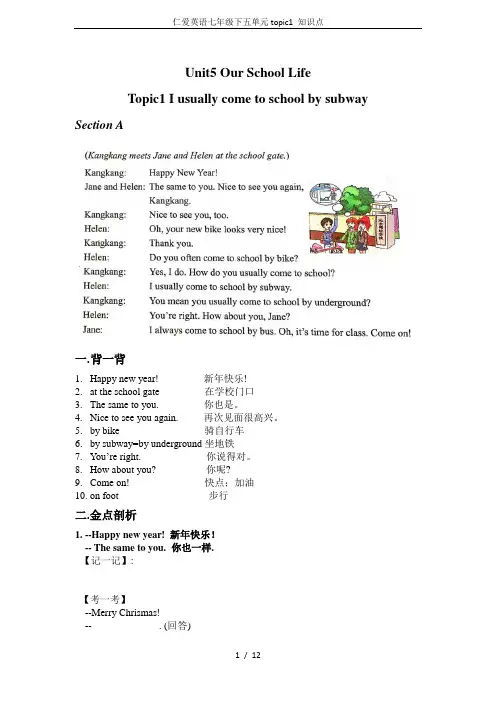
Unit5 Our School LifeTopic1 I usually come to school by subway Section A一.背一背1.Happy new year! 新年快乐!2.at the school gate 在学校门口3.The same to you. 你也是。
4.Nice to see you again. 再次见面很高兴。
5.by bike 骑自行车6.by subway=by underground坐地铁7.You’re right. 你说得对。
8.How about you? 你呢?e on! 快点;加油10.on foot 步行二.金点剖析1. --Happy new year! 新年快乐!-- The same to you. 你也一样.【记一记】:【考一考】--Merry Chrismas!-- _____________. (回答)2. Oh, your new bike looks very nice! 你的新车看起来很漂亮!【记一记】:拓展:look ____ 看look ____ 看上去像look ____ 照看【考一考】1. Ann’s mother is not at home. So Ann has to _________ her sister.2.Jim _______ his father. They both(都) have small eyes.3. Please _______ the photo! It’s wonderful.4. Your dress _____ very nice. May I have a look?A. watchB.seesC. looksD. shows3.--How do you usually come to school? 你平时怎么去上学?-- I usually come to school by subway.【记一记】:注意:① by,on, in 引导的短语在句中只能作状语,与go,come,get等连用。
Unit 5 Topic 1 Section B(22页)仁爱版七年级下册英语课件

Read 1a again and fill in the blanks.
Helen: Michael,what time do you usually _g_e_t _u_p__?(起床) Michael: I always get up _a_t about six o'clock. Helen: The early bird catches the worm. _H_o_w_do you usually come to school? Michael: I usually come to schoolo_n__fo_o_t, but _so_m__e_ti_m_e_sby bike. How about you ? Helen: I _s_e_l_d_o_m_ walk to school . I _o_f_t_en___ come by subway. What about you Sally? Sally: I _n_e_v_e_r _come to school by subway. I _a_lw__ay_s_ take a bus.
Hale Waihona Puke Activity watch TV in Frequency the afternoon
always
usually
often
sometimes
seldom
never
√
play soccer on Sundays
√
see a movie √
课堂总结
We learn: 1. some words: weekday, early, bird, catch, seldom, walk, never, ride, park, watch 2. some phrases: take a bus/car, do one’s homework watch TV, see a movie, play soccer 3. some sentences: The early bird catches the worm. I never come to school by subway.
仁爱英语七年级下Unit 5 Topic 1 Section A.B
1a Look, listen and say.
1.—Happy New Year! —The same to you. 2.—Do you often come to school by bike? —Yes, I do.
3.—How do you usually come to school? —I usually come to school by subway. 4.—It’s time for class.
2a. Study the example to understand the two ways of expressing the same meaning. Then fill in the blanks.
1a. Look, listen and say.
H: get up, on weekdays M: 6:00 H: early bird; how, go to school M: usually, on foot H: seldom, walk; often, by subway S: never, by subway; always, take a bus
for 4.—It’s time ___class.
We learn: 1. some words: gate, plane, train, ship, boat, by, always 2. some phrases: come on, on foot, by bike/car/bus/train/subway/plane/boat 3. some sentences: How do you usually come to school? I usually come to school by subway. We can: talk about the means of transportation. e.g. I often go to school by bike/bus.
Unit 5 Topic 1 Section A(29页)仁爱版七年级下册英语课件
02 新 课 讲 授
What are these?
bike
car
What are these?
subway/underground
bus
What are these?
boat
ship
骑自行车 by bike
(1) look“看起来,好像”,是系动词,后加形容词。 e.g. She looks very beautiful. 她看起来很漂亮。 (2) look 用作行为动词,表示“看”,当后面要跟宾语时,必须要跟介词at。 (3) look 还可以做名词,表示“外貌,长相”。 (4) 与look有关的短语: look at… =have a look at…看一看 look like 看起来像 look the same 看起来一样
I usually come to school by subway.
04 当 堂 检 测
一、根据句意及汉语提示,完成句子 1. Let’s meet at the school gate (大门口). 2. Look at that nice boat (小船). That’s my uncle’s. 3. Mr. Ge often goes to Canada by plane (飞机). 4. Do you usually come to Jinan by train (火车)? 5. Jim wants to go to Shanghai from Chongqing by ship (轮船).
Enjoy the பைடு நூலகம்ideo
Listen again and answer the questions.
七年级英语下册Unit5OurschoollifeTopic1IusuallycometoschoolbysubwaySectionB教案(新版)仁爱版
Unit 5 Our School LifeTopic 1 I usually come to school by subway.Section B一、教学目标1. 能根据已学语音、音标及发音规则,正确朗读下列词汇并运用于情景对话中:weekday, early, bird, catch, worm, sometimes, seldom, walk, never, ride, park, watch, TV, television, watch TV, soccer, football, movie, film2. 在Section A的基础上,复习交通方式,能正确运用always, usually, sometimes, seldom, often, never等频度副词,同时能用介词by加交通工具和动词短语两种不同方法来表示交通方式。
3. 在情景对话中,能够表达“日常的交通方式、某项活动的频度”等语言功能,如:1) I usually come to school on foot, but sometimes by bike.2) I seldom walk to school. I often come by subway.3) I never come to school by subway.4. 使学生明白早睡早起的重要性。
二、教学重点及难点在对话操练、两两问答、小组调查等活动中,学习用频度副词来进行日常活动频率的有关表达,同时还学习和操练用两种不同的表达(介词by加交通工具和动词短语)对交通方式进行问答及切换。
三、教学准备教师:教学课件;多媒体设备学生:课前预习四、相关资源五、教学过程Task 1Step 1 Warming-upFree talk1. Work in pairs based on the following structures.T: How do you usually come to school?S1: By bike.T: How do you usually go to the zoo?S2: By bus.2. Choose a few pairs to act them out.【设计意图】复习上节课所学知识点,培养学生口语表达能力。
仁爱版英语七年级下册 第五单元 知识点汇总
Unit5 Topic1Section A1.在学校大门口at the school gate2.来/去学校come/ go to school3.上课have class / have classes4.步行on foot骑自行车by bike坐公交by bus坐地铁by subway坐飞机by plane坐小汽车by car坐轮船by ship坐小船by boat坐火车by train5.该做某事了It’s time for sth./doing sth.=It’s time to do sth.6.加油,快点,来吧come onby +交通工具单数还可以替换成:in/on + a/an/the/one’s+交通工具单数(on foot除外)by car= in a car by bike=on his bikeby bus=on the bus by plane=on the planeby subway=on the subway by ship/boat=on the ship/boat by train= on the train 记忆小技巧:除了car是in,其他都是on;公共交通工具是the,其他的可以是a/an或所有格重点句子1. 你也一样The same to you.2. 你的新自行车看起来非常漂亮!谢谢!Your new bike looks very nice! Thank you.3. 你经常骑自行车来上学吗?Do you often come to school by bike?4. 你/他通常如何来上学?乘地铁。
How do/does you/he usually come to school?I/ He usually come/comes to school by subway.5. 你呢?How/ What about you?6. 该上课了。
It’s time for class.=It’s time for having class.=It’s time to have class.7. 他步行来上学。