
(完整版)闽教版四年级下册英语期末复习材料
(swim).
5. They
( fly ) a kite now.
6、The teachers
(clean) the doors now.
任务:背、默 P16-19 家长打勾并签名:
一、默写 U3:
What day is today? It ’s
(周三 ).
We That ’s right. I like
任务:背、默 P1-5
一、默写 U1: What do you
家长打勾并签名:
(经常) do every
(星期) ?
On
(周一) we
(升起) our
(国旗) .
We have a
(班会) on
(周二) .
We
(跳舞) in the
(操场) on
(周三) .
What do you often do on
2、
he go to work by bus ?
Yes, he
.
3.
she go school by car ?
No, she
.She goes
(步行 ).
4. How
she go to school?
She
to school by
(自行车 ).
任务:背、默 P36-39 家长打勾并签名:
一、默写 U2 PA:
It is
. Let ’ s our classroom.
Yang Ming is
on a
(椅子) .
He is c
the
(黑板)
Lily is c
the d
(书桌)
Julia is c
the c
(椅子)
Sally is c
the w
(窗户)
Wang Tao is c
the d
(周四) ?
We
(做运动) in the playground.
We
(把 ...弄干净) our classroom on
(周五) .
What do you o
do on
(周六) and
(周日) ?
I
(拉小提琴) on S
(周六) .
I
(踢足球) on S
(周日) .
二、默写出周日 ~周六的单词:
任务:背、默 P9-10 家长打勾并签名:
(今天早上 )。
We have a
(电脑课 )
day is today?
It ’s
(今天下午) . (周四 ).
三、写单词:
我们
穿着
窗户
获胜者
任务:背、默 P23-24 家长打勾并签名:
一、默写 U4 PA :
How
you
to school, Sally?
By
(小车 ).
BY
(校车)
How
Kate
clean _________ do _________ 三、翻译句子:
come
1、杨明正在跑步。
2、我们正在看电视。
3、王涛和杨明正在踢足球。
4、本正在骑自行车。
四、写单词:
手
马
母鸡
房子
任务:背、默 P11-12 家长打勾并签名:
一、 默写 U2 PB:
,boys and girls!
Our classroom is
(有一节数学课) this morning. (数学).But I
’m not (擅长) it.
(不要担心) . I can
(帮助) you.
It ’s very
(好) of you.
May I use your
(科学书 )?
Sure.
(给你 )。
to school?
She
to school
(步行 )
How
your mother go to
(工作 )?
She
to
(工作 ) by
(自行车 ).
二、用 do 或 does (1-7)、go 或 goes (8-10 )填空:
1 、-- How
your sister go to school?
2 、-- How
your father go to work?
3 、-- How
Yang Ling go to school?
4 、-- How
your teacher s go to school?
5 、-- How
Miss Chen go to school?
6 、-- How 7 、-- How
Sally and Julia go to school? your brothers go to school?
She’ s
.( 来自台湾 )。
D
she go to
(台湾 ) by
(飞机 )?
No, she
.
She goes by
(轮船 )。
(台湾 ) is a 二、写单词:
(美丽的地方 )。
故事
图书馆
开心的
聚会
北京
上海
伦敦
表(堂)兄弟姐妹
三、填空:
1、
do you go to school?
By
.( 火车 )
跳
橙汁
四、用所给的动词的正确形式填空:
1. The boy ______________ ( draw) now.
2. Look! The girls _______________ ( sing)in the classroom .
3. Mr Wang
(read) a book now.
4. Look! Julia and Sally
and
now.
Please
the w
(窗户 ). Yes, Miss Gao.
Please
the lights and
(风扇) .
A
.
Please
the d
(门)
OK.
(让我们) go home.
二、 翻译句子:
1、 请关掉灯:
2、 请关门:
3、 请关掉电风扇:
4、 请合上书本:
三、 写单词:
果汁
夹克衫
8、Ms. Lin
to work at 7:30.
9. Her cousin
to work at 7:30.
10.We
to school at 7:00.
三、写单词:
我的
拜拜
放风筝
天空
任务:背、默 P25-26 家长打勾并签名:
一、默写 U4 PB:
Who’s she? She ’s my
(阿姨 ).
二、写出下列动词的 -ing 形式
.(门)
run
skate
fly ________
draw ______ read ________ sing
dance _______ swim ______ ride ________
play _________ make _______ watch ________
And our teacher
Lin is very
(有趣的 ) ,too.
I like
(她的 ) class.
二、填空
I like
(美术 ). I like
(音乐 ).
We have We have We have a PE class
(一节语文课 ) on
(周一 )。
(一节美术课 ) on
(周二 )。
闽教版英语四年级下 期末复习材料
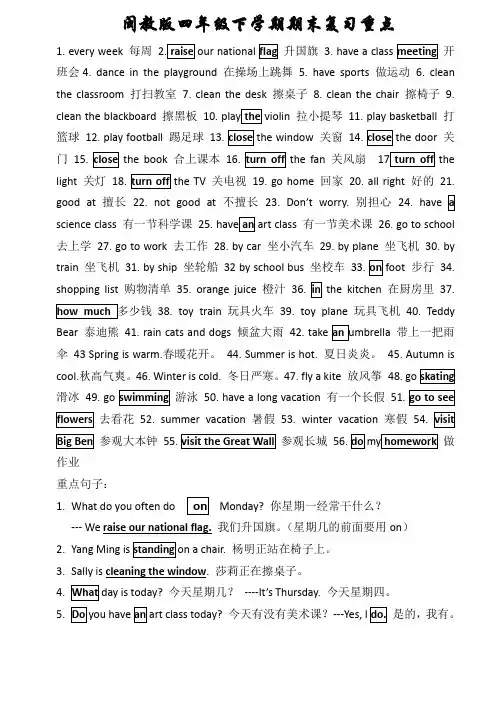
闽教版四年级下学期期末复习重点1. every week 每周升国旗开班会4. dance in the playground 在操场上跳舞5. have sports 做运动6. clean the classroom 打扫教室7. clean the desk 擦桌子8. clean the chair 擦椅子9.clean the blackboard 擦黑板拉小提琴11. play basketball 打篮球12. play football 踢足球关窗关门the book 合上课本the fan 关风扇thelight 关灯关电视19. go home 回家20. all right 好的21.good at 擅长22. not good at 不擅长23. Don’t worry. 别担心24. havescience class 有一节科学课有一节美术课26. go to school 去上学27. go to work 去工作28. by car 坐小汽车29. by plane 坐飞机30. bytrain 坐飞机31. by ship 坐轮船32 by school bus 坐校车步行34.shopping list 购物清单35. orange juice 橙汁36. the kitchen 在厨房里37.38. toy train 玩具火车39. toy plane 玩具飞机40. TeddyBear 泰迪熊41. rain cats and dogs 倾盆大雨带上一把雨伞43 Spring is warm.春暖花开。
44. Summer is hot. 夏日炎炎。
45. Autumn iscool.秋高气爽。
46. Winter is cold. 冬日严寒。
47. fly a kite 放风筝滑冰游泳50. have a long vacation 有一个长假去看花52. summer vacation 暑假53. winter vacation 寒假54.参观大本钟参观长城做作业重点句子:1.What do you often do Monday? 你星期一经常干什么?--- We raise our national flag.我们升国旗。
新闽教版小学英语四年级下册知识点资料

新闽教版小学英语四年级下册知识点新闽教版小学英语四年级下册知识总复习Unit 1 Days of the Week Unit 2 Cleaning DaySunday星期日Monday 星期一Tuesday星期二Wednesday星期三Thursday星期四 Friday 星期五Saturday星期六week星期often 经常every 每一,每个 national flag 国旗meeting 会议clean把弄干净fan 电风扇Well done!做得好1、What do you often do every week?(你们每星期经常做什么?)2、On Monday we raise our national flag.(在星期一 ,我们升国旗。
)3、We have a class meeting on Tuesda(y. 我们星期二开班会。
)4、We have sports in the playground(. 我们在操场上进行体育锻炼。
)5、We clean our classroom on Friday(. 星期五我们打扫教室。
)6、I play the violin on Saturday.(星期六我拉小提琴。
)7、I play football on Sunday.(星期天我踢足球。
)8、We dance in the playground on Wednesday我. 们星期三在操场上跳舞。
raise our national flag升国旗have aclass meeting开班会dance in the playground在操场上跳舞have sports做运动clean our classroom打扫教室play the violin 拉小提琴play football 踢足球 basketball打篮球playthe lights 关灯 turn off the fans 关风扇 watch TV 看电视Unit 3 School SubjectsChinese 语文 English 英语 math 数学music 音乐 art 美术 PE 体育— We have a Chinese/math/PE/computer/music/science class this morning. 上午我们有一节 语文/数学/体育/电脑 /音乐/科学 课。
闽教版小学四年级英语(下册)期末总复习

3.朱丽叶正在擦黑板。
Julia is cleaning the blackboard.
4.莉莉正在操场上跳舞。
Lily is dancing in the playground.
5.我们在星期五有一节音乐课。
We have a music class on Friday.
Unit4 Transportation
1.单词复习:认读拼写抽查 2.词组整理:各种交通方式 去学校__go_t_o _sc_ho_o_l __ 去工作_g_o_to_w_o_rk____ 去公园__go_t_o _th_e p_a_rk__ 去台湾__go_to_T_ai_w_an____
步行_o_n f_oo_t ____ 坐汽车_b_y_ca_r _____ 坐公交_by_b_us_____ 坐飞机_by_p_la_ne___ 坐火车_by_tr_ai_n ____ 坐校车_b_y _sc_ho_o_l b_us
• 10.我数学学得不好。
I am not good at math.
U1-U4 句子复习(翻译)
• 1.Don't worry.
别着急。
• 2.He goes to school by bus.
他坐公交去学校。
• 3.What day is today?
肯定回答:
Yes, she does. 否定ห้องสมุดไป่ตู้答: No,she doesn't.
Unit2 Cleaning Day
1.单词复习:认读拼写抽查 2.词组整理:clean词组和两个“关” 站在椅子上_s_tan_d_o_n _a c_h_air__ 擦黑板_c_le_an_th_e_b_lac_k_bo_ard 擦椅子__c_le_an_t_he_c_ha_ir_s __擦窗户___cl_ea_n_th_e _wi_nd_o_ws__
闽教版四年级下册英语知识点重点复习-打印

闽教版四年级下册英语知识点复习一、动词转换sit→sitting run→running swim→swimming get→getting shop→shoppingmake→making have→having come→comingSing→Singing go→goingpass→passingplay→playing do→doing boat→boatingwash→washing cook→cookingdraw→drawing read→reading eat→eating wear→wearing二、交通工具1、bybus2、bybike3、bymotorcycle4、bycar5、onfoot6、bytrain7、byplane询问做什么交通工具句式为:Howdoyou(they)gotoschool?或者Howdoeshe(she)gotoschool?三、食物吃东西用的动词为第一、二人称(如你、我、我们、他们)时用“have”第三人称(如他、她、它)用“has”:1、wehavehotdogs2、wehavenoodls3、wehavericeandfish4、wehaveicecream5、wehavehamburgers6、wehavedumpling四、单复数1、dumpling→dumplings2、vegetable→vegetable3、hamburger→hamburgers4、egg→egg5、peach→peaches6、grape→grape7、cake→cakes8、apple→apple9、carrot→carrots10、hotdog→hotdog只能是单数表示的东西:1、icecream2、fish3、melon4、rice5、tea6、fruit7、soap8五、房子结构(要注意搞清楚哪些东西是在哪个房间的)1、asittingroom2、abedroom3、adiningroom4、akitchen5、astudy6、abathroom六、方位词(on、in或near)1、一般在某个物体里面的用“in”如:①、Blackboardinmyclassroom②、windowsinmyclassroom③、pianointhemusicroom④、pencilsinmypencil-case⑤、icecreaminthefridge2、如果是在某个物体上面,不被包住的用“on”如:①、clockonthewall②、picturesonthewall③、bookonthetable3、在某个物体的边上就用“near”七、课目(注意有些课目第一个字母要大写,有些整个词都得大写)1、English2、Chinese3、math4、computer5、music6、art7、PE8、science八、句式1、做什么交通工具?Howdoyou(they)gotoschool?或者Howdoeshe(she)gotoschool?回答:I(they)gotoschoolbybus。
闽教版小学英语四下期末复习提纲.doc
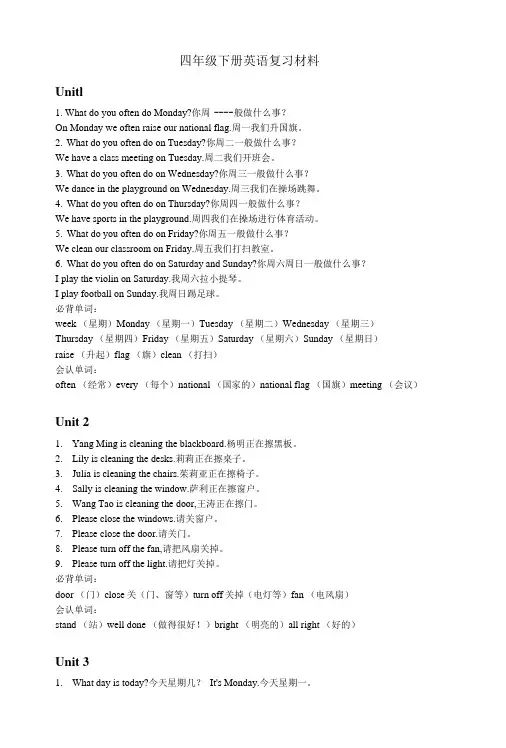
四年级下册英语复习材料Unitl1.What do you often do Monday?你周 ---- 般做什么事?On Monday we often raise our national flag.周一我们升国旗。
2.What do you often do on Tuesday?你周二一般做什么事?We have a class meeting on Tuesday.周二我们开班会。
3.What do you often do on Wednesday?你周三一般做什么事?We dance in the playground on Wednesday.周三我们在操场跳舞。
4.What do you often do on Thursday?你周四一般做什么事?We have sports in the playground.周四我们在操场进行体育活动。
5.What do you often do on Friday?你周五一般做什么事?We clean our classroom on Friday.周五我们打扫教室。
6.What do you often do on Saturday and Sunday?你周六周日一般做什么事?I play the violin on Saturday.我周六拉小提琴。
I play football on Sunday.我周日踢足球。
必背单词:week (星期)Monday (星期一)Tuesday (星期二)Wednesday (星期三)Thursday (星期四)Friday (星期五)Saturday (星期六)Sunday (星期日)raise (升起)flag (旗)clean (打扫)会认单词:often (经常)every (每个)national (国家的)national flag (国旗)meeting (会议)Unit 21.Yang Ming is cleaning the blackboard.杨明正在擦黑板。
闽教版四年级英语下册知识点复习
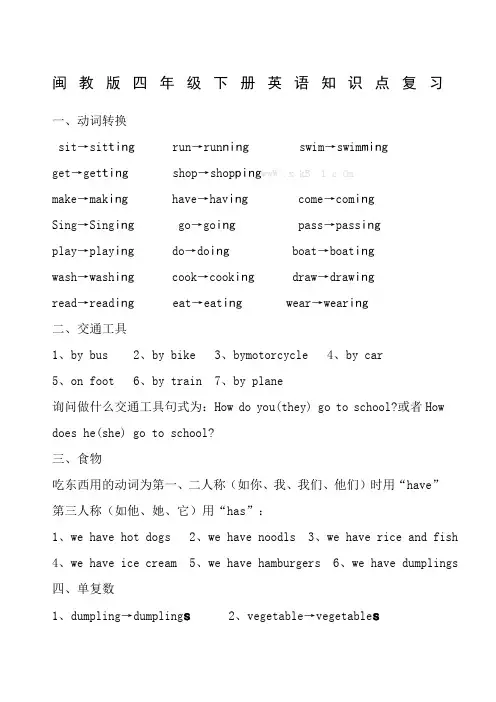
闽教版四年级下册英语知识点复习一、动词转换sit→sit ting run→run ning swim→swim mingget→get ting shop→shop ping wwW .x kB 1.c Ommake→mak ing have→hav ing come→com ingSing→Sing ing go→go ing pass→pass ingplay→play ing do→do ing boat→boat ingwash→wash ing cook→cook ing draw→draw ingread→read ing eat→eat ing wear→wear ing二、交通工具1、by bus2、by bike3、bymotorcycle4、by car5、on foot6、by train7、by plane询问做什么交通工具句式为:How do you(they) go to school?或者How does he(she) go to school?三、食物吃东西用的动词为第一、二人称(如你、我、我们、他们)时用“have”第三人称(如他、她、它)用“has”:1、we have hot dogs2、we have noodls3、we have rice and fish4、we have ice cream5、we have hamburgers6、we have dumplings四、单复数1、dumpling→dumpling s2、vegetable→vegetable s3、hamburger→hamburger s4、egg→egg s5、peach→peach es6、grape→grape s7、cake→cake s 8、apple→apple s9、carrot→carrot s 10、hot dog→hot dog s只能是单数表示的东西:1、ice cream2、fish3、melon4、rice5、tea6、fruit7、soap 8五、房子结构(要注意搞清楚哪些东西是在哪个房间的)1、a sitting room2、a bedroom3、a dining room4、a kitchen5、a study6、a bathroom六、方位词(on、in或near)1、一般在某个物体里面的用“in”如:①、Blackboard in my classroom ②、windows in my classroom ③、piano in the music room ④、pencils in my pencil-case⑤、ice cream in the fridge x k b 1 .c o m2、如果是在某个物体上面,不被包住的用“on”如:①、clock on the wall ②、pictures on the wall③、book on the table3、在某个物体的边上就用“near ”七、课目(注意有些课目第一个字母要大写,有些整个词都得大写)1、English2、Chinese3、math4、computer5、music6、art7、PE8、science八、句式1、做什么交通工具?How do you(they) go to school?或者How does he(she) go to school? 回答:I(they) go to school by bus。
闽教版四年级英语下册知识点复习定稿版
闽教版四年级英语下册知识点复习精编W O R D版IBM system office room 【A0816H-A0912AAAHH-GX8Q8-GNTHHJ8】闽教版四年级下册英语知识点复习一、动词转换sit→sitting run→running swim→swimmingget→getting shop→shopping wwW .x kB 1.c Ommake→making have→having come→comingSing→Singing go→going pass→passingplay→playing do→doing boat→boatingwash→washing cook→cooking draw→drawingread→reading eat→eating wear→wearing二、交通工具1、by bus2、by bike3、bymotorcycle4、by car5、on foot6、by train7、by plane询问做什么交通工具句式为:How do you(they) go to school或者How does he(she) go to school三、食物吃东西用的动词为第一、二人称(如你、我、我们、他们)时用“have”第三人称(如他、她、它)用“has”:1、we have hot dogs2、we have noodls3、we have rice and fish4、we have ice cream5、we have hamburgers6、we have dumplings四、单复数1、dumpling→dumpling s2、vegetable→vegetable s3、hamburger→hamburger s4、egg→egg s5、peach→peach es6、grape→grape s7、cake→cake s 8、apple→apple s9、carrot→carrot s 10、hot dog→hot dog s只能是单数表示的东西:1、ice cream2、fish3、melon4、rice5、tea6、fruit7、soap 8五、房子结构(要注意搞清楚哪些东西是在哪个房间的)1、a sitting room2、a bedroom3、a dining room4、a kitchen5、a study6、a bathroom六、方位词(on、in或near)1、一般在某个物体里面的用“in”如:①、Blackboard in my classroom ②、windows in my classroom③、piano in the music room ④、pencils in my pencil-case⑤、ice cream in the fridgex k b 1 .c o m2、如果是在某个物体上面,不被包住的用“on”如:①、clock on the wall ②、pictures on the wall③、book on the table3、在某个物体的边上就用“near ”七、课目(注意有些课目第一个字母要大写,有些整个词都得大写)1、English2、Chinese3、math4、computer5、music6、art7、PE8、science八、句式1、做什么交通工具How do you(they) go to school?或者How does he(she) go to school?回答:I(they) go to school by bus。
(完整版)闽教版四年级下册英语知识点重点复习-打印,推荐文档
一、动词转换sit→sittingrun→running swim→swimmingget→gettingshop→shoppingmake→making have→having come→comingSing→Singing go→goingpass→passing play→playing do→doingboat→boating wash→washing cook→cookingdraw→drawingread→reading eat→eating wear→wearing二、交通工具1、by bus2、by bike3、bymotorcycle4、by car5、on foot6、by train7、by plane询问做什么交通工具句式为:How do you(they) go to school?或者How does he(she) go to school?三、食物吃东西用的动词为第一、二人称(如你、我、我们、他们)时用“have”第三人称(如他、她、它)用“has”:1、we have hot dogs2、we have noodls3、we have rice and fish4、we have ice cream5、we have hamburgers6、we have dumpling四、单复数1、dumpling→dumplings2、vegetable→vegetable3、hamburger→ha mburgers4、egg→egg5、peach→peaches6、grape→grape7、cake→cakes8、apple→apple9、carrot→carrots10、hot dog→hot dog只能是单数表示的东西:1、ice cream2、fish3、melon4、rice5、tea6、fruit7、soap8五、房子结构(要注意搞清楚哪些东西是在哪个房间的)1、a sitting room2、a bedroom3、a dining room4、a kitchen5、a study6、a bathroom六、方位词(on、in或near)1、一般在某个物体里面的用“in”如:①、Blackboard in my classroom②、windows in my classroom③、piano in the music room④、pencils in my pencil-case⑤、ice cream in the fridge2、如果是在某个物体上面,不被包住的用“on”如:①、clock on the wall②、pictures on the wall③、book on the table3、在某个物体的边上就用“near”七、课目(注意有些课目第一个字母要大写,有些整个词都得大写)6、art7、PE8、science八、句式1、做什么交通工具?How do you(they) go to school?或者How does he(she) go to school?回答:I(they) go to school by bus。
闽教版英语复习提纲四下
4B Unit 1Words: hurry bus motorcycle car work often plane aunt student trainSentences: 1, What time is it , Li Hong?—It’s seven thirty.2, Look, the bus is coming. Let’s go by bus.—All right.3, How do they go to school?—They go to school by bike\on foot\bymotorcycle\by car\ by train\by bus.Grammer: 复习时间表达法及交通工具的单词,学习by bike等表示方式的短语,掌握用How提问方式及如何回答的句型。
Unit 2Words: week Sunday Monday Tuesday Wednesday Thursday Friday Saturday menuSentences: 1, There are seven days in a week.—They are Sunday \ Monday \ Tuesday \ Wednesday \ Thursday \ Friday \ Saturday .2, On Sunday I go to the park by car.On Monday I come to school on foot. On Tuesday I go towork by bike.3, What do you have for lunch on Friday?—We have dumplings, ice cream,vegetables and oranges.Grammer: 掌握星期的单词,注意在星期几用on,学习如何具体运用。
Unit 3Words: English math music science PE favorite subject yours room together food Chinese computer artSentences: 1,What day is today, Li Hong?—It’s Wednesday. We have an English class today.2, Do you have a math class today?—Yes, I do.\ No, I don’t.3, What’s your favorite subject(day\food\pet\color\sport)?—Math. What’syours?—PE. I like swimming and running.Grammer: 复习有关星期的知识,掌握科目的单词,学习如何具体运用。
闽教版四年级英语下册知识点复习
闽教版四年级下册英语知识点复习一、动词转换sit→sit ting run→run ning swim→swim mingget→get ting shop→shop pingmake→mak ing have→hav ing come→com ingSin g→Sin g ing go→go ing pass→pass ingplay→play ing do→do ing boat→boat ingwash→wash ing cook→cook ing draw→draw ingread→read ing eat→eat ing wear→wear ing二、交通工具1、by bus2、by bike3、bymotorcycle4、by car5、on foot6、by train7、by plane询问做什么交通工具句式为:How do you(they) go to school?或者How does he(she) go to school?三、食物吃东西用的动词为第一、二人称(如你、我、我们、他们)时用“have”第三人称(如他、她、它)用“has”:1、we have hot dogs2、we have noodls3、we have rice and fish4、we have ice cream5、we have hamburgers6、we have dumplings四、单复数1、dumpling→dumpling s2、vegetable→vegetable s3、hamburger→hamburger s4、egg→egg s5、peach→peach es6、grape→grape s7、cake→cake s 8、apple→apple s9、carrot→carrot s 10、hot dog→hot dog s只能是单数表示的东西:1、ice cream2、fish3、melon4、rice5、tea6、fruit7、soap 8五、房子结构(要注意搞清楚哪些东西是在哪个房间的)1、a sitting room2、a bedroom3、a dining room4、a kitchen5、a study6、a bathroom六、方位词(on、in或near)1、一般在某个物体里面的用“in”如:①、Blackboard in my classroom ②、windows in my classroom③、piano in the music room ④、pencils in my pencil-case⑤、ice cream in the fridge2、如果是在某个物体上面,不被包住的用“on”如:①、clock on the wall ②、pictures on the wall③、book on the table3、在某个物体的边上就用“near”七、课目(注意有些课目第一个字母要大写,有些整个词都得大写)1、English2、Chinese3、math4、computer5、music6、art7、PE8、science八、句式1、做什么交通工具?How do you(they) go to school?或者How does he(she) go toschool?回答:I(they) go to school by bus。