
牛津译林版八年级英语上册Unit6BirdwatchingReading教案1
译林牛津版八上英语 Unit 6 Bird watching Reading I教案
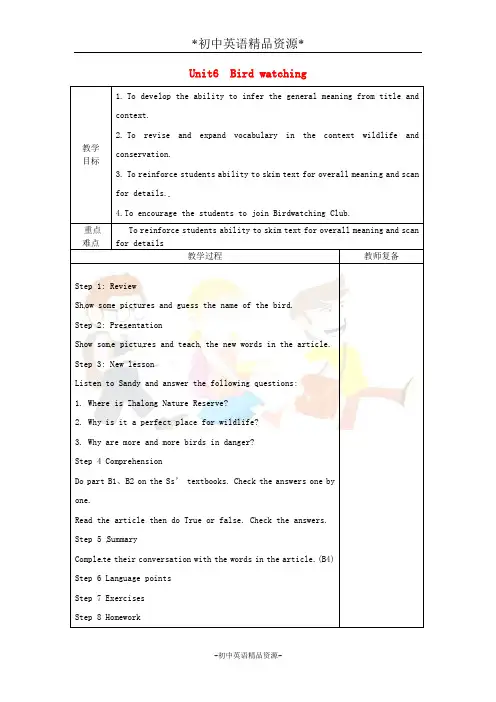
Unit6 Bird watching教学目标1.To develop the ability to infer the general meaning from title and context.2.To revise and expand vocabulary in the context wildlife and conservation.3.To reinforce students ability to skim text for overall meanin g and scan for details.4.To encourage the students to join Birdwatching Club.重点难点To reinforce students ability to skim text for overall meaning and scan for details教学过程教师复备Step 1: ReviewSh ow some pictures and guess the name of the bird.Step 2: PresentationShow som e pictu res and teach the new words in the article. Step 3: New lessonListen to Sandy and answer the following questions:1. Where is Zhalong Nature Reserve?2. Why is it a perfect place for wildlife?3. Why are more and more birds in danger?Step 4 ComprehensionDo part B1、B2 on the Ss’ textbooks. Check the answers one by one.Read the article then do True or false. Check the answers. Step 5 SummaryComple te their conversation with the words in the article.(B4) Step 6 Language pointsStep 7 ExercisesStep 8 Homework1. Describe Zhalong Nature Reserv e.2. Make a pla n how to protect the en dangered wildlife with your classmates or family.教学反思。
牛津译林版八年级上册Unit 6《Bird watching》(Welcome to the Uni

牛津译林版八年级上册Unit 6《Bird watching》(Welcome to the Unit)教学设计一. 教材分析《牛津译林版八年级上册Unit 6 Bird watching》主要介绍鸟类观察这一主题。
通过本单元的学习,学生将能够掌握关于鸟类观察的词汇和表达方式,了解鸟类观察的基本知识和技巧,提高英语听说读写能力。
本单元包括三个部分:Welcometo the Unit、Reading、Exercises。
本教学设计主要针对Welcome to the Unit部分进行设计。
二. 学情分析八年级的学生已具备一定的英语基础,对日常生活中的事物和现象有一定的认识。
但他们对鸟类观察的了解相对较少,因此在教学中需要提供相关的背景知识,帮助他们更好地理解课文内容。
此外,学生对新鲜事物充满好奇,善于观察和发现,因此在学习过程中要充分激发他们的兴趣和积极性。
三. 教学目标1.知识目标:学生能掌握关于鸟类观察的词汇和表达方式,了解鸟类观察的基本知识和技巧。
2.能力目标:学生能听懂、会说、会读、会写关于鸟类观察的句子,提高英语听说读写能力。
3.情感目标:培养学生对鸟类观察的兴趣,提高他们对自然环境的认识和保护意识。
四. 教学重难点1.重点:鸟类观察的词汇和表达方式,如:birdwatcher、binoculars、habitat等。
2.难点:如何运用所学知识进行实际交流,如:描述鸟类的外貌、习性等。
五. 教学方法1.情境教学法:通过设置具体情境,让学生在实际语境中学习鸟类观察的词汇和表达方式。
2.任务型教学法:引导学生参与鸟类观察的实际任务,提高他们的实践能力。
3.游戏教学法:通过趣味游戏,激发学生的学习兴趣,巩固所学知识。
六. 教学准备1.教材:《牛津译林版八年级上册》。
2.多媒体设备:电脑、投影仪、音响等。
3.教学素材:与鸟类观察相关的图片、视频等。
4.教学用具:黑板、粉笔、练习册等。
七. 教学过程1.导入(5分钟)利用投影仪展示一张美丽的鸟类图片,引导学生关注鸟类,激发他们的学习兴趣。
牛津译林版英语八上Unit 6《Birdwatchers》(Reading1)教学设计
牛津译林版英语八上Unit 6《Birdwatchers》(Reading1)教学设计一. 教材分析《牛津译林版英语八上Unit 6》的主题是关于“Birdwatchers”,通过讲述一群对观鸟感兴趣的人的故事,来培养学生的阅读理解能力、提高他们的语言运用能力以及培养他们保护环境、热爱大自然的意识。
本课时的阅读文本是一篇故事,主要讲述了一位名叫George的男孩在爷爷的引导下,开始对观鸟产生兴趣,并在观鸟的过程中,逐渐了解到鸟类的生活习性和保护鸟类的重要性。
二. 学情分析八年级的学生已经具备了一定的英语基础,能够理解和运用一些基本的英语语法和词汇。
但是,他们在阅读理解、词汇拓展以及语言运用方面还存在一定的问题。
因此,在教学过程中,需要针对这些方面进行有针对性的教学。
三. 教学目标1.能够理解故事的大意,掌握故事中的主要信息和细节。
2.能够运用故事中的关键词汇和句型进行简单的交流和表达。
3.能够通过阅读故事,了解鸟类的生活习性和保护鸟类的重要性,培养保护环境、热爱大自然的意识。
四. 教学重难点1.能够理解故事的大意和细节。
2.能够运用故事中的关键词汇和句型进行交流和表达。
3.能够理解鸟类的生活习性和保护鸟类的重要性。
五. 教学方法1.任务型教学法:通过设定各种任务,让学生在完成任务的过程中,理解和运用语言。
2.情境教学法:通过创设各种情境,让学生在实际情境中,理解和运用语言。
3.合作学习法:通过小组合作,让学生在互动中,提高语言运用能力。
六. 教学准备1.教材:《牛津译林版英语八上Unit 6》2.多媒体教学设备:用于展示故事文本、图片、视频等教学资源。
3.教学资源:包括与故事相关的图片、视频等。
七. 教学过程1.导入(5分钟)通过提问方式,引导学生谈论他们对鸟类的了解,激发他们的学习兴趣。
2.呈现(10分钟)用多媒体展示故事的插图,引导学生猜测故事的大致内容。
然后,展示故事的开头部分,让学生听读,并回答一些简单的问题,以了解他们对故事的理解程度。
Unit 6 Reading教案 牛津译林版八年级英语上册

Unit 6 BirdwatchingReading教案(一)总课题8A Unit 6Birdwatching 总课时第课时课题Reading 课型New教学目标知识目标1.To develop the ability to infer the general meaning from title andcontext.2.To revise and expand vocabulary in the context wildlife andconservation.3.To reinforce students ability to skim text for overall meaning andscan for details能力目标To reinforce students ability to skim text for overall meaning andscan for details情感目标To encourage the students to join Birdwatching Club.教学重点To reinforce students ability to skim text for overall meaning and scan for details 教学难点To reinforce students ability to skim text for overall meaning and scan for details课前预习1Preview the new words.2Listen to the tape and r ead the text教学方法情景教学法、归纳法教学过程教学环节教师活动二次备课Step1 PresentationStep2. Practice 1. Ask the students to talk about their favorite birds.A: Which bird do you like best?B: I like …best.A: Why?B: Because…2.Have a dictation of the new words and phra ses go birdwatching at the marketlearn more about encourage… to do st h. Crane northern3. Talk about a picture of Zhalong.E.g. What can you see in the picture? ( Birds, water and land with plants)Why are so many birds here? ( They can swim and find food here.)What birds, do you think, are they?4. Talk about a picture of ‘red-cr owned cranes’ and learn the new words, like wetland/shelter crane/rare…1.Listen to the tape and find the answers to theStep3. Production following questions:What and where is Zhalong?Is it a great place for wildlife? Why?2.Read the passage silently and focus on the questions:Why is Zhalo ng a special place?( special land / special birds)What dangers does the reserve have?( danger to Zhalong/ danger to wildlife)What actions can we take to protect birds?( government/ Birdwatching Club)3.Listen to the tape and practice reading the passage..4.Get th e students to complete the following tableZHALONG---A SPECIAL PLACE LOCATION North-east ChinaLAND TYPE Wetland IMPORTANCEAn ideal home forwildlifeProvide food andshelter for wildlife RARE BIRDSRare red-crownedcranesDANGERSLess and less space forwildlifeACTIONSPEOPLE TAKEMake reserves toprotect birds. Thebirdwatchers do a birdcount each year. Theyare studying thechanges in birds’numbe rsHOPEEv eryone should dosomething to protectwildlife1. Do C1 on Page 79 and check the answers to2. Retell the passage according to the keywords on the blackboard.(Location/ land type/ importanc e/ rare birds/ dangers/ actions people take)3.Talk about Zhalong and then do Part B2 on Page 78Step4. Homework ( Complete the conservation between Sandy and Daniel)4. Read and complete the passage about red-crowned cranes.1.Recite the new words2.Recite the passage about red-crowned cranes.3.Find out useful words and phrases in Reading Do B1 on Page 78 and C2 on Page 79.教学反思Reading教案(二)教学内容8Aunit6 Birdwatching Reading 二次备课教学目标1. To develop the ability to infer the general meaning from title and context.2. To reinforce students ability to skim text foroverall meaningand scan for details重点难点Key points:To develop the ability to infer the general meaning from title and context.Difficult points:To reinforce students ability to skim text for overall meaning and scan for details教学流程设计教学流程Step1 Revision1. Ask the students to talk about their fa vorite birds.2. Have a dictation of the new words and phrasesStep2 Presentation1. Talk about a picture of Zhalong.e.g. What can you see in the picture? ( Birds, water and land with plants)Why are so many birds here? ( They can swim and find food here.)What birds, do you think, are they?2. Talk about a picture of ‘red-crowned cranes’ and learn the设计new words, like wetland/cover/crane/rare…Step3 Practice1.Listen to the tape and find the answers to the followingquestions:What and where is Zhalong?Is it a great place for wildlife? Why?2. Read the passage silently and focus on the questions:(1) Why is Zhalong a special place?(2) What animals live in the special place? Why?(3)Why are birds and wildlife in danger?(4) What do many tourists do there?(5)What do the members of the Birdwatching Society do?(6) What actions can we take to protect birds?3. L isten to the tape and practice reading the passage..Step4 Production1. Do exercises on Page 71and check the answers.2. Retell the passage according to the keywords on theblackboard.(Location/ land type/ importance/ rare birds/ dangers/ actionspeople take)3. Talk about Zhalong and then do Part B3andB4 on P age 72( Complete the conservation between Sandy and Daniel)Homework1. Recite the new words2. Find out useful words and phrases in Reading教学反思Reading教案(三)课题Unit 6 Reading 课时课型新课教学目标To understand the meaning of the article to finish the exercises prepared for you correctly.重、难点To understand the meaning of the article to fi nish the exercises prepared for you correctly.教学设计详案二次备课内容Step1. Show learning aims. (1')Step2. Lead to the new knowledge.Free talkA: Which bird do you like best?B: I like … best.A: What do … look like?B: ….T says: We’ve learned a lot about diff erent kinds of birds. Some ofthem are now rare. They’re in danger. What can we do?Ss: We can built nature reserves for birds. The Chinese governmenthas built many nature reserves for birds. Zhalong is one of them.Today we’re going to learn about Zhal ong.Step3. Guide students to read and under stand the storycorrectly .1.Open your book, first listen once and th en try yo ur best to answerthe following questions.(6')(1). Where is Zhalong Nature Reserve?(2).What kind of land is there in Zhalong ?(3).Why are the wetlands important for the wildlife?(4).What's Zhalong famous for?(Ask some students to answer the questions and understand somewords “wetland, provide,tourist.2. Read the article aloud by yourself and know more about ZhalongNature Reserve.(6')If you find the difficulty in reading, you can learn from your partner.Practice:1. Complete Part B2 on Page71.(2')Let ss know the structure of the article.2.Finish Part B1 on Page 71.(3')Let ss understand the new words further.3.Finish Part B3 on Page72.(5')Let ss know more about Zhalong作业设计Practice in class1.Finish Part B4 o n Page 72.(4')2.完成课课练P58 二.。
牛津译林版八年级上册Unit 6《Bird watching》(Task and self-asse

牛津译林版八年级上册Unit 6《Bird watching》(Task and self-assessment)教学设计一. 教材分析《Bird watching》是人教版牛津译林八年级上册的一篇文章,主要介绍了鸟类观察这一活动。
文章通过讲述作者和鸟类观察者们一起观察鸟类的过程,使学生了解鸟类观察的方法和技巧,以及观察鸟类给人们带来的乐趣。
本篇文章题材新颖,激发学生对鸟类观察的好奇心,提高学生对英语学习的兴趣。
同时,文章中涉及到的生词和短语也比较丰富,有助于学生扩大词汇量。
二. 学情分析八年级的学生已经具备了一定的英语基础,能够进行简单的听、说、读、写操作。
但是,学生在阅读理解方面还存在一定的困难,特别是对于长篇阅读材料的理解和分析能力。
此外,学生的词汇量有限,对于一些专业术语和生僻词汇可能不太熟悉。
因此,在教学过程中,需要帮助学生理解文章内容,引导学生运用所学知识进行思考和表达。
三. 教学目标1.知识目标:–能够理解文章主要内容,把握文章大意。
–学习并掌握文章中出现的生词和短语。
–了解鸟类观察的方法和技巧。
2.能力目标:–能够运用所学知识进行阅读理解,分析文章结构。
–能够运用所学词汇和句型进行口头表达和写作。
3.情感目标:–培养学生对大自然和生物的热爱,提高学生对英语学习的兴趣。
四. 教学重难点•理解文章主要内容,掌握文章大意。
•学习并掌握文章中出现的生词和短语。
•理解文章中关于鸟类观察的方法和技巧的描述。
•运用所学知识进行阅读理解和口头表达。
五. 教学方法1.任务型教学法:通过完成各种任务,引导学生积极参与课堂活动,提高学生的实践能力。
2.情境教学法:创设真实的情境,使学生在具体的情境中学习英语,提高学生的学习兴趣。
3.合作学习法:鼓励学生之间进行合作,共同完成学习任务,提高学生的团队协作能力。
六. 教学准备1.教师准备:–熟悉教材内容,明确教学目标。
–准备相关教学材料,如PPT、图片、视频等。
牛津译林版八年级英语上册Unit6birdwatchingreadingI教学设计
2.通过具体实例,讲解一般现在时和一般过去时在描述鸟类行为和特点中的应用,帮助学生掌握语法知识。
3.引导学生阅读文章,讲解阅读策略,如略读、寻读和精读,帮助学生获取文章主旨和细节信息。
总字数:1001字
二、学情分析
针对牛津译林版八年级英语上册Unit 6 “Birdwatching” Reading I的教学,我对学生的情况进行了以下分析。八年级的学生已经具备了一定的英语基础,他们对英语学习充满热情,但阅读能力参差不齐。在词汇方面,学生已经掌握了大部分基础词汇,但对于专业性较强的词汇,如鸟类观察相关的词汇,掌握程度有待提高。此外,学生对一般现在时和一般过去时的运用尚不够熟练,需要通过本节课的学习和实践来加强。
(3)通过分组讨论、小组竞赛等形式,激发学生的学习兴趣,提高课堂参与度。
2.针对阅读理解和策略训练,我设想采用以下教学策略:
(1)设置预读任务,让学生在课前对文章进行预习,培养自主学习能力。
(2)在课堂教学中,引导学生运用阅读策略,如寻读、精读等,逐步提高阅读理解能力。
(3)设计问题链,引导学生深入思考文章内容,培养批判性思维和问题解决能力。
6.词汇复习:复习本章节所学的新词汇,要求能熟练拼写、正确运用,并对难记词汇进行整理和记忆。
3.引入主题:“Today, we are going to learn about birdwatching. It's a fun activity that helps us understand birds better.”通过简短介绍,激发学生对鸟类观察的兴趣。
牛津译林版八年级上册Unit 6《Bird watching》(Reading 2)教学设计
牛津译林版八年级上册Unit 6《Bird watching》(Reading 2)教学设计一. 教材分析《牛津译林版八年级上册Unit 6 Bird watching》的Reading 2主要介绍了一位名叫Simon的鸟类观察家在乡村观察鸟类的过程。
文章通过Simon的视角,描述了各种鸟类的特征和生活习性,如blue tit、great tit、sparrow等。
此外,文章还介绍了鸟类观察的基本方法和注意事项。
本课内容旨在让学生了解鸟类的基本知识,提高他们对生物的兴趣和保护意识。
二. 学情分析八年级的学生已经具备了一定的英语基础,能够独立阅读简单的英文文章。
但他们在阅读过程中,可能会遇到一些生词和短语,需要老师的引导和帮助。
此外,学生对鸟类的了解有限,需要通过本课的学习,拓宽他们的知识面。
三. 教学目标1.知识目标:学生能够掌握文章中出现的生词和短语,了解鸟类的基本特征和生活习性。
2.能力目标:学生能够运用所学知识,进行简单的鸟类观察和描述。
3.情感目标:培养学生对鸟类的兴趣,提高他们的环保意识。
四. 教学重难点1.重点:学生能够熟练阅读并理解文章内容,掌握生词和短语。
2.难点:学生能够运用所学知识,进行实际的鸟类观察和描述。
五. 教学方法1.任务型教学法:通过设定各种任务,激发学生的学习兴趣,提高他们的实践能力。
2.情境教学法:创设真实的鸟类观察情境,让学生在实践中学习英语。
3.合作学习法:鼓励学生分组讨论,培养他们的团队协作能力。
六. 教学准备1.教师准备:提前熟悉文章内容,准备好相关的教学材料,如PPT、图片、视频等。
2.学生准备:预习文章内容,查找生词和短语的释义。
七. 教学过程1.导入(5分钟)教师通过展示一些关于鸟类的图片,引导学生谈论他们对鸟类的了解和观察经历。
然后,简要介绍本课将要学习的内容,激发学生的兴趣。
2.呈现(10分钟)教师通过PPT展示文章标题和目录,让学生对文章结构有一个整体的认识。
牛津译林版-英语-八上-6单元 Bird watching Reading2教案
provide sb. with sth. = provide sth. for sb.
Sheep provide us with wool.
Sheep provide wool for us.
羊供给我们羊毛。
They provide us with food.
They provide food for us.
1.provide sb. with sth.
= provide sth. for sb.
2. all year round一年到头,全年
3. lead to导致
4. less and less越来越少的
比较级+ and +比较级,表示“越来
越……”
SteHomework
作业设计
1.ReciteReading.
难点
.To analyze the sentences for the students to get a better understanding
教学
准备
multi-media
教学设计详案
二次备课内容
Step1 Revision
Fill in tpoints
天气越来越冷了。
The air pollution is becoming worse and worse.
空气污染变得越来越严重了。
prevent意为“阻止”,其用法:prevent sb from doing sth
We should prevent people from making wetlands smaller
3.To make sure the students know the importance of wetlands and nature reserves
译林牛津版八上英语 Unit 6 Bird watching ReadingⅡ教案
总课题8A Unit 6Birdwatching 总课时8 第 3 课时课题ReadingⅡ课型New教学目标知识目标1.To get more detailed information about Zhalong NatureReserve.2.To analyze the sentences for the students to get abetter understanding.3.To make sure the students know the importance ofwetlands and nature reserves能力目标To make sure the stu dents know the importance of wetlandsand nature reserves情感目标To make sure the students know the importance of wetlandsand nature reserves教学重点To analyze the sentences for the students to get a better understanding.教学难点To analyze the sentences for the students to get a better understanding.课前预习1.Listen to the tape and read the text2.To summarize key points of a story by sequencing statements教学方法讲授法练习法教学过程教学环节教师活动二次备课Step1 Presentation A. RevisionAnswer some questions about the text.1.Where is Zhalong?2.Where is Heilongjiang?3.Is Zhalong Nature Reserve a good place for wildlife? Why?4.Are there many red-crowned cranes in the world? Why?5.Why are more and more birds in danger? Translate some useful expressions:a nature reserve in north-east China One of the world’s mos t important wetlands provide…for etc.B. Language points.1.provide…for…为…提供The dining-room provides food for students every day.2. endangered: in a dangerous state.Giant pandas are endangered animals.3.tourist:visitorThere are many foreign tourists visiting theStep2. PracticeStep3. ProductionStep 4. Homework. World Park in Beijing every year.4. stay n. v.He learned a lot during her stay in Japan. Please stay here till I come back.5. change n. v.Why did you make a change to the plan? Shall we change seats?6.count n. v.Our school does a student count every term.Let’s help him count the books.用 important, importance 填空It’s ___________ to learn English well.Do you know the __________of learning English?1.Read the whole passage .2.Part B1(Check the answers with the students )3.Match the first parts of the sentences at the top with the second parts at the bottom( Check the answers to Part C2 and then practice reading)4. Get the students to read the passage again. Say ‘Now you know Zhalong well. Let’s see if you can do this.’If you are a tour guide, how do you introduce Zhalong to the tourists?a nature reserve / important wetlands/ provides food and shelter / manybirds ----all year round / somebirds--- for a short stay / living areafor red-crowned cranes1. Talk about Bi rdwatching Club. Say ‘ if you are a member of the birdwatching club, can you tell us something about your club?’ Get the students to talk about the things Birdwatchibg Club does / is going to do.StudyingDo a bird countNeed more people to helpHope the infor mation will help people2. Get the students to read the whole passage together loudly again.3. Complete the short passage about Zhalong.1.Finish the relative exercises.2.Write a report about Zhalong to attract more people to protect wildlif e.3.Preview the new words in Vocabulary4.Preview using prefixes to form adjectives withopposite.教学反思。
译林版八年级英语上册Unit 6 Birdwatching 第2课时 Reading(1)教案
译林版八年级英语上册Unit 6 Birdwatching教案第2课时Reading(1)一、教学目标1、Students are expected to revise and expand vocabularies about wildlife and natural reserves in the context.2、Students are expected to develop the ability to infer the general meaning from title and context.3、Students are expected to tell others something about Zhalong Reserve.二、教学重点Students are expected to skim text for overall meaning and scan for details.三、教学难点Students will be able to introduce Zhalong Nature Reserve to others.四、教学过程(一)Revision(师)1. Revise some wild animals by showing some pictures.2. Ask the students to talk about their favourite birds.(生)1. Revise words about birds.2. Ask and answer with students.A: Which bird do you like best?B: I like …best.A: Why?B: Because…(二)Pre-reading(师)1. Have a discussion.T: There are so many kinds of birds. But some birds are rare.What can we do?S:…2. Present new words to students.T: Maybe we can build nature reserves. The Chinese government has built many nature reserves for birds. Zhalong is one of them. Today we are going to learn about Zhalong.( Then talk about the pictures of Zhalong and learn the new words: tourist、perfect、count、describe and so on.)3. Organize students to check answers.4. Play the tape and ask some questions.Why do lots of tourists go to Zhalong ?Is Zhalong a special place? Why(生)1. Students answer the questions.2. Learn the new words and phrases about Zhalong Nature Reserve.3. Help Sandy match the words on the left with the meanings on the right.4. Students listen to the tape carefully and find out the answers to the questions.(三)While-Reading(师)1. Guide students to skim and choose the main idea.Paragraph1-2: DangerParagraph3: Introduction about ZhalongParagraph4-5: Actions(生)1. Students skim the article to get the main idea and match.(师)2. Let students scan for detailed information.(1)Read paragraph 1 and do “T” or “F”.1) Zhalong Nature Reserve is in Heilongjiang in south-east China.2) Zhalong is one of the most important wetlands in the world.3) The area provides nothing for the wildlife.(2)Read paragraph 2 and match.Many birds a. 40% of them live in ZhalongSome birds b. live in Zhalong all year roundMost Birds c. for a short stayCranes d. active in the daytime(3)Read Paragraph 3 and complete the table below.(4)Read Para 4-5 and fill in the form below.(生)2. (1) Students read Paragraph 1, write a T if the sentence is true, write an F if it is false.(2)Students read paragraph 2 and match the birds on the left with the information on the right.(3)Studentsread Paragraph 3 andcomplete the table below.(4) Students read Para 4-5 and fill in the form below.(四)Post-reading(师)Have a discussionWhat about your actions to protect the birds?As a student, how to protect the birds?(生)Students discuss these two questions in groups.(五)PracticeAsk students to fill in the blanks.A report on ZhalongZhalong is a ________ reserve in North-east China. It’s a __________ place for some rare birds , because it ___________ food and _________ for wildlife.Many cranes live in Zhalong all year , while some go there for a short stay. 40% of the cranes live there, and most of them are in the daytime, so you can watch them______But now there is less and less _______ for wildlife, and fishermen keep fishing there. The Chinese _ _______ wants to _______ all these things to protect birds and wetlands. Every year, a lot of _______ go to Zhalong to watch birds.The members of Birdwatching Society are going to study the birds in Zhalong and__________their types and changes in numbers. We need more people to count and _________the birds. We hope more people will ___________ the importance of the wetlands and protect wildlife.(六)Production(师)Choose a role and rewrite the article. For example:A crane:I live in Zhalong ,I have many friends there…A fishman:I want to keep fishing there,…A farmer:I want to change the wetlands to make more space for farms …A member of Birdwatching Club:I’m studying the different kinds of birds…(生)Students rewrite the text in role.(七)Homework1、Make the article that students rewrite more perfect.2、Try to find more ways to protect birds and write them down.五、教学反思。