
国际经济学:进口关税及其福利效应单元测试题
一、单选题
1.按关税税率由低到高,下列排序正确的是()。
A.普通税率最惠国税率特惠税率
B.普惠制税率最惠国税率普通税率
C.最惠国税率特惠税率普通税率
D.普通税率特惠税率最惠国税率
正确答案:C
2.美国对洗衣机征收25%从价税后,()。
A.美国洗衣机生产者受损了
B.美国生产者和消费者都受益了
C.美国生产者和消费者都是受害者,只美国政府得益了
D.美国消费者受损了
正确答案:D
3.小国设置的进口关税()。
A.会使国家福利保持不变
B.上述三者都是可能的
C.会增加国家的福利
D.会减少国家的福利
正确答案:D
4.大国设置的进口关税()。
A.上述三者都是可能的
B.会增加国家的福利
C.会减少国家的福利
D.会使国家福利保持不变
正确答案:A
5.一个产业的有效保护率()。
A.总是高于中间投入品的名义关税率
B.取决于中间投入品的名义关税率、国内增加值
C.衡量关税对就业机会保护的程度
D.取决于该国是大国还是小国
正确答案:B
二、多选题
1.关于从量税.从价税和复合税三类计税方法的优劣势,表述正确的有()。
A.从价税的税负比较合理,同一种进口商品,质量高,价格高,税额也高,质次价廉的税额也低
B.从量税常用于发达国家、混合税常用于发展中国家
C.从量税的税率固定,同一税目下的商品无论质量好坏、价格高低均按统一税率征收,对于质好价高的商品的限制作用较小
D.混合税的好处在于兼有从价税和从量税的优点,混合税常用于耗费原材料较多的工业制成品
正确答案:A、C、D
2.下列表述正确的是()。
A.生产者剩余是指生产者对每一单位商品愿意接受的最低价格与实
际销售价格之间的差额
B.进口关税对消费者剩余和消费者剩余的影响是不一样的
C.进口关税对消费者剩余和消费者剩余的影响是一样的
D.消费者剩余是指消费者购买每一单位商品愿意支付的最高价格与实际支付价格之间的差额
正确答案:A、B、D
3.下列说法正确的有()。
A.生产扭曲损失指由于关税而导致国内生产过多地生产这种商品造成的福利损失
B.消费扭曲损失原是消费者福利的一部分,消费者损失了,也没有其他人得到,是一种无谓损失
C.消费扭曲损失是消费者损失了但生产者得到了的部分
D.无谓损失包括生产扭曲损失和消费扭曲损失
正确答案:A、B、D
4.下列说法不正确的有()。
A.名义保护只考虑了关税对制成品价格的影响,没有考虑对中间产品的保护
B.瀑布式关税结构是各国常常采用逐步升级的关税结构,即对原料进口几乎完全免税,对半成制品征收适度关税,但对最终产品征收较高关税
C.有效保护率只按国内中间产品来计算保护水平的
D.瀑布式关税结构是随着国内加工程度加深关税税率不断下降的现
象
正确答案:B、D
三、判断题
1.一国给予其他国家最惠国待遇,就表明同意向这些国家征收的关税税率不会高于对其他任何国家的商品征收的关税税率。
()
正确答案:√
2.征收进口关税使得消费者剩余减少,因此削减进口关税会使消费者享受实惠。
()
正确答案:√
3.征收进口关税的福利=消费者福利+生产者福利+政府税收。
()正确答案:√
4.与小国相反,大国征收进口关税一定增加社会净福利。
()
正确答案:×
5.有效保护率一定高于名义保护率。
()
正确答案:×
6.其他相同时,国内生产的附加值越少,有效保护率越低。
()正确答案:×。
(完整)国际经济学考试题库(答案版)

一、试述H-O模型的主要内容并予以评价。
1、基本内容:资本丰富的国家在资本密集型产品上相对供给能力较强,劳动丰富的国家则在劳动密集型产品上相对供给能力较强。
根据比较优势原则,一国出口密集使用其丰富要素的产品,进口密集使用其稀缺要素的产品.要素的自然禀赋—要素供给—要素的相对富饶程度—要素相对价格—生产成本差异-商品价格差异—贸易的发生2、评价:贡献:a、从一国经济资源优势解释国际贸易发生的原因;b、从实际优势出发决定贸易模式;c、从贸易对经济的影响分析贸易的作用.局限性:a、禀赋并非贸易发生的充分条件;b、对需求因素未予以充分考虑,影响了理论对实际情况的分析;c、过分强调静态结果,排除技术进步及实际存在的情况,影响了理论的适用性.二、结合货币市场和外汇市场,以美元为本币,请画图美联储增加货币供给后,美元对欧元的汇率将如何变动.外汇指的是以外国货币表示的,为各国普遍接受的,可用于国际间债权债务结算的各种支付手段。
货币政策是指政府或中央银行为影响经济活动所采取的措施,尤指控制货币供给以及调控利率的各项措施。
一国货币供给的增加会使该国货币在外汇市场上贬值。
美国的货币市场决定美元的利率,美元利率则影响维持利率平价的汇率。
所以当美联储增加货币供给后,会导致美元相对欧元的贬值。
但美元供给的变动对长期利率和实际产出没有影三、什么是恶性通货膨胀,可能导致恶性通货膨胀的原因以及应对措施。
恶性通货膨胀又称“超速通货膨胀”,是三位数以上的通货膨胀。
指流通货币量的增长速度大大超过货币流通速度的增长,货币购买力急剧下降,物价水平加速上升,整体物价水平以极高速度快速上涨的现象,使民众对货币价值失去信心.由于货币的流通量增加快速,使货币变得没有价值时,人们会急于要以货币换取实物,人心惶惶的结果只会更加速通货膨胀的恶化,整体经济濒临崩溃边缘。
恶性通货膨胀是一种不能控制的通货膨胀,在物价很快地上涨的情况下,就使货币失去价值.在社会经济发展和运行中,如果某一国家或地区出现了恶性的通货膨胀、剧烈的汇率波动或严重的地区政治冲突,其发行的信用货币(纸币)将存在很大的风险。
国际经济学题库(含参考答案)
国际经济学题库(含参考答案)一、单选题(共50题,每题1分,共50分)1、区域一体化组织中最松散、最低级的形式是()A、关税同盟B、自由贸易区C、共同市场D、优惠贸易安排正确答案:D2、要素价格均等化表明()A、一国丰富要素所有者受益,稀缺要素所有者受损B、一国丰富要素所有者受损,稀缺要素所有者受益C、一国丰富要素所有者和稀缺要素所有者都受益D、一国丰富要素所有者和稀缺要素所有者都受益正确答案:A3、下列不属于关税同盟动态效应的是()A、大市场效应B、加剧竞争C、吸引外资D、贸易创造效应正确答案:D4、如果开放前一国X产品的相对价格低于其贸易伙伴,则贸易后该国()A、进口 X产品B、生产者福利增加C、整体福利下降D、消费者福利增加正确答案:B5、下列()会给本国带来较大的贸易创造效应。
A、本国对贸易商品的供给弹性较大B、本国对成员国的初始关税较大C、本国与成员国之间贸易商品的成本差别较大D、本国对贸易商品的需求弹性较小正确答案:D6、初级产品的出口价格若下降,其出口量将增加,出口总收入()A、不变B、增加C、下降D、不确定正确答案:C7、马歇尔一勒纳条件所要说明的是在供给弹性()的情况下,本币贬值能够改善贸易收支的进出口需求弹性条件。
A、零B、无穷大C、1D^大于零小于1正确答案:B8、假设中国和美国都能生产小麦和布,中国将一单位劳动时间全部生产布,可以生产50米;全部生产小麦,可以生产80千克;美国将一单位劳动时间全部生产布,可以生产40米;全部生产小麦,可以生产 100千克。
如果开放后的国际交换比价为1米布=L 8千克小麦,则下列说法正确的是()A、无法比较美国和中国的获利情况B、中国从贸易开放中获利更多C、美国和中国从贸易开放中获利相同D、美国从贸易开放中获利更多正确答案:D9、下列不属于国际收支平衡表资本项目的是()A、利息收支B、短期信贷C、短期证券买卖D、票据买卖正确答案:A10、消费者剩余是()A、消费者为了商品的消费而必须向政府支付的东西B、消费者通过低于市场价格的价格而得到的收益C、消费者购买商品所需支付的价格低于其愿意支付的价格而获得的收益D、消费者可以在各种价格水平得到的收益正确答案:C11、外汇市场中的即期交易不包含()A、套汇B、投机C、国际贸易结算D、银行同业拆借正确答案:B12、如果一个中国工人能生产3匹布或者1辆汽车,一个美国工人能生产4匹布或2辆汽车,则能促进中国与美国进行贸易并各自收益的交换比率是()A、4匹布换2辆汽车B、3匹布换1辆汽车C、3匹布换2辆汽车D、5匹布换2辆汽车正确答案:D13、国际经济学的研究对象是()A、国际商品流动B、国际收支平衡C、世界范围内的稀缺资源的最优配置D^国际人员流动正确答案:C14、根据国民收入决定方程Y=C+I+G+X-M,国际收支的吸收分析法中的“吸收”是指()A、YB、C+IC、C+I+GD、X-M正确答案:C15、开放经济条件下的宏观经济政策目标是()A、追求贸易顺差B、汇率稳定C、扩大出口D、国际收支平衡正确答案:D16、在进行贸易后,一国的收入分配会发生如下变化,()A、收入由消费者转向生产者B、受到进口商品竞争压力的国内生产者遭受损失,而出口商品的生产者则会受益C、消费者受损,生产者受益D、作为整体的国家受益,而个人则会受到损失正确答案:B17、商品和服务贸易记录在国际收支平衡表中的()A、经常项目B、误差和遗漏项目C、官方结算项目D、资本项目正确答案:A18、下列哪个行业最有可能具有内部规模经济?()A、好莱坞的电影业B、加州硅谷的半导体产业C、美国的大型农场D、北京中关村的电脑城正确答案:C19、采用()的配额分配方式,配额的福利效果与关税一样。
国际经济学--作图题
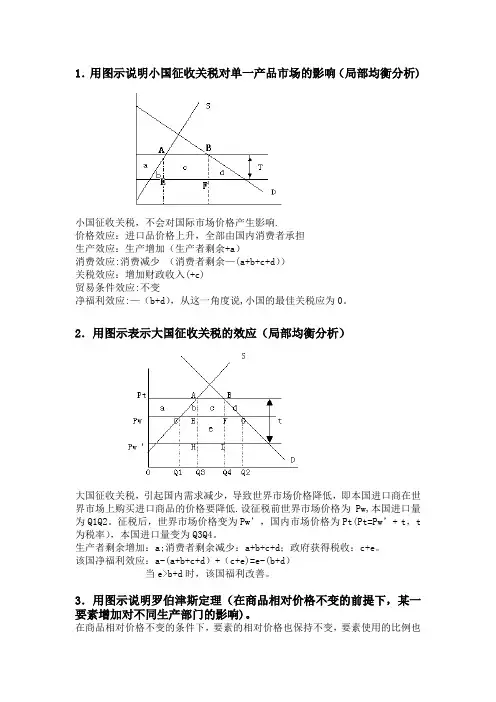
1.用图示说明小国征收关税对单一产品市场的影响(局部均衡分析)小国征收关税,不会对国际市场价格产生影响.价格效应:进口品价格上升,全部由国内消费者承担生产效应:生产增加(生产者剩余+a)消费效应:消费减少(消费者剩余—(a+b+c+d))关税效应:增加财政收入(+c)贸易条件效应:不变净福利效应:—(b+d),从这一角度说,小国的最佳关税应为0。
2.用图示表示大国征收关税的效应(局部均衡分析)大国征收关税,引起国内需求减少,导致世界市场价格降低,即本国进口商在世界市场上购买进口商品的价格要降低.设征税前世界市场价格为Pw,本国进口量为Q1Q2。
征税后,世界市场价格变为P w’,国内市场价格为Pt(Pt=Pw’+ t,t 为税率),本国进口量变为Q3Q4。
生产者剩余增加:a;消费者剩余减少:a+b+c+d;政府获得税收:c+e。
该国净福利效应:a-(a+b+c+d)+(c+e)=e-(b+d)当e>b+d时,该国福利改善。
3.用图示说明罗伯津斯定理(在商品相对价格不变的前提下,某一要素增加对不同生产部门的影响)。
在商品相对价格不变的条件下,要素的相对价格也保持不变,要素使用的比例也保持不变。
如果假定X产品为资本密集型产品,则资本的增加,必然会导致X产品的增加.而Y产品由于投入劳动的减少,造成产品的减少。
图形如下:4.下图是某国出口补贴的图形,其中.Pw为补贴前世界市场价格,Ps 为补贴后的出口价格,P s’为补贴后的世界市场价格。
请标明在出口补贴情形下的生产者剩余、消费者剩余和政府补贴额是多少,并分析出口补贴对一国福利的影响.本图为大国出口补贴的情形,即由于出口补贴,出口量增加,导致世界市场的均衡价格下降。
但国内生产者却能够以较高的价格生产,消费者不得不承受较高的价格。
故:生产者剩余增加,+(a+b+c)消费者剩余减少,—(a+b)政府补贴额为,—(b+c+d+e+f+g)很显然,从静态看,出口补贴导致一国福利下降,使福利减少了(b+d+e+f+g)。
国际经济学习题与答案2

国际经济学习题与答案2第一章国际贸易理论的微观基础习题(一)选择题1.微观经济学研究的是单个社会的资源配置问题,而国际贸易理论研究的是()A 一国的资源配置问题B两国范围内的资源配置问题C地区范围内的资源配置问题D世界范围内的资源配置问题2. 一个人在作出选择时,()A如果边际收益非常大,他或她就不用考虑机会成本B进行最小机会成本的选择C比较该选择活动的边际成本和边际收益D只有当总利益非常大时,他或她才会选择使用其稀缺的资源3.机会成本()A由自己支付,而与他人无关B对劳务而言是零,因为劳务不会持续太久;对物品而言是正的,因为物品具有长久性C是为了进行某一选择而放弃的评价最高的选择D是为了进行某一选择放弃的所有选择4.如果两个人在商品的生产中具有不同的机会成本,那么他们能够从专业化与交换中()A都受损B一人受益,一人受损C既不受益,也不受损D都能够受益5. 沿着外凸的生产可能性边界线向下移动时,随着一种物品产量的增加,生产该物品的机会成本将()A保持不变B增加C减少D无法确定6 .一个国家(),能够在其生产可能性边界线之外的点上进行消费。
A没有任何时候B在充分就业的情况下C同其他国家进行贸易时D所有生产要素全部投入生产的时候7.供给曲线除了表示不同的价格水平所提供的商品数量外,还可以被认为是()A愿意并有能力支付的曲线B边际收益曲线C供给的最高价格曲线D供给的最低价格曲线8. 在封闭条件下,一国生产技术的改进降低了棉花的生产成本,那么棉花的价格(),棉花的生产数量()A上升;增加B上升;减少C下降;增加D下降;减少9 .对于两国贸易模型来说,国际均衡价格一定处于两国贸易前的()A最低相对价格水平之下B最高相对价格水平之上C相对价格水平之间D根据具体情况而定10 .经济学家作出这样的假设:作为一种目标,消费者总是在追求()A其效用最大化B其收入的最大化C其边际效用的最大化D以上选项均不对(二)简答题1如何理解狭义和广义的国际贸易,国际贸易理论的主要研究对象是什么?2既然国际贸易理论与微观经济学的基本原理存在着一致性,为什么还要区分国际贸易与国内贸易,将国际贸易作为一个独立的问题来研究呢?3用相对价格概念解释经济行为主体是如何摆脱“货币幻觉”的影响的。
关税测试题及答案

关税测试题及答案一、选择题1. 根据WTO规则,成员国对进口商品征收关税时,应遵循的原则是:A. 最惠国待遇原则B. 国民待遇原则C. 非歧视原则D. 互惠原则2. 下列哪项不是关税的主要功能?A. 收入功能B. 保护功能C. 调节功能D. 惩罚功能二、填空题3. 进口关税通常分为_______和_______两种形式。
4. 出口商品征收关税在国际贸易中较为罕见,但某些国家为了保护_______或_______,可能会对出口商品征收关税。
三、简答题5. 简述关税对国际贸易的影响。
四、计算题6. 某国对进口汽车征收20%的关税,如果一辆汽车的到岸价格为30,000美元,计算该汽车的关税金额。
五、论述题7. 论述关税政策在国家经济中的作用及其可能带来的问题。
答案:一、1. A2. D二、3. 从价税,从量税4. 环境,资源三、5. 关税对国际贸易的影响主要体现在以下几个方面:首先,关税可以调节国内外商品的价格,保护国内产业;其次,关税可以作为国家财政收入的一部分;再次,关税政策可以影响国际贸易流向,促进或限制某些商品的进出口。
四、6. 该汽车的关税金额为30,000美元 * 20% = 6,000美元。
五、7. 关税政策是国家宏观经济调控的重要手段之一。
它可以保护国内产业免受外国商品的冲击,促进国内产业的发展;同时,关税也是国家财政收入的重要来源。
然而,过高的关税可能会引起贸易伙伴的不满,导致贸易摩擦;此外,关税壁垒也可能阻碍国际贸易的自由化,影响全球经济的发展。
关税单元测试及答案
第八章关税单元测试及答案一、单项选择题1、与复式税则相比,单式税则( )。
A.又称二栏税则B.只适用于享有最惠国待遇的国家C.被大多数发展中国家采用D.不利于实行差别待遇2、与从价税相比,从量税( )。
A.在商品价格上涨时保护作用更强B.在商品价格下降时保护作用更强C.能够体现公平税负原则D.目前被大多数国家采用3、按关税税基分类,进口关税一般包括从价税、从量税、混合税和( )。
A.反贴补税B.反倾销税C.选择税D.进口税4、发达国家对来自发展中国家的初级产品主要采取(方法征进口关税。
A.从价税 B.从量税 C.混合税 D.选择税5、进口附加税是一种( )。
A.特定的临时性措施B.普遍采用的措施C.经常性的措施D.非关税措施6、进口关税的纳税主体是( )。
A.本国进口商 B.外国出口商C.外国进口商D.进口商品7、对于工业制成品的关税征收主要采用( )方法征收。
A.从量税B.从价税C.选择税 D.季节税8、最低的一种关税为( )。
A.普通关税B.最惠国税C. 普惠制关税 D.特惠税9、按照征税的目的,关税可分为( )。
A.进口税,出口税,过境税B.进口税,进口附加税C.最惠国税,特惠税,普遍优惠税D.财政关税,保护关税10、一般地,大多数国家的关税结构是:对工业制成品的进口征收较高的关税,对半制成品的进口征收的税率( ),对原料的进口甚至免税。
A.最高B.较高C.较低D.二、多项选择题1、进口附加税的征收目的主要有( )。
A.应付国际收支危机B.维持进出口平衡C.防止外国商品低价倾销D.对他国实行歧视或报复E.增加财政收入2、下列属于进口附加税的有( )。
A.差价税 B 特惠税 C反补贴税D.反倾销税 E.名义关税3、关税的税收主体是( )。
A.外国进口商B.外国出口商C.本国进口商D.本国出口商E.进出口货物4、征收进口附加税的目的主要有( )。
A.增加财政收入 B.维持进出口平衡C.应付国际收支危机D.防止外国商品低价倾销E.对他国实行歧视或报复5、一般来说,对进口商品课征关税会导致进口国( )。
Multiple Choice Questions 国际经济学 进口关税福利效应
Multiple Choice Questions1. A tax on imports that is stipulated as a money amount per unit iscalled:a. A specific tariff.b.An ad valorem tariff.c.An effective tariff.d.An optimal tariff.ANSWER: A2. A tariff generally __________ domestic producers ofimport-competing products and ____ domestic consumers of imports and import-competing goods.a.Helps; helpsb.Hurts; hurtsc.Helps; hurtsd.Hurts; helpsANSWER: C3. A tariff allows domestic producers of import-competing goods to:I.Expand their own production and sales.II.Raise the price they charge.III.Begin to export their product.a.Ib.I and IIc.I, II, and IIId.I and IIIANSWER: B4.If a small country imposes a tariff on imported motorcycles, theworld price of motorcycles will __________ and the domestic price of motorcycles will __________.a.Rise; riseb.Fall; risec.Stay constant; rised.Stay constant; fallANSWER: C5.If a small country imposes a tariff on imported motorcycles, thesurplus of domestic producers of motorcycles will __________ and the surplus of domestic consumers of motorcycles will __________.a.Rise; riseb.Fall; fallc.Fall; rised.Rise; fallANSWER: D6.Which of the following refers to the loss consumers in theimporting country suffer based on their reduction in the consumption of a good after a tariff is imposed on that good?a.Production effect.b.Consumption effect.c.Deadweight loss.d.Consumer surplus.ANSWER: B7.Which of the following refers to the extra cost of shifting to moreexpensive home production following the imposition of a tariff?a.Production effect.b.Consumption effect.c.Deadweight loss.d.Producer surplus.ANSWER: AFigure 8.1: The U.S. Market for ShoesPrice8.Referring to Figure 8.1, the impact of a tariff on shoes on theamount of domestic producer surplus is a __________ measured by area __________.a.Gain; ab.Loss; ac.Gain; (a+b)d.Loss; (a+b)ANSWER: A9.Referring to Figure 8.1, the impact of a tariff on shoes on theamount of domestic consumer surplus is a __________ measured by area __________.a.Gain; db.Loss; dc.loss; (a+b+c+d)d.Loss; (b+d)ANSWER: C10.Referring to Figure 8.1, the revenue collected by the U.S. governmentas a result of the tariff on shoes is shown by area __________.a.ab. a + bc.cd. b + c + dANSWER: C11.Referring to Figure 8.1, the imposition of a tariff on shoes causedeconomic welfare in the U.S. to __________ by an amount measured by area __________.a.Fall; cb.Fall; (b+d)c.Fall; (b+c+d)d.Rise; (a+c)ANSWER: B12.Referring to Figure 8.1, what area measures the production effect ofthe tariff on shoes?a.ab.bc.cd.dANSWER: B13.Referring to Figure 8.1, what area measures the consumption effectof the tariff on shoes?a.ab.bc.cd.dANSWER: DFigure 8.2: The U.S. Market for ComputersPrice$2,400$2,00014.Referring to Figure 8.2, under free-trade the U.S. imported __________computers, but after imposing a tariff the U.S. imported __________computers.a.100,000; 70,000b.70,000; 100,000c.200,000; 190,000d.90,000; 100,000ANSWER: A15.Referring to Figure 8.2, the imposition of a tariff on computerscaused producer surplus to __________ by __________.a.Rise; 20,000 computersb.Rise; $44,000c.Rise; $44 milliond.Fall; $48 millionANSWER: C16.Referring to Figure 8.2, the imposition of a tariff on computers caused consumersurplus to __________ by __________.a.Fall; 10,000 computersb.Fall; $40,000c.Rise; $76 milliond.Fall; $78 millionANSWER: D17.Referring to Figure 8.2, how much revenue will the U.S. governmentcollect as a result of the tariff on computers?a.$400,000b.$40 millionc.$28 milliond.$76 millionANSWER: C18.Referring to Figure 8.2, the imposition of a tariff on computerscaused economic welfare in the U.S. to __________ by __________.a.Fall; 30,000 computersb.Fall; $6 millionc.Rise; $34 milliond.Fall; $34 millionANSWER: B19.Referring to Figure 8.2, what is the production effect of the tariff oncomputers?a.$48 million.b.$4 million.c.$28 million.d.$44 million.ANSWER: B20.Referring to Figure 8.2, what is the consumption effect of the tariffon computers?a.$2 million.b.$4 million.c.$76 million.d.$78 million.ANSWER: AUse the following information to answer questions 21 thru 27.A small country is considering imposing a $5 per bottle tariff on imported wine. Economists have estimated the following figures based on this tariff amount:World price of wine (free trade): $20Domestic production (free trade): 500,000Domestic production (after tariff): 600,000Domestic consumption (free trade): 750,000Domestic consumption (after tariff): 650,00021.With no tariff on imported wine, the country’s imports __________bottles of wine, but after imposing the tariff the country will import __________ bottles of wine.a.100,000; 100,000b.250,000; 50,000c.150,000; 50,000d.750,000; 650,000ANSWER: B22.The imposition of the tariff on wine will cause domestic producersurplus to __________ by __________:a.Rise; 100,000 bottlesb.Rise; $500,000c.Fall; $2.5 milliond.Rise; $2.75 millionANSWER: D23.The imposition of the tariff on wine will cause domestic consumersurplus to __________ by __________:a.Fall; 100,000 bottlesb.Fall; $250,000c.Fall; $3.5 milliond.Rise; $3.5 millionANSWER: C24.The imposition of the tariff on wine will cause government tariffrevenue to rise by how much?a.$250,000b.$1.25 millionc.$3.5 milliond.$500,000ANSWER: A25.The imposition of the tariff on wine will cause the country’seconomic well-being to __________ by __________.a.Fall; $0.5 millionb.Rise; $0.75 millionc.Fall; 100,000 bottles of wined.Fall; $0.75 millionANSWER: A26.What would be the production effect of the tariff on wine?a.$250,000b.$500,000c.$2.5 milliond.$2.75 millionANSWER: A27.What would be the consumption effect of the tariff on wine?a.$250,000b.$500,000c.$3.5 milliond.$2.75 millionANSWER: A28.Which of the following is a change in the ratio of international pricesof a large country's exports to the international price of the largecountry's imports resulting from the imposition of a tariff in thecountry?a.One-dollar, one-vote.b.Production effect.c.Consumption effect.d.Terms-of-trade effect.ANSWER: D29.Which of the following refers to the percentage by which a nation'strade barriers raise an industry's value added per unit of output?a.One-dollar, one-vote.b.Optimal tariff.c.Effective tariff.d.Terms-of-trade effect.ANSWER: C30.Given the following information about domestic lamp production,what is the effective rate of protection afforded to the domestic lamp industry by a 20% tariff on lamps?With free trade:Unit value (price) of a lamp = $175.00Unit cost of lamp inputs = $100.00With 20% tariff on lamps:Unit value (price) of a lamp = $210.00Unit cost of lamp inputs = $100.00a.20%b.46⅔%c.110%d.102⅔%ANSWER: B31.At free-trade prices, a tennis racquet sells for $100 and contains $40worth of aluminum inputs and $30 worth of plastic. In Country A, the nominal tariff rates are 40% on tennis racquets, 20% on aluminum, and 10% on plastic. Given these rates, what is the effective rate of protection on racquets in Country A?a.40%b.63⅓%c.10%d.96⅔%ANSWER: D32.Which of the following statements is accurate?I.Tariffs are likely to decrease world economicwell-being.II. A tariff helps producers and hurts consumers in the country imposing the tariff.III. A tariff always decreases economic domesticwell-being if imposed in a small country and may increase,decrease, or leave unchanged the economic well-being ifimposed in a large country.a.I and IIb.I and IIIc.II and IIId.I, II, and IIIANSWER: D33.If a country with monopsony power imposes a tariff on importedfarm equipment, the world price of farm equipment will:a.Fall.b.Rise.c.Be unaffected.d.Become equal to the domestic price of farm equipment.ANSWER: A34.An optimal tariff is __________ the more __________ the foreign exportsupply.a.Higher; elasticb.Lower; rigidc.Higher; inelasticd., ;&nbs, p; Lower; inelasticANSWER: C35.A nation can gain from imposing a tariff if:a.The tariff is a prohibitive tariff.b.The tariff is an ad valorem tariff.c.The tariff causes the world price to fall to such a degree thatthe amount of the tariff paid by foreign exporters exceeds thelosses caused by the production and consumption effects.d.The tariff causes the tariff revenue collected by the domesticgovernment to exceed the losses caused by the production andconsumption effects.ANSWER: C36.At free-trade prices, a bicycle sells for $100 and contains $90 worth ofinputs. Country X has a nominal tariff rate of 15% on bicycles, and 10% on the inputs. Given these rates, what is the effective rate of protection of bicycles in Country X?a.10%b.60%c.5%d.15%ANSWER: BUse the following information to answer questions 37 thru 39.With free trade, a big country produces 1 million bikes per year and imports another 2 million bikes per year at the (world) price of $60 per bike. Assume that the country imposes a specific tariff of $5 per bike. As a result, the world price of a bike decreases to $58; the import of bicycles drops down to 1.6 million bikes; and the domestic production increases to 1.1 million bikes.37.After the country imposes the tariff, domestic consumers are paying aprice of __________ for a bike.a.$60b.$70c.$63d.$65ANSWER: C38.As a result of the tariff, the government collects an amount of__________ million dollars in tax revenue.a.2b.4c.6d.8ANSWER: D39.As a result of the imposed tariff:a.The country gains national well-being because the tariffencourages production.b.The country loses national well-being because the tariff hurtsconsumers.c.The country loses national well-being because tariffs alwayslead to a welfare loss.d.The country gains national well-being because the amount ofthe tariff revenue paid by the exporting country more thanoffsets the consumption and the production effect.ANSWER: D40.The nationally optimal tariff is the tariff for which:a.The production effect is equal to the consumption effect.b.The government collects the highest revenue.c.The highest difference between the government tariff revenueand the sum of consumption and production effect is attained.d.The highest difference between the part of the tariff revenuepaid by the exporting country and the welfare loss associatedwith the consumption and production effects is attained.ANSWER: D41.Which of the following has overseen the global rules of governmentpolicy toward international trade since 1995?a.World Trade Organization.b.General Agreement on Tariffs and Trade.c.International Monetary Fund.d.World Bank.ANSWER: ATrue/False Questions42.When a tariff is imposed, it is expected that domestic producers willraise their price to the same level as the price of the imported product after the tariff is imposed.ANSWER: TRUE43.A tariff always lowers the well-being of each nation, including thenation imposing the tariff.ANSWER: FALSE44.A tariff imposed by a small country hurts the tariff imposing countrybut brings gains to the rest of the world.ANSWER: FALSE45.The consumption effect shows the welfare loss to the economyresulting from consumers shifting from imports to more expensive domestic production.ANSWER: FALSE46.The one-dollar, one-vote metric says that every dollar of gain is moreimportant than every dollar of loss, regardless of who the gainers or losers are.ANSWER: FALSE47.A nationally optimal tariff causes no production or consumptioneffects.ANSWER: FALSE48.The United Nations oversees global rules of government policytoward international trade.ANSWER: FALSE49.It is possible for a large country to be better off, worse off, or nobetter off/no worse off as a result of a tariff being imposed. ANSWER: TRUE50.For a small country, the consumption effect plus the productioneffect represent the loss in economic welfare that results from the imposition of the tariff.ANSWER: TRUE51.Monopsony power is a change in the ratio of international prices ofa large country's exports to the international price of the largecountry's imports resulting from the imposition of a tariff by thecountry.ANSWER: FALSE52.A nationally optimal tariff is a tariff that creates the largest net gainfor the country imposing it.ANSWER: TRUE53.Within a country, a tariff causes a redistribution of well beingbetween domestic producers and the government only. ANSWER: FALSE54.A small country always stands to lose by imposing a tariff becausethe tariff will not have an impact on its terms of trade. ANSWER: TRUE55.The effective rate of protection of a product measures how acountry’s entire set of trade barriers affects the value added per unit of output of this product.ANSWER: TRUE56.An ad valorem tariff is formulated as a money amount per unit ofimport that is due when the good reaches the importing country. ANSWER: FALSE57.The production effect measures the welfare gain of domesticproducers which can sell their product at a higher price as a result of the imposed tariff.ANSWER: FALSEEssay Questions58.Suppose that the world price of automobiles is $20,000 and domesticproducers of automobiles use $10,000 worth of imported inputs and no domestic inputs. What is the effective rate of protection in thedomestic automobile industry if there is a 25% tariff on importedautomobiles and a 50% tariff on imported inputs?POSSIBLE RESPONSE: The effective rate of protection for an industry is measured as the percentage change in the unit value added whichresults from all protective measures on inputs and the final good. With free trade, the value added for an automobile is$20,000-$10,000=$10,000. With a 25% tariff on imported automobiles, the new price for an automobile rises to $25,000. Accounting for thetariff on imported inputs, the new value of the inputs is $15,000. The new value added for an automobile is $25,000-$15,000=$10,000. The effective rate of protection is then ($10,000-$10,000)/$10,000=0%.pare and contrast the effects of a tariff on prices and nationalwell-being imposed in a small country with the effects of a tariffimposed in a large country. Be sure to include carefully drawn graphs.POSSIBLE RESPONSE:T ariff by a small countryTariff by a large countryA tariff imposed by a small country will not have an impact on the world price of the good. That is, the domestic price will rise by the amount of the tariff. A small country cannot gain by imposing a tariff. The welfare loss resulting from the tariff is measured by the sum of the production effect (area b) and the consumption effect (area d). As a result of the tariff, consumers lose the area (a+b+c+d), producers gain area (a), and the government collects the area (c) in tariff revenues.A tariff imposed by a large country will have an effect on the world price. As shown in the second graph, the world price will decrease once the tariff is imposed. The resulting effects on consumers and producers will essentially be the same as the above described effects. The difference (compared to the case of a small country) is the area (e) which measures the portion of the government tariff revenues that are effectively paid by foreigners. The burden of this part of thegovernment tariff revenues is carried by the foreign producers who now export to the country at a lower price. Whether a large country eventually gains or loses from the tariff depends on whether the gained area (e) is larger or smaller than the welfare loss associated with the area (b+d).60.You are given the following information about copper in the UnitedStates:Situation SituationWith T ariff Without T ariffWorld Price $0.40 per lb. $0.50 per lb.T ariff (specific) $0.20 per lb. 0U.S.Domestic Price $0.60 per lb. $0.50 per lb.U.S. Consumption 210 million lb. 250 million lb.U.S. Production 140 million lb. 100 million lb.1Calculate the loss to U.S. consumers of copper from imposing the tariff.2Calculate the gain to U.S. producers of copper from imposing the tariff.3Calculate the gain in tariff revenue to the U.S. government from imposing the tariff.4Calculate the net gain or loss to the U.S. economy as a whole from imposing the tariff.POSSIBLE RESPONSE:5As a result of the tariff the domestic price rises by $0.10 (from $0.50 to $0.60) per pound. Consumers consume 250-210=40 million pounds less. The consumption effect is ½ x $0.10 x 40 million = $2 million. Consumers lose additionally $0.10 x 210 million = $21 million due to the higher price they pay for their consumption after the tariff is imposed. They lose a total of $23 million.6U.S.producers charge $0.10 more per pound and expand their production by 40 million pounds. Their gain of producer surplus from expanding the production quantity is ½ x $0.10 x 40 million= $2 million. Their gain from selling the production quantity they used to sell before the tariff now at a $0.10 higher price is 100 million x $0.10=$10 million. Their gain totals $12 million.7The tariff revenue to the U.S. government equals the product of the imported quantity and the tariff per unit. After imposing the tariff the U.S. imports 210-140=70 million pounds. The U.S. revenue is $0.20 x 70 million= $14 million.The net gain of the U.S. as a whole is $14 million in governmentrevenue minus $23 million in consumer loss, plus $12 million inproducer gain, which equals $3 million.61.A country can actually improve its well being if it is in a position toimplement an “optimal tariff”. Explain what an optimal tariff is,what conditions must be in place in order to implement an optimaltariff, and how such a tariff will increase national welfare. Assumingyour country could implement an optimal tariff, would you suggest it do so? Why or why not?POSSIBLE RESPONSE: An optimal tariff is a tariff which maximizes the welfare of a country as measured by the gain in tariff revenue that is essentially paid by foreigners to the government minus the lossassociated with the consumption and production effects arising from the tariff. A country can gain by a tariff only if it is large enough tohave an impact on the international price of the product. By imposinga tariff the country can improve its terms of trade, and mayexperience a net gain. One needs to exert caution when advisinggovernment officials on the implementation of a tariff. Such adecision should incorporate the eventuality that importing countries retaliate by imposing trade restrictions on your country’s exports.62.“The higher the tariff, the more domestic production is increased. Thus,a prohibitive tariff is socially optimal.” Comment on this statement drawing on all you have learned in the course up to now.POSSIBLE RESPONSE: The statement is based on the (false) premise that more domestic production is better than less. Also, the statement fails to account for the well-being of other agents in the economy who are not producers: the consumers who are interested in a lower price of the good, and the government, which is collecting revenue.Let us focus first on the decision of producers. It is true that thehigher the tariff the higher the quantity supplied by domesticproducers. However, for the society as a whole this production might be too costly. It involves valuable resources that can have a better use in other industries. The loss associated with such an inefficientproduction is the production effect.A prohibitive tariff will definitely be to the disadvantage of consumersbecause the consumers will not be able to consume imports at all.The consumption effect is the loss for consumers who buy less of the product. For the government, a prohibitive tariff generates nogovernment revenues as there will be no imports of the good.63.When a small country imposes a tariff, the domestic price of thegood increases. This causes a “production” and a “consumption”effect. Explain carefully these two effects, and discuss whether theyincrease or decrease the country’s well-being.POSSIBLE RESPONSE: Small countries cannot affect the international prices of goods when they impose tariffs or other trade barriers. If a small country imposes a tariff, the domestic price of the productincreases by the size of the tariff. This will have an effect on thedecisions of domestic producers and consumers.Producers will start to produce more because they can now sell the product domestically at a higher price. Although producers stand to gain, this gain is at the expense of consumers who are paying a higher price. From the viewpoint of the society as a whole, this increase of production is a loss. The increased production costs more resources to make at home than to import from abroad. This loss is called the “production effect”.Consumers will start to consume less of the product due to its higher price although they value the product more than its internationalprice (without the tariff). This is the source of the “consumptioneffect”, which is again a loss for the country.The Basic Analysis of a TariffOverviewThis chapter begins the analysis of government policies that limit imports, by examining the tariff—a government tax on imports. The chapter has two major purposes. First, the analysis shows the effects of a tariff when the importing country is small, so that its import policies have no effect on world prices. Second, the analysis of a large importing country—one whose policies can affect world prices—shows that a large country can use a tariff to lower the price that it pays foreigners for its imports.We begin by examining the effects of a tariff imposed by a small country (contrasted with free trade), using supply and demand within the importing country. Since foreign exporters do not change the price that they charge for the product, the domestic price of the imported product rises by the amount of the tariff. Domestic producers competing with these imports can also raise their domestic prices as the domestic price of imports rises. Domestic producers gain when the government imposes a tariff on competing imports. They get a higher price for their products, they produce and sell a larger quantity (a movement along the domestic supply curve), and they receive more producer surplus. (The effects of the entire tariff system on domestic producers can be more complicated than this, because other tariffs can raise the costs of materials and components. The box on "The Effective Rate of Protection" discusses this more complete analysis, focusing on the effects of the tariff system on value added per unit of domestic production.)Domestic consumers of the product are also affected by the imposition of the tariff. They must pay a higher price (for both imported and domestically produced products), they reduce the quantity that they buy and consume (a movement along the domestic demand curve), and they suffer a loss of consumer surplus.The government also collects tariff revenue, equal to the tariff rate per unit imported times the quantity that is imported with the tariff is imposed (less than the free-trade import quantity).We thus have two domestic winners (domestic producers and the national government) and one domestic loser (domestic consumers) because of the imposition of a tariff. We can evaluate the net effect on the whole country, if we have some way of comparing winners and losers. As we did beginning in Chapter 2, we can, for instance, use the one-dollar-one-vote measure. Part of what consumers lose is matched by the gain to domestic producers, and another part is matched by the revenue gain to the government. But there is an additional amount that consumers lose and that is not a gain to the other groups. This is the net national loss from a tariff (for a small country). In the national market graph this loss is two triangles; equivalently, in the import-export graph this loss is one triangle.If we look at the national market graph, we can see why these are deadweight losses. The consumption effect of the tariff is the loss of consumer surplus for those consumers who are squeezed out of the market because the tariff "artificially" raises the domestic price, even though foreigners remain willing to sell products to the importing country at the lower world price. The production effect of the tariff is the loss from using high-cost domestic production to replace lower-cost imports (available to the country at the unchanged world price). The high production cost is shown by the height of the supply curve, for each of the extra units produced because of the tariff.The analysis is affected in important ways if the importing country is a large country, one that has monopsony power in world markets. A large country can gain from the terms-of-trade effect when it imposes a tariff. The tariff reduces the amount that the country wants to import, so foreign exporters lower their price (a movement along the foreign supply-of-exports curve). We analyze the large country case using the international market (imports and exports), and we show the tariff as driving a wedge between demand and supply, so the price to the import buyers exceeds the price received by foreign exporters by the amount of the tariff. For the large importing country, the imposition of the tariff causes a triangle of national loss (comparable to the one shown for the small country) but also a rectangle of national gain because the price paid to foreign exporters is lowered, for the units that the country continues to import.The net effect on the importing country depends on which of these two is larger. For a suitably small tariff, the rectangle is larger, so the importing country has a net gain from imposing a tariff. A prohibitive tariff would cause a net national loss, because the rectangle would disappear. It is possible to determine the country's optimal tariff—the tariff rate that makes the net gain to the importing country as large as possible. The optimal tariff rate is inversely related to the price elasticity of foreign supply of the country's imports.We conclude by pointing out that the optimal tariff causes a net loss to the whole world. The loss to the foreign exporting country is larger than the net gain to the importing country. And a country trying to impose an optimal tariff risks retaliation by the foreign countries hurt by the country's tariffObjectives of the ChapterThis chapter explicitly explains the advantages and disadvantages of a tariff imposition. Except for some recognized exceptional cases, there is a rare consensus among economists that freer trade is better than protectionism. As illustrated in this chapter, economic analysis has consistently。
国际经济学智慧树知到答案章节测试2023年北京航空航天大学
第一章测试1.国际经济学的研究对象是()。
A:国与国之间的经济活动和经济关系B:国与国之间的贸易关系C:国与国之间的金融关系D:国与国之间的政治经济关系答案:A2.国际经济学的研究内容包括以下哪两个部分?()。
A:国际贸易理论B:国际投资理论C:国际金融理论D:国际商务理论答案:AC3.国际贸易理论的主要分析工具有()。
A:总需求-总供给模型B:生产可能性边界C:社会无差异曲线D:机会成本答案:BCD4.国际金融理论研究()。
A:内外均衡理论B:国际贸易融资C:汇率决定理论D:国际收支理论答案:ACD5.国际贸易理论主要研究()。
A:国际贸易实务B:国际分工基础C:国际贸易政策D:国际贸易利益答案:BCD第二章测试1.甲国使用同样数量资源比乙国能生产更多的X,则乙国在X生产上具有()。
A:绝对劣势B:比较劣势C:绝对优势D:比较优势答案:A2.一国绝对劣势最小的产品是该国的()。
A:绝对优势产品B:比较劣势产品C:其他三项答案都正确D:比较优势产品答案:D3.下列对于绝对优势理论的理解正确的是()。
A:运用劳动价值论说明了国际贸易的利益和基础B:说明了国际贸易是一种“零和博弈”C:主张政府应加大对经济的干预D:提出了“金钱是唯一的社会财富”的观点答案:A4.律师打字速度是打字员的两倍却雇佣打字员打字所依据的理论是()。
A:绝对优势理论B:比较优势理论C:相互需求理论D:要素禀赋理论答案:B5.本国共有10000个劳动力,能够生产玉米和橡胶两种产品,单位产品劳动投入分别为3和2。
外国共有9000个劳动力,其玉米和橡胶的单位产品劳动投入分别为4和1,则()。
A:本国和外国分别在橡胶和玉米上具有比较优势B:本国和外国分别在玉米和橡胶上具有比较优势C:本国在橡胶上的劳动生产率要高于外国D:本国在两种产品上都具有绝对优势答案:B6.根据古典贸易理论,贸易后,贸易参与国的福利水平()。
A:均会恶化B:均会改善C:封闭时价格较低的国家会改善D:具有绝对优势的国家会改善答案:B7.如果机会成本递增,则国际贸易将导致()。
国际关税问题考核试卷
8.关税的征收通常会提高进口商品的____。()
9.互惠原则是国际贸易中的一个基本原则,即____原则。()
10.在全球价值链中,中间投入品来源的多样性可以降低关税政策对____的影响。()
四、判断题(本题共10小题,每题1分,共10分,正确的请在答题括号中画√,错误的画×)
A.本国产业受到外国竞争的严重威胁
B.国内市场供应不足
C.国际市场价格波动
D.国内外企业之间存在技术差距
14.关于关税与贸易平衡,以下哪些说法是正确的?()
A.关税可以提高贸易平衡
B.关税可能导致贸易平衡恶化
C.关税对贸易平衡的影响取决于具体情况
D.关税与贸易平衡之间没有关系
15.以下哪些措施可能被用来降低关税对经济的负面影响?()
国际关税问题考核试卷
考生姓名:________________答题日期:________________得分:_________________判卷人:_________________
一、单项选择题(本题共20小题,每小题1分,共20分,在每小题给出的四个选项中,只有一项是符合题目要求的)
1.以下哪项不是关税的主要作用?()
A.国际市场竞争加剧
B.贸易双方对关税政策进行协调
C.世界贸易组织(WTO)的干预
D.贸易双方经济实力差距缩小
14.关于关税与国际贸易的关系,以下哪项描述是正确的?()
A.关税对国际贸易没有影响
B.关税可以提高国际贸易的效率
C.关税可以阻碍国际贸易的发展
D.关税在国际贸易中没有任何作用
15.以下哪个国家的关税政策对国际贸易影响最大?()
关税测试题及答案
关税测试题及答案一、单选题(每题2分,共10分)1. 关税的征收对象是什么?A. 进口商品B. 出口商品C. 国内商品D. 服务贸易答案:A2. 我国关税的征收标准通常依据什么来确定?A. 商品的重量B. 商品的体积C. 商品的价值D. 商品的产地答案:C3. 关税的主要作用不包括以下哪项?A. 保护国内产业B. 增加国家财政收入C. 促进国际贸易D. 调节国际收支答案:C4. 以下哪种关税是针对特定国家或地区实施的?A. 最惠国关税B. 普通关税C. 特惠关税D. 反倾销税答案:C5. 我国对哪些商品实行零关税政策?A. 奢侈品B. 生活必需品C. 高科技产品D. 环境保护设备答案:D二、多选题(每题3分,共15分)6. 关税的征收方式包括哪些?A. 从价税B. 从量税C. 复合税D. 选择税答案:ABC7. 以下哪些因素会影响关税的征收?A. 国际政治关系B. 国内经济状况C. 国际市场需求D. 国内产业政策答案:ABCD8. 我国关税政策的主要目标包括哪些?A. 促进国内产业发展B. 保护消费者权益C. 维护国家经济安全D. 促进国际贸易平衡答案:ACD9. 以下哪些措施可以减少关税对贸易的影响?A. 降低关税税率B. 提高关税透明度C. 实行贸易便利化D. 增加非关税壁垒答案:ABC10. 我国对哪些商品实行较高的关税保护?A. 农产品B. 高端制造业产品C. 能源产品D. 文化产品答案:AB三、判断题(每题1分,共10分)11. 关税的征收可以完全由国家单方面决定。
(错)12. 关税的征收有助于减少国际贸易摩擦。
(对)13. 所有国家对所有商品都实行统一的关税税率。
(错)14. 关税的征收可以有效地保护国内的幼稚产业。
(对)15. 我国对所有进口商品都实行零关税政策。
(错)16. 关税的征收有助于增加国家的财政收入。
(对)17. 我国对出口商品不征收关税。
(对)18. 关税的征收可以调节国际收支平衡。