
外研版七年级英语上册Module 4 Unit 2教案
Module 4 Healthy food
Unit 2 Is your food and drink healthy?
教学目标
【知识与技能】
1. 掌握下列单词和短语:healthy, delicious, bread, fish, hamburger, ice
cream, noodle, rice, sugar, eat, child (pl. children), sweet, right, egg, eye, cheese, tooth (pl. teeth), bit, tired, soup, important, remember, well, stay, fat, or, breakfast, every, lunch, home, dinner, be good for, be bad for, a bit
2. 掌握下列句型:… and …are healthy food but … and … are my favourite food.
3. 能听懂关于食物和饮料的对话。
4. 能掌握have got的肯定句、否定句、疑问句及其回答。
5. 能谈论自己喜欢的食品、健康食品以及购买食物。
【情感、态度与价值观】
让学生学会区分健康食品与垃圾食品,培养学生形成良好的饮食习惯,拥有强健的体魄。
教学重难点
【教学重点】
能够读懂有关健康食品的短文。
并能在阅读中找出哪些是healthy food and drink 和unhealthy food and drink ,完成任务。
【教学难点】
能够发表自己对食品的看法。
教学过程
Step 1 Warming-up
1. Show some pictures to review the words of food and drink.
2. Review the text of Unit 1.
Step 2 Work in pairs.
1. Remember six words for food and drink. Make two lists.
Healthy food and drink:
Favourite food and drink:
2. Look at the pictures. Label the food and drink.
Answers:
1. noodles
2. ice cream
3. fish
4. hamburger
5. Coke
6. rice
7.candy Eat : noodles, ice cream, fish, hamburger, rice, candy
Drinks : Cola
3. Call back the answers from the whole class.
4. Read the words after the teacher.
Step 3 Reading.
1. Play the recording.
2. Ask the students to read through the passage.
3. Read the passage and complete the table.
4. Check with a partner.
5. Call back the answers from the whole class.
Keys:
1. Healthy food and drink: meat, carrots, eggs, potatoes, milk, cheese, fish, chicken, noodles, rice, juice, water, tea, fruit, vegetables
2. Not healthy food and drink: ice cream, hamburgers, cola, candy
Step 4 Do exercises.
1. Ask the students to read through the passage in Activity 4.
2. Complete the passage with the correct from of the words and expression from the box..
3. Check with a partner.
4. Call back the answers from the whole class.
5. Read the passage together.
Keys: 1. important 2. meal 3. lots of 4. sweet 5. teeth 6. delicious 7. fat 8. remember 9. stay
Step 5 Work in pairs.
1. Ask the students to choose food from Units 1 and 2 for their meals.
2. Talk about their answers like this:
1) What’s your favourite food and drink?
2) Is it healthy food and drink?
Step 6 Writing.
1. Join the sentences with but.
1) Juice is a healthy drink. Cola isn’t a healthy drink.
2) Noodles are healthy food. Hamburgers aren’t healthy food..
3) Meat, vegetables and fruit are healthy food. Cola, ice cream and hamburgers aren’t healthy food and drink.
4) Chocolate is delicious. Too much chocolate isn’t good for you.
2. Check with a partner.
3. Call back the answers from the whole class.
4. Complete the sentence about you.
… and …are healthy food but … and … are my favourite food.
Step 7 Important and difficult points.
A.重点短语:
1. have/has got 拥有
2. go shopping 去买东西;去购物
3. let’s do sth. 让我们去做某事
4. too much 太多
5. too many 太多
6. lots of 许多
7. be good for 对……有益8. be bad for 对……有害
9. How about… ? ……好吗?……行吗?
B.重要知识点:
一、不可数名词有:
1.water 水
2. meat 肉
3.food食物
4.fruit水果
5.beef牛肉
6.chicken鸡肉
7.juice 果
汁8. ice cream 冰激凌9.tea茶10.rice米饭11.bread面包k 牛奶13.coke 可乐14.chocolate 巧克力15.fish鱼肉16. cheese 奶酪17. sugar 糖18. candy糖果19. soup汤
二、可数名词的特殊变化:
1.child—children 孩子
2. tooth—teeth牙齿
三、连词and, or, but 的区别:
1.and:表示“和,又,与,并”,连接两个名词、动词或句子,表示并列关系。
2.or:用于否定句表示“和”的意思,用于疑问句中表示“还是,或者”的意思。
3.but:意思是“但是,而是”,表转折关系。
Homework
Write a passage to describe a healthy diet.
教学反思。
外研版英语七年级上第四模块教材分析
教学重点、 四.教学重点、难点 教学重点
教学重点: 教学重点:
Key vocabulary—email, him, have got, uncle Key structures---there is/are… I have got…
教学难点: 教学难点:
have/has got 和there be 句型的区别。 句型的区别。
5. small 与 little 区别 都含有“ 的意思。 主要强调形状、 (1)small和little 都含有“小”的意思。但small主要强调形状、面积等小, ) 和 主要强调形状 面积等小, 它不含有任何的感情色彩。 它不含有任何的感情色彩。 Eg: The box is too small. 这个盒子太小。 这个盒子太小。 主要指年龄小,含有很强的感情色彩, (2)little 主要指年龄小,含有很强的感情色彩,主观上表示对人或某种小 ) 动物含有喜爱之意。 动物含有喜爱之意。 Eg: The little girl is Mr Wang’s daughter. 那个小女孩是王先生的女儿。 那个小女孩是王先生的女儿。 6. Thank you for your email. 谢谢你的电子邮件。 谢谢你的电子邮件。 短语: 短语:Thank you for… 剖析: 表示……而感谢你。” 介词 而感谢你。 介词for 后可以接名词、代词或动词的 后可以接名词、代词或动词的-ing 剖析: “表示 而感谢你 形式。其另一种表达方式是Thanks for…。 形式。其另一种表达方式是 。 Eg: Thanks/Thank you for helping me. 谢谢你对我的帮助。 谢谢你对我的帮助。 thanks for 与thanks to的区别 的区别 因某事而感激某人” 表示对对方的行为表示感谢。 (1)thanks for 是“因某事而感激某人”,表示对对方的行为表示感谢。 ) 则表示“由于,多亏” (2)thanks to 则表示“由于,多亏”,其中的介词短语在句中作原因状 ) 常位于句首。 语,常位于句首。
七年级英语外研版上册教案: Starter Module 4 Unit 2

Unit 2What's the weather like?Ⅰ.Teaching modelListening and speakingⅡ.Teaching aims1.To learn the names of seasons and the weather2.To know how to ask and answer the weatherⅢ.Teaching aidsTape recorder,PPTⅣ.Teaching stepsStep 1:Warming-up and lead-in1.Ask students to talk something about their favourite days.2.Ask students to look at the pictures of weather symbols and teach them the words about weather(warm,hot,warm,cool).3.Give students some key words and ask students to guess what the seasons are.eg:white,holiday(假期)→winter;green,flowers→spring;yellow,harvest(收获)→autumn;water,sun→summerStep 2:Listening and repeating1.Play the tape and have students point out the new words in Activity 1.2.Play the tape and have them repeat.3.Have students read the new words aloud.4.Let students read the sentences and look at the pictures in Activity 2.5.Play the tape and have them listen and match.6.Check the answers.Keys:1-d2-b3-a4-c7.Play the tape again and ask students to listen and repeat.Step 3:Practice1.Ask students to look at the pictures in Activity 3 and ask and answer like this:(1)—What's the weather like in spring?—It's warm.(2)—What's the weather like in winter?—It's cold.(3)—What's the weather like in autumn?—It's cool.(4)—What's the weather like in summer?—It's hot.2.Play the tape and have them point.3.Ask some groups to show in class.4.Show students a map of China and ask and answer like this in pairs(Activity 6):—What's the weather like in Harbin in winter?—It's cold.5.And then ask some pairs to show in class.Step 4:Listening and writing1.Ask students to read the conversations in Activity 5.2.Then play the tape and ask students to complete them.3.Play the tape again and check the answers.Keys:1.weather 2.like;winter 3.What's the weather like4.What's the weather like;It's warm4.Let them read the conversations aloud.Step 5:Homework1.Learn the new words by heart.2.Read and recite the conversations.3.Finish off the workbook exercises.Blackboard DesignUnit 2What's the weather like?1.spring,summer,autumn,winter2.warm,hot,cool,cold3.—What's the weather like in spring?—It's warm.。
新外研版七年级上册英语 Module 4 Unit 1 教案(教学设计)

Module 4 Healthy food Unit 1 We’ve got lots of apples单词meat, bean, beef, carrot, chocolate, coffee,1、可数名词单复数的变化2、some和any的用法3、and, or 和but的用法。
能够灵活运用some与any来表达句子。
Step ⅠWarming upWhat food and drink do you know? Ask and answer in pairs.Step II Pre-listeningTask 1两人一组读课本p20 Activity 1的词语,互查纠错。
小组核对Step III Task 1: Discovery1. go +v-ing表示“去做某事”如:去游泳_______ 去钓鱼_______2. too much 意思是“太多”,用来修饰不可数名词。
如:I have got ____ _____ ____ to do today.我今天有太多的作业要做。
too many 意思也是“太多”,用来修饰可数名词复数。
如:There are _____ ____ _____ in the supermarket.超市里人太多。
Task 2: 小组,做一个新对话:A: Have you got any…?B: Yes, I have. / No, I haven’t.C: Has he/ she got any …?D: Yes, he/she has. / No, he/she hasn’t.Step IV DevelopmentRead and complete the dialogue.Tony: Have we got any fruit?Tony’s dad: Yes, we’ve got _____ apples. We _____ got any oranges.Tony: Have we ___ ___ chocolate?Tony’s dad: Yes, _____ got some chocolate. Have we got any_____ _____?Tony: No, we haven’t. ____ we got ___ ?Tony’s dad: No, we haven’t. Let’s get some _______for your mum.【温馨提示】同学们一定要注意some 与any的区别,小组内总结,成员要积极发言。
外研版七年级英语上册教案全集
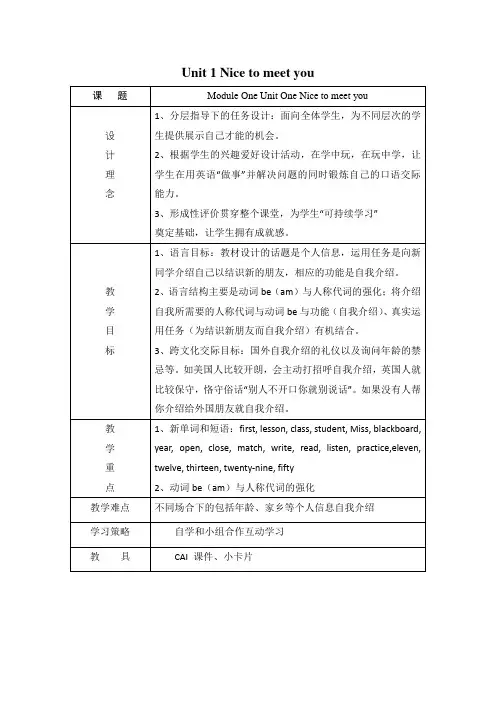
Unit 1 Nice to meet you教学流程图: 教学步骤 l (1课时)一、第一教学环节:情景创设、布置任务、激趣导入二、第二教学环节:师生互动、培养能力、给予成就感三、第三教学环节:评价总结、激发竞争、巩固提高附:评价表(小组成员之间进行评价,以星号为标记,五个星为最高,但是必须小组全票才能通过生效)Unit 2 I’m from China and I’m ChineseTeaching aimKnowledge: *useful expressions in introducing and greeting*nominal genitive pronoun & determinative genitive pronounAbilities: To be able to introduce oneself and others and greet peopleMoral education:To build up students’ confidence and interest in English- learning Key points: Introducing othersThis is Betty. This is my friend, Tony.Difficult points: 1) Asking for and receiving personal information.What’s your nameCan you introduce yourself please, BettyI’m from America. I’m 13 yea rs old.2) To master the names \ languages\ of some countriesTeaching methods: Group work, displayTeaching aids: Computer recorderTeaching procedures:Step 1 Teacher’s self-introduction (Lead-in)Name, Country, language, Age otherKey Sentence Structures:My name is ##.My first name is ##.My telephone number is ##.I’m from ##. I ‘m ##.My age is a secret.I am from Beijing. I come from Beijing. I am a native in Beijing.I come from China. I was born in China and brought up in China. I speak Chinese. In my spare time, I enjoy ###.My E-mail Address is ##.Step 2 Foreign teacher’s introduction (The same)This is our foreign teacher. (Name, Country, language, Age other) Students’ Activity: Listen and get some informationStep 3. The stud ents’ IntroductionNameAgeTeacherYearClassPhone numberE-mail addressCountryLanguageOtherListen and prepare the introduction.Introduce themselves according to the form.Pair work; Introduce themselves.Step 4. Part 2 on the book.Please listen to the tape so that we can know more about Daming, Lingling and Wang Hui. Please don’t open your books. Look at the blackboard.Listen and Answer.:1)Where is Daming from2)Where is Lingling from3)Where is Wang Hui from4)How old are theyName Country Language Age OtherBettyTonyLinglingWork in pairs to practise the dialogue.Students’activity: Listen to the tape; Practise their listening; Improve their abilities of get informationStep 5. Learning the dialogue.Practise the listening skill & Role playStudents’ activity: According to the form, they work in groups to practise the dialogue.Step6. Show a map of the world to practise the names \ languages of the countries Listen and think so many foreign countries’ names.Step7. Read aloudThe students read aloud to practise oral English.Write some sentences about the pictures.Step9. Learning the language item.1)My name’s … /I’m from…/He’s fourteen years old.2)The names of the countries.The students learn the language points.Homework: Introduce one of your pen-friends.Unit 3 Language in use学习目标:1.学习be动词的简单用法。
新外研版七年级上册英语 Module 4 Unit 2 教案(教学设计)

Module 4 Healthy foodUnit 2 Is your food and drink healthy?单词delicious ,hamburger, sugar, sweet,1、学会用but和and来描述自己最喜欢的食物学会用but和and来描述食物。
StepⅠWarming upTalk in pairs : What is your favorite food, fruit, and vegetables, which is healthy and which is not healthy?Step ⅡPre-readingTask 1: Finish Activity1—2(先独立完成,再小组讨论)【温馨提示】根据活动要求完成任务,任务很简单,同学们一定要积极参与Task 2 :Close your books and listen to Activity3 and say “What is Healthy food and drink?”【温馨提示】这是锻炼你们听力的好机会,你们要认真听哟!Task 3 : Finish Activity3(先独立完成,然后结对练习)【温馨提示】小组间展开竞争,看哪一组最棒。
Step ⅢWhile-reading自读短文并能按以下导词进行复述:Noodles and rice are …but too much meat is not… … are sweet and too much sugar is … you. Eat the … food and be … … are good for your eyes, …are good for your teeth.. Have a lot of …when you are a bit tired. It’s important to remember…【温馨提示】学生先跟读课文,纠正语音,语调,解决里面的生词,然后自读课文,接着教师领述,最后学生试着自己练习复述,并小组展示。
外研版英语七年级上册Module 4 Unit 2课件
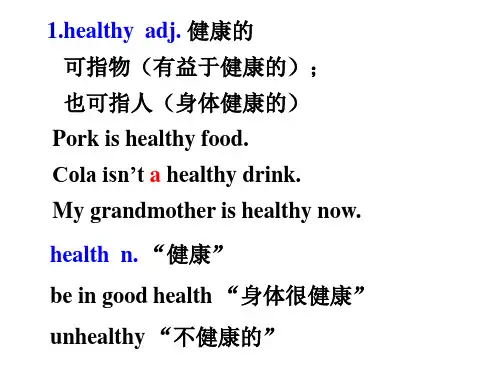
A. meat, eggs and milk B. water, tea and hamburgers
C. chicken soup
D. milk, cheese and fish
( D ) 5.Which of the following is NOT true? A. Eat noodles or rice, not hamburgers. B. Have a good breakfast every morning. C. Drink juice, water, tea and milk, not cola. D. Eat lots of chocolate and vegetables.
Tips:看标题、
开头句。
( D ) 1. What’s the passage mainly about?
A. Healthy food
B. Healthy drink
C. Shopping list
D. Both A and B
( B ) 2. __________ are good for your eyes.
3. 在否定句中代替and,“和” I don’t like bread, rice or porridge. 我不喜欢面包、米饭和粥。
4. 连接两个并列的句子,表 “否则,要不然” Hurry up, or you’ll be late. 快点,否则你要迟到啦。
You must go there quickly or you will not get the gift. 你必须快点去那儿,否则你就得不到礼物了。
A. carrots, eggs and sweet
B. milk, cheese and fish
七年级英语上册Module4教案外研版
七年级英语外研版(上)学案Module 4 My family一、学习目标:1.单词和短语:many , people , aunt , grandfather , grandmother , grandparent , uncle , have got , email , him2.交际用语:1) How many people are there in your family ? 你们家有多少人?2) Thank your for your email . 谢谢你的电子邮件。
3) We’ve got a small family . 我们有个小家庭。
4) — Have you got any brother ? 你有兄弟吗?— Yes , I have . / No , I haven’t . 是的,我有。
/ 不,我没有。
5) He hasn’t got any brothers . 他没有兄弟。
3. 语法:have / has got 的用法。
二、重点及难点:there be 与 have/has , have /has got 的区别三、学习步骤:Unit 1 How many people are there in your family ? 一)自主学习A. 写出一组你能够想到的关于家庭成员的词汇(至少10个)____________________________________________________________________________________________________________________________________________________________________________________________________________________________________________________________________ Answers:father , mother , brother , sister , uncle , aunt , grandfather , grandmother , parents , grandparents , grandson , granddaughter , wife , husbandB .Look at the pictures . Label Tony’s family .aunt , brother , father , grandfather , grandmother , grandparents , mother , parents , sister , uncleAnswers:1. grandmother2. grandfather3. grandmother4. grandfather5. uncle6. aunt7. mother8. father9. uncle 10. sister二)知识点学习1. family home和house的区别1) family的意思是“家庭、家庭成员”,与居住的房子无关。
七年级英语Module4 Unit2教案 外研社 教案
MODULE 4My familyPart 1: Teaching design第一部分教学设计Function Describing familiesStructureHave /has got (affirmative, negative, interrogative)Listening/Speaking Identifying family membersDescribingyour familyReading/Writing Describing familiesDescribing families; using punctuation: full stops, capital letters, question marksCulture FamiliesTask Writing about your familyUnit 2 I’ve got a small family.■Warming upHi, everyone! Today I want to introduce my family to you. I’ve got a small family, not a big family. There are three people in my family, my father, my mother and I. I have got no sisters or brothers. I am the only child of my parents. My family is a happy small family. We love each other very much.Have you got a small family or a big family? Do you like to introduce your family to us? Now let’s go to page 22 to learn some interesting things about family.■Reading and vocabulary1 Match words in Box A with the words in Box B.First let’s match words in Box A with the words in Box B. Can you find the correct answer?a unt→ uncle grandma→grandpagral ndmother→ grandfathermother→ father mum→ dad sister→ brother2 Work in groups. Talk about your family.This time I’d like you to work in groups and talk about your family. Have you got a big family? How many people are there in your family? Who are they? Use the words big and small in your conversation.big/ small---Have you got a small family or a big family?---I’ve got a bigfamily. There are ten people in my family.I’ve got four grandparents, my mum and dad, two uncles, an aunt and a brother.---Have you got a small family or a big family?---I’vegot a small family. There are three people in my family. They are my father, my mother andI.3 Work in pairs.Read the email and answer the questions.On page 23, we can see an email from Lingling to Diana. What can you learn from this email? After you read theLet’s read the email. While reading try to cut (断句)/ the sentences into parts, blacken(涂黑)the predicates,Read the email once again. This time pay attention to its meaning. Try to understand the passage yourself.■Writing4 Look at this passage. Underline the capital letters,full stops and question marks.In our writing, it is important to know the use of capital letters, full stops, question marks and other punctuations.5 Put capital letters, full stops, and question marks into this passage.Do you know when to use the capital letters? Do you know the difference between full stops and question marks? Please put these things into the passage below.。
外研版七年级英语上册Module 4 全部课件
the day after tomorrow
Sun. Mon. Tue. Wed. Thu. Fri. Sat.
1 2 3 45
6
7 8 9 10 11 12
13 14 15 16 17 18 19
20 21 22 23 24 25 26
27 28 29 30
1.What day is it today?今天是星期几? 2.What day is it tomorrow?明天是星期几? 3.What day is it yesterday?昨天是星期几? 4.What day is it the day after tomorrow? 后天是星期几? 5. What day is it the day before yesterday? 前天是星期几?
Wednesday
Friday
Thursday
Z: Good morning, class. What day is it today? S: It’s Monday. Z: Yes, it’s Monday. Write it in your book. S: M-O-N-D-A-Y. Z: What day is it tomorrow? S: Tuesday. Z: Yes, tomorrow is Tuesday.
What day , What day is it today? It is Monday. It is Monday. Monday, Tuesday, Wednesday. Monday, Tuesday, Wednesday.
What day, What day is it tomorrow? It is Thursday. It is Thursday. Thursday, Friday, Saturday. Sunday, Sunday, Sunday. I like Sunday.
秋季学期外研版初中七年级英语上册教案全册
秋季学期外研版初中七年级英语上册教案全册Module1Myclamate(共5课时)Unit1Nicetomeetyou(2课时)Ⅰ.Teachinggoal(教学目标)1.能够听懂、读懂关于自我介绍的对话。
2.能够运用所学动词be的基本句型进行简单的自我介绍。
Ⅱ.Teachingdifficultie(教学重难点)重点:掌握本单元的基本词汇和句型,正确运用be动词的各种形式造句。
难点:能够用英语进行自我介绍。
Ⅲ.Teachingaid:(教学辅助)PPT课件第1课时(Activity1—3)ⅣTeachingcontent(教学内容)Ⅴ.Teachingprocedure:(教学过程)Step1.Warming-up播放英文歌曲或视频“Dayoftheweek”来活跃课堂气氛,同时为接下来的教学内容作好准备。
当学生能熟练地唱出这首歌时,英语教学就变得容易多了。
Step2Liteningandreading1.Litenandread.(Activity1)①教师播放录音,让学生整体感知对话内容。
②教师再次播放录音,学生跟—1—读、模仿。
③学生两人一组练习对话。
④教师让不同的小组展示对话,关注学生的发音。
2.Litenandrepeat.Nowpoint,akandanwer.(Activity2)①教师放录音,学生听录音。
②教师再次播放录音,学生跟读、模仿。
③学生两人一组根据日历练习对话。
④教师让部分小组展示对话。
环节说明:本活动以日历的形式让学生学习表示星期一至星期日的7个词汇,然后指着日历上的具体日期来询问星期几,进而练习相关句型“Whatdayiittoday”教师向学生说明在西方国家Sundayithefirtdayoftheweek,让学生了解这种文化差异。
Step3Practice1.Readandmatch.Nowlitenandcheck.(Activity3)①学生个体活动,完成匹配。