
仁爱英语八年级下Unit7Topic2SectionA课件
pan n.平底锅
fry v.用油煎,用油炸
New words
cut v.切
oil n.油
Listen and answer
1. What will Kangkang do?
He will make fried rice for their food festival. 2. What does Kangkang think of cooking? He thinks cooking is fun.
1. Put it down ______ (light), or you may break it.
2. Can they speak French? I want to know. (合并为一句)
3. Do you know? Are the children playing games? (合并 为一句)
3. cook noodles
4. put noodles in a bowl
5. fill the bowl with bone soup
6. add ham, cabbage and onions
1. (1)Learn adverbs of manner: finely, lightly, immediately (2)Learn other new words and phrases: cut, oil, add, deep, cooker, pork, cut up, ham, noodle, bowl, advantage, cheap 2. Emotions Offering help: Would you like me to help you?
用所给词的适当形式填空。
1. Would you like me ______ (help) you? to help 2. I’m glad that you are trying ______ (help) others. to help
finely 3. Cut some cooked meat _________(fine).
1. cooked meat ________ oil 2. ________ rice 3. ________ fried rice salt 4. ________
Key words of 2a 1. put a pot, boil some water, add pork bones 2. cut up ham, cabbage and onions
then
next
first
finally
after that
second
3
Work alone
Listen to the passage carefully and choose the best answers.
1. People go to restaurants because ______. C A. they’re tired of cooking B. they’re too busy C. Both A and B 2. People can’t eat ______ in a western fast food restaurant. C A. hamburgers B. chicken legs C. fried rice 3. What is the advantage of western fast food?______ A A. You can get it in a few minutes. B. It’s always cheap. C. It looks beautiful. 4. What does the writer think of Chinese fast food restaurants?_____ C A. They are becoming more and more important. B. They are becoming less and less popular. C. They are becoming more and more popular.
Unit 7 Food Festival
Topic2 Cooking is fun! Section A
Key words of 1a
How to make fried rice?
cut some cooked meat finely. First , _______________________________ put some oil in the pan. Next, ________________________________ fry the meat lightly. Then, _______________________________ add the rice slowly. After that, ____________________________
4. Put a large deep pot on the _______ (cook) carefully. cooker to do 5. What do I need ________(do)? slowly 6. You need to add the rice ______ (slow). 7. _______(final) you should add some salt. Finally
Finally, ______________________________ add some salt.
Materials: … How to cook: First, … Next, … Then, … After that, ... Finally, …
How to cook a bowl of noodles ?
careful + ly → carefully fine + ly → finely light + ly → lightly slow + ly → slowly
cook … carefully cut … finely fry … lightly add … slowly
1b
Work alone
单项选择。 ( B)1. Cook noodles for 3-5 minutes in ___ pot. A. other B. another C. others D. the other ( B)2. ______ is good for our health. A. Run B. Running C. Runs D. To run ( A)3. We are proud ______ our school. A. of B. for C. in D. to ( D)4. It’s very kind _____ you to help us. A. for B. to C. at D. of ( C)5. Linda does her homework ______. A. care B. careful C. carefully D. cares ( D)6. –-We win the match ! ---______. A. Never mind. B. It doesn’t matter. C. You’re welcome. D. Well done!
First, put a deep large pot on the cooker careful ly ( careful ). Boil some water in the pot, and add pork bones to make bone soup. Second, cut up ham, cabbage and green onions Next, cook noodles for 3-5 minutes in another pot. Then, put the noodles in a bowl immediately. fine ly( fine ).
4. Mike doesn’t cook as carefully as Jack.(写出同义句) Jack ______ ______ ______ than Mike. 5. Li lei draws better than any other student in his class. (写出同义句) Li lei ______ ______ in his class.
1a
Look, listen and say
Kangkang: Mom, I’d like to make fried rice for our food festival. But I’m not sure whether I can cook it well. Mother: I’m glad that you are trying to help others. I’m proud of you! Would you like me to help you? Kangkang: Yes, please. It’s very kind of you. Mother: Look. It’s easy, Kangkang. But you must cook very carefully. First, cut some cooked meat very finely. Kangkang: Like this? Mother: Yes. Well done! Next, you need to put some oil in the pan. Then fry the meat lightly. Kangkang: What do I need to do after that? Mother: You need to add the rice slowly. Fry it for a few minutes. Finally, add some salt. Kangkang: Yeah! Cooking is fun!
仁爱版八年级英语下册课件 Unit 6 Topic 2 Section A

Have a match
1.Would you help me make a plan to explore Beijing before he comes?
2. Would you like to come to China for your vacation?
3. How about exploring Tian’anmen Square?
Tonight I am busy with the homework. prapare sth. for sb. 为某人准备某物 prapare for sth.=get ready for sth.为某事做准备 prepare to do sth.=get ready to do sth.准备做某事
Lead in
What are they doing? They are talking on the phone. What are they talking about?
Learning 1a Listen, look and say.
Darren: Hello! This is Darren. I'd like to speak to Michael.
4√
5√
visit the Great Wall
meet their friend
v. to get or accept sth. from sb. 收到
receive a postcard
Learning
1c
Read 1a and number the following sentences. Then try to retell it.
Language points
5. Would you help me make a plan to explore Beijing before he comes? 在他来之前,你能帮我制定一个考察北京的计划吗? 这是一个由连词before引导的时间状语从句。 before“在……之前”,根据具体语境还可意为 “还没来得及/ 还没有……就……;……才……”等。 after“在……之后”表示主句动作发生在从句动作之后。 e.g.昨天我们离开学校的时候,我们打扫了教室。
仁爱英语八年级下册Unit7 Topic2SectionA课文英汉互译重点短语重难句详解

Unit 7Topic 2SectionA课文英汉对照,重点短语及重难句详解一. 课文英汉对照Kangkang: Mom, I'd like to make fried rice for our food festival. But I'm not sure whether I can cook it well.康康: 妈妈,我想为我们的美食节做炒饭,但我不确定是否能把它做好。
Mother: I'm glad that you are trying to help others. I'm proud of you!Would you like me to help you?妈妈: 我很高兴你尽力去帮助别人,我为你感到骄傲,需要我帮忙吗?Kangkang: Yes, please. It's very kind of you.康康: 好啊。
你真是太好了。
Mother: Look. it's easy, Kangkang. But you must cook very carefully. First, cut some cooked meat very finely.妈妈: 瞧,很容易的,康康。
但你必须仔细的烹饪。
首先,把一些熟肉仔细的切成小片。
Kangkang: Like this?康康: 像这样吗?Mother: Yes. Well done! Next, you need to put some oil in the pan. Then fry the meat lightly.妈妈: 对,真棒!接下来你需要往锅里放些油,然后把肉轻微的炒一炒。
Kangkang: What do I need to do after that?康康: 接下来我需要做什么呢?Mother: You need to add the rice slowly. Fry it for a few minutes. Finally, add some salt.妈妈: 你要慢慢的把米饭加进去,炒上几分钟。
八年级英语Unit 7 Topic2 SectionA
Unit 7.Topic 2Section A一. Learning aims:学习表示顺序的副词,了解某些中餐的做法,增长学生的日常生活知识。
二. Learn new word :切______ 添加 ______ 用油炸 ______ 切碎 ______ 微小地______油______ 优点 ______ 轻轻地 ______ 火腿 _______ 猪肉______面条_____ 炊具 ________ 平底锅 _______ 锅 _______ 碗_____洋葱 ______ 立即________三. Important phrases:做炒米 ___________ 尽力帮助别人_________ 小心地烹饪_________熟肉 _____________ 需要做某事 __________ 轻轻地炒__________像这样 __________ 细微地切 __________ 干得好__________然后 ____________ 慢慢地加 ___________ 烹饪很有趣_________你真是太好了 ________________________我不确定我是否能烹饪好 ______________________四. Emphasis sentences:1.It`s very kind of you.你真是太好了。
这句话用于表扬,赞美对方,也可用于对对方所做的事表示感谢。
be kind (友好)to 对某人友好,善待某人 We must be kind ___ the old.all kinds(种类) of 各种各样的 I have all kinds ____ toys.2.cooked(cook) meat. 熟肉动词后加--ing ,表示动作正在进行,主动。
动词后加-- ed ,表示动作的完成,被动______(boil) water 沸腾的水。
______(boil) 开水3.You need to add the rice slowly。
仁爱英语八年级下 Unit 7 Topic 2 重点短语、重点句型、难点辨析,语法详解
重点短语:1.make fried rice 炒米饭2.2. be proud of 为... 而自豪3.cooked food 熟肉4.4. Well done 真棒 5.cut up 切碎,制碎6.6.make bone soup 熬骨头汤7. fill...with... 用...装满...8. 8.be tired of 讨厌、厌倦9.fast foodrestaurant 快餐店10.10.two pieces ofbread 两片面包11.spread...on... 往...上涂抹12.12.put...together把......放在一起13.pour..over 往.....倒...14. 14.learn...from从......学到......15.Practice makesperfect 熟能生巧16. 16.not bad 不错17.Help oneself to 随便用.......18. e sth to dosth 用......做某事19.a formal westerndinner party正式西方宴会20.20. western tablemanners西方的就餐礼仪21.for the firsttime 第一次做某事22.22.at the table 在桌旁 23.startwith 以.....开始 24. 24.eat up 吃光25.drink to sb 为某人干杯26.take a sip 喝一小口27.point at 指着......28..finish doing sth完成做某事29.all over theworld 全世界30.eating habits 饮食习惯31.far away from 远离 32.pickup 捡起33.at the same time 在同时34.in the north 在北方重点句型:1.You often teachme to be kind to the poor and the old.你经常教我要善待穷人和老人。
新仁爱版八年级英语下册unit7Topic1sectionA教案
unit7 Topic1 sectionA 教案Ⅰ. Material analysis本节课为话题的第一节课,建议用1课时上完。
主要活动为Section A 的1a 和2。
本话题由C raig Kielburger 从12岁起建立解放儿童组织,创办柯氏国际儿童基金展开。
在本课1a 的对话中,为了帮助Craig Kielburger ,Kangkang, Michael, Maria 和Jane 决定举办一次“国际美食节”。
通过让学生了解四个小伙伴为美食节做的种种努力,鼓励他们积极参与有益的课外实践活动,培养关心他人,乐于助人的态度。
本话题的语法重点是学习that 引导的宾语从句。
Ⅱ. Teaching aims Knowledge aims :1. 学生能正确拼读并运用为美食节做准备的词和短语。
2. 学生能简单地掌握宾语从句的用法。
Skill aims :1. 能听懂有关筹集资金计划的对话。
2. 能使用英语简单谈论筹集资金的计划。
3. 能连贯流畅地朗读对话。
4. 能写出简单的帮助他人的短文。
Emotional aims :学习积极参与有益的课外实践活动,关心他人,乐于助人。
Ⅲ. The key points and difficult points Key points :1. 谈论筹集资金的计划。
2. 初步掌握宾语从句的用法。
Difficult points :写出关于筹集资金帮助他人的短文。
Ⅳ. Learning strategies注意发现语言的规律并能运用规律举一反三。
Ⅴ. Teaching aidsComputer Computer multimedia multimedia multimedia projector, projector, projector, the the the pictures pictures pictures of of of Craig Craig Craig Kielburger, Kielburger, Kielburger, a a a poster, poster, poster, the the the pictures pictures pictures of of soup, cheese, cookies, and pancakes, a picture of a blind person, a video of the earthquake in Ya’an.Ⅵ. Teaching proceduresStep Interaction patternStudent activity Teacher activityIntroduction (8 minutes)1. The whole class work. 2. The whole class work. 3. Group work. 4. The whole class work. 5. The whole class work. 1. Focus their attention on the teacher. 2. Students read the passage passage about about about the the the traffic traffic rules rules they they they made made made after after class. 3. Students discuss in groups and ans w er the wer the questions with the structure: I think Iwill…4. Students learn and grasp the new words and phrases with the help of the teacher. 5. Students report the information about Craig Kielburger they collected. 1. Greet students ready for learning. 2. Teacher asks the students to to report report report the the the homework. homework. Let Let the the the students students students read read read the the passage passage about about about the the the traffic traffic rules they made after class. 3. Teacher asks the students to think about the following questions: If someone isin trouble, what will youdo? If someone needs money,what will you do? Then ask the studen ts to answer them with the structure: I think I will…4. 4. Teacher Teacher Teacher teaches teaches teaches the the the new new words by summing up the answers above: “Now Now I I I see, see, see, some some some students students will turn to their their parents, parents, which means they will ask their parents for help. Some students imaginethat they can put on a play to to raise raise raise money. money. money. Y ou Y ou can can try your best to help others, others, I’m I’m I’m so so so proud proud proud of of you!”5. 5. Teacher Teacher Teacher shows shows shows the the the pictures pictures o f Craig Kielburger to the students. Ask the students to to report report report the the the information information about Craig Kielburger they collected. Presentation (10 minutes) 1. The whole class work. 2. Individual work. 3. The whole class work. 4. Individual work. 5. The whole class work. 6. The whole class work. 7. Individual work. 8. The whole class work. 9. Individual work. 10. The whole class work. 1. Students look at the picture of 1a, and understand understand the the the picture picture with the help of the information under it. 2. Students watch the flash, and then mark the sentences of 1b wi th T or F. 3. Students check the answers. 4. Students read the conversation and match the information of 1c. 5. Students check the answers. 6. Students read the sentences aloud. 7. Students find out the same same structure structure structure in in in the the sentences of 1c. 8. Students check the answers. 9. Students watch the flash flash and and and answer answer the questions. 10. Students check the answers. 1. T eacher praises students’ information they collected after after class. class. class. Encourage Encourage Encourage them them to keep on making a preview before before class. class. class. Then Then Then let let let the the students students look look look at at at the the the picture picture of of 1a 1a 1a and and and undund erstand erstand the the picture picture with with with the the the help help help of of of the the information under it. 2. Teacher plays the flash of 1a. Ask the students to watch watch the the the flash, flash, flash, and and and then then mark mark the the the sentences sentences sentences of of of 1b 1b with T or F. 3. Teacher asks two students to tell the answers. 4. Teacher asks the students to to read read read the the the conversation conversation and match the information of 1c. 5. Teacher asks two students to tell the answers.6. Teacher asks the students to read the sentences aloud. 7. Teacher asks the students to find out the same structure in the sentences of 1c. 8. Teacher asks two students to tell the answers. 9. Teacher asks the students to watch the flash again and answer the following questions: (1) How many schools did Free the Children build? (2) What’s Michael’s task?10. Teacher asks two students to tell the answers. Teach the new word p osterposter by showing a real poster to them. Consolidation (10 minutes) 1. The whole class work. 2. The whole class work. 3. Group work. 4. The whole class work. 5. Group work. 6. The whole class work. 7. The whole class work. 1. Students read the conversation after the recording sentence by sentence. 2. Students try to follow the speed, paying attention to the pronunciation and intonation. 3. Students discuss in groups groups to to to find find find out out out the the difficult difficult points points points and and and sum sum up the main points. 4. 4. Students Students Students underline underline underline in in their books and make some notes. Learn and grasp grasp the the the new new new words words and phrases. 5. Students discuss in groups: What will the food festival be like? 6. V olunteers report the result of the discussion. 7. Students act out the conversation of 1a. 1. Teacher plays the recording sentence by sentence. 2. Teacher plays the recording without stopping. 3. Teacher asks the students to learn in groups to find out the difficult points in the conversation. At last let them sum up the main points of the conversation. 4. 4. T eacher T eacher makes makes makes a a a summary summary to to explain the key points and explain the key points and difficult points to the students. (1) have/hold/ organize a food festival (2) turn to sb. /ask sb. for help (3) make a poster (4) get in touch with sb. (5) try one’s best to do sth. (6) make it a success (7) 由that 引导的宾语从句引导的宾语从句5. T eacher lets the students read 1a, and then discuss what the food festival will be like with the the help help help of of of the the the pictures pictures pictures and and the example. Let them practice the usage of the object clauses. 6. Teacher asks four students to report the result of the discussion. Finish 1d. 7. T eacher asks the students to act out the conversation of 1a. Practice (10 minutes) 1. The whole class work. 2. Group work. 3. Individual work. 4. The whole class work. 5. Pair work. 6. Individual work. 7. The whole class work. 1. Students learn and grasp the new words with the help of the teacher. 2. Students discuss what the children children should should should prepare prepare for for the the the food food food festival festival festival in in groups. 3. Students write down the conversations. 4. Students evaluate the conversations, conversations, and and and then then check check the the the answers answers answers with with the teacher. 5. Students act out the conversations in pairs. 6. Students listen and match match the the the people people people with with what we can do. 7. Students check the answers. 1. Teacher teaches the new words soup, cheese, cookies,and pancakes by by showing showing their pictures on the screen. Teach set and set the tableby explaining their Chinese meaning. 2. Teacher asks the students to discuss what the children should prepare for the food festival. 3. Teacher asks four students to write down the conversations on the blackboard. The other students write down at least two conversations in their each workbook. 4. 4. Teacher Teacher Teacher lets lets lets two two two or or or three three students evaluate the conversations on the blackboard. Check the answers. 5. Teacher lets the students act act out out out the the the conversations conversations in pairs. 6. 6. Teacher plays the recording Teacher plays the recording of of 3 3 3 for for for the the the students students students and and lets the students listen and match the people with what we can do. 7. 7. Teacher Teacher Teacher lets lets lets two two two students students tell tell their their their answers. answers. answers. Teach Teach blind by showing a picture of a blind person. Production (7 minutes) 1. Group work. 2. The whole class work. 3. The whole class work. 4. The whole class work. 5. Individual work. 1. Students watch the video and discuss in groups. 2. Students write down their opinions with the structure I think…3. Students share their opinions with with the the whole class. 4. Students summarize Section A with the teacher. 5. Students finish the homework after class. 1. Teacher plays the video of the Ya’an earthquake. Lead the students to discuss in groups: “A terr“A terrible earthquake ible earthquake struck Ya’an in Sichuan Province at 8: 02 on the morning of April 20th this year. Le t’s discuss how to help the p eople in Ya’an.”people in Ya’an.”2. Teacher asks the students to write down their opinions with the structure Ithink…3. Teacher asks four students from different groups to share their opinions. Tell them that we should try our best to help the people in trouble. 4. Teacher shows the summary of this section to the students. 5. Teacher assigns homework: (1) Review the summary after class. (2) Write down a passage about how to help the the people people people in in in Y Y a’an with the sentences containing object clauses. (3) Search some typical foods in different countries to prepare for Section B. Teaching Reflection The students a dmire Craig Kielburger very much. It’s a successful admire Craig Kielburger very much. It’s a successful lesson: lesson: The The The students students students want want want to to to learn learn learn from from from him him him to to to help help help the the the people people people in in trouble. The teacher should introduce more information of Craig Kielburger to the students to encourage them to help others from now on. Ⅶ. Blackboard designUnit 7 Food Festival Topic 1 We’re preparing for a food festival. Section A 1. have/hold/ organize a food festival 2. turn to sb. /ask sb. for help 3. make a poster 4. get in touch with sb. 5. try one’s best to do sth.6. make it a success 7. Kangkang knows (that) Graig comes from Canada. 8. set the table 。
仁爱版八年级英语下册Unit 7 Topic 2 Section A优质课课件(共21张PPT)
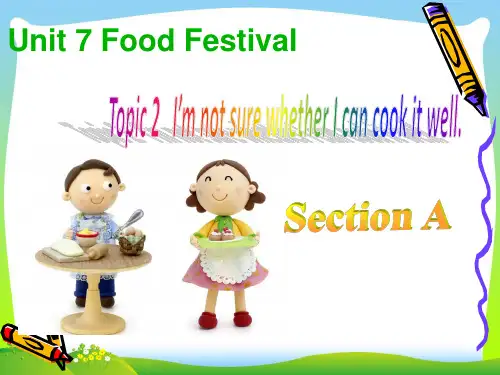
3b Work in pairs and talk with your partner about the fast food in China.
You may begin like this: A:What do you think of the food in McDonald's or KFC? B:I like the food in KFC very much because.../I don't like to eat in McDonald's because...
2.Junk foods are_____C________.
A. foods that taste good B. foods that have much oil C. foods that are not good for health 3.What can we put on a pizza or a hamburger to make them
He works for the rights of children. Let's make Craig's dream come true!
How to cook porridge?
v.增加,添加
n.锅;壶,瓶,罐
First, Second, Next, Then, Finally,
put some water in the pot boil water wash rice add rice cook
3 a
1. Many parents dislike their children eating pizzas and
hamburgers because___C__________.
仁爱版八年级英语下册Unit7Topic2SectionA教学设计
3.树立正确的人生观和价值观,明白付出与回报的关系,懂得珍惜和感恩;
4.增强环保意识,关注社会问题,积极参与社会公益活动;
5.提高自信心和自尊心,勇于表达自己的观点和看法,尊重他人的不同意见。
一个全面的志愿者活动介绍。”
2.引导学生关注社会问题,培养他们的同理心和关爱他人的意识;
3.鼓励学生积极参与志愿者活动,将所学知识运用到实际生活中,体验助人为乐的喜悦;
4.培养学生的团队合作精神,让他们在志愿者活动中学会相互尊重、相互帮助;
5.培养学生热爱英语,树立终身学习的观念,为他们的未来发展奠定基础。
三、教学重难点和教学设想
(一)教学重难点
1.新词汇和短语的掌握:本节课涉及多个新词汇和短语,学生需要在实际语境中运用,以达到熟练掌握的程度。
Example:
I志愿者at the local hospital every Saturday. I help the nurses give medicine to the patients and talk to them to make them feel better. I want to be a volunteer because I want to help others and learn more about medical knowledge.
2.学生分享自己在本节课的收获,包括新词汇、句型、语法等方面。
3.教师强调参与志愿者活动的重要性,鼓励学生在日常生活中积极投身于志愿者事业,为社会贡献力量。
4.布置课后作业,要求学生运用所学知识,描述自己参加过的或想参加的志愿者活动,巩固课堂所学。
五、作业布置
1.请学生运用本节课所学的词汇和句型,写一篇关于自己理想中的志愿者活动的短文,不少于80词。要求描述清楚活动的性质、目的以及自己为何想参与其中,以此来巩固学生对一般现在时态的掌握,并激发他们参与社会实践的热情。
Unit7 Topic2 SectionD -2023-2024学年七年级英语下册精品课件(仁爱版)
at the age of “在......岁时” 相当于:when + sb. + be + 年龄
There is something wrong with his eyes.
= Something is wrong with...
......出了毛病
He can’t see anything any more.
There was something wrong with her eyes and she couldn’t see anything.
1b Read 1a and complete the following tasks.
A. Check(√) the correct answer(s).
1. Jenny may be______years old.
__A_t_t_h_e_a_g_e__ of five, she could play the piano __v_e_r_y_w__e_ll__, but she could only write __a__fe_w____ words. When she was six, there was _s_o_m_e_t_h_in_g__w_r_o_n_g_ with her eyes. Jenny _c_o_u_l_d_n_’t_ see anything _a_n_y__m_o_r_e__. Life was very ___h_a_rd__ fore her!
/wɜ:d/ n. 单词
Jenny
While-reading
Before reading the passage, think about the following questions.
仁爱版八年级英语下册Unit7Topic2SectionB优秀教学案例
在学生小组讨论后,我会对讨论情况进行总结归纳。我会邀请学生分享他们在讨论中的亮点和收获,并对他们的表现进行点评。同时,我会对本节课所学知识进行归纳总结,强调重点和难点,让学生对所学内容有一个清晰的认识。
(五)作业小结
在课堂的最后,我会布置作业,让学生巩固所学知识。作业包括两部分:一部分是练习题,让学生运用情态动词can、一般现在时的被动语态和不定代词进行描述;另一部分是写作任务,让学生编写一个关于运动会的小故事。在作业布置后,我会对课堂内容进行小结,提醒学生注意作业的完成时间和质量。
5.教学目标的全面性:本节课的教学目标涵盖了知识与技能、过程与方法、情感态度与价值观三个部分,全面促进了学生的全面发展。在实现教学目标的过程中,学生不仅掌握了英语知识,还培养了良好的情感态度和价值观。
作为一名特级教师,我深知教学案例亮点的重要性。在设计本节课的教学方案时,我力求突出情境创设、问题导向、小组合作、反思与评价和教学目标等亮点,以提高学生的学习兴趣和实际运用能力。通过本节课的教学,我希望学生能够掌握情态动词can的用法、一般现在时的被动语态和不定代词的用法,提高他们的英语水平。同时,我也希望他们能够在学习过程中,培养积极向上的情感态度,树立正确的价值观。
五、案例亮点
1.情境创设的生动性:以学校运动会为背景,通过展示运动会场景的图片和视频,让学生在真实、生动的情景中学习和运用英语。情境创设不仅激发了学生的学习兴趣,还提高了他们的语言运用能力。
2.问题导向的有效性:设计一系列问题,引导学生思考、探究和解决问题。问题导向的运用,使学生在回答问题的过程中,自然而然地掌握了情态动词can的用法、一般现在时的被动语态和不定代词的用法。
(三)小组合作
在教学过程中,我会组织学生进行小组合作,让他们在合作中学习、交流和进步。例如,在教授一般现在时的被动语态时,我会让学生分组完成一个任务:每组编写一个关于运动会的小故事,故事中要包含一般现在时的被动语态。通过小组合作,学生可以互相学习、取长补短,提高自己的语言运用能力。
仁爱版八年级英语下册课件 Unit 7 Topic 1 Section A授课课件
5. Kangkang: Good! I’ll get in touch with Craig Kielburger on the Internet to get more information about him. 好!我将从网上与克雷格·柯伯格联系,了解 更多关于他的信息。
get in touch with 与……联系;和……接触 e.g. You can get in touch with the school by telephone or by e-mail. 你可以通过电话或电子邮件与学校取得联系。
Summary
We learn:
1. Some words: task, poster, touch, success, imagine, soup, cheese, cookie, pancake, set, blind
2. Some phrases: know about, raise money, food festival, turn to, make a poster, get in touch with, try one’s best, set the table
We can:
Make sentences with that guide the object clauses.
Exercise
一、选择填空
1. Jane: Do you know about Craig Kielburger? 你知道克雷格·基尔伯格吗?
know about了解,知道……的情况 e.g. He wants to know about Chinese culture. 他想了解中国文化。 know v. 知道,认识 e.g. I know her. She is our monitor. 我认识她。她是我们的班长。