
陕旅版四年级英语第一单元单元计划
一、 复习单词: Grangpa,grandma,father,mother,brother,sister,teacher,student. 重 难 点 及 教 法 二、 能听、说、读、写有关职业的单词: Cook,doctor,driver,policeman,nurse,worker,famer. 三、 能听懂、会说、会读、会用与家庭成员和职业有关的交际用语: 1.¬-What is your...?-He/She is a„
第一 单元Leabharlann 四年级英语 教材分析及计划
本单元教学共分为4课时。第一课时以词汇教学为主,主要是对家庭成员的名称进行 复习并学习有关职业的词汇,“词不离句”是本课时教学要遵循的原则。第二课时为会 教 材 内 容 话教学,要求学生在学习重点词汇的基础上能够理解和运用对话What is your father? He is a...Is your mother a worker? No,she is not.She is a nurse.学习怎样对某 人的职业进行回答。第三课时以PartB中的Let`s learn more为主,让学生拓展学习更 多有关职业职业的表达,理解和运用句型I want to be a...表达个人理想。第四课时在 综合复习本单元重难点的基础上,通过练习检测学生的学习效果
本单元计划用3课时完成,第一课时主要以单词教学为主: 教 学 计 划 第二课时以课文对话为主,主要培养学生运用英语的积极性; 第三课时学习韵文,以课后作业巩固和练习为主,加强学生在本单元对知识的总结 和梳理。
主备课人 教研组长审阅
何芳荣
单元备课时数 教导处审阅
4
备课组长验收 2014 年 8 月 22日
陕旅版四年级上册英语全册教案
陕旅版四年级上册英语全册教案Unit 1: Where Is My Schoolbag?Part A:Step 1: Warm-up- Greet the students and start with a quick review of the previous lesson about classroom objects.- Sing the "Hello, Hello" song together.Step 2: Presentation- Introduce the new vocabulary: schoolbag, book, pen, pencil, ruler, eraser, and sharpener.- Use flashcards and real objects to demonstrate the meaning of each word.- Teach the question "Where is my schoolbag?" and the responses "It's on the desk" and "It's under the chair."Step 3: Practice- Role-play the dialogue with a few students, using the new vocabulary and question.- Have students work in pairs to practice the dialogue, switching roles to take turns.Step 4: Consolidation- Play a "Find the Object" game where students have to listen to a description and find the corresponding object in the classroom.Step 5: Wrap-up- Review the new vocabulary and sentence structures before moving on to the next activity.Part B:Step 1: Listening- Play the audio recording of the dialogue and have students follow along in their books.Step 2: Speaking- Have students practice the dialogue in pairs, using the audio recording as a reference.Step 3: Reading- Ask students to read the dialogue aloud, focusing on pronunciation and intonation.Step 4: Writing- In their workbooks, have students write the dialogue using the correct punctuation and capitalization.Step 5: Group Activity- Divide the class into groups and have them create a similar dialogue using the new vocabulary. Each group will then perform their dialogue for the class.Step 6: Review- Review the key vocabulary and grammar points covered in this lesson.Step 7: Homework- Assign the students to write a short paragraph describing the items in their schoolbag.。
Unit1What’syourfatherPartA(教学设计)陕旅版英语四年级上册
陕旅版小学英语四年级Unit1 What’s your father?教学设计
课题Unit1 What’s your father?
课型Practice
教学目标
1. 知识与技能目标:通过练习掌握本课的重点句型:
What is he /she ?
He/ She is a….
What’s your…..?
He/ She is a ….
2. 过程与方法目标:
通过对话练习能用句型谈论其他人员的职业并能用I want to be a….表达各自的理想。
3. 情感与态度目标:
通过对话练习提高学生的会话能力,自我表达能力,树立自己的理想,增强学习自信心。
教学重难点
通过练习掌握重点句型,并能够自由讨论其他成员的职业
教学用具PPT 教学光碟
教学方法练习法。
陕旅版四年级下册英语第一单元单元教学计划
陕旅版四年级下册英语第一单元单元教学计划Unit Teaching Plan for Grade 4, Term 2, EnglishIntroduction:介绍:In this unit teaching plan, I will outline a step-by-step approach to teach the first unit of the Shaanxi Tourism Edition for Grade 4 students. This unit focuses on basic vocabulary related to weather and seasons, as well as simple sentence structures to express preferences.在本单元教学计划中,我将详细说明逐步教授陕旅版四年级下册英语第一单元的方法。
本单元侧重于与天气和季节相关的基础词汇,以及表达偏好的简单句结构。
Objectives:目标:- To introduce and practice vocabulary related to weatherand seasons.- To provide opportunities for students to use the target language in context.- To develop listening, speaking, reading, and writing skills through various activities.- 引入和练习与天气和季节相关的词汇。
- 提供机会让学生在语境中使用目标语言。
- 通过各种活动来培养听、说、读、写等技能。
Procedure:程序:1. Warm-up activity: Start the lesson with a weather-related song or rhyme. Ask students about their favorite season and why they like it.热身活动:用一个与天气相关的歌曲或童谣开始这一课。
陕旅版四年级英语下册第一单元
陕旅版四年级英语下册第一单元第一课时教学目标:学习“四会”单词:house, study, bedroom, kitchen, living room, dining room.教学重点:能听懂.会写.会读.会说house, study, bedroom, kitchen,living room, dining room。
教学难点:通过学习.能够用英语表达住所名称。
教学环节:学习目标(2分钟)(一)出示学习目标:学习“四会”单词:house, study, bedroom, kitchen, living room, dining room, 并用所学单词和句型表达住所名称(二)学习There be句型。
自主学习(15分钟)(一)温故知新复习有关日常活动的词汇:wathc TV, go to bed, have lunch, 同桌进行简单句型问答。
(二)阅读方法对照课本.边看边练习拼写描述住所的单词。
(三)互助释疑同桌间一边指着住所图片.一边读出单词.交流不会读的单词。
(四)探究出招同桌间练习书写.可以互相检查拼写。
展示交流(10分钟)(一)小组展示小组内练习用英语描述住所(二)班级展示指名小组上讲台做游戏.用英语描述住所。
点拨升华(8分钟)(一)教师放录音.学生跟读.纠正读音。
(二)学生开火车读单词。
(三)用句子There be …描述住所。
课堂作业(5分钟)作业当堂清1.单词拼写h se 房子b dr m 卧室b throom 卫生间d ing room 餐厅l ing room 客厅k tch 厨房2.单词连线house 卧室bedroom 餐厅bathroom 卫生间dining room 客厅living room 房子kitchen 厨房study 书房挑战自我造6个 There be 句子板书设计:Unit 1 Our New Househouse 房子This is our new house. bedroom 卧室There are two bedrooms. bathroom 卫生间dining room 餐厅living room 客厅kitchen 厨房study 书房课后反思:第二课时教学目标:学习句型1.—What’s in your new house?—There is a …There are …2. — My house is not very big.— But it is beautiful.教学重点:熟练掌握句型.并进行简单的对话。
陕旅版小学英语4上Revision1__单元总目标
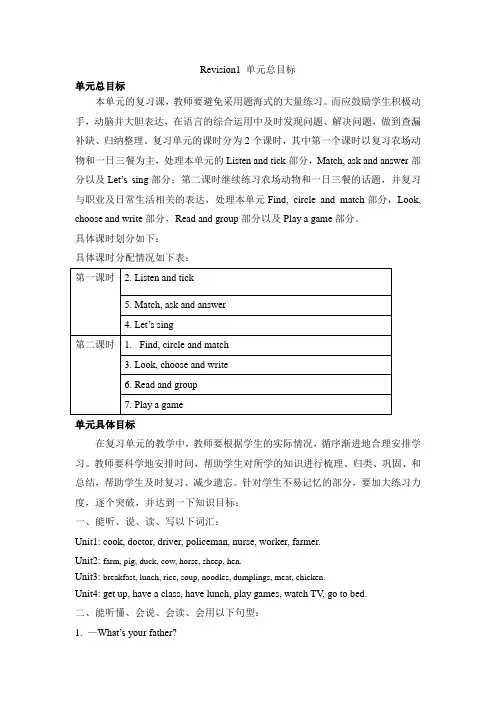
Revision1 单元总目标单元总目标本单元的复习课,教师要避免采用题海式的大量练习。
而应鼓励学生积极动手,动脑并大胆表达,在语言的综合运用中及时发现问题、解决问题,做到查漏补缺、归纳整理。
复习单元的课时分为2个课时,其中第一个课时以复习农场动物和一日三餐为主,处理本单元的Listen and tick部分,Match, ask and answer部分以及Let’s sing部分;第二课时继续练习农场动物和一日三餐的话题,并复习与职业及日常生活相关的表达,处理本单元Find, circle and match部分,Look, choose and write部分,Read and group部分以及Play a game部分。
具体课时划分如下:具体课时分配情况如下表:单元具体目标在复习单元的教学中,教师要根据学生的实际情况,循序渐进地合理安排学习。
教师要科学地安排时间,帮助学生对所学的知识进行梳理、归类、巩固、和总结,帮助学生及时复习、减少遗忘。
针对学生不易记忆的部分,要加大练习力度,逐个突破,并达到一下知识目标:一、能听、说、读、写以下词汇:Unit1: cook, doctor, driver, policeman, nurse, worker, farmer.Unit2: farm, pig, duck, cow, horse, sheep, hen.Unit3: breakfast, lunch, rice, soup, noodles, dumplings, meat, chicken.Unit4: get up, have a class, have lunch, play games, watch TV, go to bed.二、能听懂、会说、会读、会用以下句型:1. —What’s your father?—He is a…—What about…?—He/ She is a…—Is your mother…?—No, she isn’t. She is a…—What is he/ she?—He/ She is a…—I want to be a…2. —What are…?—They’re…—What do they have on the farm? —They have…—What does Colin have?—He has…3. —What’s for breakfast/ lunch? —We have…—Dinner is ready.—What’s for dinner?—We have…—Do we have…?—No, we don’t.4. —When do you…?—I…—Do you have…?—Yes, we do.—When does your father/ mother? —He/ She…。
陕旅版四年级下册英语第一单元单元教学计划
陕旅版四年级下册英语第一单元单元教学计划全文共3篇示例,供读者参考篇1Unit 1 Teaching PlanHey guys! We just started a new unit in our English textbook and I'm really excited about it. This unit is all about learning how to describe different jobs and workplaces. I think it's going to be super useful for when we get older and start thinking about careers.The unit kicked off with a fun dialogue between two characters - Tom and Lucy. They were talking about what they want to be when they grow up. Tom said he wants to be a chef because he loves cooking, and Lucy said she wants to be a teacher because she likes working with kids. I thought it was a great way to start learning some key vocabulary for talking about different professions.After the dialogue, we learned a bunch of new words related to jobs and workplaces. Some of the jobs we covered were doctor, police officer, engineer, artist, and athlete. We also learned words for different workplace settings like a hospital,school, office, factory, and stadium. The textbook had really colorful pictures to go along with each job and workplace which made it easier to remember the new vocabulary.One of the activities we did was matching the jobs to their corresponding workplaces. Like we had to draw a line from "doctor" to "hospital" or from "teacher" to "school". It was a bit tricky at first, but doing that exercise really helped cement the connections in my mind.We also spent some time looking at the typical duties and responsibilities for different professions. For example, we learned that doctors examine patients, give treatments, and prescribe medication. While police officers patrol neighborhoods, respond to emergencies, and enforce laws. Getting that background information was useful for building a fuller understanding of what each job actually entails.My favorite part of the unit so far was when we had to write a short paragraph describing our dream job and why we'd like to do it. I wrote about wanting to be a video game designer because I love technology and being creative. We got to share our paragraphs with partners which was really cool to hear about everyone's different interests and aspirations.The grammar focus for this unit has been on using the simple present tense to talk about jobs and their associated duties. We've practiced making statements like "Firefighters rescue people from burning buildings" and asking questions like "What does a marine biologist do?" Working on this grammar point has definitely improved my ability to communicate clearly about professions.We've also started learning how to ask people follow-up questions about their jobs using question words like what, where, when, why, etc. For instance, you could ask someone "Where do you work?" or "Why did you decide to become a nurse?" Being able to ask good follow-up questions will allow us to have more substantive conversations on this topic.Although we haven't gotten to this part yet, I'm really looking forward to the unit project at the end. From what I understand, we'll get to conduct interviews with people who have interesting jobs in our community. I think it will be fascinating to hear firsthand accounts of what their daily work is really like. I'm especially hoping to be able to interview a chef, veterinarian, or someone else with a cool job related to animals or food.Overall, I've been having a blast with this unit so far. Learning about different careers has been eye-opening and is getting me excited to think more about my own future path. The activities have been really engaging, and I feel like I'm building some valuable skills for communicating about jobs and workplaces in English. I can't wait to see what other neat stuff we'll get to do as we continue exploring this unit!篇2Unit 1 Teaching Plan: My HobbiesHey there, fellow students! It's me, your friendly neighborhood English learner, here to give you the inside scoop on our upcoming unit. Get ready for an adventure into the world of hobbies and free-time activities!First things first, let's talk about what we'll be learning in this unit. We're going to explore different kinds of hobbies, from sports and games to arts and crafts. We'll learn how to talk about our favorite pastimes and ask others about theirs. Plus, we'll discover some cool new vocabulary related to hobbies and leisure activities.But that's not all! We'll also be practicing our English skills in fun and engaging ways. Here's a sneak peek at some of the activities we'll be doing:Conversation PracticeWe'll be having lots of conversations with our classmates and teacher about our hobbies. This will help us get comfortable using the new vocabulary and expressions we've learned. We might even play some conversation games or do role-plays to make it more interesting!Reading and Listening ActivitiesOur textbook has some cool stories and dialogues about kids and their hobbies. We'll be reading and listening to these to improve our comprehension skills. Who knows, we might even learn about some new hobbies we've never heard of before!Writing TasksWe'll be putting our writing skills to the test by creating short texts about our own hobbies. We might write a paragraph, a poem, or even a short story! This will help us practice using the new vocabulary and grammar structures we've learned.Project WorkGet ready for some hands-on fun! We'll be working on a project related to hobbies and free-time activities. We might create a poster, a video, or even a short skit to present to the class. This is a great way for us to showcase our creativity and teamwork skills.Games and PuzzlesWho doesn't love a good game or puzzle? We'll be playing some fun English games and solving puzzles related to hobbies and leisure activities. This will help us reinforce the new vocabulary and concepts we've learned in a super engaging way.But wait, there's more! We'll also be exploring some interesting cultural aspects related to hobbies from around the world. We might learn about traditional games, crafts, or sports from different countries. This will not only expand our knowledge but also help us appreciate and respect cultural diversity.Now, I know what you're thinking: "But English can be so hard sometimes!" Don't worry, my friends. Our teacher has a ton of tricks up their sleeve to make learning fun and engaging. They'll be using all sorts of cool techniques like songs, chants, videos, and even games to help us grasp the new concepts.And remember, learning a language is a journey, not a race. If you ever feel stuck or overwhelmed, don't hesitate to ask for help. Our teacher and classmates are here to support each other every step of the way.So, what are you waiting for? Get ready to embark on an exciting adventure into the world of hobbies and free-time activities! Let's have fun, learn new things, and make incredible memories along the way!篇3Unit 1 Teaching PlanHey there, fellow students! I'm super excited to share with you the teaching plan for Unit 1 of our 4th grade English textbook. This unit is going to be a blast, and I can't wait to dive into all the fun activities and lessons our teacher has in store for us.First things first, let's talk about the unit theme: "My Busy Day." Doesn't that sound like a topic we can all relate to? With our jam-packed schedules filled with school, extracurricular activities, and (hopefully) some playtime, our days are definitely bustling with excitement!To kick things off, our teacher will introduce us to the unit through an engaging warm-up activity. I've heard rumors that it might involve some sort of charades or acting out different daily routines. How fun is that? It's the perfect way to get our creative juices flowing and set the tone for the unit.Next up, we'll dive into the vocabulary section. Brace yourselves, because we're about to learn some super useful words and phrases related to daily activities. From "waking up" and "getting dressed" to "having breakfast" and "going to school," we'll be able to describe our mornings like true champs. And let's not forget about afternoon and evening activities like "doing homework," "playing sports," and "watching TV." With these vocab gems under our belts, we'll be unstoppable!But wait, there's more! Our teacher has a bunch of engaging activities planned to help us practice and reinforce these new words. We might play vocabulary games like charades or Pictionary, or perhaps we'll create colorful flashcards or posters to decorate our classroom. Who knows, we might even have a friendly competition to see who can use the most new words in a sentence or story!Moving on to the reading section, we'll dive into some captivating stories and dialogues about kids' daily routines. Ican't wait to read about the adventures of characters like Tommy, who always seems to oversleep, or Emily, the super-organized student who has her entire day planned down to the minute. I bet we'll learn some valuable lessons about time management and the importance of balancing work and play.Of course, no English lesson would be complete without speaking and listening practice. Our teacher will probably have us work in pairs or small groups to role-play conversations about our daily schedules. We might even record ourselves using the cool language lab equipment and then analyze our pronunciation and fluency. Talk about a confidence boost!But the fun doesn't stop there! For the writing portion of the unit, we'll get to flex our creative muscles by crafting our very own stories or journal entries about a day in our lives. Imagine all the hilarious (and maybe even embarrassing) moments we can include. Just think of the laughs we'll share as we read our masterpieces aloud to the class!And let's not forget about the grammar focus for this unit: simple present tense. We'll learn how to use this tense to talk about our daily routines and habits. With plenty of practice exercises and games, we'll become grammar gurus in no time!Last but not least, our teacher has promised us a special project or performance to wrap up the unit. Could it be a class play where we act out our daily routines? Or maybe we'll create a giant class mural depicting a typical day in the life of a 4th grader? The suspense is killing me!All in all, Unit 1 is shaping up to be an absolute blast. With so many engaging activities, fun stories, and opportunities to practice our English skills, I know we're going to come out of this unit feeling like true language rockstars. So, let's gear up, grab our pencils and notebooks, and get ready to embark on an exciting journey through "My Busy Day"!。
四年级英语上册 全册教案 陕旅版
教案:四年级英语上册(陕旅版)第一章:Unit 1 My Classroom1.1 Teaching objectivesStudents can understand and use the words: desk, chr, window, blackboard, door.Students can understand and use the sentence pattern: "What's this? It's a/an".Students can municate with others about their classroom.1.2 Teaching key and difficult pointsNew words: desk, chr, window, blackboard, door.Sentence pattern: "What's this? It's a/an"1.3 Teaching proceduresStep 1: Lead-inGreeting and introduction.Step 2: PresentationShow pictures of a classroom and ask students what they see. Introduce the new words: desk, chr, window, blackboard, door. Practice the sentence pattern: "What's this? It's a/an"Step 3: PracticeDivide students into groups and ask them to describe their classroom in prs.Role-play the conversation with the new words and sentence pattern.Step 4: ConsolidationAsk students to draw their classroom and label the objects with the new words.Present and pare the drawings with the class.1.4 HomeworkPractice the sentence pattern: "What's this? It's a/an" with parents. Write a short description of their classroom.第二章:Unit 2 My Body2.1 Teaching objectivesStudents can understand and use the words: head, eyes, nose, mouth, ears, arm, leg.Students can understand and use the sentence pattern: "Point to your". Students can municate with others about their body.2.2 Teaching key and difficult pointsNew words: head, eyes, nose, mouth, ears, arm, leg.Sentence pattern: "Point to your"2.3 Teaching proceduresStep 1: Lead-inGreeting and introduction.Step 2: PresentationShow pictures of different body parts and ask students what they are. Introduce the new words: head, eyes, nose, mouth, ears, arm, leg.Practice the sentence pattern: "Point to your"Step 3: PracticeAsk students to point to their body parts and say the words.Role-play the conversation with the new words and sentence pattern. Step 4: ConsolidationAsk students to work in groups and create a poem about their body parts.Present and share the poems with the class.2.4 HomeworkPractice the sentence pattern: "Point to your" with parents.Draw a picture of their body and label the body parts.第三章:Unit 3 My Family3.1 Teaching objectivesStudents can understand and use the words: father, mother, brother, sister, grandmother, grandfather.Students can understand and use the sentence pattern: "This is my". Students can municate with others about their family.3.2 Teaching key and difficult pointsNew words: father, mother, brother, sister, grandmother, grandfather. Sentence pattern: "This is my"3.3 Teaching proceduresStep 1: Lead-inGreeting and introduction.Step 2: PresentationShow pictures of different family members and ask students who they are.Introduce the new words: father, mother, brother, sister, grandmother, grandfather.Practice the sentence pattern: "This is my"Step 3: PracticeAsk students to introduce their family members using the new words and sentence pattern.Role-play the conversation with the new words and sentence pattern. Step 4: ConsolidationAsk students to work in groups and create a short story about their family.Present and share the stories with the class.3.4 HomeworkPractice the sentence pattern: "This is my" with parents.Draw a picture of their family and label the family members.第四章:Unit 4 My Home4.1 Teaching objectivesStudents can understand and use the words: house, door, window, floor, roof, bed, chr.Students can understand and use the sentence pattern: "What's in your home?".Students can municate with others about their home.4.2 Teaching key and difficult pointsNew words: house, door, window, floor, roof, bed, chr.Sent第六章:Unit 5 My School6.1 Teaching objectivesStudents can understand and use the words: school, classroom, teacher, desk, chr, blackboard.Students can understand and use the sentence pattern: "I go to school ". Students can municate with others about their school life.6.2 Teaching key and difficult pointsNew words: school, classroom, teacher, desk, chr, blackboard. Sentence pattern: "I go to school "6.3 Teaching proceduresStep 1: Lead-inGreeting and introduction.Step 2: PresentationShow pictures of a school and ask students what they see.Introduce the new words: school, classroom, teacher, desk, chr, blackboard.Practice the sentence pattern: "I go to school "Step 3: PracticeAsk students to talk about their way to school.Role-play the conversation with the new words and sentence pattern. Step 4: ConsolidationAsk students to write a short story about their school day.Share the stories with the class.6.4 HomeworkPractice the sentence pattern: "I go to school " with parents.Draw a picture of their school and label the objects.第七章:Unit 6 My Clothes7.1 Teaching objectivesStudents can understand and use the words: clothes, shirt, pants, skirt, shoes, hat.Students can understand and use the sentence pattern: "What's this? It's a/an".Students can municate with others about their clothes.7.2 Teaching key and difficult pointsNew words: clothes, shirt, pants, skirt, shoes, hat.Sentence pattern: "What's this? It's a/an"7.3 Teaching proceduresStep 1: Lead-inGreeting and introduction.Step 2: PresentationShow pictures of different clothes and ask students what they are. Introduce the new words: clothes, shirt, pants, skirt, shoes, hat. Practice the sentence pattern: "What's this? It's a/an"Step 3: PracticeAsk students to point to their clothes and say the words.Role-play the conversation with the new words and sentence pattern. Step 4: ConsolidationAsk students to work in groups and create a poem about clothes. Present and share the poems with the class.7.4 HomeworkPractice the sentence pattern: "What's this? It's a/an" with parents. Draw a picture of their clothes and label the items.第八章:Unit 7 Food8.1 Teaching objectivesStudents can understand and use the words: food, rice, noodles, meat, vegetable, fruit.Students can understand and use the sentence pattern: "I like". Students can municate with others about their favorite food.8.2 Teaching key and difficult pointsNew words: food, rice, noodles, meat, vegetable, fruit.Sentence pattern: "I like"8.3 Teaching proceduresStep 1: Lead-inGreeting and introduction.Step 2: PresentationShow pictures of different food items and ask students what they are. Introduce the new words: food, rice, noodles, meat, vegetable, fruit. Practice the sentence pattern: "I like"Step 3: PracticeAsk students to talk about their favorite food.Role-play the conversation with the new words and sentence pattern. Step 4: ConsolidationAsk students to work in groups and create a list of healthy foods. Present and share the lists with the class.8.4 HomeworkPractice the sentence pattern: "I like" with parents.Write a short paragraph about their favorite food.第九章:Unit 8 Colors9.1 Teaching objectivesStudents can understand and use the words: colors, red, yellow, blue, green, black, white.Students can understand and use the sentence pattern: "What color is it?It's".Students can municate with others about colors.9第十章:Unit 9 Animals10.1 Teaching objectivesStudents can understand and use the words: animals, cat, dog, fish, bird, mouse.Students can understand and use the sentence pattern: "What's this? It's a/an".Students can municate with others about animals.10.2 Teaching key and difficult pointsNew words: animals, cat, dog, fish, bird, mouse.Sentence pattern: "What's this? It's a/an"10.3 Teaching proceduresStep 1: Lead-inGreeting and introduction.Step 2: PresentationShow pictures of different animals and ask students what they are. Introduce the new words: animals, cat, dog, fish, bird, mouse. Practice the sentence pattern: "What's this? It's a/an"Step 3: PracticeAsk students to point to the animals and say the words.Role-play the conversation with the new words and sentence pattern. Step 4: ConsolidationAsk students to work in groups and create a poem about animals. Present and share the poems with the class.10.4 HomeworkPractice the sentence pattern: "What's this? It's a/an" with parents. Draw a picture of their favorite animal and label it.第十一章:Unit 10 Seasons11.1 Teaching objectivesStudents can understand and use the words: seasons, spring, summer, autumn, winter.Students can understand and use the sentence pattern: "What's the weather like? It's".Students can municate with others about the weather and seasons. 11.2 Teaching key and difficult pointsNew words: seasons, spring, summer, autumn, winter.Sentence pattern: "What's the weather like? It's"11.3 Teaching proceduresStep 1: Lead-inGreeting and introduction.Step 2: PresentationShow pictures of different seasons and ask students what they are.Introduce the new words: seasons, spring, summer, autumn, winter. Practice the sentence pattern: "What's the weather like? It's"Step 3: PracticeAsk students to talk about the weather in different seasons.Role-play the conversation with the new words and sentence pattern. Step 4: ConsolidationAsk students to work in groups and create a chart about the weather in different seasons.Present and share the charts with the class.11.4 HomeworkPractice the sentence pattern: "What's the weather like? It's" with parents.Write a short paragraph about their favorite season and why.第十二章:Unit 11 Numbers12.1 Teaching objectivesStudents can understand and use the words: numbers, one, two, three, four, five.Students can understand and use the sentence pattern: "How many? There are".Students can count and municate with others about numbers.12.2 Teaching key and difficult pointsNew words: numbers, one, two, three, four, five.Sentence pattern: "How many? There are"12.3 Teaching proceduresStep 1: Lead-inGreeting and introduction.Step 2: PresentationShow pictures of different objects and ask students how many there are. Introduce the new words: numbers, one, two, three, four, five. Practice the sentence pattern: "How many? There are"Step 3: PracticeAsk students to count objects in the classroom.Role-play the conversation with the new words and sentence pattern. Step 4: ConsolidationAsk students to work in groups and create a poster about numbers. Present and share the posters with the class.12.4 HomeworkPractice the sentence pattern: "How many? There are" with parents. Count objects at home and write a short story about what they counted. 第十三章:Unit 12 Family and Friends13.1 Teaching objectivesStudents can understand and use the words: family, friends, mother, father, sister, brother.Students can understand and use the sentence pattern: "This is my".Students can municate with others about their family and friends.13.2 Teaching key and difficult points重点和难点解析。
新版陕旅版四年级Unit 1--4
小黑板 单词卡片
教 学 过 程
调整与思考
一、课程导入(Leading In)
1、日常口语练习。
2、分角色读对话,复习上节课内容。
二、课程展示(Presentation)
1、读课本上的故事,理解含义。
2、小组内交流故事内容。
3、展示交流
4、班级展示
1).请同学上台表演故事情节,教师进行适当的情感教育。
十里镇中心小学教案
课题
Unit1Our New House
课时
第四课时
课型
新授
教者
卢燕春
教材分析
本课主要让学生学会表达家里的房间,并能用所学举行进行简单的描述家中的房间。
教
学
目
标
知识目标
1. 能够听懂、会读Part B Read a story 部分的对话
2. 通过Part C 部分的练习,对本单元所学知识进行全面复习
2).请同学上台做游戏,一人读,一人画,巩固所学知识。
3). 请同学上台做游戏,一人读单词,另外一个同学指出住所。
3、当堂练习(Practice Activities)
1、学生进行角色扮演,练习所学对话。
Guessing game
板书设计
Hale Waihona Puke 作业设计Unit 1 Our New House
— Is he in the…?
2. 通过Part C 部分的练习,对本单元所学知识进行全面复习
3. 能够熟练掌握句型:Is he in the…? Yes, he is./ No, he isn’t. He is…
教学难点
通过Read a story 部分的学习,提高学生学习英语的兴趣。
陕旅版四年级下册英语第一单元单元教学计划
陕旅版四年级下册英语第一单元单元教学计划全文共5篇示例,供读者参考陕旅版四年级下册英语第一单元单元教学计划篇1一,本书教学的总体目标在教材的总体设计目标上,本教材的内容强调兴趣、成就感和自信心的建立;在教学方法上,强调经验、实践、参与和创造性思维的发展。
在语言教学的内容上,强调语感、语音语调的基础和交际能力的培养。
它符合新课程标准的精神,遵循小学生英语学习的规律和儿童心理生理发展的需要,以小学生的生活体验和认知发展水平为基本出发点,充分体现现代教学理念和素质教育思想,强调学生在学习过程中的感知、体验、实践、参与和思维能力的发展。
这本教科书的主要特点是:1)突出学生学习兴趣的培养。
每个单元的主角都是活泼可爱的动物和小学生同龄的孩子。
课堂活动以学生活动为主。
听、说、做、唱、玩、演,能激发学生的参与感,保持学习兴趣。
2)突出小学英语交际能力的培养,教材每个单元的话题都与学生的日常生活息息相关。
通过情景的引入,有利于学生及时实践和运用新学到的语言知识,这与我校生命教育的理念和六大特点是完全一致的。
它将教材内容和生活有机地结合起来,提高了英语课堂教学的效率。
3)注重评价对学生的激励作用。
教材有“自我评价”制度,体现了传统考试形式的改革,突出了以学生为主体的教学理念,有利于培养学生的自我意识。
具体教学目标如下:1、理解句子写作的规律,能正确抄写一些单词,正确拼写。
2、能归纳出教材中单词的类别:星期、天气、动词短语、时间的表达。
3、掌握简单的对话,比如问别人每天做什么,问时间和天气,问别人意见。
4、能阅读和记忆一些简单的英语单词,比如周一,雨天,四十五等等。
5、能够区分元音组合的发音,找出不同种类的单词。
6、能够听英语指令并做出相应的动作。
二、本教材的教学内容第七单元今天是星期一。
1、星期一你做什么?我上学。
2、今天是星期几?今天是星期一。
第八单元莫奇迟到了1、几点了?现在是一点钟。
2、该上学了。
该去上学了。
最新陕旅版四年级英语上册教案第一单元Unit1
What is your father?一、教学目标:1、掌握本课的职业单词,并能正确、流利的拼读,理解词义。
2、掌握本课的句型What is your father/mother?询问他人职业的用语及其正确回答。
3、能正确流利读小诗。
教学重点:1.1.能听懂、会说、会拼写,认读职业单词,并对单词teacher 进行复习巩固。
2.2.能听懂What’s your …?并能根据实际情况用He’s/she’s a …回答。
3.3.能听懂、会说What’s he/she ? 并能根据实际情况用He’s/she’s a …回答。
4.4.能读小诗歌What is your father\ mother?教学难点1.能听懂What’s your …?并能根据实际情况用He’s/she’s a …回答。
2.能听懂、会说What’s he/she ? 并能根据实际情况用He’s/she’sa …回答。
3.能配动作诵读小诗歌What is your father\ mother ?二、教学准备:多媒体课件三、教学过程:Step1:T:1、greeting2、sing a songT:Today is sunny。
Are you happy?S:Yes。
T:Now,let′s sing a song。
OK!S:OK!T:Good!Nice to see meet you。
S:Nice to meet you ,too。
T:How are you?S:I′M fine,thank you ,and you。
T:I′M fine ,too. Sit down ,please.Show PPTT: Who is she?S: She is Miss Ling.T: Good! It′s me . What is she? (show PPT)S: She is a teacher.T: You are so clever. Teacher—teacher—teacher—teacher. Read after me.S: teacher—teacher—teacher—teacher.T: We can see many teacher in the school or a hospital?S: In the school.T: Yes, we can see many teacher in the school. Who is in hospital?Let′s have a look.( show PPT) What′s he? Oh, he is a doctor. D—o—c—t—or doctor doctor ,Read the word.S: D—o—c—t—or doctor doctor.T: Doctor stand up. Read the word.S: D—o—c—t—or doctor doctorT: Whose father is a doctor? Feng Chenxiang′s .Let′s ask . “What′s your father?”Feng Chenxiang: He is a doctor.S1:Feng Chenxiang ,Feng Chenxiang,What′s your father?Feng Chenxiang:He is a doctor.S2: Feng Chenxiang ,Feng Chenxiang,What′s your father?Feng Chenxiang:He is a doctor.S3: Feng Chenxiang ,Feng Chenxiang,What′s your father?Feng Chenxiang: He is a doctor.(Show PPT)T: Then you look “Who is he?”S2: He is Wang Yubo.T: Wang Yubo , what′s your father? (show PPT)Wang Yubo: He is a …T: He is a cook. Cook cook , he is a cook. Cooks stand up, read the word.S: Cook cook ,he is a cookT: (show PPT) Who is she ?S: She is Chen Ximiao.T:(show PPT) Let′s have a look. Chen Ximiao , What′s your father?Chen Ximiao: He is a policemen.T: You are so clever. policeman , policeman, He is a policeman. Then read the word. And read it one by one.S: policeman, policeman, He is a policeman.T: policeman stand up, read the word .S: policeman, policeman, He is a policeman.T: Good!(show PPT). Who is he ?S: He is Qian Long.T: Good, Qian Long, What′s your father? (show PPT).Qian Long: He is a …T: Oh, he is a farmer. Farmer, farmer, he is a farmerS: Farmer, farmer, he is a farmer.T: Farmers stand up. Read the word .S: Farmer, farmer, he is a farmer.T: G reat, now let′s ask Qian Long, What′s your father?Qian Long: He is a farmer.S1: What′s your father?Qian Long: He is a farmer.T: (show PPT)You look, who is he ?S: He is Huang Wenzhuo.T: Good. Huang Wenzhuo, what′s your father?Huang Wenzhuo: He is a worker.T: You are great. Worker, worker, he is a worker.S: Worker, worker, he is a worker.T:Good .now we ask Huang Wenzhuo “What′s your father?”Huang Wenzhuo: He is a worker.T: Good. (show PPT). Who is she? —S: She is Li Yumeng.T: Good. Li Yumeng , “What′s your mother?”Li Yumen: She is a nurse.T: wonderful ! nurse nurse ,she is a nurse. Read after me.S:nurse nurse ,she is a nurse.T:Nurse stand up .read the word.S: nurse nurse ,she is a nurse.T: Good. Now let′s ask Li Yumeng , “What′s your mother?”S: She is a nurse.T: very good. (show PPT) Who is she?S: She is Chen Boyu.T: You are right. Chen Boyu , “What′s your mother?” (show PPT).Chen Boyu: She is a …T: Driver , she is a driver. Read after me. Driver driver ,dr—i—v—er driverShe is a driver.S: Driver driver ,dr— i—v—er driverShe is a driver.T: Driver stand up .read the word .S: Driver driver ,dr— i—v—er driverShe is a driver.T: So we ask Chen Boyu “What′s your mother?”Chen Boyu: She is a driver.T: very good. Look children , who is she?S: She is Zhang Ruixi .T: Zhang Ruixi “What′s your mother?” (show PPT).S: She is a singer.T: Wonderful. Singer. Read after me. Singer singer, she is a singer .S: Singer singer, she is a singer .T: Singer stand up . read the word.S: Singer singer, she is a singer .T: Good , now we ask Zhang Ruixi “What′s your mother?”Zhang Ruixi: She is a singer.Step2:Let′s chantT: Children, now let′s chant .Ok!S: Ok!What′s your father? What′s your father?Cook cook , he is a cook. Cook cook , he is a cook.What′s your mother? What′s your mother?Singer singer,she is a singer. Singer singer ,she is a singer.T: Good. We try again. OK!S: OK!Step3:Talk about your picture!T: Good! Boys and girls , show me your picture ,then talk about your picture , you may use “who is he ?” He is …. What′s your father? He is a …. Who is she ? She is …. What′s your mother? She is a …. And six persons as a group ,practice these sentence.OK!S: OK!T: S practice ,teacher walk around and help them.Then check their practice.T: Our father、mother very kind of me ,they are our good friend. So we love father and we love mother.板书设计:What′s Y our Father?What′s your father?He is a ….What′s your mother?She is a ….Doctor cook policeman farmer worker nurse driver singer What′s your father? What′s your father? Cook cook , he is a cook. Cook cook , he is a cook. What′s your mother? What′s your mother? Singer singer ,she is a singer. Singer singer ,she is a singer.。