
最新牛津译林初中八年级英语上册《Unit 3 A Day out Task》教案
Unit 3 A day out
Task
Teaching aims 掌握本课的生词、词组及重要的句型表达。
掌握书本中列出的出行计划,完成相关练习。
能够为自己一天的出行计划列出提纲。
写信邀请朋友外出郊游。
Importance and difficulties写信邀请朋友外出郊游。
Procedures
Step1 Warming up
Questions
Do you want to travel?
Where would you like to go?
Why?
Do you want to go to Beijing?
Can you tell me some famous places in Beijing?
Step2预习展示
1 T: Kitty and Daniel are making a plan now. Let’s take a look.
2 Read Part A on P 40 and then answer the following questions.
How many interesting places are they going to visit? What are they?
What will they do in Beihai Park?
What can they do at Tian’anmen Square?
How long will they stay there?
When will they leave Wangfujing Street?
Step 3 Practice
T: So the plan is ready. And now Kitty and Daniel are writing an invitation letter to the classmates. Help them fill in the missing information on P 41.
Students read the letter and fill in the blanks.
Discuss the answers in groups and then check together.
Read the letter again and then answer the following questions.
Why do they write the letter?
How much will they spend per person during the trip?
Step 4 Writing guide
1. How many main parts are there in this letter?
Read loudly and know what each main part is about.
Part 1: Purpose of the letter。
Part 2: Plan (Four paragraphs. )
Part 3: Cost (Para 6)
Part 4: Instructions (Para 7)
附加:Date; Name of receiver; Closing; Signature(s)
3. Learn from Kitty and Daniel.
Linda will go back to the USA soon.
It will take about an hour to get to ….
The cost is about 50 per student.
We hope you can join us.
4. Read the above sentences loudly and try to remember them.
Step 5 Writing
T: Your online friend is coming to visit you. It’s time for you to plan a day out for him/her and write an invitation letter to your classmates.
Show the day out. (Date; Name of receiver; Purpose of the letter; Plan; Cost; Instruction; Closing; Signature)
Writing
1) Discuss in groups about the plan and write it down first.
2) Students write individually.
3) Editing, drafting, checking and rewriting.
4) Teamwork show (The reporter of each group should be made to read their letter before the whole class.)
Blackboard design
Unit 3 A day out
Task
Teaching reflection:。
牛津译林版八年级英语上册《nit 3 A day out Task: A big day out》优质课课件_9

_a_n_d_r_o_w__b_o_a_t_s___ there.
Wangfujing Street
We will leave the park at 4:30 p.m.and go shopping in____________.
At 6:30 p.m., we will take the underground and go back to
Unit 3 A day out Task
学习目标:
1、通过学习范文,掌握文章写作结构。 2、能够自己组织信息,写信邀请朋友郊游。
Linda will go back to the USA. Kitty and Daniel are planning a day out .
Look at the plan and answer some questions.
to)… 5. It will take about…minutes/ hour(s). 6. We will see/ visit… 7. We will go back to …by… 8. The cost is about …per student. 9. We hope you can/ will join us. first, then, after that, next, at last/ finally
Linda will go back to the USA soon. We are planning a day out on
Saturday, 16 October.
Here is our plan.
Underground Station
We will meet at 7_:_3_0__a.m. at Sunshine_______________. It will take
最新牛津译林初中八年级英语上册《Unit 3 A day out》study教案
Unit 3 A day out教学目标1.To develop understanding of the differences between facts and opinions2.To in troduce students to the use of regi ster3.T o encourage students to state facts and express opinions教学重难点To encourage students to state facts and express opinions集体备课二次备课教学过程:1.Make students aware of the difference between facts andopinions. On the board, write a sentence stating a fac t. Thenin another column on the board, write a sentence2.This section introduc es the differences between facts andopinions. Language is sometimes used to express opinions inorder to persuade. A combination of facts and opinions isoften used in advertis ements, newspaper stories, featur esand articles as well as in letters and reports. The languag eof opinions creates more interest and can influence thefeelings of the readers.A fact is something that you know has happene d or is truewhereas an opinion is what you think about something basedon your personal judgment.3. This section introduces the differences between factsand opinions. Langu age is sometimes used to expressopinions in order to persuade. A combination of facts andopinions is often used in ad vertisements, newspaper stories, features and articles as well as in letters and reports. The language of opinions creates more interest and can influe nce the feelings of the readers.A fact i s something that you know has happened or is true whereas an opin ion is wh at you think about something based on your pe rsonal judgment.教后记:。
最新牛津译林版中学八年级英语上册《Unit 3 A day out(第4课时)》教案
A day out教学目标1.To know the meaning of ‘as...as’‘not as/so...as’.2.To know how to use ‘as...as’‘not as/so...as’.3.To use‘as...as’& ‘not as/so...as’to say the things and people that are the same in some ways.4.To activate the students’ awareness of comparing.教学重难点Importants points:To learn to use ‘as...as’‘not as/so...as’ properly. Difficult points:1.To guide Ss to express the sentences.2.To let Ss know how to use ‘as...as’‘not as/so...as’.集体备课二次备课教学过程:Step 1 Lead-in1.Greetings2.Match th e proverbs with correct Chinese. Find out the same part‘as...as’.As cool as cucumber 镇定自若As poor as church mouse一贫如洗An honest man’s nod is as good as his bond。
君子一言,驷马难追Step 2 ‘as...as’1.Talk about some pictures:P1.The flowers in the garden are beautiful.The flowers on the wall are also beautiful.The flowers on the wall are as beautiful as those in the garden.P2.The film we saw last night was exciting.The film we are watching now is also exciting.The film we are watching now is as exciting as the one we saw last night.P3.The hat in the window looks strange.The hat on the man’s head also looks strange.The hat on the man’s head looks as strange as the one in the window.2.Watch the sentences to work out the rule:as+adj.+as Activity 1. To make more sentences with ‘as+adj.+as’.Step 3. ‘not as...as’Choose the talles t girl in our class: Kitty is tall. Choose the tallest boy in our class:Tom is also tall.Let them stand together:kitty is not as tall as Tom.=Kitty is not so tall as Tom.=Kitty is shorter than Tom.=Tom is taller than kitty.Compare the pictures:P.The apples in the basket are very big.The apples i n the box are small.The app les in the box are not as big as the ones in the basket.The appl es in the box are not so big as the ones in the basket. =The apples in the box are smaller than the ones in the basket.=The apples in the basket are bigger than the ones in the box.Watch and work out the rule: Not as/so+adj.+as而且这样的句子还可以跟比较级进行转换而意思不变。
牛津译林版八年级英语上册 《8A Unit3 A day out Task》课件(共19张PPT)

Beihai Park
Task
Read the plan on page 40 and answer the questions.
1. HFoouwr.mTahney’prelaTceiasno’faninmteernesStqauraerteh,etyhe gPoailnagcetomvuiseitu?mW, BhaetihaariePtahreky?and Wangfujing Street.
1. Do the writing exercises. 2. Preview Do it yourself on page 42. 3. Preview the new words and
expressions.
What can they do there?
TTThPiWhaeeenToaP’TTSpnhaauhhlngeleameefm’BWucsGBmejGainirMnehrtreergdSaearu’iqPaStssCPutatWeNraluHuaeerabmecaskelettlll
Plan of the trip
19th October Dear Classmates
Our e-friend Tina is visiting us. We are planning a day out for her. We want to invite you to join us on Oct. 24th.
Here is our plan for the day: First, We’ll meet ________________________________________ ______________________________________________________ ______________________________________________________ ____________________________________________________ .
牛津译林版八年级上册Unit 3《A day out》(Reading 2)教学设计
牛津译林版八年级上册Unit 3《A day out》(Reading 2)教学设计一. 教材分析《A day out》是人教版牛津译林八年级上册Unit 3的教学内容,文章讲述了一个男孩和他的爷爷一起度过的一天。
通过这一天的活动,男孩了解了爷爷年轻时的经历,增进了他们之间的感情。
本文主题积极向上,旨在让学生在理解故事的同时,学会关爱家人,珍惜与家人相处的时光。
文章难度适中,语言简洁易懂,插图生动有趣,有利于激发学生的学习兴趣。
二. 学情分析八年级的学生已经具备了一定的英语基础,能够听、说、读、写一些简单的英语句子。
但他们在阅读理解、词汇积累以及语法运用方面仍有待提高。
此外,学生对家庭亲情题材的文章感兴趣,容易产生共鸣。
在教学过程中,教师应关注学生的个体差异,充分调动他们的学习积极性,引导他们主动参与课堂活动。
三. 教学目标1.知识目标:让学生掌握故事的基本情节,理解文章主题;学会生词和短语;提高学生的阅读理解能力。
2.能力目标:培养学生运用英语进行日常交流的能力;提高学生的写作技巧。
3.情感目标:教育学生关爱家人,珍惜与家人相处的时光;培养学生的团队协作精神。
四. 教学重难点1.重点:让学生掌握故事情节,理解文章主题;学会生词和短语;提高阅读理解能力。
2.难点:引导学生运用英语进行表达,并在实际情境中运用所学知识。
五. 教学方法1.情境教学法:通过设置情境,让学生在真实的环境中感受和体验英语。
2.互动式教学法:鼓励学生积极参与课堂活动,提高他们的口语表达能力。
3.任务型教学法:通过完成任务,让学生在实践中运用英语,提高他们的综合语言运用能力。
六. 教学准备1.教材:人教版牛津译林八年级上册Unit 3《A day out》。
2.多媒体设备:电脑、投影仪、音响等。
3.教学素材:相关图片、视频、课件等。
4.作业布置:提前准备相关练习题,巩固所学知识。
七. 教学过程1.导入(5分钟)利用多媒体展示一幅家庭和睦的图片,引导学生谈论自己的家人和亲情。
牛津译林版八年级英语上册 《8A Unit3 A day out Task》课件(共19张PPT)
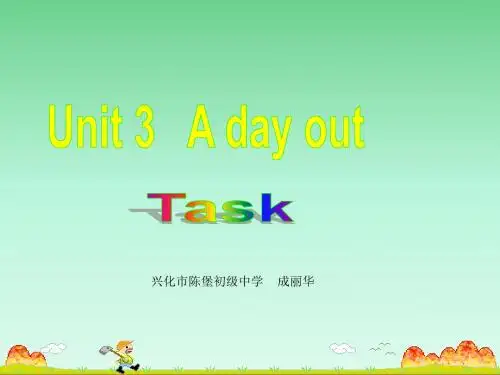
Place
Activity
7:30 a.m.
Sunshine Underground Station
Meet everyone
8:30 a.m.
by underground See the biggest city square in
-9:00 Tian’anmen Square the world
Linda is going back to the USA soon, so Kitty and Daniel are inviting their classmates to go with Linda on a trip.
Which places in Beijing do you think they will visit?
What can they do there?
TTThPiWhaeeenToaP’TTSpnhaauhhlngeleameefm’BWucsGBmejGainirMnehrtreergdSaearu’iqPaStssCPutatWeNraluHuaeerabmecaskelettlll
Plan of the trip
19th October Dear Classmates
Our e-friend Tina is visiting us. We are planning a day out for her. We want to invite you to join us on Oct. 24th.
Here is our plan for the day: First, We’ll meet ________________________________________ ______________________________________________________ ______________________________________________________ ____________________________________________________ .
牛津译林版八年级英语上册Unit 3 Task 示范课教学设计
Period7Task
一、教学内容分析
本节课是本单元的写作课,由下面几个部分组成:A部分是Kitty和Daniel为即将回国的Linda制定的一日出游计划;B部分是需要补充完成的一封邀请信;C部分要求学生通过小组讨论,模仿A制定自己的出游计划,然后借助计划及Useful expressions写一封信邀请自己的朋友外出游玩。
16. Students evaluate andimprovetheirwriting.
活动层次
学习理解之感知与注意
迁移创新之想象与创造、判断与评价
效果评价
通过观察学生的反馈,判断学生对相关景点和活动的理解情况。
观察学生的填表以及写作情况,及时给与帮助与评价。
环节设计意图:通过讨论扬州的景点和活动以及指定计划表,丰富了学生的写作素材,锻炼学生在新情境中运用所学知识的能力,并培养其用所学知识做事的习惯和意识。借助写作后互评的活动,帮助学生相互学习,共同提升。
6. Students read and complete the passage.
活动层次
学习理解之感知与注意、获取与梳理、概括与整合
应用实践之内化与运用
效果评价
观察学生的作答情况,了解学生对细节信息的获取情况。
观察学生对计划的谈论情况,判断其对出游计划的理解情况。
环节设计意图:培养学生获取关键信息的能力,感知出游计划的细节,理解计划内容。并通过谈论计划培养学生的语言表达能力,同时加深对计划的理解。
环节设计意图:通过多样性活动,帮助学生感知语言的丰富性,了解写作框架,为写作做铺垫。
环节四:联系自身,迁移创新,输出并评估文章。(18mins)
教师引导学生根据所梳理的结构、内容、语言以及计划表写一封邀请朋友扬州一日游的邀请信,通过自评、同伴互评等多种方式评估文章,完善写作。
8A英语八年级上册(牛津译林版)Unit 3 A day out (Task)公开课ppt课件
What shall we do at...?
be going to... would like... plan to... ... ...
We shall ... What else can we do? We can...
Transport
Place
Sunshine Underground Station
9:30 a.m.The Palace 12:30p.m. Museum 1:30 p.m.4:30 p.m.
4:45 p.m.6:30 p.m. Beihai Park Wangfujing Street Sunshine Town
Time
7:30 a.m.
Place
Sunshine Underground Station Tian’anmen Square The Palace Museum Beihai Park Wangfujing Street Sunshine Town
Activity
Meet everyone
8:30 a.m.9:00 a.m.
9:30 a.m.12:30p.m. 1:30 p.m.4:30 p.m. 4:45 p.m.6:30 p.m.
See the biggest city square in the world
Visit the museum
Sunshine Town
have a day out in Zhangjiagang
Where will you visit?
I will visit...
Where else would you like to go?
I think I can go to...,too.
牛津译林版八年级英语上册《nit 3 A day out Task: A big day out》优质课课件_3
Practice
climb play
Activity
Place
Eat local snacks and… Dongguan Street
Enrich our
expressions
Make your article better & smooth
Can you find these conjunctions and adverbs in the letter?
Tian’anmen Square
e.g. We will get to Tian’anmen Square at
7:30 a.m., and we’ll leave there at 8:30a.m..Leabharlann …Practice
Time 8:00-10:30
Place the Slender West Lake
First…, Second…, Then… , And…, After that…, Next…, Finally…
Have a try !
Plan a big day out in Yangzhou for your classmates .
Write an invitation letter to them.
Yangzhou Museum
Dongguan Street …
where
when
plan
by bus by car by bike on foot …
how what
at 8:00 from 8:30-10:30 after lunch in the evening ….
go boating take photos see the old things eat local snacks …
【最新】牛津译林版八年级英语上册Unit 3 A day out Welcome to the Unit 教案
A: Which________country do you want to visit, Simon?
B: I want to visit_________.
A: Which_______do you want to go to?
B: I want to go to________.
T: Yes, they are someforeigncountries and places of interest in the world.
T: How can we go on a trip? Ss: By bus、by plane、by boat/take a boat.
Step 2: Welcome to the unit.
2.Read and answer: What kind of hill is Edd ie going to climb? Ss: food hill.
3.To guess meaning from pictures
Teaching focus
1.To introduce foreign cities and popular places of interest.
2.To guess meaning from pictures
Difficult points
TheEiffelTower:It was built in 1889. It is 324 metres tall. It has 1,665 steps.
The Opera House:It was built in 1973.It has 1000 rooms. It’s one of the most famous buildings.