
八年级仁爱英语unit7 topic2 section C课件
根据句意和首字母完成单词 1. It’s polite to f_______ western table manners if you go to ollow a formal western dinner party. ating 2. It’s polite to finish e_______ everything on your plate in western countries. aise 3. When you drink to somebody, you’d better r______ your glass and take o_______ a sip. nly 4. Is it impolite to eat with your arms or e_______ on the lbows table in America.? 5. If you can’t remember these rules, just do a________ s other people do.
2
Work alone
Listen to the passage and mark the following statements True (T) or False (F).
( T ) 1. Usually there is a knife and fork for each person. ( F ) 2. The fork is on the right. ( T ) 3. People use the spoons for soup and dessert. ( F ) 4. The passage is about how to have a Chinese meal.
Remember not to drink too much. If you can’t remember these rules, just do as other people do. 依照,按照 remember (not) to do sth. 记得(不)去做某事 remember doing sth. 记得做过某事
The dinner always starts with a small dish. When you start eating, you should keep the fork in your right hand start with=begin with end with dish(小菜) (小菜)
Let’s have a competition!
One student tells the table manners while the others act out a short dumb play on a formal western dinner.
Tools: knife, fork, spoon, glass, plate, bowl, napkin How to start a formal western dinner: First, when you sit down at the table, take your napkin and put it on your lap. You should keep the knife in your right hand and the fork in your left. It’s polite to eat up the food on your plate. Don’t take more food than you need. Try to speak quietly and smile a lot. Never drink too much during a dinner. When you drink to somebody, you’d better raise your glass and take only a sip. …
1b
Work alone
Read 1a again and mark the following statements True (T) or False (F).
( T ) 1.When you start eating, you should take your napkin first and put it on your lap. ( F ) 2.At table, people always keep the fork in their left hands. ( F ) 3.It’s impolite to eat up the food on your plate. ( F ) 4.It’s polite to speak loudly and smile a lot. ( T ) 5.When you drink to somebody, you should raise your glass and take only a sip.
you should speak quietly and smile a lot.
When you drink to somebody, you’d better raise your glass and take only a sip. drink to sb.为…干杯 raise one’s hand举手 take a sip 喝一小口
3
Group work
Discuss eating customs in different countries, using object clause.
1. Is it impolite to eat soup very noisily in most African countries? 2. Can people eat with their left hands in Muslim countries? 3. Will people leave as soon as they finish eating in western countries? 4. Do Americans eat food like chicken legs with their fingers? 5. Does a formal western dinner always start with a small dish? Eg: Is it polite to point with chopsticks at people in China? A:I want to know whether/if it is point to point with chopsticks at people in China. B:I don’t think that it is polite to point with chopsticks at people in China.
Unit 7 Food val
Topic2 Cooking is fun! Section C
Western Food
glass
spoon
plate
fork
The fork is on the left. napkin
The knife is between the plate and the two spoons. knife
1. Retell 1a. 2. Collect more information about table manners in different countries.
把下列句子合并成一个句子。 把下列句子合并成一个句子。 1. I don’t know. Is he a student? I don’t know if /whether he is a student. 2. I’m not sure. Is it good eat too much? I’m not sure if/whether it is good eat too much. 3. I want to know. Is it polite to use a large spoon and a fork to eat in Thailand? I want to know if/whether it is polite to use a large spoon and a fork to eat in Thailand. 4. I’m not sure. Is there a UFO? I’m not sure if/whether there is a UFO. 5.He wants to know. Will it rain tomorrow? He wants to know if/whether it will rain tomorrow.
When you sit down at the table, take your napkin and put it on your lap. at the table 在桌子旁边 at table 就餐,吃饭 就餐, at table They are sitting ________ (就餐 就餐). 就餐 napkin
If you use your knife, then put the fork in your left hand.
It’s polite to eat up the food on your plate, so don’t take more food than you need. eat up 吃完,吃光 吃完, (代词宾格放中间 代词宾格放中间) 代词宾格放中间
仁爱英语八年级下册Unit7 Topic2SectionA课文英汉互译重点短语重难句详解

Unit 7Topic 2SectionA课文英汉对照,重点短语及重难句详解一. 课文英汉对照Kangkang: Mom, I'd like to make fried rice for our food festival. But I'm not sure whether I can cook it well.康康: 妈妈,我想为我们的美食节做炒饭,但我不确定是否能把它做好。
Mother: I'm glad that you are trying to help others. I'm proud of you!Would you like me to help you?妈妈: 我很高兴你尽力去帮助别人,我为你感到骄傲,需要我帮忙吗?Kangkang: Yes, please. It's very kind of you.康康: 好啊。
你真是太好了。
Mother: Look. it's easy, Kangkang. But you must cook very carefully. First, cut some cooked meat very finely.妈妈: 瞧,很容易的,康康。
但你必须仔细的烹饪。
首先,把一些熟肉仔细的切成小片。
Kangkang: Like this?康康: 像这样吗?Mother: Yes. Well done! Next, you need to put some oil in the pan. Then fry the meat lightly.妈妈: 对,真棒!接下来你需要往锅里放些油,然后把肉轻微的炒一炒。
Kangkang: What do I need to do after that?康康: 接下来我需要做什么呢?Mother: You need to add the rice slowly. Fry it for a few minutes. Finally, add some salt.妈妈: 你要慢慢的把米饭加进去,炒上几分钟。
仁爱版英语八年级下册Unit7Topic2SectionC课时教学设计

设想:教师巡回指导,关注每个学生的学习状态,提供个性化的反馈和帮助。
4.练习巩固:设计不同形式的练习,如填空、选择、改错等,帮助学生巩固所学知识。
设想:根据学生的掌握情况,适时调整练习难度和量,确保每个学生都能得到有效的练习。
5.口语作业:与家人或朋友分享本节课所学内容,讨论志愿者活动的经历或看法。学生可以通过录制视频或音频的形式,将口语作业提交给教师。
6.拓展阅读:推荐学生阅读一本与志愿者活动相关的英文书籍或观看相关纪录片,了解不同领域的志愿者活动,拓宽视野。
作业布置要求:
1.学生应按时完成作业,注意作业质量,保持书写工整、卷面整洁。
2.语法:学生能够理解并运用一般现在时和现在进行时描述正在进行的动作或状态。
3.阅读理解:学生能够通过阅读文章,提取关键信息,理解文章大意,并能够回答相关问题。
4.写作:学生能够仿照文章结构,运用所学词汇和语法,撰写关于志愿者活动的短文。
5.口语表达:学生能够在小组活动中,运用所学知识进行讨论和表达,提高口语交流能力。
4.写作方面,学生对文章结构的把握和逻辑表达尚需加强,教师应通过写作指导,帮助学生提升写作水平。
5.口语表达方面,学生在小组讨论和课堂展示中,可能存在紧张和不自信的现象,教师应鼓励学生大胆开口,增强其口语表达能力。
6.情感态度与价值观方面,八年级学生正处于青春期,具有较强的自我意识和独立思考能力,教师应结合教材内容,引导学生树立正确的价值观,培养其社会责任感。
5.课堂总结:通过师生共同总结,帮助学生梳理本节课的学习内容,强化重点知识。
设想:鼓励学生主动参与总结,通过绘制思维导图等方式,提高学生的归纳总结能力。
仁爱英语八年级下 Unit 7 Topic 2 重点短语、重点句型、难点辨析,语法详解
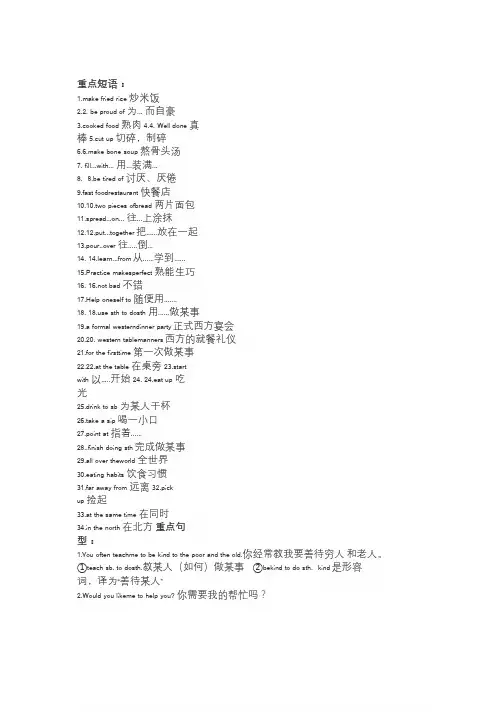
重点短语:1.make fried rice 炒米饭2.2. be proud of 为... 而自豪3.cooked food 熟肉4.4. Well done 真棒 5.cut up 切碎,制碎6.6.make bone soup 熬骨头汤7. fill...with... 用...装满...8. 8.be tired of 讨厌、厌倦9.fast foodrestaurant 快餐店10.10.two pieces ofbread 两片面包11.spread...on... 往...上涂抹12.12.put...together把......放在一起13.pour..over 往.....倒...14. 14.learn...from从......学到......15.Practice makesperfect 熟能生巧16. 16.not bad 不错17.Help oneself to 随便用.......18. e sth to dosth 用......做某事19.a formal westerndinner party正式西方宴会20.20. western tablemanners西方的就餐礼仪21.for the firsttime 第一次做某事22.22.at the table 在桌旁 23.startwith 以.....开始 24. 24.eat up 吃光25.drink to sb 为某人干杯26.take a sip 喝一小口27.point at 指着......28..finish doing sth完成做某事29.all over theworld 全世界30.eating habits 饮食习惯31.far away from 远离 32.pickup 捡起33.at the same time 在同时34.in the north 在北方重点句型:1.You often teachme to be kind to the poor and the old.你经常教我要善待穷人和老人。
八年级下册英语Unit 7 Topic 2 Section C

Dandu Nine-Year School
Li Qingyong
Do you remember how to make a sandwich? (5 steps)
First, take two pieces of bread and put butter on
napkin A _______
正式的______ formal 餐桌礼仪_____________ table manner lap 菜肴________ dish quietly 膝部_______ 安静地_________ 进餐___________ 肘部________ dine elbow 手指_______________ finger
补)
宾语从句中,有or not时只用whether
You should keep the fork in your left hand.
adv做状语
Remember not to drink too much.
Just do as other people do.
方式状语从句
1a
1b
1.When you start dining, you should take your napkin first and put it on your lap. ( T ) 2.At the table, people always keep the fork in their left hands. ( F ) ( F) 3.It’s impolite to eat up the food on your plate. 4.It’s polite to speak loudly and smile a lot. ( F ) 5.When you drink to someone, you should raise your glass and take only a little. ( T )
仁爱版英语八年级上册Unit3Topic2《Whatsweetmusic》(SectionC)说课稿
仁爱版英语八年级上册Unit 3 Topic 2《What sweet music》(SectionC)说课稿一. 教材分析仁爱版英语八年级上册Unit 3 Topic 2《What sweet music》(Section C)是一篇关于音乐欣赏的阅读材料。
通过讲述一篇关于一位音乐家和他的音乐的故事,让学生在阅读过程中感受音乐的美丽,提高他们的阅读理解能力和音乐鉴赏能力。
此篇课文内容丰富,语言优美,贴近学生生活,有助于激发学生对音乐的热爱。
二. 学情分析八年级的学生已经具备了一定的英语基础,对音乐有一定的了解和兴趣。
但他们在阅读理解、词汇运用和音乐鉴赏方面还存在一定的困难。
因此,在教学过程中,教师需要关注学生的个体差异,充分调动学生的积极性,引导他们主动参与课堂活动。
三. 说教学目标1.知识目标:让学生掌握 Section C 课文中的关键词汇和句型,提高阅读理解能力。
2.能力目标:培养学生运用英语进行交流的能力,提高音乐鉴赏能力。
3.情感目标:激发学生对音乐的热爱,培养他们欣赏美好事物的能力。
四. 说教学重难点1.教学重点:课文的理解和词汇的掌握。
2.教学难点:音乐术语的理解和运用,阅读策略的培养。
五. 说教学方法与手段1.教学方法:采用任务型教学法,让学生在完成任务的过程中提高英语运用能力。
2.教学手段:利用多媒体课件、音频和视频材料,激发学生学习兴趣,提高课堂效果。
六. 说教学过程1.Pre-reading:引导学生谈论自己对音乐的喜爱,激发学习兴趣。
2.While-reading:分组阅读课文,讨论课文内容,回答问题。
3.Post-reading:学生展示自己的音乐作品,进行音乐欣赏和评价。
七. 说板书设计板书设计应简洁明了,突出重点。
可采用思维导图的形式,将课文内容、关键词汇和音乐术语进行整理,帮助学生巩固记忆。
八. 说教学评价1.课堂参与度:观察学生在课堂活动中的积极参与情况,评价他们的学习态度。
Unit1+Topic+2+Section+D+课件+2022-2023学年仁爱版英语八年级上册

David Beckham
tomatoes 西红柿(pl.)
potatoes 马铃薯(pl.)
A famous football player in England.
['hɪərəʊ] n. He’s a hero for soccer fans.
英雄
复数:heroes
I kick the ball to you. And you pass me the ball like this. I’ll kick you the ball again. You can also pass a teammate the ball. Bring Peter a present.
2. Is it important ___C_____ healthy food?
A. eat B. eating
C. to eat
D. eats
3. He ___C___ yesterday. I hope he’ll be well soon.
A. fall ill
B. falls ill
C. fell ill
It means the grass.
2.How many[gsrpɑo:rtss]小are草m;e草nt地ioned
被提及 in the passage?
And what are they?
Two.
They are football and cricket.
主要的
段落
3.What’s the m[maienɪni]daedaj.of Paragraph 2 and 3?
…one of the most popular sports… …has a history of… inventor…Canada…… invented…for…in… At first,…so that …soon became…In…,… came into being.
湖南省耒阳市冠湘中学仁爱英语八年级下册Unit7Topic2SectionB公开课课件(共20张PPT)
Name
Activity
Can
Can’t
Miss Zhou
cook
Yes, but _n_o_t_v_e_r_y_w_e_l_l _.
Jeff Mr. Zhao
Ann
play soccer
No, he _c_a_n_’t_d_o__it_a_t_a_ll.
play the piano Yes, he can _p_la_y__it_a__li_tt_le.
Tom
Jim
Bob
ride a bike /drive a car play basketball/play soccer sing/play thLOeGgOuitar
3a. A.Listen to the conversations and number the pic
B. Listen again and complete the table.
3.—Can you speak Japanese? —Of course Ican (会),but only a little(一点点)
4. —Can Polly count these flowers(数这些花吗)? 5.Wei Hua,please take my book to Jane(带去).
A: Can he/she...? B: Yes, but not very well./Yes, he/she can do it
a little/very well. A: Can he/she...very well? B: No, he/she can't do it at all.
4. Listen and write the words
Jack is my friend. He can speak English very well, but he can’t sing English songs.
仁爱版八年级英语下册Unit7Topic2SectionA教学设计
3.树立正确的人生观和价值观,明白付出与回报的关系,懂得珍惜和感恩;
4.增强环保意识,关注社会问题,积极参与社会公益活动;
5.提高自信心和自尊心,勇于表达自己的观点和看法,尊重他人的不同意见。
一个全面的志愿者活动介绍。”
2.引导学生关注社会问题,培养他们的同理心和关爱他人的意识;
3.鼓励学生积极参与志愿者活动,将所学知识运用到实际生活中,体验助人为乐的喜悦;
4.培养学生的团队合作精神,让他们在志愿者活动中学会相互尊重、相互帮助;
5.培养学生热爱英语,树立终身学习的观念,为他们的未来发展奠定基础。
三、教学重难点和教学设想
(一)教学重难点
1.新词汇和短语的掌握:本节课涉及多个新词汇和短语,学生需要在实际语境中运用,以达到熟练掌握的程度。
Example:
I志愿者at the local hospital every Saturday. I help the nurses give medicine to the patients and talk to them to make them feel better. I want to be a volunteer because I want to help others and learn more about medical knowledge.
2.学生分享自己在本节课的收获,包括新词汇、句型、语法等方面。
3.教师强调参与志愿者活动的重要性,鼓励学生在日常生活中积极投身于志愿者事业,为社会贡献力量。
4.布置课后作业,要求学生运用所学知识,描述自己参加过的或想参加的志愿者活动,巩固课堂所学。
五、作业布置
1.请学生运用本节课所学的词汇和句型,写一篇关于自己理想中的志愿者活动的短文,不少于80词。要求描述清楚活动的性质、目的以及自己为何想参与其中,以此来巩固学生对一般现在时态的掌握,并激发他们参与社会实践的热情。
Unit7 Topic2 SectionD -2023-2024学年七年级英语下册精品课件(仁爱版)
at the age of “在......岁时” 相当于:when + sb. + be + 年龄
There is something wrong with his eyes.
= Something is wrong with...
......出了毛病
He can’t see anything any more.
There was something wrong with her eyes and she couldn’t see anything.
1b Read 1a and complete the following tasks.
A. Check(√) the correct answer(s).
1. Jenny may be______years old.
__A_t_t_h_e_a_g_e__ of five, she could play the piano __v_e_r_y_w__e_ll__, but she could only write __a__fe_w____ words. When she was six, there was _s_o_m_e_t_h_in_g__w_r_o_n_g_ with her eyes. Jenny _c_o_u_l_d_n_’t_ see anything _a_n_y__m_o_r_e__. Life was very ___h_a_rd__ fore her!
/wɜ:d/ n. 单词
Jenny
While-reading
Before reading the passage, think about the following questions.
仁爱版八年级英语下册Unit7Topic2SectionB优秀教学案例
在学生小组讨论后,我会对讨论情况进行总结归纳。我会邀请学生分享他们在讨论中的亮点和收获,并对他们的表现进行点评。同时,我会对本节课所学知识进行归纳总结,强调重点和难点,让学生对所学内容有一个清晰的认识。
(五)作业小结
在课堂的最后,我会布置作业,让学生巩固所学知识。作业包括两部分:一部分是练习题,让学生运用情态动词can、一般现在时的被动语态和不定代词进行描述;另一部分是写作任务,让学生编写一个关于运动会的小故事。在作业布置后,我会对课堂内容进行小结,提醒学生注意作业的完成时间和质量。
5.教学目标的全面性:本节课的教学目标涵盖了知识与技能、过程与方法、情感态度与价值观三个部分,全面促进了学生的全面发展。在实现教学目标的过程中,学生不仅掌握了英语知识,还培养了良好的情感态度和价值观。
作为一名特级教师,我深知教学案例亮点的重要性。在设计本节课的教学方案时,我力求突出情境创设、问题导向、小组合作、反思与评价和教学目标等亮点,以提高学生的学习兴趣和实际运用能力。通过本节课的教学,我希望学生能够掌握情态动词can的用法、一般现在时的被动语态和不定代词的用法,提高他们的英语水平。同时,我也希望他们能够在学习过程中,培养积极向上的情感态度,树立正确的价值观。
五、案例亮点
1.情境创设的生动性:以学校运动会为背景,通过展示运动会场景的图片和视频,让学生在真实、生动的情景中学习和运用英语。情境创设不仅激发了学生的学习兴趣,还提高了他们的语言运用能力。
2.问题导向的有效性:设计一系列问题,引导学生思考、探究和解决问题。问题导向的运用,使学生在回答问题的过程中,自然而然地掌握了情态动词can的用法、一般现在时的被动语态和不定代词的用法。
(三)小组合作
在教学过程中,我会组织学生进行小组合作,让他们在合作中学习、交流和进步。例如,在教授一般现在时的被动语态时,我会让学生分组完成一个任务:每组编写一个关于运动会的小故事,故事中要包含一般现在时的被动语态。通过小组合作,学生可以互相学习、取长补短,提高自己的语言运用能力。