
现在完成时课件《八年级英语下册》
现在完成时
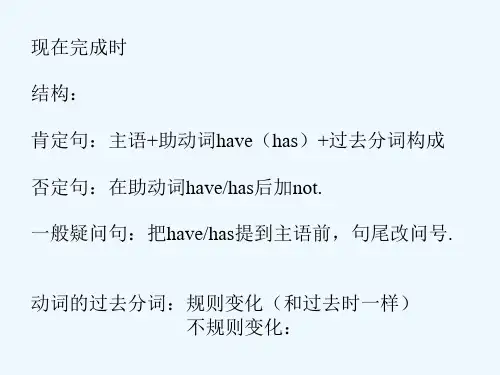
现在完成时 结构: 肯定句:主语+助动词have(has)+过去分词构成
否定句:在助动词have/has后加not.
一般疑问句:把have/has提到主语前,句尾改问号.
动词的过去分词:规则变化(和过去时一样) 不规则变化:
不规则变化:
am/is-was-been begin-began-begun do-did-done drink-drank-drunk eat-ate-eaten fly-flew-flown
中。总之,说话时该人不在现场,例如:
----Where is Tom? ----He has gone to the bookshop. 他到书店去了。 Jack Johnson has gone to London. 杰克.约翰逊到伦敦去了。
注意点一: 现在完成时与一般过去时的用法比较 现在完成时表示过去的动作一直延续到现在甚至会继续下去或表示 过去的动作对现在造成的影响;一般过去时表示动作发生的时间在 过去。现在完成时属于现在时态范围,因此,不能和表示过去的时 间状语连用。 如:yesterday, last night, two weeks ago等 试比较: The plane has arrived . 飞机已经来了。(说明现在的情况:飞机 在这儿) The plane arrived a quarter ago. 飞机是一刻中以前来的。(强 调动作发生的时间在过去) I have taught here for fifteen years. 我在这儿已经教了十五年。 (表示十五年前的动作一直延续到现在,还可能会继续。) I taught here for a year. 我过去在这儿教过一年。(表示“我“现 在已经不在这儿任教了)
瞬间动词与延续性动词的转换
come/go — be (in) borrow — keep die — be dead begin — be on go out — be off leave — be away buy — have get to know — know go out — be off arrive – be here/there
注意点一: 现在完成时与一般过去时的用法比较 现在完成时表示过去的动作一直延续到现在甚至会继续下去或表示 过去的动作对现在造成的影响;一般过去时表示动作发生的时间在 过去。现在完成时属于现在时态范围,因此,不能和表示过去的时 间状语连用。 如:yesterday, last night, two weeks ago等 试比较: The plane has arrived . 飞机已经来了。(说明现在的情况:飞机 在这儿) The plane arrived a quarter ago. 飞机是一刻中以前来的。(强 调动作发生的时间在过去) I have taught here for fifteen years. 我在这儿已经教了十五年。 (表示十五年前的动作一直延续到现在,还可能会继续。) I taught here for a year. 我过去在这儿教过一年。(表示“我“现 在已经不在这儿任教了)
⑤ I’ve just finished my homework. ⑥ He has not come yet.
2)表示过去已经开始,持续到现在的动作或 状态,也可以表示实质可能继续下去的动作或 状态。 通常和 for(段时间), since(点时间) 引导 的时间状语连用.以及 so far, by now, these days, in the last ten years 等连用。
( ×) I have bought a new dictionary for a week. I have had a new dictionary for a week. ( ) 我买一本新词典已有一星期了。 ( ) They have been here for two days. ( ×) They have come here for two days. 他们来这儿已经两天了。 He has joined the League member for two years. ( ×) ( ) He has been a League member for two years. 他已入团两年了。
注意点三:have been in, have been to 与have gone to 的用法 1、have (has) been in 表示“在某地(多长时间)”,现在仍在那里。常与表 示一段时间的状语连用。例如: Mr. Brown has been in Shanghai for three days. 布朗来上海已经有三天了。 They have been in Canada for five years. 他们到加拿大有五年了。 2、have( has)been to表示“曾经去过某地”,现在已经不在那里了。可与just,源自ever, never等连用,例如:
I have just been to the post office. 我刚才去邮局了。 Mary has never been to the Great Wall. 玛丽从未去过长城。 Have you ever been to Hangzhou before? 你以前曾经去过杭州吗? Have (has) been to 后面可接次数,表示去过某地几次。例如: They have been to that village several times. 他们去过那个村庄好几次了。 3、have (has) gone to 意为“到某地去了”,表示到了某地或正在去某地的途
(“洗衣服”是发生在过去的动作,对现在造成的结 果是“衣服干净了”) I have just had my breakfast. (对现在的影响:不饿)
通常与表示包括现在在内的时间副词 just(刚刚), already(已经), before, yet(一般疑问:已经;否定句: 还) never, ever等状语连用
marry/get married (to)— be married (to) begin to work/study/live – work/study/leave fall asleep/get to sleep — be asleep join the Party — be in the Party/be a member of
I have been here for just over two years.
He has worked here since 1989. 从1989年,
I haven’t seen her these days. She has learnt English for 3 years/since 3 years ago. They have lived here since 1990. What has happened to the USA in the last 350 years?
Put the following sentences into English.
1. A: 火车已经开走了. B: 什么时候开走的?
A: The train has left. B: When did it leave.
A: It left half an hour ago. A: 2. A: 这本书我已经买了两年了 . I`ve had the book for two year
√
√
√
The man has been dead for several years. The man has died for several years. 这个人已经死了几年了。
( ) ( ×)
√
1.I have borrowed the book for 2 weeks. ( B kept ) A B C 2.The film has begun for 5 minutes.( B been on) A B C
① I have never heard of that before. ② Have you ever ridden a horse? ③ She has already finished the work.
④ Have you milked the cow yet? Yes, I have done that already.
B: 看过.
A: 什么时候看的. B: 上周星期天看的.
注意点二、非延续性动词与现在完成时 短暂性动词在肯定句、疑问句中不能与时间段连用,这些 动词是:become, begin, buy, borrow, arrive, come, die, fall, finish, get to know, go, join, leave, marry等。 为了表述这种意思,我们常用相应的延续性动词have, keep等来代替非延续性动词。 他入党五年了。He joined the Party five years ago . ——He has been in the Party for five years. ——He has been a Party member for five years. ——It is five years since he joined the Party. 电影开始五分钟了。 The film began five minutes ago. ——The film has been on for five minutes. ——It is five minutes since the film began.
hide-hid-hidden lie-lay-lain ring-rang-rung see-saw-seen speak-spoke-spoken come-came-come
run- ran – run
become-became-become
1)表过去发生的某一动作对现在造成的影响或结果。 例如: I have just cleaned my clothes. 我刚洗过衣服。
现在完成时 结构: 肯定句:主语+助动词have(has)+过去分词构成
否定句:在助动词have/has后加not.
一般疑问句:把have/has提到主语前,句尾改问号.
动词的过去分词:规则变化(和过去时一样) 不规则变化:
不规则变化:
am/is-was-been begin-began-begun do-did-done drink-drank-drunk eat-ate-eaten fly-flew-flown
中。总之,说话时该人不在现场,例如:
----Where is Tom? ----He has gone to the bookshop. 他到书店去了。 Jack Johnson has gone to London. 杰克.约翰逊到伦敦去了。
注意点一: 现在完成时与一般过去时的用法比较 现在完成时表示过去的动作一直延续到现在甚至会继续下去或表示 过去的动作对现在造成的影响;一般过去时表示动作发生的时间在 过去。现在完成时属于现在时态范围,因此,不能和表示过去的时 间状语连用。 如:yesterday, last night, two weeks ago等 试比较: The plane has arrived . 飞机已经来了。(说明现在的情况:飞机 在这儿) The plane arrived a quarter ago. 飞机是一刻中以前来的。(强 调动作发生的时间在过去) I have taught here for fifteen years. 我在这儿已经教了十五年。 (表示十五年前的动作一直延续到现在,还可能会继续。) I taught here for a year. 我过去在这儿教过一年。(表示“我“现 在已经不在这儿任教了)
瞬间动词与延续性动词的转换
come/go — be (in) borrow — keep die — be dead begin — be on go out — be off leave — be away buy — have get to know — know go out — be off arrive – be here/there
注意点一: 现在完成时与一般过去时的用法比较 现在完成时表示过去的动作一直延续到现在甚至会继续下去或表示 过去的动作对现在造成的影响;一般过去时表示动作发生的时间在 过去。现在完成时属于现在时态范围,因此,不能和表示过去的时 间状语连用。 如:yesterday, last night, two weeks ago等 试比较: The plane has arrived . 飞机已经来了。(说明现在的情况:飞机 在这儿) The plane arrived a quarter ago. 飞机是一刻中以前来的。(强 调动作发生的时间在过去) I have taught here for fifteen years. 我在这儿已经教了十五年。 (表示十五年前的动作一直延续到现在,还可能会继续。) I taught here for a year. 我过去在这儿教过一年。(表示“我“现 在已经不在这儿任教了)
⑤ I’ve just finished my homework. ⑥ He has not come yet.
2)表示过去已经开始,持续到现在的动作或 状态,也可以表示实质可能继续下去的动作或 状态。 通常和 for(段时间), since(点时间) 引导 的时间状语连用.以及 so far, by now, these days, in the last ten years 等连用。
( ×) I have bought a new dictionary for a week. I have had a new dictionary for a week. ( ) 我买一本新词典已有一星期了。 ( ) They have been here for two days. ( ×) They have come here for two days. 他们来这儿已经两天了。 He has joined the League member for two years. ( ×) ( ) He has been a League member for two years. 他已入团两年了。
注意点三:have been in, have been to 与have gone to 的用法 1、have (has) been in 表示“在某地(多长时间)”,现在仍在那里。常与表 示一段时间的状语连用。例如: Mr. Brown has been in Shanghai for three days. 布朗来上海已经有三天了。 They have been in Canada for five years. 他们到加拿大有五年了。 2、have( has)been to表示“曾经去过某地”,现在已经不在那里了。可与just,源自ever, never等连用,例如:
I have just been to the post office. 我刚才去邮局了。 Mary has never been to the Great Wall. 玛丽从未去过长城。 Have you ever been to Hangzhou before? 你以前曾经去过杭州吗? Have (has) been to 后面可接次数,表示去过某地几次。例如: They have been to that village several times. 他们去过那个村庄好几次了。 3、have (has) gone to 意为“到某地去了”,表示到了某地或正在去某地的途
(“洗衣服”是发生在过去的动作,对现在造成的结 果是“衣服干净了”) I have just had my breakfast. (对现在的影响:不饿)
通常与表示包括现在在内的时间副词 just(刚刚), already(已经), before, yet(一般疑问:已经;否定句: 还) never, ever等状语连用
marry/get married (to)— be married (to) begin to work/study/live – work/study/leave fall asleep/get to sleep — be asleep join the Party — be in the Party/be a member of
I have been here for just over two years.
He has worked here since 1989. 从1989年,
I haven’t seen her these days. She has learnt English for 3 years/since 3 years ago. They have lived here since 1990. What has happened to the USA in the last 350 years?
Put the following sentences into English.
1. A: 火车已经开走了. B: 什么时候开走的?
A: The train has left. B: When did it leave.
A: It left half an hour ago. A: 2. A: 这本书我已经买了两年了 . I`ve had the book for two year
√
√
√
The man has been dead for several years. The man has died for several years. 这个人已经死了几年了。
( ) ( ×)
√
1.I have borrowed the book for 2 weeks. ( B kept ) A B C 2.The film has begun for 5 minutes.( B been on) A B C
① I have never heard of that before. ② Have you ever ridden a horse? ③ She has already finished the work.
④ Have you milked the cow yet? Yes, I have done that already.
B: 看过.
A: 什么时候看的. B: 上周星期天看的.
注意点二、非延续性动词与现在完成时 短暂性动词在肯定句、疑问句中不能与时间段连用,这些 动词是:become, begin, buy, borrow, arrive, come, die, fall, finish, get to know, go, join, leave, marry等。 为了表述这种意思,我们常用相应的延续性动词have, keep等来代替非延续性动词。 他入党五年了。He joined the Party five years ago . ——He has been in the Party for five years. ——He has been a Party member for five years. ——It is five years since he joined the Party. 电影开始五分钟了。 The film began five minutes ago. ——The film has been on for five minutes. ——It is five minutes since the film began.
hide-hid-hidden lie-lay-lain ring-rang-rung see-saw-seen speak-spoke-spoken come-came-come
run- ran – run
become-became-become
1)表过去发生的某一动作对现在造成的影响或结果。 例如: I have just cleaned my clothes. 我刚洗过衣服。
合集下载
人教英语八年级下册Unit10现在完成时 (共33张PPT)

1. since意为“自从……以来”, 它既可作 介词,也可作连词。作介词时, 后接表 示过去的时间点, 表示某事开始的时间; 作连词时, 引导时间状语从句, 从句常用 一般过去时。如:
We have been here since last Sunday / two years ago. Mr. Jones has worked here since he was twenty-five.
4. Cathy and Amy _h_a_v_e_n_’_t _b_e_e_n_ (not be) back to their hometown for two years. They _m__i_ss__ (miss) their hometown a lot and hope to visit the place next year.
1. Do you have a(n) _______? How long have you had it?
2. Do you own a(n) _______? How long have you owned it?
Things
How long
Tony favorite book for two years
over there? --I’ve had it for three years. 2. --How long has his son owned the
train and railway set? --He’s owned it since his fourth
birthday.
根据课本内容, 完成下,表示 一个动作或一种状态已经持续了多 长时间。如:
I have studied here for three years. She has been away for five days.
八年级英语下册 现在完成时课件 人教新目标版.ppt
重点句型: It is/ has been+段时间+since从句 段时间+has passed+ since从句
eg. 他死了两年了:
He died two years ago.
He has been dead for two years /since two years ago
It is/ has been two years since he died.
A month has passed since I borrowed the book.
Have/has gone to have/has been to have/has been in
❖ have/has gone to:已经去了或在途中,还没 有返回;
❖ have/has been to:曾今去过某地,现在已经 回来了,后面可接表示“次数”的状语;
1.Jack has gone to the cinema. Jack hasn’t gone to the cinema.
Has Jack gone to the cinema? Yes, he has. / No, he hasn’t. 2.They have finished their homework. They haven’t finished their homework.
before, by now (so far), 到目前为止 once, twice…, just, recently yet(否/疑), already(肯), ever, never, 曾经,从不
Exercises:
一、按要求变化下列各句。
1.She has listened to a piece of foreign music.(否定句)
八年级下英语现在完成时态课件

• They haven’t bought any new house since they moved to Shanghai.
• She hasn’t bought any new clothes for a year.
三.几个相近短语的区别:
have/has gone to:已经去了或在途中,还没有 返回;(去了未回来)
• Have you met him before? • 你以前见过他吗? • My brother met her in the street two
days ago. • 我哥哥两天前在街上遇到了她。 • I have just had breakfast. • 我刚吃过早餐。 • She had breakfast just now. • 她刚吃了早餐。
最近
in the past/last +时间段 过去的…
by now, so far, up to now, till now 迄今
once, twice…
一次…
all/in one’s life
某人一生
(1)already
肯定句: “己经”
I’ve already had breakfast. (更常见) = I’ve had breakfast already.
I have finished my homework. I have not finished my homework. Have you finished your homework? Yes, I have./No, I haven’t.
She has been to Europe. She hasn’t been to Europe. Has she been to Europe? Yes, she has./No, she hasn’t.
• She hasn’t bought any new clothes for a year.
三.几个相近短语的区别:
have/has gone to:已经去了或在途中,还没有 返回;(去了未回来)
• Have you met him before? • 你以前见过他吗? • My brother met her in the street two
days ago. • 我哥哥两天前在街上遇到了她。 • I have just had breakfast. • 我刚吃过早餐。 • She had breakfast just now. • 她刚吃了早餐。
最近
in the past/last +时间段 过去的…
by now, so far, up to now, till now 迄今
once, twice…
一次…
all/in one’s life
某人一生
(1)already
肯定句: “己经”
I’ve already had breakfast. (更常见) = I’ve had breakfast already.
I have finished my homework. I have not finished my homework. Have you finished your homework? Yes, I have./No, I haven’t.
She has been to Europe. She hasn’t been to Europe. Has she been to Europe? Yes, she has./No, she hasn’t.
Unit8现在完成时课件人教版八年级英语下册

1.找
2. 变
3.去
4.加
What have they haddaomeal at a restaurant since they left school?
特殊疑问句
特殊疑问句= 特殊疑问词+ 一般疑问句
what who when which why what color what time
代替事物、事情 代替人 代替时间 代替事物,表选择 代替原因 代替颜色 代替时间点
2、before 表示之前发生的事情,放在句末。 I have been。
现在完成时的时间状语:
3、yet 放在否定句和一般疑问句句末。
just, before, recently,still, lately, never, ever, twice, on several occasions, in the past/weeks/months/years, till now.
6、ever
表示经常的或习惯性的动作,常与表示频率的时间状语连用。 放在 have/has后面,动词后面
例句:Their debts have grown ever larger. 他们的债务不断增加。
根据句意,完成下列句子 1,They _h_a_v_e_g_o_n_e (go) to the Beihu Park this year.
2,以不发音的e结尾
+d
3, 辅音字母+y结尾
改y为i+ed
4,以重读闭音节结尾, 双写该辅音字母
末尾只有一个辅音字母
+ed
示例
work---worked visit---visited
live---lived hope---hoped
精美课件PPT八年级英语下册 现在完成时课件

在并可能还将持续下去。动词
使用延续性动词。常与for或
since引导的时间连用
for+一段时间 since+时间点 since+句子(一般过去时)
E.g. Kate has lived here for 3 years.
Kate has lived here since 3 years ago.
Kate has lived here since she came to China.
• start/begin be on sh/ end
be over
• catch a cold
have a cold get up be up
• get to know
know get out
be out
• close
be closed wake up
be awake
• go to sleep
father. • 5. The twins s_a_w__(see) my father just now. • ☆6. Many tallbuildingsh_a_v_e__b_e_e_n__b_u(ibltuild)
in the past 5 years.
•
用法二:
表示过去某个时间开始的动作 或存在的状态,一直持续到现
语文
小魔方站作品 盗版必究
谢谢您下载使用!
更多精彩内容,微信扫描二维码获取 扫描二维码获取更多资源
“手”)
上古时期汉民族以“三”代表多 数,因此用三个相同部件的重叠 来给“众多”的词义特点造字。
这种字书写麻烦,结构不但难看 ,更重要的是,不符合汉字左右 布局的主流结构,因此,有些被 其他字所替代,有些被废弃不用
现在完成时课件《八年级英语下册》 PPT
( (
√×))
1.I have borrowed the book for 2 weeks.
A
B
C ( B kept )
2.The film has begun for 5 minutes.( B been on)
ABC
3. 这辆自行车我买了两年了。
I’ve __h_a_d_ the bike f_o_r two years.
4. He left Nanjing two ye_e_n_ _a_w_a_y_ f_r_om___ Nanjing for
two years.
5. The monkey died last month.
The monkey _h_a_s__ b__ee_n__ d__ea_d__ for a month.
1)表过去发生的某一动作对现在造成的影响或结果。 例如: I have just cleaned my clothes. 我刚洗过衣服。
(“洗衣服”是发生在过去的动作,对现在造成的结 果是“衣服干净了”)
I have just had my breakfast. (对现在的影响:不饿)
通常与表示包括现在在内的时间副词 just(刚刚), already(已经), before, yet(一般疑问:已经;否定句: 还) never, ever等状语连用
① I have never heard of that before. ② Have you ever ridden a horse? ③ She has already finished the work. ④ Have you milked the cow yet?
Yes, I have done that already. ⑤ I’ve just finished my homework. ⑥ He has not come yet.
人教版八年级下册Unit8现在完成时精品课件(61张)
Key words
yet ever never since
for just
I _h_a_v_e__ just m_e__n_d_e_d__ the desk, you
can take it to your classroom . (mend )
人教版八年级下册Unit8现在完成时精 品课件 (61张 )
trees up to now . (plant )
人教版八年级下册Unit8现在完成时精 品课件 (61张 )
人教版八年级下册Unit8现在完成时精 品课件 (61张 )
Key words
for just
yet ever never since before already so far
up to now in the past 10 years
yet ever
A: H_a_v_e____ you ever _b_e_e_n___ to the
park? ( be ) B: Yes, I went there last summer.
人教版八年级下册Unit8现在完成时精 品课件 (61张 )
人教版八年级下册Unit8现在完成时精 品课件 (61张 )
He __h_a_s__li_ve_d___ in this city
ever since then. (live )
人教版八年级下册Unit8现在完成时精 品课件 (61张 )
人教版八年级下册Unit8现在完成时精 品课件 (61张 )
Key words
for just
yet ever never since before 在完成时精 品课件 (61张 )
Key words
for just
人教版八年级英语下册《现在完成时态》课件_29
I haven’t seen him these days. My grandma hasn’t learnt English.
现代完成时态
• (3).一般疑问句及其回答 -Have you read this book? -Yes, I have. -No, I haven’t.
现代完成时态
现在完成时用法: 1.表示动作在过去完成,强调对现在产生的
现代完成时态
2).have/has gone to表示去了某地,还没回 来,不能与以上词连用。
• eg: Tom is not here, he has gone to the office.
• He has left home for 30 days.(× )
• He hasn’t left home 30 days.(√ )
现代完成时态
3).have/h 1).have/has been to表示去过某地,已经回
来了。可与once, twice, never, ever等连用。 eg:He has been to Japan twice.
现代完成时态
(1).I have seen the film twice. (2).She has lived here since 1995. (3).He has been to shanghai. (4).She has gone to shanghai.
现代完成时态
2、结构 • (1).肯定句:主语+have/has+动词过去分词
Present Perfect Tense 现在完成时态
Present Perfect Tense----现在完成时
冬天已经来了, Winter has already come,
现代完成时态
• (3).一般疑问句及其回答 -Have you read this book? -Yes, I have. -No, I haven’t.
现代完成时态
现在完成时用法: 1.表示动作在过去完成,强调对现在产生的
现代完成时态
2).have/has gone to表示去了某地,还没回 来,不能与以上词连用。
• eg: Tom is not here, he has gone to the office.
• He has left home for 30 days.(× )
• He hasn’t left home 30 days.(√ )
现代完成时态
3).have/h 1).have/has been to表示去过某地,已经回
来了。可与once, twice, never, ever等连用。 eg:He has been to Japan twice.
现代完成时态
(1).I have seen the film twice. (2).She has lived here since 1995. (3).He has been to shanghai. (4).She has gone to shanghai.
现代完成时态
2、结构 • (1).肯定句:主语+have/has+动词过去分词
Present Perfect Tense 现在完成时态
Present Perfect Tense----现在完成时
冬天已经来了, Winter has already come,
人教版八年级英语下册现在完成时(原创课件)
【简写】 • have not = haven't
has not = hasn't
【例句】 • I have not found the book. •9 She hasn't paid for the meal.
句式转换:
【一般疑问句】 • Have/Has + 主语 + done ?
【回答】 • 肯定:Yes, 人称代词主格 +have/has. • 否定:No, 人称代词主格 +haven't/hasn't.
Key and difficult points
1. 辨析:have been to & have gone to 的用法
Phase have been to have gone to
Meaning / Difference
去过某地,已经回来了 去了某地,还没回来
【练习1】根据中文意思,翻译句子。
11
时态标志词: (多放在have/has和done之间)
• just【adv.刚;正好】 • already【adv.已经】 • ever 【adv.曾经】
• never 【adv.不曾】
12
他刚来到。 He has just come. 我已经把邮件发送出去了。 I have already sent the email. Betty曾经到过上海。 Betty has ever been to Shanghai. 她不曾看过这部电影。 She has never seen this film.
• so far / up to now / by now / until now【到目前为止】 We have tried several times so far / up to now / … 到目前为止,我们已经尝试过好几次了。
现在完成时 课件(张PPT)八年级英语(下)人教版
2 Where is Mr. Wang? has gone to
He __________________ the library.He wants to borrow some books.
Has been in 表示已经待在某地多长时间,常与时间段连用。
Eg: Tom has been in Australia for 12 years.
No , never.
在用法2中,常与for或since 引导的时间状语连用。 For+一段时间
Eg : I have lived here for 5 years.
时间点(一段时间)
Since + 词组
从句(一般过去时)
eg: I have been here since 2010. I have been here since 8 years ago.
ever 与 never 1. ever 用在肯定句或疑问句中,翻译为“曾经”
Eg. I have ever been to Hangzhou. Have you ever been to Hangzhou?
2.Never 用在否定句中,翻译为“从来没有”。 Eg : I have never been to Hangzhou.
注意:① 带ever 的肯定句变否定句时, 要将ever变成never. ②带ever的一般疑问句做否定回答时,用no, never.
Eg: He has ever been to Beijing .(否定句) He has never been to Beijing.
Have you ever been to Beijing?(作否定回答)
Eg. I have already had breakfast. =I have had breakfast already.
He __________________ the library.He wants to borrow some books.
Has been in 表示已经待在某地多长时间,常与时间段连用。
Eg: Tom has been in Australia for 12 years.
No , never.
在用法2中,常与for或since 引导的时间状语连用。 For+一段时间
Eg : I have lived here for 5 years.
时间点(一段时间)
Since + 词组
从句(一般过去时)
eg: I have been here since 2010. I have been here since 8 years ago.
ever 与 never 1. ever 用在肯定句或疑问句中,翻译为“曾经”
Eg. I have ever been to Hangzhou. Have you ever been to Hangzhou?
2.Never 用在否定句中,翻译为“从来没有”。 Eg : I have never been to Hangzhou.
注意:① 带ever 的肯定句变否定句时, 要将ever变成never. ②带ever的一般疑问句做否定回答时,用no, never.
Eg: He has ever been to Beijing .(否定句) He has never been to Beijing.
Have you ever been to Beijing?(作否定回答)
Eg. I have already had breakfast. =I have had breakfast already.